Get 20% OFF All Premium 3D & STL Models!

In the dynamic world of 3D visualization, automotive models stand as a pinnacle of detail and engineering. From breathtaking cinematic renders to high-octane game environments, a meticulously crafted 3D vehicle can elevate any project. Few cars command attention like the Toyota Supra, a name synonymous with performance and iconic design. The 2020 iteration, a triumphant return to form, blends a revered heritage with cutting-edge aesthetics and engineering, making it a dream subject for 3D artists and developers alike.
Today, we’re diving deep into what makes a premium 3D car model, specifically focusing on the remarkable Toyota Supra 2020 3D Model available on 88cars3d.com. This asset isn’t just a static representation; it’s a versatile toolkit designed for everything from ultra-realistic automotive rendering to demanding real-time game development, AR/VR experiences, and even physical 3D printing. We’ll explore the technical nuances, workflow integrations, and creative possibilities that such a high-fidelity asset provides, proving why it’s an indispensable addition to any digital arsenal.
The choice of a 3D model’s file format is far more than a technicality; it’s a foundational decision that dictates compatibility, workflow efficiency, and ultimately, the success of your project. Each format serves a specific purpose, optimized for different software, engines, or applications. When acquiring a complex asset like the Toyota Supra 2020 3D Model, understanding these distinctions is paramount to leveraging its full potential across your varied creative pipelines. Let’s break down the most common and critical formats included with this exceptional 3D car model.
The .blend file format is Blender’s native project file. It encapsulates an entire Blender scene, including geometry, materials, textures, lighting, cameras, animation data, and even modifiers. For users entrenched in the Blender ecosystem, this is often the preferred format as it offers full editability. You can dissect every aspect of the Supra model, from adjusting shaders to tweaking mesh topology, exploring the intricate hierarchy, or even re-rigging components for custom animations. It’s ideal for artists who want to deeply customize the asset or integrate it into an existing Blender project with minimal fuss, providing a complete, ready-to-render scene.
FBX (Filmbox) is a proprietary file format owned by Autodesk, widely recognized as the industry standard for 3D data exchange, particularly between different 3D software and real-time game engines like Unreal Engine and Unity. It efficiently stores not only mesh data but also materials, textures, animation, and rigging information. The .fbx format is highly optimized for performance, making it the go-to choice for game assets. When importing the Supra into Unreal, for instance, the .fbx will bring in the model with its clean UVs, pre-set pivots for wheels and steering, and basic material assignments, ready for advanced material setup within the engine. Its robust support for skeletal animations also makes it invaluable for animated sequences.
The Wavefront .obj format is one of the oldest and most widely supported 3D file formats. It’s a universal standard, compatible with virtually every 3D modeling and rendering application. An .obj file primarily stores geometric data (vertices, UVs, normals, polygons) and can reference external .mtl (material) files for basic material properties. While it doesn’t typically support animation or advanced rigging, its simplicity and widespread compatibility make it excellent for cross-software static model exchange. For many artists, the .obj version of the Supra provides a solid, clean mesh foundation that can be easily imported into any software for texturing and rendering.
GLB (GL Transmission Format Binary) is the binary version of glTF, an open-standard, royalty-free 3D file format developed by the Khronos Group. It’s specifically designed for efficient transmission and loading of 3D scenes and models in web browsers, AR (Augmented Reality), and VR (Virtual Reality) applications. A single .glb file can contain all geometry, materials, textures, and animation data, making it incredibly convenient for deploying interactive 3D content online or in mobile AR experiences. The Supra in .glb format is perfect for virtual car configurators, immersive showrooms, or showcasing the model directly on a webpage with minimal load times.
STL (Stereolithography) is the most common file format for 3D printing. It represents a 3D object as a series of connected triangles, forming the surface geometry of the model. The .stl format is universally recognized by 3D printing software (slicers) and machines. While it lacks color or texture information, it provides a precise, watertight mesh essential for physical fabrication. The Supra’s .stl variant is crucial for hobbyists and professionals looking to produce physical scale models, allowing them to directly prepare the digital asset for manufacturing.
PLY (Polygon File Format, or Stanford Triangle Format) is another format used for storing 3D data, particularly from 3D scanners or for CAD applications. Like .obj, it primarily describes the raw geometry of an object, but it can also store additional properties like color, transparency, and even normal vectors per vertex or face. While not as universally prevalent as .obj or .fbx for artistic exchange, .ply is valued for its precision and ability to handle point clouds and highly detailed meshes, making it suitable for engineering analysis or specific visualization tasks where high geometric accuracy is paramount.
The “.unreal” extension often refers to a prepared asset or package designed specifically for Unreal Engine. While Unreal primarily uses .fbx for initial import, a dedicated “.unreal” file suggests the model has likely gone through an optimization and packaging process, potentially including pre-configured materials, collision meshes, LODs (Levels of Detail), and blueprint setups. This format aims to provide a near plug-and-play experience for Unreal developers, significantly reducing setup time and ensuring the Supra is production-ready for racing games, simulators, or detailed cinematic sequences within the engine.
The .max file is Autodesk 3ds Max’s native project file. Similar to .blend, it saves the entire scene, including all models, materials, textures, lighting, camera settings, and animations within 3ds Max. For users of this robust architectural visualization and animation software, the .max file provides maximum flexibility. It allows for complete manipulation of the Supra model, leveraging 3ds Max’s extensive toolset for rendering with engines like V-Ray or Corona, or integrating it into complex animations. It’s perfect for detailed studio renders or for developers using 3ds Max as their primary modeling and scene assembly tool.
By offering this comprehensive suite of file formats, the Toyota Supra 2020 3D Model ensures maximum compatibility and utility, catering to diverse workflows across the 3D industry. This foresight in asset packaging is a hallmark of quality products found on platforms like 88cars3d.com.
Recreating an automotive icon like the Toyota Supra 2020 in 3D demands an extraordinary blend of technical precision and artistic sensibility. The goal is not merely to replicate its shape, but to capture its spirit, its aggressive stance, and the intricate details that define its character. The Toyota Supra 2020 3D Model excels in this, delivering a product that stands out in visual fidelity and structural accuracy.
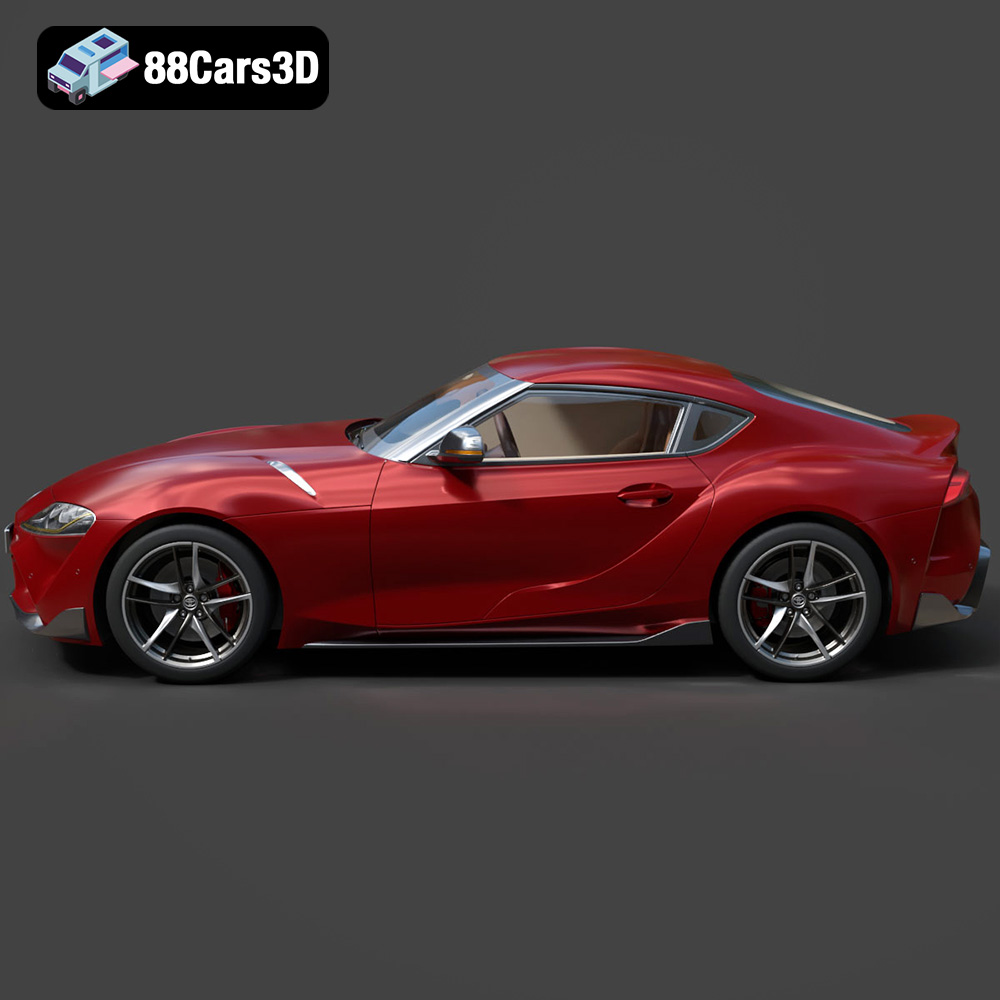
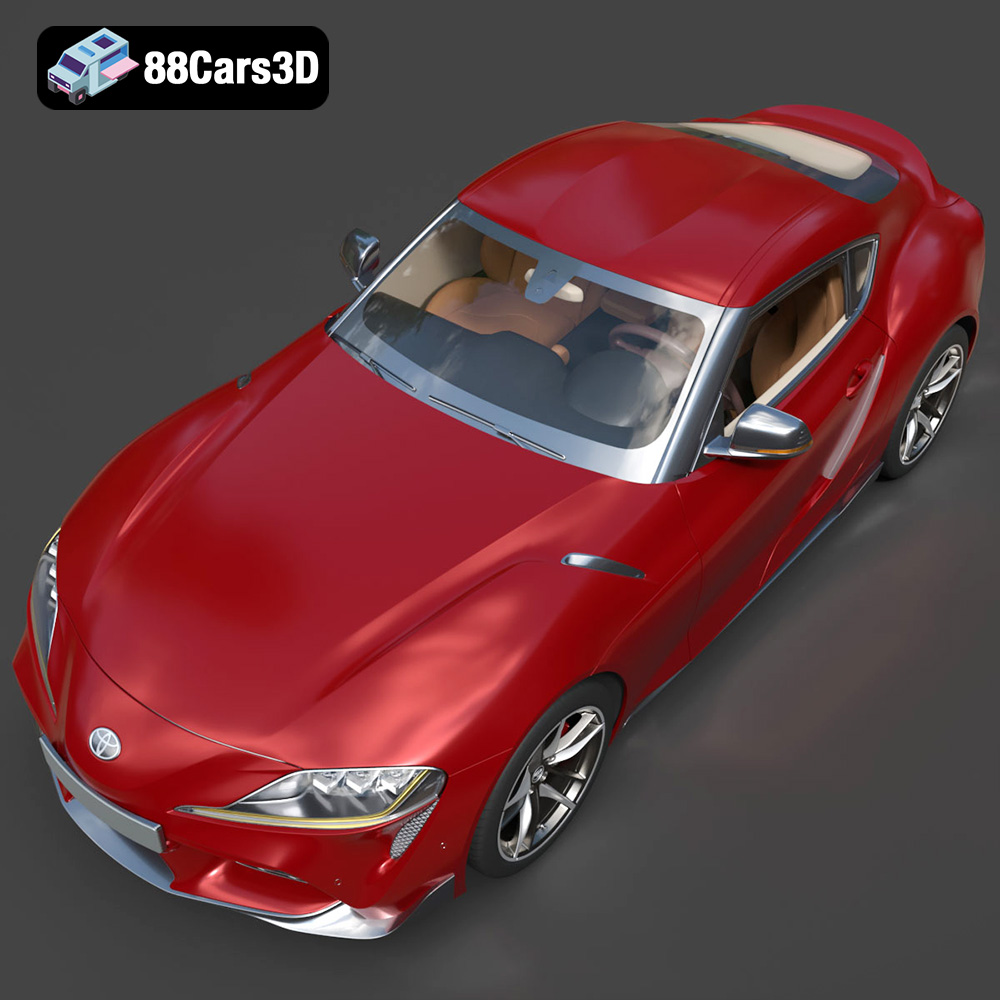
The Supra’s exterior is a masterpiece of modern sports car design, and this 3D model faithfully renders every curve and contour. The aggressive aerodynamic profile, from the distinctive double-bubble roof to the prominent rear lip spoiler, is accurately proportioned. Particular attention has been paid to the striking LED headlight clusters and the unique taillight assemblies, which are often defining features in automotive rendering. Moving beyond the surface, the model includes precision-modeled alloy wheels with realistic low-profile performance tires, along with detailed brake calipers, rotors, and suspension components. What truly sets this model apart is the meticulously detailed B58 3.0L turbocharged inline-six engine bay. This level of detail extends to the authentic dual-branch sports exhaust system, making the model suitable not just for exterior shots but for close-up inspections and even animations that expose these mechanical components.
The experience of a sports car is often defined by its cockpit, and this Supra model does not disappoint. The interior features highly detailed sports bucket seats with authentic stitching patterns, an accurate leather-wrapped steering wheel complete with paddle shifters, and a high-fidelity digital instrument cluster. The infotainment display and intricate center console, including the gear selector, dials, and pedal box, are all rendered with meticulous care. This level of interior detail is crucial for projects requiring first-person POV (Point of View), such as racing simulators, virtual showrooms, or cinematic sequences where the camera might linger inside the cabin. The optimized geometry ensures that even with this richness, the model remains suitable for real-time applications.
In today’s fast-paced digital landscape, efficiency and performance are as critical as visual quality. A stunning model is only truly valuable if it can be seamlessly integrated into various demanding pipelines. The Toyota Supra 2020 3D Model has been engineered with real-time performance in mind, making it an ideal game asset.
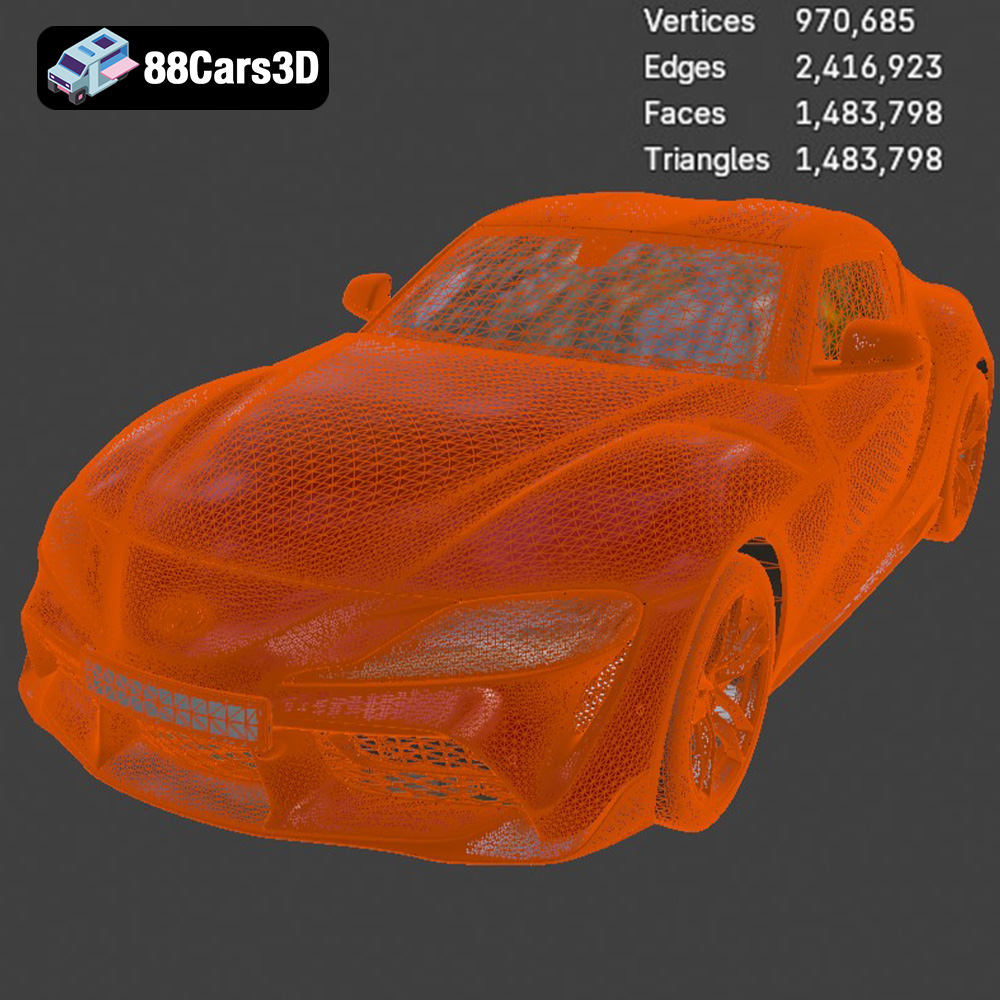
The core advantage of this model lies in its optimized topology of approximately 250,000 triangles. This polycount strikes an excellent balance, providing extreme visual detail without overburdening real-time engines like Unreal Engine and Unity. For game developers, this means faster load times, smoother frame rates, and the ability to populate environments with high-quality vehicles without compromising performance. The model boasts clean geometry and intelligent material separation, which are critical for efficient texture mapping and shader creation within game engines. Crucially, it features proper pivot setups for realistic steering, wheel rotation, and suspension travel, enabling authentic vehicle physics and animation directly out of the box. Separate meshes for wheels, suspension, and steering further simplify the animation process, allowing for dynamic interactions and customization within your game environment.
Beyond traditional gaming, the Supra’s optimization extends its utility to cutting-edge AR/VR applications. Imagine a virtual showroom where potential buyers can walk around, sit inside, and even customize the Supra in real-time. The game-ready polycount and clean topology make this a reality, allowing for fluid, immersive experiences on various AR/VR platforms. For high-end animation and architectural visualization (arch-viz), the model serves as an exceptional prop. Its real-world scale accuracy, based on the actual vehicle chassis, ensures it integrates perfectly into photorealistic scenes, whether it’s parked in a luxury villa’s driveway or featured in a brand’s promotional video. The model’s premium visual fidelity means it holds up under close scrutiny, even in 4K renders.
The versatility of a well-crafted 3D model extends beyond digital screens. For enthusiasts, collectors, or even product designers, the ability to transition a digital asset into a physical object is invaluable. The Toyota Supra 2020 3D Model includes an .stl format specifically tailored for 3D printing, opening up a world of tangible creativity.
3D printing requires specific considerations to ensure a successful print. The .stl format provided is engineered to be watertight and manifold, crucial characteristics for error-free slicing. When preparing the Supra for physical production, recommended scales like 1:12, 1:18, or 1:24 offer a good balance between size, detail, and printability. For optimal detail reproduction, especially for the intricate features of a car, resin printing is highly recommended over FDM, allowing for finer layer heights (0.04–0.12 mm) that capture every subtle curve and vent. Essential print settings include a wall thickness of 1.2–2.0 mm for structural integrity and an infill of 20–30% for internal support without excessive material consumption.
Successful 3D printing often extends into careful post-processing. Supports will be required for detailed parts like the exhaust system, mirrors, and the steering wheel to prevent drooping during printing. Strategic print orientation, such as printing the main frame at an angle, can enhance structural integrity and minimize visible layer lines. Wheels are best printed separately for cleaner results and easier assembly. After printing, sanding and priming are essential steps to achieve a smooth surface, ready for painting. Hobbyists can then apply authentic factory colors with metallic finishes, or unleash their creativity with custom paint jobs, decals, and weathering effects, turning a digital asset into a unique physical collectible.
A high-quality 3D asset is most powerful when it seamlessly integrates into diverse professional workflows. The Toyota Supra 2020 3D Model, with its multiple file formats and optimized structure, is built for adaptability, supporting artists and developers across various software platforms and disciplines.
For users of Autodesk 3ds Max, the inclusion of a native .max file is a significant advantage. It allows immediate access to the model within a familiar environment, with materials likely pre-configured for standard renderers like V-Ray or Corona. Artists can easily import the Supra, set up studio lighting, apply advanced shaders, and rig the vehicle for complex animations – from simple turntable renders to elaborate chase sequences. Similarly, Blender users benefit immensely from the .blend file. This means the model can be opened directly in Blender, maintaining its scene hierarchy, modifiers, and potentially even Cycles or Eevee-ready materials. This enables artists to leverage Blender’s powerful animation tools, physics simulations, and advanced rendering capabilities to create stunning visuals without the hassle of extensive re-importing and setup.
The model’s “game-ready” optimization truly shines in real-time engines. For Unreal Engine, importing the .fbx or the specific “.unreal” package is straightforward. The separated components (wheels, suspension, steering) and proper pivot points are critical for setting up vehicle blueprints, enabling realistic physics and player control in racing games or simulators. Developers can then assign advanced PBR (Physically Based Rendering) materials, integrate custom LODs (Levels of Detail) for performance scaling, and implement intricate lighting scenarios. This allows for the rapid development of immersive interactive experiences, where the Supra acts as a hero vehicle or a crucial element of an open-world environment. Its optimized polycount ensures smooth framerates even when multiple instances of the vehicle are present.
In architectural visualization (Arch-Viz) or cinematic production, a detailed vehicle often serves as a crucial element for context and realism. The Supra model, with its real-world scale and high visual fidelity, is perfect for this. Arch-Viz artists can drop the model into a scene rendered with V-Ray or Corona for 3ds Max, or Cycles for Blender, to instantly elevate the realism of a luxury garage, a street scene, or a sophisticated showroom. For cinematographers, the model can be rigged and animated using its separate components, allowing for dynamic camera movements and compelling storytelling. Its clean topology means it can be easily subdivided further for extreme close-ups in pre-rendered animations if required, pushing visual boundaries for brand campaigns or high-end lifestyle renders.
While the provided Toyota Supra 2020 3D model is exceptional out-of-the-box, its true power lies in the extensive customization options it offers. Professional artists and studios rarely use assets exactly as they are; the ability to tailor a model to specific project needs is paramount.
The included files and optimized material separation allow for effortless aesthetic modifications. Changing the body color is a fundamental customization – from replicating authentic factory colors to experimenting with bespoke custom finishes, matte, gloss, or even metallic flake effects. Artists can easily adjust material properties to achieve different looks, perhaps a sleek, reflective chrome finish for a concept render, or a grittier, worn look for a post-apocalyptic game environment. The precision-modeled alloy wheels can be re-textured or re-materialized, and tire textures can be swapped between street variants for a smooth urban look or off-road patterns for a rugged, adventurous scene. This level of material control empowers artists to perfectly match the vehicle’s appearance to their project’s unique artistic direction.
Beyond the vehicle itself, the Supra model’s adaptability extends to its interaction with diverse environments. The ability to adapt lighting for different scenarios is crucial. Whether it’s a sun-drenched outdoor scene, a dramatic studio setup with controlled highlights, or a moody street racing night scene, the model’s clean material breakdown simplifies lighting adjustments. Artists can also integrate custom decals, liveries, or damage effects to create unique narrative elements. This creative freedom transforms the base model into an infinitely adaptable asset, ready to be incorporated into virtual showrooms, dynamic racing games, immersive AR experiences, or high-definition cinematic renders. The high-quality foundation ensures that every modification maintains visual integrity and professional appeal.
The Toyota Supra 2020 stands as a testament to modern automotive engineering, and its digital counterpart, the Toyota Supra 2020 3D Model, truly embodies that spirit in the virtual realm. From its meticulously recreated exterior and interior details to its game-ready optimization and extensive file format support, this asset is designed to be a cornerstone for any serious 3D project. Whether you are a game developer pushing the boundaries of real-time graphics, an architect visualizing a luxury garage, an AR/VR creator building immersive experiences, or a hobbyist seeking to 3D print a stunning model, this Supra provides the technical precision and creative flexibility you need.
The comprehensive range of file formats—including .blend, .fbx, .obj, .glb, .stl, .ply, .unreal, and .max—ensures seamless integration into virtually any professional pipeline, maximizing its value across the industry. This commitment to quality and versatility is what sets premium 3D car models apart, and you can find exceptional assets like this on 88cars3d.com, empowering your next project with unparalleled realism and performance.
The Toyota Supra 2020 marks the triumphant return of a legendary sports car icon. Fusing a rich heritage with modern engineering, this masterpiece boasts an aggressive aerodynamic profile, signature double-bubble roof, and a meticulously detailed B58 3.0L turbocharged inline-six engine bay. Every curve, from the striking LED headlight clusters to the prominent rear lip spoiler and dual-branch exhaust system, has been faithfully recreated to capture its powerful stance and dynamic aesthetics.
Crafted with premium visual fidelity, this 3D model features a highly optimized topology of approximately 250,000 triangles, making it exceptionally game-ready without sacrificing extreme detail. Its clean geometry and intelligent material separation ensure seamless integration into real-time rendering pipelines, making it a top-tier asset for game development, AR/VR applications, high-end animation, and architectural visualization.
Perfect for street racing environments, virtual showrooms, digital car configurators, and cinematic automotive animations.
.blend, .fbx, .obj, .glb, .stl, .ply, .unreal, .max
Tags:
toyota, supra-2020, sports-car, coupe, jdm, game-ready, low-poly, optimized, car-3d-model, game-asset, rendering, vr-ar, blend, fbx, obj, glb, stl, ply, unreal, maxVespa VNB 125-B 3D Model 3D Printable STL
$39.99
.blend
.coupe
.fbx
.glb
.jdm
.max
.obj
.ply
.rendering
.sports car
.stl
.toyota
.unreal
car-3d-model
game asset
game-ready
low-poly
optimized
supra-2020
VR/AR