Get 20% OFF All Premium 3D & STL Models!

In the expansive landscape of 3D modeling, few subjects captivate the imagination quite like iconic automotive designs. Beyond the sleek lines of modern supercars, there’s a profound appreciation for vehicles that tell a story, vehicles that shaped history and pushed the boundaries of engineering in their time. The Volkswagen Schwimmwagen Typ 166 stands as a prime example. This amphibious off-road vehicle, a workhorse of World War II, is celebrated not just for its unique boat-like hull and rugged durability, but for its pioneering spirit as one of the most mass-produced amphibious cars ever built.
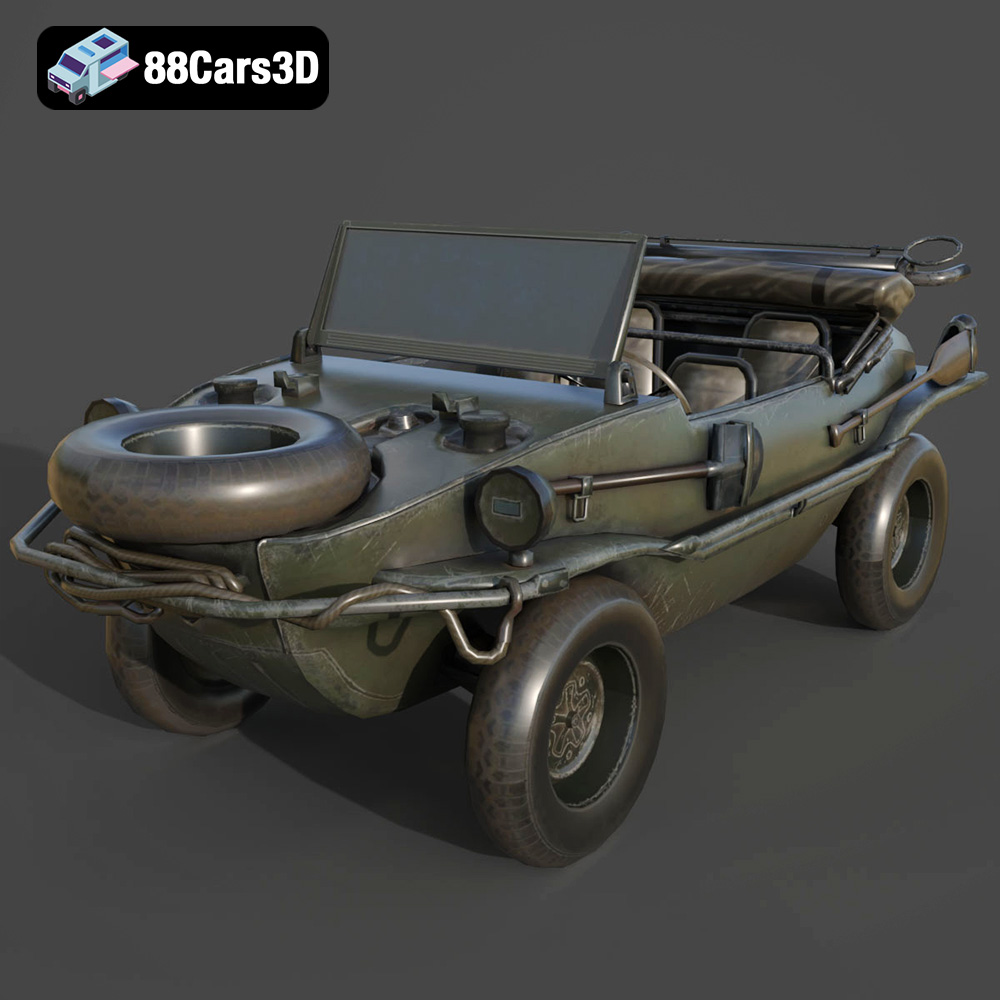
For 3D artists, game developers, AR/VR creators, and visualization specialists, accurately recreating such a vehicle presents a fascinating challenge and a rewarding opportunity. A high-quality 3D model like the Volkswagen Schwimmwagen Typ 166 3D Model available at 88cars3d.com isn’t just a static representation; it’s a meticulously crafted asset, ready to be integrated into diverse professional pipelines. It embodies a blend of historical authenticity and technical optimization, making it an invaluable tool for projects ranging from historical military simulators to immersive educational experiences and stunning cinematic renders.
When working with complex 3D car models like the Volkswagen Schwimmwagen Typ 166, understanding the various file formats available is crucial for seamless integration into different software, engines, and applications. Each format serves a specific purpose, optimized for particular stages of the production pipeline or end-use scenarios. The Schwimmwagen model package comes with a comprehensive suite of these formats, ensuring maximum compatibility and flexibility.
The .blend file is the native format for Blender, a powerful open-source 3D creation suite. For the Volkswagen Schwimmwagen, this file provides the complete, editable project scene. This means artists gain access to the raw mesh data, modifiers, custom properties, and the full nodal material setup within Blender’s Cycles or Eevee render engines. It’s ideal for those who prefer to work within Blender, allowing for in-depth customization, re-texturing, animation, or integration into existing Blender scenes. You can easily adjust the Schwimmwagen’s body colors, modify tire textures, or tweak material finishes directly.
.fbx (Filmbox) is arguably the most common and versatile interchange format in the 3D industry, especially for game development. It efficiently packages mesh geometry, materials, textures, animations, and skeletal data into a single file. For the Schwimmwagen, the .fbx format ensures that its game-ready optimization, accurate real-world scale, and proper pivot setup for components like wheels and the propeller are preserved when imported into real-time engines like Unreal Engine and Unity. Its robust support for animations makes it the go-to choice for adding dynamic movement to the vehicle.
The .obj (Wavefront OBJ) format is a widely adopted, universal standard for exchanging 3D geometry. While it primarily stores mesh data (vertices, normals, UVs, faces), it references external .mtl (material) files for basic material properties and texture paths. The .obj version of the Schwimmwagen ensures broad compatibility across virtually all 3D software packages, even those with limited .fbx support. It’s an excellent choice for static renders, archival, or when precise control over material setup needs to be done manually in a new software environment.
.glb (GL Transmission Format Binary) is a relatively newer format, rapidly gaining traction for its efficiency in web, augmented reality (AR), and virtual reality (VR) applications. It’s a binary variant of glTF, which embeds all necessary data—geometry, materials, textures, animations—into a single, compact file. This “all-in-one” packaging makes the Schwimmwagen .glb model incredibly fast to load and display in browsers, AR viewers, and lightweight VR experiences, making it perfect for immersive virtual showrooms or educational AR applications.
.stl (Stereolithography) is the de facto standard for 3D printing. It represents a 3D model as a collection of unconnected triangles, defining only the surface geometry. The Schwimmwagen’s .stl file is explicitly prepared for additive manufacturing, allowing hobbyists and professionals to physically replicate the iconic vehicle. The product description highlights recommended print settings, such as scale (1:16, 1:35, 1:24), layer height, infill, and the necessity for supports for intricate details like the exhaust and propeller, ensuring successful physical prints.
.ply (Polygon File Format) is often used for storing 3D data from 3D scanners, CAD systems, or for scientific analysis. It’s capable of storing various properties associated with vertices and faces, such as color, normal vectors, and confidence values. While less common for general 3D asset exchange than .fbx or .obj, the Schwimmwagen’s .ply version offers a high-precision mesh representation that can be valuable for specific engineering, reverse engineering, or detailed structural analysis tasks.
The .unreal format, often delivered as part of an Unreal Engine project file or specific asset package, indicates that the Volkswagen Schwimmwagen 3D Model is optimized and potentially pre-configured for direct use within the Unreal Engine ecosystem. This means materials might already be set up using Unreal’s physically based rendering (PBR) pipeline, collisions defined, and LODs (Levels of Detail) potentially implemented, significantly accelerating integration into a game or real-time simulation project. It streamlines the workflow for Unreal developers, allowing them to focus on gameplay and environment rather than initial asset setup.
Finally, the .max file is the native format for Autodesk 3ds Max, a leading software for 3D modeling, animation, and rendering. Similar to the .blend file for Blender users, the .max file provides the full, editable scene for the Schwimmwagen. This includes all geometry, modifiers, intricate material setups (potentially for V-Ray or Corona Renderer), and any scene-specific configurations. It caters to 3ds Max artists who require the highest level of control for complex rendering projects, animations, or extensive model modifications.
Bringing a piece of history like the Volkswagen Schwimmwagen Typ 166 into the digital realm requires more than just technical skill; it demands meticulous research and an unwavering commitment to authenticity. The goal is not merely to create a car model, but to resurrect a historical artifact, allowing its unique character and engineering marvels to be appreciated in new contexts.
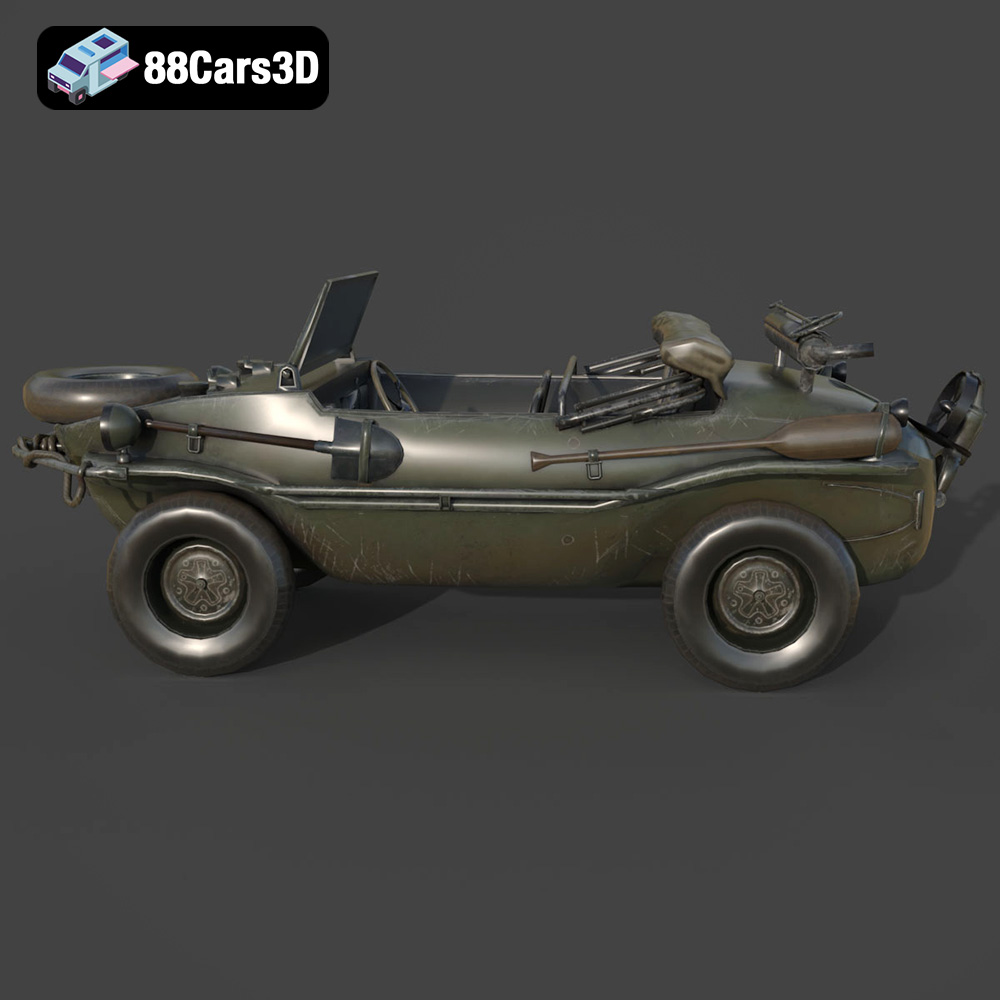
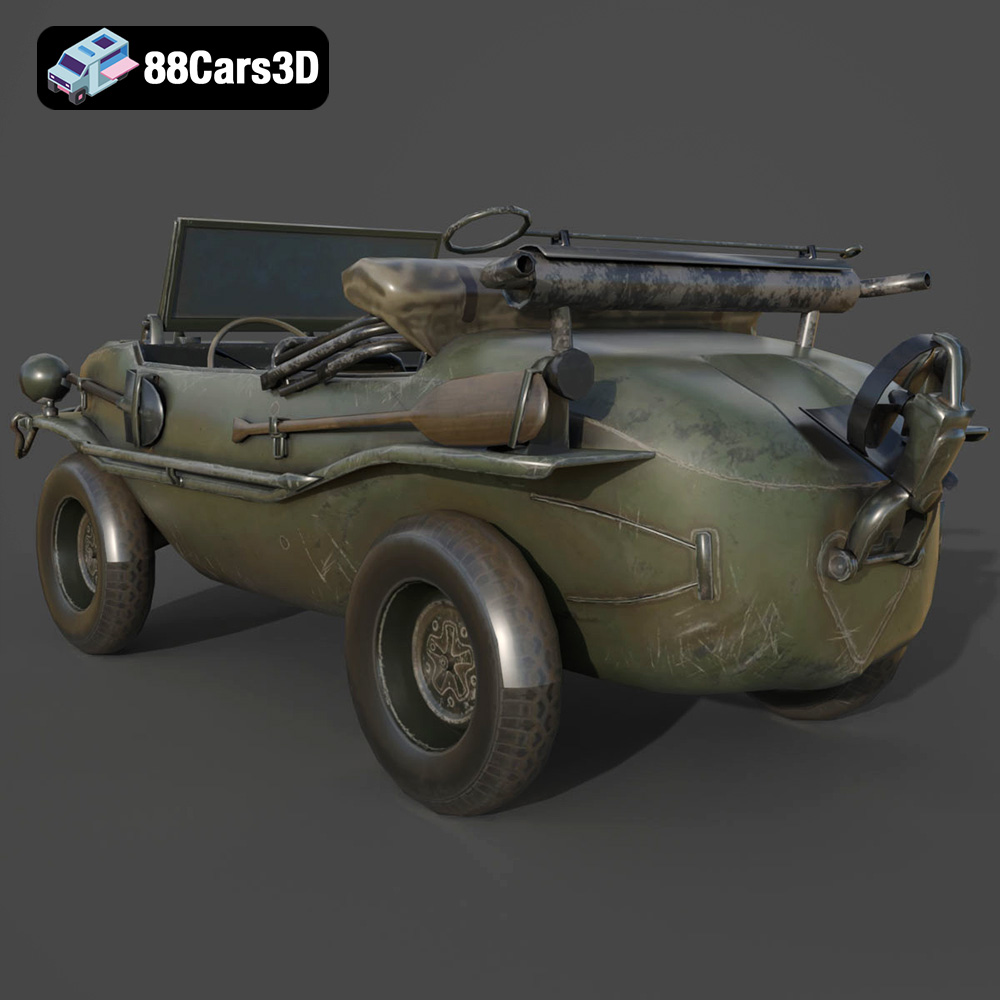
The challenge with any historical military vehicle lies in accurately replicating details that might seem minor but are crucial to its identity. For the Schwimmwagen, this includes its distinctive watertight hull geometry and proportions, the specific design of its rear-mounted air-cooled flat-four engine housing, and the authentic fold-down rear propeller mechanism. The model from 88cars3d.com excels in these areas. Features like period-accurate military lighting, blackout headlamps, high-tread off-road tires, and rugged leaf spring suspension details are all faithfully recreated. Separate components for wheels, propeller, suspension, and steering are not just visually accurate but are also prepared for animation, a testament to the comprehensive design approach.
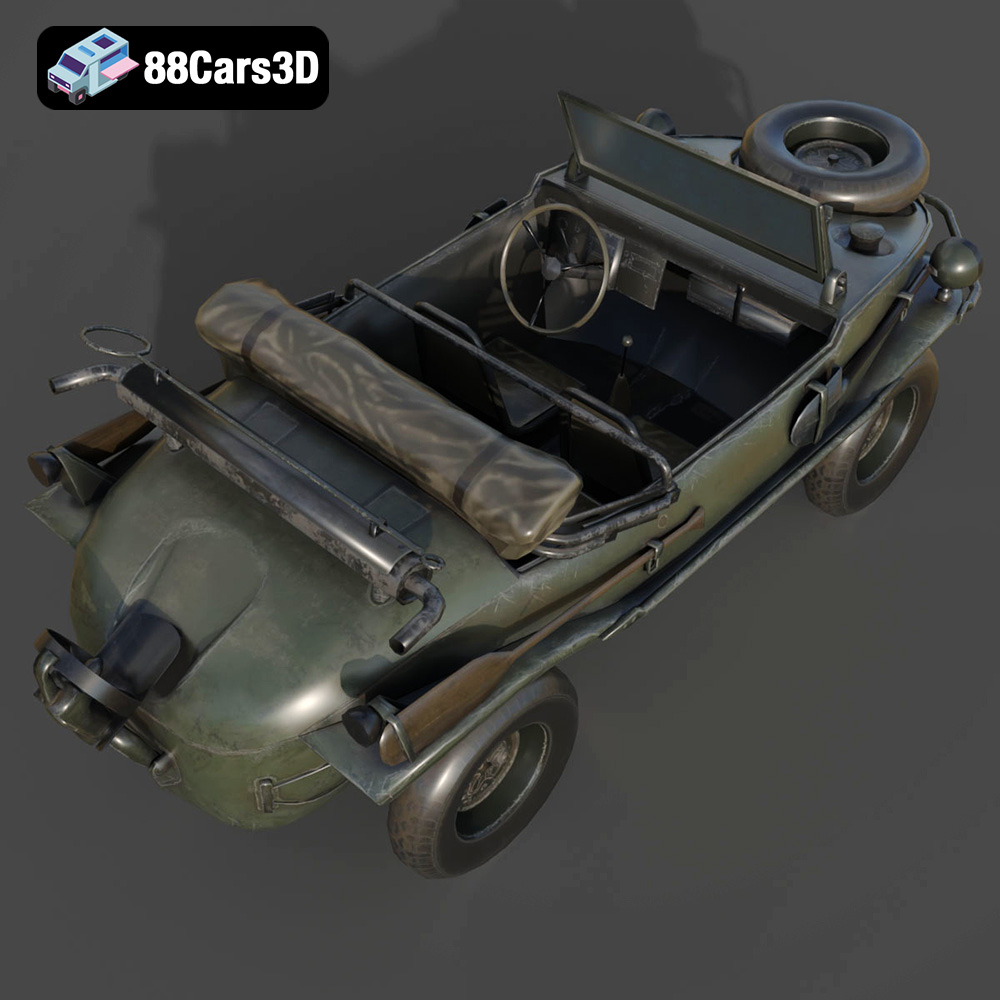
Even the interior, though utilitarian by design, is a crucial part of the vehicle’s historical context. The minimalist three-spoke steering wheel, sparse military-spec instrument cluster, and detailed floor-mounted gear shifter all contribute to the sense of stepping back in time. This level of detail ensures the model is suitable not only for external beauty shots but also for first-person perspectives in games, where the user might interact with the cockpit.
Beyond geometric accuracy, the realism of a 3D model hinges heavily on its materials and textures. A brand-new, factory-fresh Schwimmwagen might look interesting, but its true character emerges with textures that tell a story of its operational life. High-quality PBR (Physically Based Rendering) materials are essential for rendering realistic metal, rubber, and painted surfaces that react correctly to light. While the base model provides clean, optimized textures, the ability to customize these allows artists to add subtle weathering, mud splatters, or paint chipping. This customization can transform the model from a generic asset into a unique, narrative-rich piece, perfectly fitting a specific scene or historical moment in a project. For instance, creating a worn camouflage pattern or showing rust on exposed metal can significantly elevate the visual storytelling in an automotive rendering or game environment.
In today’s interactive 3D landscapes, performance is paramount. A stunningly detailed 3D model is only valuable if it can be rendered smoothly and efficiently in real-time applications like video games, AR/VR experiences, and interactive configurators. This is where the concept of “game-ready” optimization comes into play, a core advantage of the Volkswagen Schwimmwagen Typ 166 3D Model.
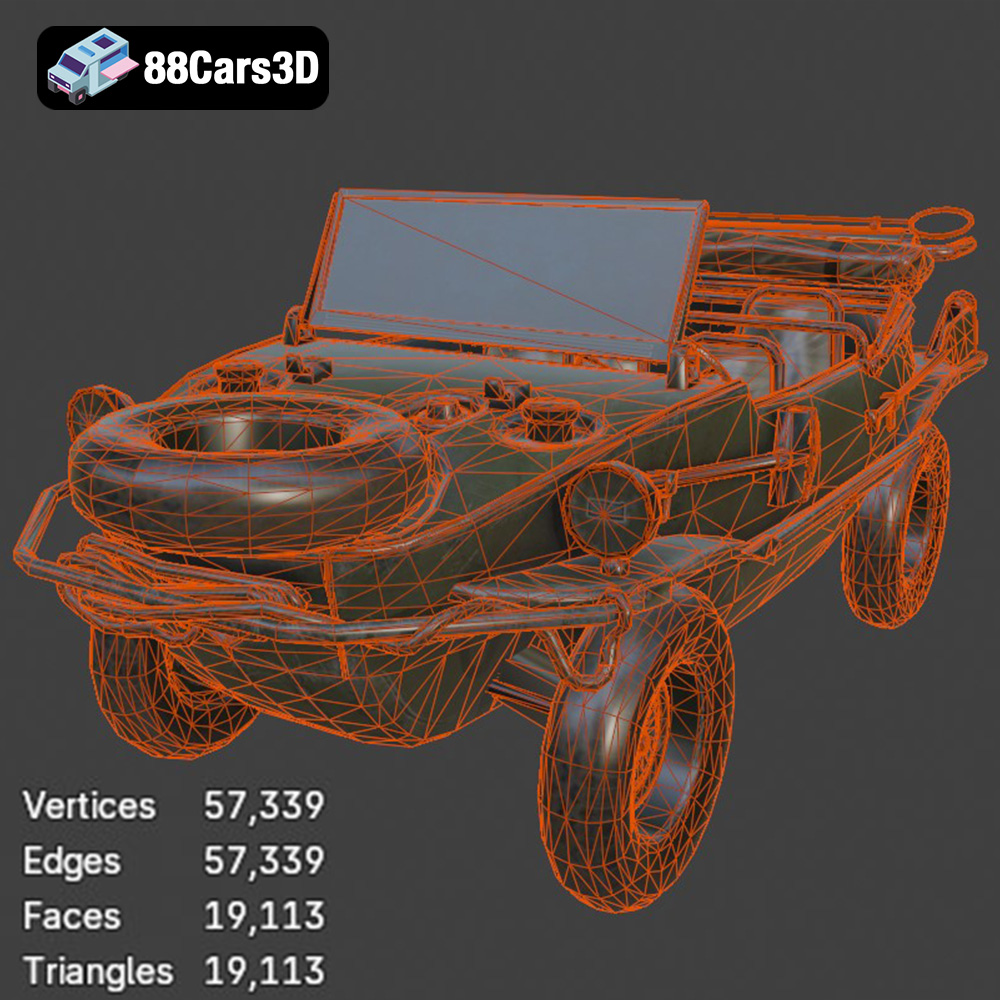
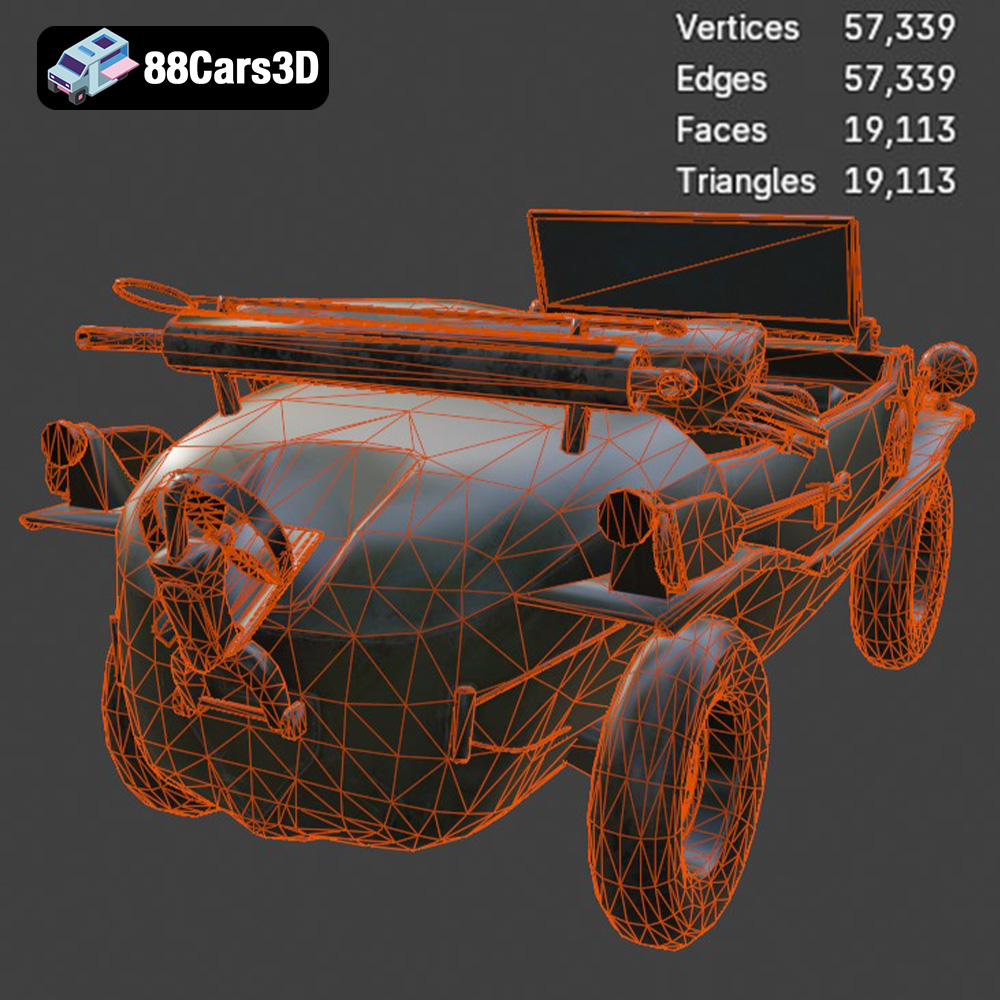
The Schwimmwagen model boasts approximately 150,000 triangles. This number represents a careful balance. On one hand, it’s sufficiently high to capture the intricate details of the vehicle’s watertight chassis, engine housing, and suspension, ensuring high-end visual realism. On the other hand, it’s optimized enough to prevent excessive strain on a game engine’s rendering pipeline. In real-time environments like Unreal Engine or Unity, every triangle contributes to rendering cost. A model with an unnecessarily high polycount can quickly degrade frame rates, leading to a poor user experience. Conversely, a model with too few polygons might lack the visual fidelity required for modern titles. The ~150,000 triangle count for the Schwimmwagen strikes this perfect balance, offering stunning visuals without compromising performance, making it truly game-ready for demanding applications.
Beyond static geometry, a truly functional vehicle model requires thoughtful rigging and pivot point setup. For the Volkswagen Schwimmwagen, this means ensuring that each interactive component has its pivot point correctly placed. The wheels, for example, have pivots centered for realistic rotation and steering. The fold-down propeller mechanism has its pivot point correctly located for smooth deployment and retraction animation. Similarly, suspension components are set up for proper travel, allowing for realistic bouncing and compression over terrain. These seemingly small technical details are crucial for animators and game developers, enabling them to bring the vehicle to life with authentic movement. Without proper pivot setups, animating a vehicle becomes a tedious and often inaccurate process, hindering its utility in dynamic environments.
The versatility of a well-crafted 3D car model is one of its greatest assets. The Volkswagen Schwimmwagen Typ 166 3D Model is designed to be a multi-faceted tool, ready for deployment across a spectrum of professional applications, each leveraging its unique combination of historical accuracy and technical optimization.
For rendering and visualization professionals, this Schwimmwagen model is an ideal candidate for creating stunning, high-resolution imagery and animations. Imagine a historical military diorama brought to life with cinematic lighting, or a striking promotional piece for a museum exhibit. With its detailed geometry and PBR-ready materials, artists can import the model into rendering software like V-Ray, Corona Renderer, Arnold, or Redshift, apply advanced lighting setups, and produce photorealistic visuals. The ability to customize colors, textures, and material finishes allows for creating anything from a pristinely restored museum piece to a battle-hardened veteran, perfect for brand campaigns, historical documentaries, or even concept art.
The “game-ready” nature of the Schwimmwagen makes it invaluable for game developers. Its optimized polycount and meticulous pivot setup mean it can be seamlessly integrated into various game genres. Consider a World War II open-world game where players need to navigate diverse terrains and water bodies; the Schwimmwagen fits perfectly. For historical military simulators, its accuracy provides an authentic experience. Even in rugged off-road racing games, the model’s distinct appearance and amphibious capabilities could offer unique gameplay mechanics. The included .fbx and .unreal formats streamline the process for developers working in Unreal Engine or Unity, allowing them to focus on gameplay mechanics and environmental design rather than laborious asset preparation.
The applications extend beyond traditional rendering and gaming. For AR/VR experiences, the Schwimmwagen, particularly in its optimized .glb format, can serve as an immersive educational tool. Imagine a virtual museum where users can walk around, inspect, and even “drive” a historical vehicle, learning about its features and history in an interactive way. For mobile AR experiences, the lightweight nature of .glb ensures smooth performance on various devices. Furthermore, the inclusion of the .stl format opens the door to the growing world of 3D printing. Hobbyists, military modelers, and educators can print display-scale replicas, assemble them, and paint them with authentic factory colors, bringing a tangible piece of history into their hands. The detailed 3D print settings provided, from recommended scales to support requirements, guide users to achieve high-quality physical models.
Acquiring a high-quality 3D asset is the first step; effectively integrating it into an existing professional workflow is where its true value is realized. The Volkswagen Schwimmwagen Typ 166 3D Model is designed with this integration in mind, offering multiple file formats to suit various software ecosystems and project requirements.
For artists working in Blender, the native .blend file provides immediate access to the entire scene. You can open the file, inspect the topology, modify materials using Blender’s powerful shader editor, or even add custom animations. If you’re creating a cinematic render, you can set up studio lighting, experiment with different camera angles, and leverage Blender’s Cycles or Eevee for stunning output. Similarly, 3ds Max users can load the .max file, which includes the complete model with all its components and materials. This allows for deep customization, integration with complex scene environments, and advanced rendering setups using engines like V-Ray or Corona. The clean mesh and proper pivot setups mean less time spent cleaning up geometry and more time focusing on creative execution.
For game developers and real-time visualization specialists using Unreal Engine, the process is incredibly streamlined. The .fbx file, or potentially an included .unreal asset, is the primary import method. Upon importing, Unreal Engine can automatically generate materials, though it’s often best practice to fine-tune them using Unreal’s PBR material editor to match the desired look and feel of your project. Crucially, the Schwimmwagen’s accurate real-world scale translates directly into Unreal, ensuring it fits correctly within your environments. Collision meshes can be generated or imported for realistic physical interactions. The separated components with proper pivots enable developers to easily rig the vehicle for dynamic driving mechanics, propeller deployment, and even rudimentary destruction or damage systems. Implementing the Schwimmwagen becomes a quick and efficient process, allowing for rapid prototyping and iteration in your game development cycle.
Investing in a premium 3D model like the Volkswagen Schwimmwagen Typ 166 from 88cars3d.com isn’t just about solving an immediate need; it’s about acquiring a versatile foundation for future creative endeavors. The ability to customize and adapt a high-quality asset significantly enhances its long-term value and utility.
The product description highlights several customization options, underscoring the model’s adaptability. Artists can easily change body colors, applying historical factory colors, various camouflage patterns, or even experimental finishes. Modifying tire textures from clean variants to off-road mud-splattered versions can dramatically alter the vehicle’s context. Adjusting material finishes—from matte military paint to a glossier, restored look, or even weathered metallic textures—allows for fine-tuning its visual narrative. Furthermore, adapting lighting for different environments, whether it’s a sunny battlefield or a shadowy museum interior, will make the model truly shine. This flexibility means one core asset can be re-purposed across multiple projects without requiring a complete overhaul, saving significant production time and resources.
A well-structured 3D model, characterized by optimized topology, accurate scale, and correctly set up pivots, is inherently future-proof. When you download a model like the Volkswagen Schwimmwagen Typ 166, you’re not just getting geometry; you’re getting a meticulously engineered digital asset. This foundation prevents common pitfalls such as mesh errors, scaling issues, or animation problems that often plague lower-quality models. By starting with a professional-grade asset, artists and developers can confidently build upon it, knowing that the underlying structure is sound. This ensures that the model will remain compatible with evolving software versions, new rendering techniques, and diverse project requirements for years to come, solidifying its position as a valuable long-term investment in any professional 3D asset library.
The Volkswagen Schwimmwagen Typ 166 3D Model is more than just a digital replica; it’s a meticulously crafted piece of history, optimized for modern 3D workflows. Its exceptional attention to detail, game-ready optimization, and broad file format support make it an indispensable asset for a wide range of applications—from immersive game development and stunning automotive rendering to interactive AR/VR experiences and detailed 3D printing projects. By offering such a versatile and high-quality model, 88cars3d.com empowers creators to bring historical narratives to life with unparalleled realism and efficiency. Whether you’re a seasoned professional or an aspiring artist, this iconic amphibious vehicle offers a wealth of creative possibilities, ready to be integrated into your next masterpiece. Explore this model and other premium 3D car models at 88cars3d.com today.
The Volkswagen Schwimmwagen Typ 166 is an iconic World War II amphibious off-road vehicle, celebrated for its rugged durability and unique boat-like hull design. Serving as one of the most mass-produced amphibious cars in history, it features a distinctive rear-mounted air-cooled flat-four engine, a fold-down propeller system, and four-wheel drive capability. This highly accurate 3D model meticulously captures its utilitarian military aesthetics, from the riveted watertight chassis to the spare tire mounted on the sloping front hood.
Engineered with exceptional attention to detail, this 3D model boasts optimized topology and an efficient triangle count, ensuring it is fully game-ready without compromising on visual fidelity. Whether you are developing a historic military simulator, creating an immersive AR/VR educational experience, or producing high-end cinematic renders, this model delivers unparalleled realism and performance across all major real-time engines and 3D software.
Perfect for historical military simulations, World War II dioramas, rugged off-road racing games, and museum-quality interactive exhibits.
.blend, .fbx, .obj, .glb, .stl, .ply, .unreal, .max
Tags:
volkswagen, schwimmwagen-typ-166, military-vehicle, amphibious-vehicle, ww2-vehicle, classic-car, off-road, game-ready, low-poly, optimized, car-3d-model, game-asset, rendering, vr-ar, blend, fbx, obj, glb, stl, ply, unreal, maxVespa VNB 125-B 3D Model 3D Printable STL
$39.99
.blend
.fbx
.glb
.max
.obj
.ply
.rendering
.stl
.unreal
.volkswagen
amphibious-vehicle
car-3d-model
classic-car
game asset
game-ready
low-poly
military-vehicle
off-road
optimized
schwimmwagen-typ-166
VR/AR
ww2-vehicle