Get 20% OFF All Premium 3D & STL Models!

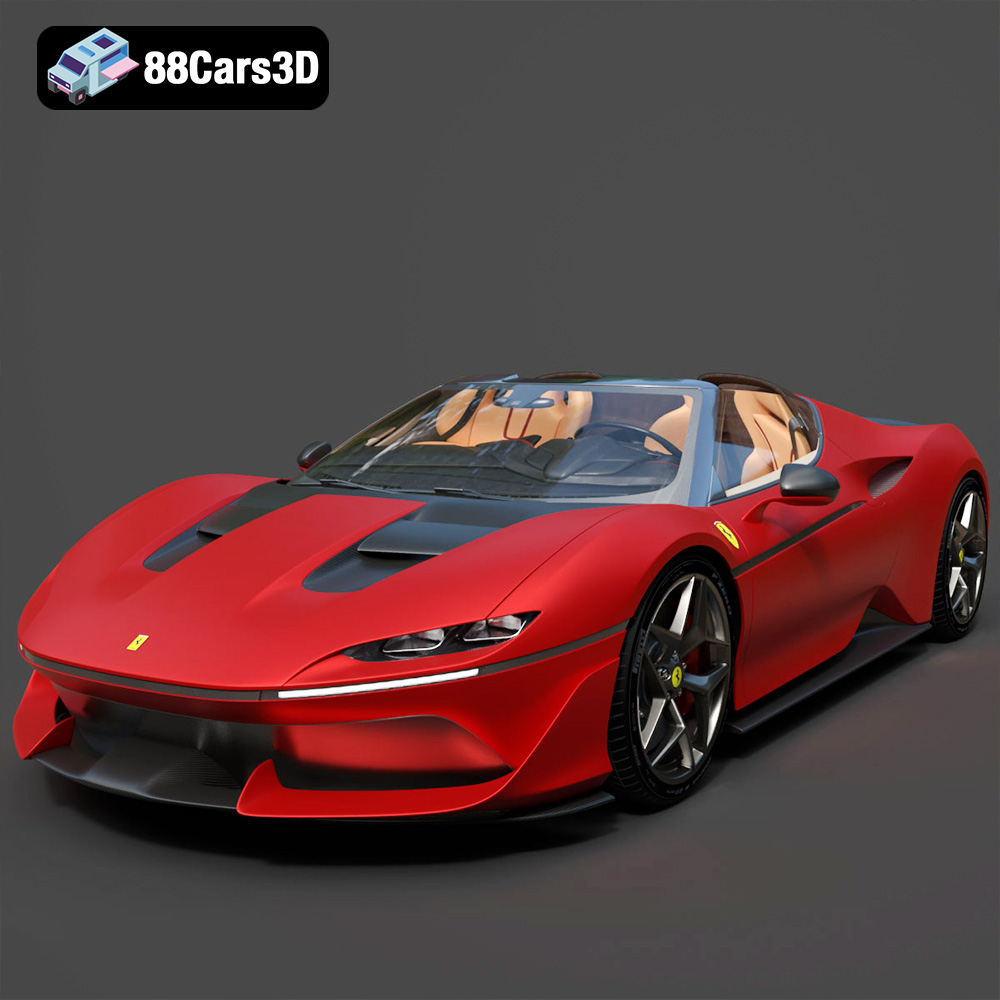
In the world of automotive design, few names command the same reverence and passion as Ferrari. Their vehicles are not merely machines; they are works of art, engineering marvels, and symbols of ultimate performance. Among these legends, the Ferrari J50 2017 stands out as a particularly exquisite and rare masterpiece. Created to commemorate 50 years of Ferrari’s presence in Japan, this limited-edition supercar, based on the formidable 488 Spider, features radically distinct, futuristic bodywork, a sleek targa roof, and a visual aggressiveness that sets it apart even within the exclusive Ferrari lineage. Its sculpted mid-engine profile, housing a potent twin-turbo V8, and striking quad taillights evoking retro styling, make it a truly iconic design.
For designers, game developers, visualization artists, and enthusiasts, bringing such a vehicle into the digital realm with authenticity and precision is a profound challenge. That’s where meticulously crafted 3D car models, like the Ferrari J50 2017 available on 88cars3d.com, become indispensable. These assets transform complex physical artistry into digital fidelity, opening a universe of possibilities from hyper-realistic renders to immersive virtual experiences. This article delves into the technical intricacies and creative potential of high-quality 3D car models, using the Ferrari J50 2017 as our prime example, exploring how it empowers professionals across various industries.
Recreating a vehicle as intricate and visually dynamic as the Ferrari J50 2017 in 3D is a testament to the skill and dedication of digital artists. It involves far more than simply tracing outlines; it requires a deep understanding of automotive design principles, aerodynamics, and the subtle nuances that give a car its character. Every curve, every vent, and every panel must be painstakingly modeled to mirror its real-world counterpart, ensuring that the digital representation evokes the same emotion as the physical car.
The journey begins with extensive research, gathering blueprints, high-resolution photographs, and often, even laser scan data of the actual vehicle. This foundational data is then translated into a polygonal mesh, the skeleton of any 3D model. For a premium asset like the Ferrari J50 2017, the emphasis is on clean topology – a well-organized mesh structure that allows for smooth deformations, efficient UV mapping, and seamless integration into various software pipelines. The model’s “well-balanced triangle count” of approximately 350,000 triangles is crucial here, striking an optimal equilibrium between visual detail and performance, making it highly versatile for both game-ready applications and high-end rendering.
The Ferrari J50 2017 3D model doesn’t just replicate geometry; it encapsulates the essence of this exceptionally rare supercar. From the accurate frame geometry and targa-top proportions to the visible mid-mounted twin-turbo 3.9L V8 engine block under the rear cover, every detail is considered. The aggressive rear aerodynamic diffuser, signature sleek LED headlights, classic quad circular taillights, and exclusive custom-designed multi-spoke wheels with high-performance tire details all contribute to its stunning visual fidelity. Even the brake calipers and suspension geometry are meticulously detailed, with separate components designed for realistic animation, offering unparalleled control for animators and simulation developers.
The versatility of a 3D model is often defined by the range and quality of file formats it supports. Different formats cater to specific workflows, software, and application requirements. A comprehensive package, such as the Ferrari J50 2017 3D model from 88cars3d.com, includes a suite of industry-standard formats, ensuring maximum compatibility and utility. Understanding these formats is crucial for any professional working with 3D assets.
The **.blend** file format is the native format for Blender, a powerful open-source 3D creation suite. A .blend file typically contains a complete Blender scene, including the model’s geometry, materials, textures, lighting, camera setups, animation data, and even physics simulations. This format is ideal for users working entirely within the Blender ecosystem, allowing for full editability, non-destructive workflows, and access to all the original scene settings. For artists who prefer Blender, starting with the .blend file provides the most flexibility for customization and further development of the Ferrari J50.
The **.fbx** (Filmbox) format is an industry-standard proprietary file format developed by Autodesk, known for its robust support for 3D models, animation, and scene data. It acts as an excellent interchange format between various 3D applications and is especially crucial for game development. Its binary nature makes it efficient, and it can store complex data like meshes, materials (often with PBR metadata), rigging, skinning, and animation. For integrating models into real-time engines like Unreal Engine or Unity, .fbx is often the go-to choice due to its comprehensive data storage capabilities. The **.unreal** format, while not a standalone universal file type in the same vein as FBX or OBJ, refers to an asset that has been specifically prepared and optimized for direct import or even provided as a packaged asset within Unreal Engine. This often means the FBX has been imported, materials set up with Unreal’s shader system, and proper collision, LODs (Levels of Detail), and pivot points configured, making it truly “engine-ready” for immediate use in real-time environments.
The **.obj** (Wavefront OBJ) format is one of the most widely supported and universal 3D file formats. It is a simple, text-based format that primarily describes the geometry of a 3D model, including vertices, normals, UV coordinates, and faces. It can also reference external material libraries (.mtl files) for surface properties. While it doesn’t support animation or rigging directly, its simplicity and widespread compatibility make it an excellent choice for static meshes and cross-software transfers. The Ferrari J50 in .obj format ensures it can be opened and worked with in virtually any 3D software. The **.ply** (Polygon File Format) is another versatile format, often used for storing 3D data from 3D scanners. It can store a wider range of properties than OBJ, including color, transparency, normals, texture coordinates, and even reliability information for each vertex or face. It’s available in both ASCII and binary versions and is particularly useful for applications requiring high precision mesh data, such as CAD or scientific analysis, offering a robust representation of the Ferrari J50’s complex surfaces.
The **.glb** (GL Transmission Format Binary) is a relatively newer format, rapidly gaining traction for web-based 3D, AR, and VR applications. It is a binary version of the glTF format, designed for efficient transmission and loading of 3D scenes and models. A single .glb file can embed all necessary data, including geometry, materials, textures, and animations, making it highly portable and optimized for interactive experiences in browsers, mobile AR, and virtual environments. This format is crucial for showcasing the Ferrari J50 in interactive web configurators or mobile AR apps. The **.max** format is the native scene file format for Autodesk 3ds Max, a long-standing professional 3D modeling, animation, and rendering software. Like .blend, a .max file contains an entire 3ds Max scene, including complex object hierarchies, modifiers, materials, lighting, and animation data. It is ideal for users who primarily work in 3ds Max and require full access to the original project settings for advanced animation, rendering, and scene manipulation.
Finally, the **.stl** (Stereolithography) format is the de facto standard for 3D printing. It represents a 3D model’s surface geometry using a tessellation of triangles. Unlike other formats, .stl files typically do not store color, texture, or material information – only the pure geometric form. For hobbyists and professionals looking to bring the Ferrari J50 2017 into the physical world through additive manufacturing, the .stl format is essential, enabling direct printing of the model at various scales. The inclusion of this format emphasizes the model’s versatility, catering to both digital and tangible applications.
The true value of a premium 3D car model, such as the Ferrari J50 2017, lies in its seamless adaptability across a spectrum of professional applications. Whether it’s the demanding performance requirements of a game engine or the absolute fidelity sought in cinematic rendering, a well-optimized asset is a cornerstone of efficient production.
In game development, every polygon counts. The Ferrari J50 2017 3D model, with its “game-ready & optimized” ~350,000 triangles, strikes a perfect balance. This polycount allows for impressive visual realism without crippling real-time engine performance in titles like open-world adventures, racing simulators, or virtual test drives. Crucially, the model boasts proper pivot setups for steering, wheel rotation, and suspension travel, allowing game developers to animate vehicle dynamics realistically with minimal effort. Its clean mesh topology also facilitates the creation of LODs (Levels of Detail), ensuring the car renders efficiently whether it’s up close or in the distance.
For cinematic sequences, architectural visualizations (arch-viz), or product showcases, photorealism is paramount. The meticulous detailing of the Ferrari J50 2017 model’s exterior and interior features, from the visible engine block to the high-resolution instrument cluster, provides an exceptional foundation. Artists can leverage its clean geometry and PBR (Physically Based Rendering) ready materials (implicit in modern 3D software and file formats like FBX) to achieve stunning results. Customization options, such as changing body colors (Rosso Corsa or bespoke finishes), modifying tire textures, or adjusting material finishes (matte, gloss, metallic, carbon fiber), empower artists to tailor the model to specific scenes and branding campaigns, creating captivating lifestyle renders or studio lighting setups.
Augmented Reality (AR) and Virtual Reality (VR) demand highly optimized assets that can render smoothly on a variety of devices, from mobile phones to high-powered headsets. The Ferrari J50 2017 model’s balanced polycount and clean topology make it ideal for immersive virtual showrooms, interactive configurators, and mobile AR applications. The highly detailed interior, “optimized geometry for first-person POV,” ensures that stepping into the virtual cockpit provides a truly authentic and engaging experience, making it perfect for driving simulations or virtual car tours. The inclusion of the .glb format further underscores its readiness for browser-based and mobile AR/VR deployment.
Beyond the surface aesthetics, the true quality of a 3D model lies in its underlying technical specifications. These details dictate its performance, flexibility, and overall utility in professional pipelines. The Ferrari J50 2017 3D model exemplifies meticulous craftsmanship at every level.
The foundation of this model’s excellence is its “real-world scale accuracy,” ensuring that it adheres to the precise dimensions of the actual vehicle chassis. This is critical for architectural visualizations, simulations, and any scenario where accurate spatial representation is vital. The “excellent topology” refers to the clean, well-distributed arrangement of polygons, which prevents shading artifacts, facilitates smooth deformations during animation, and simplifies UV mapping for texture application. This attention to underlying structure is what allows the model to scale effortlessly from real-time applications to high-fidelity rendering.
Every exterior feature of the Ferrari J50 2017 has been reproduced with remarkable fidelity. This includes not just the overall “accurate Ferrari J50 frame geometry and targa-top proportions” but also granular elements. The “detailed mid-mounted twin-turbo 3.9L V8 engine block visible under the rear cover” adds a layer of authenticity crucial for close-up shots or even virtual engine bays. Furthermore, “dual exhaust system details and aggressive rear aerodynamic diffuser,” “signature sleek LED headlights and classic quad circular taillights,” and “exclusive custom-designed multi-spoke wheel and high-performance tire details” are all painstakingly modeled. Even “detailed brake calipers and suspension geometry” contribute to the overall realism, allowing for highly accurate representations of the vehicle’s mechanics. The separation of “wheels, suspension, and steering components for animation” is a key advantage, saving animators countless hours in rigging.
The interior of a supercar is just as important as its exterior, defining the user’s experience. This model’s “highly detailed two-tone sport seat details with distinctive trim” and “F1-style flat-bottom steering wheel and paddle shifters” immerse the viewer. The “high-resolution instrument cluster and infotainment screens” provide believable details for first-person views, essential for gaming and VR. The “center console layout with precise control details, pedals, and buttons” completes the cockpit, ensuring that every element contributes to an authentic driving experience, whether virtual or rendered.
High-quality 3D car models are not just digital toys; they are powerful tools driving innovation across various industries. The Ferrari J50 2017 3D model, available on 88cars3d.com, exemplifies how such assets become foundational elements in cutting-edge projects, offering a significant return on investment through saved development time and enhanced visual output.
For game development studios creating the next generation of racing titles, or automotive brands designing interactive virtual showrooms, highly optimized 3D car models are non-negotiable. The Ferrari J50 2017, optimized for real-time engines, can be dropped directly into a virtual environment, providing instant access to a visually stunning and physically accurate vehicle. Imagine a virtual showroom where prospective buyers can walk around, open doors, and even “sit inside” the J50, customizing colors and materials in real-time. This level of immersion, powered by assets from 88cars3d.com, revolutionizes the consumer experience and training simulations alike.
Marketing and advertising agencies frequently utilize 3D models to create compelling brand campaigns without the prohibitive costs and logistical challenges of physical photoshoots or video productions. A Ferrari J50 2017 3D model can be placed in any environment imaginable – from a bustling cityscape to a serene mountain pass – under any lighting condition, allowing for unparalleled creative freedom. For cinematic sequences, the model’s separate, animatable components enable dynamic camera movements and realistic vehicle animations, delivering Hollywood-level visual effects for a fraction of the traditional cost. This flexibility makes it an invaluable asset for agencies aiming to produce high-impact visuals.
Beyond screens, the Ferrari J50 2017 3D model’s inclusion of the .stl format unlocks the world of 3D printing. Hobbyists, collectors, and even automotive enthusiasts can bring a tangible piece of this rare supercar into their homes. This extends beyond simple display models; imagine custom accessories, scale replicas for dioramas, or even functional parts (with appropriate engineering considerations). The customization options provided, such as changing body colors, modifying tire textures, and adjusting material finishes, further empower users, whether in digital rendering or as a guide for post-processing 3D prints, to truly make the model their own.
The inclusion of the .stl format for the Ferrari J50 2017 3D model offers an exciting avenue for enthusiasts and designers to bridge the gap between the digital and physical worlds. However, achieving a high-quality 3D print requires understanding specific settings and considerations for additive manufacturing.
When preparing the Ferrari J50 for 3D printing, the choice of technology – FDM (Fused Deposition Modeling) or resin (SLA/DLP) – significantly impacts the outcome. For fine details and a smoother finish, “Resin printing is recommended.” This allows for layer heights as low as “0.04–0.12 mm,” capturing the intricate curves and sharp edges of the supercar’s bodywork. For FDM printing, while still viable, slightly thicker layers might be necessary, and careful calibration is key. Recommended scales like “1:12 / 1:18 / 1:24” ensure that the model retains sufficient detail without becoming overly fragile. Crucially, “supports are required for detailed parts like exhaust, mirrors, splitters” to prevent warping and ensure structural integrity during the printing process. Optimal “wall thickness: 1.2–2.0 mm” and “infill: 20–30%” contribute to a robust yet material-efficient print.
Once printed, the physical model benefits immensely from post-processing. This typically involves removing supports, sanding to smooth out layer lines (especially with FDM prints), and applying a primer to create an even surface for painting. For an authentic look, applying “authentic factory colors with metallic finishes” can truly bring the Ferrari J50 to life, mirroring its real-world counterpart. This meticulous approach to both digital modeling and physical fabrication ensures that the final printed product is a worthy representation of Ferrari’s exquisite design.
The Ferrari J50 2017 is a pinnacle of automotive design, and its premium 3D model offers an unparalleled opportunity to explore, visualize, and interact with this masterpiece in the digital realm. From game-ready optimization to high-end rendering fidelity, and from comprehensive file format support to detailed interior and exterior features, this asset embodies versatility and technical excellence. Whether you’re a game developer seeking realistic vehicles, a visualization artist crafting breathtaking scenes, an AR/VR innovator building immersive experiences, or a hobbyist eager to 3D print a stunning replica, this model provides the foundation for exceptional results. It truly empowers professionals and enthusiasts to push the boundaries of creativity and technical artistry.
By investing in high-quality 3D car models like the Ferrari J50 2017 from 88cars3d.com, you’re not just acquiring an asset; you’re gaining a powerful tool that streamlines workflows, reduces development time, and elevates the final visual impact of your projects. Explore the potential and unlock new creative avenues with this meticulously crafted digital automotive marvel.
The Ferrari J50 2017 is a limited-edition masterpiece created to celebrate 50 years of Ferrari in Japan. Based on the 488 Spider, it boasts radically distinct, futuristic bodywork with a sleek targa roof, aggressive aerodynamic front fascia, and quad taillights that evoke iconic retro styling. The model perfectly captures the dynamic lines, the sculpted mid-engine profile housing the potent twin-turbo V8, and the striking visual balance of this exceptionally rare supercar.
This premium 3D model is meticulously crafted to deliver stunning visual fidelity while maintaining excellent topology. With a well-balanced triangle count, it is highly optimized as a game-ready asset without compromising on high-end rendering quality. The mesh structure is clean, making it incredibly versatile across major workflows like game development, immersive AR/VR experiences, animation, and high-resolution visualization.
Perfect for high-end racing simulators, virtual showrooms, architectural visualizations, and cinematic automotive animations.
.blend, .fbx, .obj, .glb, .stl, .ply, .unreal, .max
Tags:
ferrari, j50, 2017, supercar, sports-car, game-ready, low-poly, optimized, car-3d-model, game-asset, rendering, vr-ar, blend, fbx, obj, glb, stl, ply, unreal, maxMercedes Benz CLS 500 3D Model 3D Printable STL
$19.99
.2017
.blend
.fbx
.ferrari
.glb
.max
.obj
.ply
.rendering
.sports car
.stl
.supercar
.unreal
car-3d-model
game asset
game-ready
j50
low-poly
optimized
VR/AR