Get 20% OFF All Premium 3D & STL Models!

In the expansive and intricate world of 3D modeling, the demand for highly detailed, historically accurate, and versatile assets is constant. Whether you’re crafting a cinematic masterpiece, developing the next-generation open-world game, or designing immersive architectural visualizations, the quality of your 3D car models can make or break your project. Among the countless vehicles that have graced our roads, certain classics hold a unique appeal, blending nostalgia with iconic design. One such vehicle, a true symbol of industrial fortitude and timeless British engineering, is the 1965 Ford Transit Mk1 Panel Van. For professionals and enthusiasts alike, having access to a meticulously crafted 3D model of this legend is invaluable.
Vintage commercial vehicles, particularly those from the mid-20th century, embody a distinct character and narrative often missing in modern designs. They represent an era of robust utility, simpler aesthetics, and a certain working-class charm. For 3D artists, these vehicles offer rich storytelling potential, capable of grounding scenes in specific historical periods or adding a touch of rustic authenticity. The Ford Transit Mk1, with its distinctive flat-front styling and reputation as a reliable workhorse, is more than just a vehicle; it’s a cultural icon. Recreating this essence in a digital format requires not just artistic skill, but a deep understanding of technical optimization and historical accuracy.
The challenge of bringing a classic like the 1965 Ford Transit Mk1 into the digital realm lies in balancing visual fidelity with performance efficiency. This is where expert-level 3D model creation truly shines. A high-quality model must accurately capture the vehicle’s proportions, its characteristic features, and even the subtle wear and tear that hints at its history, all while being optimized for various demanding applications. The Ford Transit Mk1 Panel Van 1965 3D Model exemplifies this balance, offering a game-ready asset that doesn’t compromise on detail, making it an ideal choice for any professional seeking top-tier 3D car models. Sourced from platforms like 88cars3d.com, such assets empower artists to focus on their creative vision, confident in the technical integrity of their foundational elements.
Navigating the diverse landscape of 3D software and applications requires a solid grasp of various file formats. Each format serves a specific purpose, offering different levels of compatibility, optimization, and feature retention. Understanding these nuances is critical for efficient workflow, seamless integration, and achieving desired output across different platforms, from game engines to 3D printers. The Ford Transit Mk1 Panel Van 1965 3D Model, for instance, comes equipped with a comprehensive suite of file formats, ensuring maximum versatility for any project.
The .blend format is Blender’s native file type. It’s much more than just a mesh container; it encapsulates an entire Blender scene, including all objects, materials, textures, lighting setups, animations, cameras, modifiers, and even scripts. This makes .blend files incredibly powerful for artists working primarily within Blender, as they retain full editability and all scene dependencies. For the Ford Transit Mk1, the .blend file would provide the most comprehensive version, allowing users to deeply customize every aspect, from altering the chassis geometry to tweaking material nodes or preparing it for complex animation sequences within Blender’s robust environment. Its strength lies in its complete, self-contained nature, ideal for iterative design and detailed project management within Blender.
.fbx (Filmbox) is arguably the most widely adopted proprietary 3D interchange format, developed by Autodesk. It’s a binary format that excels at transferring entire scenes, including meshes, materials (with some limitations), textures, animations, skinning, and camera data, between various 3D applications like 3ds Max, Maya, Blender, Unity, and Unreal Engine. Its robustness and widespread support make it the go-to format for game development and animation pipelines. The .fbx version of the Ford Transit Mk1 is perfect for direct import into game engines, ensuring that crucial elements like pivot points, material assignments, and potential skeletal rigging are preserved.
.obj (Wavefront Object) is another ubiquitous format, known for its simplicity and near-universal compatibility. It’s a text-based format that primarily stores mesh geometry (vertices, normals, UVs, faces) and can link to external .mtl (material) files for basic material definitions. While .obj doesn’t support animation or complex scene data like .fbx, its simplicity makes it an excellent choice for basic mesh exchange across almost any 3D software. For the Transit Mk1, the .obj file serves as a reliable fallback, guaranteeing the core mesh data is always accessible, regardless of your primary software choice.
.glb (GL Transmission Format Binary) is the binary version of glTF, a royalty-free specification for the efficient transmission and loading of 3D scenes and models by applications. Optimized for web and real-time environments, .glb packages all assets (geometry, materials, textures, animations) into a single, compact file. It’s rapidly becoming the standard for AR, VR, and browser-based 3D applications due to its efficiency and PBR (Physically Based Rendering) material support. The .glb version of the Ford Transit Mk1 is ideal for developers building interactive web experiences, AR filters, or VR showcases where performance and fast loading times are paramount.
The .unreal format, while not a standard file extension for external exchange, typically refers to assets specifically prepared and optimized for direct import or use within Unreal Engine. This could involve an .fbx file that has been thoroughly tested, configured, and perhaps even includes a pre-built Unreal scene or asset package. An “engine-ready asset” in .unreal context implies that it adheres to Unreal Engine’s best practices for materials, collision, LODs (Levels of Detail), and blueprint functionality, minimizing setup time for game developers. For the Ford Transit Mk1, this signifies that the model is primed for immediate integration into Unreal Engine projects, saving considerable time and effort in the development pipeline.
.stl (STereoLithography) is the most common file format for 3D printing. It represents a 3D model as a series of connected triangles, describing only the surface geometry without color, texture, or other properties. While simple, its ubiquity makes it the industry standard for sending models to 3D printers. The .stl version of the Ford Transit Mk1 is crucial for hobbyists or professionals looking to create physical scale models, requiring careful consideration of print settings, supports, and scale as outlined in the product description.
.ply (Polygon File Format, also Stanford Triangle Format) is designed to store polygonal models, often used for data from 3D scanners. It can store a wider range of properties than .stl, including color, transparency, texture coordinates, and even reliability information. While less common for direct rendering, .ply is valuable for precision mesh data, especially in CAD, engineering analysis, or when high-fidelity surface data is required. For the Ford Transit Mk1, its inclusion offers an alternative for highly detailed geometric analysis or for specialized industrial applications where the mesh integrity is paramount.
The .max format is the native scene file for Autodesk 3ds Max. Similar to .blend, it saves the entire scene, including all objects, modifiers, materials, lights, cameras, animations, and render settings specific to 3ds Max. For artists whose primary workflow revolves around 3ds Max for architectural visualization, product design, or high-end cinematic rendering, the .max file of the Ford Transit Mk1 is invaluable. It allows for complete manipulation within the software’s powerful toolkit, leveraging its advanced rendering capabilities with engines like V-Ray or Corona. This format provides the most flexibility for detailed scene composition and animation within the 3ds Max ecosystem, showcasing the depth of the 3D car models available.
Creating compelling 3D assets requires more than just aesthetic appeal; it demands robust technical foundations. The Ford Transit Mk1 Panel Van 1965 3D Model stands as a testament to this principle, meticulously engineered for performance and fidelity across a spectrum of applications. Every detail, from its geometry to its internal components, has been considered to deliver a truly professional-grade asset.
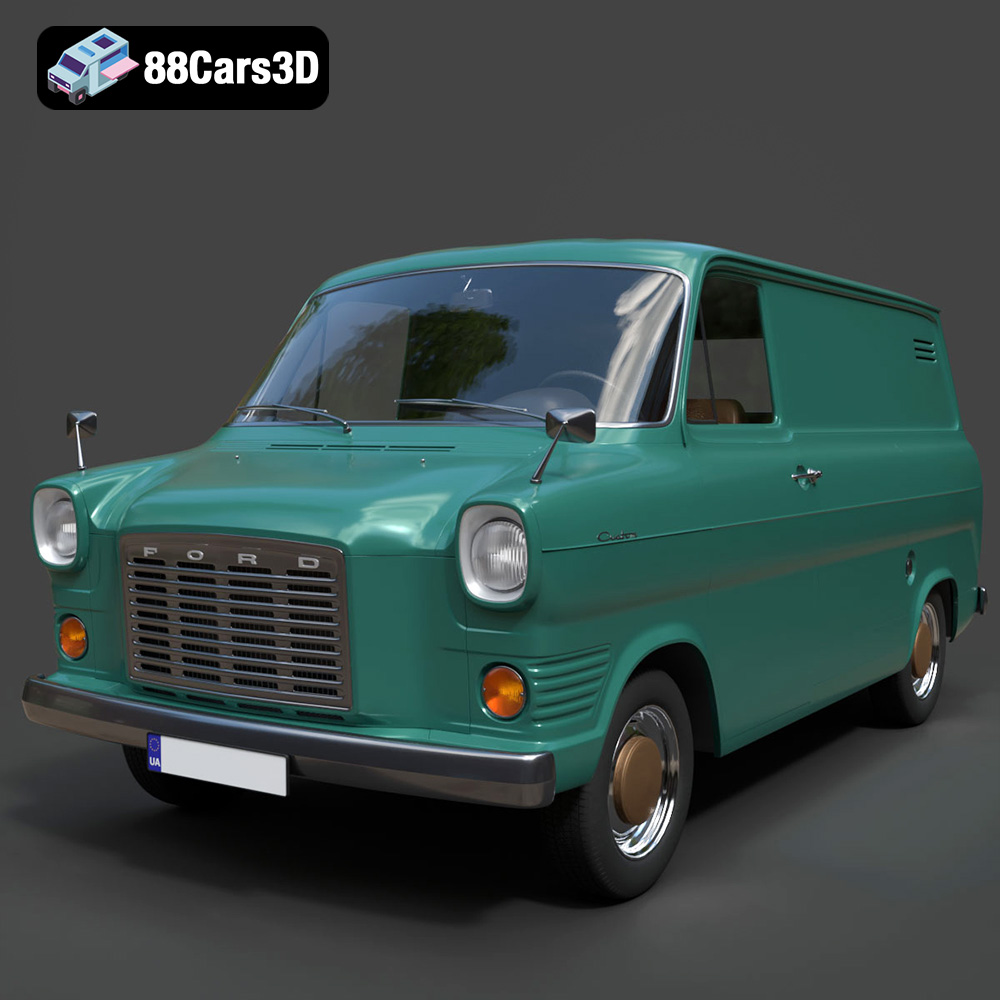
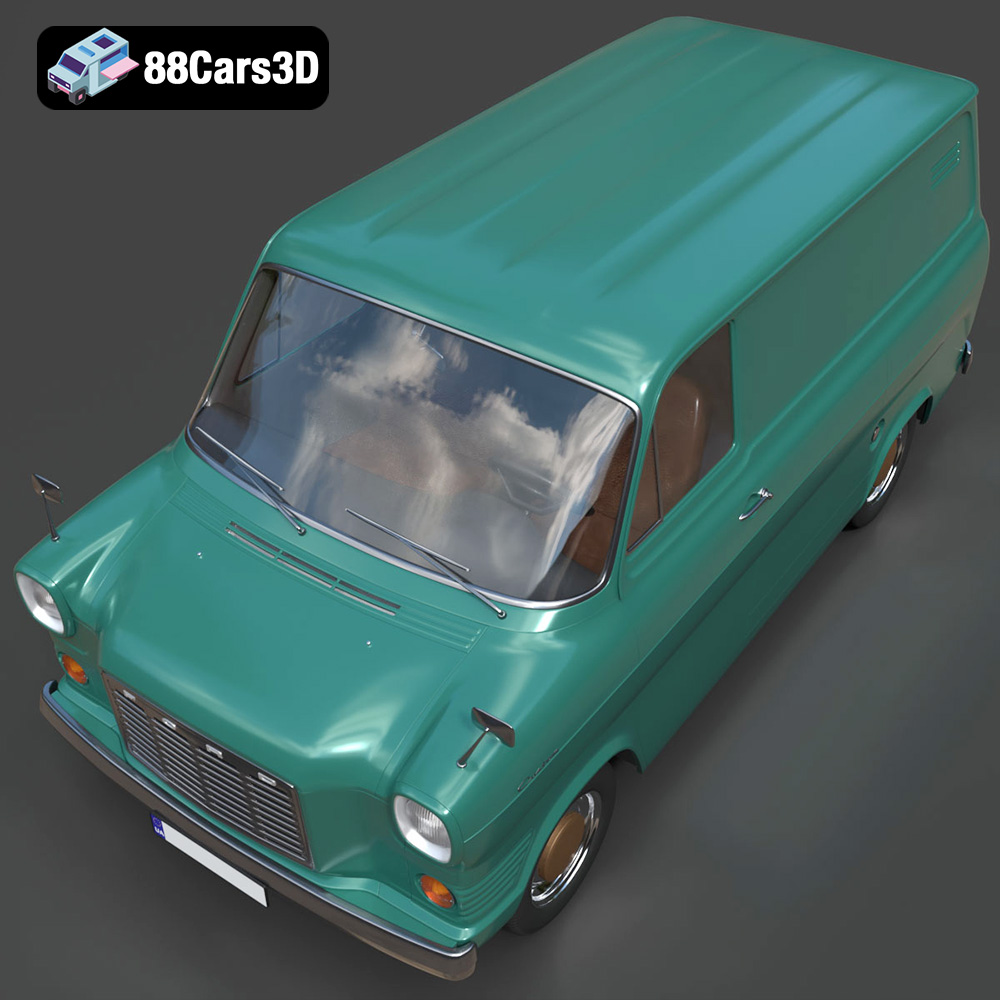
The model’s exterior is a triumph of accurate reproduction. It features the authentic Ford Transit Mk1 Panel Van frame geometry and its classic flat-front proportions, instantly recognizable to enthusiasts. Beyond just visual accuracy, the model incorporates detailed approximations of the V4 engine block and undercarriage components, including a period-correct side-exit exhaust system. This level of subsurface detail is crucial for close-up renders or realistic under-the-hood shots. The inclusion of authentic vintage circular halogen headlights and twin-lens taillights further enhances its realism. Crucially, the model is built for animation: its separate wheels, suspension, and steering components are properly pivoted, allowing for realistic rotation, steering, and suspension travel without complex setup. This ‘animation-ready’ feature is a significant advantage for automotive rendering and game assets, enabling dynamic scenes right out of the box.
Stepping inside, the cockpit and interior features maintain the same level of period accuracy. The authentic dual vinyl seating configuration, classic two-spoke steering wheel, and minimalist, dial-based instrument cluster transport the viewer straight into the 1960s. The traditional manual floor shifter, pedals, and handbrake levers complete the look. Beyond aesthetics, the interior geometry is optimized for first-person POV in gaming environments. This means careful consideration of polygon density, ensuring that the visible areas have sufficient detail for immersion while unseen parts are optimized to maintain performance. Such optimization is a hallmark of high-quality game assets, preventing unnecessary resource drain and ensuring smooth gameplay, even in complex scenes.
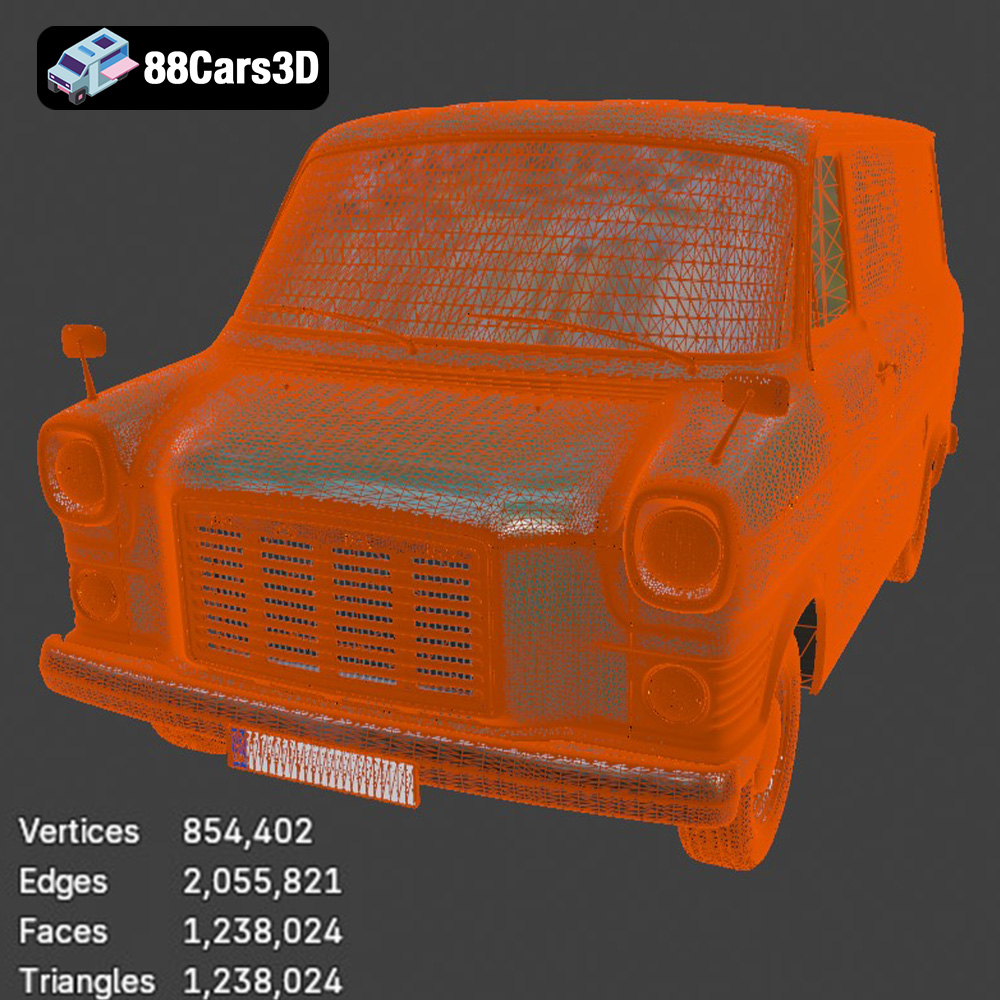
Technical specifications are paramount for any professional 3D car model. The Ford Transit Mk1 model is game-ready and optimized, boasting approximately 180,000 triangles. This polycount strikes a near-perfect balance, offering exceptional visual realism for high-end rendering while remaining highly efficient for real-time engines like Unreal and Unity. This careful optimization means developers don’t have to spend valuable time reducing mesh complexity, and artists can achieve stunning visuals without bogging down their scene. Furthermore, the model adheres to real-world scale accuracy, based on the actual vehicle chassis, ensuring seamless integration into architectural visualization projects or any scene requiring precise dimensional consistency. Proper pivot setup for steering, wheel rotation, and suspension travel are fundamental, allowing for immediate and accurate animation control, showcasing the thoughtful engineering behind this asset available on 88cars3d.com.
A truly versatile 3D car model isn’t just about its inherent quality; it’s about how seamlessly it integrates into diverse professional pipelines. The Ford Transit Mk1 Panel Van 1965 3D Model has been designed with this flexibility in mind, making it a valuable asset for a wide range of creative and technical endeavors.
For high-end automotive rendering, 3ds Max remains an industry standard, often paired with powerful renderers like V-Ray or Corona. The .max file provided with the Ford Transit Mk1 is perfectly suited for this environment. Artists can import the model, which typically comes with well-defined UVs and material slots, and then apply advanced PBR (Physically Based Rendering) materials. This allows for realistic reflections, refractions, and diffuse properties that accurately simulate real-world paint, glass, and metal. The animation-ready components—separate wheels, suspension, and steering—enable dynamic camera shots, showcasing the van in motion or during a static studio presentation. Imagine creating a stunning historical advertisement or a detailed product visualization, where every curve and material reacts authentically to light, highlighting the Transit’s timeless design. The model’s optimized topology ensures smooth subdivisions for crisp close-ups without excessively high polycounts, a critical factor in managing render times for complex automotive rendering scenes.
The demand for realistic game assets is higher than ever, and the Ford Transit Mk1 excels in this arena. With its ‘game-ready’ optimization and inclusion of .fbx and specifically prepared .unreal formats, integrating this model into Unreal Engine or Unity is a streamlined process. Developers can import the model, where its approximately 180,000 triangles represent an ideal balance for real-time performance. The pre-set pivot points for wheels and steering significantly reduce setup time for vehicle physics and animation blueprints. Collision meshes can be generated quickly, and LODs (Levels of Detail) can be implemented to ensure optimal performance across different viewing distances. This model is perfect for populating open-world environments, creating period-accurate racing games, or even simulating historical transport. Its optimized geometry and material setup ensure it contributes to an immersive experience without taxing the game engine, making it a stellar example of high-quality 3D car models for gaming.
Blender, with its increasing power and versatility, is a favorite for architectural visualization (arch-viz) and cinematic scene composition. The .blend file of the Ford Transit Mk1 provides full editability and seamless integration into Blender projects. Artists can leverage Blender’s Cycles or Eevee renderers to place the van within a meticulously designed street scene, an industrial backdrop, or a rustic garage. The model’s real-world scale is invaluable here, ensuring it fits proportionally within any architectural context. Furthermore, the ability to easily customize materials, apply Blender’s extensive modifier stack, or even animate the vehicle within a larger scene makes it incredibly flexible. Imagine a cinematic fly-through of a newly designed urban district, where the classic Transit Mk1 adds character and a sense of history to the foreground, enriching the overall narrative of the visualization.
The utility of high-quality 3D car models extends far beyond traditional screen-based rendering. Advances in 3D printing and immersive technologies like Augmented Reality (AR) and Virtual Reality (VR) have opened new frontiers for digital assets, allowing them to manifest in physical form or create interactive, spatial experiences. The Ford Transit Mk1 Panel Van 1965 3D Model is engineered to thrive in these cutting-edge applications.
For hobbyists and professionals alike, the allure of holding a physically tangible representation of a beloved classic vehicle is immense. The inclusion of the .stl format for the Ford Transit Mk1 makes this a reality. The .stl format, specifically designed for additive manufacturing, allows users to send the model directly to a 3D printer. While the digital model is optimized for visual realism, preparing it for 3D printing involves a few critical steps. The recommendation for resin printing (SLA/DLP) with fine layer heights (0.04–0.12 mm) is key for capturing the intricate details of the van’s chassis, lights, and interior elements. Careful consideration of wall thickness (1.2–2.0 mm), infill percentage (20–30%), and strategically placed supports ensures structural integrity and successful print outcomes. Furthermore, the advice on print orientation (angled frame, separate wheels) demonstrates an understanding of the practicalities of 3D printing, minimizing deformation and maximizing detail retention. Post-processing, including sanding, priming, and applying authentic factory colors, transforms the raw print into a stunning display-scale model, a tangible piece of automotive history.
The burgeoning fields of Augmented Reality (AR) and Virtual Reality (VR) demand highly optimized 3D assets that can be rendered in real-time on various devices, from powerful VR headsets to everyday smartphones. The Ford Transit Mk1 Panel Van 1965 3D Model is perfectly suited for these immersive applications, thanks to its game-ready optimization and the inclusion of the .glb format. The .glb format is specifically designed for efficient transmission and loading of 3D scenes in web-based and mobile AR/VR environments. Imagine a virtual showroom where prospective buyers can walk around a historically accurate 1965 Transit Mk1, inspecting every detail in 3D space. Or an AR application that places the classic van directly into your driveway through your smartphone camera. The model’s balanced polycount (~180,000 triangles) ensures smooth performance even on less powerful hardware, crucial for maintaining immersion and preventing motion sickness in VR. Its real-world scale accuracy also contributes significantly to a believable AR experience, where digital objects must seamlessly blend with the physical world. This versatility highlights the forward-thinking design behind modern 3D car models.
While the inherent quality of a 3D model is crucial, its true value often lies in its adaptability. Professional projects rarely use an asset “as-is”; customization is key. The Ford Transit Mk1 Panel Van 1965 3D Model is built with this flexibility in mind, offering numerous avenues for artists to tailor it to their specific creative and technical requirements.
The ability to easily modify materials and textures is fundamental to integrating any 3D car model into a unique scene. The Transit Mk1 allows for extensive material customization. Artists can change body colors, experimenting with a spectrum of factory-accurate hues or exploring entirely custom finishes, from matte and gloss to various metallic flakes. This is achieved by adjusting the parameters of the PBR materials (roughness, metallic, specular, normal maps) that are typically set up in the included file formats. Furthermore, tire textures can be swapped or modified to reflect different scenarios—imagine chunky off-road variants for a rugged adventure scene, or sleek street tires for an urban environment. This level of material control empowers artists to dictate the mood, age, and narrative of the vehicle, making it look brand new, weathered, or even custom-painted for a specific brand or story. Such versatility is a hallmark of premium game assets and rendering models.
Beyond the vehicle itself, how it interacts with its environment is paramount to realism. The Ford Transit Mk1 3D model is designed to respond authentically to various lighting setups. Artists can adapt the lighting to suit different environments, whether it’s the harsh, directional sunlight of an outdoor scene, the soft, diffused ambiance of an indoor studio, or the dramatic glow of a cinematic night render. This involves adjusting scene lights, environment maps (HDRIs), and post-processing effects to bring out the best in the model’s materials and forms. The model’s well-defined surfaces and material separation mean that shadows fall realistically, reflections behave credibly, and highlights catch the light in a visually appealing manner. This seamless integration into diverse lighting scenarios ensures that the Transit Mk1 always looks its best, whether it’s the star of a detailed architectural visualization or a background element in a fast-paced game. The accessibility of such high-quality 3D car models from sites like 88cars3d.com significantly streamlines production workflows.
The journey through the intricacies of 3D car models, their file formats, and their applications reveals a dynamic and ever-evolving landscape where precision, optimization, and versatility are paramount. The Ford Transit Mk1 Panel Van 1965 3D Model stands out as a prime example of a meticulously crafted digital asset that caters to the diverse needs of modern 3D artists and developers. From its historically accurate exterior and interior details to its game-ready optimization and comprehensive file format support, this model is built to elevate any project.
Whether your focus is on high-fidelity automotive rendering in 3ds Max, building immersive game worlds in Unreal Engine, crafting compelling architectural visualizations in Blender, or exploring the frontiers of 3D printing and AR/VR, the Transit Mk1 offers a robust and adaptable foundation. Its balanced polycount, real-world scale, and animation-ready components ensure both visual excellence and efficient performance across platforms. The flexibility for material and environmental customization further empowers artists to tailor the model to their unique creative visions, transforming a classic commercial vehicle into a bespoke element of their digital narratives.
Investing in high-quality 3D assets like the Ford Transit Mk1 Panel Van 1965 3D Model from reputable sources such as 88cars3d.com is not merely about acquiring a digital object; it’s about gaining access to a powerful tool that streamlines workflows, enhances realism, and ultimately frees up valuable creative energy. This iconic van, reimagined in stunning 3D, is more than just a model—it’s an invitation to explore new possibilities in digital art and interactive experiences.
The iconic 1965 Ford Transit Mk1 Panel Van is a legendary commercial vehicle that revolutionized the European light commercial market. Known for its wide track, car-like handling, and unmistakable flat-front styling, this workhorse set the standard for modern vans. Its distinctive silhouette, robust chassis, and classic V4 engine configuration make it a highly sought-after vintage classic among enthusiasts and collectors. This highly detailed, game-ready 3D model boasts optimized topology, ensuring exceptional visual fidelity while maintaining excellent real-time performance. Designed meticulously for seamless integration into modern game engines, architectural visualizations, and immersive AR/VR environments, the model captures every nuance of the original 1960s commercial aesthetic. Perfect for vintage city environments, historical transport simulations, classic garage scenes, and period-accurate architectural renderings.
$19.99
.blend
.fbx
.ford
.glb
.max
.obj
.ply
.rendering
.stl
.unreal
1965
car-3d-model
classic-van
commercial-vehicle
game asset
game-ready
low-poly
optimized
panel-van
transit-mk1
VR/AR