Get 20% OFF All Premium 3D & STL Models!

In the dynamic world of digital content creation, the pursuit of realism and efficiency is constant. From stunning automotive renders to immersive game environments and interactive AR/VR experiences, high-quality 3D assets form the bedrock of compelling visuals. Among these, meticulously crafted 3D car models stand out as particularly demanding, requiring an intricate balance of artistic fidelity and technical precision. These models are not just static representations; they are versatile tools that power a multitude of professional applications, enabling artists and developers to bring their visions to life with unparalleled authenticity.
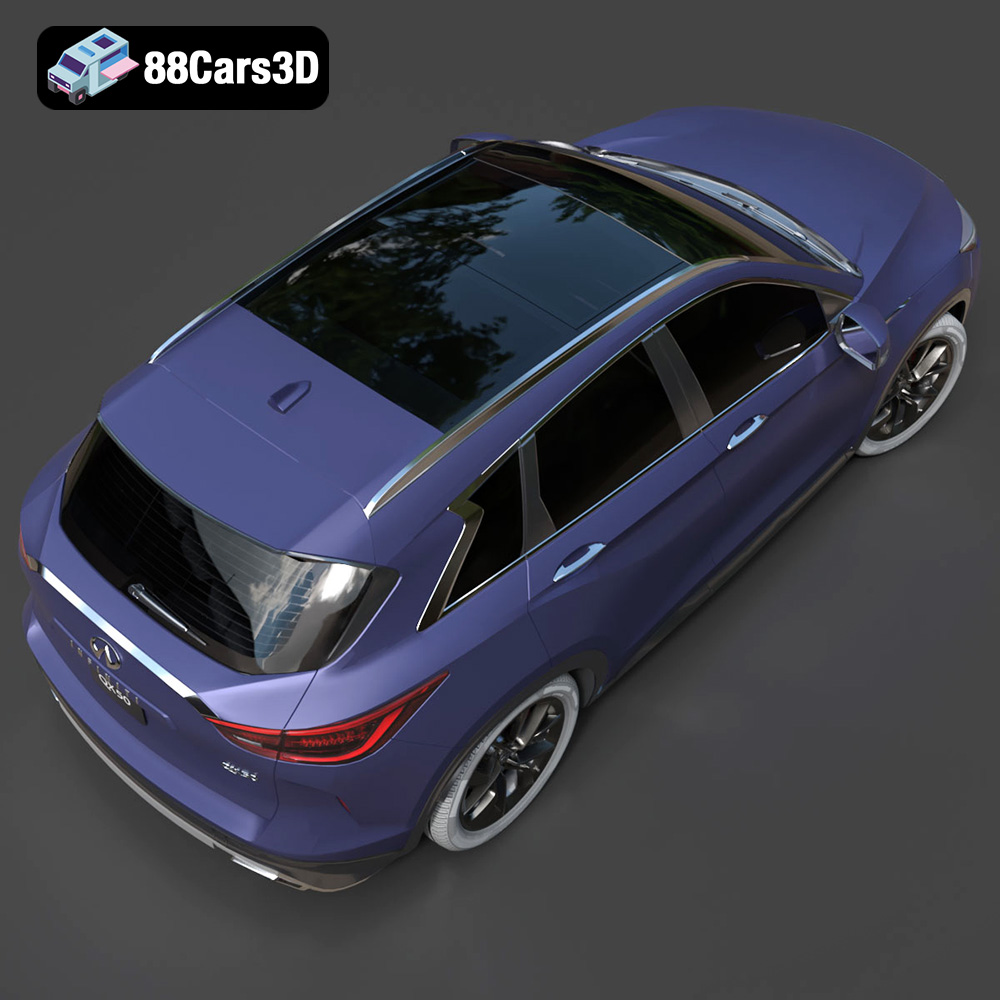
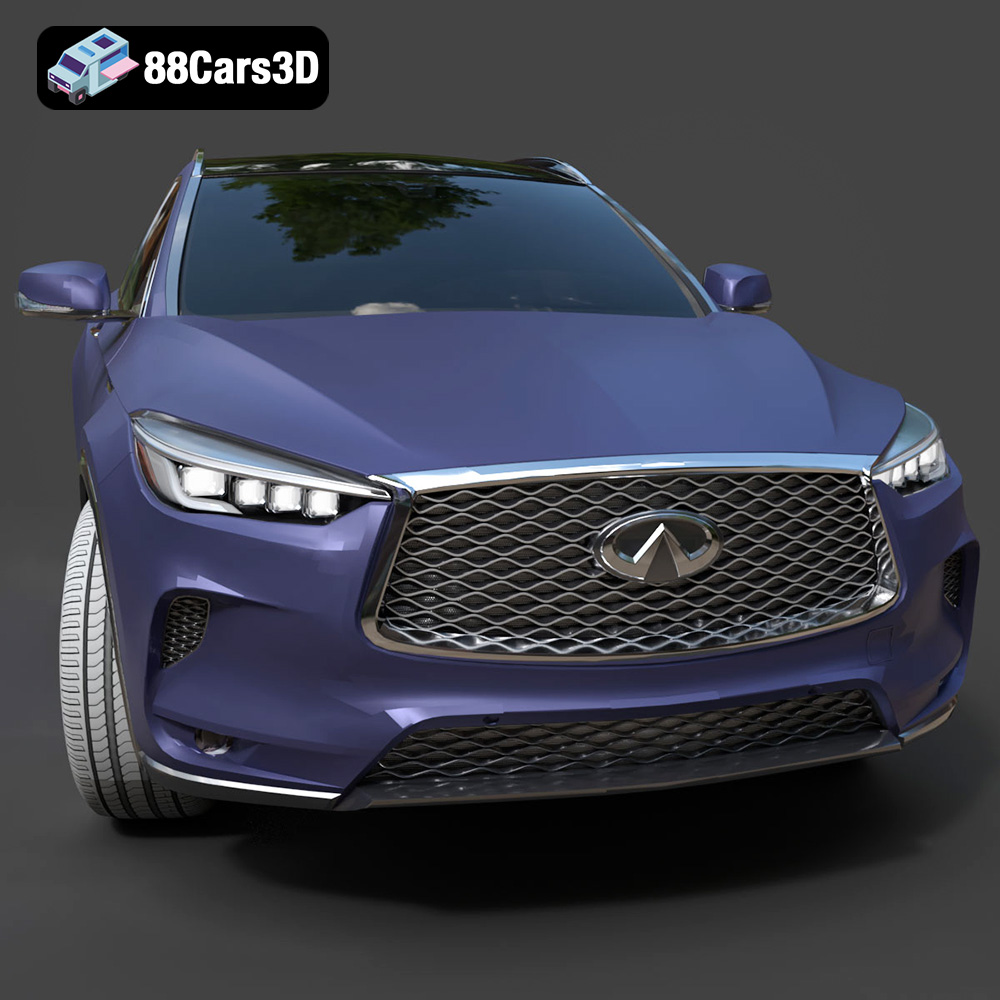
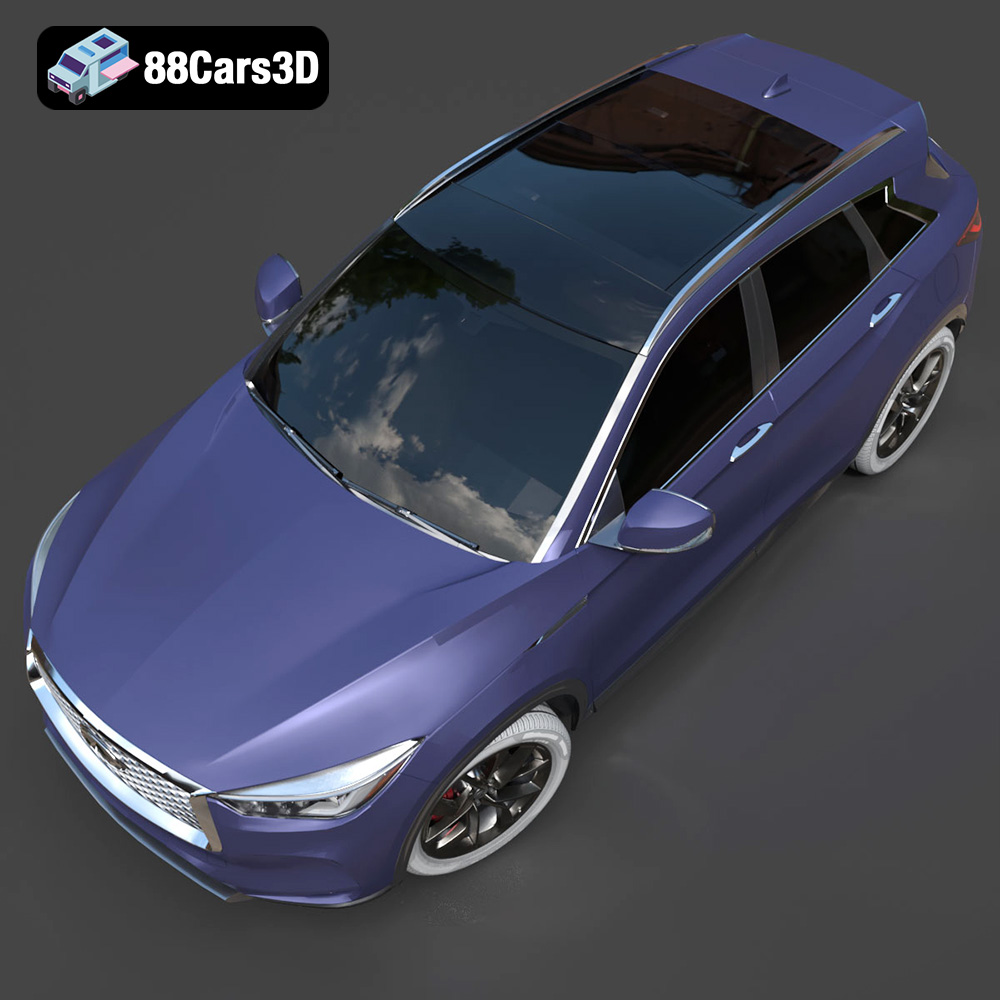
The journey from concept to a photorealistic digital vehicle is complex, often involving thousands of hours of skilled labor. This is why sourcing pre-made, high-grade assets can be a game-changer for studios and individual professionals alike. Imagine needing a sophisticated luxury crossover SUV for your next project – a model that perfectly captures the elegance and engineering of its real-world counterpart. This is where a product like the Infiniti QX50 2019 3D Model truly shines. Available at 88cars3d.com, it embodies the meticulous craftsmanship and technical excellence required to seamlessly integrate into demanding pipelines, offering a significant advantage in both time and quality for a wide array of digital endeavors.
The visual impact of any 3D project hinges on the quality of its assets. For automotive subjects, this is amplified due to the intricate curves, reflective surfaces, and complex mechanical details inherent in vehicle design. A premium 3D car model goes beyond mere visual appeal; it is a precisely engineered digital construct designed to perform flawlessly across various platforms and applications.
In the automotive industry, 3D models are indispensable tools throughout the design and marketing lifecycle. From initial concept sketches to final product presentations, high-fidelity models allow designers to visualize and iterate with accuracy, test aerodynamics, and present vehicles in compelling virtual environments long before physical prototypes are built. For marketing, these models enable the creation of breathtaking advertisements, interactive configurators, and virtual showrooms that captivate audiences and showcase a vehicle’s every detail. The Infiniti QX50 2019 3D Model, with its “exceptionally clean geometry” and “realistic materials,” provides an ideal base for such high-stakes visualization tasks, ensuring that every render gleams with professional polish.
The quality of a 3D asset directly impacts workflow efficiency. Poorly optimized models can lead to slow render times, buggy game performance, and frustrating conversion issues between software. Conversely, well-constructed 3D car models, featuring optimized polygon counts, clean topology, and proper UV mapping, streamline production. They are easier to animate, texture, rig, and integrate, saving countless hours and reducing potential headaches. For studios aiming for AAA quality in game development or cinematic realism in architectural visualization, investing in assets like those found on 88cars3d.com is a strategic decision that pays dividends in both output quality and project timelines.
The Infiniti QX50 2019 3D Model exemplifies the benchmark for professional-grade 3D car models. Its “meticulous attention to detail” and “sophisticated design” are not just aesthetic claims; they translate into practical advantages. This level of detail means fewer adjustments are needed post-purchase, allowing designers and developers to focus on creative tasks rather than remedial geometry fixes. Whether it’s for an architectural visualization project needing a realistic vehicle in a driveway, a game needing a high-performance asset, or a VR experience requiring precise collision detection, the quality of this model ensures reliable and visually striking results.
Navigating the diverse landscape of 3D software and applications often means dealing with a multitude of file formats, each with its strengths, weaknesses, and specific use cases. A truly versatile 3D model, like the Infiniti QX50 2019 3D Model, offers compatibility across a broad spectrum of these formats, ensuring maximum utility for any professional pipeline. Understanding what each format brings to the table is crucial for efficient workflow and optimal results.
The .blend format is the native file type for Blender, an increasingly popular open-source 3D creation suite. When a model is provided in .blend, it typically includes not just the mesh data but also the full Blender scene setup: materials, textures, lighting, cameras, animations, and even modifiers. This makes it ideal for users working primarily in Blender who want a fully editable and ready-to-render scene, often with pre-configured PBR materials. The included .blend file for the Infiniti QX50 2019 3D Model offers this complete package, allowing for immediate customization and rendering within Blender’s powerful ecosystem.
.fbx (Filmbox) is a proprietary file format owned by Autodesk, but it has become an industry-standard interchange format, particularly prevalent in game development. It efficiently stores 3D model data, including geometry, materials, textures, animations, and skeletal data. Its robust support in game engines like Unreal Engine and Unity makes it the go-to choice for real-time applications where performance and accurate data transfer are critical. The .fbx version of the Infiniti QX50 2019 3D Model is optimized for these environments, ensuring smooth integration and predictable performance.
The .obj (Wavefront OBJ) format is one of the oldest and most universally supported 3D file formats. It’s a simple, text-based format that primarily stores geometry (vertices, normals, UVs, faces) and can reference external material (.mtl) and texture files. While it doesn’t support advanced features like animation or rigging, its widespread compatibility makes it an excellent choice for basic mesh transfer between virtually any 3D software. For users needing a clean mesh to start from, or for cross-software compatibility, the .obj version of the Infiniti QX50 2019 3D Model is invaluable.
.glb (GL Transmission Format Binary) is the binary version of glTF, a royalty-free specification for 3D scenes and models. It’s highly optimized for efficient transmission and loading of 3D models in web-based applications, AR/VR experiences, and mobile platforms. A single .glb file can contain geometry, materials, textures, animations, and skeletal data, making it self-contained and easy to deploy. The .glb file for the Infiniti QX50 2019 3D Model is specifically designed for these emerging technologies, providing a lightweight yet visually rich asset for interactive and immersive digital environments.
.stl (Stereolithography) is a standard file format used for 3D printing and CAD software. It represents a 3D model as a series of connected triangles, describing only the surface geometry without color or texture information. While not suitable for rendering, it is absolutely essential for physical manufacturing and rapid prototyping. If you plan to 3D print a scale model of the Infiniti QX50 2019, the provided .stl file ensures accuracy and compatibility with most 3D printers and slicing software.
The .ply (Polygon File Format or Stanford Triangle Format) is another format for storing 3D data, particularly point clouds and polygon meshes. It can store a wider range of properties than .obj, including color, transparency, surface normals, and even confidence values for each vertex or face. It’s often used in scientific computing, 3D scanning, and applications where detailed mesh analysis is required. The .ply version of the Infiniti QX50 2019 3D Model can be beneficial for specific visualization or analytical tasks.
The .unreal format, or more accurately, assets pre-configured for Unreal Engine, typically refers to a collection of files (meshes, materials, textures) organized and sometimes packaged in a way that allows for direct import and optimal performance within the Unreal Engine ecosystem. This might involve specific material setups (e.g., master materials), collision meshes, and LODs (Levels of Detail) tailored for Unreal. The “Pre-configured for Unreal Engine use” claim for the Infiniti QX50 2019 3D Model signifies that significant work has been done to ensure it is engine-ready, saving developers crucial integration time.
The .max format is the native file type for Autodesk 3ds Max, a powerful 3D modeling, animation, and rendering software widely used in architectural visualization, product design, and cinematic production. Similar to .blend, a .max file contains the entire scene data, including geometry, materials, lighting, cameras, and animations, making it fully editable and ready for complex rendering tasks within 3ds Max. The inclusion of an editable .max file for the Infiniti QX50 2019 3D Model means users of this industry-standard software can leverage its full capabilities for high-end rendering and animation projects.
The true value of a premium 3D car model lies not just in its visual appeal, but in its underlying technical construction. For the Infiniti QX50 2019 3D Model, this involves several key aspects that ensure its versatility and high performance across various applications.
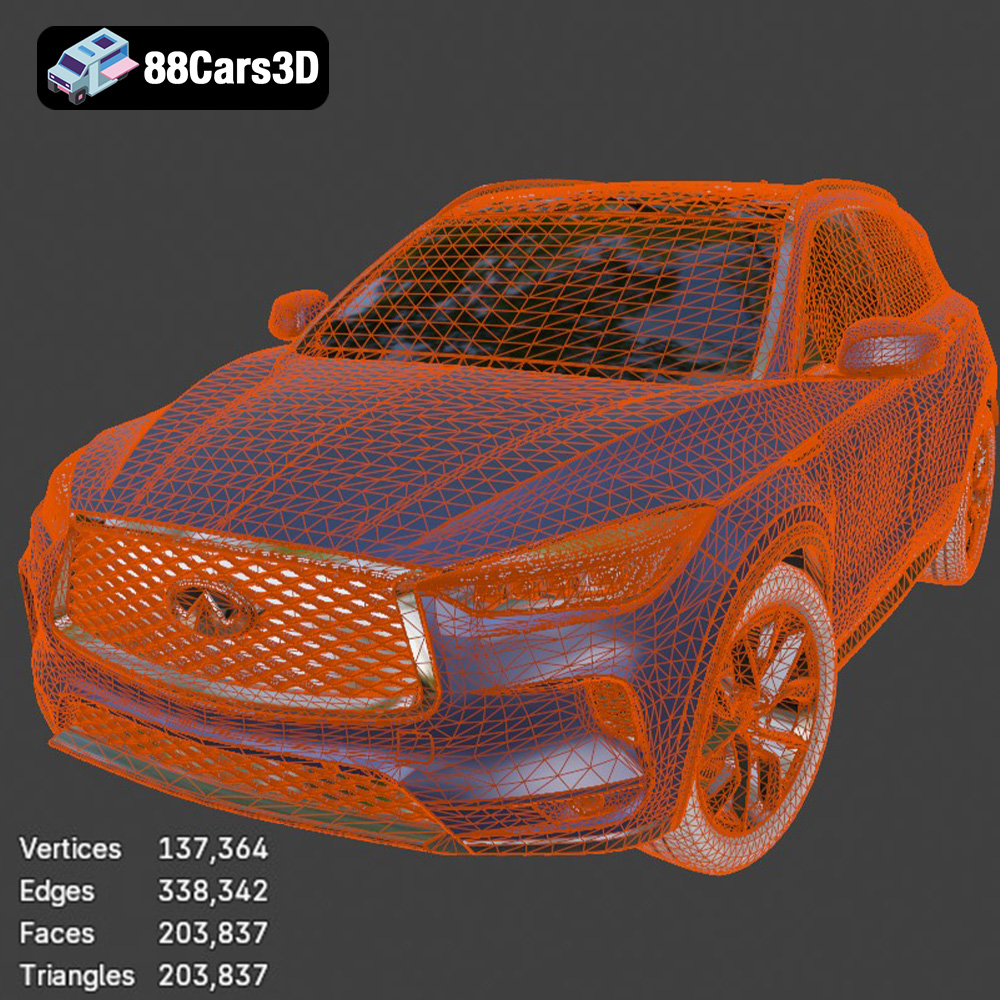
At the core of any high-quality 3D model is its geometry. “Exceptionally clean geometry” implies that the mesh is free from common issues like non-manifold edges, overlapping faces, and inverted normals. “Professional-grade topology” means the polygon flow follows the contours of the vehicle naturally, facilitating smooth subdivisions, deformation during animation, and clean UV unwrapping. This attention to detail reduces rendering artifacts and makes the model robust for modification, ensuring that features like the sleek lines of the QX50 2019 are accurately represented without visual glitches.
The realism of a 3D vehicle is heavily dependent on its materials. The Infiniti QX50 2019 3D Model boasts “realistic materials that ensure outstanding performance under varied lighting conditions.” This often translates to adherence to Physically Based Rendering (PBR) workflows, where materials are designed to mimic real-world light interaction. PBR materials use maps like Albedo (color), Normal (surface detail), Roughness (specularity), Metallic (reflectivity), and Ambient Occlusion (shadows) to create incredibly convincing surfaces – from the glossy paintwork to the intricate textures of tires and interior fabrics. Such materials ensure the model looks stunning whether illuminated by a studio light setup or dynamic outdoor HDRIs.
A truly professional 3D car model doesn’t stop at the exterior. The description mentions a “fully modeled interior” and “every element… constructed to meet the strictest industry standards.” This level of detail is crucial for close-up shots, virtual reality experiences where users can look inside the vehicle, or interactive configurators. It means door panels, dashboard components, seats, steering wheel, and even smaller elements like buttons and stitching are accurately modeled and textured. This comprehensive detailing ensures that the Infiniti QX50 2019 3D Model holds up under intense scrutiny, making it suitable for high-end cinematic sequences or interactive walkthroughs.
The true power of a high-quality 3D asset like the Infiniti QX50 2019 3D Model is realized through its seamless integration into diverse professional workflows. Its multi-format availability and robust construction allow it to be a cornerstone asset across different industries.
For automotive studios, advertising agencies, and architectural visualization firms, 3ds Max remains a dominant force for high-end rendering. Leveraging the .max file included with the Infiniti QX50 2019 3D Model, professionals can easily load the vehicle, apply advanced V-Ray or Corona Renderer materials, set up intricate lighting scenarios, and compose cinematic camera angles. Its clean geometry facilitates smooth subdivisions for close-up shots, while its realistic materials react accurately to global illumination, producing photorealistic images and animations that rival real-world photography. This workflow is essential for creating compelling marketing visuals or presenting new vehicle designs.
In the realm of game development and real-time simulations, performance is paramount. The included .fbx and pre-configured .unreal files for the Infiniti QX50 2019 3D Model are engineered for this demanding environment. Game developers can import the model into Unreal Engine, where its optimized mesh and PBR materials will render efficiently, maintaining high frame rates. Collision meshes can be added, and the model can be rigged for animations, such as opening doors or rotating wheels. This makes it an ideal asset for driving simulations, open-world games, or interactive showrooms, providing both visual fidelity and runtime efficiency.
Blender has grown into a formidable tool for architects and VR/AR developers due to its powerful rendering capabilities (Cycles and Eevee) and robust VR toolkit. The .blend file of the Infiniti QX50 2019 3D Model comes with materials and lighting already set up, allowing architectural visualizers to drop the vehicle into their scene to add a touch of realism to an exterior render or an interior garage scene. For VR experiences, the .glb format is particularly useful, offering an optimized, web-friendly version that can be easily integrated into platforms like WebXR or Unity/Unreal VR projects, enabling users to explore the QX50 in an immersive virtual space.
The versatility of a high-quality 3D car model extends far beyond simple rendering, touching various industries and professional needs. The Infiniti QX50 2019 3D Model, with its comprehensive detail and format versatility from 88cars3d.com, is a prime example of an asset that serves multiple purposes.
In today’s visually-driven market, stunning visuals are critical for product promotion. Automotive brands frequently use 3D car models to create marketing materials for brochures, websites, and television commercials. These models allow for creative freedom unbound by physical limitations – cars can be placed in impossible environments, shown in various colors, or highlighted with intricate camera movements not feasible with live-action shoots. A model like the QX50 2019 allows advertising agencies to produce high-impact visuals that truly capture the vehicle’s essence, driving consumer interest and engagement without the significant costs associated with traditional photography or film production.
Beyond marketing, 3D car models are integral to the automotive design process itself. Designers use these models to refine shapes, test different body kits, analyze ergonomics, and simulate various scenarios before committing to expensive physical prototypes. The high precision and editable nature of models like the Infiniti QX50 2019 3D Model allow engineers to conduct virtual crash tests, assess aerodynamic performance, and even plan manufacturing processes. The .stl format, in particular, becomes crucial here for quickly creating 3D printed scale models or components for tangible evaluation, accelerating the design cycle and reducing costs.
From driver training simulators for professional racers to virtual showroom experiences for potential buyers, 3D car models are at the heart of immersive simulation. The Infiniti QX50 2019 3D Model, especially in its game-engine ready .fbx and .unreal formats, can be integrated into advanced simulators to provide realistic driving physics and visual feedback. This is invaluable for teaching new drivers, practicing complex maneuvers, or even developing autonomous driving systems. Furthermore, interactive AR/VR applications, using the .glb format, can place the QX50 directly into a customer’s driveway, allowing them to explore features and customize options in a highly engaging, realistic manner.
While the initial quality of a 3D car model is paramount, its effective use in various projects often requires optimization to balance visual fidelity with performance. Professionals working with assets like the Infiniti QX50 2019 3D Model need to consider these factors, especially when transitioning between high-resolution renders and real-time applications.
For game development and real-time engines, maintaining optimal frame rates is crucial. High-poly models, while great for cinematic renders, can bog down performance. This is where Levels of Detail (LODs) come into play. A professional 3D car model, or at least its source files, should be amenable to creating multiple versions of the model with varying polygon counts. The highest LOD is used when the car is close to the camera, showcasing every detail, while lower LODs are swapped in as the car moves further away, reducing the computational load without a noticeable drop in visual quality. Clean topology, as found in the Infiniti QX50 2019 3D Model, makes the process of generating effective LODs much smoother and more reliable.
UV mapping is the process of flattening the 3D surface of a model into a 2D space so that a texture can be applied. Well-executed UVs are crucial for preventing stretching or distortion of textures and for maximizing texture resolution. For complex models like cars, this means carefully organizing UV islands to utilize texture space efficiently. The Infiniti QX50 2019 3D Model, with its “realistic materials” and “professional-grade topology,” implies meticulous UV work. Furthermore, effective texture management involves optimizing texture resolution, using appropriate file formats (e.g., .png, .tga for alpha channels; .jpg for diffuse), and implementing texture atlases to reduce draw calls in game engines, further enhancing performance.
Even the most detailed 3D car model needs expert lighting and rendering to truly shine. Understanding how light interacts with the materials – the metallic sheen of the paint, the reflectivity of glass, the subtle roughness of plastic trim – is key. Using PBR-calibrated lighting setups, such as physically accurate HDRIs (High Dynamic Range Images) for environmental lighting and area lights for studio setups, ensures the model looks convincing. Furthermore, rendering techniques like global illumination, ambient occlusion, and ray-traced reflections contribute significantly to realism. The robust material setup of the Infiniti QX50 2019 3D Model, with its promise of “outstanding performance under varied lighting conditions,” means it’s ready to integrate into these advanced rendering pipelines with minimal adjustment.
The demand for high-quality 3D car models continues to grow across an expanding array of digital industries. From the precision required for automotive design to the performance needs of game development and the immersive qualities of AR/VR, these assets are critical components of professional success. The Infiniti QX50 2019 3D Model stands as an excellent example of a premium digital asset that meets these stringent requirements, offering meticulous detail, professional-grade topology, realistic materials, and unparalleled versatility across multiple file formats.
By understanding the nuances of various 3D file formats and recognizing the technical depth required to produce such models, professionals can make informed decisions that significantly enhance their workflows. Investing in a high-fidelity asset like the Infiniti QX50 2019 not only saves valuable production time but also elevates the final visual quality of any project. For those seeking to equip their digital arsenal with top-tier 3D car models, a visit to 88cars3d.com offers a curated selection of assets designed to meet the highest industry standards, empowering creators to achieve their most ambitious digital visions.
Discover the exceptional realism and precision of the Infiniti QX50 2019 3D Model. Crafted with meticulous attention to detail, this premium digital asset accurately reflects the stunning aesthetics and sophisticated design of the renowned luxury crossover SUV. This model features exceptionally clean geometry, professional-grade topology, and realistic materials that ensure outstanding performance under varied lighting conditions. Every element, from its bold exterior curves to its fully modeled interior, has been constructed to meet the strictest industry standards for professional 3D design. Designed for unparalleled versatility, this 3D vehicle is ready to be integrated seamlessly into a wide range of professional applications. Whether you are working on advanced game development, creating photorealistic architectural renders, building immersive AR/VR experiences, or producing cinematic visual effects, this asset delivers reliable and visually striking results.
$39.99
.2019
.arvr
.blend
.car3dmodel
.crossover
.fbx
.gameasset
.glb
.infiniti
.max
.obj
.ply
.qx50
.rendering
.simulation
.stl
.unreal
SUV