Get 20% OFF All Premium 3D & STL Models!

In the dynamic world of 3D visualization, the demand for exceptionally detailed and versatile assets continues to grow exponentially. From blockbuster game titles and immersive virtual reality experiences to high-fidelity architectural renderings and product configurators, the quality of 3D models forms the bedrock of any successful project. Nowhere is this more evident than with automotive assets, where precision, historical accuracy, and optimization are paramount. A truly great 3D vehicle model doesn’t just look good; it functions seamlessly across diverse platforms and creative pipelines.
This pursuit of digital perfection is perfectly encapsulated by the Vintage Vespa 3D Model, a stunning example of meticulous craftsmanship available for download. This isn’t merely a static representation; it’s a meticulously engineered asset designed to bring the timeless charm of Italian ‘La Dolce Vita’ into any digital environment. Whether you’re a game developer seeking an iconic street vehicle, a visualization artist crafting a nostalgic scene, or an AR/VR designer building an immersive experience, understanding the technical depth behind such a model is crucial for leveraging its full potential.
The choice of file format is a critical decision in any 3D project, directly impacting compatibility, workflow efficiency, and the final output quality. A versatile asset, like the Vintage Vespa 3D Model found on 88cars3d.com, offers a comprehensive suite of formats, each serving distinct purposes and catering to specific industry standards. Understanding these formats is key to maximizing your creative potential and ensuring seamless integration into your preferred software and pipeline.
The .blend format is the native file type for Blender, the powerful open-source 3D creation suite. When you download a .blend file, you’re receiving a complete Blender scene, often including not just the mesh geometry but also materials, textures, lighting setups, cameras, animations, and even physics simulations. This format is ideal for Blender users who want to dive straight into an editable project, making quick modifications, re-texturing, or integrating the model into an existing Blender scene with minimal fuss. It preserves all the intricate details and organizational structures set up by the original artist, providing maximum flexibility for customization.
Autodesk’s .fbx (Filmbox) format has become an industry standard for data exchange between various 3D applications and game engines. It’s renowned for its robust ability to store not only mesh data (vertices, faces, UVs) but also materials, textures, animations, skinning, and camera information. For game developers working with Unreal Engine or Unity, .fbx is often the go-to choice due to its excellent compatibility and efficiency in importing complex animated assets. Its widespread adoption makes it an indispensable format for collaborative workflows and pipelines involving multiple software packages.
The .obj (Wavefront OBJ) format is one of the oldest and most widely supported 3D file formats. It’s a universal standard primarily focused on storing geometry data: vertices, UV coordinates, normals, and face information. While it doesn’t typically embed textures or animations directly, it references external material files (.mtl) that define color and texture paths. Its simplicity and broad compatibility make it excellent for cross-software transfers when you primarily need the raw mesh data, providing a reliable fallback for virtually any 3D application.
.glb (GLB, GL Transmission Format Binary) is the binary version of the glTF format, designed for efficient transmission and loading of 3D scenes and models by engines and applications. It’s a single-file format that includes geometry, materials, textures, animations, and more, all optimized for performance. .glb is rapidly gaining traction for its efficiency and ease of use in augmented reality (AR), virtual reality (VR), and web-based 3D applications, making it perfect for interactive configurators or social media filters where quick loading and low file sizes are crucial.
The .stl (Stereolithography) format is the ubiquitous standard for 3D printing. It represents a 3D model as a series of connected triangles (a tessellation) without any color, texture, or material information. Its primary purpose is to define the surface geometry of an object for fabrication. When preparing the Vintage Vespa 3D Model for physical output, converting it to .stl is the first step, allowing slicing software to interpret the model’s form and generate toolpaths for the 3D printer.
The .ply (Polygon File Format) is a versatile file format for storing 3D data, particularly from 3D scanners. It can store not only polygonal meshes but also point clouds, and it allows for various properties like color, transparency, normals, and even texture coordinates to be associated with vertices or faces. While not as common for general asset exchange as .fbx or .obj, .ply is often used in scientific, engineering, and CAD applications where precise, often scanned, mesh data with rich attribute information is required for analysis or specialized processing.
The .unreal format, or more accurately, assets packaged for direct import into Unreal Engine projects, signifies a model that has been specifically prepared and optimized for the engine’s unique requirements. This might involve proper pivot setups, collision meshes, LODs (Levels of Detail), and a material setup compatible with Unreal’s Physically Based Rendering (PBR) system. While often leveraging .fbx for the initial import, an “.unreal” designation implies a higher level of engine-specific readiness, saving developers significant time on setup and optimization within the engine itself.
Similar to .blend for Blender, .max is the native project file format for Autodesk 3ds Max, a leading software for 3D modeling, animation, and rendering. A .max file contains the entire scene hierarchy, including geometry, materials, textures, lighting, cameras, animation keyframes, and plugins. It offers the most comprehensive editing capabilities within 3ds Max, making it the preferred format for artists who wish to integrate the Vespa directly into their 3ds Max projects, modify parameters extensively, or utilize specific 3ds Max rendering features like V-Ray or Corona.
Creating a high-quality 3D model, especially of an iconic vehicle like the Vintage Vespa, requires a delicate balance between visual authenticity and technical efficiency. This particular model stands out for its meticulous attention to detail coupled with intelligent optimization, making it suitable for a broad spectrum of professional applications.
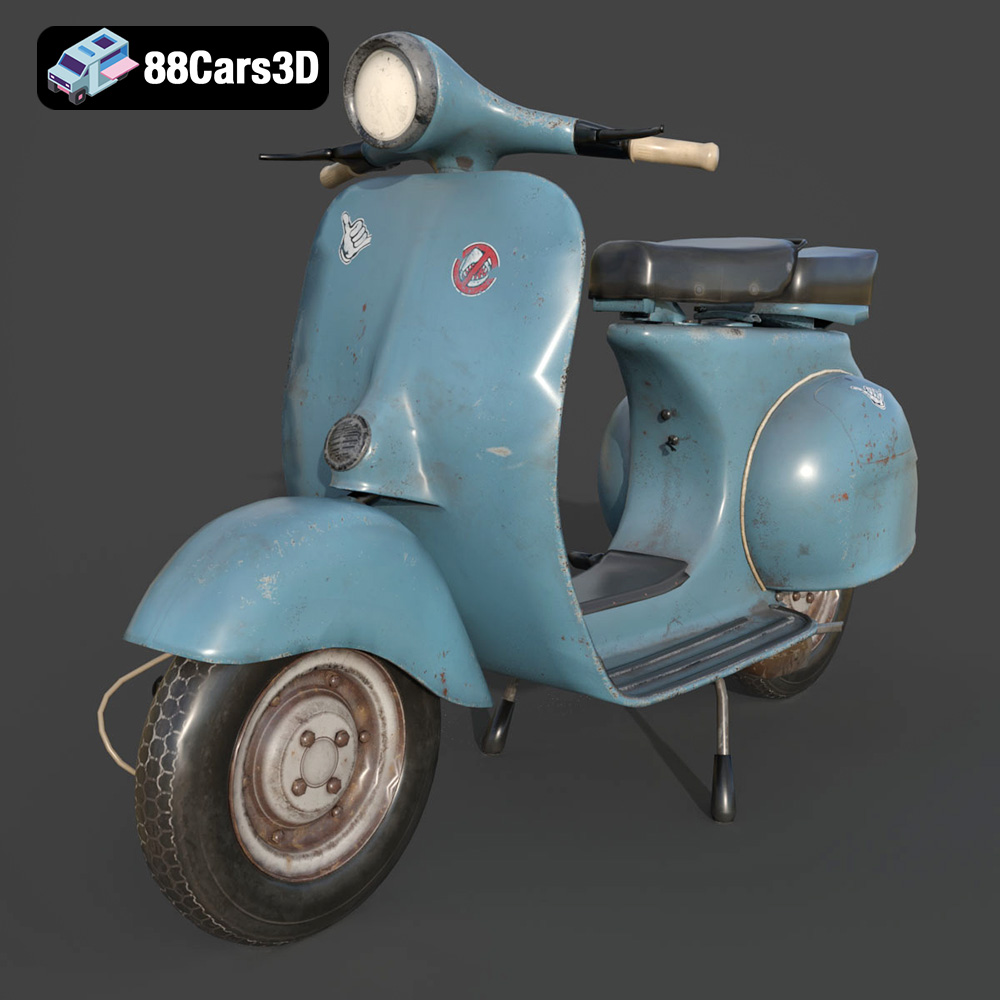
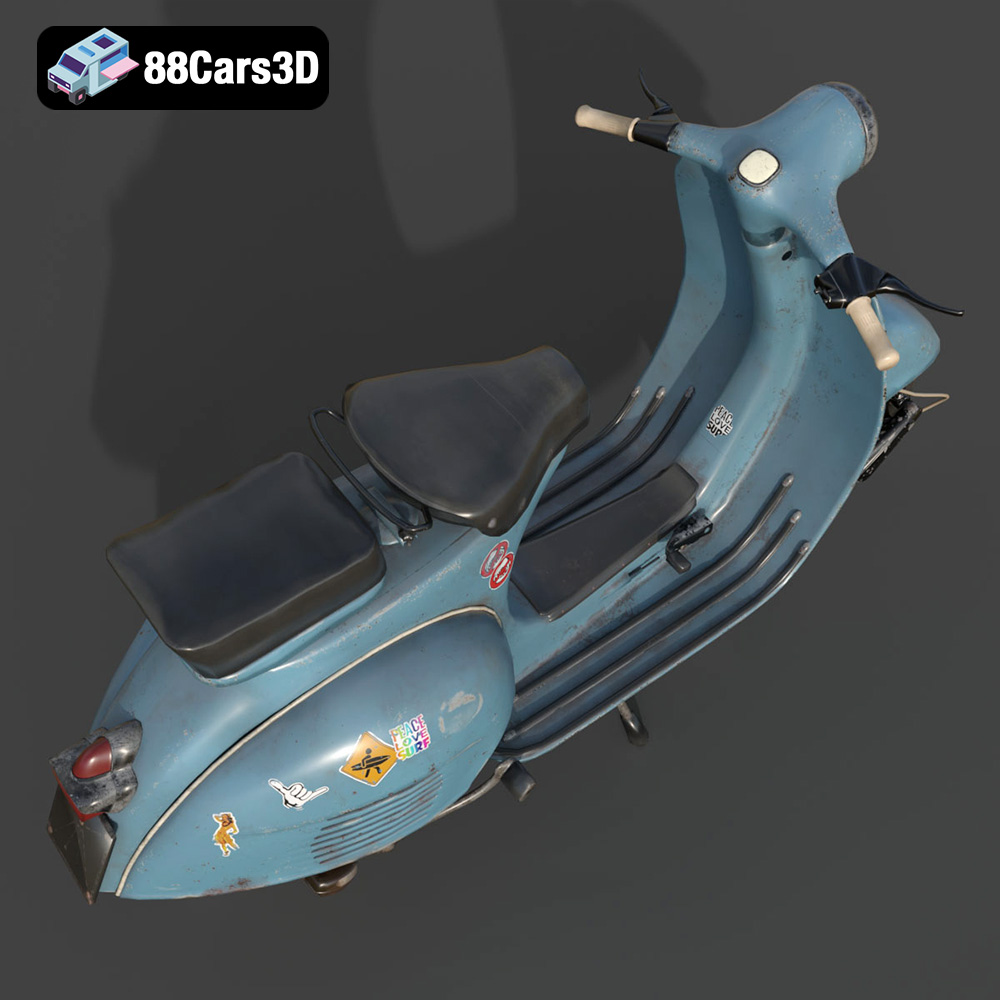
The core appeal of the Vintage Vespa 3D Model lies in its faithful recreation of the real-world scooter’s aesthetics and mechanics. Every curve of the pressed steel monocoque chassis, the distinctive sweeping side cowls, and the signature step-through frame has been accurately rendered. This includes the retro headlamp, the detailed engine side casing with its characteristic cooling fins, and the vintage exhaust system. The model extends this accuracy to the smaller, yet critical, components: the iconic round headlamp and taillight housing, the stamped steel wheels with classic tread tires, and even the signature single-sided trailing-link front suspension.
Inside the cockpit, the attention to detail continues. Artists will appreciate the authentic sprung saddle with its beautifully stitched details, the chrome tubular handlebar complete with iconic grips and switches, and the vintage analog instrument cluster. Even the original clutch and brake levers, alongside the twist-gear selector, are present, offering a complete and immersive representation. This level of detail ensures that whether the Vespa is viewed in a wide shot or a close-up, its authenticity remains undeniable, crucial for high-end automotive rendering and visualization projects.
Visual fidelity often comes at the cost of performance, especially in real-time environments. However, the Vintage Vespa 3D Model strikes a superb balance with its optimized topology, featuring approximately 150,000 triangles. This poly count is a sweet spot, delivering stunning visual realism without bogging down game engines like Unreal or Unity. Such optimization is critical for interactive experiences where smooth frame rates are paramount.
The versatility of the Vintage Vespa 3D Model, particularly its multi-format availability through 88cars3d.com, allows for seamless integration into a wide array of professional 3D workflows, catering to game development, architectural visualization, cinematic rendering, and immersive experiences.
For game developers, the Vintage Vespa is more than just a prop; it’s a dynamic asset designed for interaction and immersion. Its optimized polycount (~150,000 triangles) makes it ideal for real-time engines like Unreal Engine and Unity. When imported via .fbx or the dedicated .unreal format, developers can expect a model that is ready for immediate use.
Architectural visualization (ArchViz) artists, product designers, and marketing professionals rely on high-fidelity models for stunning, photorealistic renders. The Vintage Vespa 3D Model excels in this arena, offering the detail required for close-up shots and cinematic sequences.
Augmented Reality (AR) and Virtual Reality (VR) demand models that are both visually rich and extremely lightweight. The .glb format, included with the Vintage Vespa, is specifically designed for these emerging technologies.
The journey of a 3D model doesn’t always end on a screen. For enthusiasts, collectors, or even designers creating physical prototypes, the ability to 3D print an asset is a significant advantage. The Vintage Vespa 3D Model offers this capability through its included .stl format, opening up a world of tangible creations.
Converting a digital asset, especially one as detailed as this Vespa model, into a physical object requires careful consideration of 3D printing parameters. The .stl file provides the necessary geometric data for slicing software to interpret the model’s surface, defining how the printer will build it layer by layer. However, the quality of the print relies heavily on proper settings and preparation.
A successful 3D print is often just the beginning. Post-processing is where the model truly comes to life, mimicking the aesthetic of the original vehicle.
A premium 3D model like the Vintage Vespa isn’t just a static asset; it’s a foundation for boundless creativity. Its well-structured topology and material setup empower artists to personalize and integrate it into highly specialized projects, pushing the boundaries of realism and imaginative design.
The included file formats (especially .blend and .max) provide maximum flexibility for customization. This allows artists to adapt the model to specific project needs, whether it’s for historical accuracy, a futuristic reinterpretation, or a stylized game environment.
For artists aiming for absolute photorealism, the Vintage Vespa 3D Model provides an excellent base for implementing advanced rendering techniques.
In a competitive digital landscape, the distinction between a passable 3D asset and a truly professional-grade one is vast. For studios and individual artists, investing in high-quality 3D car models, such as the Vintage Vespa from 88cars3d.com, is not just about aesthetics; it’s about efficiency, reliability, and ultimately, delivering superior results.
Developing a complex vehicle model from scratch is an incredibly time-consuming and resource-intensive endeavor. It requires specialized skills in modeling, UV mapping, texturing, rigging, and optimization. By purchasing a pre-made, high-quality asset, professionals can bypass hundreds of hours of development time. This allows teams to focus their efforts on core project elements, such as level design, animation, coding, or scene composition, significantly accelerating project timelines and reducing overall costs.
Premium 3D models come with a guarantee of quality and consistency. They are meticulously crafted, optimized, and tested across various platforms. This means less time spent fixing topology errors, re-UV mapping, or re-configuring materials. Assets like the Vintage Vespa, with its balanced triangle count and properly set up pivots, ensure a predictable and high-quality result straight out of the box, maintaining a professional standard across all deliverables.
Paradoxically, pre-made assets can actually enhance creative freedom. With the foundational work already done to an exceptional standard, artists are liberated to experiment with customization, explore different visual styles, or focus on storytelling without being bogged down by technical modeling challenges. The versatile file formats provide the flexibility needed to adapt the model to unique creative visions, making it a springboard for innovation rather than a constraint.
The world of 3D modeling thrives on innovation and precision, and the role of high-quality assets in achieving stunning digital realities cannot be overstated. The Vintage Vespa 3D Model is a testament to this philosophy, offering an iconic piece of automotive history meticulously crafted for modern digital pipelines. Its combination of authentic design, optimized topology, and multi-format compatibility makes it an invaluable resource for game developers, visualization artists, AR/VR creators, and even 3D printing enthusiasts.
From powering immersive game environments and rendering photorealistic cinematic scenes to enabling interactive AR experiences and facilitating tangible 3D prints, this model embodies versatility. It simplifies complex workflows, saves precious development time, and provides a robust foundation for creative expression. For professionals seeking top-tier 3D car models and automotive rendering assets, 88cars3d.com stands as a reliable source for assets that truly empower creativity and elevate project quality. Embrace the timeless charm and technical excellence of the Vintage Vespa 3D Model, and let it drive your next digital masterpiece.
Capture the essence of Italian La Dolce Vita with this meticulously crafted Vintage Vespa 3D model. Celebrating decades of iconic design heritage, this classic scooter is immediately recognizable by its pressed steel monocoque chassis, beautifully sweeping side cowls, and signature step-through frame. From the authentic retro headlamp to the detailed engine side casing and vintage exhaust system, every element has been faithfully recreated to preserve the timeless elegance of this two-wheeled legend.Engineered for maximum versatility, this model features highly optimized topology with a balanced triangle count (~150,000 triangles), delivering stunning visual fidelity without compromising real-time performance. Whether you are building an interactive environment, rendering a highly realistic cinematic, or designing an immersive VR experience, this game-ready asset provides exceptional detail right out of the box.Perfect for urban environments, European street scenes, retro dioramas, and lifestyle visualizations.
$39.99
.blend
.fbx
.glb
.max
.obj
.ply
.rendering
.scooter
.stl
.unreal
.vespa
classic-scooter
game asset
game-ready
low-poly
motorcycle-3d-model
optimized
retro-vehicle
vintage-vespa
VR/AR