Get 20% OFF All Premium 3D & STL Models!

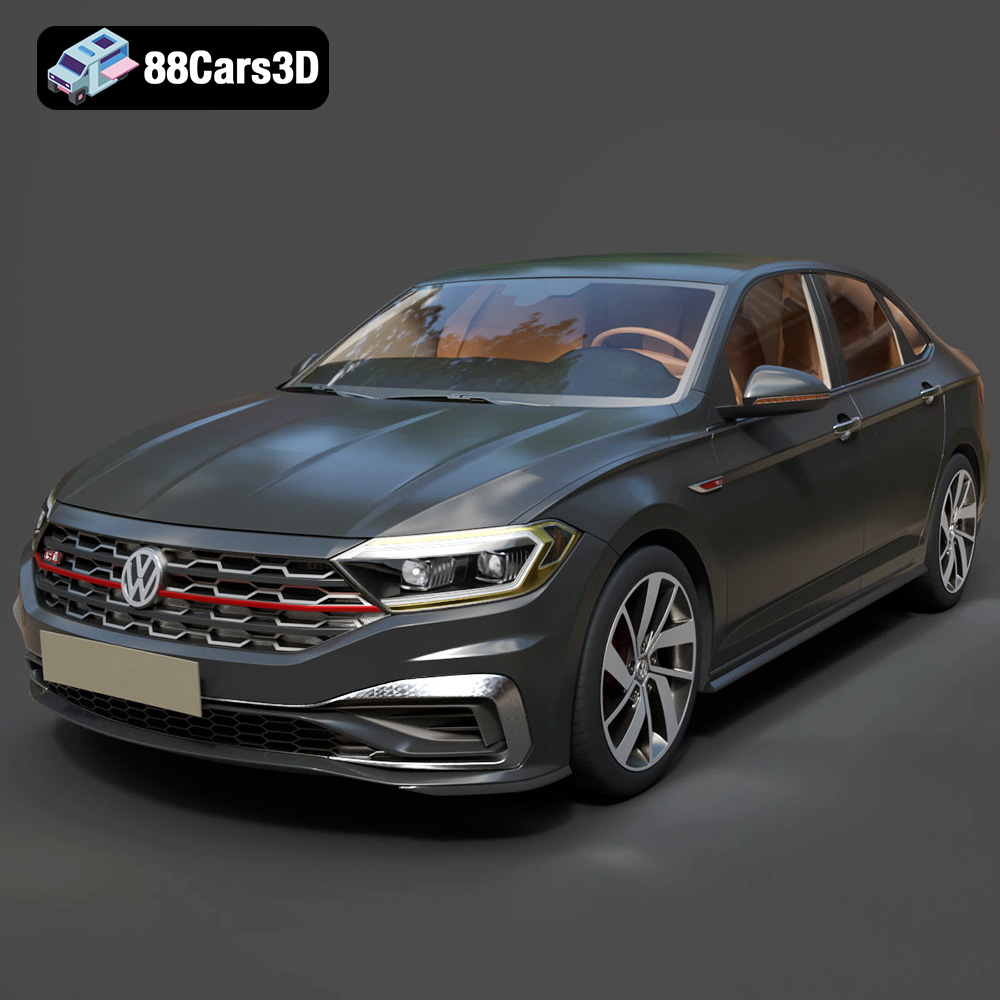
In the fast-evolving landscape of digital design, the demand for high-fidelity 3D assets is paramount. From breathtaking cinematic sequences to hyper-realistic gaming environments and cutting-edge architectural visualizations, a meticulously crafted 3D model can elevate a project from ordinary to extraordinary. Nowhere is this more evident than in the automotive sector, where precision and visual accuracy are non-negotiable. Imagine bringing a dynamic sports sedan, like the Volkswagen Jetta GLI 2019, to life in a virtual space—its aggressive stance, signature red accents, and detailed interior all replicated with stunning realism. This is precisely what professional 3D car models offer, serving as the foundational building blocks for a myriad of creative and technical endeavors.
Today, we delve into the intricate world of automotive 3D modeling, exploring its indispensable role across various industries. We’ll examine the technical specifications that define quality, the diverse file formats that facilitate compatibility, and how a prime example, the Volkswagen Jetta GLI 2019 3D Model, exemplifies the pinnacle of modern asset creation, enabling developers and artists to achieve unparalleled realism and performance.
Navigating the world of 3D modeling requires a solid understanding of the various file formats available, each tailored for specific use cases, software compatibility, and optimization needs. For complex 3D car models like the Volkswagen Jetta GLI 2019, having access to multiple formats ensures maximum versatility and seamless integration into diverse professional workflows. Let’s break down the essential formats typically provided by high-quality marketplaces like 88cars3d.com:
The .blend file is the native format for Blender, a powerful open-source 3D creation suite. When you download a .blend file, you’re not just getting the mesh; you’re getting the entire scene setup as it was created by the artist. This includes all materials, textures, lighting, camera setups, and often even animation rigs. For users primarily working in Blender, this format offers the highest degree of editability and control, allowing for deep customization, modification of the topology, tweaking of PBR materials, or re-rendering with different lighting conditions. It’s the go-to for artists who want to delve into the model’s core structure and integrate it natively into their Blender projects.
Autodesk’s .fbx (Filmbox) format is arguably the most widely adopted interchange format in the 3D industry, especially within game development. It excels at transferring 3D model data, including meshes, materials (often simplified or referenced), textures, animation, and rigging information, between different software applications. For real-time engines like Unreal Engine and Unity, .fbx is the standard. Its robust support for hierarchies and animation makes it perfect for game assets where components like wheels, suspension, and steering need to be animated independently. The Volkswagen Jetta GLI 2019 3D Model in .fbx ensures it’s instantly ready for import into these engines, often requiring minimal setup to get it driving or rendering efficiently.
The .obj (Wavefront OBJ) format is a venerable and widely supported option for transferring static 3D geometry between applications. It’s a text-based format that defines geometry (vertices, normals, texture coordinates, faces) and can reference external material (.mtl) files for basic color and texture information. While it doesn’t typically carry animation or rigging data, its universal compatibility makes it an excellent choice for archival purposes or for importing into virtually any 3D software package, from CAD programs to sculpting tools. It’s a reliable fallback when other formats present compatibility issues, ensuring that the core mesh data of models like the Jetta GLI is accessible everywhere.
.glb (GL Transmission Format Binary) is the binary version of glTF, a royalty-free specification for 3D scenes and models. Designed for efficient transmission and loading, .glb packages all necessary data (geometry, materials, textures, animations) into a single compact file. This makes it incredibly popular for web-based 3D viewers, AR/VR applications, and mobile experiences where file size and loading speed are critical. For showcasing the Volkswagen Jetta GLI 2019 in an interactive web configurator or an augmented reality app, .glb provides an optimized, high-performance solution with excellent visual quality.
The .stl (Stereolithography) format is the undisputed standard for 3D printing. It represents a 3D model as a collection of unconnected triangular facets, defining only the surface geometry without color, texture, or material properties. While not ideal for rendering or animation, it’s precisely what 3D printers need to slice a model into layers for physical fabrication. The Jetta GLI 2019 3D Model, when converted to .stl, becomes a blueprint for a tangible replica, allowing hobbyists and professionals to create physical prototypes or display pieces. It’s crucial for the mesh to be watertight (no holes) for successful STL exports.
The .ply (Polygon File Format, or Stanford Triangle Format) is another common format for storing 3D data, particularly useful for scanned data, point clouds, and precision meshes. It can store not only geometry but also color, transparency, and normal vectors per vertex or per face. While less common for general animation or game assets compared to FBX, it offers robust support for complex geometric data and can be a good choice for applications requiring highly accurate surface reconstruction, scientific visualization, or CAD integration where mesh integrity is paramount.
The .unreal format, or often a packaged asset within an Unreal Engine project, is a highly optimized version specifically prepared for the Unreal Engine. This typically means the model has already been imported, scaled, had its collision meshes generated, materials set up using Unreal’s PBR system, and potentially Lods (Levels of Detail) created. While not a standalone file type in the traditional sense like FBX, providing an “Unreal-ready” asset significantly accelerates the workflow for game developers, reducing the time spent on engine-specific setup and allowing immediate use of the Volkswagen Jetta GLI 2019 3D Model in their projects.
Similar to .blend for Blender, the .max file is the native project format for Autodesk 3ds Max, a leading software for modeling, animation, and rendering. An included .max file grants users full access to the original scene, including complex modifiers, intricate material setups (like V-Ray or Corona), lighting environments, and advanced rigging. For professionals entrenched in the 3ds Max ecosystem, this format offers unparalleled flexibility for high-end automotive rendering, creating sophisticated animations, or deep customization of the model for specific visualization needs.
The availability of these diverse formats for the Volkswagen Jetta GLI 2019 3D Model underscores its professional-grade quality and the commitment of marketplaces like 88cars3d.com to provide versatile solutions for every digital artist and developer.
When selecting a 3D car model, the devil is truly in the details. The Volkswagen Jetta GLI 2019 3D Model available on 88cars3d.com exemplifies the meticulous craftsmanship required for truly outstanding digital assets. It’s not just a generic car model; it’s a faithful digital twin, engineered for both visual fidelity and optimal performance across various applications.
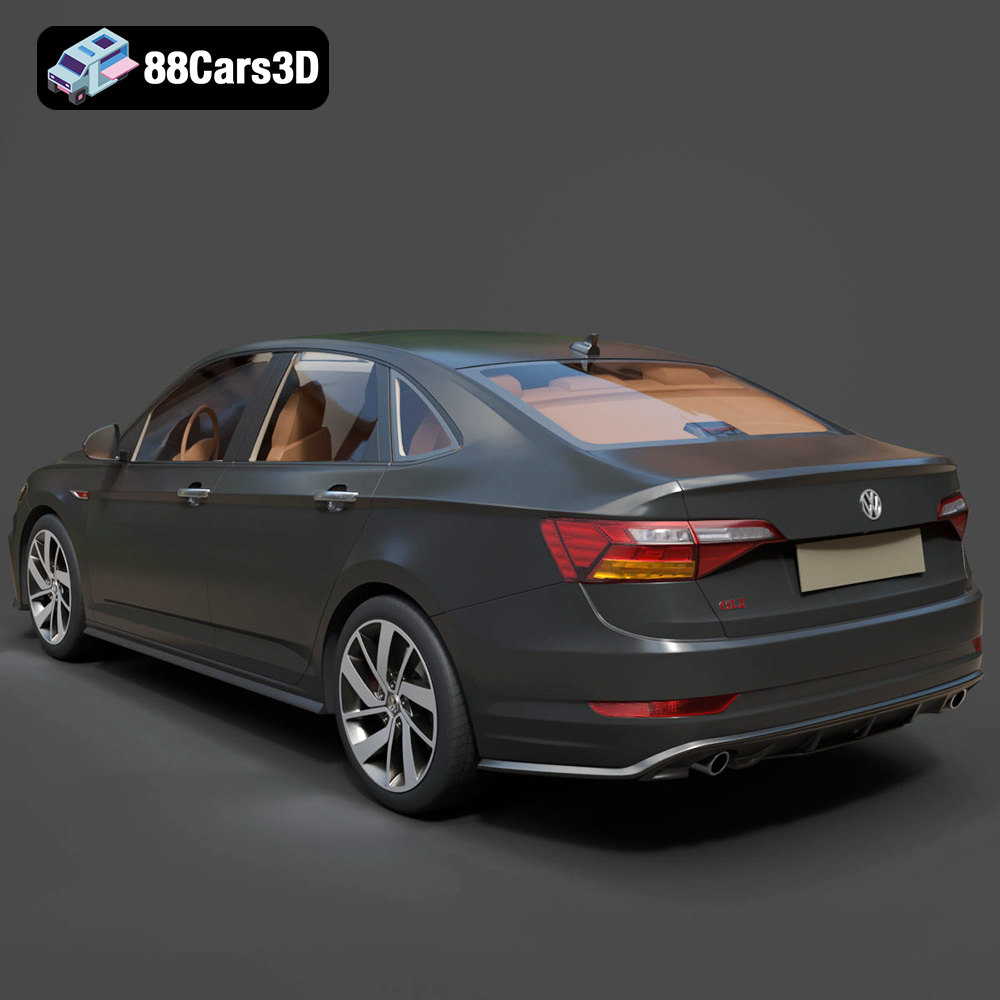
The exterior of the Jetta GLI 2019 is its most striking feature, and the 3D model captures every curve and aggressive line with topological accuracy. From the signature honeycomb grille with its iconic red accents to the sleek LED projector headlights and taillight clusters, no detail is overlooked. The model accurately represents the 2.0L TSI turbocharged 4-cylinder engine block, although primarily for visual representation rather than functional simulation. The sport-tuned dual exhaust system with chrome tips, the exclusive GLI alloy wheels featuring realistic performance tire treads, and even the detailed red brake calipers are all meticulously recreated. Crucially, components like the wheels, suspension, and steering are separate objects, properly pivoted for realistic animation and interactive control, a critical feature for any dynamic simulation or game.
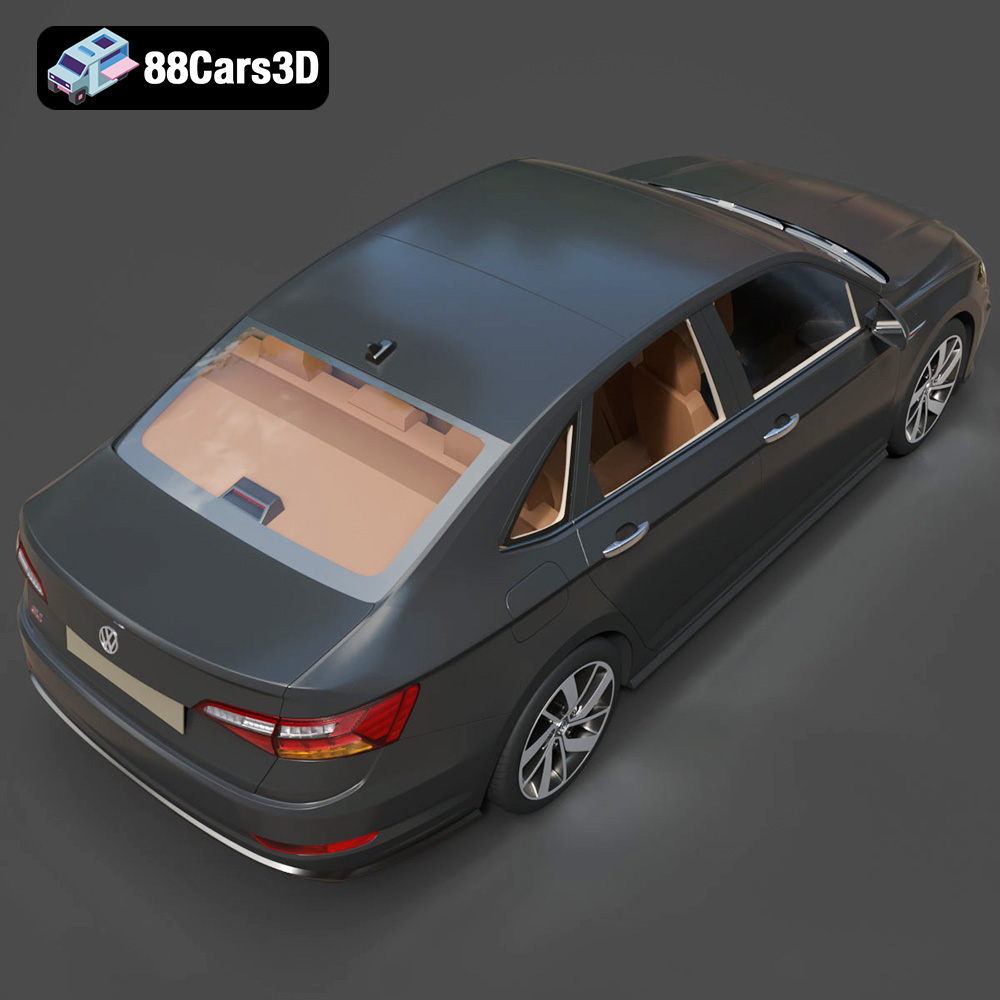
The immersive experience of a 3D car model extends far beyond its exterior. The interior of the Volkswagen Jetta GLI 2019 3D Model is equally detailed, providing an authentic cockpit environment. Sport seats with their distinctive red contrast stitching, the leather-wrapped flat-bottom sport steering wheel, and a modern digital cockpit with an infotainment instrument cluster are all accurately represented. Even the pedals, shift lever, and center console controls are modeled with precision, offering an optimized geometry ideal for first-person perspective (FPV) in gaming or for close-up interior renderings, ensuring a believable user experience whether the viewer is inside a game or a VR environment.
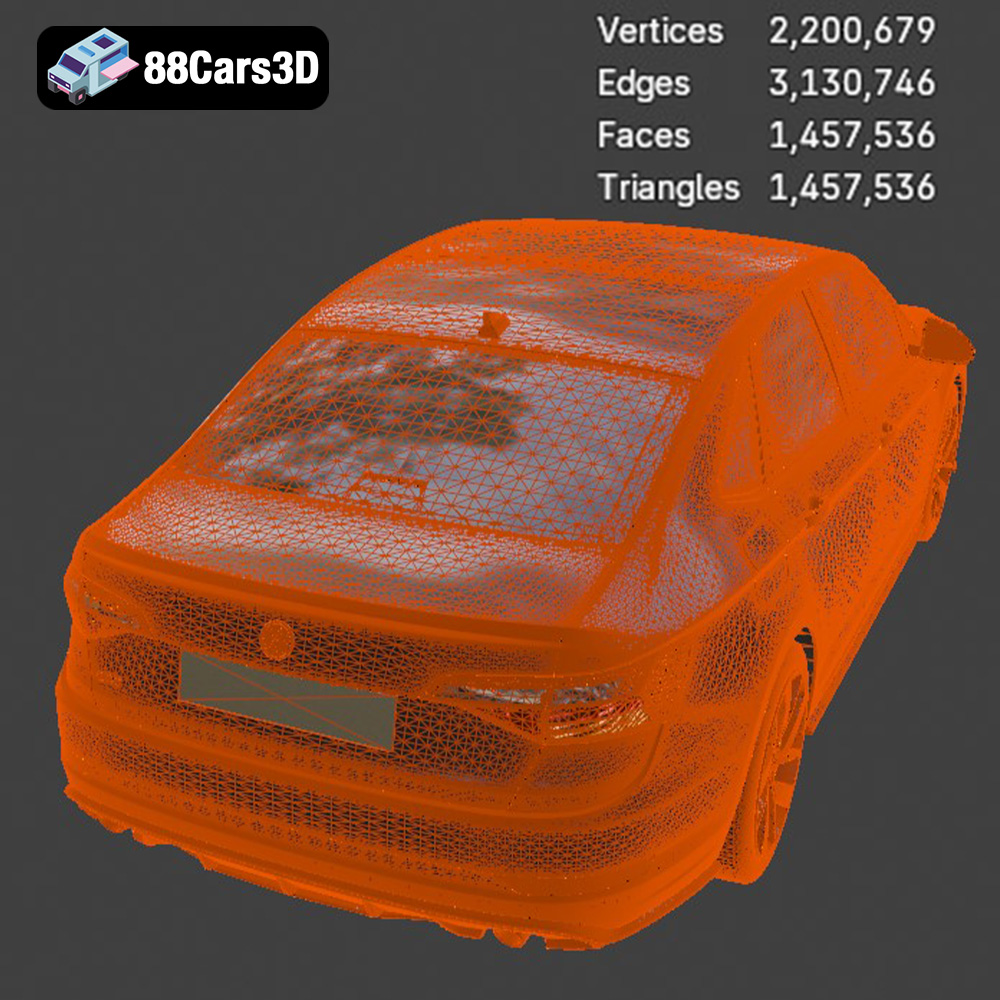
One of the most significant advantages of this specific 3D model is its “game-ready” optimization. With approximately 250,000 triangles, it strikes a perfect balance between high-end visual realism and efficient real-time performance. This polycount is ideal for modern game engines like Unreal and Unity, allowing for stunning visual fidelity without bogging down frame rates. The model is built to real-world scale based on actual vehicle chassis data, ensuring correct proportions and physics interpretation in simulations. Furthermore, the proper pivot setup for steering, wheel rotation, and suspension travel simplifies the animation process and ensures realistic movement dynamics, making it an invaluable asset for racing titles, open-world games, and automotive simulators.
A high-quality 3D model is only as useful as its ability to integrate seamlessly into diverse professional pipelines. The Volkswagen Jetta GLI 2019 3D Model, with its comprehensive file format support and optimized geometry, is designed for maximum utility across various industries.
For artists and studios specializing in high-end automotive rendering and animation, the .max and .blend formats provide native access to the model within their preferred software. In 3ds Max, users can fully exploit the detailed geometry to create photorealistic studio renders, animated advertisements, or product visualizations. They can easily modify PBR materials, add complex lighting setups with V-Ray or Corona, and rig the separate components for sophisticated driving animations. Similarly, Blender artists benefit from the complete scene file, enabling them to customize every aspect, from shader networks to environmental lighting, leveraging Blender’s powerful Cycles or Eevee render engines for stunning results. This flexibility makes the Jetta GLI model a cornerstone asset for any automotive visualization project, from commercial campaigns to concept presentations.
The game development industry demands assets that are not only visually impressive but also performant and easy to implement. With the .fbx and dedicated .unreal formats, the Volkswagen Jetta GLI 2019 3D Model is primed for Unreal Engine and Unity workflows. Importing the .fbx file into Unreal Engine allows developers to quickly set up vehicle physics, apply the detailed PBR materials, and integrate it into their game worlds. The optimized polycount ensures it runs smoothly, even in dense open-world environments or fast-paced racing simulators. Artists can leverage Unreal’s powerful cinematic tools to create cutscenes or use the model as a driveable vehicle asset, enhancing the realism and immersion of their games. This pre-optimized nature significantly reduces development time and resources, allowing teams to focus on gameplay and storytelling.
The immersive capabilities of Augmented Reality (AR) and Virtual Reality (VR) are transforming how we interact with products, especially in the automotive sector. The .glb format of the Jetta GLI model is perfectly suited for these applications. Developers can use it to create interactive virtual showrooms where customers can explore the car’s exterior and interior in a 360-degree environment, customize paint colors, or even “sit” inside the car in VR. For AR experiences, the model can be accurately superimposed onto real-world environments via a smartphone or tablet, allowing potential buyers to visualize the car in their driveway. These interactive automotive configurators empower businesses to provide engaging, pre-purchase experiences that drive customer interest and sales, leveraging the high-quality 3D car models from resources like 88cars3d.com.
While digital rendering and real-time applications are primary uses for 3D car models, the tangible world of 3D printing opens up another exciting dimension. The Volkswagen Jetta GLI 2019 3D Model, with its .stl compatibility, bridges the gap between digital design and physical reality, allowing enthusiasts and professionals to create physical replicas.
When preparing the Jetta GLI model for 3D printing, especially for display-scale hobbyists, specific considerations are crucial. The recommended scales of 1:12, 1:18, or 1:24 offer a good balance between manageable print size and retaining fine details. For achieving the best results, especially with intricate elements like the grille, wheels, and interior, resin printing (SLA/DLP) is highly recommended over FDM printing. Resin printers can achieve significantly finer layer heights (0.04–0.12 mm) and smoother surface finishes. Optimal wall thickness should be maintained between 1.2–2.0 mm to ensure structural integrity without excessive material usage. An infill of 20–30% typically provides enough strength for display models.
Successful 3D printing is often followed by a crucial post-processing stage. The Jetta GLI model will require supports for detailed parts such as the exhaust system, mirrors, and potentially the steering wheel if printed separately. Careful support removal is essential to avoid damaging fine features. The recommended print orientation involves printing the main frame angled for improved structural integrity and minimizing visible layer lines on prominent surfaces, while wheels and smaller parts are often best printed separately for maximum detail and easier painting. After printing, sanding and priming are vital steps to smooth out any layer lines or imperfections. Finally, applying authentic factory colors with metallic finishes can transform a raw print into a stunning, true-to-life replica, making the physical Volkswagen Jetta GLI 2019 3D Model a standout piece in any collection.
A truly professional 3D asset provides not just a static model but a flexible foundation for creative expression. The Volkswagen Jetta GLI 2019 3D Model offers extensive customization options, allowing artists and developers to adapt it to the specific needs and aesthetic of their projects.
The high-quality PBR (Physically Based Rendering) materials included with the Jetta GLI model are designed for easy modification. Users can effortlessly change body colors, experimenting with factory shades, custom paints, or unique finishes like matte, gloss, or metallic effects. This is crucial for branding, product visualization, or ensuring the vehicle fits perfectly within a game’s art style. Beyond the body, tire textures can be swapped or modified to represent different variants, such as off-road or high-performance street tires, adding another layer of visual customization and narrative potential.
The versatility of this 3D model extends to how it interacts with its environment. Artists can easily adapt the lighting to simulate various conditions—from a bright, sunny outdoor scene to a dramatic, moody studio setup or a gritty urban night scene. The proper pivot setup and real-world scale also mean the model responds realistically to environmental reflections and shadows, enhancing overall realism. Whether it’s for an architectural visualization project requiring a car to complement a building design, or a game environment that needs a vehicle to react dynamically to changing light conditions, the Jetta GLI 2019 3D Model stands ready to be integrated and customized to perfection, providing a robust and adaptable asset for any creative challenge.
The world of digital content creation is continually pushing the boundaries of realism and immersion. At the heart of this advancement lies the demand for exquisitely detailed and technically sound 3D assets. The Volkswagen Jetta GLI 2019 3D Model stands as a prime example of such an asset, meticulously crafted to serve a multitude of professional applications. Its optimized geometry, comprehensive PBR materials, and broad file format compatibility ensure it’s not just a beautiful render but a powerful tool for game developers, visualization artists, AR/VR creators, and even 3D printing enthusiasts.
From animating realistic driving sequences in 3ds Max or Blender to populating vast open-world games in Unreal Engine, or showcasing an interactive product in AR, this model delivers both aesthetic appeal and robust technical performance. The availability of diverse formats like .blend, .fbx, .obj, .glb, .stl, .ply, .unreal, and .max makes it an incredibly versatile choice, streamlining workflows and empowering creators. Investing in high-quality 3D car models like the Jetta GLI from trusted sources such as 88cars3d.com is not merely acquiring a digital file; it’s investing in efficiency, realism, and the limitless potential of your creative projects. Elevate your next project with a model that truly embodies precision and performance.
The Volkswagen Jetta GLI 2019 combines everyday practicality with thrilling performance, standing out as a premier sports sedan in its class. Known for its GTI-borrowed turbocharged engine, aggressive honeycomb grille with iconic red accents, and sleek aerodynamic profile, this vehicle strikes the perfect balance between track-ready styling and modern sophistication. From its distinctive front fascia to the dual exhaust setup, every element of this athletic sedan has been meticulously captured. This meticulously crafted 3D model features game-ready optimization with approximately 250,000 triangles, ensuring high-end visual fidelity without compromising real-time performance in modern engines. With stunning topological accuracy and highly detailed PBR materials, it provides unmatched realism for close-up shots and gameplay alike. Perfect for immersive racing simulators, urban environment open-world games, high-end architectural visualizations, and interactive automotive configurators.
$39.99
.2019
.blend
.fbx
.glb
.max
.obj
.ply
.rendering
.sedan
.stl
.unreal
.volkswagen
car-3d-model
game asset
game-ready
jetta-gli
low-poly
optimized
sports-sedan
VR/AR