Get 20% OFF All Premium 3D & STL Models!

In the dynamic worlds of automotive design, game development, architectural visualization, and marketing, the demand for hyper-realistic and technically precise 3D car models has never been higher. These digital assets are the bedrock upon which immersive experiences, compelling advertisements, and groundbreaking simulations are built. From showcasing a vehicle’s sleek aerodynamics in a virtual showroom to populating the bustling streets of an open-world game, the quality of your 3D model directly impacts the fidelity and impact of your final product.
At the forefront of this evolution stands assets like the BMW X3 2024 3D Model Download STL FBX OBJ GLB Blend. This particular model exemplifies the meticulous craftsmanship and technical optimization required to meet the rigorous demands of professional pipelines. It’s more than just a digital representation; it’s a versatile tool designed to integrate seamlessly into diverse applications, offering both visual brilliance and performance efficiency. Whether you’re a game developer striving for authentic vehicle physics, an architect envisioning a new urban landscape, or a marketer crafting the next generation of visual campaigns, understanding the nuances of high-quality 3D car models is paramount.
The choice of file format for a 3D model is far more than a simple preference; it’s a critical decision that dictates compatibility, functionality, and performance across different software, engines, and applications. Professional 3D artists and developers must be intimately familiar with these distinctions to ensure their assets can be seamlessly integrated and leveraged effectively. The BMW X3 2024 3D Model, for instance, is offered in a comprehensive suite of formats, each serving specific purposes within the industry.
The .blend format is native to Blender, a powerful open-source 3D creation suite. When you download a .blend file, you’re not just getting the mesh; you’re receiving a complete Blender scene. This includes all geometry, materials (with node setups for Cycles or Eevee), textures, lighting, cameras, rigging, and animation data. It’s the ideal format for artists who primarily work in Blender and require full editability of every component. For automotive rendering specialists, the .blend file allows for deep customization, from adjusting material shaders for paint reflectivity to modifying interior fabric textures or even tweaking the vehicle’s geometry for bespoke design iterations.
Developed by Autodesk, the .fbx (Filmbox) format is an industry standard for interoperability, particularly prevalent in game development and animation. It’s highly robust for transferring 3D models, animation, and scene data between different software applications like 3ds Max, Maya, Blender, and major game engines like Unreal Engine and Unity. .fbx excels at preserving hierarchies, pivot points, skinning, and blend shapes, making it perfect for game assets like the BMW X3 2024 3D Model where wheel rotations, suspension travel, and steering animations are crucial. Its efficient handling of complex scenes with multiple objects and animations makes it a go-to for game-ready assets.
The .obj (Wavefront Object) format is one of the oldest and most universally supported 3D file formats. It’s a simple, text-based format that primarily stores geometry (vertices, normals, texture coordinates, and faces) and references to external material (.mtl) and texture files. While it doesn’t support animation or rigging, its widespread compatibility makes it an excellent choice for basic mesh transfer between virtually any 3D software. For artists needing a clean, straightforward mesh for sculpting, texturing in external applications like Substance Painter, or for general cross-software use, the .obj version of a 3D car model offers maximum flexibility.
The .glb (GL Transmission Format Binary) is the binary version of .gltf and is rapidly becoming the standard for 3D web content, augmented reality (AR), and virtual reality (VR) applications. It encapsulates everything into a single file: geometry, materials (PBR ready), textures, animations, and even scene hierarchy. This “single file delivery” model makes .glb incredibly efficient for loading and displaying 3D models in browsers, mobile devices, and immersive environments. For showcasing the BMW X3 2024 3D Model in a mobile AR configurator or an online virtual showroom, .glb is the definitive choice due to its optimization and ease of deployment.
The .stl (Standard Tessellation Language) format is the cornerstone of 3D printing. It describes only the surface geometry of a 3D object as a collection of triangles, without any color, texture, or material information. While it may seem simplistic, this format is universally understood by 3D printers and slicing software. For hobbyists or professionals looking to create a physical scale model of the BMW X3 2024 3D Model, the .stl file is essential. Careful preparation, including checking for manifold geometry and appropriate scaling, is crucial for successful prints.
The .ply (Polygon File Format) is often used for storing 3D data from 3D scanners, CAD software, and scientific applications. It can store a wide range of properties for each vertex and face, including color, transparency, surface normals, and texture coordinates. While less common for general artist workflows than .fbx or .obj, it’s valuable for applications requiring high precision or direct translation from point cloud data. For specialized analysis or integration into CAD systems, the .ply variant of the BMW X3 2024 3D Model provides robust data integrity.
The .unreal format isn’t a standalone file type in the traditional sense, but rather denotes an asset specifically optimized and configured for direct import and use within Unreal Engine. This often implies that the .fbx or other base mesh has been pre-processed, materials set up with Unreal’s Physically Based Rendering (PBR) system, collision meshes generated, and sometimes even basic blueprints for vehicle physics are included. For game developers, receiving an “Unreal-ready” version of the BMW X3 2024 3D Model significantly reduces setup time, allowing for immediate integration into real-time environments without extensive re-configuration.
Similar to .blend, the .max format is native to Autodesk 3ds Max, a leading software for 3D modeling, animation, and automotive rendering. A .max file contains the entire scene data, including geometry, materials (V-Ray, Corona, Arnold), lighting setups, cameras, modifiers, and animation data. It’s the preferred format for professionals whose primary workflow revolves around 3ds Max, offering the highest degree of editability and control over the asset. This is especially useful for complex studio renders, creating detailed car animations, or integrating the BMW X3 2024 3D Model into intricate architectural visualization scenes.
Creating a truly exceptional 3D car model is a blend of artistic precision and technical mastery. It demands an understanding of industrial design, meticulous attention to detail, and a deep knowledge of 3D software and optimization techniques. A premium asset, like the BMW X3 2024 3D Model available on 88cars3d.com, encapsulates these principles, providing a foundation for stunning visual projects.
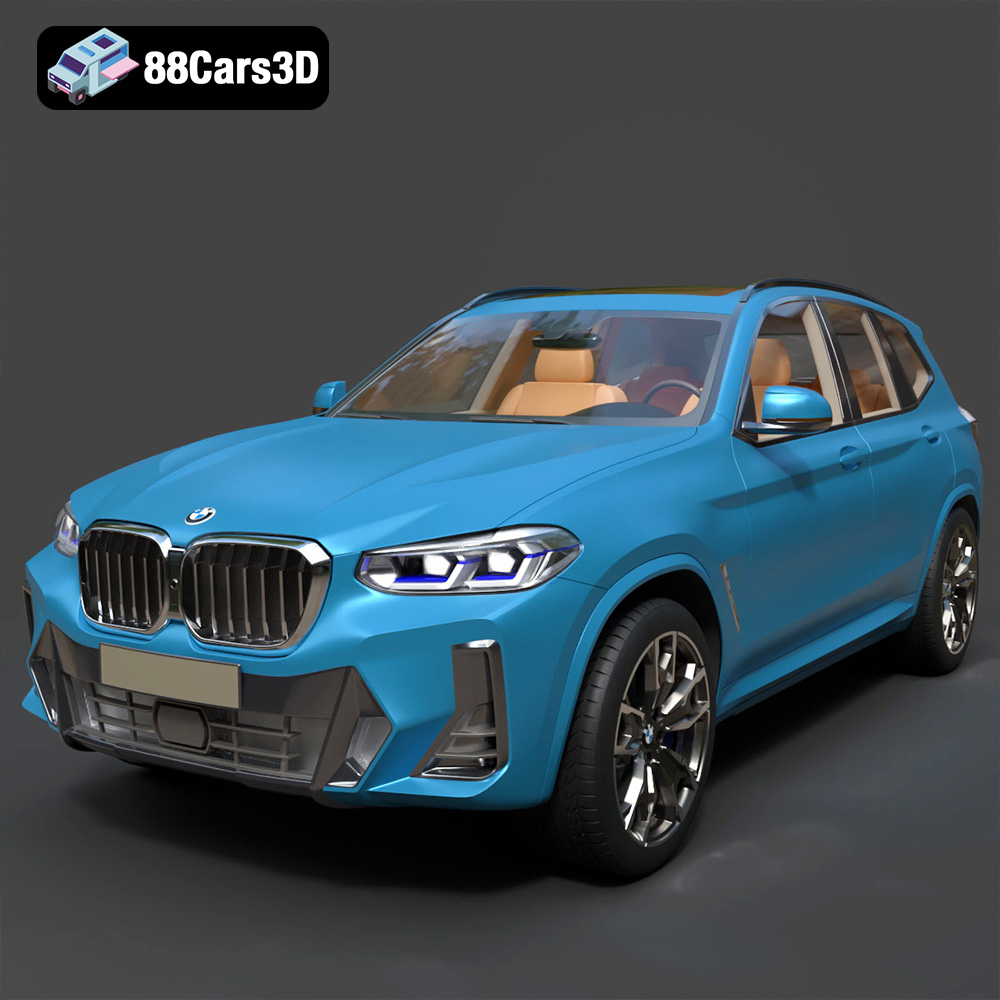
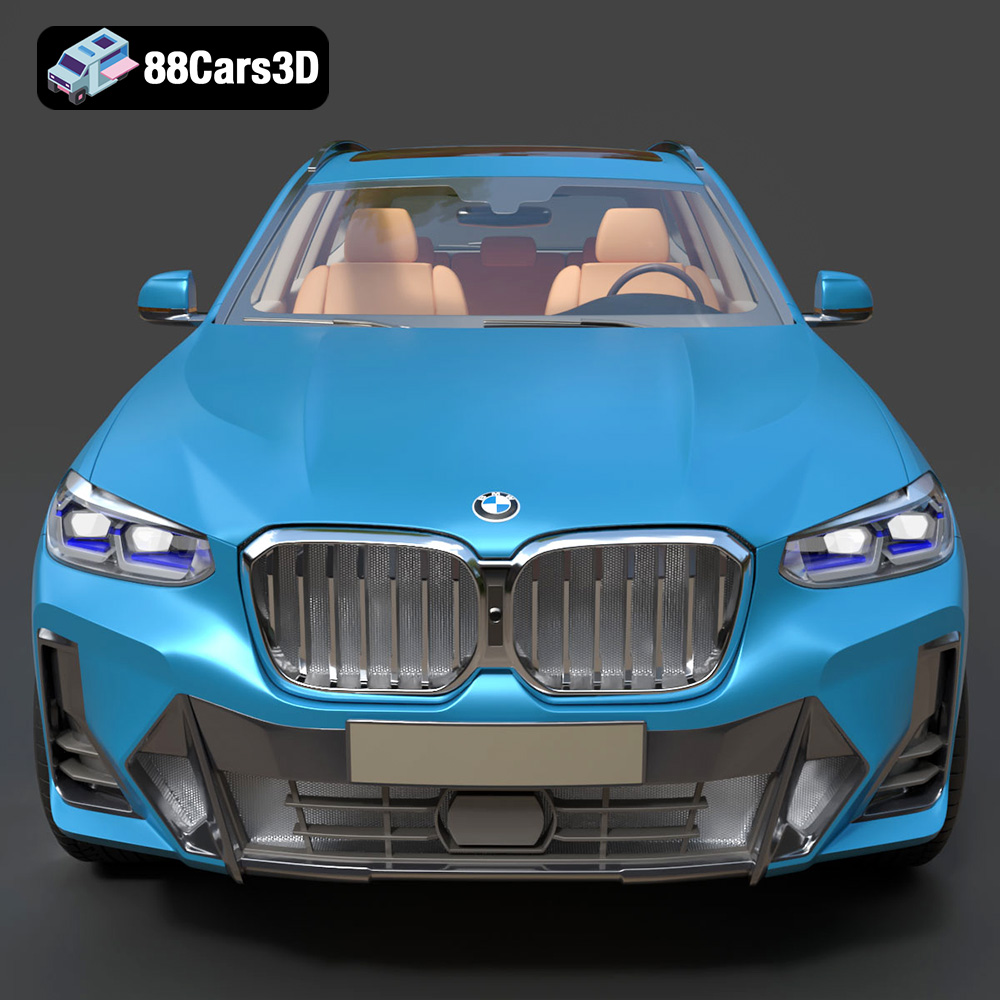
The initial impact of any 3D car model comes from its exterior. Replicating the confident stance and sharp aerodynamic profile of a real-world vehicle requires painstaking accuracy. The BMW X3 2024 3D Model showcases this with its accurate frame geometry and dynamic proportions. Details such as the signature BMW kidney grille, high-definition LED headlight clusters, distinctive 3D taillights, and the integrated twin dual-exhaust system are not just modeled; they are faithfully recreated to reflect the true heritage of BMW’s design language. Even the muscular wheel arches and the meticulously recreated alloy wheels with realistic tire treads contribute significantly to the model’s authenticity, making it ideal for high-end automotive rendering.
Beyond the gleaming exterior, the interior of a vehicle 3D model is crucial, especially for applications like virtual showrooms, AR experiences, or first-person perspectives in games. The BMW X3 2024 3D Model doesn’t cut corners here, featuring premium contoured seat details with realistic stitching patterns, an accurate multifunctional steering wheel, and a detailed central column. The high-resolution digital instrument cluster and infotainment screen integration, along with precise control details like the gear selector, pedals, and center console buttons, ensure a fully immersive experience. Optimized geometry for first-person POV makes this model particularly valuable for game assets where player interaction with the interior is expected.
Visual fidelity must often be balanced with performance, especially for real-time applications. The BMW X3 2024 3D Model achieves this balance through an optimized topology of approximately 250,000 triangles. This poly count is a sweet spot, providing sufficient detail for hyper-realistic visuals without overburdening game engines or rendering pipelines. Such optimized geometry is critical for game-ready assets, ensuring smooth frame rates and efficient resource utilization in environments like Unreal Engine and Unity. Furthermore, the model’s real-world scale accuracy, based on actual vehicle chassis dimensions, and proper pivot setup for steering, wheel rotation, and suspension travel, are fundamental for realistic physics and animation.
The true value of a high-quality 3D car model lies in its utility across a diverse range of professional applications. From the iterative cycles of game development to the demanding standards of commercial advertising, these assets serve as indispensable building blocks. The BMW X3 2024 3D Model provides an excellent example of how a versatile asset can streamline various workflows.
For game developers, integrating a vehicle means more than just dropping a mesh into a scene. It requires an optimized asset that performs efficiently, supports realistic physics, and allows for dynamic interactions. The BMW X3 2024 3D Model, with its 250,000 triangle count, is perfectly suited for modern game engines like Unreal Engine and Unity. Its ‘game-ready’ status means that the geometry is clean, UVs are properly unwrapped for texturing, and pivot points are correctly set for accurate steering, wheel rotation, and suspension travel. This allows developers to focus on gameplay mechanics and environmental design, knowing that their game asset will behave realistically and look stunning in racing titles, open-world adventures, or driving simulators. The availability in .fbx and .unreal formats directly supports these pipelines.
In the realm of automotive rendering and architectural visualization, visual fidelity is paramount. Marketing campaigns, product configurators, and architectural walkthroughs demand photorealistic results. The BMW X3 2024 3D Model excels here, providing the detail necessary for captivating studio shots and lifestyle scenes. Artists can leverage the .max and .blend files to work within 3ds Max or Blender, utilizing advanced rendering engines like V-Ray, Corona, or Cycles. This allows for precise control over materials, lighting, and camera angles to produce breathtaking images. Imagine this X3 model parked in a beautifully rendered architectural scene or featured prominently in a luxury advertisement – the possibilities are endless. Resources like 88cars3d.com provide artists with such premium starting points, significantly cutting down production time.
Augmented Reality (AR) and Virtual Reality (VR) are transforming how we interact with products, offering immersive showrooms and interactive configurators. The BMW X3 2024 3D Model is an ideal candidate for these cutting-edge applications, especially with its optimized geometry and .glb format. The efficient nature of the .glb file ensures quick loading times and smooth performance on mobile devices and VR headsets, critical for maintaining high frame rates and preventing user discomfort. Developers can create compelling virtual showrooms where users can explore the X3’s interior and exterior, change colors, or even “place” the car in their real-world environment using AR. These interactive experiences offer a powerful way for brands to engage with potential customers and showcase their products in a novel, memorable fashion.
Beyond digital screens, 3D models are increasingly bridging the gap to the physical world through additive manufacturing. The ability to translate a digital design into a tangible object has opened new avenues for prototyping, display models, and even custom components. High-quality 3D car models, like the BMW X3 2024 3D Model, are perfectly positioned to benefit from this technology, offering opportunities for hobbyists and professionals alike to create physical replicas.
Converting a high-detail rendering model into a 3D printable file requires specific considerations. The .stl format is the standard for 3D printing, defining the geometry as a series of interconnected triangles. The BMW X3 2024 3D Model is available in .stl, allowing direct compatibility with 3D printers. Key print settings recommended for this model include scales like 1:12, 1:18, or 1:24 for display purposes. Layer height between 0.04–0.12 mm is suggested, with resin printing often recommended for capturing the fine details of the X3’s exterior and interior. Proper wall thickness (1.2–2.0 mm) and infill (20–30%) are critical for structural integrity, while supports are necessary for intricate parts such as the exhaust system, mirrors, and specific interior elements. Printing the frame angled and wheels separately is a common practice to optimize structural strength and detail resolution.
Once a 3D print is complete, the journey to a high-quality physical model is far from over. Post-processing is an art form in itself. This involves careful sanding to remove layer lines, applying primer to create a smooth, uniform surface, and then meticulously painting the model with authentic factory colors, often incorporating metallic finishes to mimic the real BMW X3. This process can transform a raw 3D print into a stunning, display-quality replica. For car enthusiasts, model builders, or even automotive design students, having access to an accurate and optimized 3D car model like the one found on 88cars3d.com provides an invaluable head start for creating truly impressive physical projects.
One of the most significant advantages of working with high-quality 3D car models is their inherent flexibility and customization potential. A well-constructed asset isn’t just a static representation; it’s a dynamic canvas upon which artists and designers can unleash their creativity, adapting the model to countless scenarios and artistic visions.
The ability to modify materials and textures is fundamental to integrating a 3D model into diverse projects. With the BMW X3 2024 3D Model, artists have the freedom to change body colors, experimenting with a spectrum of factory hues or entirely custom finishes to match a specific brand identity or artistic mood. Beyond the primary body, tire textures can be swapped between off-road variants for rugged scenes or street-specific treads for urban environments. Adjusting material finishes—from a sleek gloss to a sophisticated matte or a shimmering metallic—can dramatically alter the vehicle’s perceived luxury and character. This level of control over visual properties ensures that the automotive rendering perfectly aligns with the project’s requirements, whether it’s a realistic simulation or a stylized artistic piece.
A 3D car model never exists in a vacuum; its perceived realism is heavily influenced by the environment and lighting it inhabits. High-quality assets are designed to respond realistically to various lighting conditions, allowing creators to adapt the model for different environments seamlessly. Imagine the BMW X3 2024 3D Model bathed in the warm glow of a sunset, cruising under the stark midday sun, or illuminated by the artificial lights of a studio setup. Each scenario demands unique lighting adjustments to evoke the desired mood and highlight the car’s features. Furthermore, the model can be integrated into vast digital landscapes, cityscapes, or futuristic concepts, serving as a focal point or an integral element of a larger narrative. The versatility provided by models from 88cars3d.com empowers creators to tell compelling stories and craft visually stunning experiences across all mediums.
The journey through the world of advanced 3D modeling reveals that the creation and utilization of premium 3D car models are pivotal to innovation across various industries. From the meticulous detail required for automotive rendering to the performance optimization demanded by game assets, the technical intricacies are profound. The BMW X3 2024 3D Model stands as a testament to this, embodying the perfect balance of visual fidelity, technical precision, and versatile compatibility across a range of file formats.
Whether you are developing the next generation of open-world games with realistic driving dynamics, crafting an immersive AR/VR experience for a virtual car showroom, producing high-impact marketing visuals, or even bringing a digital design to life through 3D printing, the foundational quality of your 3D asset is non-negotiable. Investing in well-engineered models not only elevates the quality of your output but also significantly streamlines your workflow, allowing more time for creative iteration and project refinement.
As the digital landscape continues to evolve, the demand for such high-caliber assets will only intensify. For professionals seeking to push the boundaries of visual realism and interactive experiences, exploring a curated selection of premium 3D models, such as those offered by 88cars3d.com, is an essential step towards achieving unparalleled results. Embrace the power of precision and drive your projects forward with models designed for excellence.
The BMW X3 is the epitome of the premium compact luxury SUV, combining sporty driving dynamics with versatile, everyday practicality. This exceptionally detailed 3D model captures its confident stance, sharp aerodynamic profile, and the iconic, aggressive kidney grille paired with sleek LED lighting elements. Every visual cue, from the muscular wheel arches to the integrated exhaust system, reflects the true heritage of BMW’s ultimate driving machines. Engineered with an optimized topology of approximately 250,000 triangles, this game-ready asset delivers high-end visual fidelity without compromising real-time performance. Its meticulously structured geometry ensures seamless integration into major game engines like Unreal Engine and Unity, providing both efficiency and hyper-realistic detail. Perfect for open-world racing games, architectural visualization, immersive VR showrooms, and high-end brand rendering.
$19.99
.2024
.blend
.bmw
.fbx
.glb
.luxury suv
.max
.obj
.ply
.rendering
.stl
.unreal
.x3
car-3d-model
game asset
game-ready
low-poly
optimized
SUV
VR/AR