Get 20% OFF All Premium 3D & STL Models!

In the dynamic world of 3D modeling, where precision meets artistry, the demand for high-quality, versatile assets is paramount. Whether you’re crafting a breathtaking automotive rendering, designing an immersive virtual reality experience, or populating the sprawling landscapes of a next-generation game, the foundation of your project lies in the fidelity and optimization of your 3D models. Iconic vehicles, with their rich history and distinctive aesthetics, offer not just visual appeal but also a narrative depth that can elevate any digital creation.
Among these timeless designs, few capture the spirit of an era quite like the Vintage Vespa. Its elegant curves, functional charm, and quintessential “La Dolce Vita” essence make it a beloved subject for artists and developers alike. A meticulously crafted 3D model of such a vehicle isn’t merely a static object; it’s a gateway to storytelling, a vital component for believable environments, and a testament to the power of detailed digital craftsmanship. This article delves into the intricacies of integrating premium 3D car models into professional workflows, using a high-quality Vintage Vespa 3D model as our prime example, and exploring the technical considerations that empower creators across various industries. From understanding crucial file formats to leveraging optimized geometry for real-time performance, we’ll navigate the landscape of modern 3D production, highlighting how assets from platforms like 88cars3d.com can transform your projects.
The choice of a 3D model file format is far more than a technicality; it’s a strategic decision that impacts compatibility, performance, and workflow efficiency. Different formats are optimized for specific use cases, ranging from highly editable scene files to universal exchange formats and specialized outputs for real-time engines or 3D printing. Understanding their strengths and limitations is crucial for any professional working with 3D car models or other complex assets.
The .blend format is native to Blender, the increasingly popular open-source 3D creation suite. A .blend file is a complete scene package, containing not just the mesh data for the Vintage Vespa, but also its materials, textures, lighting, cameras, animations, rigging, and even custom scripts. This makes it an incredibly powerful format for artists working entirely within Blender, offering full editability and control over every aspect of the model. For users acquiring a .blend file, it means immediate access to the creator’s exact setup, often allowing for easier customization and scene integration without tedious re-setup of materials or hierarchies.
As Autodesk’s proprietary format, .fbx (Filmbox) has become an undisputed industry standard for exchanging 3D data between different software applications. It excels at preserving complex scene information, including mesh data, materials, textures, animation, skeletal rigging, and even camera and lighting data, albeit with varying degrees of fidelity depending on the receiving software. For game development, .fbx is often the go-to format for importing assets like the Vintage Vespa into engines like Unreal Engine and Unity, due to its robust support for animation and scene hierarchy. Its widespread adoption ensures reliable data transfer across diverse pipelines.
The .obj (Wavefront OBJ) format is one of the oldest and most widely supported 3D file formats. It’s a simple, text-based format primarily used for geometric data (vertices, normals, texture coordinates) and references to external material files (.mtl). While it doesn’t support animation or rigging, its universality makes it an excellent choice for basic mesh exchange when maximum compatibility is required. If you need to import the Vintage Vespa’s geometry into virtually any 3D software without worrying about complex features, .obj is a dependable choice. It’s often used as a fallback or for models where only the static mesh is needed.
.glb (GL Transmission Format Binary) is the binary version of glTF, a royalty-free specification for the efficient transmission and loading of 3D scenes and models by applications. It packages mesh data, materials, textures, and animations into a single, compact file. .glb is specifically optimized for web-based 3D, augmented reality (AR), and virtual reality (VR) applications, offering fast loading times and efficient rendering. For showcasing the Vintage Vespa in a browser-based configurator, an AR app on a mobile device, or an interactive VR showroom, .glb is the ideal format, delivering rich visuals with minimal overhead.
.stl (STereoLithography) is the de facto standard file format for 3D printing. It represents a 3D model as a series of connected triangles, defining only the surface geometry of an object without color, texture, or other properties. While lacking visual richness, its simplicity is perfect for manufacturing. When preparing the Vintage Vespa for physical production, converting it to .stl is the crucial step. The product description highlights its suitability for display-scale hobbyists and even provides recommended print settings, demonstrating its utility beyond digital screens.
.ply (Polygon File Format) is another format for storing 3D data, particularly known for its ability to store properties such as color, transparency, and range data in addition to geometry. It’s often used in scientific and engineering applications, such as 3D scanning, where precise mesh data with additional vertex properties is important. While less common for general artistic asset exchange compared to .fbx or .obj, its presence alongside the Vintage Vespa model indicates its readiness for more specialized applications, potentially for detailed analysis or integration into CAD-like pipelines.
While not a standalone file extension in the traditional sense, “.unreal” often refers to assets that are packaged and optimized specifically for direct import and use within Unreal Engine. This typically means an .fbx file that has been carefully prepared with proper materials, UVs, collision meshes, and pivot points to conform to Unreal’s specifications, often with pre-configured LODs (Levels of Detail). For the Vintage Vespa, an “Unreal-ready” asset implies it’s been tested and tuned for optimal performance and visual fidelity within the engine, minimizing import issues and maximizing developer efficiency, making it a true game asset.
Similar to .blend for Blender, .max is the native file format for Autodesk 3ds Max, a powerful 3D modeling, animation, and rendering software widely used in architectural visualization, automotive design, and film/TV production. A .max file encapsulates the entire scene, offering full editability. For professionals whose primary workflow revolves around 3ds Max, acquiring the Vintage Vespa in this format provides the highest level of control and allows for seamless integration into existing projects, leveraging 3ds Max’s robust toolset for animation, advanced rendering, and scene setup.
Bringing an iconic vehicle like the Vintage Vespa into the 3D realm requires a profound understanding of both art and engineering. It’s not just about replicating shapes, but about capturing the essence, the materials, and the functional integrity of the original design. The Vintage Vespa 3D model provided by 88cars3d.com exemplifies this meticulous approach, offering a benchmark for quality in 3D car models.
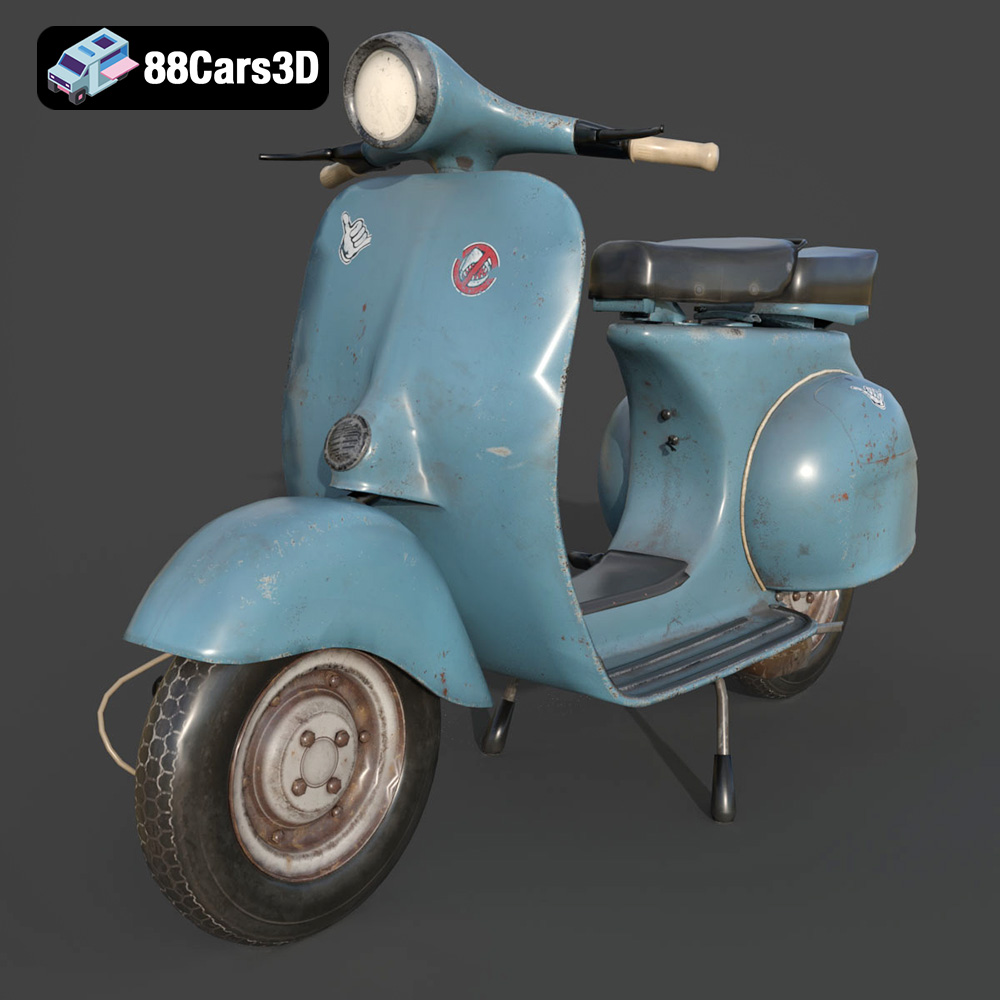
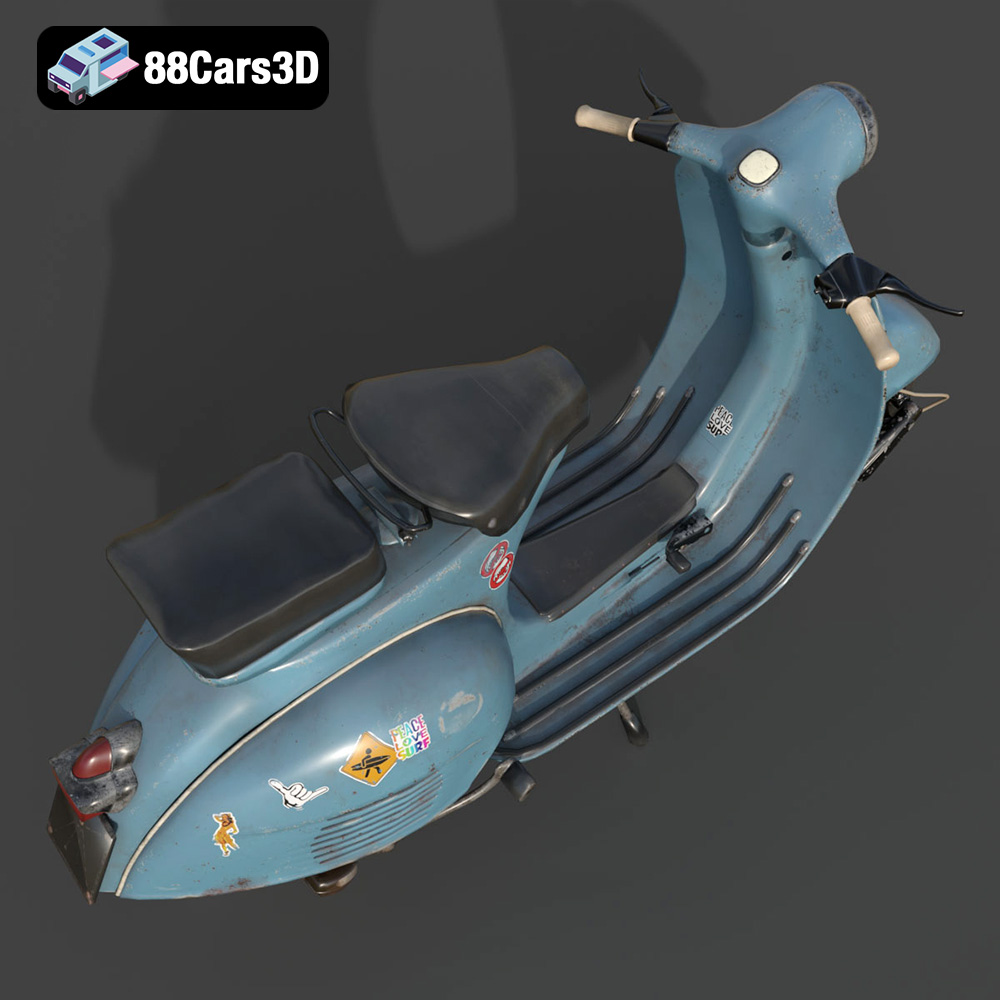
The product description for the Vintage Vespa highlights an extraordinary level of detail, a crucial factor for achieving photorealism and immersive experiences. The model faithfully recreates the pressed steel monocoque chassis, the elegantly sweeping side cowls, and the signature step-through frame—elements that define the Vespa’s silhouette. Beyond the obvious, intricate components like the detailed 2-stroke engine casing with its characteristic cooling fins, the classic curved exhaust system, and the vintage stamped steel wheels with accurate tread tires demonstrate a commitment to authenticity. Even the cockpit, often overlooked in external shots, features an authentic sprung saddle, chrome tubular handlebars, and a vintage analog instrument cluster. This granular attention ensures that the model holds up under close scrutiny, whether viewed in a high-resolution render or an interactive first-person game environment.
While detail is crucial, it must be balanced with performance, especially for real-time applications like game development or AR/VR. The Vintage Vespa 3D model strikes this balance masterfully with its highly optimized topology, boasting approximately 150,000 triangles. This polycount is significant enough to maintain stunning visual fidelity and complex curves but low enough to avoid bogging down real-time engines like Unreal or Unity. This “game-ready” optimization means developers spend less time cleaning up meshes and more time integrating the asset into their environments, confident that it will perform smoothly across various platforms. Proper UV mapping (though not explicitly detailed, it’s implied by “game-ready”) is also essential for efficient texture application and consistent visual quality.
Accuracy extends beyond visual replication to functional integrity. The Vintage Vespa model adheres to real-world scale, which is vital for believable scene composition and for ensuring compatibility with other assets in a shared virtual space. Furthermore, the model is engineered with proper pivot setups for key components like steering, wheel rotation, and suspension travel. The separation of wheels, suspension, and steering components means that animators have immediate control, allowing for realistic motion, turns, and dynamic reactions within a scene. This pre-articulation drastically reduces setup time for animators and riggers, making the model a highly practical choice for projects requiring dynamic vehicle interaction.
High-quality 3D car models are not just aesthetic additions; they are fundamental tools that enable a wide range of professional applications. The versatility of assets like the Vintage Vespa 3D model allows professionals to streamline their workflows and elevate the standard of their output across diverse industries.
For game developers, authentic 3D car models are essential for creating immersive open-world environments, realistic racing titles, or even background props that add character to a scene. The Vintage Vespa, with its optimized ~150,000 triangle count, is perfectly suited as a game asset. Its “game-ready” status means it’s designed to be drag-and-drop into engines like Unreal or Unity, requiring minimal additional optimization. Developers can leverage its accurate geometry and pivot setups to implement realistic physics, driveable mechanics, or simply use it as a static prop that enhances environmental storytelling, giving players a sense of a lived-in world. The inclusion of an .unreal format option further simplifies integration, providing an engine-ready asset from the start.
In automotive design and advertising, stunning visualizations are key to conveying a product’s appeal. Whether for brand campaigns, lifestyle scenes, or detailed studio lighting setups, the Vintage Vespa 3D model offers excellent fidelity for high-end rendering. Artists using 3ds Max, Blender, or other rendering suites can apply advanced materials, sophisticated lighting scenarios, and cinematic camera angles to produce photorealistic images and animations. The meticulous details, from the engine casing to the stitched seat, become focal points in close-up renders, showcasing the product with unparalleled realism. This kind of asset is invaluable for creating marketing collateral, configurators, or even virtual showrooms that highlight design excellence.
The burgeoning fields of Augmented Reality (AR) and Virtual Reality (VR) demand highly optimized assets that can render smoothly on a variety of hardware, from powerful VR headsets to mobile AR devices. The Vintage Vespa’s balanced polycount and its availability in formats like .glb make it an ideal candidate for immersive applications. Imagine a virtual showroom where customers can walk around the Vespa, inspect its details, and even change its color in real-time. Or an AR app that superimposes the scooter into a real-world environment. Its suitability for first-person POV in gaming also translates directly to VR, allowing users to feel like they are truly interacting with the classic vehicle. This interactive potential opens up new avenues for product display, education, and entertainment.
Understanding the theoretical applications of 3D car models is one thing; seeing them in action across various professional contexts solidifies their value. Let’s explore how the Vintage Vespa 3D model can be leveraged in specific, real-world scenarios.
Consider a project requiring a nostalgic cinematic animation of a bustling European street. An artist using 3ds Max or Blender would start by importing the Vintage Vespa 3D model, perhaps utilizing the .max or .blend native file for maximum editability. The separate components for wheels, suspension, and steering would allow for precise animation of the scooter coming to a gentle stop or navigating a turn. Advanced rendering engines within these software packages could then be used to apply realistic PBR (Physically Based Rendering) materials, capturing the subtle metallic sheen of the bodywork, the texture of the tires, and the worn leather of the seat. Global illumination, volumetric lighting for atmospheric haze, and depth of field would combine to create a truly photorealistic and emotionally resonant scene, where the Vespa isn’t just a prop, but a character.
For a game studio developing an open-world urban adventure, the Vintage Vespa could serve multiple roles. Importing the .fbx or the “Unreal-ready” asset into Unreal Engine would be the first step. Developers could easily integrate it into the game’s physics system, allowing players to drive it, or position it as part of environmental storytelling – perhaps parked outside a café, contributing to the game’s ambiance. The optimized geometry ensures it won’t impact frame rates, even when multiple instances are present. The articulated parts would allow for dynamic interactions like suspension compression over bumps or functional steering. Furthermore, custom materials could be set up in Unreal’s material editor to allow for real-time color changes or damage effects, enhancing player immersion and customization options.
Beyond digital screens, the Vintage Vespa 3D model offers the exciting possibility of physical creation through 3D printing. For a hobbyist or a professional looking to create a display piece, the .stl format is essential. The product description provides specific guidance: recommended scales (1:12, 1:18, 1:24), layer height (0.04–0.12 mm for resin printing), wall thickness, and infill percentages. Crucially, it advises on supports for delicate parts like the exhaust and handlebars, and print orientation for structural integrity. Post-processing steps like sanding, priming, and painting with authentic factory colors, perhaps with metallic finishes, transform the raw print into a stunning, tangible replica. This transition from a high-fidelity digital asset to a physical object showcases the incredible versatility of well-prepared 3D car models available on platforms like 88cars3d.com.
Investing in high-quality 3D models means more than just acquiring a static asset; it’s about gaining a flexible foundation for future creativity and adaptation. The Vintage Vespa 3D model’s inherent design and included file formats offer extensive customization possibilities, extending its lifespan and utility across numerous projects.
One of the immediate benefits of a well-structured 3D model is the ease with which its materials can be modified. Whether you want to represent a showroom-fresh Vespa with a high-gloss metallic paint job or a weathered, rust-speckled scooter found in a forgotten barn, the underlying mesh remains robust. Users can easily change body colors (from classic factory shades to custom finishes), modify tire textures (perhaps from street variants to off-road looks), and adjust material finishes (matte, gloss, metallic, or even a distressed look). This adaptability ensures that the single Vintage Vespa 3D model can serve a wide array of visual narratives and aesthetic requirements without requiring a completely new model for each variation.
The design of this particular Vintage Vespa 3D model, with its separate wheels, suspension, and steering components, is a significant advantage for animators. This modularity allows for precise control over motion. You can animate the wheels spinning, the suspension compressing as it goes over a bump, the handlebars turning for steering, and even the kickstand deploying. For cinematic projects, this means creating realistic drive cycles or dynamic interactions with the environment. In interactive experiences, these individual controls are crucial for integrating the model with physics engines, allowing for a truly responsive and believable vehicle. The proper pivot setup simplifies rigging, making the asset readily amenable to complex motion studies and character interactions.
A high-quality 3D asset is an investment. By providing multiple file formats (.blend, .fbx, .obj, .glb, .stl, .ply, .unreal, .max), the Vintage Vespa 3D model ensures maximum compatibility and longevity. As software evolves or project requirements shift, having the model in various industry-standard and native formats means you’re prepared for any pipeline. This future-proofing aspect is invaluable for studios and freelancers alike, ensuring that a single purchase can be integrated into current projects and easily repurposed for future endeavors, minimizing rework and maximizing creative output. This makes it an ideal choice for building an extensive library of reliable 3D car models.
The world of 3D modeling thrives on precision, versatility, and artistic vision. As we’ve explored through the lens of a beautifully crafted Vintage Vespa 3D model, the integration of high-quality assets is fundamental to achieving professional-grade results across game development, automotive rendering, AR/VR, and even 3D printing. Understanding the nuances of various file formats empowers creators to select the right tool for the job, optimizing for performance, compatibility, or specific output requirements.
From its meticulously recreated design details to its game-ready optimization and extensive file format support, the Vintage Vespa 3D model stands as a prime example of an asset engineered for diverse professional workflows. Its ability to be customized, animated, and seamlessly integrated into various software environments highlights the value of investing in premium 3D car models. Whether you’re aiming to evoke nostalgia in a cinematic render, add authentic flair to a virtual city, or bring a digital design into the physical world, high-fidelity assets are the cornerstone of compelling digital content.
For those seeking to elevate their projects with such exceptional 3D models, exploring curated marketplaces like 88cars3d.com offers a robust selection of assets designed to meet the rigorous demands of modern 3D production. Embrace the power of expertly crafted 3D models and unlock new creative possibilities in your next endeavor.
Capture the essence of Italian La Dolce Vita with this meticulously crafted Vintage Vespa 3D model. Celebrating decades of iconic design heritage, this classic scooter is immediately recognizable by its pressed steel monocoque chassis, beautifully sweeping side cowls, and signature step-through frame. From the authentic retro headlamp to the detailed engine side casing and vintage exhaust system, every element has been faithfully recreated to preserve the timeless elegance of this two-wheeled legend. Engineered for maximum versatility, this model features highly optimized topology with a balanced triangle count (~150,000 triangles), delivering stunning visual fidelity without compromising real-time performance. Whether you are building an interactive environment, rendering a highly realistic cinematic, or designing an immersive VR experience, this game-ready asset provides exceptional detail right out of the box. Perfect for urban environments, European street scenes, retro dioramas, and lifestyle visualizations.
$39.99
.blend
.fbx
.glb
.max
.obj
.ply
.rendering
.scooter
.stl
.unreal
.vespa
classic-scooter
game asset
game-ready
low-poly
motorcycle-3d-model
optimized
retro-vehicle
vintage-vespa
VR/AR