Get 20% OFF All Premium 3D & STL Models!

In the dynamic worlds of game development, architectural visualization, and cutting-edge AR/VR experiences, the pursuit of photorealism and immersive detail is relentless. Automotive design, with its intricate curves, reflective surfaces, and powerful presence, presents one of the most challenging yet rewarding subjects for digital artists. A truly exceptional 3D car model isn’t just an asset; it’s a cornerstone for creating compelling narratives, engaging simulations, and breathtaking visual spectacles.
Imagine a digital environment where every vehicle reflects light with scientific accuracy, where interior details are tangible, and where animations flow with mechanical precision. This level of fidelity is not just a luxury; it’s a necessity for projects aiming to capture attention and deliver authentic experiences. Whether you’re a seasoned game developer crafting the next open-world driving sensation, an architect visualizing a sleek sedan integrated into a luxury property, or a brand marketer showcasing a new vehicle line-up in an interactive configurator, the quality of your 3D car models directly impacts the perceived value and realism of your final output.
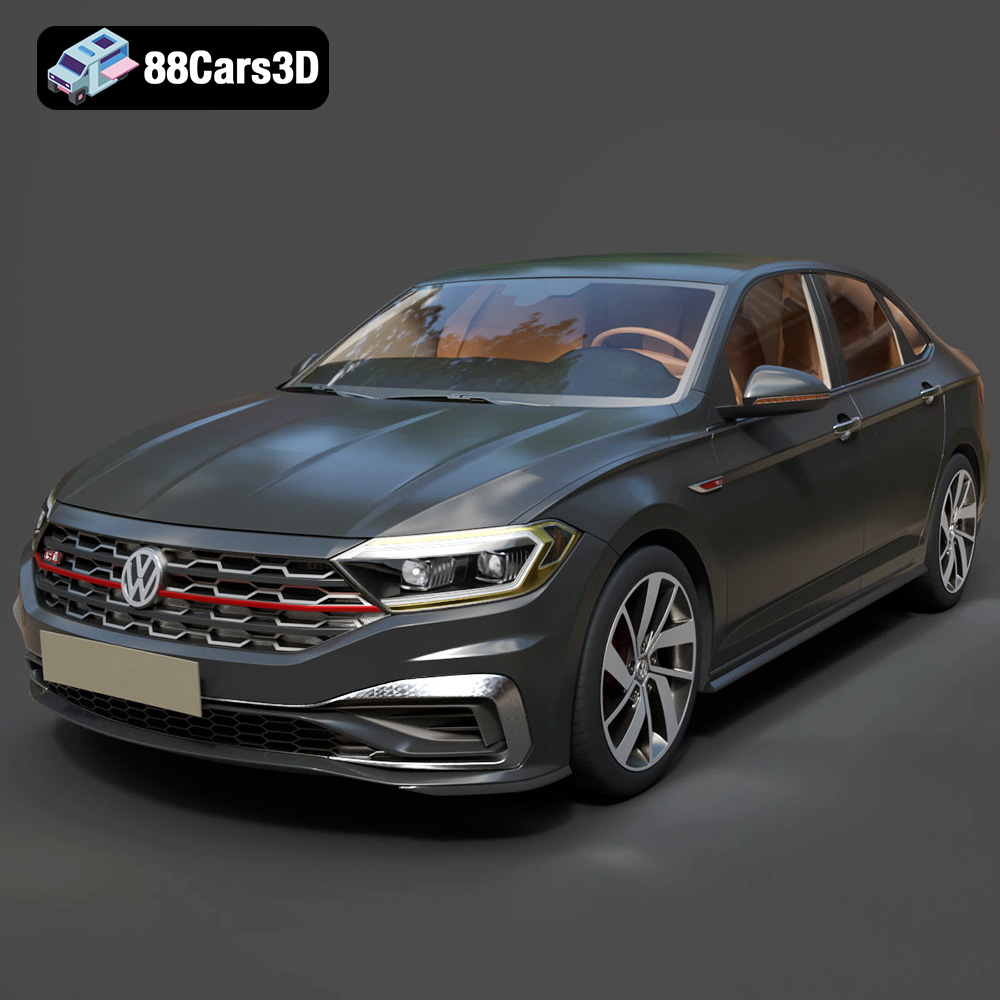
This pursuit of digital perfection is precisely where a model like the Volkswagen Jetta GLI 2019 3D Model truly shines. It encapsulates the thrilling performance and refined aesthetics of its real-world counterpart, meticulously translated into a versatile digital asset. From its iconic red accents to its sport-tuned stance, this model offers a robust foundation for a myriad of professional applications, promising both visual fidelity and optimized performance across various platforms.
The journey from a designer’s sketch to a fully interactive digital car model is complex, requiring expertise in modeling, texturing, rigging, and optimization. High-quality 3D car models serve as the critical link, allowing creators to bridge the gap between abstract ideas and tangible digital realities. They are the building blocks that populate virtual showrooms, race tracks, and urban landscapes, bringing a sense of life and authenticity to otherwise sterile digital environments.
Modern audiences expect nothing less than stunning realism. This demand drives the need for models with accurate proportions, precise topology, and PBR (Physically Based Rendering) materials that react authentically to light. The subtlest details—from tire tread patterns to interior stitching—contribute to an overarching sense of immersion. A high-fidelity model, such as the Volkswagen Jetta GLI 2019 3D Model, is engineered with this demand in mind, offering the granular detail required for close-up renders and the optimized geometry essential for smooth real-time performance.
When working with 3D car models, selecting the correct file format is as crucial as the model’s quality itself. Each format is designed with specific use cases, software compatibilities, and data efficiencies in mind. Understanding these distinctions is paramount for ensuring seamless integration into your professional workflow, whether you’re focused on automotive rendering, game development, or 3D printing. The Volkswagen Jetta GLI 2019 3D Model, available on 88cars3d.com, exemplifies versatility by being offered in a comprehensive suite of these essential formats.
The .blend format is the native file type for Blender, the powerful open-source 3D creation suite. A .blend file typically contains an entire scene, including the 3D model geometry, materials, textures, lighting, cameras, animation data, and even physics simulations. Its primary advantage is its complete editability within Blender, offering artists full control over every aspect of the asset. For the Jetta GLI model, a .blend file would provide the most flexible starting point for custom rigging, material adjustments, or scene integration specifically within Blender’s ecosystem, making it ideal for artists who prefer or are proficient in this software.
.fbx (Filmbox) is arguably the most widely adopted proprietary file format for 3D data exchange, developed by Autodesk. It’s an excellent choice for transferring 3D models, animation, and various other forms of 3D data between different software applications like Maya, 3ds Max, Cinema 4D, and most importantly, game engines like Unreal Engine and Unity. FBX supports hierarchical data structures, meaning it can preserve object relationships, pivot points, and animations, which is crucial for complex rigged models. For game assets like the Jetta GLI, .fbx is often the go-to for its robust support of animation, PBR materials, and efficient handling of optimized geometry.
The .obj (Wavefront OBJ) format is a universal standard for 3D geometry. It’s a simpler format compared to FBX, primarily storing polygon mesh data (vertices, normals, texture coordinates) and typically referencing external material (.mtl) and texture files. Its strength lies in its widespread compatibility; almost every 3D software application can import and export .obj files. While it doesn’t support animation or rigging data natively, it’s perfect for static models or as a fallback for geometry transfer. For the Jetta GLI, an .obj version ensures broad compatibility, allowing artists using niche or older software to still access the core model geometry and PBR materials.
.glb (GL Transmission Format Binary) is the binary version of the glTF format, an open standard for 3D scenes and models. Designed for efficient transmission and loading of 3D assets in web-based applications, AR (Augmented Reality), and VR (Virtual Reality) environments, .glb packs geometry, materials, textures, and animation into a single compact file. Its optimization for real-time applications and web streaming makes it incredibly powerful for interactive automotive configurators or mobile AR experiences showcasing the Jetta GLI directly in a browser or on a smartphone.
.stl (Stereolithography) is the de facto standard file format for 3D printing and CAD software. It represents a 3D model as a series of connected triangles, describing only the surface geometry of an object without color, texture, or other CAD attributes. For hobbyists or professionals looking to physically manifest the Jetta GLI, an .stl file provides the necessary data for slicing software to prepare the model for 3D printing. It’s a critical format for prototyping, scale models, or even creating custom car parts.
.ply (Polygon File Format or Stanford Triangle Format) is a file format for storing three-dimensional data from 3D scanners. It can store a variety of properties for each vertex (such as color, normal vectors, transparency) and face (such as color). While less common for general automotive assets, its precision and ability to store rich per-vertex data make it valuable for scientific visualization, point cloud data, or scenarios where highly accurate mesh information, potentially derived from real-world scans, is crucial. For the Jetta GLI, it offers an alternative, robust mesh representation.
The .unreal format, or more accurately, assets packaged for Unreal Engine, implies that the model has been specifically prepared and potentially imported into an Unreal project, often leveraging its native asset structure. This means materials are set up using Unreal’s PBR workflow (often with a Master Material instance), collisions are defined, LODs (Levels of Detail) might be implemented, and it’s ready to be dropped into a scene. For the Jetta GLI, an .unreal asset significantly reduces setup time for game developers, offering a truly “engine-ready” component optimized for performance within the Unreal ecosystem.
The .max format is the native scene file for Autodesk 3ds Max, a leading 3D modeling, animation, rendering, and compositing software. Similar to .blend, a .max file contains the complete scene, including geometry, materials, textures, lighting, cameras, and animation. Artists heavily invested in the 3ds Max ecosystem will find this format invaluable for its full editability, allowing for complex scene setup, advanced rendering with V-Ray or Corona, and intricate animation sequences. The Jetta GLI in .max format provides the ultimate flexibility for high-end rendering and animation projects within 3ds Max.
The provision of the Volkswagen Jetta GLI 2019 3D Model in all these formats by 88cars3d.com underscores a commitment to flexibility and professional utility, ensuring that no matter your software or intended application, you have the right tool for the job.
The creation of a high-fidelity 3D car model like the Volkswagen Jetta GLI 2019 is a testament to meticulous craftsmanship and technical prowess. It’s not merely about replicating shapes; it’s about capturing the essence of the vehicle, from its aggressive stance to the subtle nuances of its interior. This model is engineered to meet the stringent demands of modern digital production pipelines, offering both visual splendor and practical performance.
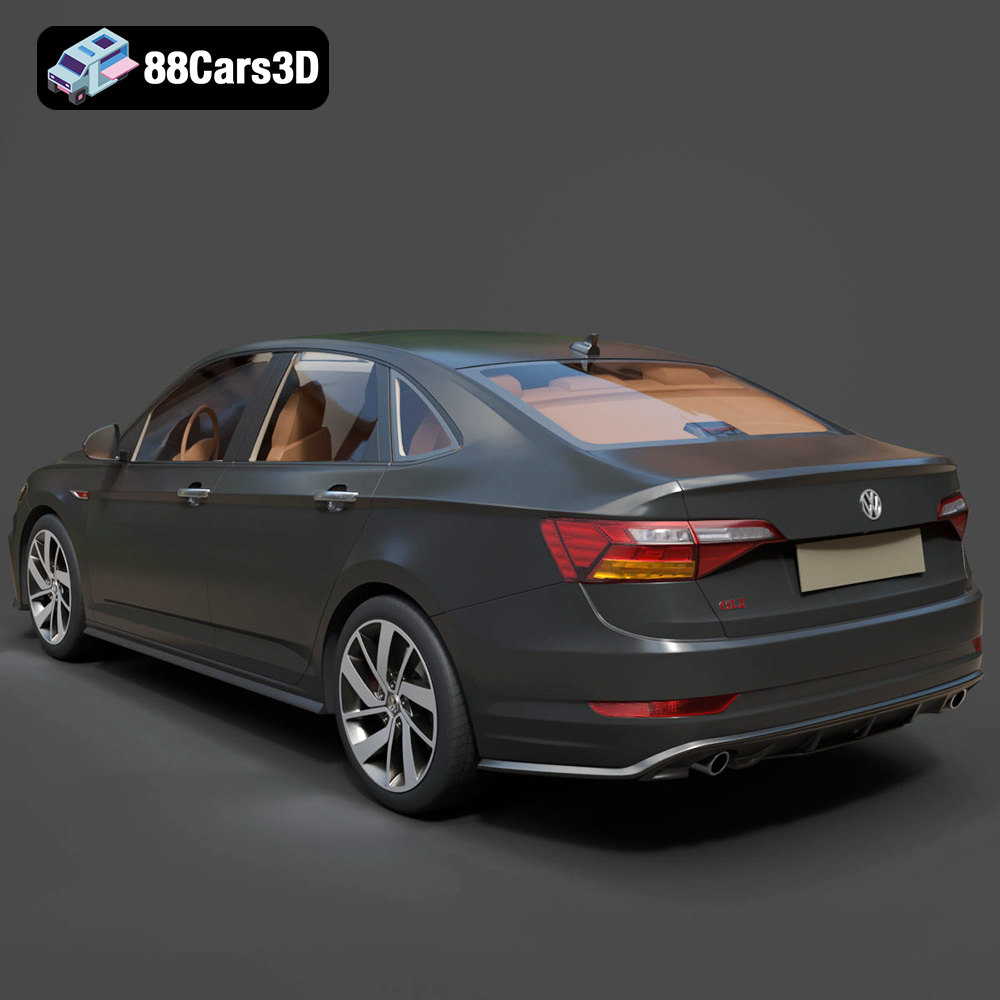
The first impression of any vehicle comes from its exterior, and the Jetta GLI is no exception with its distinctive sports sedan persona. This 3D model painstakingly recreates the vehicle’s accurate frame geometry and proportions, ensuring that its digital twin is indistinguishable from the real thing in terms of silhouette and scale. The aggressive honeycomb grille, complete with its iconic red accents, is meticulously modeled, as are the sleek aerodynamic profiles that define the car’s dynamic flow. Special attention has been paid to elements like the sport-tuned dual exhaust system with chrome tips, signature LED projector headlights, and sleek taillight clusters. The exclusive GLI alloy wheels are not just placeholders; they feature performance tire treads and detailed red brake calipers, all contributing to an authentic and visually striking representation. Furthermore, the sport suspension lowering details are captured, giving the model that characteristic aggressive stance. Crucially for animators, the wheels, suspension, and steering components are separated, allowing for realistic rotation, travel, and articulation in dynamic scenes.
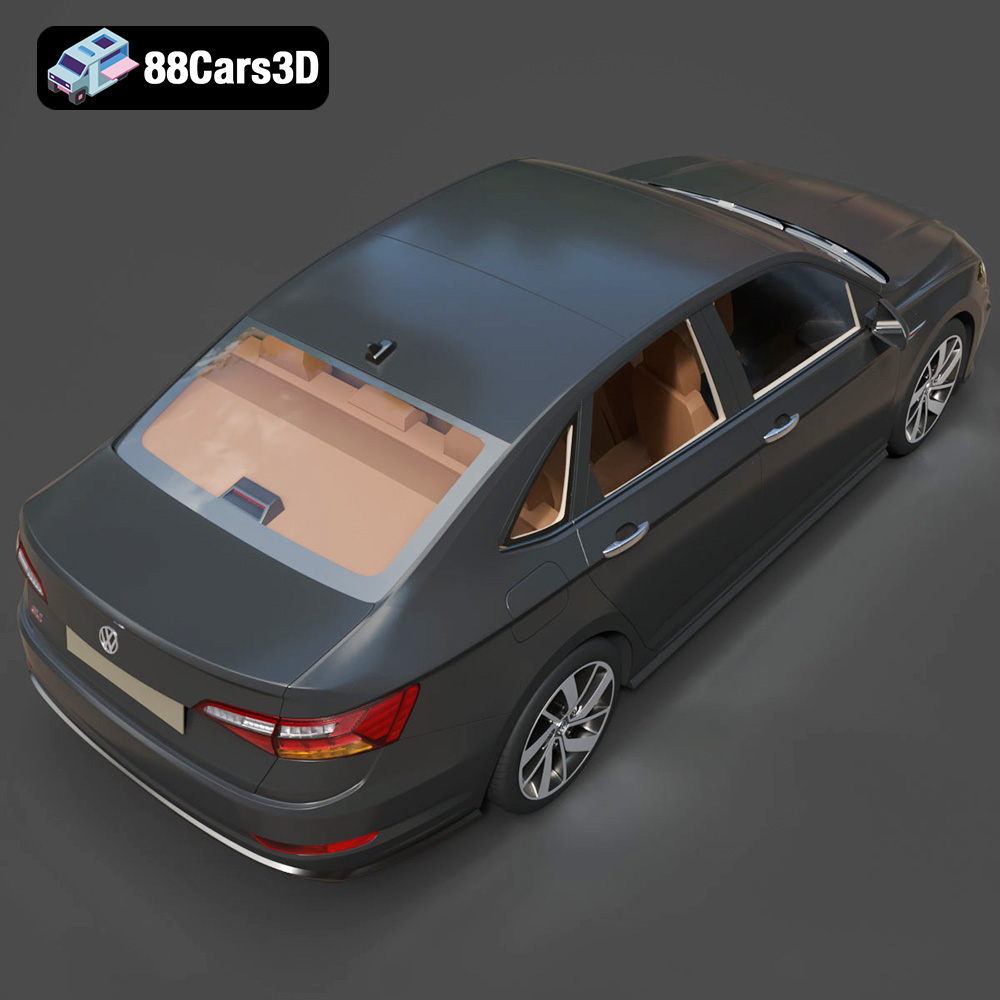
While the exterior draws the eye, the interior defines the driving experience. The Jetta GLI 3D model doesn’t neglect this crucial aspect, offering a fully realized cockpit designed for immersion. Sport seats with signature red contrast stitching details are faithfully rendered, echoing the GLI’s performance pedigree. The leather-wrapped, flat-bottom sport steering wheel, digital cockpit, and modern infotainment instrument cluster are all accurately represented, providing a rich environment for virtual drivers. Even smaller details like the pedals, shift lever, and center console controls are modeled with care. This level of interior fidelity is particularly vital for applications like first-person POV in gaming or interactive configurators, where users expect to explore every corner of the vehicle.
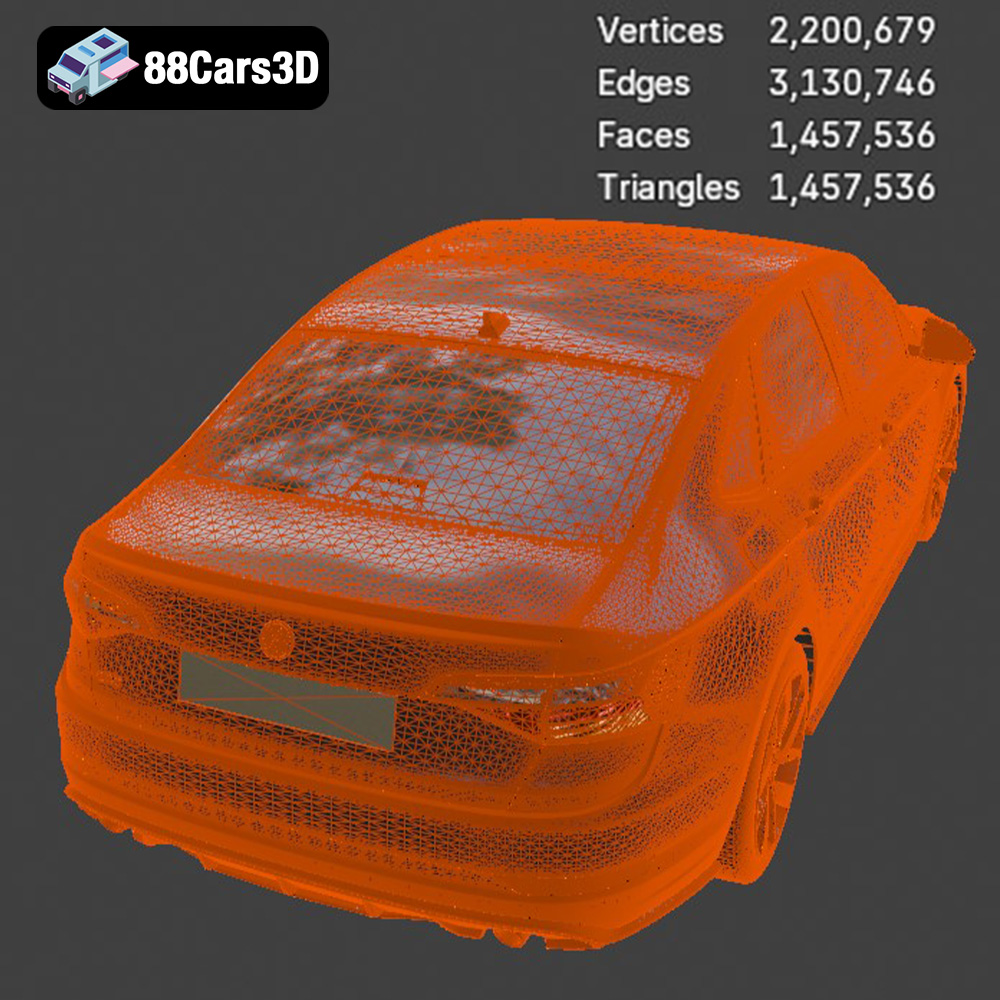
One of the standout features of the Volkswagen Jetta GLI 2019 3D Model from 88cars3d.com is its game-ready optimization. With approximately 250,000 triangles, the model strikes an exceptional balance between high-end visual fidelity and real-time performance. This poly count is carefully chosen to ensure that the model looks stunning in close-up shots and cinematic sequences, while simultaneously maintaining smooth frame rates in demanding real-time engines like Unreal and Unity. Real-world scale accuracy is maintained, which is critical for consistent scene integration and realistic physics in simulations. Furthermore, proper pivot setups for steering, wheel rotation, and suspension travel are pre-configured, drastically reducing the setup time for animators and game developers. Coupled with highly detailed PBR materials, this model ensures unmatched realism for a wide array of applications, making it a truly versatile and high-value asset.
A high-quality 3D car model is only as valuable as its ability to seamlessly integrate into professional production pipelines. The Volkswagen Jetta GLI 2019 3D Model, with its multiple file formats and optimized topology, is designed for maximum utility across various industries, from high-fidelity automotive rendering to immersive game development.
For high-end architectural visualization and marketing campaigns, photorealistic rendering is paramount. Using the .max format, artists can leverage the full power of 3ds Max alongside industry-leading renderers like V-Ray or Corona Renderer. The Jetta GLI model’s accurate geometry and PBR materials are ideally suited for this. Workflows typically involve:
The Jetta GLI’s attention to detail, from its engine block representation to its exterior proportions, ensures that even the most discerning clients will be impressed with the authenticity of the rendered visuals.
For game developers, performance and visual quality must go hand-in-hand. The Jetta GLI’s game-ready optimization (~250k triangles) and availability in .fbx and .unreal formats make it an ideal game asset. Typical workflows include:
This model is particularly well-suited for immersive racing simulators or urban environment open-world games where visual fidelity needs to be maintained at high frame rates.
The demand for interactive experiences in AR/VR is rapidly expanding, especially in automotive showrooms and configurators. The Jetta GLI’s .glb format is tailor-made for these applications:
The ability to adapt material finishes, change body colors, and modify tire textures directly on the model provides unparalleled flexibility for AR/VR developers to create dynamic and engaging automotive showcases.
The versatility of a well-structured 3D car model extends beyond purely digital realms. For enthusiasts, designers, or educators, the ability to transform a virtual asset into a physical object via 3D printing offers a unique tactile experience. The Volkswagen Jetta GLI 2019 3D Model includes an .stl format, making this transition from screen to tangible display remarkably straightforward.
The .stl file format is the industry standard for 3D printing, representing the model’s surface geometry as a collection of triangles. While it strips away textures and materials, it provides the precise volumetric data needed by 3D slicers. For the Jetta GLI, preparing the .stl for printing involves a few critical considerations:
These technical specifications ensure that anyone with access to a 3D printer can bring a miniature version of the Jetta GLI to life, perfect for display, custom dioramas, or even as a unique gift.
Printing is only the first step. To truly emulate the real Volkswagen Jetta GLI, post-processing is key. This typically involves:
The journey from a digital .stl file to a beautifully painted physical model of the Jetta GLI is a rewarding experience, showcasing the incredible versatility of high-quality 3D car models available on platforms like 88cars3d.com.
One of the most powerful advantages of working with premium 3D car models is the inherent flexibility they offer for customization. The Volkswagen Jetta GLI 2019 3D Model is built with adaptability in mind, allowing artists and developers to tailor its appearance to perfectly match their project’s specific aesthetic or branding requirements. This goes far beyond simple color changes, delving into the nuanced world of material properties and environmental integration.
The Jetta GLI model’s PBR materials are designed to be highly adjustable, providing a vast palette for creative expression. PBR (Physically Based Rendering) materials simulate how light behaves in the real world, allowing for incredibly realistic surface properties. With this model, you can:
This deep material customizability ensures that the Jetta GLI can seamlessly fit into any visual style, from hyper-realistic studio renders to stylized game environments.
Beyond the model itself, how it interacts with its environment is crucial for achieving realism. The Jetta GLI model’s accurate proportions and PBR materials make it highly responsive to various lighting conditions and scene setups:
The ability to finely tune both the model’s appearance and its interaction with the digital world underscores its value as a versatile game asset and rendering component. With the Volkswagen Jetta GLI 2019 3D Model from 88cars3d.com, you’re not just getting a static object; you’re acquiring a highly adaptable foundation for boundless creative possibilities.
In a saturated market of digital assets, finding a reliable source for truly high-quality 3D car models can be a challenge. 88cars3d.com distinguishes itself by offering a curated selection of meticulously crafted models, exemplified by the Volkswagen Jetta GLI 2019 3D Model. This platform is more than just a marketplace; it’s a commitment to professional-grade assets that meet the rigorous demands of contemporary digital production.
Every model featured on 88cars3d.com undergoes stringent quality checks to ensure it meets professional standards. This means:
This dedication to quality eliminates the guesswork often associated with asset purchases, allowing artists and developers to focus on their creative endeavors rather than fixing mesh errors or re-optimizing geometry.
By providing assets like the Volkswagen Jetta GLI 2019 3D Model, 88cars3d.com empowers creators to rapidly expand their digital garages with production-ready vehicles. Whether you’re building a vast open-world game, developing an interactive AR/VR experience, or producing high-end automotive rendering for a client, having access to such a diverse and high-quality library saves invaluable time and resources. Instead of spending weeks modeling a vehicle from scratch, you can acquire a meticulously crafted asset and immediately integrate it into your workflow, dedicating more time to scene composition, animation, and creative refinement. This efficiency is critical in fast-paced production environments and allows for a higher volume of creative output without compromising on quality.
The convenience and reliability offered by 88cars3d.com make it an indispensable resource for anyone serious about elevating their 3D automotive projects with exceptional 3D car models and game assets.
The digital frontier of automotive design and visualization is constantly expanding, demanding ever-increasing levels of realism, detail, and performance. Whether you are a professional crafting the next blockbuster game, an architect envisioning urban landscapes, or a marketer bringing a brand to life in AR/VR, the quality of your 3D car models is a fundamental determinant of your project’s success and impact.
The Volkswagen Jetta GLI 2019 3D Model stands as a prime example of what a premium digital asset can offer. Its meticulous exterior and interior detailing, game-ready optimization, accurate real-world scale, and flexible PBR materials ensure it’s a robust solution for a wide spectrum of applications. From the high-fidelity demands of automotive rendering in 3ds Max to the performance-critical environments of Unreal Engine and Unity for game assets, and even the tangible output of 3D printing, this model proves its versatility. The provision of numerous industry-standard file formats by 88cars3d.com further enhances its utility, guaranteeing seamless integration into virtually any professional workflow.
Investing in high-quality assets like the Volkswagen Jetta GLI 2019 3D Model from 88cars3d.com is not just about acquiring a digital object; it’s about acquiring a foundation for innovation. It’s about saving valuable production time, elevating visual standards, and empowering artists and developers to push the boundaries of what’s possible in the digital automotive realm. Embrace the precision, performance, and aesthetic excellence that this model brings to your next project, and experience the transformative power of truly exceptional 3D content.
The Volkswagen Jetta GLI 2019 combines everyday practicality with thrilling performance, standing out as a premier sports sedan in its class. Known for its GTI-borrowed turbocharged engine, aggressive honeycomb grille with iconic red accents, and sleek aerodynamic profile, this vehicle strikes the perfect balance between track-ready styling and modern sophistication. From its distinctive front fascia to the dual exhaust setup, every element of this athletic sedan has been meticulously captured. This meticulously crafted 3D model features game-ready optimization with approximately 250,000 triangles, ensuring high-end visual fidelity without compromising real-time performance in modern engines. With stunning topological accuracy and highly detailed PBR materials, it provides unmatched realism for close-up shots and gameplay alike. Perfect for immersive racing simulators, urban environment open-world games, high-end architectural visualizations, and interactive automotive configurators.
$39.99
.2019
.blend
.fbx
.glb
.max
.obj
.ply
.rendering
.sedan
.stl
.unreal
.volkswagen
car-3d-model
game asset
game-ready
jetta-gli
low-poly
optimized
sports-sedan
VR/AR