Get 20% OFF All Premium 3D & STL Models!

In the dynamic world of 3D modeling, the demand for high-quality, versatile assets continues to grow across industries. From captivating automotive rendering for advertising campaigns to creating immersive game environments and cutting-edge AR/VR experiences, the foundation of any successful project lies in the fidelity and optimization of its 3D models. A truly professional 3D asset bridges the gap between stunning visual realism and efficient real-time performance, empowering creators to push the boundaries of digital design.
Understanding these critical needs, resources like 88cars3d.com provide a crucial service, offering meticulously crafted 3D car models that meet rigorous industry standards. Among their impressive collection, the Mercedes-Benz A-Class 3-Door (2010) 3D Model stands out as a prime example of an asset engineered for comprehensive usability. This model encapsulates the blend of detailed design and technical optimization that modern projects demand, making it an ideal choice for a vast array of professional applications.
This article will delve into the intricacies of integrating such high-quality automotive 3D models into various professional workflows, explore the critical role of file formats, and highlight how a meticulously designed asset like the Mercedes-Benz A-Class 3-Door (2010) can elevate your projects from concept to stunning reality.
Creating a professional 3D car model is far more than just sculpting a vehicle in digital space; it’s an intricate balance of artistic vision, technical precision, and strategic optimization. Every curve, every panel gap, and every material nuance must be considered to deliver an asset that performs flawlessly, whether it’s being rendered in a cinematic sequence or driven in a fast-paced racing game.
The core challenge in 3D automotive modeling lies in achieving photorealistic detail without crippling performance. For high-end architectural visualizations or marketing renders, a virtually limitless polygon count might be acceptable to capture every minute detail. However, for real-time applications such as game development or AR/VR, excessive geometry can lead to frame rate drops and poor user experience. Expert modelers employ techniques like efficient topology, smart UV mapping, and baking high-resolution details into normal maps to create assets that look stunning while remaining lean and efficient.
This balance is crucial for assets that need to serve multiple masters. A model used for a glossy promotional render might also need to perform smoothly in an interactive configurator. The ability to scale detail and optimize performance without sacrificing visual integrity is a hallmark of truly professional 3D car models.
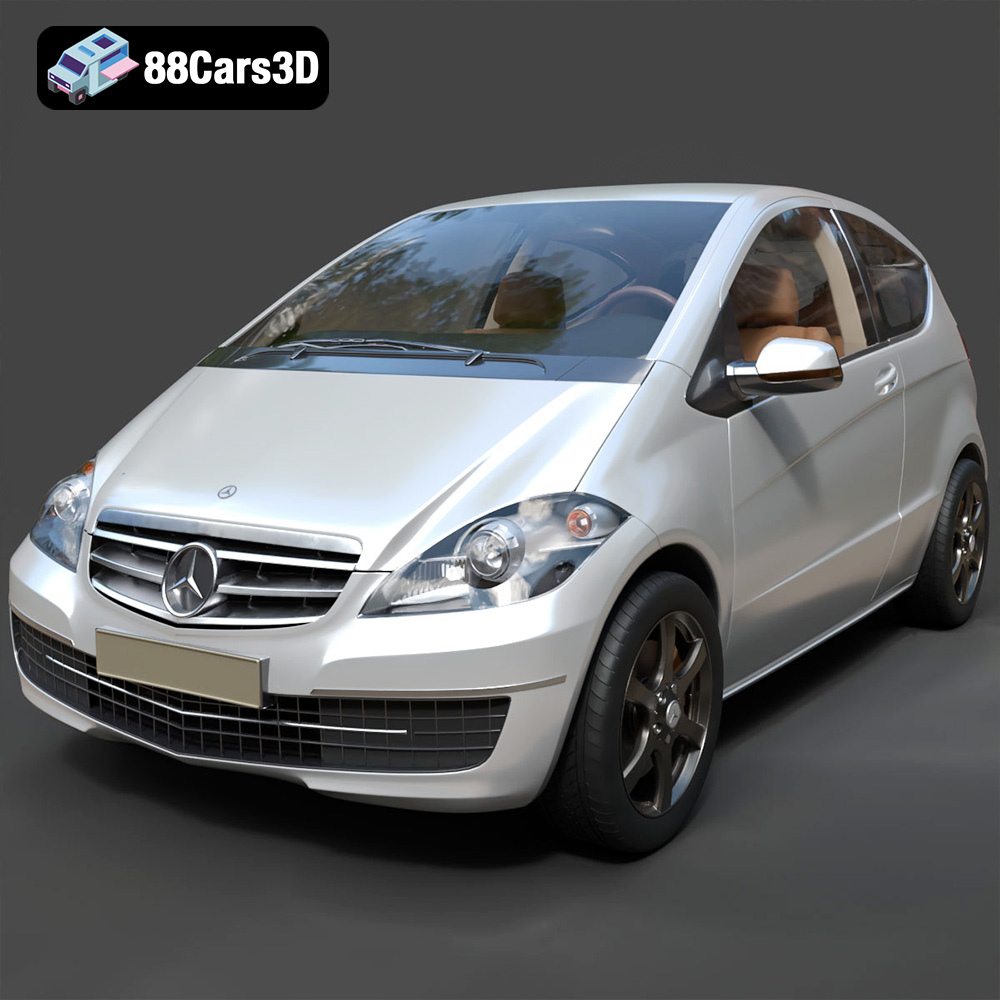
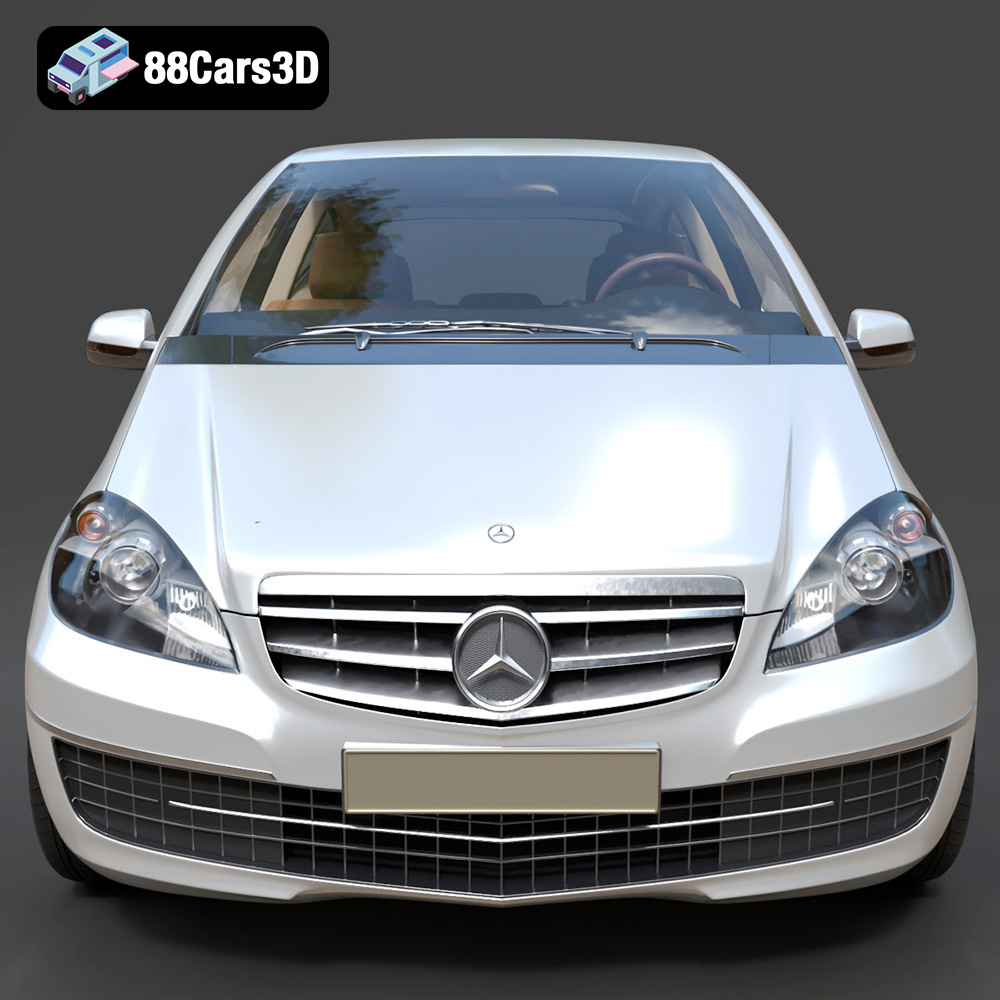
The Mercedes-Benz A-Class 3-Door (2010) 3D model exemplifies this balanced approach. It faithfully reproduces the distinctive wedge-shaped silhouette, the iconic three-pointed star on the grille, and the sporty 3-door configuration, capturing the essence of the real vehicle. Yet, beneath its authentic exterior lies a highly efficient topology with approximately 150,000 triangles. This polycount is a testament to its “game-ready” optimization, allowing for seamless integration into real-time engines like Unreal Engine and Unity, while still retaining enough detail for high-end rendering and visualization.
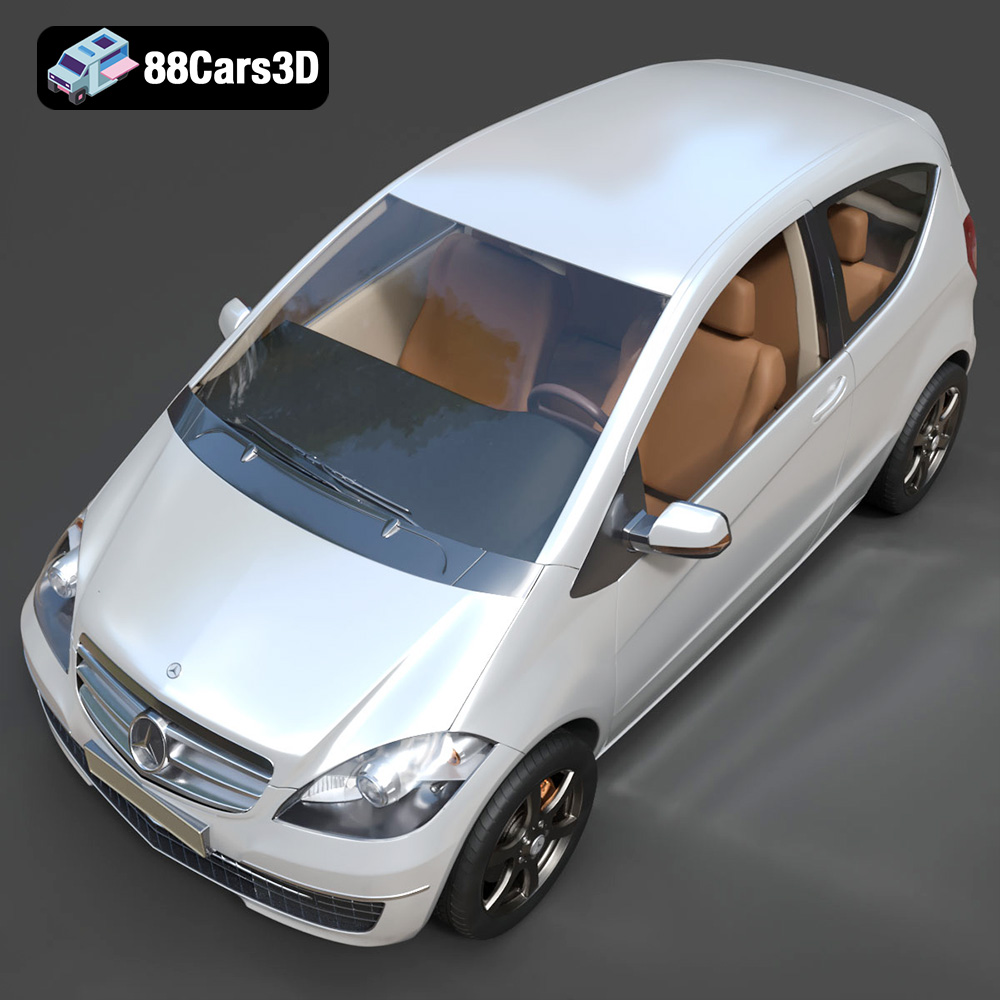
Features such as accurately modeled exhaust systems, high-resolution headlights, factory-spec alloy wheels, and a detailed interior including the dashboard, steering wheel, and seating arrangement, ensure that the model holds up under close scrutiny, whether it’s for a cinematic shot or a first-person perspective in a driving simulation. The model’s real-world scale accuracy and proper pivot setups for animation (steering, wheel rotation, suspension) further enhance its utility and realism.
Investing in high-quality 3D car models saves invaluable development time and resources. Rather than modeling a vehicle from scratch, which can take weeks or months, professional assets provide an immediate foundation. This allows designers and developers to focus on creative aspects, animations, environment building, and project-specific customizations. For companies like 88cars3d.com, ensuring their offerings like the Mercedes-Benz A-Class 3-Door (2010) are delivered with optimal topology, clean UVs, and multiple file formats means they are truly “plug-and-play” for a professional workflow, accelerating production cycles and guaranteeing a consistent level of quality.
The choice of file format for a 3D model is not merely a technicality; it’s a critical decision that dictates compatibility, functionality, and performance across different software, engines, and applications. Professional 3D assets, such as the Mercedes-Benz A-Class 3-Door (2010) available on 88cars3d.com, are often provided in a suite of formats to ensure maximum versatility. Understanding when and why to use each format is paramount for a streamlined workflow.
The .blend format is the native file type for Blender, the popular open-source 3D creation suite. A .blend file contains a complete scene, including mesh data, materials, textures (packed or linked), animation, lighting, cameras, and even custom scripts. When you receive a .blend file, you’re getting a fully editable Blender project. This is ideal for artists who primarily work in Blender, allowing for non-destructive workflows, easy material adjustments, and full access to the original scene setup. For the Mercedes-Benz A-Class 3-Door (2010) model, the .blend file would provide complete control over every aspect of the asset within its native environment.
.fbx (Filmbox) is an Autodesk-developed proprietary file format that has become the de facto standard for 3D data exchange across various software and game engines. It’s incredibly robust, capable of storing not just mesh data, but also complex animations, skeletons, skinning, blend shapes, cameras, and lights. FBX excels in pipelines where assets need to move between different applications like 3ds Max, Maya, Blender, ZBrush, and then into game engines like Unreal Engine or Unity. For game developers and animators using the Mercedes-Benz A-Class 3-Door (2010), the .fbx format is often the preferred choice due to its comprehensive support for animation and scene data, ensuring that the model’s rigged components and pivot points are preserved.
The .obj (Wavefront OBJ) format is one of the oldest and most universally supported 3D file formats. It’s an open standard that primarily stores geometric data: vertices, normals, UV coordinates, and faces. Material information is typically stored in an accompanying .mtl (Material Template Library) file. While .obj is excellent for exchanging basic mesh data and is supported by virtually every 3D software, it does not support animation, rigging, or scene information like lights and cameras. It’s often used for static models, architectural visualization, or as a fallback when more complex formats are not supported. For simple imports of the Mercedes-Benz A-Class 3-Door (2010) model into a new scene where only the raw geometry and basic materials are needed, .obj serves well.
.glb is the binary version of the glTF (GL Transmission Format), an open standard designed for efficient transmission and loading of 3D scenes and models by applications. Think of it as the “JPEG of 3D.” A .glb file is self-contained, packing all necessary textures, meshes, materials, and animations into a single file, making it highly optimized for web-based 3D, augmented reality (AR), virtual reality (VR), and mobile applications. Its efficiency and self-containment make it perfect for showcasing the Mercedes-Benz A-Class 3-Door (2010) in interactive online viewers or AR experiences on smartphones, where quick loading and minimal data transfer are crucial.
.stl (Stereolithography) is the dominant file format for 3D printing. It represents a 3D model as a series of connected triangles (a triangular mesh) and contains no color, texture, or material information – only surface geometry. While simplistic, its widespread adoption makes it essential for physical fabrication. If you intend to 3D print the Mercedes-Benz A-Class 3-Door (2010) model, the .stl file is what your slicer software will use to generate toolpaths for your 3D printer. It requires a watertight mesh and careful consideration of scale and print settings.
The .ply (Polygon File Format) is another format for storing 3D data, particularly useful for models generated from 3D scanners or for CAD applications. Unlike .stl, .ply can store additional attributes such as color, transparency, normals, texture coordinates, and even reliability information for each vertex and face. This makes it a richer format for preserving data from complex scanning processes or for detailed analysis where such attributes are important. While not as universally used as .fbx or .obj for general asset exchange, it’s valuable for specific engineering or scientific visualization tasks involving the Mercedes-Benz A-Class 3-Door (2010).
The .unreal format, or more precisely, an “Unreal-ready” asset, typically refers to an asset that has been imported, optimized, and set up within the Unreal Engine environment, often saved as a .uasset file within the engine’s content browser. While not a direct external file format for general exchange, receiving a model designated as “.unreal” means it has likely undergone specific preparation: LOD (Level of Detail) generation, proper material setups using Unreal’s physically based rendering (PBR) system, collision meshes, and optimized scaling. For the Mercedes-Benz A-Class 3-Door (2010), this implies the model is ready for immediate drag-and-drop use within an Unreal Engine project, saving significant setup time for game developers and real-time visualization artists.
The .max format is the native scene file for Autodesk 3ds Max, a powerful 3D modeling, animation, and rendering software widely used in architectural visualization, game development, and film production. A .max file, similar to a .blend file for Blender, stores the entire 3ds Max scene, including geometry, materials, textures, lighting, cameras, modifiers, and animation data. Providing the Mercedes-Benz A-Class 3-Door (2010) model in .max format offers 3ds Max users the highest level of flexibility and control over the asset, allowing for full editing, customization, and seamless integration into existing 3ds Max projects and rendering pipelines like V-Ray or Corona Renderer.
The true value of a versatile 3D asset like the Mercedes-Benz A-Class 3-Door (2010) from 88cars3d.com becomes evident when integrated into professional production pipelines. Its multi-format availability and optimized design cater to a broad spectrum of industries, enabling creators to achieve high-quality results efficiently.
In architectural visualization, vehicles play a crucial role in bringing scenes to life, adding context, scale, and dynamism to static buildings. High-quality 3D car models populate street scenes, parking lots, and driveways, making renders feel more lived-in and realistic. For urban planning, these models can be used in simulations to analyze traffic flow, pedestrian interaction, or the visual impact of new developments. The Mercedes-Benz A-Class 3-Door (2010), with its accurate real-world scale and detailed exterior, is perfect for serving as a “traffic populator” in these scenes, blending seamlessly into urban or suburban environments. Its optimized geometry ensures that even large numbers of vehicles won’t bog down rendering times, especially in panoramic or fly-through animations.
The game industry constantly pushes for greater realism and immersion, making high-quality 3D car models indispensable for racing games, open-world adventures, and simulators. The “game-ready” optimization of the Mercedes-Benz A-Class 3-Door (2010) model, with its ~150,000 triangles, is ideal for direct integration into engines like Unreal Engine and Unity. Its proper pivot setup for steering, wheel rotation, and suspension travel simplifies the animation and physics setup for game developers. Furthermore, the detailed interior is optimized for first-person perspectives, enhancing player immersion. Developers can rapidly integrate this model, apply game-specific shaders, and focus on gameplay mechanics rather than extensive asset creation.
Augmented Reality (AR) and Virtual Reality (VR) are transforming how we interact with products and environments. Automotive brands, in particular, leverage AR/VR for virtual showrooms, interactive configurators, and immersive training simulations. The Mercedes-Benz A-Class 3-Door (2010) model’s optimized geometry and support for formats like .glb make it perfectly suited for these emerging platforms. In a VR showroom, users can walk around, open doors, and even “sit” inside the car, experiencing its design in a fully immersive way. For AR, the model can be projected into the real world via a smartphone, allowing potential customers to visualize the car in their driveway. The model’s efficiency ensures smooth performance on a range of devices, from high-end VR headsets to mobile phones.
The foundation of any high-quality 3D asset lies in its underlying technical structure. For a complex subject like an automobile, precision in geometry, topology, and texture mapping is paramount. The Mercedes-Benz A-Class 3-Door (2010) model demonstrates meticulous attention to these technical details, ensuring both visual fidelity and performance.
The model’s geometry is expertly crafted to accurately represent the W169 chassis. “Optimized topology” means that the polygons (in this case, triangles) are distributed intelligently: denser where curvature or detail is high (e.g., around wheel wells, headlights, or the grille emblem) and sparser on flatter surfaces. This approach maintains sharp edges and smooth curves without an excessive polygon count. With approximately 150,000 triangles, the model strikes a delicate balance, making it viable for real-time applications while still looking impressive in static renders.
Equally important is UV mapping, the process of unwrapping the 3D model’s surface into a 2D space for texture application. Clean, organized UVs are essential for high-resolution texture mapping without distortion, allowing for realistic paint finishes, decals, and material variations. The model’s optimized UVs ensure that textures align correctly and efficiently, contributing to its photorealistic appearance across various rendering engines.
Accuracy in 3D modeling extends beyond visual appeal to practical dimensions. The Mercedes-Benz A-Class 3-Door (2010) model adheres to real-world scale, a critical factor for accurate architectural visualization, product design integration, and realistic simulation. Placing a car of incorrect scale into an architectural scene instantly breaks immersion and makes objects appear out of proportion.
Furthermore, proper pivot setups for animated components are non-negotiable for professional workflows. Separate elements like wheels, doors, and steering components have their pivot points correctly positioned at their rotation axes. This allows for straightforward animation of steering, realistic wheel rotation, and authentic suspension travel without complex rigging adjustments, making the model highly functional for dynamic scenes and interactive experiences in game engines or animation software.
A comprehensive 3D car model includes both exterior and interior details. The Mercedes-Benz A-Class 3-Door (2010) features a meticulously modeled exterior, capturing the signature Mercedes grille, swept-back headlights, distinct taillight clusters, and factory-spec alloy wheel designs with realistic tire treads. The authentic suspension stance and ride height further enhance its realism.
The interior, often overlooked in “low-poly” assets, is also carefully considered. The cockpit boasts an authentic Mercedes-Benz compact luxury seating arrangement, a detailed steering wheel with integrated emblem and controls, and an accurate dashboard layout with instrument cluster details. The modeled center console, shifter, pedals, and climate controls ensure that the model is suitable for first-person perspectives in gaming or detailed virtual tours, providing a complete and immersive experience.
While often associated with digital rendering and virtual environments, high-quality 3D car models also bridge the gap into the physical world through 3D printing. The Mercedes-Benz A-Class 3-Door (2010) model, like many premium assets from 88cars3d.com, is designed with 3D printability in mind, opening up new avenues for physical prototypes, collectibles, and educational tools.
For 3D printing, the most common file format is .stl. This format represents the surface geometry as a collection of triangles. The Mercedes-Benz A-Class 3-Door (2010) model is convertible to .stl, but preparing a digital model for physical printing often involves specific considerations beyond simple format conversion. The model needs to be “watertight,” meaning it has no holes or gaps in its mesh that would confuse the slicing software. While professional models are often watertight by design, specific adjustments might be needed depending on the target scale and printing technology. Breaking down complex models into printable components (e.g., body, wheels, mirrors) is often necessary for optimal print quality and support structure management.
Achieving a high-quality physical replica requires careful attention to print settings. For the Mercedes-Benz A-Class 3-Door (2010) model, recommended scales typically range from 1:12 to 1:24, offering a good balance between detail and print size. Layer height is critical for surface smoothness; 0.04–0.12 mm is suggested, with resin printing often recommended for capturing fine details due to its higher resolution capabilities. Wall thickness (1.2–2.0 mm) and infill (20–30%) are important for structural integrity.
Supports are almost always required for overhangs and intricate parts like exhaust systems, mirrors, and steering components. Strategic print orientation, such as printing the main frame at an angle, can improve structural integrity and reduce the need for excessive supports. Post-processing, including sanding, priming, and applying authentic factory colors with metallic finishes, is essential to bring the physical model to life, mimicking the luster of a real vehicle.
3D printed car models serve various practical purposes. Hobbyists can create highly detailed display pieces. Automotive designers can use them for rapid prototyping, allowing them to physically inspect and iterate on designs before committing to expensive manufacturing. Educational institutions can utilize them as teaching aids for engineering or design students. Furthermore, architects and urban planners can incorporate physical models into miniature cityscapes, adding another layer of realism to their presentations and allowing for tangible interaction with their designs.
A truly professional 3D car model is not just a static representation; it’s a flexible foundation upon which endless creative possibilities can be built. The Mercedes-Benz A-Class 3-Door (2010) model provides robust customization options, allowing artists and developers to adapt it to specific project requirements and artistic visions.
The ability to easily modify materials and textures is fundamental to customization. With the Mercedes-Benz A-Class 3-Door (2010) model, users can effortlessly change body colors, applying anything from authentic factory colors to custom finishes like matte, gloss, or various metallic effects. This is achieved by adjusting the material parameters within your chosen 3D software or game engine. Beyond paint, the flexibility extends to tire textures (e.g., swapping between street and winter variants), window tints, and interior fabric selections. This level of control allows for limitless creative expression, from recreating specific trim levels to conceptualizing entirely new looks.
The perceived quality of any 3D model is heavily influenced by its lighting and surrounding environment. A well-constructed model, like the Mercedes-Benz A-Class 3-Door (2010), reacts realistically to various lighting setups. Artists can adapt the lighting to mimic different times of day (e.g., harsh midday sun, soft sunset glow), weather conditions (overcast, rainy), or studio lighting for product showcases. Integrating the model into diverse environments—be it an urban street, a sprawling desert landscape, or a futuristic sci-fi setting—is straightforward thanks to its accurate material definitions and PBR (Physically Based Rendering) readiness. This versatility is key for creating impactful automotive renders that evoke specific moods or convey particular narratives.
Beyond static renders, the Mercedes-Benz A-Class 3-Door (2010) is designed for dynamic applications. Its separate wheels, doors, and steering components, coupled with properly set pivot points, make it inherently ready for animation. Users can animate doors opening and closing for virtual showrooms, simulate steering and wheel rotation for driving sequences, or depict suspension travel for realistic terrain interaction. This animation readiness significantly enhances its utility for game cinematics, advertising spots, and interactive simulations, transforming it from a static object into a dynamic, interactive element within any digital scene.
In the competitive realm of 3D visualization and real-time development, the quality and versatility of your assets are paramount. The Mercedes-Benz A-Class 3-Door (2010) 3D Model stands as a testament to what professional-grade 3D car models can offer: a perfect synergy of aesthetic fidelity and technical optimization. From its meticulous exterior and interior detailing to its game-ready polygon count and multi-format compatibility, this model provides a robust foundation for a myriad of projects.
Whether you are an architectural visualizer populating a cityscape, a game developer crafting an immersive open-world experience, an AR/VR designer building a virtual showroom, or a hobbyist looking to 3D print a detailed replica, this asset delivers. Its extensive file format support – including .blend, .fbx, .obj, .glb, .stl, .ply, .unreal, and .max – ensures seamless integration into virtually any professional workflow, maximizing efficiency and creative potential.
By choosing high-quality 3D car models from trusted sources like 88cars3d.com, artists and developers gain a significant advantage, freeing them to focus on innovation and storytelling rather than exhaustive asset creation. The Mercedes-Benz A-Class 3-Door (2010) model is more than just a digital car; it’s a versatile tool ready to drive your next project to success.
The Mercedes-Benz A-Class 3-Door (2010) represents a defining era of compact luxury, blending urban practicality with premium German engineering. This 3D model captures the distinctive wedge-shaped silhouette, prominent front grille with the iconic three-pointed star, and the sleek 3-door configuration that gives it a sportier edge over its 5-door sibling. Expertly crafted with game-ready optimization, this model features a highly efficient topology while maintaining exceptional visual fidelity. With an optimized triangle count, it perfectly bridges the gap between high-end architectural visualization and real-time performance, making it an ideal asset for game development, AR/VR experiences, and high-quality animations. Perfect for urban driving simulations, virtual showrooms, architectural traffic populations, and lifestyle renders.
$39.99
.2010
.blend
.fbx
.glb
.hatchback
.max
.obj
.ply
.rendering
.stl
.unreal
3-door
a-class
car-3d-model
compact-car
game asset
game-ready
low-poly
mercedes-benz
optimized
VR/AR