Get 20% OFF All Premium 3D & STL Models!

In the fast-evolving realms of game development, automotive rendering, and virtual reality, the quality of your 3D assets can make or break a project. From the subtle glint on a polished fender to the precise geometry of an engine component, every detail contributes to immersion and visual fidelity. Professional studios and independent creators alike are constantly searching for resources that not only meet stringent technical demands but also capture the essence and soul of their subjects. This pursuit often leads to a reliance on expertly crafted, ready-to-use 3D models that accelerate workflows and elevate creative output.
One such exemplary asset, designed to inject character and authentic vintage appeal into any digital scene, is the Vespa P200E 3D Model. This iconic scooter, a symbol of Italian design and urban freedom, has been meticulously recreated to serve a wide array of professional applications. Whether you’re populating a bustling city environment in a game engine, crafting a nostalgic advertising campaign, or developing an interactive AR experience, a high-quality model like the Vespa P200E provides an unparalleled foundation. Let’s explore the technical intricacies and creative possibilities that premium 3D models unlock, using this classic scooter as our guide.
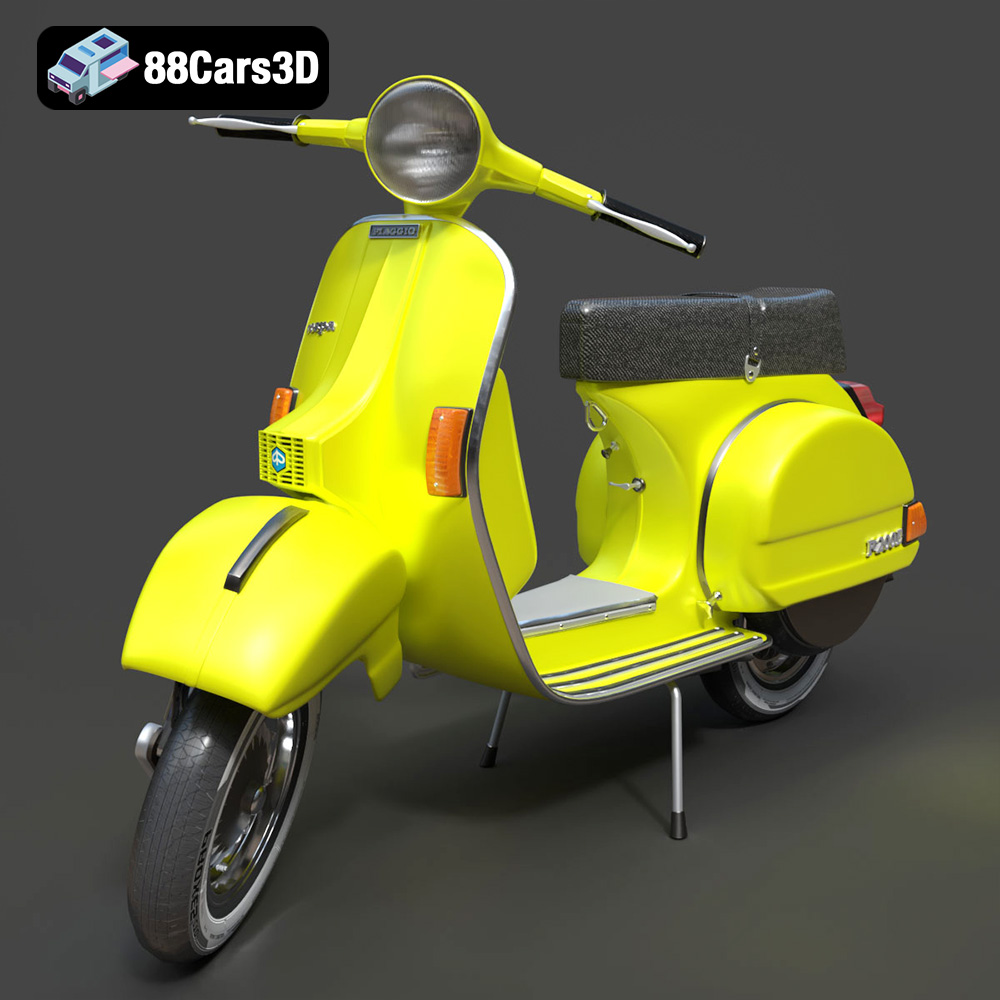
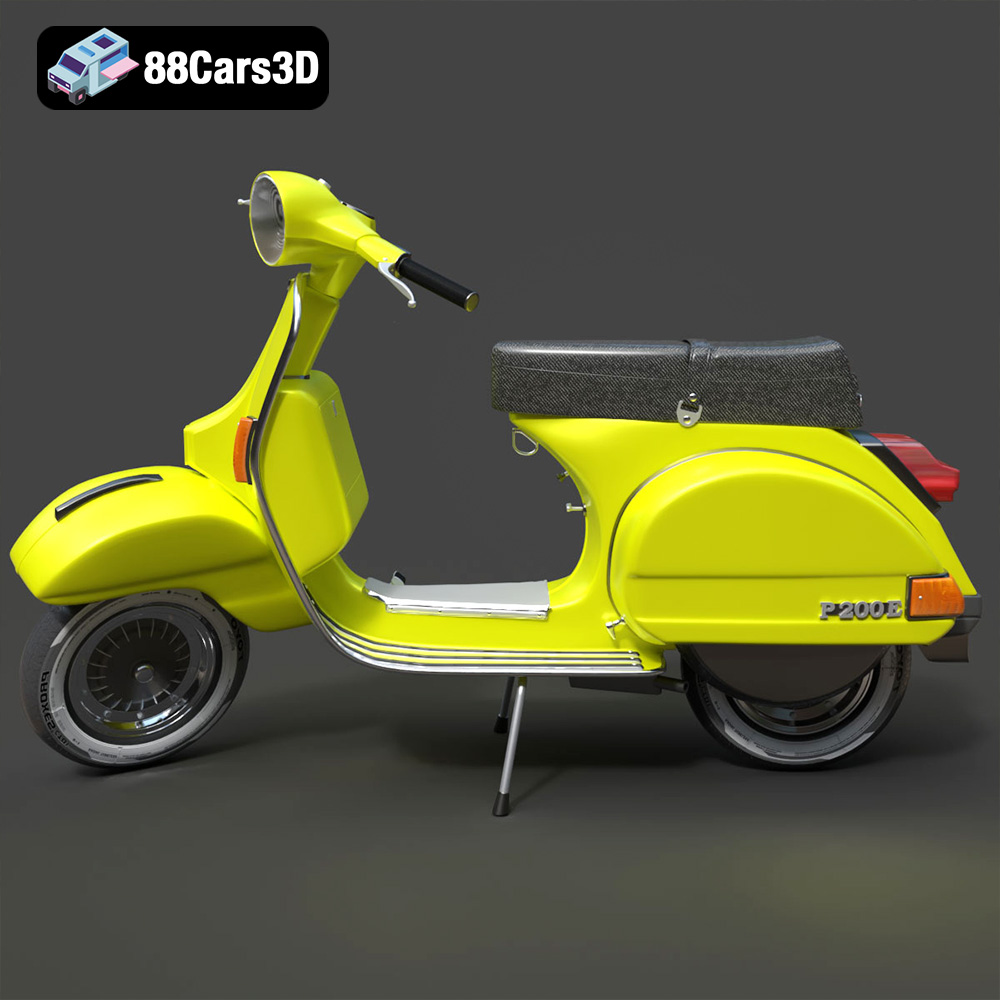
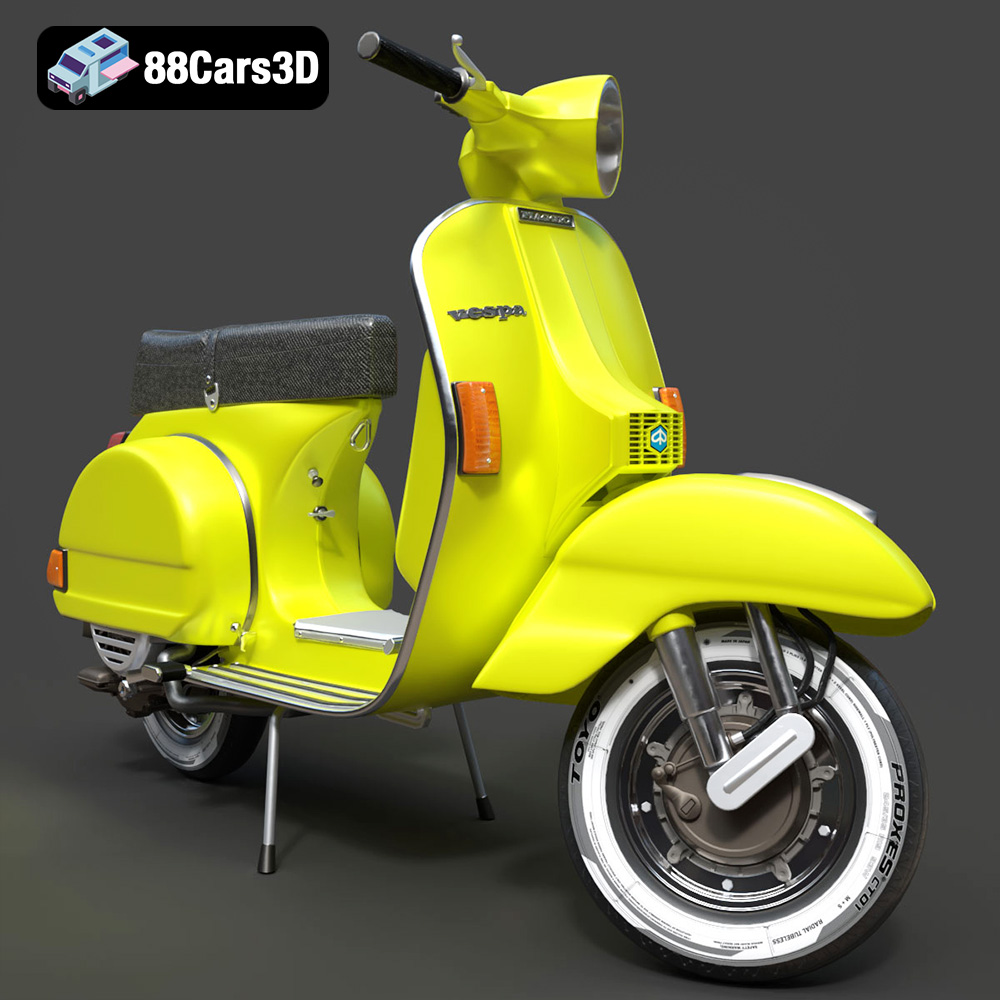
The Vespa P200E is more than just a scooter; it’s a cultural phenomenon, a design masterpiece that defined an era. Its distinctive step-through frame, elegant curves, and unmistakable sound evoke a sense of freedom and timeless style. Recreating such an icon in 3D demands an extraordinary level of precision and respect for its heritage. A well-executed 3D model doesn’t just replicate geometry; it translates the emotional and aesthetic qualities that make the original so beloved. This 3D model of the Vespa P200E perfectly embodies this philosophy, offering an authentic representation that captures its vintage aesthetic from the rounded headlamp to the signature rear engine cowlings.
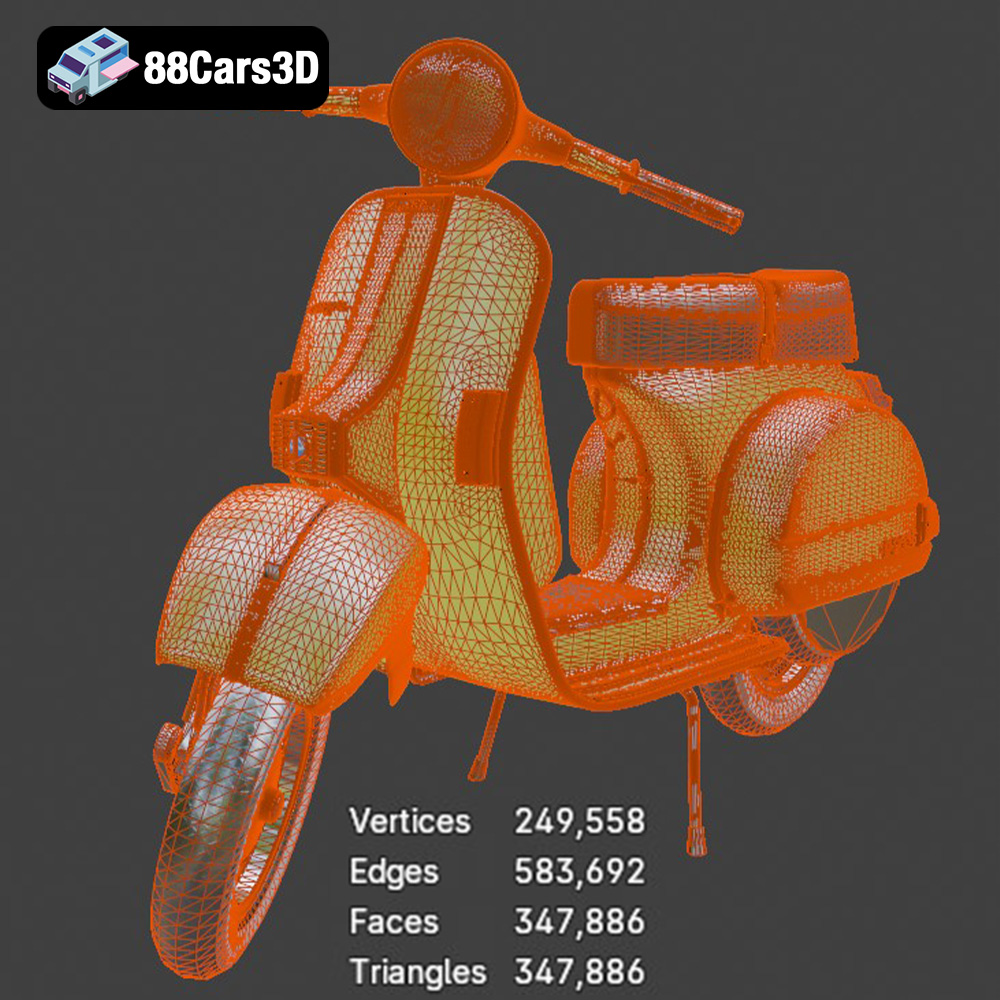
The true power of a high-fidelity 3D model lies in its versatility and efficiency. Imagine the time and resources saved by acquiring a pre-optimized, game-ready asset compared to modeling it from scratch. For complex subjects like vehicles, this advantage is magnified exponentially. Premium 3D models provide not only the raw geometry but also optimized topology, proper UV mapping, and often pre-configured materials, ready for immediate integration into various pipelines. This allows artists and developers to focus on scene composition, animation, and overall storytelling, rather than getting bogged down in repetitive modeling tasks. The Vespa P200E, with its game-ready topology and real-world scale accuracy, is a prime example of such a time-saving, quality-enhancing asset.
The world of 3D modeling is rich with diverse file formats, each designed with specific purposes, compatibilities, and technical characteristics in mind. Understanding these distinctions is crucial for seamless integration into various software environments and production pipelines. The Vespa P200E 3D Model comes with a comprehensive suite of file formats, ensuring maximum flexibility for any project. Let’s delve into each one to clarify their unique advantages and ideal use cases.
The `.blend` file format is the native project file for Blender, the powerful open-source 3D creation suite. When you download a `.blend` file, you’re not just getting a model; you’re getting a fully editable Blender scene. This includes all geometry, materials (often configured for Cycles or Eevee renderers), textures, lighting, camera setups, and even animation data if present. For users entrenched in the Blender ecosystem, this format offers the most flexibility for non-destructive editing, custom modifications, and direct rendering within Blender. It’s ideal for artists who want to deeply customize the Vespa P200E, perhaps adjusting its material node setup or integrating it into a complex animated sequence within Blender itself.
Autodesk’s `.fbx` (Filmbox) format has become an unofficial industry standard for 3D data interchange, particularly dominant in game development and animation. Its strength lies in its ability to store a wide range of data, including mesh geometry, materials, textures, bones, skinning, and animation. `.fbx` is highly optimized for performance, making it the go-to format for importing assets into real-time engines like Unreal Engine and Unity. When using the Vespa P200E in a game development pipeline, the `.fbx` version ensures that all necessary components, such as its optimized mesh and material assignments, transfer cleanly and efficiently, ready for in-engine configuration.
The `.obj` (Wavefront OBJ) format is one of the oldest and most universally compatible 3D file formats. It’s a simple, text-based format primarily used for transferring mesh geometry, including vertices, normals, and UV coordinates. While `.obj` files can reference external `.mtl` (material) files for basic color and texture information, they don’t support advanced material properties, rigging, or animation. This simplicity is also its strength: almost every 3D software application can import and export `.obj` files without issues. For static renders or base geometry modifications of the Vespa P200E, `.obj` provides a robust, error-free foundation.
`.glb` (GL Transmission Format Binary) is a relatively newer format rapidly gaining traction, especially for web-based 3D, augmented reality (AR), and virtual reality (VR) applications. It’s a binary version of `glTF`, designed to be an efficient, single-file container for 3D scenes and models. `.glb` includes geometry, PBR (Physically Based Rendering) materials, textures, animation, and scene hierarchy all in one compact package. Its optimization for quick loading and efficient parsing makes it perfect for displaying the Vespa P200E in browser-based configurators, mobile AR experiences, or light VR applications, where performance and ease of deployment are paramount.
The `.stl` (Stereolithography) format is the standard for 3D printing. It represents a 3D model as a series of connected triangles, describing only the surface geometry without color, texture, or material information. For hobbyists and professionals looking to physically manifest the Vespa P200E, the `.stl` file is essential. The product description for the Vespa P200E even provides detailed 3D print settings, making it easy to convert the digital model into a tangible collectible or prototype, reinforcing its versatility for display-scale hobbyists.
The `.ply` (Polygon File Format) is another format for storing 3D data, often used in applications like 3D scanning, CAD, and scientific visualization. While it can also store polygonal meshes, it has broader support for storing additional data associated with vertices and faces, such as color, transparency, surface normals, and even confidence values. This precision makes `.ply` suitable for detailed analysis or when integrating the Vespa P200E into pipelines that require more granular data than `.obj` or `.stl` might offer, such as reverse engineering or detailed CAD integration.
The `.unreal` format isn’t a direct file extension in the traditional sense, but rather signifies an asset or asset package specifically prepared and optimized for seamless integration into Unreal Engine. This typically means the `.fbx` or `glTF` has been imported, and its materials, textures, collisions, and possibly LODs (Levels of Detail) have been configured within Unreal Engine itself, ready for direct use in real-time environments. For developers working with Unreal, the `.unreal` version of the Vespa P200E implies a minimal setup time and maximum compatibility, reflecting its “game-ready” optimization for Epic Games’ robust platform.
Similar to `.blend` for Blender, `.max` is the native project file format for Autodesk 3ds Max, a long-standing industry leader in 3D modeling, animation, and rendering. A `.max` file contains the complete scene information, including complex modifiers, animation timelines, lighting setups, cameras, and advanced material definitions (e.g., V-Ray or Corona Renderer materials). For professionals using 3ds Max, the `.max` version of the Vespa P200E offers the highest degree of editability and control for high-end rendering, complex animation sequences, or integration into existing 3ds Max projects.
Creating a 3D model that balances visual authenticity with technical performance is an art form in itself. The Vespa P200E 3D Model from 88cars3d.com exemplifies this balance, demonstrating an acute understanding of both design fidelity and pipeline efficiency. Its construction is a testament to meticulous craftsmanship, ensuring it performs optimally across diverse applications.
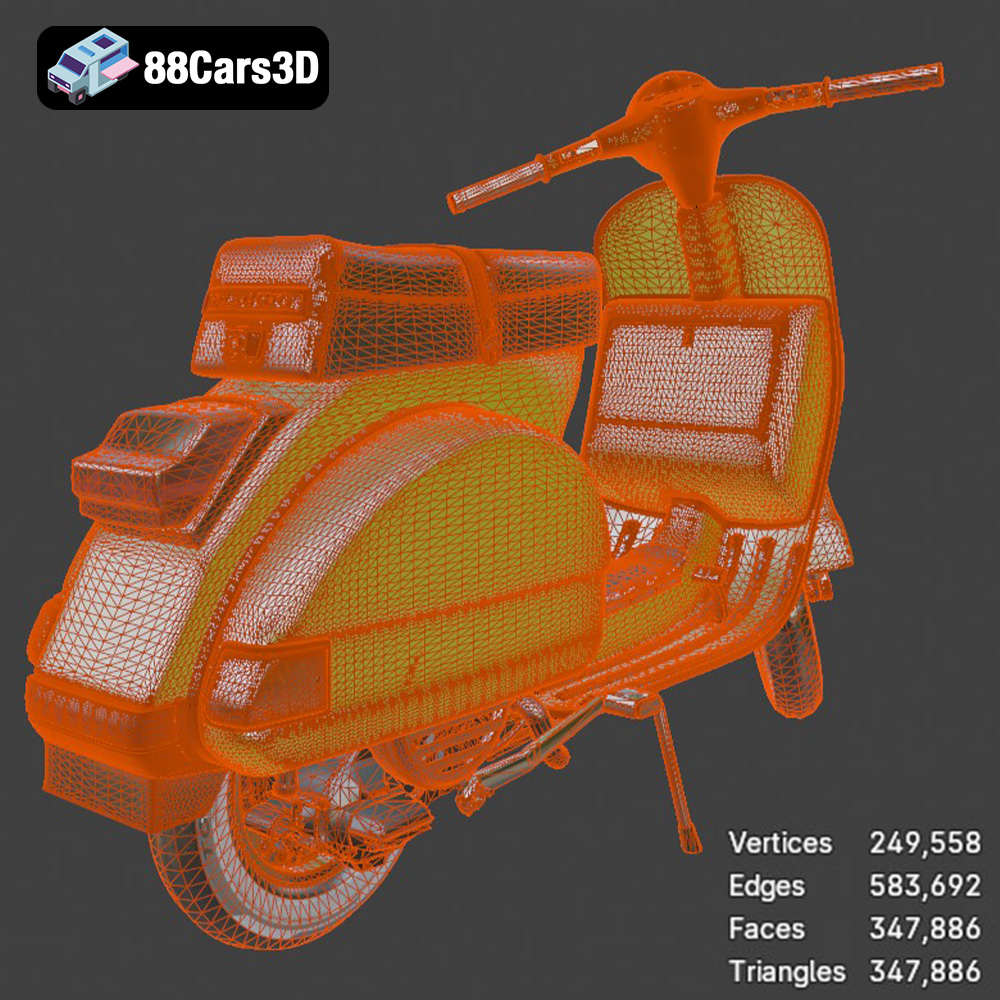
One of the standout features of this Vespa P200E model is its game-ready topology, boasting approximately 50,000 triangles. This polycount strikes a perfect equilibrium, delivering stunning visual realism without compromising performance in real-time environments like Unreal Engine or Unity. In game development, every triangle counts; an excessively high polycount can bog down frame rates, while too few triangles can lead to blocky, unrealistic visuals. The ~50,000 triangle count for a detailed vehicle like the Vespa P200E is a sweet spot, allowing for smooth shading, crisp details, and excellent material response even on mid-range hardware. This optimization extends beyond just polycount; the clean geometry and efficient UV mapping ensure that texture memory usage is minimized and rendering is swift.
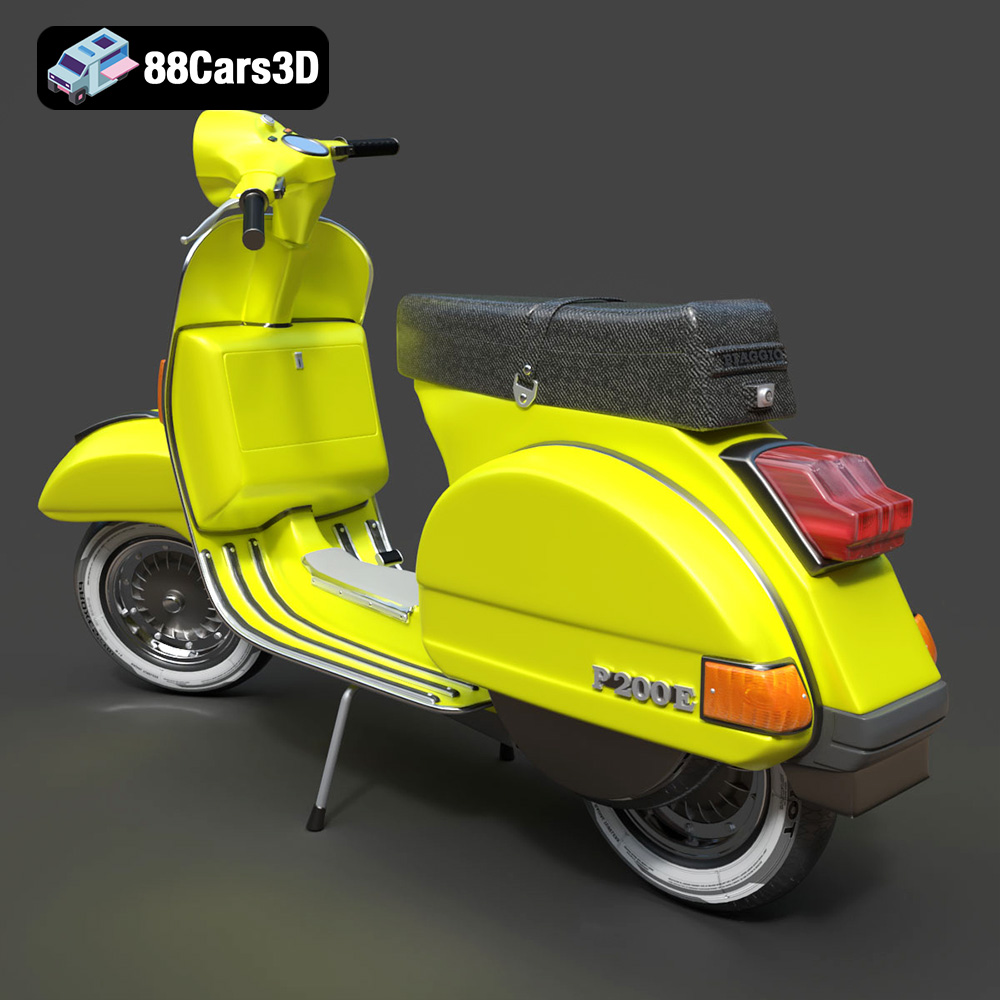
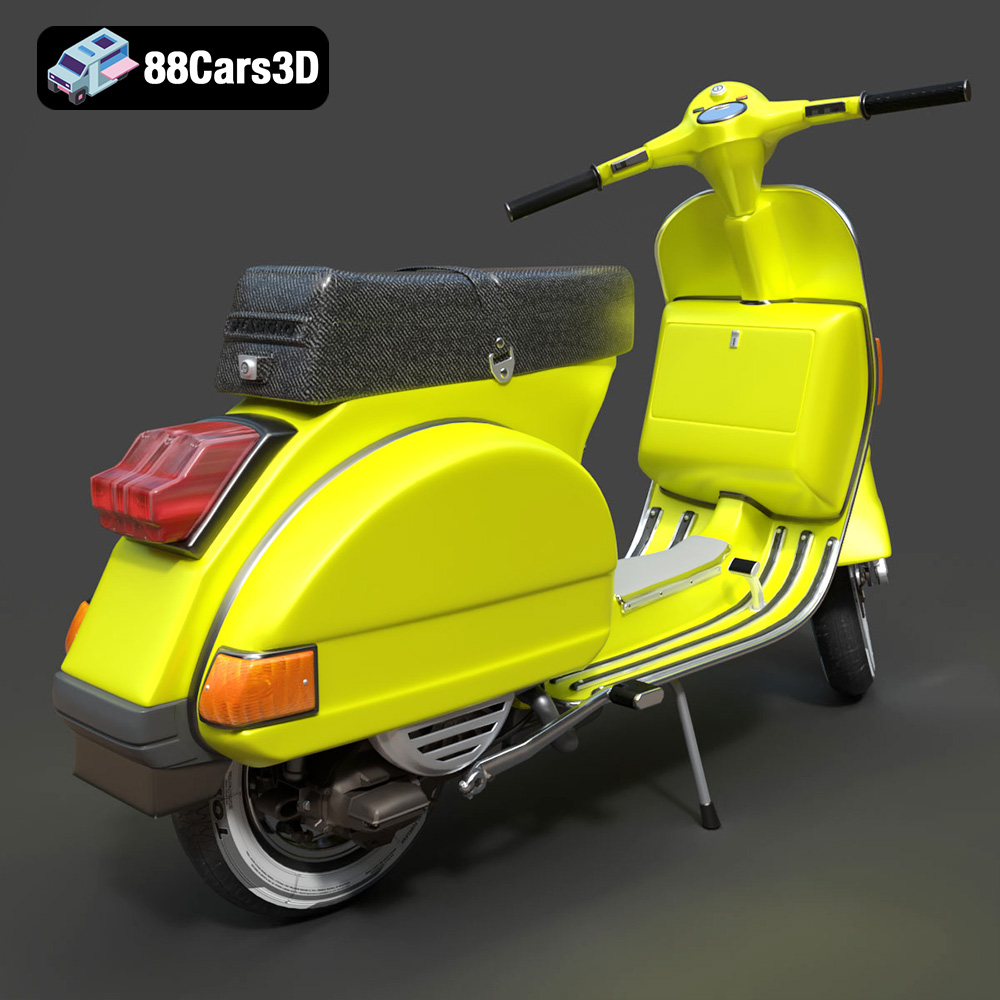
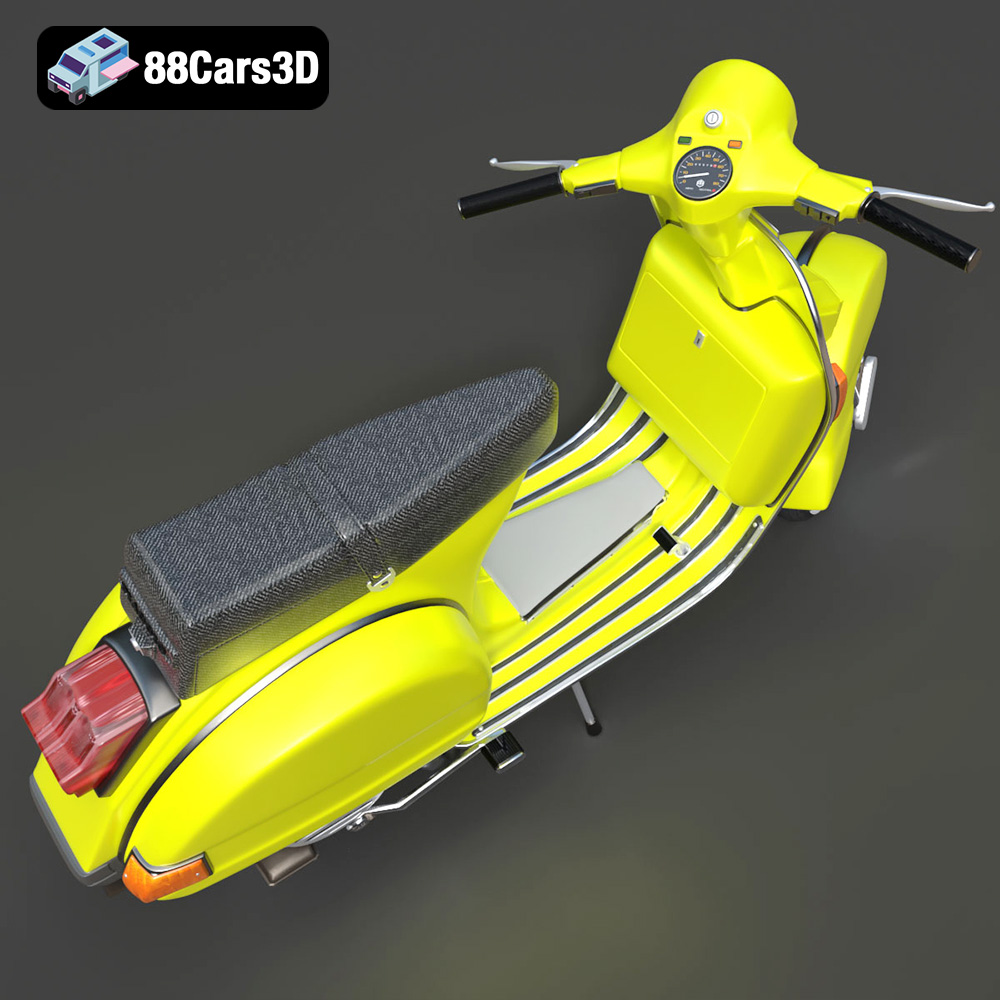
The essence of the Vespa P200E’s charm lies in its distinctive features, and this 3D model meticulously recreates each one. The accurate step-through frame geometry and proportions are faithfully preserved, providing an immediate sense of recognition. Details extend to the internal mechanisms, with a carefully modeled 2-stroke engine housing and transmission case, and an authentic classic exhaust box. On the exterior, signature elements like the round headlight, classic indicators, and integrated taillight are all present and accounted for. Even the 10-inch wheels feature accurate classic tread patterns. Inside the cockpit, the classic dual-seat design with textured upholstery, signature curved handlebars with integrated controls, and the authentic vintage analog speedometer contribute to an immersive experience. The detailed floorboard with anti-slip strips and foot brake pedal further enhances the realism, making it suitable for even first-person POV in gaming.
Beyond static beauty, the Vespa P200E 3D Model is engineered for dynamic scenarios. It features separate wheels, suspension, and steering components, each with proper pivot setups. This thoughtful design is critical for animators and game developers, as it allows for realistic steering, wheel rotation, and suspension travel without complex rigging efforts. Whether you’re animating a cinematic sequence, integrating it into a driving simulator, or setting up interactive controls in a virtual experience, the pre-configured pivots significantly streamline the animation process, saving countless hours of setup time and ensuring physically accurate movement.
The true measure of a high-quality 3D asset lies in its utility across diverse professional applications. The Vespa P200E 3D Model, with its optimized geometry, detailed features, and multiple file formats, is designed to be a workhorse for creative industries.
For game developers, the Vespa P200E is an ideal addition to open-world games, racing titles, and urban simulators. Its optimized ~50,000 triangle count strikes the perfect balance between visual fidelity and real-time performance, making it a “game-ready” asset. Imagine a bustling European city street in a modern open-world RPG, enhanced by the presence of this iconic scooter. Its proper pivot setup for steering and wheel rotation allows for easy integration into vehicle physics systems, providing players with an authentic driving experience. Developers can quickly texture and integrate the model into engines like Unreal or Unity, leveraging its clean topology for smooth deformations and realistic lighting.
Augmented Reality (AR) and Virtual Reality (VR) applications demand highly optimized models that maintain visual quality while delivering fluid interactivity. The `.glb` format, included with the Vespa P200E, is perfect for such immersive experiences. Imagine a virtual showroom where customers can walk around the Vespa, inspect its details up close, or even change its color in real-time. Brands can utilize this model for interactive mobile AR experiences, allowing users to “place” the scooter in their own environment. Its real-world scale accuracy further enhances the sense of presence in these virtual spaces, creating compelling and engaging user interactions.
For advertising agencies, product designers, and visualization studios, the Vespa P200E 3D Model is an exceptional tool for creating stunning renders and brand campaigns. Its meticulous detailing and authentic proportions make it perfect for lifestyle scenes, studio lighting setups, or architectural visualizations that require an element of vintage charm. Artists can leverage the `.max` or `.blend` files to fully customize materials, lighting, and camera angles, producing photorealistic images for brochures, websites, or video advertisements. The ability to modify body colors, tire textures, and material finishes means endless possibilities for bespoke visualization projects, ensuring that the model can be adapted to any creative brief.
The inclusion of an `.stl` file specifically caters to the growing community of 3D printing enthusiasts and professionals. The Vespa P200E can be converted from a digital asset into a tangible display piece. The product description provides crucial 3D print settings, recommending scales like 1:12, 1:18, or 1:24, and suggesting resin printing for fine details. Guidance on layer height, wall thickness, infill, and support structures ensures successful prints. This extends the model’s utility beyond purely digital mediums, allowing designers to create physical prototypes, collectors to own a miniature replica of their favorite scooter, or artists to craft unique custom pieces.
The true value of a versatile 3D asset like the Vespa P200E lies not just in its inherent quality but in the ease with which it can be customized and integrated into diverse scenes. This flexibility allows artists to tailor the model to specific project requirements, enhancing its visual impact and narrative potential.
The Vespa P200E 3D Model is designed with customization in mind. Artists have the freedom to change body and tank colors, applying anything from authentic factory colors to custom metallic finishes or matte treatments. This allows the scooter to seamlessly fit into different aesthetic contexts, from a vibrant, modern advertising campaign to a grittier, post-apocalyptic game environment. Furthermore, the ability to modify tire textures opens up possibilities for different scenarios – street variants for urban scenes, or even a more rugged texture for an off-road interpretation. The model’s clean geometry ensures that new materials and textures will apply smoothly and render beautifully, maintaining visual integrity.
A 3D model’s appearance is heavily influenced by its environment. The Vespa P200E’s robust construction and proper UV mapping make it highly adaptable to various lighting conditions and scene environments. Whether it’s bathed in the warm glow of a sunset, positioned under harsh studio lights, or parked beneath dappled city streetlights, the model will react realistically. Artists can experiment with different HDRI maps, global illumination settings, and volumetric effects to create specific moods and atmospheres, from a sun-drenched Italian piazza to a moody, rain-soaked alley. The accurate material response ensures that metallic parts shine, paint reflects, and rubber textures grip, regardless of the lighting setup.
Integrating premium automotive 3D car models like the Vespa P200E into a scene is about more than just placing an object; it’s about telling a story. A classic scooter can evoke nostalgia, represent freedom, or signify a character’s personality. By customizing its condition (pristine or weathered), its accessories (helmets, luggage), and its placement within a carefully designed environment, artists can craft compelling narratives. For instance, a vintage Vespa parked outside a retro cafe might suggest a character’s quaint lifestyle, while a slightly battered one left in a neglected garage could hint at a past adventure. The inherent character of the Vespa P200E, combined with its customization potential, makes it an invaluable storytelling tool.
In the competitive landscape of digital media production, where time is money and quality is paramount, leveraging professionally crafted 3D assets is not just a convenience—it’s a strategic advantage. Premium automotive 3D car models fundamentally impact project efficiency, visual quality, and overall market success.
Developing a complex 3D model like a vehicle from scratch is an incredibly time-consuming and expensive endeavor. It requires skilled 3D modelers, texture artists, and often technical artists for optimization and rigging. By acquiring a high-quality, pre-optimized asset such as the Vespa P200E 3D Model from a reputable marketplace like 88cars3d.com, studios can significantly reduce production timelines and labor costs. This allows teams to allocate resources to other critical aspects of a project, such as level design, animation, or interactive mechanics, without compromising on the visual fidelity of key assets. The immediate availability of a game-ready, multi-format model accelerates development cycles and ensures projects stay within budget.
For companies involved in automotive design, marketing, or lifestyle branding, the visual presentation of vehicles is crucial. High-quality 3D models enable the creation of stunning marketing materials, interactive product configurators, and immersive virtual experiences that capture attention and drive engagement. The Vespa P200E, with its detailed exterior and interior features, allows brands to showcase the scooter’s iconic design with unparalleled realism. This level of detail in 3D car models fosters a deeper connection with audiences, whether it’s through a cinematic render on a website or an interactive virtual walkthrough in a mobile application. It elevates the perceived value of both the product and the brand.
88cars3d.com is committed to providing artists and developers with high-quality 3D car models that meet professional standards. The Vespa P200E 3D Model is a prime example of this commitment, offering detailed craftsmanship, technical optimization, and broad format compatibility. By sourcing models from 88cars3d.com, creators gain access to a reliable library of assets that are rigorously tested and prepared for immediate integration into demanding production pipelines. This focus on quality and versatility empowers users to achieve their creative visions with confidence and efficiency.
The digital landscape is one of continuous innovation, demanding both artistic flair and technical precision. For projects involving automotive themes, the choice of 3D assets can be a defining factor in a project’s success. As we’ve explored, a meticulously crafted 3D car model, such as the Vespa P200E, offers an incredible array of advantages, from its game-ready optimization and detailed realism to its broad compatibility across various software and applications.
Whether you’re an indie game developer aiming for immersive virtual worlds, an automotive designer creating next-generation visualizations, or a marketing professional crafting compelling brand narratives, premium 3D models serve as indispensable tools. They provide the foundation for breathtaking visuals, streamline complex workflows, and ultimately free up creative energy for innovation. The Vespa P200E 3D Model, with its detailed features, extensive file format support, and animation-ready components, is more than just a model; it’s a versatile asset ready to accelerate your creative vision. Investing in such quality assets from resources like 88cars3d.com means investing in efficiency, fidelity, and the success of your next project. Embrace the digital road and let these expertly crafted models drive your creations forward.
The Vespa P200E is a true icon of Italian design, celebrated for its timeless styling and reliable 2-stroke engine. This 3D model perfectly captures the scooter’s distinctive step-through frame, signature rear engine cowlings, and classic vintage aesthetic that made it a cultural phenomenon. From the rounded headlamp to the unmistakable tail section, every curve has been meticulously recreated to offer an authentic representation of this legendary two-wheeler. Crafted with a focus on optimization and visual fidelity, this model features a game-ready topology of approximately 50,000 triangles. It delivers stunning realism without sacrificing performance in real-time environments. The clean geometry ensures smooth shading and excellent material response, making it highly versatile for game development, AR/VR applications, animation, and high-end visualization.
$39.99
.blend
.fbx
.glb
.max
.obj
.ply
.rendering
.scooter
.stl
.unreal
.vespa
.vintage
classic-scooter
game asset
game-ready
low-poly
motorcycle-3d-model
optimized
p200e
VR/AR