Get 20% OFF All Premium 3D & STL Models!

The world of 3D modeling continually blurs the lines between digital artistry and engineering precision. Nowhere is this more apparent than in the meticulous creation of 3D car models, where every curve, every rivet, and every material nuance must be faithfully reproduced. For professionals in game development, automotive rendering, and visualization, a high-quality 3D asset is not just a model; it’s a foundation for immersive experiences, captivating visuals, and technically accurate simulations. This commitment to authenticity is perfectly embodied in models like the 1971 Ford E-Series Econoline Club Wagon, a digital classic that transcends mere aesthetics to offer a versatile, performance-optimized asset for a myriad of professional applications.
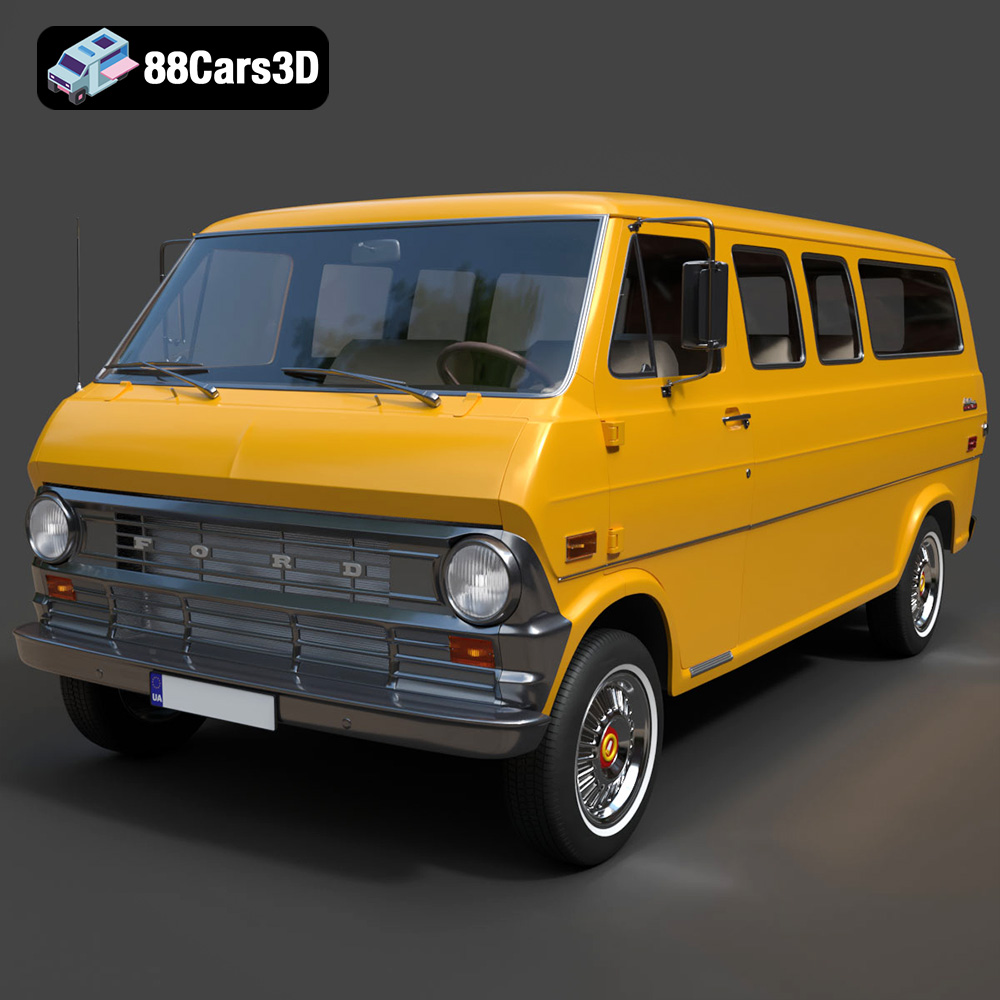
The Ford E-Series Econoline Club Wagon, with its distinctive “short-nose” design, stands as an icon of 1970s American road culture. Capturing this vintage charm requires a deep understanding of automotive design history and advanced 3D modeling techniques. From its utilitarian front grille and classic round headlights to its robust chassis and period-correct V8 or inline-six engine placement, every detail in its 3D rendition is designed to evoke nostalgia while meeting stringent technical demands. Whether you’re building an open-world game, developing an interactive AR/VR experience, or crafting a photorealistic architectural visualization, having access to such a meticulously crafted asset, available for download at 88cars3d.com, can significantly accelerate your workflow and elevate your project’s visual fidelity.
Classic vehicles hold a unique place in popular culture and design history. Their forms often represent pivotal moments in engineering and style, making them compelling subjects for 3D artists and valuable assets for various industries.
Classic cars are more than just modes of transport; they are cultural artifacts, often symbolizing eras, movements, and lifestyles. A faithfully reproduced 3D model of a classic, like the 1971 Ford E-Series Econoline Club Wagon, allows creators to transport audiences back in time. Game developers can populate their virtual worlds with historically accurate vehicles, enhancing immersion. Filmmakers and advertisers can create period-piece scenes with precise authenticity. This digital preservation allows designers to study classic aesthetics, understand past engineering solutions, and even use these models as inspiration for modern designs. The E-Series Econoline, for instance, evokes the spirit of family road trips, burgeoning counterculture, and a distinctly American sense of freedom, all of which are palpable even in its digital form.
For any professional application, accuracy is paramount. In 3D modeling, this means more than just visual similarity; it extends to scale, proportions, and even the underlying mechanical components. A truly accurate 3D car model, such as those found on 88cars3d.com, should reflect real-world dimensions and engineering principles. This level of detail ensures that if the model is used for simulations, vehicle dynamics, or even 3D printing, it behaves and appears as its real-world counterpart would. For the 1971 Econoline, this includes accurate frame geometry, detailed engine block representation, and period-correct undercarriage components, crucial for scenarios ranging from realistic driving simulations to educational digital archives.
Navigating the diverse landscape of 3D model file formats is a critical skill for any professional working with digital assets. Each format offers distinct advantages and serves specific purposes, making the choice of file type crucial for compatibility, performance, and workflow efficiency. The 1971 Ford E-Series Econoline Club Wagon 3D model comes with a comprehensive suite of formats, ensuring its versatility across virtually any professional pipeline.
When working within specific software ecosystems or requiring maximum editability, native formats are invaluable. The .blend format provides a fully editable Blender scene, complete with materials, lighting, and any animation setups. This is ideal for artists who primarily work in Blender and need to make extensive modifications, re-texture, or integrate the model deeply into an existing Blender project. Similarly, the .max format serves as an editable 3ds Max project. It offers the same level of flexibility for 3ds Max users, allowing access to the original scene’s hierarchies, modifiers, and rendering setups, making it perfect for animation, rendering, and complex scene integration within an Autodesk-centric workflow.
For broader compatibility, universal formats are indispensable. The .obj (Wavefront OBJ) format is one of the most widely supported 3D file formats, making it excellent for cross-software compatibility. It stores geometry (vertices, normals, UVs) and can reference material definitions (MTL files). While it doesn’t typically store advanced scene data like animations or rigging, its universality ensures that the Ford Econoline model can be imported into almost any 3D application, from Maya and Cinema 4D to various CAD programs, serving as a reliable mesh interchange format. The .fbx (Filmbox) format, developed by Autodesk, is another cornerstone for interoperability, particularly strong in game development and animation pipelines. It supports not only geometry and materials but also skeletal animation, rigging, and camera data. This makes .fbx an ideal choice for transferring the Econoline model into game engines like Unreal and Unity, or between DCC applications, preserving animation and structural hierarchies.
For real-time environments, specialized formats are optimized for performance and ease of use. The .unreal format signifies an engine-ready asset specifically tailored for Unreal Engine. This often means the model has been pre-configured with appropriate materials, LODs (Levels of Detail), and collision meshes, minimizing setup time for developers. Similarly, .fbx is a primary format for Unity and Unreal due to its robust support for game asset requirements. The .glb (GL Transmission Format Binary) is a modern, compact format optimized for efficient loading in AR, VR, and browser-based 3D applications. It encapsulates models, textures, and animations into a single binary file, making the Ford Econoline easily deployable in webGL viewers or mobile AR experiences where file size and quick loading are critical.
The convergence of digital modeling and physical fabrication necessitates specific file types. The .stl (Standard Tessellation Language) format is the de facto standard for 3D printing. It represents a 3D model as a series of connected triangles, defining the surface geometry without color or texture information. This format allows hobbyists and professionals to take the digital 1971 Econoline and transform it into a tangible, display-scale model. For more advanced or precise applications, the .ply (Polygon File Format) offers a versatile means to store 3D data, including not only vertex positions and face lists but also properties like color, transparency, and even texture coordinates. While .stl is a surface description, .ply can handle a richer dataset, making it suitable for scientific visualization, CAD, or analysis where precision and additional attributes are required beyond simple mesh geometry.
Each of these formats facilitates a different aspect of professional 3D workflow, from intricate modeling and animation to game deployment and physical fabrication. The availability of the 1971 Ford E-Series Econoline Club Wagon in such a diverse array of formats ensures its maximal utility and adaptability for any project on 88cars3d.com.
Creating a high-quality 3D car model is an intricate process that demands both artistic vision and technical acumen. The 1971 Ford E-Series Econoline Club Wagon 3D model exemplifies this balance, delivering both authentic aesthetics and robust technical specifications.
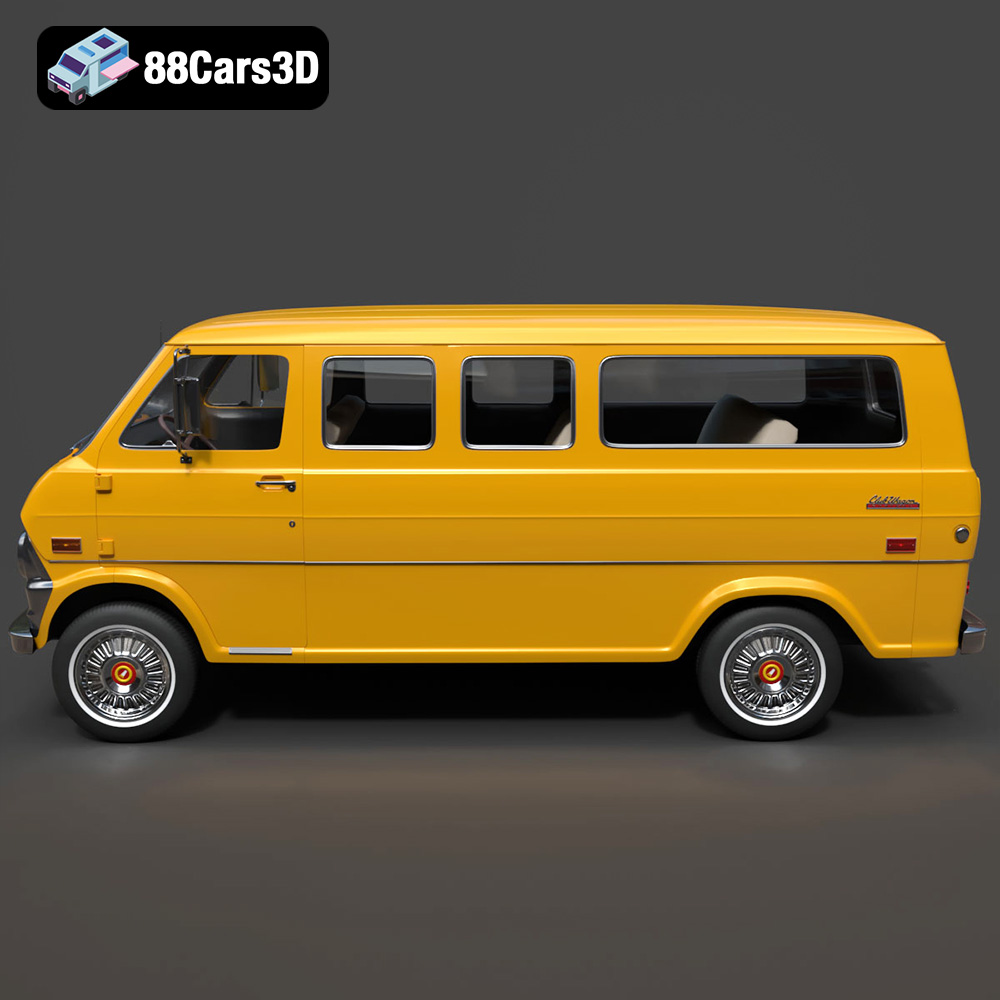
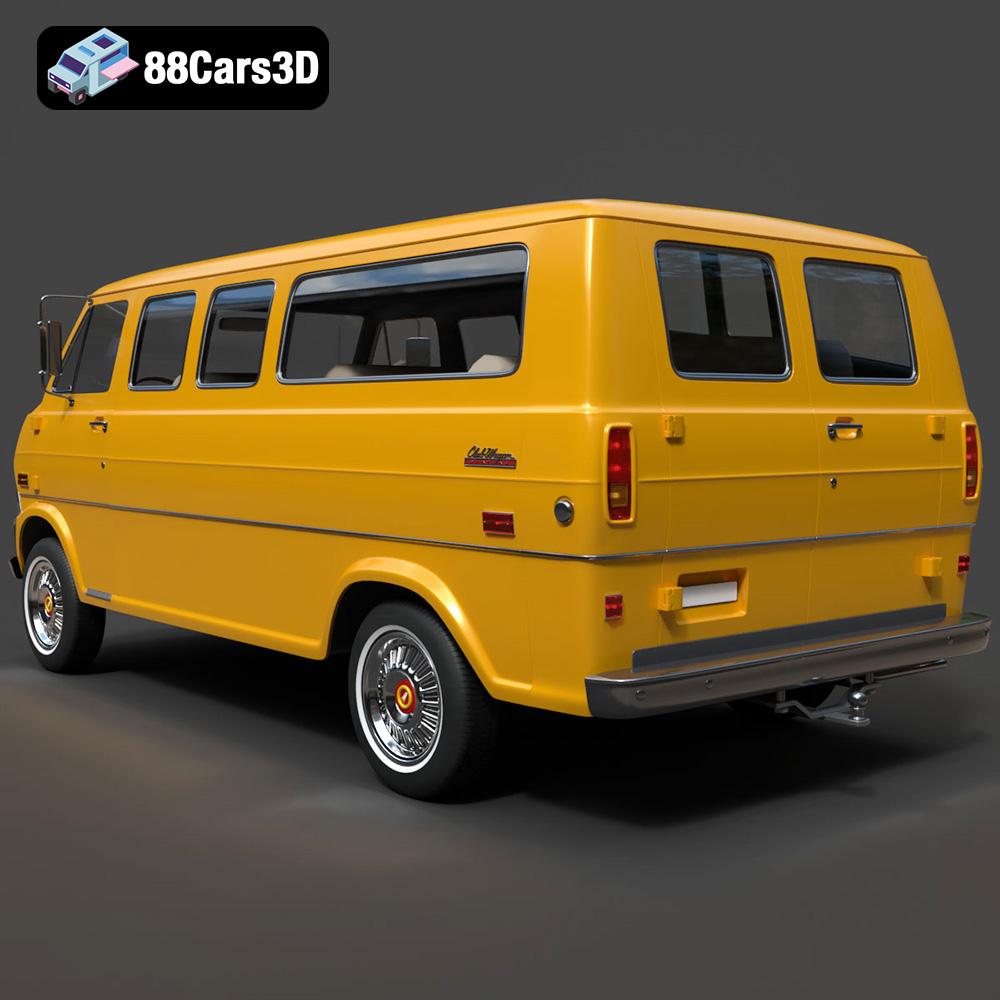
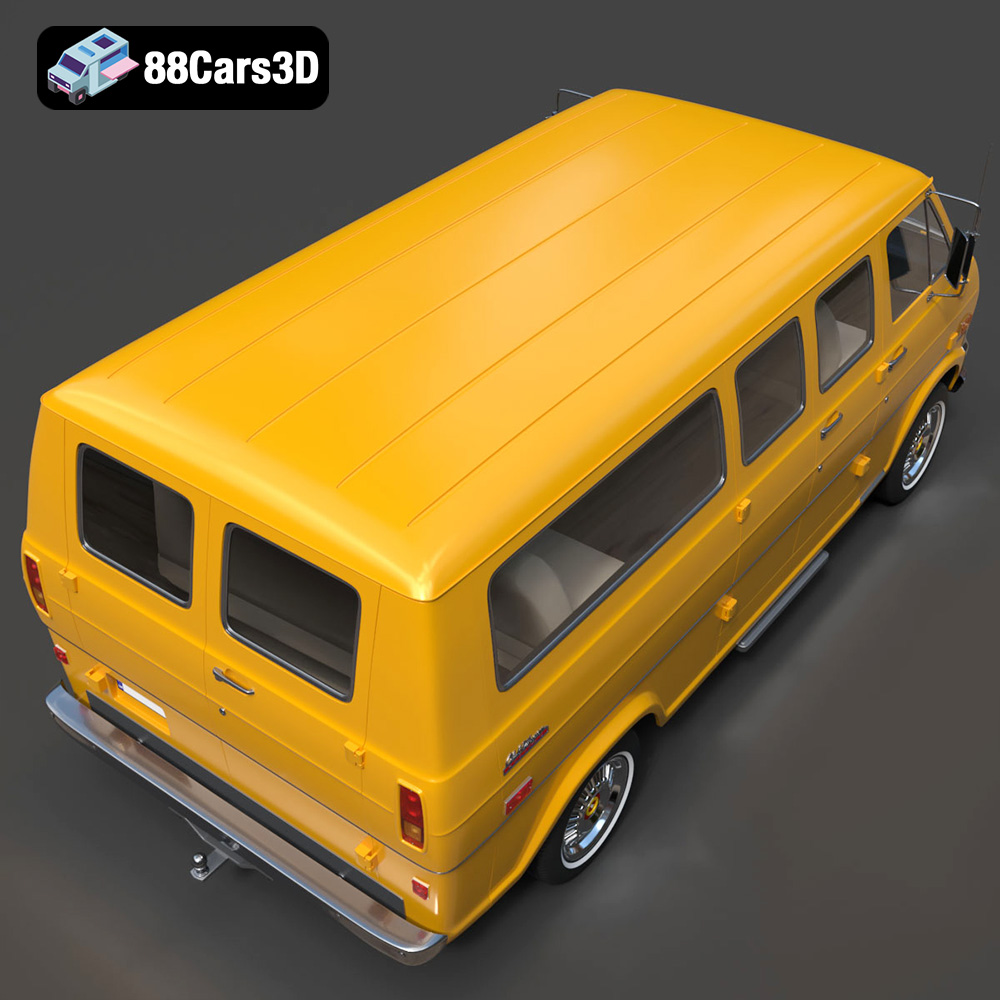
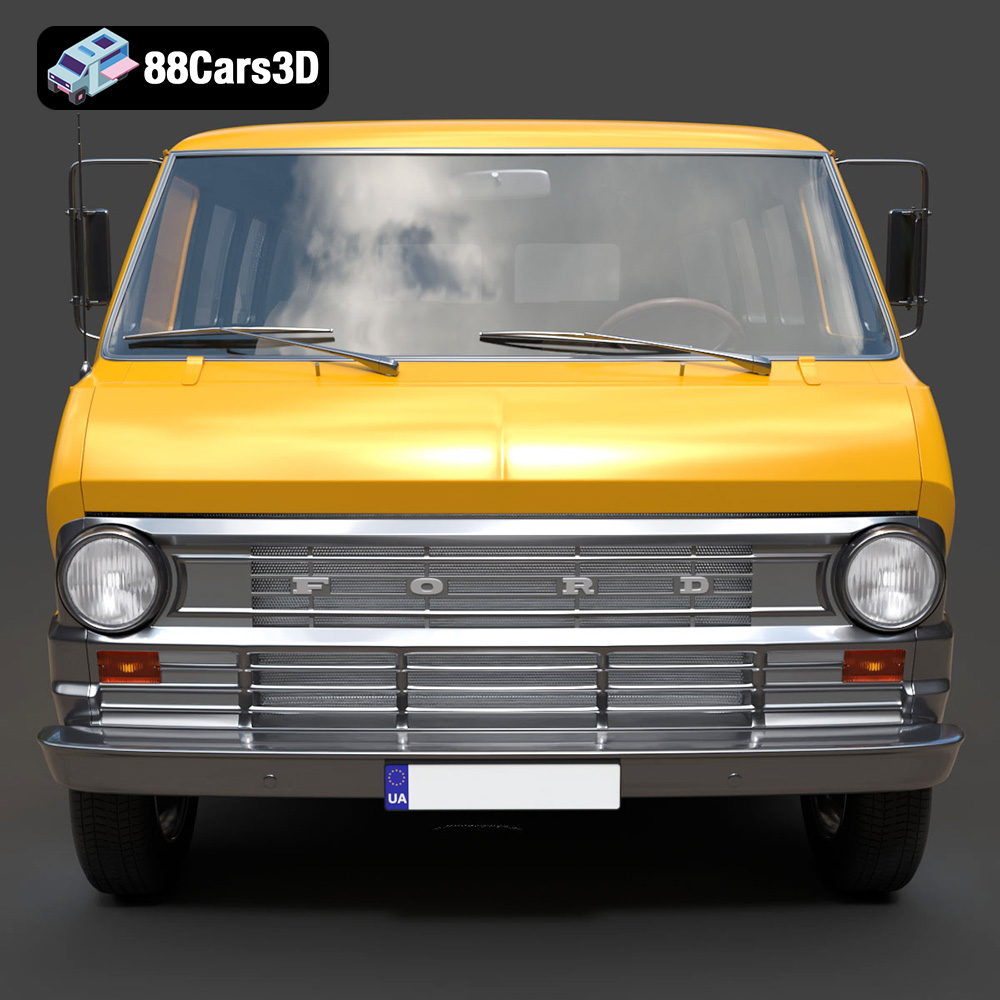
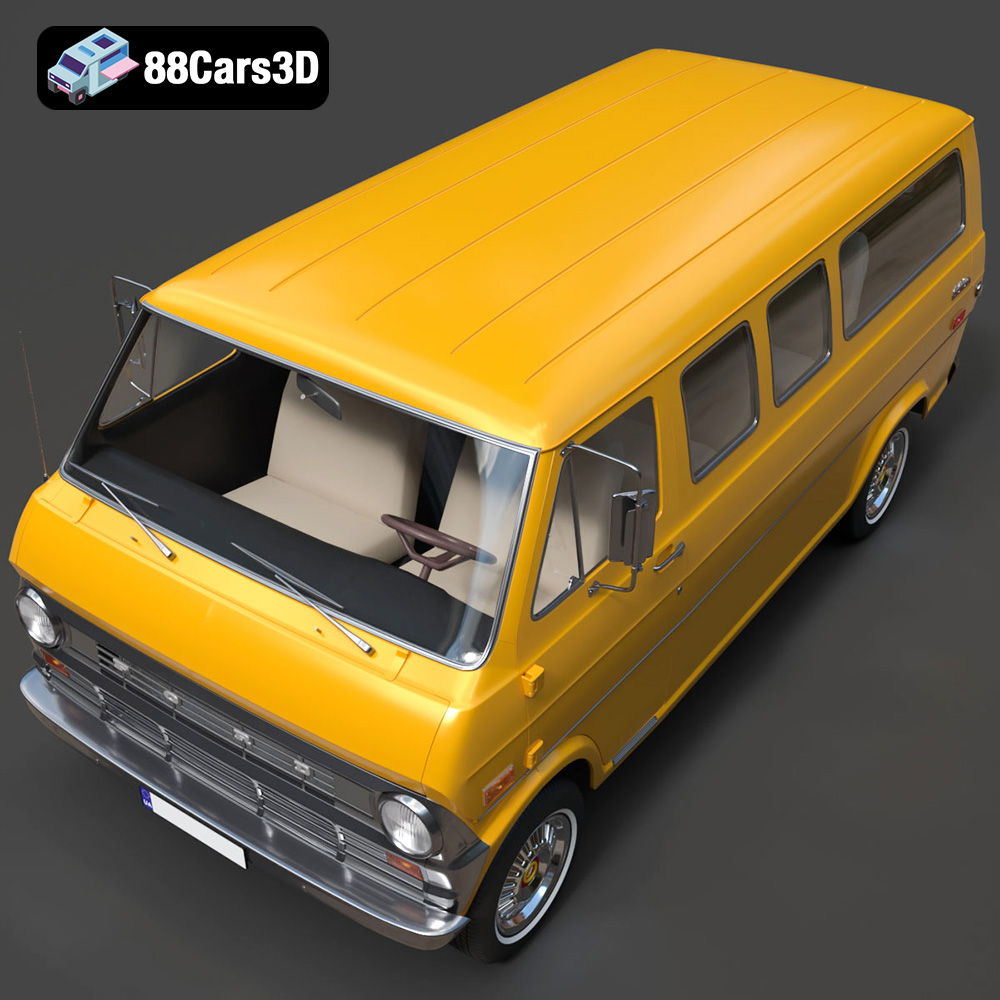
The exterior of the Econoline Club Wagon model is a masterclass in historical accuracy. Every dimension, from the iconic “short-nose” forward-control design to the elongated body, mirrors the real-world vehicle. The bold, utilitarian front grille, distinct round headlights, and vertical taillights are not merely approximate representations but carefully modeled features based on period references. The classic steel wheels with chrome hubcaps and high-profile tires further cement its retro appeal. This attention to detail extends to the subtle nuances of body panels and window frames, ensuring that reflections and lighting interact realistically with the surfaces, whether in a high-fidelity render or a real-time game environment.
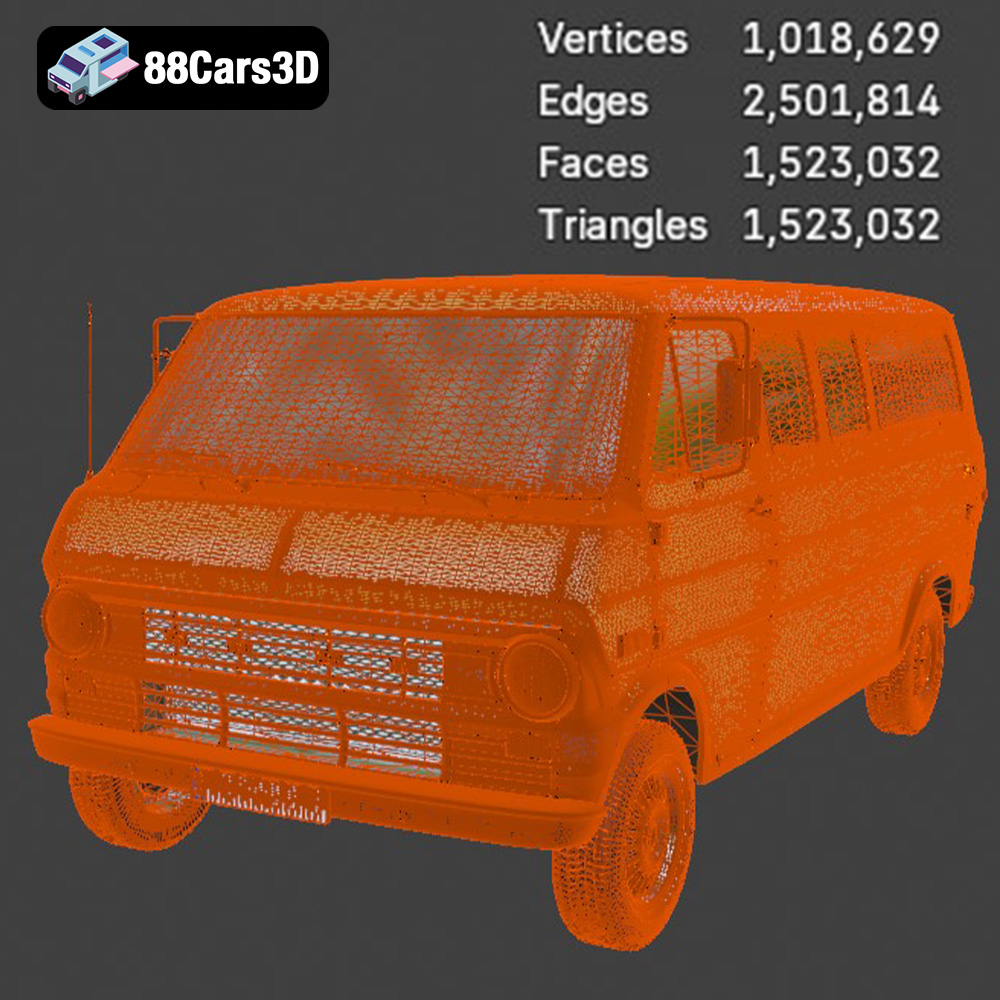
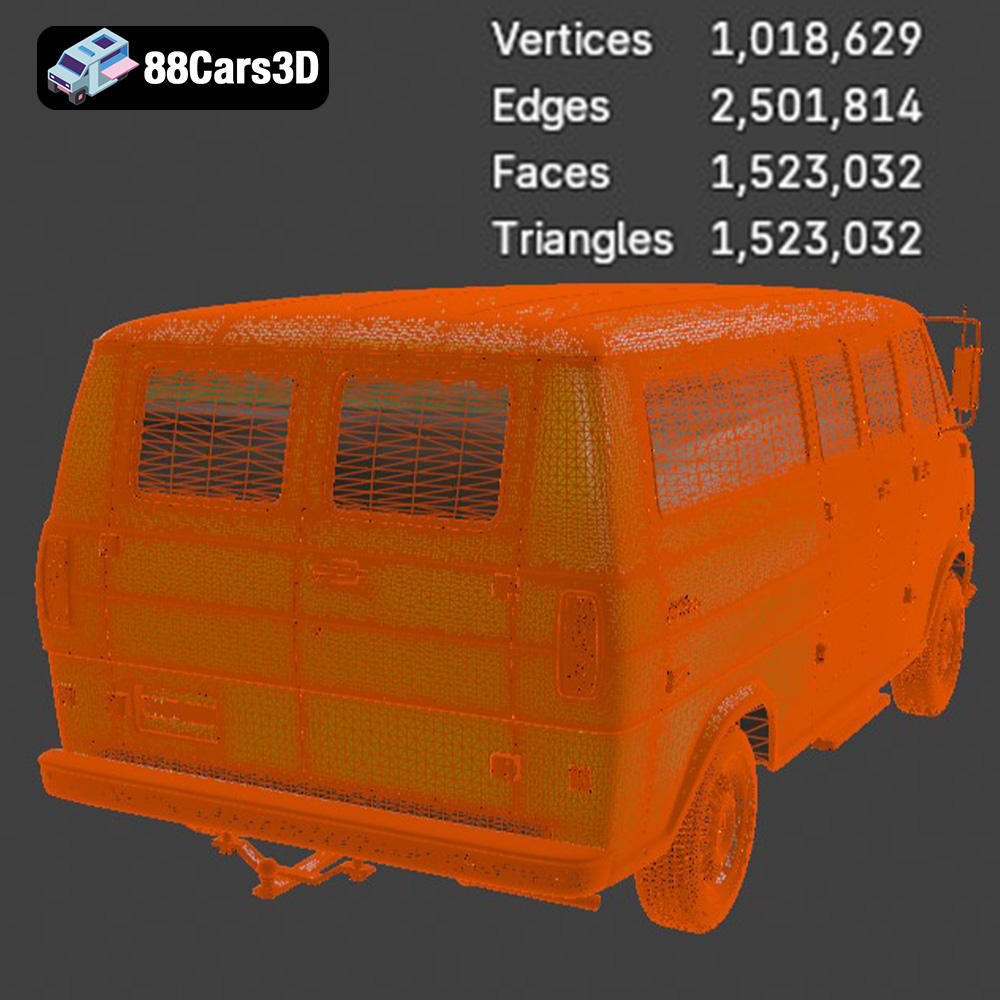
The interior of the Econoline is just as thoughtfully designed. Stepping inside (virtually), one finds a spacious multi-row passenger seating arrangement complete with classic vinyl texture detailing. The two-spoke steering wheel, utilitarian instrument cluster with analog dials, and accurate control details like floor pedals and a column shifter create an authentic cockpit experience. What makes this particularly valuable for game development is its optimized geometry. With approximately 250,000 triangles, the model strikes an excellent balance between visual realism and game-ready performance. This moderate poly count ensures smooth frame rates, even in heavy game environments or interactive VR applications, while maintaining enough detail for first-person POV immersion.
Beyond the visible surfaces, the model incorporates structural representations critical for advanced use cases. It features a detailed engine block honoring the classic Ford V8/Inline-6 design, period-correct undercarriage components, and a vintage exhaust system. Crucially for animators and simulation specialists, the model includes separate wheels, suspension, and steering components. This modularity, combined with a proper pivot setup, allows for realistic steering, wheel rotation, and suspension travel animations, making it an invaluable asset for racing games, simulators, or cinematic sequences where vehicle dynamics are paramount. The real-world scale accuracy further enhances its utility across a wide range of professional tasks.
The true value of a versatile 3D asset lies in its ability to seamlessly integrate into diverse professional workflows. The 1971 Ford E-Series Econoline Club Wagon 3D model is specifically engineered for this, offering robust compatibility and optimization for leading platforms.
For game developers, the Econoline model is a dream to work with. Its optimized ~250,000 triangle count is ideal for real-time engines like Unreal Engine and Unity, ensuring minimal performance overhead. The availability of the .fbx and .unreal formats means developers can import the model with confidence, knowing that material assignments, UVs, and potential LOD setups are preserved. In Unreal Engine, artists can quickly apply advanced material instances, set up realistic physics for the separated suspension and wheel components, and integrate it into vehicle blueprints for drivable gameplay. For Unity, the .fbx format facilitates straightforward import and configuration for its Universal Render Pipeline (URP) or High-Definition Render Pipeline (HDRP), allowing for stunning visual quality even in mobile or VR titles. This model is perfect for populating open-world vintage driving games or adding a touch of retro realism to a racing simulator.
Beyond real-time applications, the Ford Econoline excels in offline rendering scenarios. Professionals using 3ds Max can leverage the .max file to access the original scene, refine materials, adjust lighting, and create photorealistic renders for advertising, architectural visualization, or cinematic sequences. The detailed geometry ensures that studio lighting setups yield accurate reflections and highlights, bringing out the classic lines of the van. Blender artists benefit from the .blend file, offering complete control over the model. They can easily integrate it into existing scenes, utilize Blender’s powerful Cycles or Eevee renderers for stunning visualizations, and even use its animation tools to create captivating car commercials or visual effects shots. Whether it’s a nostalgic lifestyle scene or a detailed product showcase, this model provides the foundation for high-end automotive rendering.
The advent of AR and VR technologies has opened new avenues for showcasing products and creating immersive experiences. The 1971 Econoline, available in the .glb format, is perfectly suited for these emerging platforms. Its optimized polycount and single-file structure (for .glb) allow for efficient loading in virtual showrooms, interactive configurators, or mobile AR experiences. Imagine a user exploring the vintage van in a virtual garage, changing its classic 70s two-tone paint job, or examining its detailed engine block in augmented reality. This model can serve as a central asset for educational experiences, historical tours, or innovative marketing campaigns that push the boundaries of digital engagement.
The journey of a 3D model doesn’t always end on a digital screen. For many enthusiasts and professionals, the ability to bring a virtual object into the physical world through 3D printing offers an exciting new dimension of interaction. The 1971 Ford E-Series Econoline Club Wagon 3D model, available in formats like .stl and .ply, is fully prepared for this transition.
The inclusion of the .stl format is specifically for 3D printing, making the Econoline model accessible to hobbyists and professional model makers alike. The .stl file converts the detailed polygonal mesh into a triangulated surface ready for slicing software. While the digital model is optimized for visual fidelity, preparing it for printing involves considerations for physical integrity. The model’s robust geometry ensures that it translates well into a physical object. For more advanced applications, the .ply format offers a denser, more precise mesh, which can be beneficial for larger-scale or highly detailed resin prints where every subtle curve and edge must be accurately reproduced.
To achieve the best results when 3D printing the Ford Econoline, specific settings and post-processing techniques are recommended. For display-scale models (e.g., 1:12, 1:18, 1:24), resin printing is highly recommended due to its ability to capture fine details like the vehicle’s grilles, lighting fixtures, and interior elements with superior precision. Layer heights between 0.04–0.12 mm will yield smooth surfaces. Ensuring adequate wall thickness (1.2–2.0 mm) is crucial for structural integrity, especially for delicate parts like mirrors, exhaust systems, and the steering wheel, which will require supports during printing. Printing the frame at an angle can further enhance structural strength, and separating components like wheels allows for better print quality and easier post-processing. After printing, sanding, priming, and applying authentic factory colors with metallic finishes can transform the raw print into a stunning, collectible miniature of the classic van, further showcasing the versatility of high-quality 3D car models from 88cars3d.com.
In competitive industries like game development, advertising, and automotive design, the quality and efficiency of asset pipelines are paramount. Investing in premium 3D car models offers significant strategic advantages that can differentiate a project and streamline production.
Developing a complex 3D car model from scratch is a time-consuming and expensive endeavor, requiring specialized skills in modeling, texturing, rigging, and optimization. By acquiring a pre-made, high-quality asset like the 1971 Ford E-Series Econoline Club Wagon, professionals can drastically reduce production timelines and costs. This allows teams to allocate resources to other critical areas of development, such as gameplay mechanics, environmental design, or interactive features. The “game-ready & optimized” nature of this specific model means less time spent on technical cleanup and more time on creative implementation, delivering projects faster and within budget.
For marketing agencies and visualization studios, stunning visuals are key to captivating audiences and winning clients. High-fidelity 3D car models enable the creation of photorealistic renders, immersive animations, and interactive experiences that powerfully convey a brand’s message or a product’s features. Imagine a classic car brand launching a retro-themed campaign using the Econoline model, digitally rendered in a sun-drenched 70s landscape. Or an architectural firm integrating the van into a scene to add a touch of period authenticity to a proposed development. Such detailed assets elevate the quality of presentations, making them more engaging, persuasive, and memorable, ultimately leading to stronger client relationships and more impactful projects.
When selecting 3D assets, particularly for demanding professional projects, the source of your models is as crucial as the models themselves. 88cars3d.com distinguishes itself as a reliable marketplace for high-quality automotive 3D assets.
88cars3d.com prides itself on offering a curated selection of premium 3D car models, ensuring that each asset meets a high standard of detail, accuracy, and technical optimization. The 1971 Ford E-Series Econoline Club Wagon is a prime example of this commitment. Unlike generic marketplaces, 88cars3d.com specializes in vehicles, meaning their offerings are designed with the specific needs of automotive rendering, game development, and visualization professionals in mind. This focus translates into models that are not just visually appealing but also technically robust, with clean topologies, proper UVs, and versatile file formats, ready for immediate integration into demanding pipelines.
Beyond the quality of the individual models, 88cars3d.com provides the reliability and support that professionals require. When investing in a 3D asset, knowing that it’s been rigorously tested for compatibility and performance across various software and engines offers invaluable peace of mind. The comprehensive product descriptions, including detailed technical specifications and application guidance for models like the Ford Econoline, empower users to make informed decisions. This dedication to quality and user support makes 88cars3d.com a trusted partner for anyone seeking to elevate their projects with exceptional 3D car models.
The creation and utilization of high-quality 3D car models represent a fascinating intersection of art and engineering, offering immense value across diverse industries. The 1971 Ford E-Series Econoline Club Wagon 3D model stands as a testament to this, delivering a meticulously crafted, performance-optimized asset steeped in historical charm. From its authentic exterior and detailed interior to its game-ready polycount and support for critical animations, this model provides a versatile foundation for any creative endeavor.
Whether your project demands photorealistic automotive rendering, seamless integration into a vibrant game world, an immersive AR/VR experience, or even a tangible 3D printed collectible, this Ford Econoline model is equipped to meet and exceed expectations. Its extensive file format support – including .blend, .fbx, .obj, .glb, .stl, .ply, .unreal, and .max – ensures maximum compatibility and flexibility, making it an indispensable tool for professionals. By choosing high-quality 3D car models from trusted sources like 88cars3d.com, you not only save valuable time and resources but also significantly elevate the visual fidelity and impact of your work. Embrace the blend of nostalgia and cutting-edge technology, and bring your visions to life with assets that truly deliver.
Experience the vintage charm of the 1971 Ford E-Series Econoline Club Wagon with this highly accurate 3D model. Known for its iconic “short-nose” forward-control design, this classic passenger van represents a golden era of American road trips and family travel. The model captures the quintessential retro styling cues of the early 70s, including the bold, utilitarian front grille, distinct round headlights, classic steel wheels with chrome hubcaps, and the elongated body design fitted with expansive passenger windows. Underneath, it features structural representations of its robust chassis and classic Ford V8 or inline-six engine placement, complete with period-correct exhaust routing. Crafted with an optimized topology of approximately 250,000 triangles, this 3D model offers the perfect balance between high-end visual fidelity and game-ready performance. Every surface has been meticulously modeled to ensure accurate reflections and smooth shading, making it an ideal asset for real-time engines like Unreal Engine and Unity, as well as high-resolution offline rendering. Whether deployed in an interactive VR showroom, an animated sequence, or a heavy game environment, the model maintains its structural integrity without sacrificing frame rates. Perfect for 1970s period-piece films, retro lifestyle visualizations, classic car garage scenes, and open-world vintage driving games.
$19.99
.blend
.e-series
.fbx
.ford
.glb
.max
.obj
.ply
.rendering
.stl
.unreal
1971
car-3d-model
classic-van
club-wagon
econoline
game asset
game-ready
low-poly
optimized
passenger-van
retro-vehicle
van-3d-model
VR/AR