Get 20% OFF All Premium 3D & STL Models!

In the vast landscape of 3D visualization, certain vehicles hold an almost mythical status, transcending their real-world utility to become digital icons. Among them, the High Mobility Multipurpose Wheeled Vehicle, universally recognized as the Humvee, stands as a testament to ruggedness, adaptability, and unwavering strength. For professionals in game development, automotive rendering, AR/VR, and simulation, access to a meticulously crafted 3D model of such an iconic machine is invaluable. It’s not merely about replicating a form; it’s about capturing its essence, its mechanical integrity, and its potential for dynamic interaction within a virtual environment. This is precisely what the Humvee 3D Model available at 88cars3d.com offers: a fully optimized, highly detailed asset poised to elevate any project. This article delves into the technical intricacies and versatile applications of integrating a premium 3D car model like the Humvee into diverse professional pipelines, exploring everything from file formats to advanced rendering techniques and real-time engine implementation.
The choice of 3D model file format is a critical decision that dictates compatibility, functionality, and ease of integration into your specific workflow. Understanding the strengths and weaknesses of each format is paramount for maximizing efficiency and ensuring your assets perform as intended. The Humvee 3D Model download comes packed with a comprehensive suite of formats, each serving a unique purpose in the professional pipeline.
The .blend file format is Blender’s native project file. When you acquire a .blend file, you’re getting a fully editable Blender scene, complete with all its associated data. This includes not only the mesh geometry and UV maps but also materials, textures, lighting setups, cameras, animations, physics simulations, and modifiers. For Blender artists, this is the most flexible format, offering complete creative freedom to inspect the model’s construction, modify its topology, adjust materials using node-based setups (Cycles/Eevee), or even re-rig and animate directly within the software. It’s ideal for deep customization, educational purposes, or projects where Blender is the primary DCC (Digital Content Creation) tool.
.fbx (Filmbox) is arguably the most widely adopted interchange format in the 3D industry, particularly favored for game development and animation. Developed by Autodesk, FBX excels at preserving a wide range of data, including geometry, UVs, materials (though often simplified), textures, animations, skinning, and even basic scene hierarchy. Its strength lies in its robust compatibility across various 3D applications like 3ds Max, Maya, Blender, and real-time engines such as Unreal Engine and Unity. When importing an FBX, developers can expect a relatively seamless transfer of the model’s core attributes, making it the go-to choice for transferring game assets, rigged characters, and animated props between different software environments. For the Humvee 3D model, the FBX version is perfectly suited for dropping into your game engine and preparing for physics and interaction.
The .obj (Wavefront OBJ) format is a venerable and widely supported open standard primarily focused on storing 3D geometry data. It typically includes vertex positions, UV coordinates, vertex normals, and faces (polygons). While incredibly universal and compatible with virtually every 3D software package, OBJ files are generally simpler than FBX, often lacking support for animations, rigging, or complex material definitions (though they can link to external .mtl files for basic material properties). Its strength lies in its pure mesh representation, making it excellent for cross-software compatibility, archival purposes, or scenarios where only the geometry is needed, perhaps for sculpting or retopology in another application. It’s a reliable fallback when other formats present issues, offering clean, raw mesh data for the Humvee model.
.glb is the binary version of the glTF (GL Transmission Format) format, which has rapidly gained traction as the “JPEG of 3D.” GLB packages all assets – geometry, materials, textures, animations – into a single, self-contained file, making it highly efficient for transmission and loading. Its primary use cases revolve around web-based 3D applications, augmented reality (AR), and virtual reality (VR) experiences. GLB is designed for real-time rendering, offering a compact file size and fast parsing, which is crucial for delivering smooth performance on mobile devices and web browsers. For showcasing the Humvee in an interactive online configurator or an AR app, the .glb format is the ideal choice due to its optimization and ease of deployment.
The .stl (Stereolithography) format is the undisputed standard for 3D printing. It represents 3D surfaces as a collection of unconnected triangles, forming a “tessellated” surface without any color, texture, or material information. Essentially, an STL file describes only the geometry of an object. While not suitable for rendering or animation due to its lack of higher-level data, it’s perfect for translating a digital 3D model into a physical object. For enthusiasts looking to print a detailed miniature Humvee, the .stl file provides the necessary geometry for slicing software to prepare the model for a 3D printer. The Humvee model is specifically designed to convert well to STL, with considerations for printability already in mind.
The .ply (Polygon File Format) is another format used for representing 3D data, particularly popular in academic and research settings, as well as for storing data from 3D scanners. Similar to OBJ and STL, it describes polygonal models, but it can also store additional properties like color per vertex, normal vectors, and even transparency. PLY is known for its precision and flexibility, often used in CAD, reverse engineering, and scientific visualization where accurate geometric data and additional attributes are crucial. For scenarios requiring high-fidelity mesh analysis or integration into specific engineering software, the .ply version of the Humvee offers a robust solution.
The .unreal designation implies a version of the asset specifically prepared or packaged for direct import and optimal performance within Unreal Engine. While often technically an FBX or similar file internally, receiving an asset labeled “.unreal” suggests that it has undergone specific preparation steps – such as optimized mesh division, material separation, correct scaling, and potentially even collision meshes or LODs (Levels of Detail) – to ensure it integrates seamlessly into the Unreal Engine ecosystem with minimal post-import work. This is a massive time-saver for game developers working with Epic’s powerful real-time platform, allowing for quick deployment of the Humvee as an interactive asset.
Finally, the .max file format is the native scene file for Autodesk 3ds Max. Like .blend, it encapsulates the entire project, including all geometry, materials, textures, lights, cameras, animations, and scene settings. For 3ds Max users, this provides the highest level of control and flexibility, allowing for in-depth modifications, integration with Max’s robust rendering engines (V-Ray, Corona, Arnold), and leveraging its powerful animation tools. If your primary workflow revolves around 3ds Max for automotive rendering, architectural visualization, or cinematic sequences, the .max file for the Humvee offers a direct entry point into your professional environment.
The availability of such a diverse range of formats for the Humvee 3D Model ensures that regardless of your software preference or project requirements, you have a perfectly tailored asset ready for immediate deployment. This multi-format approach underscores the versatility and professional-grade quality of the 3D car models available on 88cars3d.com.
Crafting a truly exceptional 3D model of an iconic vehicle like the Humvee requires more than just polygon pushing; it demands an understanding of its legacy, its utilitarian purpose, and the subtle nuances that define its presence. This particular Humvee 3D model stands out due to its meticulous attention to both macroscopic form and intricate detail, ensuring its visual fidelity meets the demands of high-end rendering and real-time interactive experiences.
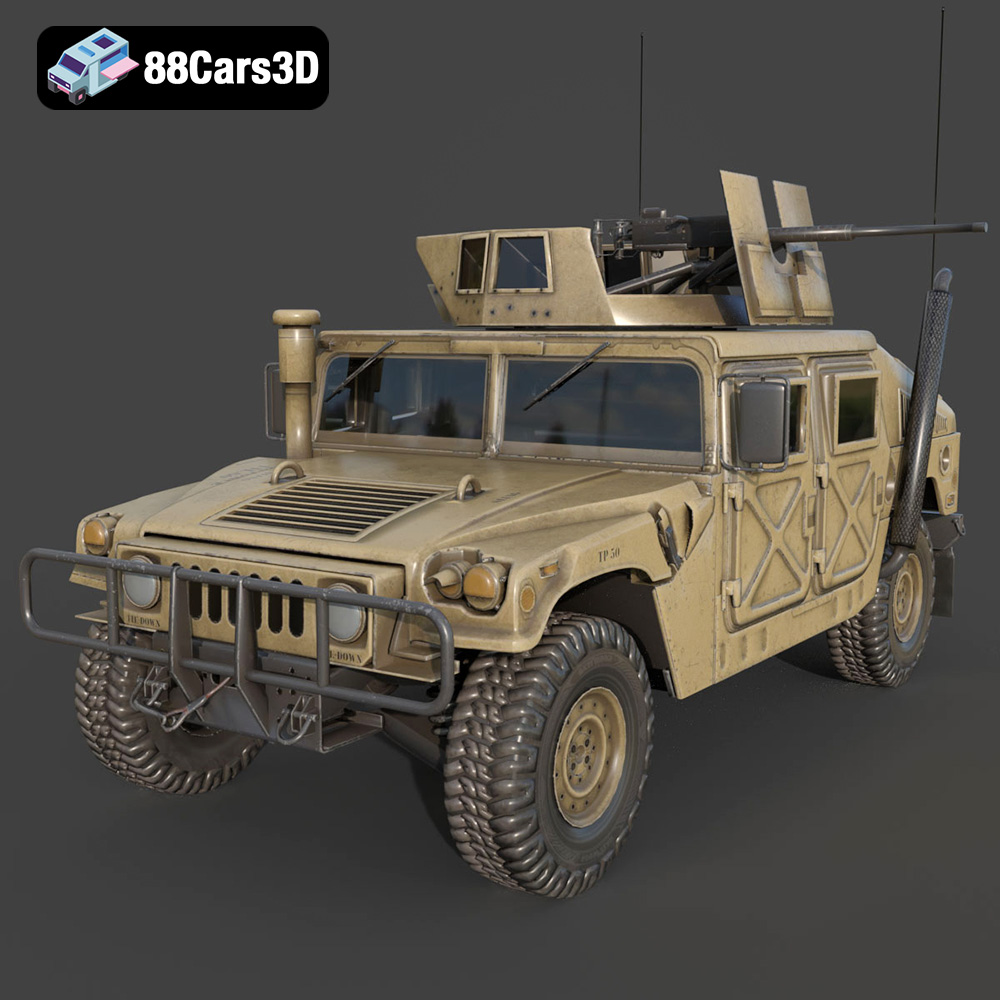
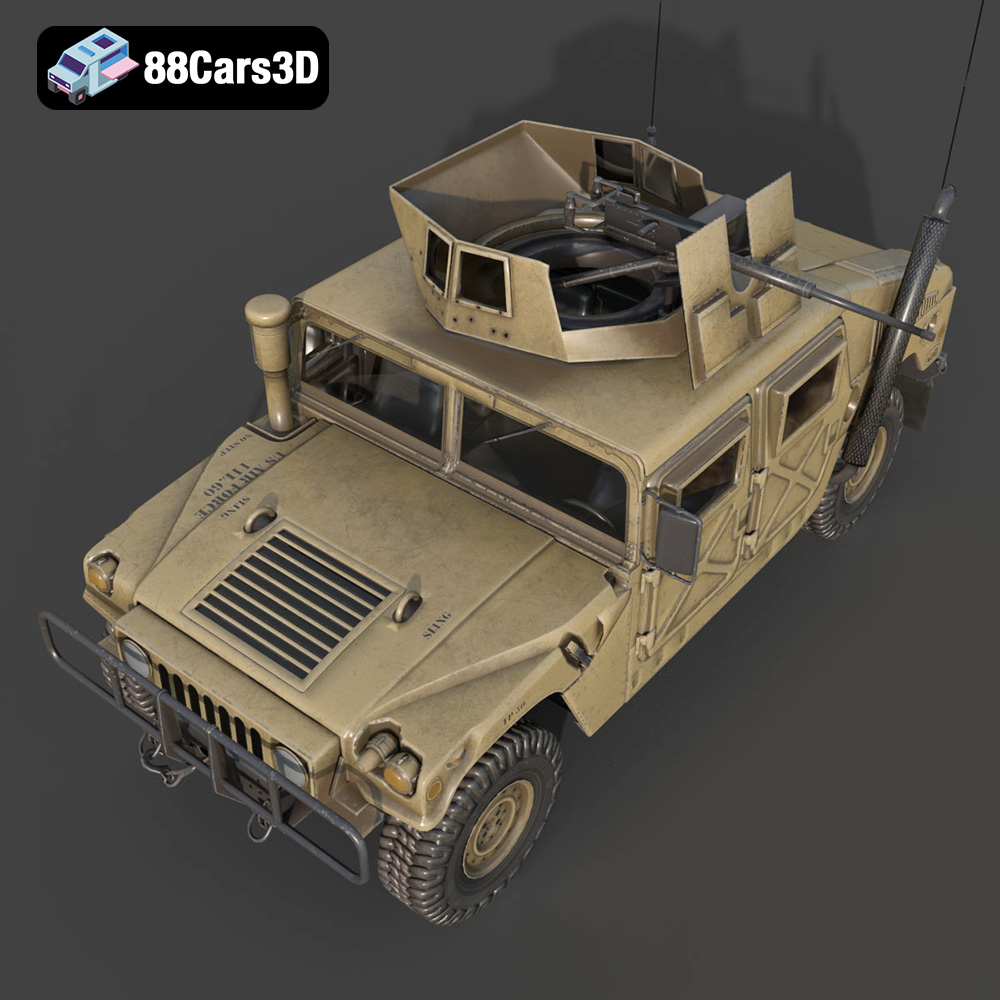
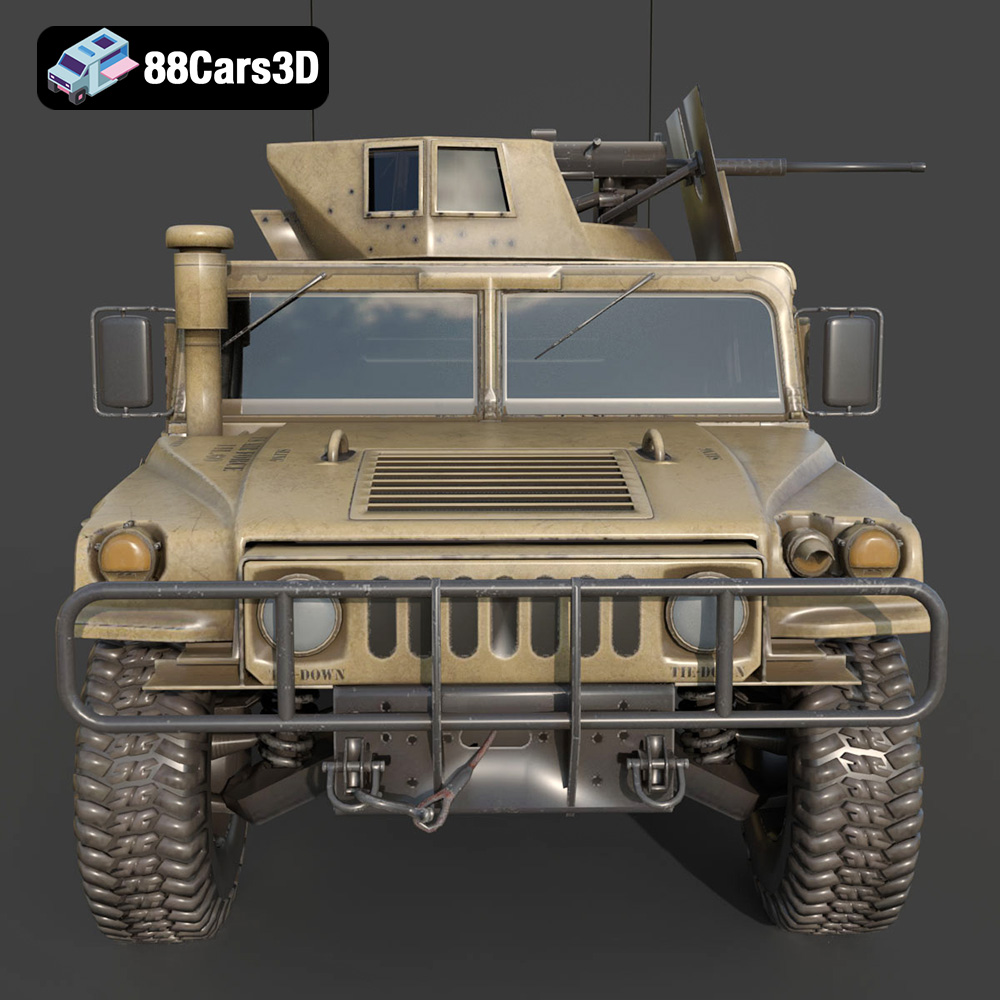
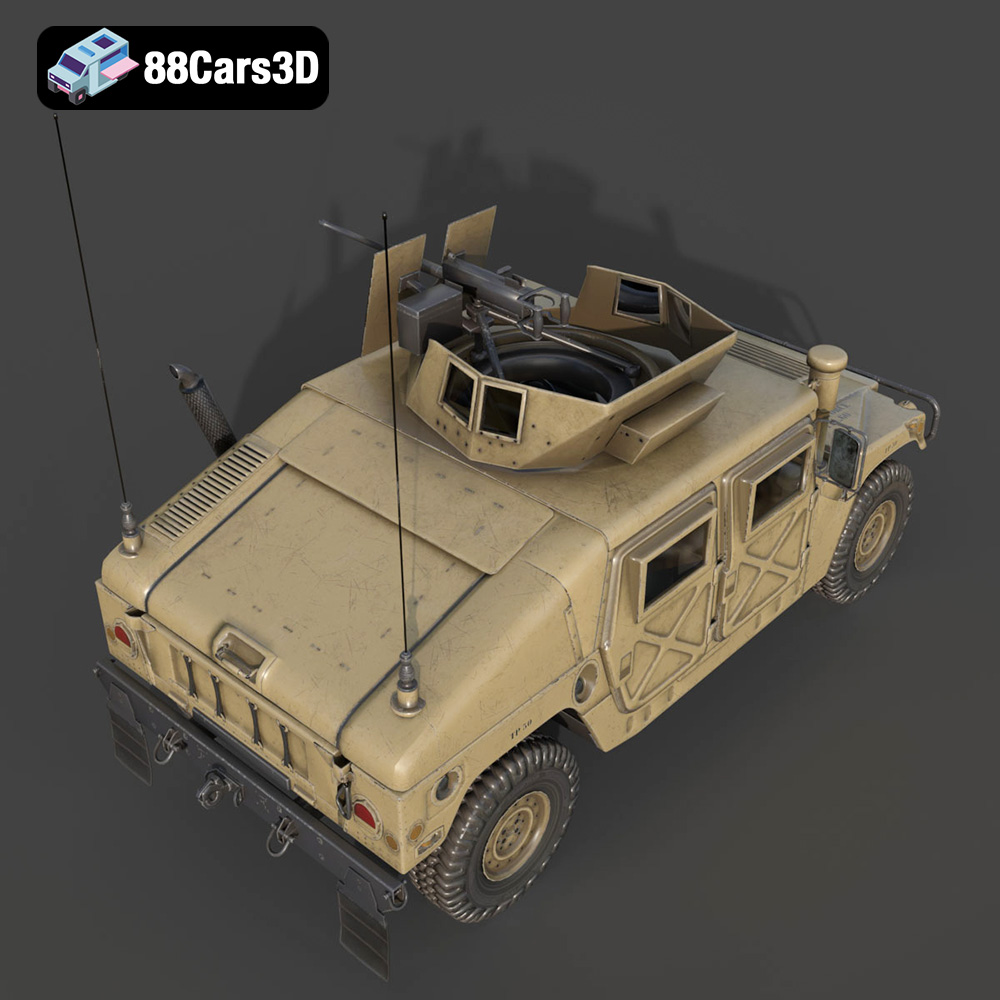
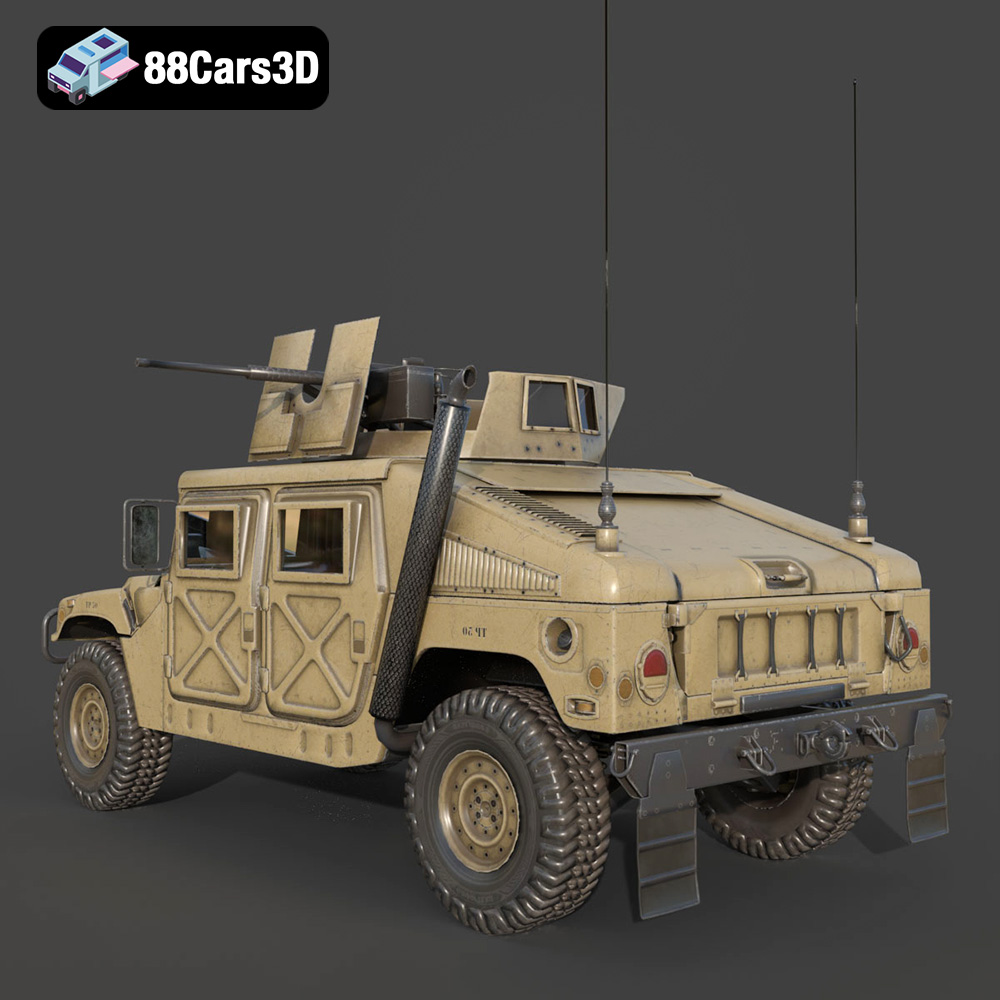
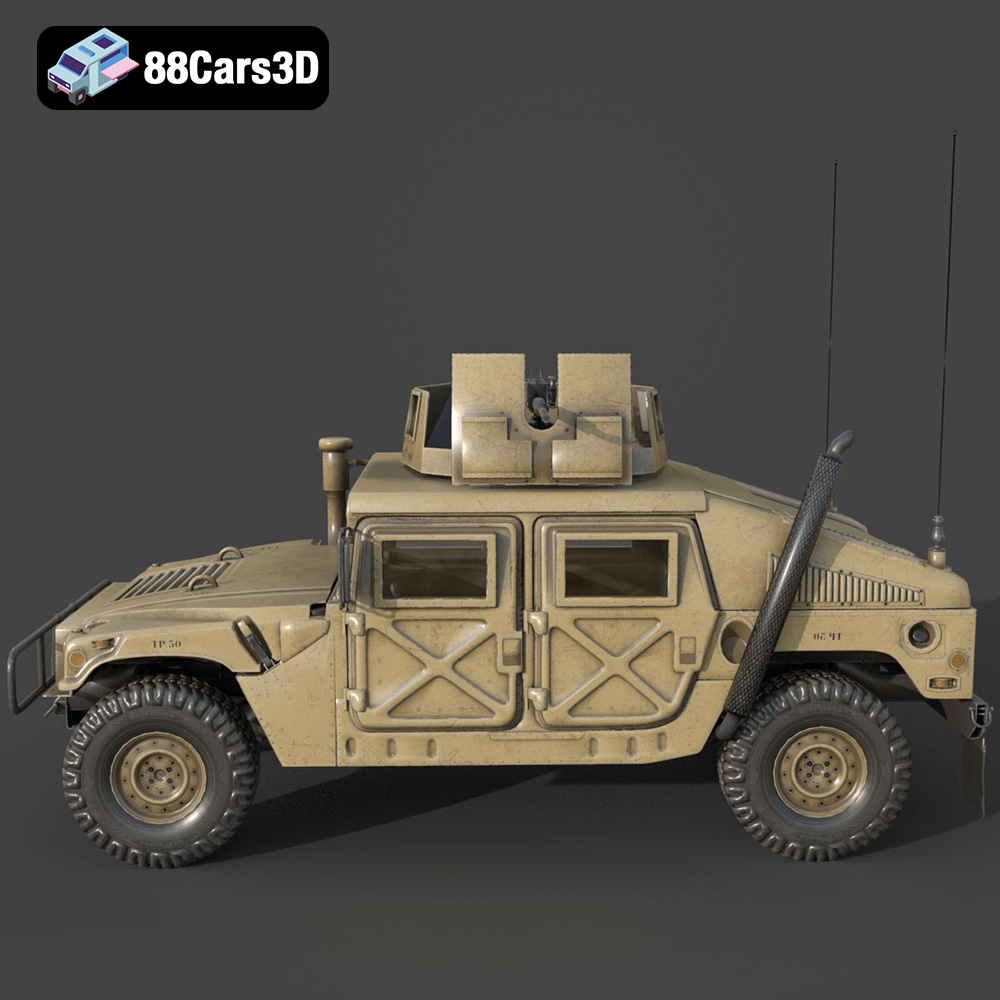
The Humvee’s exterior is instantly recognizable, a blend of aggressive posture and functional design. This 3D model faithfully captures the vehicle’s “aggressive, wide-stance chassis,” which is fundamental to its real-world stability and off-road prowess. The “signature sloped hood” and “robust exterior detailing” are accurately recreated, reflecting the vehicle’s military origins. Key visual elements, such as the “distinctive round headlights, blackout lighting, and rear military-spec taillights,” are not merely textured onto flat surfaces but are modeled with proper geometry, allowing for realistic light interaction and depth. The “chunky, deeply grooved off-road tires mounted on heavy-duty tactical rims” are crucial for conveying its rugged capability, and in this model, they are not only detailed but are separate components, allowing for realistic rotation and interaction. Furthermore, the “intricately modeled independent double-wishbone suspension components” and the “detailed heavy-duty drivetrain and exposed chassis elements” showcase a commitment to mechanical accuracy, providing depth and realism for close-up renders or dynamic camera movements.
While often overlooked in favor of the exterior, a well-modeled interior is vital for immersive first-person perspectives in games or detailed cinematic shots. The Humvee 3D model doesn’t disappoint, offering a “spartan, utilitarian seating arrangement with tactical safety harnesses” that speaks to its functional nature. The “rugged steering wheel and functional-style military dashboard” provide a believable cockpit environment. Details like the “authentic analog instrument cluster with tactical gauge layouts” and “detailed heavy-duty pedals, transmission shifters, and central drive tunnel” contribute significantly to the sense of presence. Critically, the interior geometry is “optimized for first-person POV in gaming,” meaning that the details are sufficient for player interaction without incurring unnecessary polycount, striking that crucial balance between visual quality and real-time performance. This level of internal detail ensures that whether your project is a driving simulator, a tactical game, or a virtual training environment, the user experience within the Humvee’s cabin will be authentic and engaging.
In the realm of 3D assets, especially for real-time applications, raw visual detail must be balanced with technical efficiency. The Humvee 3D model excels in this regard, engineered to deliver “exceptional visual fidelity without compromising frame rates,” a critical factor for professional-grade projects.
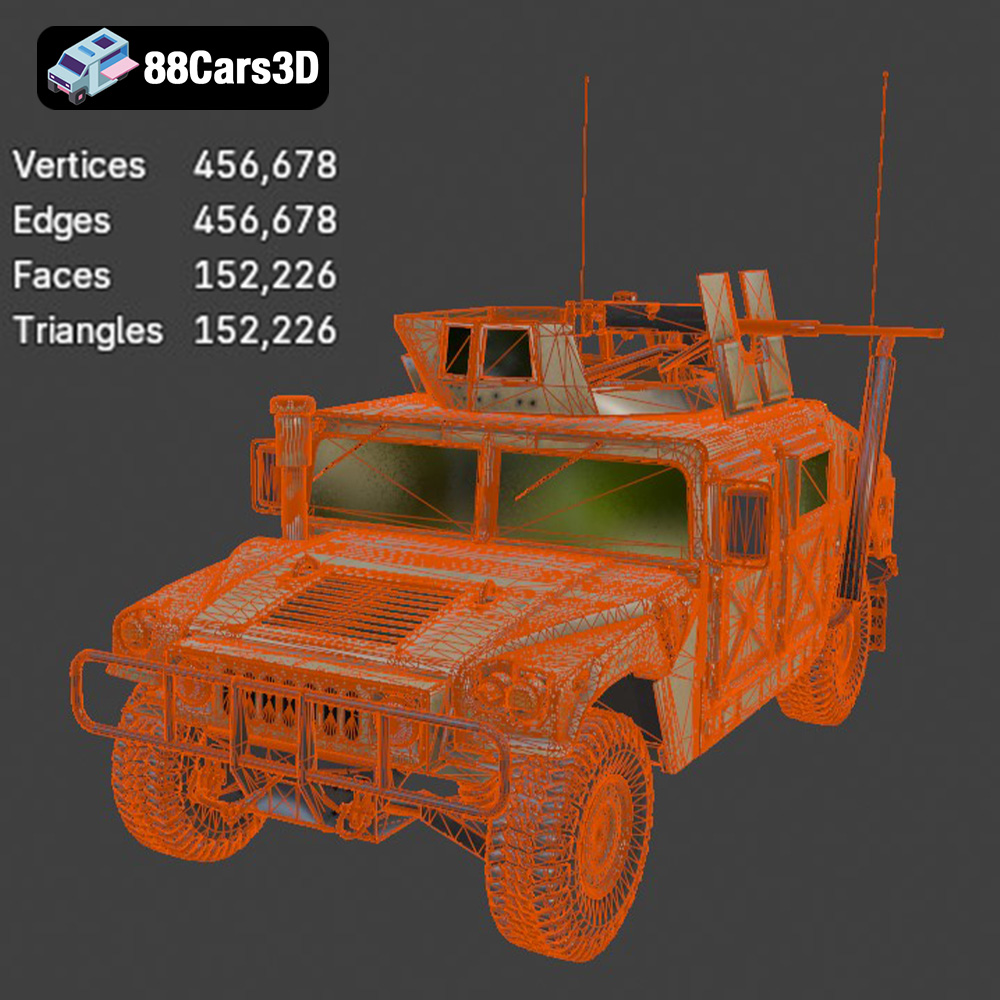
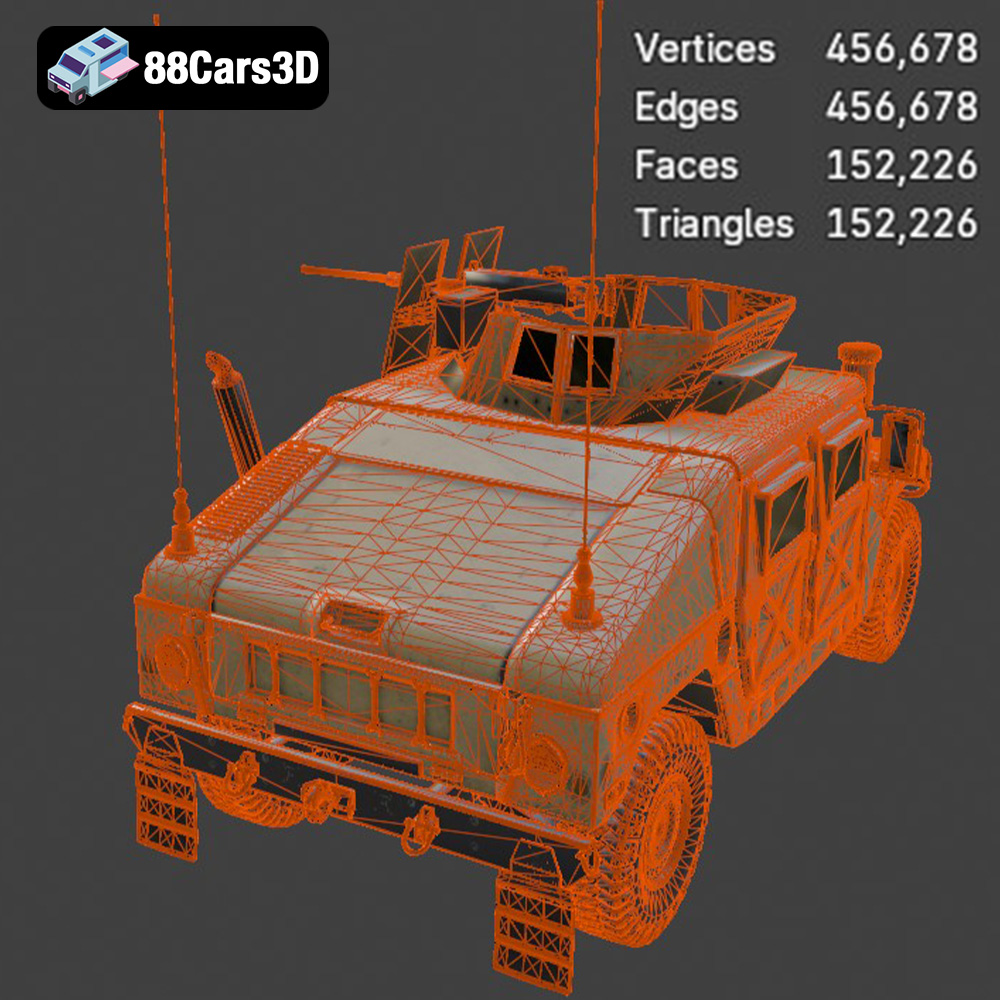
The “game-ready & optimized” nature of this model is highlighted by its approximate “65,000 triangle count.” This figure is not arbitrary; it represents a carefully calculated balance. For real-time engines like Unreal Engine and Unity, a model must be detailed enough to look convincing from various distances but not so complex that it bogs down the rendering pipeline. 65,000 triangles for a full vehicle like the Humvee is a sweet spot, allowing for “high-end visual realism” while ensuring smooth performance in demanding scenarios such as open-world games with multiple vehicles or high-detail AR/VR environments. This optimization extends to the “real-world scale accuracy based on actual vehicle chassis,” which is fundamental for correct physics simulation, collision detection, and seamless integration into virtual worlds built to scale. The textures and materials are also “carefully mapped to provide photorealistic lighting responses,” meaning they react accurately to different light sources, contributing significantly to the overall realism without requiring excessive shader complexity.
Beyond static visual appeal, a truly versatile 3D car model must be prepared for animation and interaction. The Humvee model addresses this with its intelligent structural breakdown. It features “separate wheels, suspension, and steering components for animation,” which is a foundational requirement for any vehicle physics system or cinematic sequence. More specifically, the “proper pivot setup for steering, wheel rotation, and suspension travel” is a testament to its production readiness. This means that animators and game developers can easily apply rotations to the steering wheel to control direction, rotate wheels for driving, and simulate realistic suspension compression and extension over uneven terrain. This pre-configured pivot information saves countless hours in the rigging and implementation phases, allowing developers to focus on fine-tuning vehicle dynamics and creating compelling animated sequences rather than wrestling with foundational setup issues. Whether you’re building a driving simulator or animating a high-octane chase scene, the Humvee 3D model is built from the ground up to be fully animatable and interactive.
The true value of a premium 3D asset lies in its seamless integration into diverse professional workflows. The Humvee 3D model, with its array of file formats and optimized structure, is designed to be a versatile tool for various applications, from high-fidelity renders to interactive experiences.
For professionals specializing in automotive rendering, the availability of both .max and .blend files provides immense flexibility. In 3ds Max, artists can leverage its robust modeling and rendering capabilities with engines like V-Ray, Corona Renderer, or Arnold. The native .max file ensures that all scene data, including potential material setups, lights, and cameras, are preserved, offering a perfect starting point. Artists can easily adjust materials for the Humvee’s body and components, experimenting with “factory colors, custom finishes,” or “matte, gloss, metallic” effects to match specific brand campaigns or visualization needs. Similarly, Blender users benefit from the .blend file, enabling full access to the model’s structure within Blender’s powerful ecosystem. With Cycles or Eevee rendering engines, artists can achieve stunning photorealistic results, setting up complex studio lighting or integrating the Humvee into realistic environmental scenes. The ability to modify tire textures (e.g., “off-road vs. street variants”) further enhances creative control, allowing for tailored visualizations to fit any narrative or aesthetic requirement. This adaptability makes the Humvee 3D model an exceptional asset for high-end cinematic visualization and marketing campaigns.
The “game-ready” optimization of the Humvee 3D model is specifically tailored for modern game engines like Unreal Engine and Unity. The inclusion of .fbx and a dedicated .unreal file streamlines the import process significantly. For Unreal Engine, the .unreal file suggests a near-drag-and-drop solution, minimizing the need for manual setup of materials, scaling, or pivot points. Once imported, game developers can immediately begin integrating the Humvee into their game world. This includes setting up robust vehicle physics, configuring collision meshes, implementing damage models, and attaching interactive elements. The “proper pivot setup for steering, wheel rotation, and suspension travel” is invaluable here, as it directly supports realistic vehicle handling and animation within the game engine’s physics system. Whether it’s for “open-world games, racing titles, and simulators,” the optimized polycount and clear hierarchy ensure that the Humvee can be spawned in multiples without heavily impacting performance, making it a reliable workhorse for any virtual battlefield or challenging terrain.
The future of interactive experiences heavily relies on augmented reality (AR), virtual reality (VR), and web-based 3D. The Humvee 3D model’s inclusion of the .glb format positions it perfectly for these cutting-edge applications. GLB files are highly optimized for efficiency, packing all necessary assets into a single file, which results in faster loading times and smoother performance on mobile devices and web browsers – critical factors for AR/VR experiences. For “immersive virtual showrooms, configurators, and mobile AR experiences,” the Humvee can be instantly loaded, viewed from any angle, and even placed within real-world environments via AR. Imagine a potential customer exploring the Humvee’s detailed exterior and interior virtually, or a military trainee interacting with a digital twin in an immersive VR environment. The model’s balanced polycount ensures it runs smoothly even on less powerful hardware often used for AR/VR, while its photorealistic materials maintain a high standard of visual quality. This capability opens doors for innovative engagement and training solutions.
The versatility of a well-crafted 3D model extends beyond digital screens, offering tangible outputs through 3D printing. The Humvee 3D model is not just for digital rendering; it’s also prepared for physical fabrication, allowing enthusiasts and professionals alike to bring this iconic vehicle into the real world as a detailed scale model.
The inclusion of the .stl format is key for 3D printing enthusiasts and model makers. STL files are the universal language of 3D printers, providing the necessary triangulated mesh data for slicing software. The product description offers specific “3D Print Settings” that serve as an excellent guide for achieving optimal results. Recommended scales like “1:12 / 1:18 / 1:24” allow for various display sizes, catering to different preferences and printer capabilities. Crucial details like “layer height: 0.04–0.12 mm” suggest that the model is designed to capture fine details, with “Resin printing recommended for fine details” indicating that high-resolution output is intended and achievable. Practical advice on “wall thickness: 1.2–2.0 mm,” “infill: 20–30%,” and the absolute necessity of “Supports: Required for detailed parts like exhaust, mirrors, handlebars” ensures that even novice 3D printers can achieve a successful print. The guidance on “Print orientation: Frame printed angled for structural integrity; wheels printed separately” reveals a thoughtful preparation of the model for physical manufacturing, minimizing warping and maximizing detail retention.
Once printed, the physical Humvee model provides a new canvas for customization and realism. The recommendation for “Post-processing: Sanding, primer, and authentic factory colors with metallic finishes” guides modelers towards a professional finish. This transforms the raw 3D print into a display-worthy replica. Hobbyists can meticulously paint the model, add weathering effects to simulate battle scars, or create custom dioramas, further enhancing its appeal. The Humvee’s rugged aesthetic lends itself perfectly to various finishes, from standard military drab to post-apocalyptic custom paint jobs, offering endless creative opportunities. The availability of the .ply format also opens doors for more advanced reverse engineering workflows or for specific industrial 3D printing techniques that might require more attribute data than STL provides. Whether for personal collection, educational display, or even as a prototype, the 3D printable Humvee model offers a unique tangible extension of its digital counterpart, demonstrating the comprehensive nature of 3D car models offered by 88cars3d.com.
The journey through the technical specifications and versatile applications of the Humvee 3D Model reveals it to be far more than just a digital asset. It’s a meticulously engineered toolkit for professionals across game development, automotive rendering, AR/VR, and 3D printing. From its iconic and detailed geometry to its balanced polycount for real-time performance, and its comprehensive suite of industry-standard file formats, this model is built for immediate and impactful integration into any creative pipeline. The foresight in preparing separate components for animation, optimizing the interior for first-person views, and even providing guidance for physical 3D printing underscores a deep understanding of professional demands.
In a world where visual fidelity and technical efficiency are paramount, having access to such a high-quality, game-ready 3D car model can significantly accelerate project development and elevate final output. Whether you’re building an immersive tactical simulation, crafting a photorealistic automotive visualization, or developing an interactive AR experience, the Humvee 3D Model download from 88cars3d.com stands as a robust and reliable choice. It exemplifies the standard of excellence that modern 3D assets should strive for, offering both precision and unparalleled versatility for your next project.
The High Mobility Multipurpose Wheeled Vehicle (HMMWV), widely known as the Humvee, is an iconic tactical vehicle celebrated for its unparalleled durability, utilitarian design, and legendary off-road capabilities. This 3D model meticulously captures its aggressive, wide-stance chassis, signature sloped hood, heavy-duty independent suspension, and robust exterior detailing that makes the Humvee an enduring symbol of military and tactical strength. Engineered for maximum versatility, this game-ready 3D model features highly optimized topology with a balanced triangle count that ensures exceptional visual fidelity without compromising frame rates. The textures and materials are carefully mapped to provide photorealistic lighting responses, making it an outstanding asset for real-time game engines, immersive AR/VR training environments, and cinematic animations. Perfect for military simulations, post-apocalyptic survival games, tactical off-road racing titles, and high-end cinematic visualization.
$19.99
.blend
.fbx
.glb
.hmmwv
.humvee
.max
.obj
.ply
.rendering
.stl
.tactical
.unreal
am-general
car-3d-model
game asset
game-ready
low-poly
military-vehicle
off-road
optimized
VR/AR