Get 20% OFF All Premium 3D & STL Models!

The roar of four Wright R-3350 Duplex-Cyclone radial engines, the glint of bare-metal aluminum reflecting the sun, and the distinctive silhouette soaring through history’s pages – the Boeing B-29 Superfortress is more than just an aircraft; it’s a symbol of technological prowess and historical significance. From its pivotal role in World War II to its service in the Korean War, this heavy bomber pushed the boundaries of aviation engineering, featuring innovations like a pressurized cabin, remote-controlled gun turrets, and sophisticated fire control systems. For designers, animators, game developers, and historical enthusiasts, recreating such an icon in digital form demands precision, performance, and an unwavering commitment to detail.
This is where a truly exceptional 3D model becomes indispensable. Imagine bringing this legend to life in a new flight simulator, a cinematic historical documentary, an immersive VR experience, or even as a beautifully rendered display piece. The challenge lies in balancing intricate historical accuracy with the technical demands of modern real-time engines and rendering pipelines. Fortunately, resources like 88cars3d.com understand these nuanced requirements, offering a diverse range of high-quality 3D models. While renowned for their exquisite collection of 3D car models and assets perfect for automotive rendering, their commitment to quality extends across the spectrum, exemplified by this meticulously crafted Boeing B-29 Superfortress 3D Model. This product is not just a digital asset; it’s a gateway to recreating history with unparalleled fidelity, offering a game-ready solution without compromising visual realism.
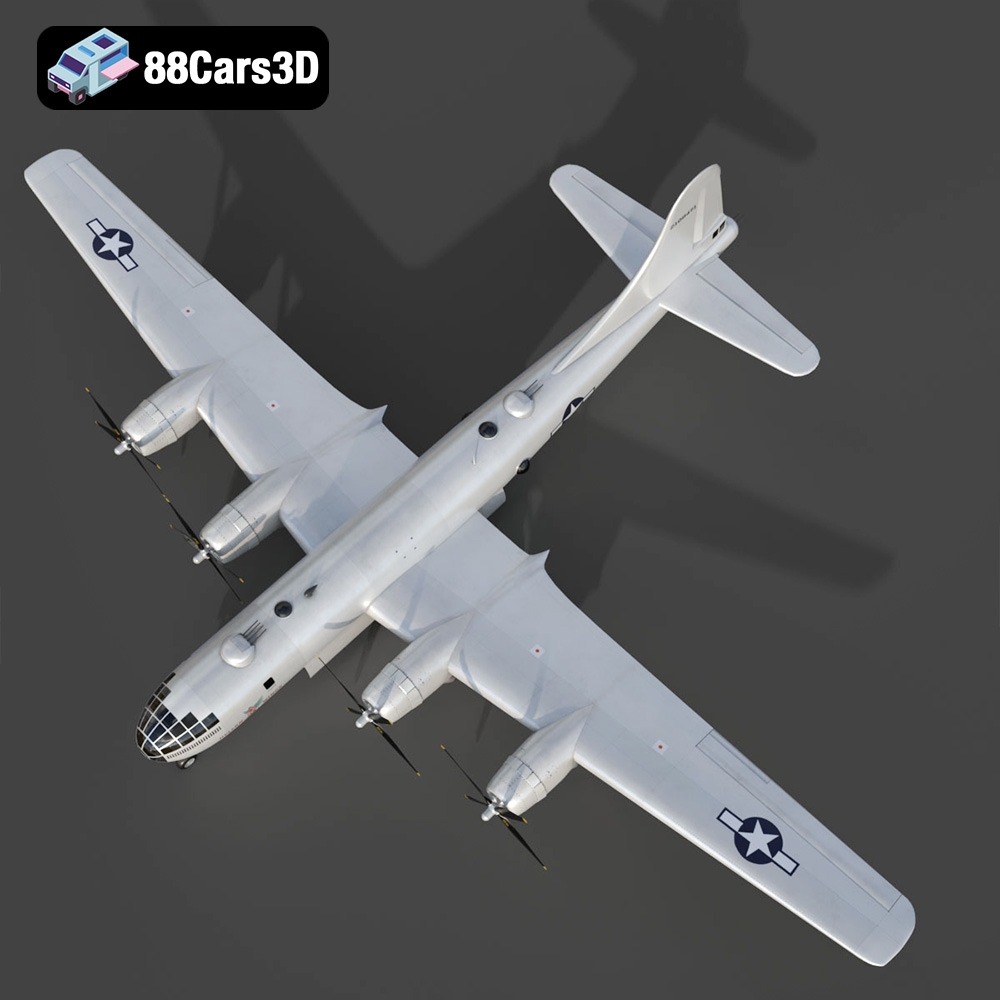
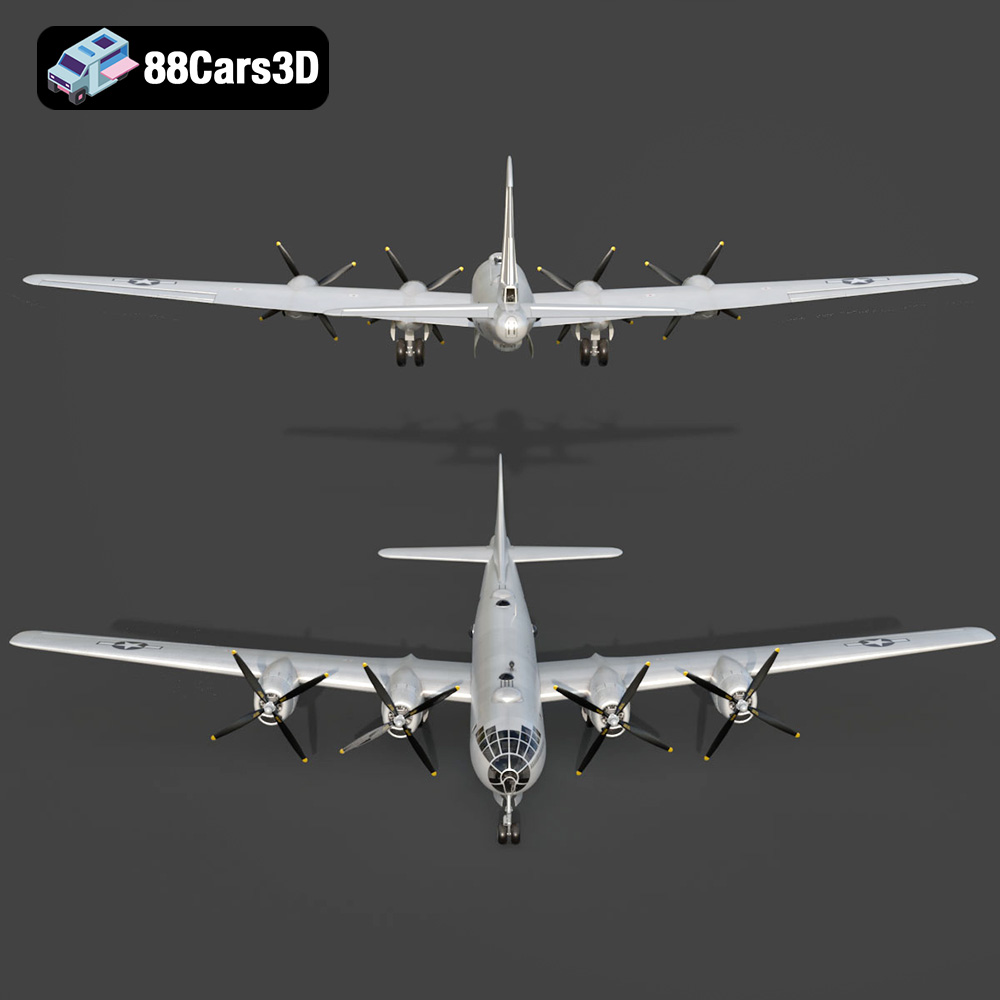
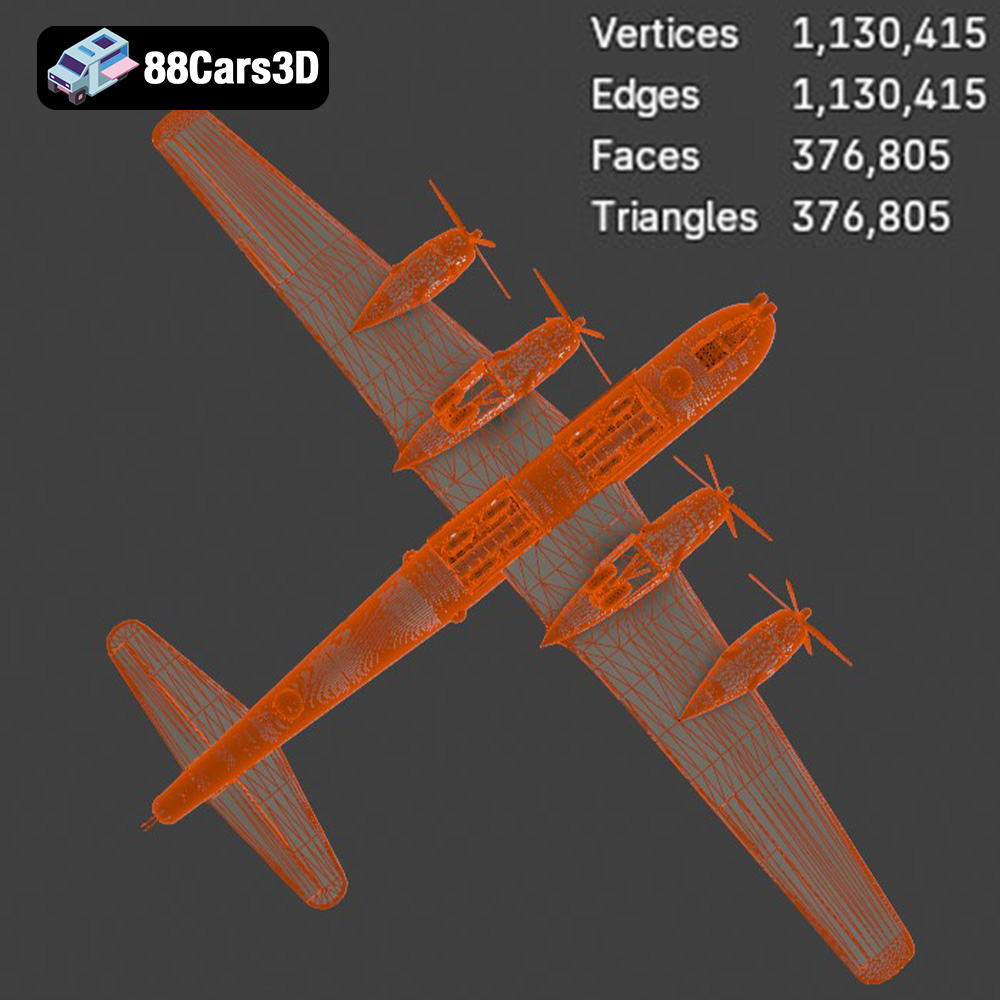
When embarking on a project involving an aircraft of the B-29’s stature, the foundation lies in the quality of its 3D model. This Superfortress model is a testament to precision engineering, designed from the ground up to serve multiple high-demand applications. With an optimized topology boasting approximately 150,000 triangles, it achieves that delicate balance between visual richness and real-time performance. This makes it an ideal candidate for integration into cutting-edge game engines like Unreal and Unity, where frame rates and scene complexity are paramount. Beyond gaming, its realism shines in cinematic rendering and immersive VR experiences.
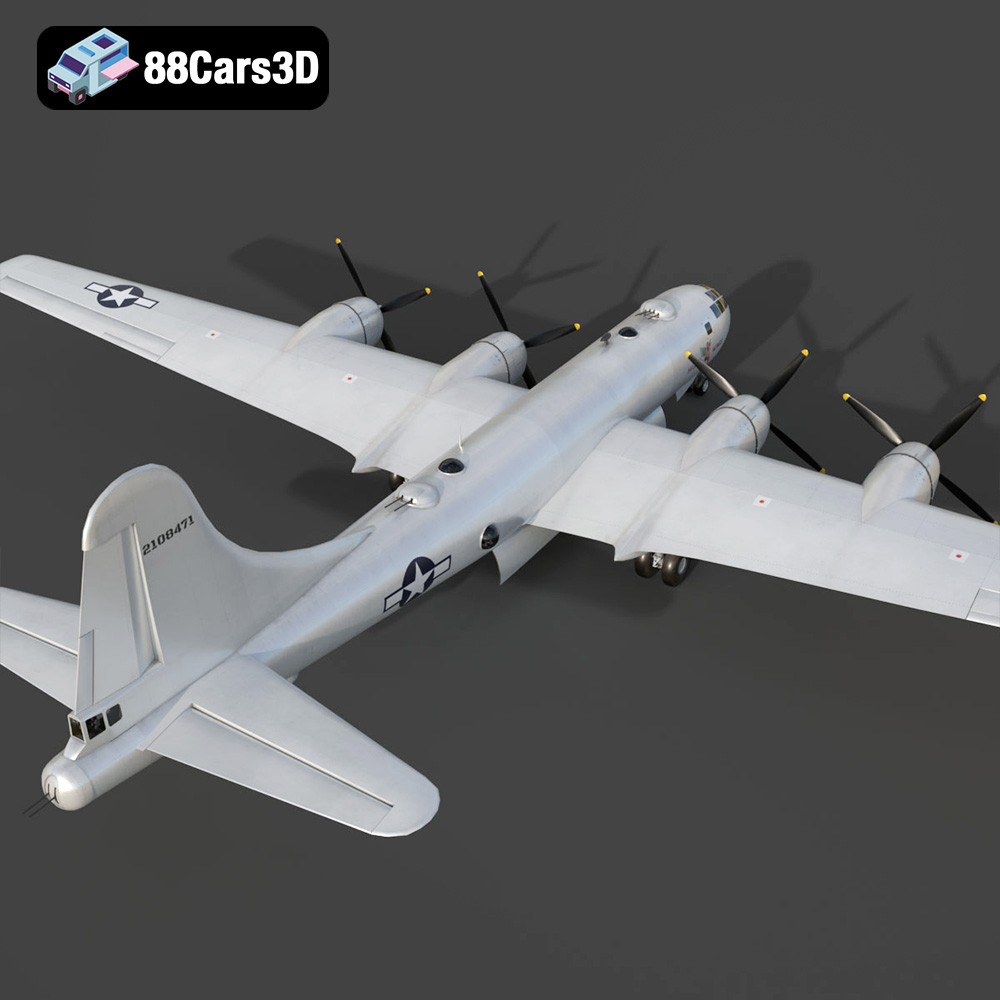
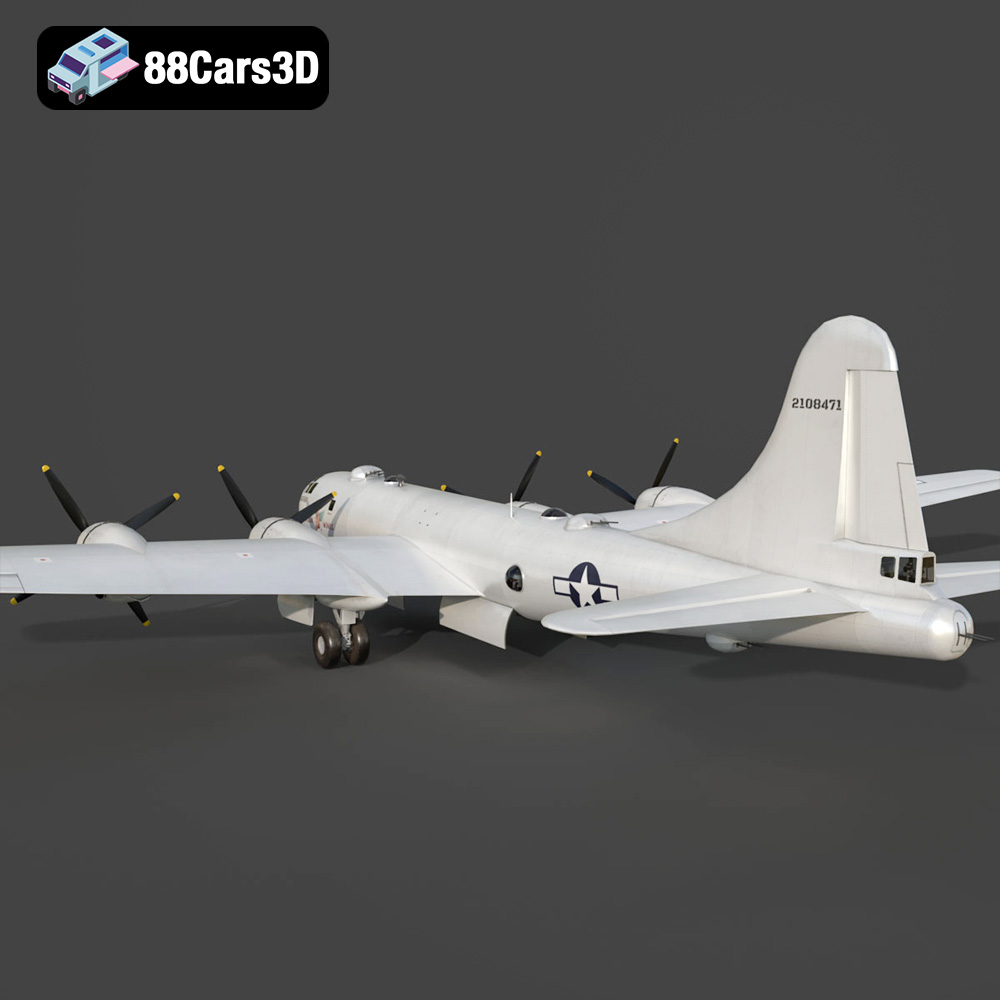
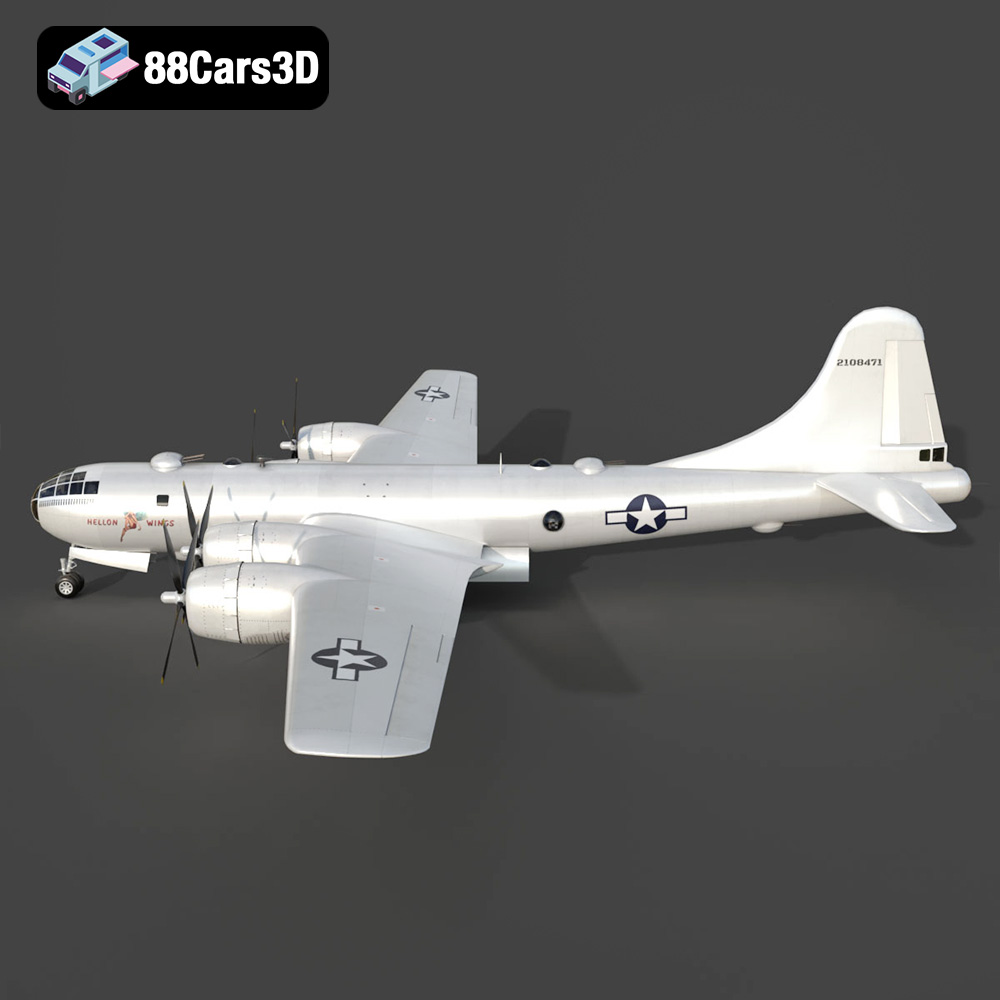
The exterior of this B-29 model captures every iconic detail. From the accurate fuselage geometry and proportions, meticulously recreated based on actual aircraft blueprints, to the distinctive Wright R-3350 Duplex-Cyclone radial engine housings and propellers, every element speaks of authenticity. The model includes functional features crucial for animation, such as separate propellers ready for rotation, bomb bay doors poised to open, and independent ailerons and elevators for dynamic flight sequences. Even subtle nuances like detailed exhaust vents, panel lines, and rivet placements are present, ensuring that close-up renders and detailed inspections hold up to scrutiny. The complex dual-wheeled tricycle landing gear, a hallmark of the B-29, is also fully articulated, ready for retraction and deployment animations.
For those seeking to place viewers directly into the heart of the Superfortress, the model’s interior detailing is equally impressive. The fully modeled pressurized forward crew compartment offers an authentic environment, complete with detailed pilot and co-pilot flight control yokes and seating. The analog instrument panels and navigation gauges are faithfully reproduced, providing a rich visual experience for first-person perspectives in gaming and VR simulations. The bombardier’s highly detailed greenhouse nose station, a defining characteristic of the B-29, is also meticulously crafted, making this model perfect for scenarios demanding deep immersion and historical accuracy. This attention to both exterior and interior detail ensures that whether your project requires a wide cinematic shot or an intimate cockpit view, the B-29 model delivers.
Navigating the diverse world of 3D modeling often means understanding the nuances of various file formats. Each format serves a specific purpose, offering different levels of data preservation, compatibility, and optimization for distinct workflows. The Boeing B-29 Superfortress 3D Model from 88cars3d.com exemplifies this versatility by providing a comprehensive suite of formats, ensuring it seamlessly integrates into virtually any professional pipeline. Choosing the right format is critical for efficiency, performance, and maintaining the integrity of your 3D asset.
The `.blend` file is Blender’s native format, renowned for being a complete package. When you download a `.blend` file, you’re not just getting the model; you’re getting the entire Blender scene. This includes all geometry, materials, textures (packed within the file or linked), lighting setups, camera positions, animations, rigging, modifiers, and even scene properties. It offers a fully editable environment, making it ideal for users who primarily work in Blender and wish to further modify, animate, or re-render the model within its original creative context. For artists looking to dissect the model’s construction, understand its material setup, or integrate it into a larger Blender project, the `.blend` file is the go-to choice, preserving every detail of the artist’s original work.
Autodesk’s Filmbox (`.fbx`) format is arguably the most widely adopted interchange format in the 3D industry, particularly for game development and animation pipelines. It excels at transferring complex 3D data, including meshes, materials (often supporting PBR workflows), textures, skeletons, skinning, and most importantly, animation data. For professionals working with Unreal Engine, Unity, 3ds Max, Maya, or Cinema 4D, `.fbx` is the de facto standard. Its robust support for skeletal animations and blend shapes makes it indispensable for character animation and dynamic assets. When importing into game engines, `.fbx` typically offers the most streamlined workflow, preserving hierarchies and pivot information crucial for real-time interactivity.
The Wavefront Object (`.obj`) format is a venerable and universal standard for exchanging static 3D geometry. It’s a text-based format that primarily stores vertex positions, UV coordinates, vertex normals, and polygonal faces. It can reference external material library files (`.mtl`) for basic color and texture information. While it doesn’t support advanced features like animation, rigging, or scene-specific data, its simplicity and widespread compatibility across virtually all 3D software make it an excellent choice for transferring raw mesh data. If your primary need is to import a clean, static mesh into an application that might struggle with more complex formats, `.obj` is a reliable workhorse.
The GL Transmission Format (`.glb`) is the binary version of glTF, a royalty-free specification for the efficient transmission and loading of 3D scenes and models by applications. It’s often referred to as the “JPEG for 3D” due to its optimization for web-based applications, augmented reality (AR), virtual reality (VR), and mobile platforms. A `.glb` file is a single file containing the 3D model, textures, and animation data, making it incredibly easy to share and embed. Its compactness and focus on runtime efficiency make it perfect for browser-based 3D viewers, immersive web experiences, and any scenario where quick loading and low file sizes are crucial.
The Stereolithography (`.stl`) format is the undisputed standard for 3D printing. It represents a 3D model as a series of connected triangles, defining only the surface geometry of an object. Crucially, `.stl` files do not carry color, texture, or material information – they are purely about shape. For hobbyists, engineers, and designers looking to bring the B-29 Superfortress into the physical world through 3D printing, the `.stl` format is essential. It provides the raw, tessellated mesh data that 3D printers use to build objects layer by layer.
The Polygon File Format (`.ply`) is a robust format often used for storing 3D data from 3D scanners or for applications requiring precise mesh information, such as CAD or scientific analysis. Unlike `.stl`, `.ply` can store more comprehensive data, including color, transparency, texture coordinates, surface normals, and various properties per vertex or face. It supports both ASCII and binary encodings. While less common for general animation, its ability to store rich attribute data makes it valuable in specific technical visualization or reverse-engineering workflows where maintaining detailed scan information is critical.
The `.unreal` extension isn’t a standalone universal file format in the same way `.fbx` or `.obj` are. Instead, it signifies an asset that has been specifically prepared, optimized, and often packaged within or for the Unreal Engine environment. This typically means the original model (likely an `.fbx`) has been imported, had its materials set up using Unreal’s PBR system (e.g., as `.uasset` files), had collision geometry added, LODs generated, and potentially been set up as a Blueprint or Static Mesh asset ready for immediate use within an Unreal project. It implies an “engine-ready” state, saving developers significant setup time and ensuring optimal performance within the engine.
Similar to `.blend` for Blender, the `.max` file is the native project format for Autodesk 3ds Max. It encapsulates an entire 3ds Max scene, including all geometric data, intricate material setups, texture paths, complex rigging, animations, light sources, cameras, modifier stacks, and scene settings. For users deeply integrated into the 3ds Max ecosystem, the `.max` file provides the most comprehensive and editable version of the model. It allows for full artistic control, enabling further development, modification, and high-fidelity rendering within a professional studio environment.
Understanding these formats is key to leveraging the full potential of a versatile 3D asset like the Boeing B-29 Superfortress model, ensuring that it fits perfectly into any desired pipeline, from game development to 3D printing.
In the fast-paced world of 3D, a model’s visual quality must often be balanced against its performance. This is particularly true for game development and real-time applications where every polygon and texture call can impact frame rates. The Boeing B-29 Superfortress 3D model is a prime example of an asset engineered with this critical balance in mind.
The core advantage of this B-29 model for game developers is its “game-ready” optimization. With an approximate triangle count of 150,000, it strikes a perfect balance. This polycount is sufficiently detailed to render the B-29’s complex form with high visual realism, capturing its distinct features and historical accuracy, without overburdening a game engine. Modern engines like Unreal and Unity can handle this complexity efficiently, especially when paired with proper Level of Detail (LOD) implementation (which can be generated from this base model) and PBR (Physically Based Rendering) materials.
The model also boasts real-world scale accuracy, a crucial factor for believable flight simulators and immersive combat games. This ensures that when the B-29 is placed alongside other game assets, or piloted in a first-person perspective, its size and proportions feel correct. Furthermore, the proper pivot setup for propeller rotation, landing gear retraction, and control surfaces (ailerons, elevators) means developers can implement animations with minimal rigging effort, saving valuable production time. This attention to technical detail makes it an invaluable game asset for historical titles or any project demanding a high-fidelity aircraft.
Augmented Reality (AR) and Virtual Reality (VR) push the boundaries of immersion, but they also impose stringent performance demands due to the need for high frame rates and often running on mobile or less powerful hardware. The B-29 Superfortress model, with its optimized geometry and efficient design, is perfectly suited for these emerging platforms. Imagine stepping into a virtual museum experience, standing beside a life-sized B-29, or even taking a virtual flight from its cockpit. The optimized polycount ensures that such experiences remain smooth and responsive, preventing motion sickness and enhancing user engagement.
For educational applications, the model can be used to create interactive virtual aviation museums, allowing users to explore the B-29’s exterior and interior in unprecedented detail. Its compatibility with formats like `.glb` further streamlines deployment to web-based AR/VR platforms, making it accessible to a wider audience. The fully modeled pressurized forward crew compartment and detailed analog instrument panels are specifically designed for first-person POV, offering an authentic and educational experience without compromising performance.
The versatility of a high-quality 3D model extends far beyond digital rendering and real-time applications. For enthusiasts, model builders, and educators, the ability to physically manifest a digital creation offers a unique dimension of engagement. The Boeing B-29 Superfortress 3D model provides precisely this capability, alongside extensive customization options that empower artists to tailor its appearance to specific project needs.
The inclusion of the `.stl` format in the B-29 Superfortress package immediately signals its readiness for 3D printing. This opens up a world of possibilities for scale modelers and hobbyists who wish to hold a tangible piece of history. While the model is optimized for digital use, careful consideration of 3D print settings can yield stunning physical replicas.
Recommended scales like 1:72 or 1:144 offer a good balance between detail and printability. For optimal results, particularly in capturing the fine details like panel lines and rivet placements, resin printing is often recommended over FDM, allowing for layer heights as fine as 0.04–0.12 mm. Structural integrity is key for a complex aircraft, so a wall thickness of 1.2–2.0 mm and an infill of 20–30% are suggested. Due to its intricate geometry, supports will be required for delicate parts such as the propellers, gun turrets, and the landing gear. Furthermore, strategic print orientation – such as printing the fuselage angled or split into sections – can enhance structural integrity and reduce the need for excessive supports. Post-processing, including sanding, priming, and painting with authentic bare-metal aluminum factory colors and subtle weathering, can transform a raw print into a museum-quality display piece.
A truly professional 3D model doesn’t just offer fidelity; it offers flexibility. The B-29 Superfortress model provides robust customization options, allowing artists to adapt its appearance to suit diverse narrative or aesthetic requirements. This is crucial for projects that demand unique liveries, specific historical periods, or imaginative scenarios.
For instance, the exterior finishes can be easily modified. Instead of the iconic bare-metal aluminum, artists can apply olive drab camouflage for early war variants or even create custom nose art to reflect specific squadrons. The ability to modify weathering effects is also paramount for realism; artists can add exhaust stains, battle damage, dirt, or dust to reflect years of service or specific combat scenarios. Adjusting material finishes – from a gleaming, freshly polished metallic look to a matte, worn appearance – further enhances the model’s adaptability. Finally, adapting lighting for different environmental renders can dramatically alter the mood and visual impact, whether depicting a sunny pre-flight inspection or a dramatic night bombing run. This level of control ensures the Boeing B-29 Superfortress can tell any story an artist wishes to convey.
For professional 3D artists, game developers, and visualization specialists, the ultimate test of a 3D model lies in its seamless integration into established workflows. The Boeing B-29 Superfortress 3D model is engineered to be a powerful asset across various industry-standard software, providing a flexible foundation for high-end projects.
Both Autodesk 3ds Max and Blender are powerhouses in the 3D industry, each with a loyal following and robust capabilities for modeling, animation, and rendering. The inclusion of native `.max` and `.blend` files with the B-29 model ensures that users of both platforms have full access to the original, editable scene.
In **3ds Max**, the `.max` file provides a complete project, including all geometry, materials, and potentially even initial rigging and animation setups. A professional workflow might involve:
Similarly, **Blender** artists can open the `.blend` file and immediately access a fully functional scene. A typical workflow could involve:
The detailed interior, including the pilot’s controls and bombardier’s station, allows for intimate camera shots and virtual cockpit tours, perfect for educational content or interactive museum exhibits within both environments.
For game developers and real-time visualization specialists, Unreal Engine is an industry leader. The inclusion of `.fbx` and `.unreal` (engine-ready asset) formats makes integrating the Superfortress remarkably straightforward.
A professional workflow in **Unreal Engine** would typically look like this:
The “game-ready” nature of the B-29 model, including its optimized topology and real-world scale, significantly reduces the time and effort required for artists to prepare it for real-time environments, allowing them to focus on creative execution rather than technical hurdles. Whether for high-end rendering or immersive real-time experiences, this model stands as a professional-grade solution.
The Boeing B-29 Superfortress is an aircraft that transcends its historical context, captivating imaginations with its engineering marvels and significant legacy. For anyone seeking to integrate this iconic heavy bomber into their digital projects, the quality and versatility of its 3D representation are paramount. This meticulously crafted Boeing B-29 Superfortress 3D Model delivers on all fronts, offering an unparalleled combination of historical accuracy, technical optimization, and broad compatibility.
From its incredibly detailed exterior, featuring animatable components and authentic panel lines, to its fully modeled and immersive interior, every aspect of this model has been engineered for maximum realism and performance. The optimized 150,000-triangle count ensures it is game-ready for demanding real-time engines like Unreal and Unity, while its real-world scale and proper pivot setups streamline animation workflows. Beyond the screen, its direct compatibility with 3D printing through the `.stl` format allows hobbyists and modelers to bring this legend into the physical realm.
Crucially, the comprehensive suite of included file formats – `.blend`, `.fbx`, `.obj`, `.glb`, `.stl`, `.ply`, `.unreal`, and `.max` – guarantees seamless integration into virtually any professional pipeline, whether you’re working in 3ds Max, Blender, or dedicated game engines. This flexibility, coupled with extensive customization options for finishes, weathering, and materials, empowers artists to tailor the Superfortress to their unique creative visions.
Whether you’re developing a high-fidelity flight simulator, producing a cinematic historical documentary, creating an immersive AR/VR experience, or simply aiming for breathtaking renders, this Boeing B-29 Superfortress 3D model is an invaluable asset. It is a testament to the high standards found on marketplaces like 88cars3d.com, which consistently provide top-tier 3D models – not only for those seeking exquisite 3D car models or solutions for automotive rendering, but also for niche historical aircraft and other game assets that demand precision and performance. Elevate your next project by harnessing the power of a truly exceptional digital recreation of an aerial legend.
The Boeing B-29 Superfortress is a legendary four-engine propeller-driven heavy bomber designed by Boeing, flown primarily by the United States during World War II and the Korean War. This iconic aircraft features a pressurized cabin, dual-wheeled tricycle landing gear, and a highly advanced remote-controlled computer-directed machine gun fire control system, wrapped in a gleaming bare-metal aluminum finish. This highly detailed 3D model boasts optimized topology with an approximate triangle count of 150,000, ensuring game-ready performance without sacrificing visual fidelity. Designed for maximum realism, it is precision-engineered for seamless integration into real-time engines, providing exceptional quality for flight simulators, historical documentaries, and high-end rendering.
$19.99
.aircraft
.blend
.boeing
.fbx
.glb
.max
.obj
.ply
.rendering
.stl
.unreal
aircraft-3d-model
b-29-superfortress
game asset
game-ready
heavy-bomber
low-poly
optimized
VR/AR
ww2-aircraft