Get 20% OFF All Premium 3D & STL Models!

In the vibrant world of digital creation, the humble automobile stands as a perpetual muse, a complex blend of engineering artistry and cultural icon. From the sleek lines of a modern supercar to the rugged utility of a vintage workhorse, 3D car models are indispensable assets across a spectrum of industries – game development, cinematic rendering, immersive AR/VR experiences, and even precision 3D printing. The demand for historically accurate, meticulously optimized, and production-ready models is at an all-time high, driving innovation in how these assets are created and deployed.
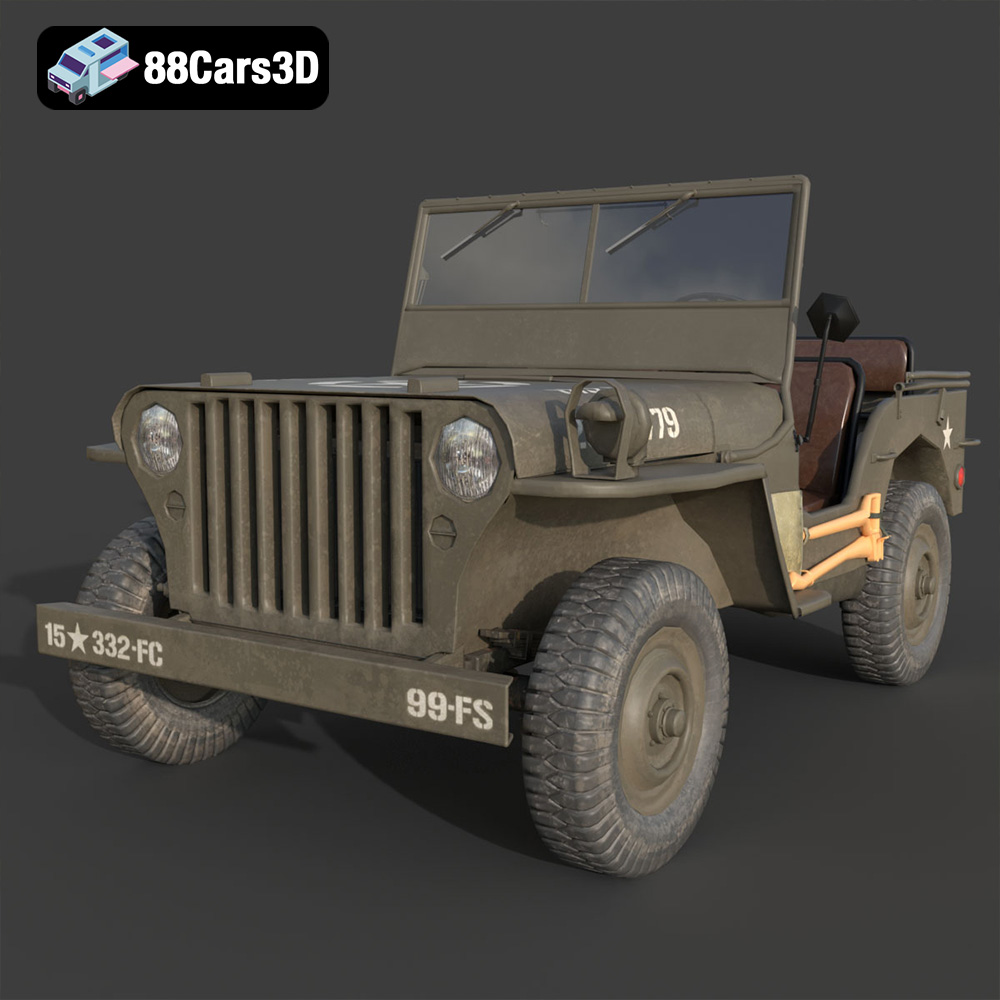
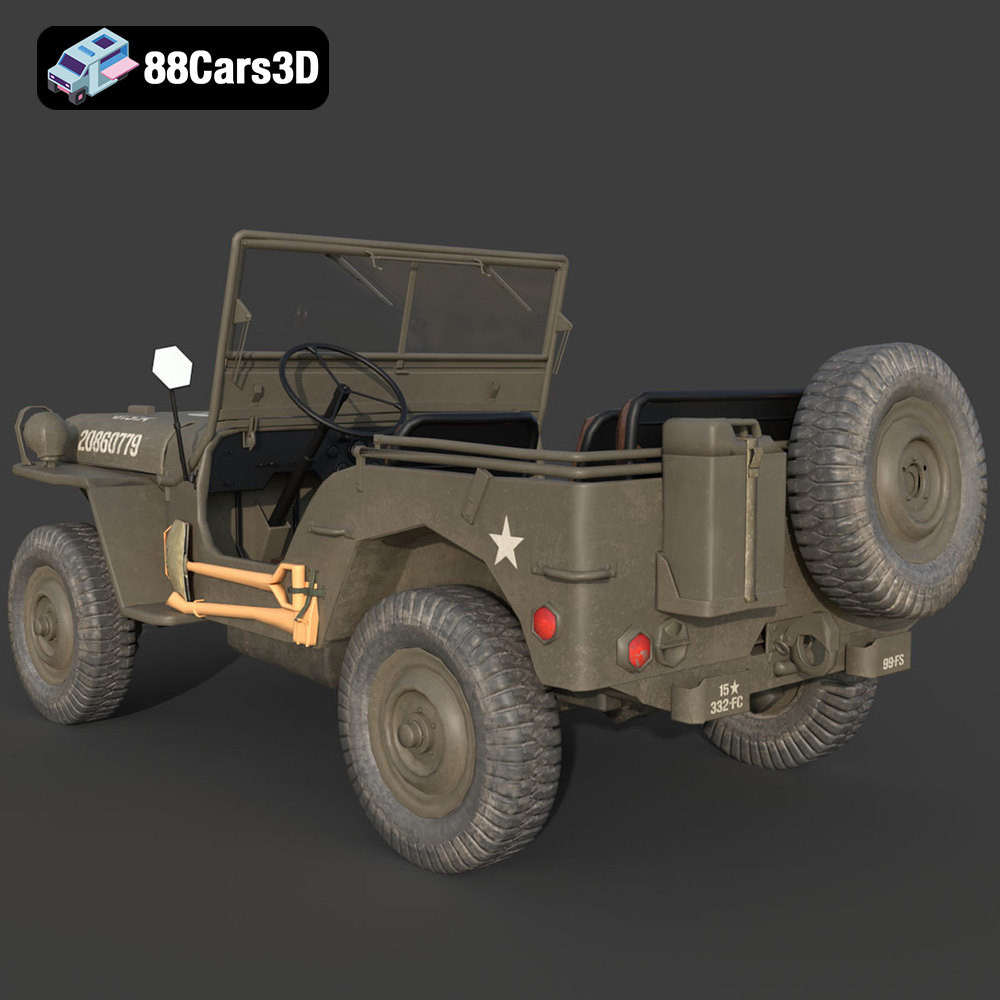
Among the pantheon of automotive legends, few command as much respect and immediate recognition as the US Army Willys Jeep. This iconic vehicle, forged in the crucible of World War II, represents the pinnacle of utilitarian design and unparalleled off-road capability. Its distinctive slotted grille, flat fenders, and robust chassis tell a story of resilience and adaptability. For digital artists and developers looking to recreate historical narratives or inject a touch of classic ruggedness into their projects, a high-quality 3D model of this legend is invaluable. That’s precisely what we find with the US Army Willys Jeep 3D Model available on 88cars3d.com – a prime example of an asset engineered for professional use across diverse pipelines.
Creating compelling 3D car models goes far beyond simply mimicking real-world shapes. It involves a deep understanding of geometry, optimization, material science, and the specific demands of various digital environments. A truly professional 3D car model is a carefully engineered asset, designed to perform efficiently while delivering breathtaking visual fidelity.
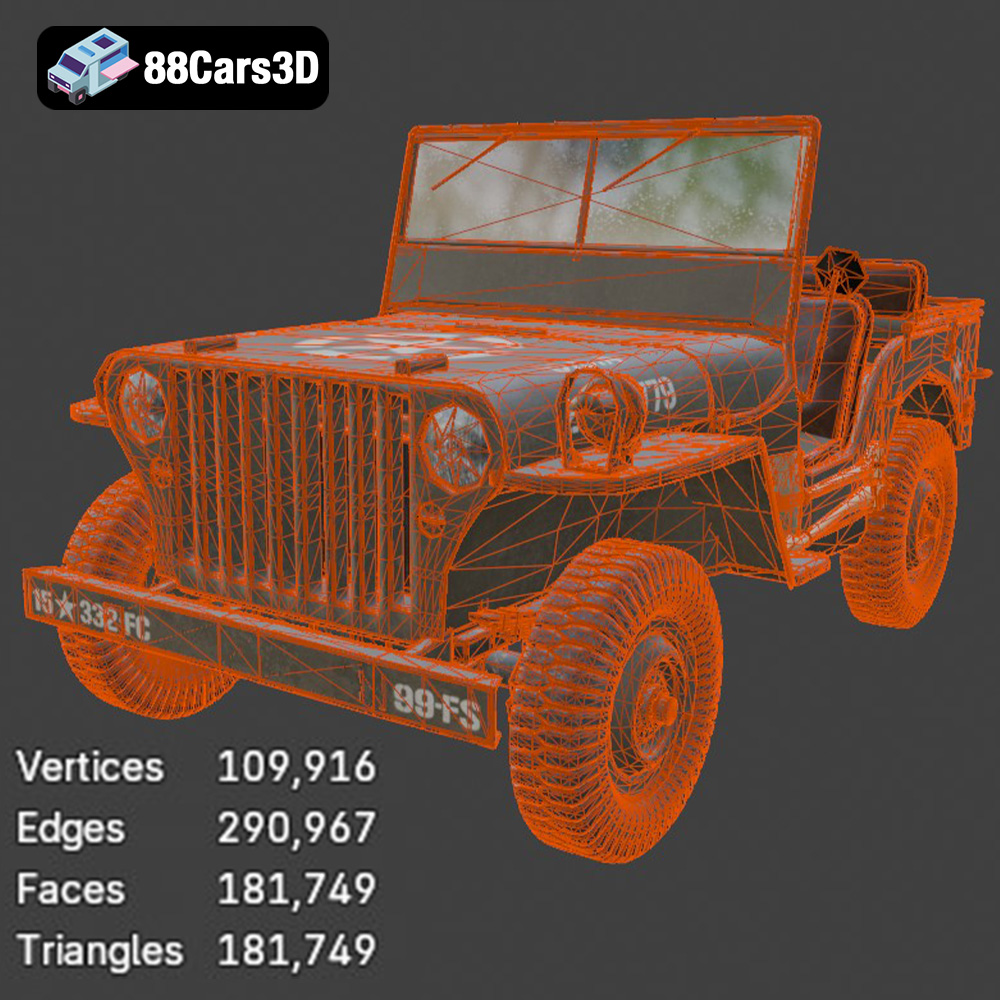
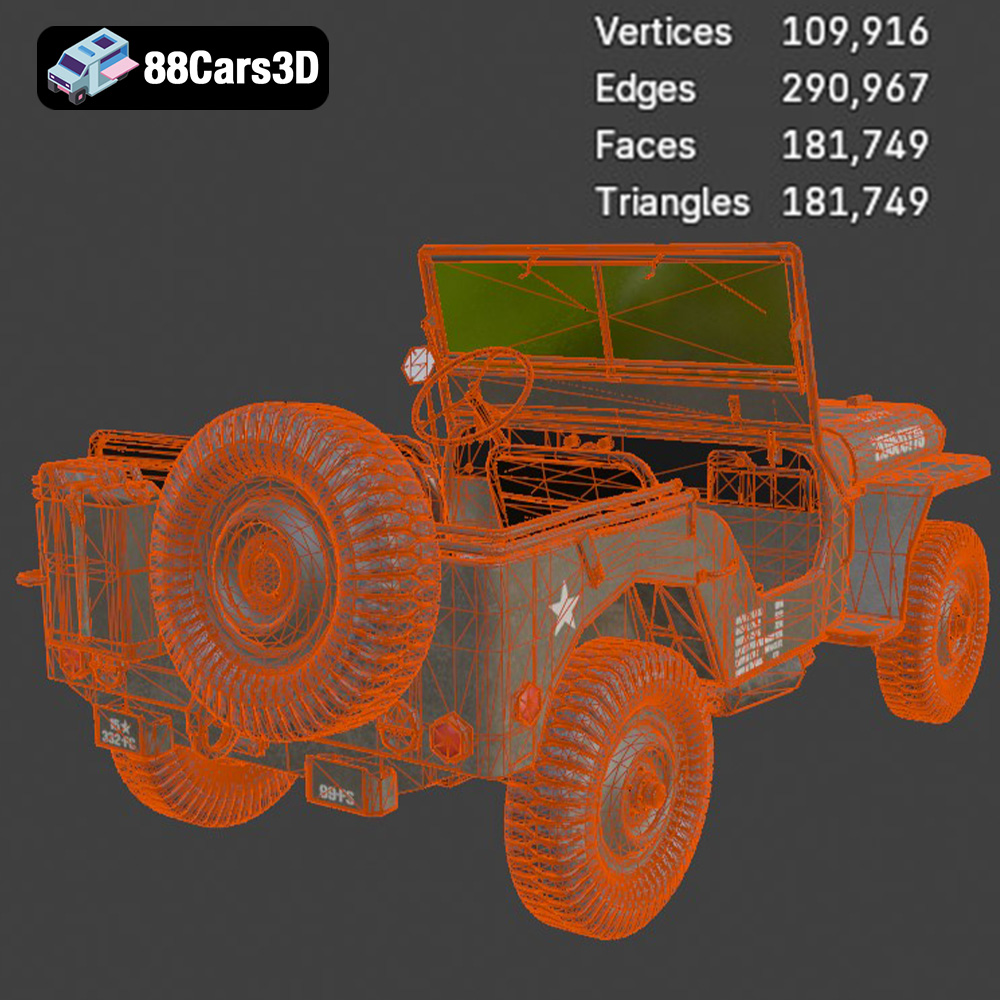
At the core of any high-performance 3D model is its topology – the arrangement of vertices, edges, and faces that form the mesh. For automotive assets, clean, quad-based topology is often preferred for its flexibility in deformation, subdivision, and UV mapping. However, for real-time applications like games or AR/VR, the mesh must also be meticulously optimized to reduce polygon count without sacrificing visual detail. The US Army Willys Jeep 3D Model, for instance, boasts an optimized topology of approximately 150,000 triangles. This figure strikes a critical balance: low enough to ensure excellent frame rates in interactive applications, yet high enough to capture the intricate details of the Jeep’s bodywork, engine block, and suspension components for stunning close-up renders.
Especially for vehicles with significant historical importance, accuracy is paramount. This extends beyond general shape to precise proportions, panel gaps, and the faithful reproduction of unique features. For the Willys Jeep, this means meticulously recreating its iconic slotted grille, the specific design of its leaf spring suspension, the layout of its ‘Go Devil’ inline-four engine, and the utilitarian design of its cockpit. Professional artists often work with extensive reference materials – blueprints, historical photographs, and even physical scans – to ensure every curve and angle aligns with the real-world counterpart. The US Army Willys Jeep 3D Model exemplifies this commitment to accuracy, making it suitable for historically sensitive projects such as WWII video games or VR museum exhibits.
Beyond the raw geometry, the true magic of realism comes from materials and textures. High-quality 3D car models utilize physically based rendering (PBR) workflows, employing maps like Albedo (Base Color), Roughness, Metallic, Normal, and Ambient Occlusion to simulate how light interacts with surfaces. This allows for realistic representations of painted metal, rubber tires, canvas seats, and weathered surfaces. The ability to customize these materials, changing body colors (e.g., olive drab, desert sand), modifying tire textures, or adjusting finishes (matte, gloss, metallic), is a key advantage offered by professionally crafted models like the Willys Jeep, providing immense flexibility for diverse scenes and scenarios.
The choice of file format is a critical decision in any 3D workflow, dictating compatibility, feature retention, and optimization for specific applications. Professional 3D car models, such as those found on 88cars3d.com, often come in a variety of formats to ensure maximum versatility across different software and engines. Understanding these formats is key to streamlining your production pipeline.
The `.blend` format is Blender’s native project file. It stores the entire Blender scene, including mesh data, materials, textures, animations, rigging, cameras, lighting, and even scene settings. This makes it an incredibly powerful format for Blender users, offering full editability and preserving all scene information. If you’re working primarily within Blender for rendering, animation, or game asset creation, the `.blend` file provides the most comprehensive starting point, allowing direct manipulation of every aspect of the US Army Willys Jeep 3D Model.
The Filmbox (`.fbx`) format, developed by Autodesk, is arguably the most widely adopted interchange format in the 3D industry. It’s excellent for transferring 3D data between different software applications (like 3ds Max, Maya, Blender, Cinema 4D) and, crucially, into game engines like Unreal Engine and Unity. `.fbx` can store mesh data, materials (though PBR materials often need re-setup in the target application), animations, rigging, cameras, and lights. It’s designed for efficiency and is highly optimized for real-time pipelines, making it an ideal choice for importing the Willys Jeep 3D Model into game development projects.
The Wavefront Object (`.obj`) format is a simple, universal 3D data format that is supported by virtually all 3D software. It primarily stores geometry (vertices, normals, UVs, and faces) and can reference external material files (`.mtl`). While it doesn’t support animation or advanced scene data, its widespread compatibility makes it an excellent choice for basic mesh transfer or as a fallback option when other formats encounter issues. For the Willys Jeep, an `.obj` file ensures that anyone with any 3D software can import the core geometry and begin texturing.
GL Transmission Format Binary (`.glb`) is the binary version of glTF (Graphics Library Transmission Format). It’s an open-standard, royalty-free format designed for efficient transmission and loading of 3D scenes and models by engines and applications. `.glb` packages all model data (geometry, textures, animations, PBR materials) into a single compact file, making it perfect for web-based 3D viewers, AR/VR applications, and mobile experiences. Its optimization for real-time rendering and small file size makes it superb for deploying the Willys Jeep 3D Model in interactive online showcases or augmented reality museum exhibits.
Stereolithography (`.stl`) is the de facto standard file format for 3D printing. It represents a 3D model as a series of connected triangles (a triangulated surface mesh) without color or texture information. While simple, it’s universally understood by 3D printers and slicing software. The Willys Jeep 3D Model’s availability in `.stl` format allows hobbyists and professionals to bring the digital asset into the physical world, creating tangible replicas for display or prototyping. Specific print settings, like those recommended for the Willys Jeep (scale, layer height, supports), are crucial for successful output.
The Polygon File Format (`.ply`), also known as the Stanford Triangle Format, is a versatile format often used for storing 3D data from 3D scanners or for CAD/engineering applications. It can store various properties for each vertex (like color, normal vectors) and face (like color), and supports both ASCII and binary encodings. While less common for general 3D asset transfer, its precision makes it valuable for specific niche applications or for integrating detailed scan data into a project involving the Willys Jeep.
While not a traditional standalone file extension, many high-quality asset packs for Unreal Engine often refer to “Unreal Engine-ready” assets or include a file that’s specifically structured for direct import and setup within Unreal. This typically means the model (often an `.fbx` or similar) has been correctly scaled, pivoted, had its UVs optimized for lightmapping, and possibly even includes a basic material setup that translates easily into Unreal’s PBR system. For assets like the Willys Jeep, an `.unreal` designation signifies that it’s designed for seamless integration, minimizing setup time and ensuring optimal performance within the engine.
The `.max` format is Autodesk 3ds Max’s native scene file. Similar to Blender’s `.blend`, it saves the entire 3ds Max project, including all geometry, materials, textures, lighting, cameras, animations, and modifier stacks. This format offers maximum flexibility for users who work with 3ds Max for architectural visualization, automotive rendering, or animation. The availability of the Willys Jeep 3D Model in `.max` format provides 3ds Max artists with a fully editable scene, enabling deep customization, advanced rendering setups, and complex animation workflows.
The true value of a versatile 3D asset like the US Army Willys Jeep 3D Model lies in its ability to seamlessly integrate into various professional production pipelines. From high-octane game development to photorealistic cinematic rendering, the technical specifications and included file formats ensure broad applicability.
For game developers, the blend of visual quality and performance is paramount. A model must look great but also contribute to smooth frame rates. The US Army Willys Jeep 3D Model, with its 150,000-triangle count, is explicitly designed to be game-ready. Its optimized geometry, real-world scale, and proper pivot setup for steering, wheel rotation, and suspension travel make it ideal for integration into engines like Unreal Engine and Unity. Imagine this Willys Jeep navigating historical battlefields in a WWII title, traversing open-world environments, or serving as a detailed prop in a military simulator. The `.fbx` format facilitates direct import, while the `.unreal` designation ensures a streamlined workflow for Unreal Engine artists, often requiring minimal post-import setup for materials and rigging.
When the goal is breathtaking photorealism for commercials, film, or architectural visualizations, the focus shifts slightly from real-time performance to maximum detail and complex lighting. Software like 3ds Max and Blender, paired with powerful renderers such as V-Ray, Corona, Arnold, or Cycles, can leverage the high fidelity of the Willys Jeep model. The `.max` and `.blend` files provide native access to the model’s full detail, allowing artists to finely tune materials, add advanced textures, set up intricate studio lighting, and create dynamic animations. Imagine the Willys Jeep featured in a historically accurate documentary scene, a compelling automotive advertisement, or as part of a detailed digital environment for a brand campaign, showcasing its rugged charm with unparalleled visual depth.
The burgeoning fields of Augmented Reality (AR) and Virtual Reality (VR) demand highly optimized models that can be rendered efficiently on diverse hardware, from powerful VR headsets to mobile phones. The Willys Jeep’s game-ready optimization and `.glb` format make it an excellent candidate for these applications. It could be showcased in a virtual museum exhibit, allowing users to inspect the vehicle from all angles in a VR environment, or integrated into an AR app that superimposes the Jeep onto a real-world scene. The compact nature of `.glb` ensures quick loading times and smooth interaction, crucial for delivering a convincing immersive experience whether for virtual showrooms, historical simulations, or interactive product configurators.
This particular 3D model isn’t just a generic car; it’s a meticulously crafted digital replica of a historical icon. Every aspect has been considered to deliver a highly functional and visually stunning asset, exemplifying the quality available at 88cars3d.com.
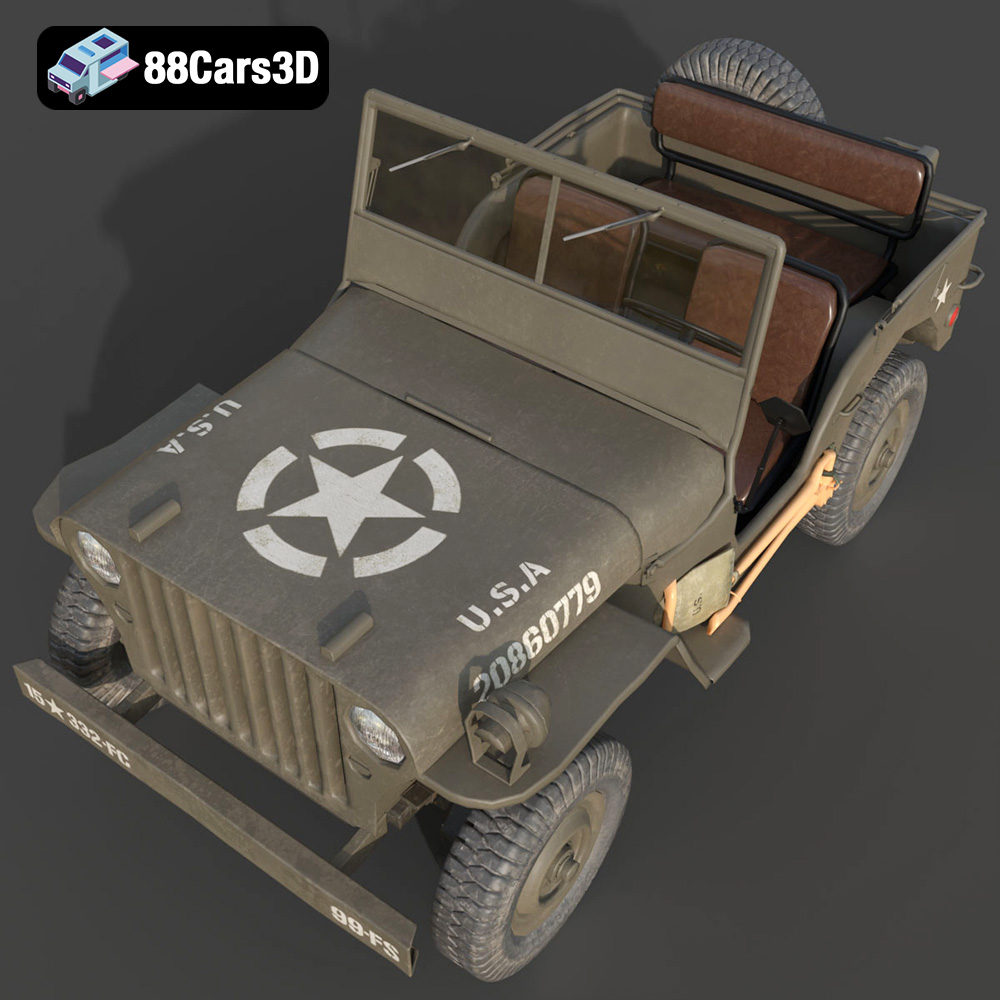
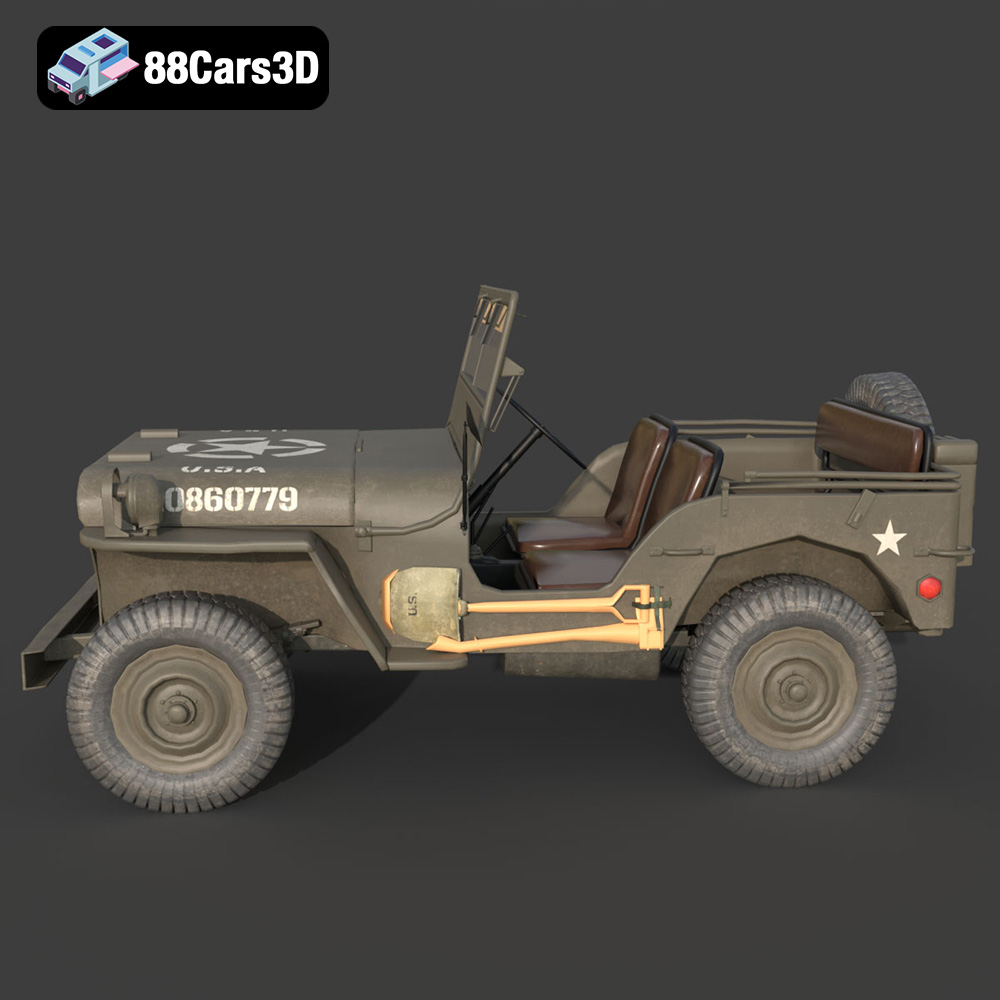
The exterior of the US Army Willys Jeep 3D Model captures its definitive characteristics with impressive accuracy. The iconic slotted grille, a signature of the Willys design, is faithfully rendered alongside period-accurate blackout lighting. The ‘Go Devil’ inline-four engine block is detailed enough for under-hood renders, complemented by an authentic side-mounted exhaust and attached jerry cans. Crucially, components like the military-tread tires on rugged steel wheels, detailed leaf spring suspension, and rigid live axles are modeled separately, enabling realistic animation of wheel rotation, steering, and suspension travel – vital for dynamic scenes and interactive applications.
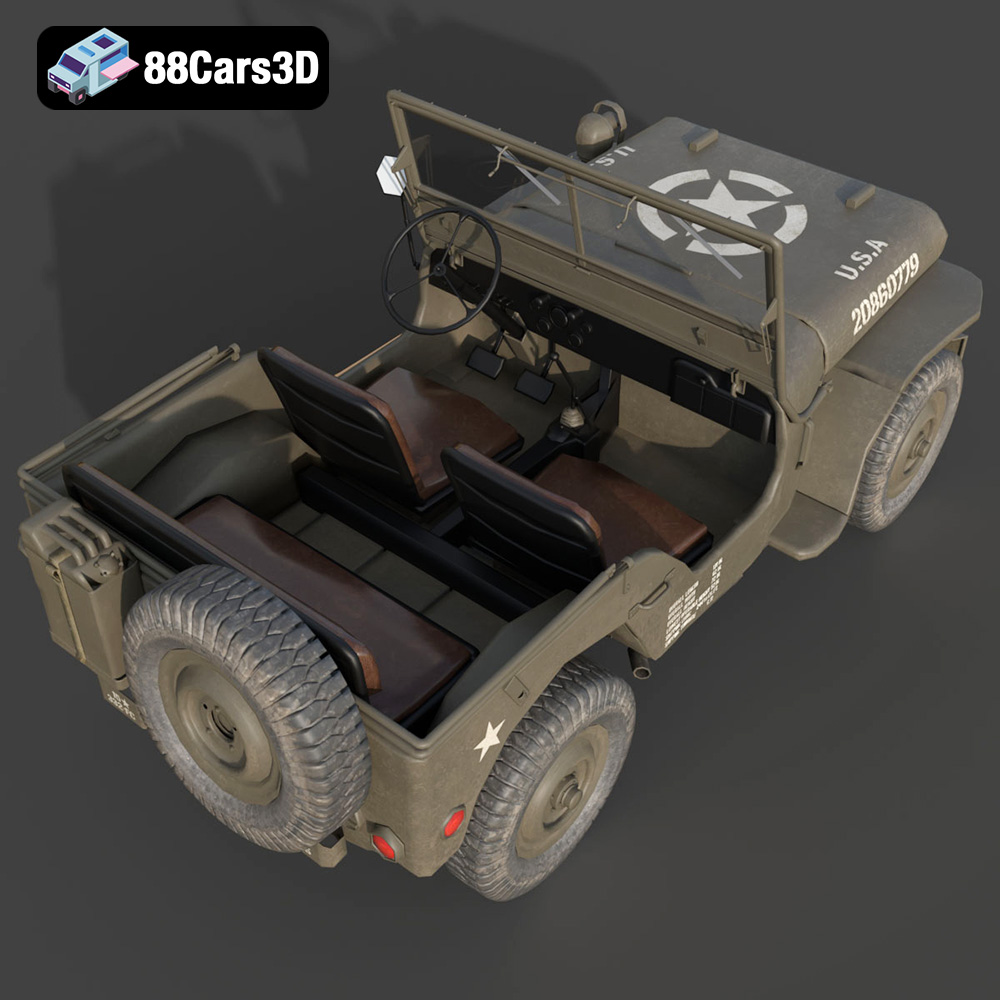
The interior of the Willys Jeep was designed for functionality over comfort, and the 3D model perfectly captures this utilitarian spirit. Authentic canvas-upholstered bucket seats provide a true-to-life feel, while the classic large-diameter thin-rimmed steering wheel and minimalist center-mounted instrument cluster evoke the era. The presence of the 4WD transfer case levers and manual floor shifter adds a layer of realism and interactivity. Furthermore, the cockpit geometry is optimized for first-person perspective in gaming, ensuring a seamless and immersive experience for players who will be “driving” this digital vehicle.
A static model can only go so far. For many professional applications, animation is key. The Willys Jeep model is designed with this in mind, featuring proper pivot setups for all crucial components, enabling realistic steering, wheel rotation, and suspension articulation. Beyond animation, its customization options are extensive: easily change body colors to suit different environments (olive drab, desert sand, navy grey), modify tire textures for various terrains (muddy off-road vs. clean display variants), or adjust material finishes to achieve specific looks (matte, gloss, metallic). This flexibility ensures the model can be adapted to virtually any project requirement.
The utility of high-quality 3D car models extends beyond purely digital realms. With advancements in additive manufacturing, these assets can be brought to life as physical objects, opening new avenues for display, prototyping, and collectible creation.
The inclusion of the `.stl` format for the US Army Willys Jeep 3D Model is a significant advantage for 3D printing enthusiasts. While an `.stl` file provides the raw mesh, successful printing requires careful preparation. This includes ensuring the model is watertight (no open edges), checking for manifold geometry, and sometimes simplifying the mesh for faster print times. The product description provides crucial recommendations for 3D print settings, such as optimal scales (1:12, 1:18, 1:24), layer height (0.04–0.12 mm, with resin printing recommended for fine details), wall thickness, and infill. These details are critical for hobbyists aiming to produce high-quality physical replicas.
For complex models like vehicles, strategic print orientation and support structures are essential. The guidance to print the frame angled for structural integrity and wheels separately is invaluable. Furthermore, the detailed parts like the exhaust, mirrors, and handlebars will undoubtedly require supports. Once printed, post-processing steps such as sanding, priming, and painting are necessary to achieve a professional finish. Replicating authentic factory colors with metallic finishes can transform a raw print into a stunning display piece, showcasing the detailed craftsmanship of the original 3D model in a tangible form.
In a competitive digital landscape, time is money. Relying on pre-optimized, high-quality 3D car models can dramatically accelerate production schedules and elevate the overall quality of any project. 88cars3d.com stands out as a reliable source for such assets.
Developing a 3D car model from scratch, especially one as detailed and accurate as the US Army Willys Jeep, is a time-consuming and skill-intensive endeavor. It involves extensive modeling, UV unwrapping, texturing, rigging, and optimization – processes that can take weeks or even months for a single artist. By acquiring a production-ready model from a reputable marketplace like 88cars3d.com, developers and artists can bypass these initial stages, immediately integrating a high-quality asset into their workflow. This not only saves significant development costs but also frees up valuable resources to focus on other critical aspects of their project, such as game mechanics, scene composition, or animation refinement.
A well-made 3D model is a long-term investment. Its versatility across various file formats and applications means it can be repurposed for multiple projects, from a hero asset in a game to a detailed prop in an architectural visualization, or a base for a 3D printed collectible. The detailed nature and historical accuracy of the US Army Willys Jeep 3D Model ensure its timeless appeal and relevance. By choosing premium assets, you ensure compatibility with current industry standards and future-proof your creative endeavors, always having access to top-tier resources that meet the demands of professional productions.
The digital frontier continues to expand, driven by the relentless pursuit of realism and immersive experiences. High-quality 3D car models are at the forefront of this evolution, serving as foundational assets for everything from groundbreaking video games to intricate cinematic narratives and tangible 3D prints. The US Army Willys Jeep 3D Model from 88cars3d.com stands as a testament to the power of meticulously crafted digital assets, offering an unparalleled blend of historical accuracy, technical optimization, and multi-format versatility. Whether you’re a game developer seeking an iconic vehicle, a renderer aiming for cinematic quality, or a hobbyist eager to bring history to life through 3D printing, this model provides a robust and reliable solution. Embracing such high-caliber assets is not merely a convenience; it’s a strategic move that empowers creators to focus on their vision, confident in the quality of their digital foundations.
The US Army Willys Jeep is the definitive military off-road vehicle of World War II, celebrated for its rugged durability, legendary versatility, and iconic flat-fender design. This quintessential 4×4 features the unmistakable slotted grille, a utilitarian bodywork approach, and the recognizable layout of its reliable inline-four engine, making it a timeless symbol of American military heritage. This high-quality 3D model features an optimized topology of approximately 150,000 triangles, delivering the perfect balance between stunning visual fidelity and game-ready performance. Meticulously modeled to ensure historical accuracy, it provides outstanding details for up-close rendering while maintaining excellent frame rates for interactive applications. Perfect for historical World War II video games, military simulators, VR museum exhibits, and cinematic battlefield renderings.
$19.99
.blend
.fbx
.glb
.jeep
.max
.obj
.ply
.rendering
.stl
.unreal
car-3d-model
classic-car
game asset
game-ready
low-poly
military-vehicle
off-road
optimized
us-army
VR/AR
willys