Get 20% OFF All Premium 3D & STL Models!

Few vehicles embody a blend of timeless style, practical urban mobility, and cultural significance quite like the Vespa scooter. Since its inception, this iconic Italian two-wheeler has navigated bustling cityscapes and inspired generations with its distinctive curves and effortless elegance. Translating such a beloved piece of design into the digital realm requires precision, passion, and a deep understanding of 3D modeling principles. For artists, game developers, architects, and visualizers, a high-quality 3D representation of the Vespa isn’t just an asset; it’s a statement, a historical touchstone, and a versatile tool for storytelling.
This article delves into the intricacies of integrating premium 3D models into diverse professional workflows, using the exceptional Vespa 01-08 3D Model from 88cars3d.com as our prime example. We’ll explore everything from essential file formats and technical specifications to real-world applications in game development, architectural visualization, AR/VR, and even 3D printing. Understanding the nuances of a meticulously crafted asset like the Vespa 01-08 can elevate your projects, offering both visual fidelity and optimal performance across various platforms. Join us as we unpack the technical advantages and creative possibilities this classic scooter brings to the digital canvas.
When acquiring a 3D model, the file formats it comes in are as crucial as the model itself. Each format is designed for specific purposes, offering different levels of compatibility, data retention, and optimization for various software and pipelines. The Vespa 01-08 3D model, available on 88cars3d.com, is a prime example of a versatile asset, packaged with a comprehensive suite of formats to ensure maximum utility for any project.
The .blend format is native to Blender, the popular open-source 3D creation suite. When you receive a .blend file, you’re getting the complete working project. This includes not only the mesh data but also all materials, textures, lighting setups, camera positions, animations, and even modifiers used during the modeling process. For the Vespa 01-08, the .blend file provides a fully editable scene, allowing artists to delve deep into its construction, modify components, adjust shaders, or animate specific parts like the steering and suspension with ease. It’s the ideal starting point for anyone intending to customize the model significantly or integrate it into a Blender-centric pipeline for rendering or game development.
The .fbx (Filmbox) format is an industry-standard proprietary file format developed by Autodesk for 3D content exchange. It’s incredibly robust, capable of storing not just geometry but also animation, cameras, lights, and materials in a highly interoperable way. This makes it the go-to format for exporting assets between different 3D software packages (like 3ds Max, Maya, Blender) and, crucially, for importing into real-time engines such as Unreal Engine and Unity. For the Vespa 01-08, the .fbx variant ensures that its optimized 120,000 triangle count, proper pivot setups, and material assignments translate seamlessly into game environments, ready for collision setup and interactive physics.
The .obj (Wavefront Object) format is one of the oldest and most universally supported 3D file formats. It’s a simple, text-based format primarily used to store 3D geometry (vertices, normals, texture coordinates, and faces) and references to external material files (.mtl). While it doesn’t typically store animation or rigging data, its widespread compatibility makes it an excellent choice for basic mesh exchange between virtually any 3D software. For the Vespa 01-08, the .obj file guarantees that the model’s core geometry is accessible to artists using less common software or those needing a clean, unadorned mesh for sculpting or retopology.
The .glb (GL Transmission Format Binary) is a relatively newer format, optimized for the efficient transmission and loading of 3D scenes and models in web and AR/VR applications. It’s a binary container format that includes 3D model data, animations, and PBR (Physically Based Rendering) materials in a single file, making it highly self-contained and performant. For presenting the Vespa 01-08 in an interactive virtual showroom, a mobile AR experience, or directly on a webpage, the .glb format is ideal due to its compact size and native support in many modern browsers and AR platforms.
The .stl (STereoLithography) format is the standard file type for 3D printing. It represents a 3D model as a series of connected triangles (a triangulated surface mesh), effectively describing the surface geometry of an object without color, texture, or other CAD attributes. While simple, its ubiquity in additive manufacturing means that the Vespa 01-08’s .stl file allows hobbyists and professionals to physically manifest the digital model. The provided file comes ready for slicing software, enabling users to print scaled replicas of the scooter with recommended settings for resin printers to capture fine details.
The .ply (Polygon File Format, also known as Stanford Triangle Format) is another format for storing 3D data, particularly suited for scanner data and applications requiring precision meshes. It can store a wider range of properties than .stl, including color, transparency, and sometimes even confidence values for scanned data. While less common for general 3D asset exchange, its inclusion for the Vespa 01-08 caters to specialized applications like reverse engineering, scientific visualization, or CAD/CAM workflows where mesh integrity and additional per-vertex data are paramount.
The .unreal file format, often referring to an asset specifically prepared or packaged for Unreal Engine, implies an asset that has undergone specific optimization and setup processes within the engine itself, or is provided as a pre-packaged Unreal asset. This might include fully configured static meshes, skeletal meshes, materials using Unreal’s PBR system, LODs (Levels of Detail), and even basic collision meshes. For the Vespa 01-08, an .unreal asset significantly streamlines the integration process, potentially offering an immediate drag-and-drop solution into your Unreal project, complete with proper pivots for animation, engine-ready materials, and optimal performance.
The .max format is the native file format for Autodesk 3ds Max, a powerful 3D modeling, animation, rendering, and visualization software. Similar to the .blend file for Blender, the .max file encapsulates the entire scene, including geometry, materials, lighting, cameras, animation keyframes, and modifiers. For professionals working in architectural visualization, product design, or high-fidelity cinematic rendering, the .max file of the Vespa 01-08 provides maximum flexibility. Users can leverage 3ds Max’s robust toolset to create intricate animations, produce stunning photorealistic renders with V-Ray or Corona, or integrate the scooter into complex scenes with precise control over every detail.
The inclusion of such a diverse array of file formats for the Vespa 01-08 3D model from 88cars3d.com underscores its adaptability and value as a premium asset, ensuring it meets the demands of virtually any digital production pipeline.
The essence of a compelling 3D model lies in its ability to faithfully replicate real-world objects while adhering to technical best practices. The Vespa 01-08 3D model exemplifies this balance, offering a stunningly accurate digital twin of the iconic scooter, optimized for various high-demand applications.
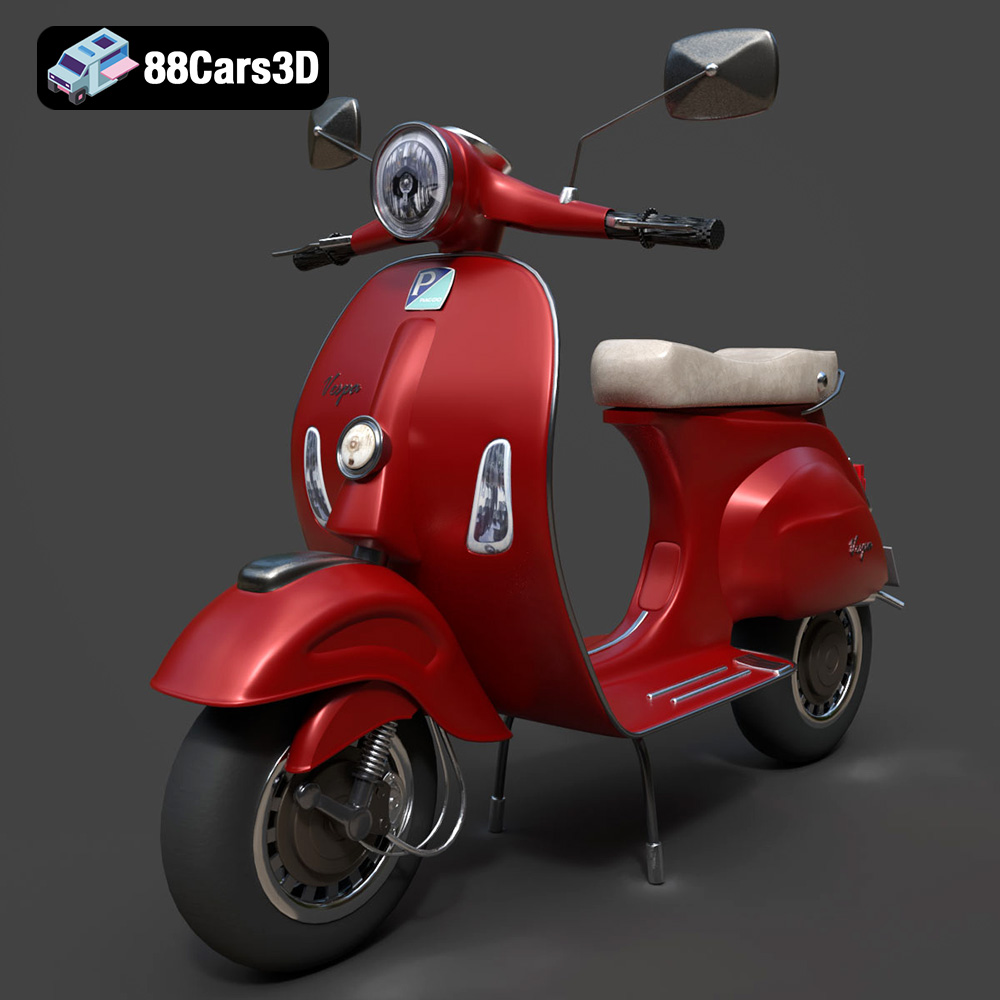
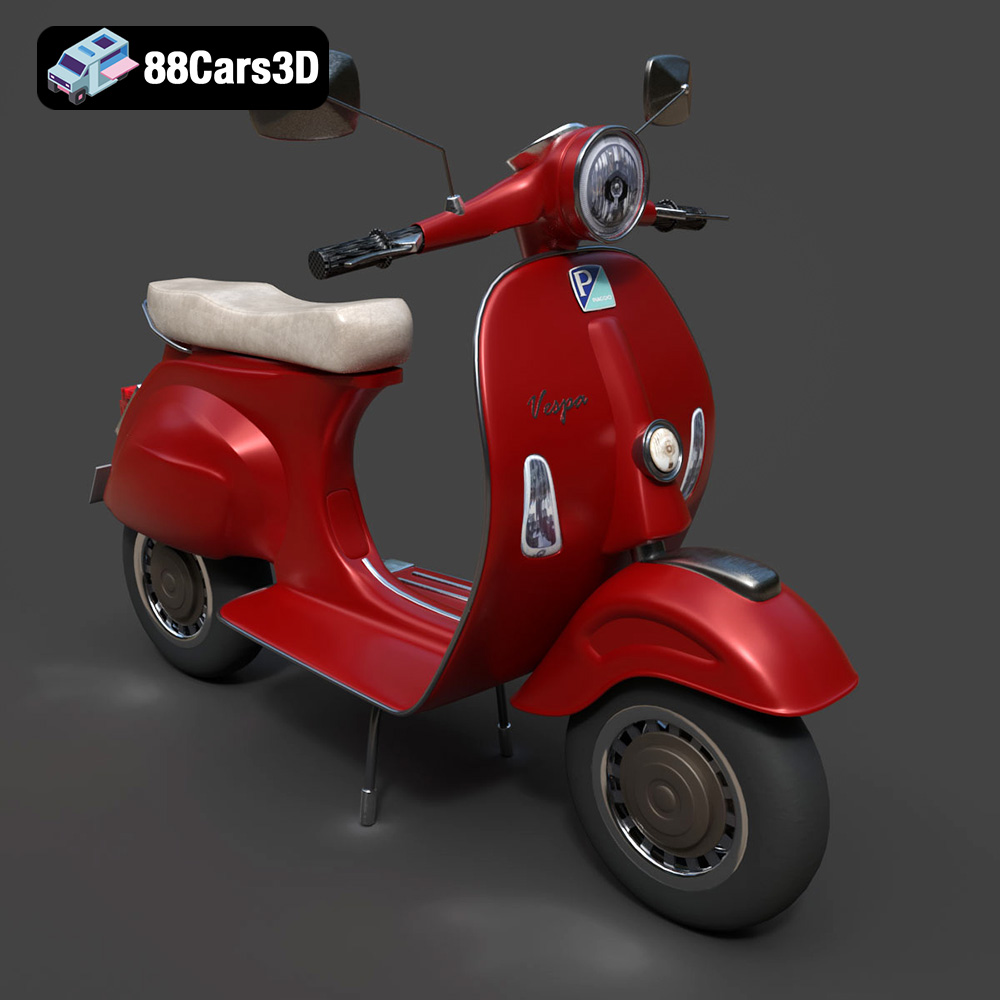
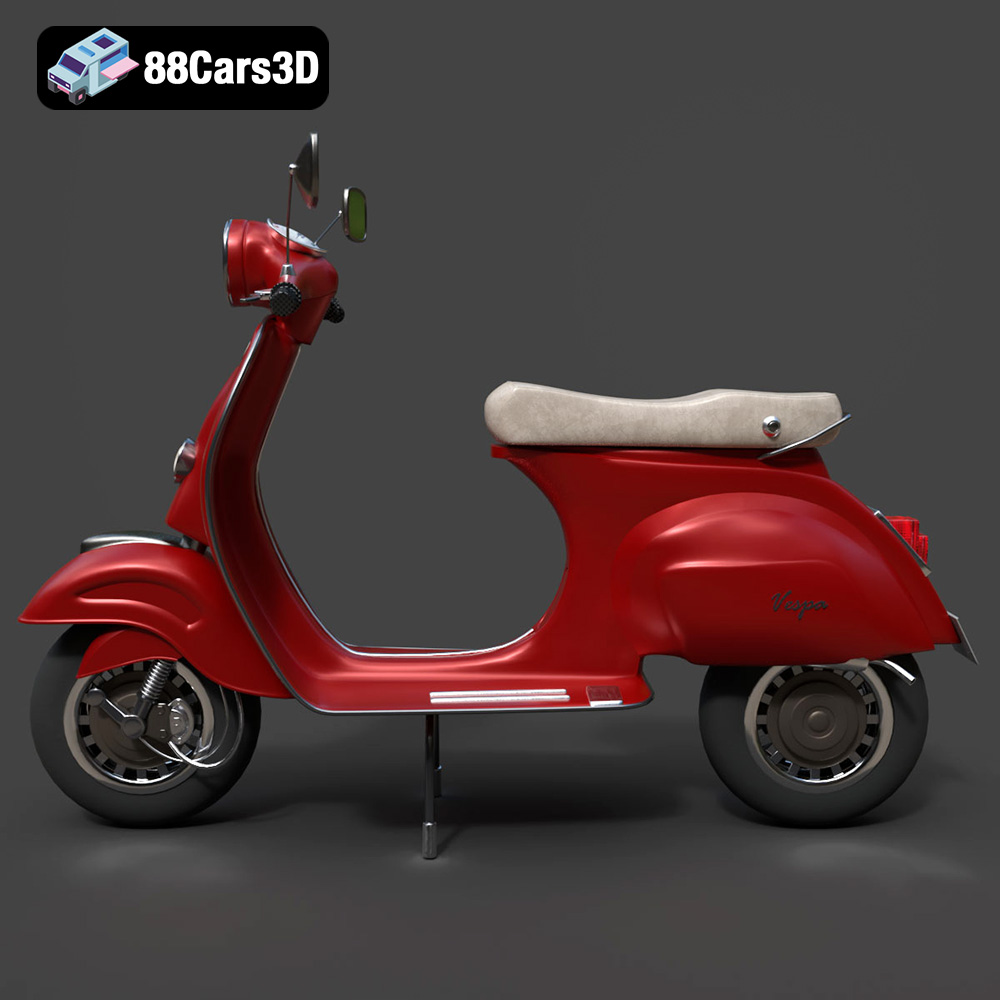
One of the first things that stands out with this Vespa model is its commitment to authenticity. The 01-08’s signature step-through frame, classic round headlamp, and distinctive curved bodywork are replicated with exacting precision. This isn’t just about superficial resemblance; it’s about capturing the vehicle’s “soul.” Details like the classic retro exhaust system, the intricate cooling vents on the engine enclosure, and the vintage taillight housing all contribute to an undeniable sense of realism. For projects requiring historical accuracy or a strong brand identity, such meticulous detailing is indispensable. The accurate trailing-link front suspension details, for instance, aren’t merely aesthetic; they provide a foundation for realistic animation and physics in dynamic scenes.
Beyond the exterior, the interior (or cockpit, in the case of a scooter) offers an equally impressive level of detail. The ergonomic dual-seat saddle with its subtle stitching, the classic curved handlebars with authentic grips, and the vintage-style analog instrument cluster all contribute to a highly immersive experience. For game developers, this means the model is ready for first-person POV shots, allowing players to feel genuinely connected to the ride. In VR experiences, this attention to the rider’s immediate environment is critical for suspension of disbelief and enhancing user engagement. Every lever, switch, and footboard is modeled with care, ensuring that even close-up renders or interactive elements hold up to scrutiny.
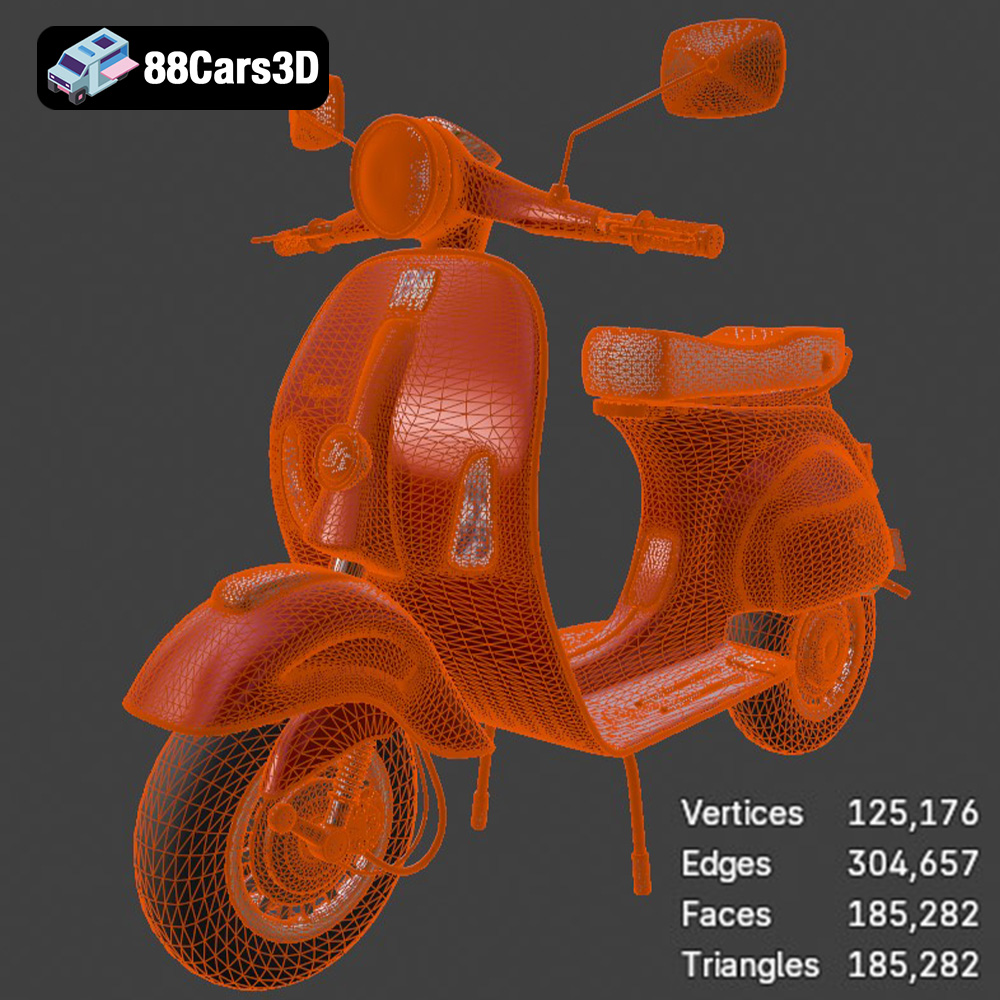
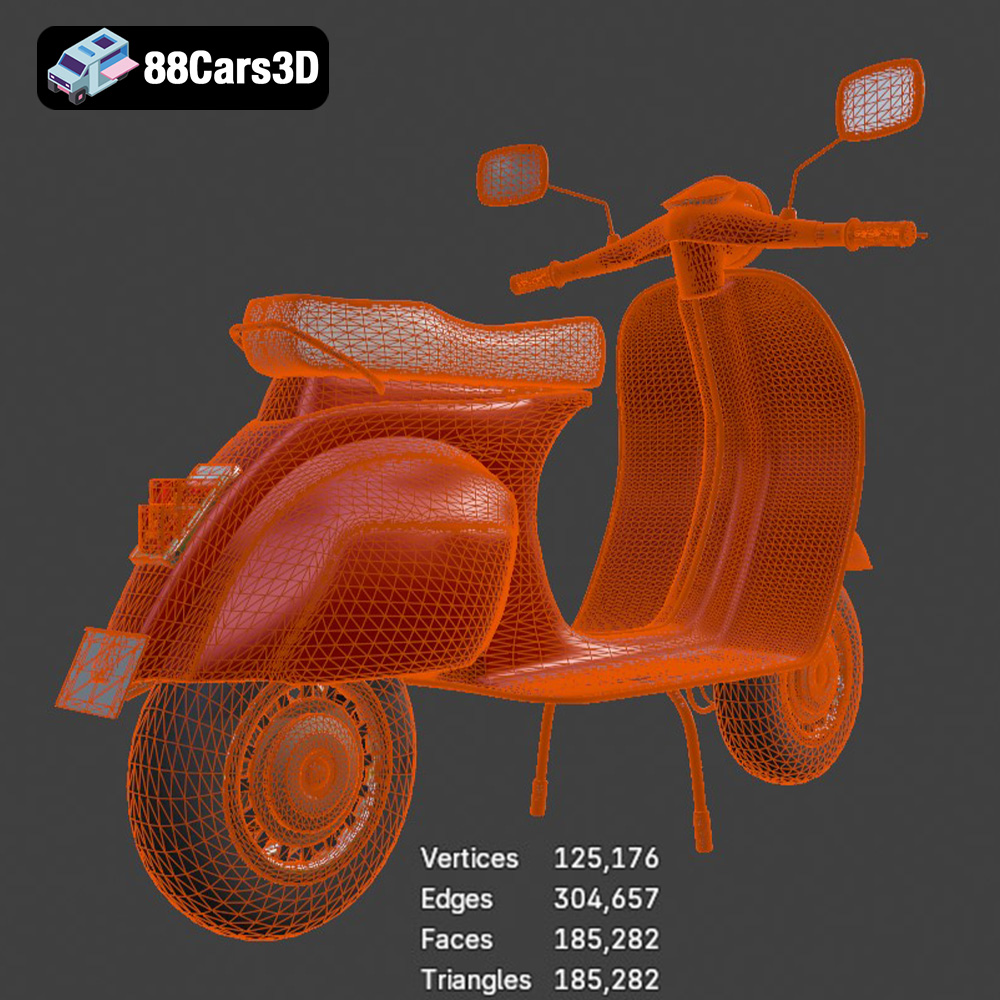
Underpinning this visual fidelity are robust technical specifications. The model boasts “premium topology,” a crucial indicator of a well-constructed 3D asset. This means the mesh is clean, efficient, and optimized for deformation and texturing, preventing artifacts and ensuring smooth rendering. Furthermore, its “real-world scale accuracy” based on actual vehicle chassis dimensions ensures seamless integration into environments built to scale, whether it’s an architectural visualization scene or an open-world game map. This precision minimizes the need for manual scaling and adjustments, saving valuable development time and ensuring consistent results across different projects. The optimized 120,000 triangle count strikes a perfect balance, delivering high-end visual realism without overburdening real-time engines.
In today’s fast-paced digital landscape, efficiency and performance are as vital as visual quality. The Vespa 01-08 3D model from 88cars3d.com is engineered not just for stunning renders but also for seamless integration into the most demanding real-time environments, particularly game development.
The “game-ready & optimized” tag isn’t just marketing jargon; it signifies a deliberate design choice. With an optimized 120,000 triangle count, the Vespa 01-08 model achieves a critical balance. It’s detailed enough to look fantastic in modern engines like Unreal and Unity, capturing the Vespa’s iconic curves and details without appearing blocky or simplistic. Yet, it remains lean enough to be efficiently rendered in real-time, allowing for multiple instances of the scooter in a scene without significant performance drops. This makes it an ideal choice for open-world games where traffic density or numerous background assets are common, or for racing titles where every frame per second counts. The clean topology also aids in generating efficient collision meshes, essential for realistic physics interactions.
The inclusion of .fbx and .unreal file formats directly addresses the needs of game developers working with Unreal Engine and Unity. The .fbx format ensures that the model’s geometry, UVs, and pivot points (critical for animation) transfer correctly. For example, the separate wheels, suspension, and steering components, combined with proper pivot setups for rotation and travel, mean that a technical artist can quickly rig and animate the Vespa within the engine, simulating realistic physics and dynamic movement. The .unreal asset, when provided, further streamlines this by offering an already prepared asset, potentially saving hours of setup time for materials, LODs, and basic collision geometry within Unreal Engine itself. This “plug-and-play” capability is a huge advantage for rapid prototyping and production in game development pipelines.
Beyond traditional games, the model’s optimization extends to various real-time rendering applications. In interactive configurators for automotive brands, for instance, users can explore the Vespa 01-08 in real-time, changing colors, materials, and even viewing it in different lighting conditions. For AR/VR experiences, where rendering hundreds of frames per second is crucial for immersion, the optimized polycount and efficient materials ensure a smooth, comfortable experience without motion sickness. This model is perfect for virtual showrooms, interactive tours, or mobile AR apps where performance on less powerful hardware is a key consideration. Its balanced technical specifications make it a versatile foundation for any project demanding high-quality visuals within real-time constraints.
The utility of a premium 3D asset like the Vespa 01-08 extends far beyond traditional screen-based rendering and game development. Its robust technical foundation and diverse file formats open doors to cutting-edge applications in Augmented Reality (AR), Virtual Reality (VR), and even tangible manifestations through 3D printing.
The immersive nature of AR and VR demands highly optimized assets that can be rendered seamlessly at high frame rates. The Vespa 01-08 3D model is exceptionally well-suited for these environments. With its 120,000 triangle count, it strikes the perfect balance between visual fidelity and performance, ensuring that users can interact with the scooter without experiencing lag or visual artifacts. For instance, in a virtual showroom developed for VR, potential customers could walk around the Vespa, inspect its details up close, or even “sit” on it, experiencing its scale and ergonomics in a truly immersive way. In AR, the model can be placed in a real-world environment through a smartphone or tablet, allowing users to visualize the scooter in their garage, driveway, or even their living room. The inclusion of the .glb format is particularly beneficial here, as it’s designed for efficient transmission and rendering in web-based AR/VR applications, making deployment easier across various platforms.
One of the most exciting applications of a detailed 3D model is its potential for physical creation through 3D printing. The Vespa 01-08 comes with an .stl file, the industry standard for additive manufacturing, enabling hobbyists and professionals to bring this iconic design into the physical world. While the digital model is optimized for screens, the .stl conversion maintains the essential geometry required for a successful print. The product description provides excellent guidance for 3D print settings, recommending resin printing for fine details at scales like 1:12 or 1:18. This level of advice is invaluable, covering everything from layer height and infill to print orientation and support requirements. Imagine printing a highly detailed miniature of the Vespa for a diorama, a desktop display, or even as a collectible. Post-processing suggestions like sanding, priming, and applying authentic factory colors further enhance the realism of the physical model, showcasing the versatility of a well-prepared 3D asset.
Beyond AR/VR and 3D printing, the Vespa 01-08 3D model is an invaluable asset for architectural visualization and lifestyle renderings. Placing this classic scooter in front of a modern café, parked on a cobblestone street, or casually leaning against a chic urban apartment building immediately injects character, narrative, and a sense of “lived-in” realism into a scene. For interior designers, it can serve as a stylish prop in a garage or studio space, hinting at the owner’s personality. The model’s premium topology and accurate detailing mean it will hold up under close-up shots and various lighting conditions, making it perfect for high-resolution marketing materials, brand campaigns, and editorial imagery. The ability to easily change body colors and material finishes further enhances its adaptability to match any desired aesthetic, making it a go-to asset for creating vibrant, engaging visual stories.
A high-quality 3D model like the Vespa 01-08 is more than just a collection of polygons; it’s a foundation for creative exploration across a multitude of professional disciplines. Its design and included file formats ensure seamless integration into various software ecosystems.
For professionals leveraging Autodesk 3ds Max, the included .max file is a direct gateway to advanced rendering and animation workflows. Artists can immediately open the scene and begin utilizing 3ds Max’s robust toolset. Imagine integrating the Vespa into a bustling city street scene for an architectural visualization project, rendering it with photorealistic engines like V-Ray or Corona. The “proper pivot setup for steering, wheel rotation, and suspension travel” within the model is a significant advantage. This means animators can quickly set up a rig to animate the scooter realistically, perhaps for a cinematic sequence or a product commercial. Adjusting materials for different lighting conditions, adding complex shaders, or even breaking down the model into components for an exploded view animation are all straightforward tasks with the native .max file, allowing for unparalleled control and fidelity in output.
The .blend file offers similar advantages for Blender users, providing a fully editable scene. Blender’s powerful Eevee and Cycles renderers can produce stunning images and animations. A Blender artist could easily modify the Vespa 01-08’s paint scheme, add custom decals, or even integrate it into a stylized scene with non-photorealistic rendering. The flexibility of Blender allows for rapid prototyping and iteration. For instance, a game developer using Blender could refine the model’s UV mapping for texture atlases, create custom LODs (Levels of Detail) for optimization, or develop a more complex animation rig to handle dynamic suspension behavior. The active and supportive Blender community also means a wealth of tutorials and resources are available for advanced customization, making the Vespa 01-08 a fantastic starting point for any Blender project.
For game development and real-time simulations, integrating the Vespa 01-08 into Unreal Engine is a streamlined process. The .fbx file, and especially the .unreal packaged asset, are designed for this. Upon import, the model’s optimized geometry, UVs, and pivot points should transfer correctly. Artists can then apply Unreal’s powerful Physically Based Rendering (PBR) materials, leveraging its comprehensive material editor to create realistic paint, chrome, and rubber surfaces. Setting up collision geometry is straightforward, allowing the Vespa to interact realistically with the game world. Furthermore, the separate components (wheels, suspension, steering) make it easy to create a skeletal mesh and integrate it into Unreal’s vehicle blueprint system. This enables dynamic physics, realistic driving mechanics, and interactive elements, turning a static model into a fully functional in-game asset. Whether for a racing game, an open-world sandbox, or an interactive VR experience, the Vespa 01-08 is built to perform within the demanding constraints of a real-time engine.
Purchasing a premium 3D model is an investment, and its true value often lies in its adaptability and the potential for customization. The Vespa 01-08 3D model from 88cars3d.com offers extensive options, ensuring it remains a versatile asset for years to come across various projects.
The product description highlights several key customization options that empower artists to make the Vespa truly their own. The ability to “Change body/tank colors” is fundamental. Whether you need a classic factory color like Rosso Corallo or a vibrant custom finish to match a brand’s aesthetic, the model’s clean material breakdown allows for easy color adjustments within your chosen 3D software (Blender, 3ds Max, Unreal, etc.). Furthermore, the option to “Modify tire textures (off-road vs. street variants)” and “Adjust material finishes (matte, gloss, metallic)” provides granular control over the scooter’s visual appearance. This means the same base model can seamlessly transition from a pristine showroom piece to a rugged urban commuter or a vintage showpiece with a weathered patina, simply by adjusting textures and shader properties. Such flexibility ensures the Vespa 01-08 can fit into any narrative or visual style your project demands.
Beyond the model itself, its performance in different lighting scenarios is crucial. The mention of “Adapt lighting for different environments” underscores the PBR (Physically Based Rendering) readiness of the asset. PBR materials react realistically to various lighting conditions, meaning the Vespa will look accurate whether placed under a bright studio light setup, the harsh midday sun, or the moody glow of a rainy evening street. This allows artists to drop the model into diverse scenes – from bustling urban cityscapes to serene countryside roads or minimalist studio environments – with confidence that its materials will behave predictably and beautifully. The meticulous topology and UV mapping contribute significantly here, ensuring that textures and lighting effects wrap around the model without distortion or artifacts, maintaining visual integrity across any scene.
Investing in a well-crafted 3D model like the Vespa 01-08 is a step towards future-proofing your asset library. Its optimized geometry, clean topology, and comprehensive file format support ensure compatibility with current and future software versions and rendering pipelines. As game engines evolve and real-time visualization techniques advance, having a foundationally sound asset means less rework and more efficiency. The included .blend, .fbx, .obj, .glb, .stl, .ply, .unreal, and .max files cover virtually every common workflow, safeguarding your investment. Whether you’re a freelance artist, a game studio, or an architectural firm, knowing that an asset like this Vespa 01-08 will seamlessly integrate into various projects for years to come is a significant advantage, allowing you to focus on creativity rather than compatibility issues.
The journey from the classic streets of Italy to the intricate world of digital creation is a testament to the enduring appeal of iconic design and the power of expert 3D modeling. The Vespa 01-08 3D model, available at 88cars3d.com, stands as a prime example of a meticulously crafted asset that transcends mere digital representation. It is a versatile tool designed to meet the rigorous demands of professional workflows across game development, automotive rendering, architectural visualization, AR/VR experiences, and even tangible 3D printing.
We’ve explored how its diverse file formats – from the editable depths of .blend and .max to the universal compatibility of .fbx and .obj, and the specialized applications of .glb, .stl, .ply, and .unreal – provide unparalleled flexibility. Its optimized 120,000 triangle count, premium topology, and accurate real-world scale ensure both stunning visual fidelity and efficient performance. Whether you’re animating a cinematic sequence in 3ds Max, building an immersive virtual world in Unreal Engine, or creating a detailed physical replica, this model provides the technical foundation you need.
The Vespa 01-08 3D model is more than just a beautiful object; it’s a strategic investment in your creative toolkit. Its robust design, game-ready optimization, and extensive customization options mean it’s ready to integrate seamlessly into your next project, enhancing visual realism and streamlining your production pipeline. For professionals seeking high-quality 3D car models and versatile game assets, exploring the offerings at 88cars3d.com, starting with this exceptional Vespa, is a definitive step towards elevating your digital creations.
Experience the timeless charm of the iconic Italian scooter with this meticulously crafted Vespa 01-08 3D model. Capturing the quintessential elegance, curved bodywork, and vintage flair that made this two-wheeler a global phenomenon, this model faithfully replicates its signature step-through frame, classic round headlamp, and compact engine enclosure. Every defining feature, from the stylish front fairing to the retro exhaust styling, is represented with stunning clarity. This model is built with premium topology, boasting an optimized 120,000 triangle count that perfectly balances high-end visual fidelity with game-ready performance. Whether you’re integrating it into an urban game environment, producing a high-budget animation, or developing an interactive VR showroom, this asset ensures seamless rendering and smooth performance across modern real-time engines. Perfect for urban cityscapes, lifestyle visualizations, retro-themed games, and immersive VR experiences.
$19.99
.blend
.fbx
.glb
.max
.moped
.obj
.ply
.rendering
.scooter
.stl
.unreal
.vespa
01-08
classic-scooter
game asset
game-ready
low-poly
motorcycle-3d-model
optimized
VR/AR