Get 20% OFF All Premium 3D & STL Models!

In the dynamic world of digital design, the ability to create, manipulate, and integrate high-quality 3D models is paramount. From breathtaking cinematic sequences to immersive game environments and precise architectural visualizations, a meticulously crafted 3D vehicle can elevate a project from ordinary to extraordinary. Automotive design, in particular, demands an acute attention to detail, precision engineering, and an understanding of how light interacts with complex surfaces.
Today, we delve into the intricate process of leveraging professional-grade 3D car models, exploring their technical nuances, diverse applications, and the workflows that bring them to life. We’ll examine how a premium asset, such as the Toyota Land Cruiser 200 Executive Lounge 2021-08 3D Model, exemplifies the standards required for demanding creative projects. This iconic SUV, known for its blend of rugged capability and luxurious refinement, serves as a perfect case study for understanding the versatility and technical depth involved in high-fidelity 3D vehicle assets available on marketplaces like 88cars3d.com.
The journey of a 3D model, from its creation to its final application, often involves navigating a complex landscape of file formats. Each format serves a specific purpose, optimized for different software, engines, or end-use scenarios. Understanding these distinctions is critical for designers, developers, and artists seeking to maximize compatibility, performance, and creative flexibility. The Toyota Land Cruiser 200 Executive Lounge 2021-08 3D Model comes with a comprehensive suite of these formats, ensuring its adaptability across various professional pipelines.
The .blend file is the native format for Blender, one of the most powerful and widely used open-source 3D content creation suites. When you acquire a .blend file, you’re not just getting a mesh; you’re getting a complete Blender scene. This includes all geometry, materials (with node setups for textures, shaders, and PBR properties), lighting, cameras, animation data, and even physics simulations. For artists working in Blender, this format offers unparalleled flexibility, allowing for deep customization, modification of the mesh, tweaking of material properties, and re-rendering with Blender’s Cycles or Eevee engines. For the Land Cruiser model, this means access to its meticulously set up PBR materials and organized scene hierarchy directly within Blender.
FBX (Filmbox) is a proprietary file format developed by Autodesk, serving as a robust intermediary format for 3D data exchange between various applications. It’s exceptionally popular in game development due to its ability to store not only mesh data but also animations, skinning information, cameras, and lighting. Engines like Unreal Engine and Unity have highly optimized FBX importers, making it the go-to choice for integrating complex game assets. The Land Cruiser model, provided as an .fbx, ensures that its optimized geometry, pivot points for animation (wheels, steering, suspension), and material slots transfer seamlessly into a real-time environment, ready for game logic and interactivity.
The Wavefront OBJ format is a simple, widely supported geometry definition file format. While it doesn’t typically store advanced scene data like animations or complex material nodes, it excels at representing 3D geometry (vertices, normals, UVs, faces) and can link to external Material Template Library (MTL) files for basic material properties. Its universality makes it a safe bet for transferring mesh data between virtually any 3D software package, from 3ds Max to Maya, Cinema 4D, and ZBrush. If you need a clean mesh to start a new project or for retopology, the .obj version of the Land Cruiser is an excellent foundation.
GLB (GL Transmission Format Binary) is a modern, compact 3D file format designed for efficient transmission and loading of 3D scenes and models by engines and applications. It’s the binary version of glTF, embedding all model data (geometry, textures, animations) into a single file, which is highly beneficial for web-based 3D viewers, AR/VR applications, and mobile experiences where performance and rapid loading are crucial. The .glb version of the Land Cruiser is perfect for showcasing the model interactively in a web browser or integrating it into an augmented reality experience, offering a streamlined, optimized package.
STL (STereoLithography) is the standard file format for 3D printing. It represents a 3D model as a collection of unconnected triangles, defining only the surface geometry without color, texture, or other CAD attributes. While simple, its ubiquity makes it essential for physical prototyping. The .stl version of the Land Cruiser allows enthusiasts and professionals to bring the digital model into the physical realm, creating scale models with a 3D printer. Careful preparation, as discussed later, is key for successful prints.
PLY (Polygon File Format, also known as Stanford Triangle Format) is a file format for storing 3D data from 3D scanners. It supports properties such as color, transparency, surface normals, texture coordinates, and data confidence values, which are not supported by the simpler STL format. PLY is often used in scientific visualization, reverse engineering, and CAD applications where precise mesh data, potentially including per-vertex attributes, is crucial. For detailed analysis or specialized manufacturing, the .ply Land Cruiser model provides a robust data set.
While not a universal file extension in the same vein as FBX or OBJ, a “.unreal” asset typically refers to a highly optimized and pre-configured asset package specifically prepared for direct import or even existing within an Unreal Engine project structure. This often means it comes with Unreal Engine-specific materials (master materials and instances), textures packed for optimal performance, collision meshes, LODs (Levels of Detail), and proper blueprints or skeletal setups for vehicle physics. For the Land Cruiser model, this means a significantly streamlined workflow for Unreal Engine developers, saving hours of configuration and setup time, and ensuring it performs as intended within the engine’s ecosystem.
The .max file is the native scene file format for Autodesk 3ds Max, a leading software for 3D modeling, animation, rendering, and visualization. Similar to .blend, a .max file provides the full scene with all its components: geometry, materials (including V-Ray, Corona, or Arnold specific setups), lighting, cameras, and animation curves. For professionals working in architectural visualization or high-end product rendering using 3ds Max, the .max version of the Land Cruiser offers the most comprehensive access to the original scene setup, allowing for full control over rendering parameters, material adjustments, and scene integration. It’s perfect for artists who need to drop the vehicle into an existing 3ds Max scene and render with their preferred engine.
The Toyota Land Cruiser 200 Executive Lounge 2021-08 3D Model from 88cars3d.com isn’t just a generic SUV; it’s a meticulously engineered digital replica of a luxury off-roader. Its design principles reflect a keen understanding of both real-world automotive aesthetics and the technical demands of 3D production.
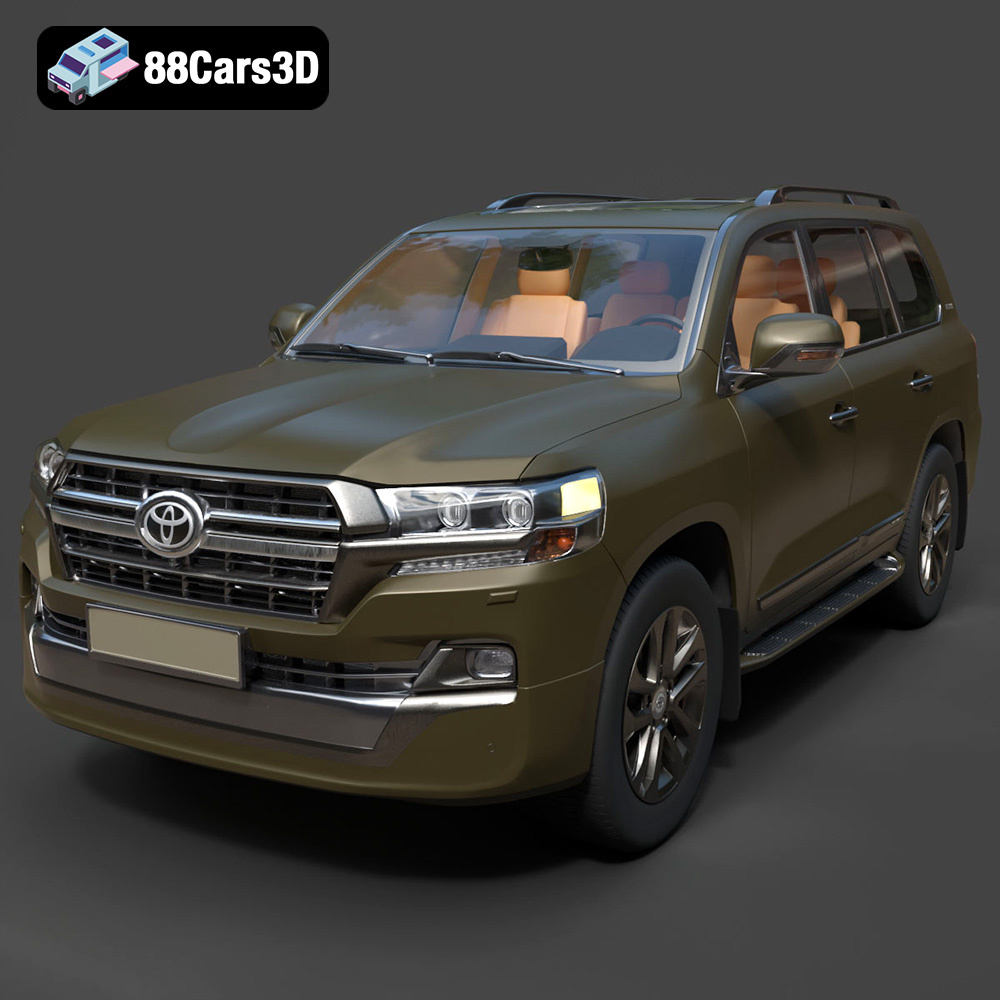
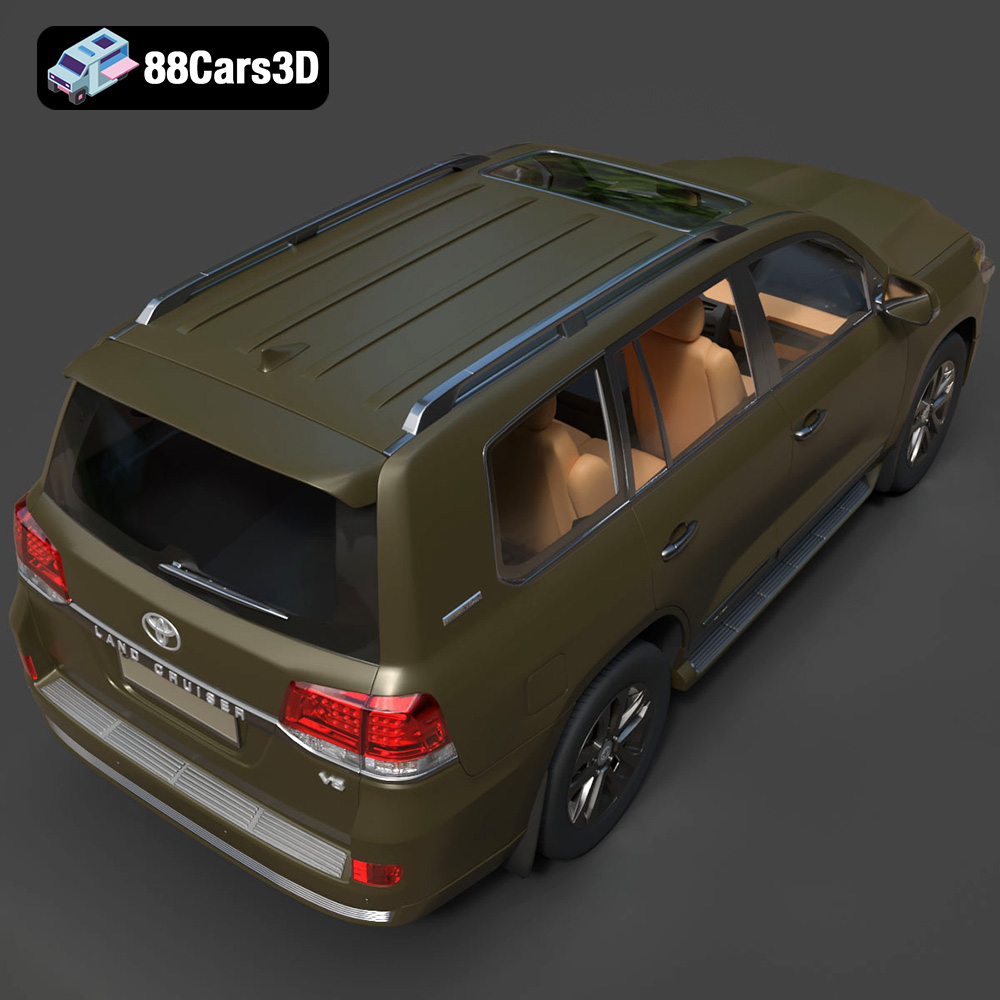
Every curve and contour of the physical vehicle has been faithfully translated into its 3D counterpart. The imposing stance, a hallmark of the Land Cruiser, is immediately recognizable. Critical to its identity is the distinctive Executive Lounge front grille, which has been recreated with intricate detail, setting this model apart. From the authentic dual-exhaust system to the premium LED headlights and striking taillight clusters, no visual cue has been overlooked. The alloy wheels with high-traction SUV tires are accurately modeled, ensuring realistic contact with virtual terrains. Furthermore, the robust independent suspension components are accurately represented, with separate geometry for wheels, suspension, and steering. This segmentation is crucial, enabling animators to create realistic vehicle dynamics, from subtle steering adjustments to dramatic suspension travel over challenging terrain.
Stepping into the virtual cockpit of the Executive Lounge reveals an equally impressive level of detail. The plush premium leather seating, characteristic of this trim level, is meticulously textured and modeled, inviting a closer look. The steering wheel, complete with accurate multi-function buttons, feels tangible, while the infotainment screen and instrument cluster display sharp, readable graphics. The center console, climate controls, pedals, and shifter are all present and accounted for, contributing to an immersive interior experience. Crucially, the geometry is optimized for first-person point-of-view (POV) in gaming, meaning that even from the driver’s seat, the detail holds up without excessive polycount impacting performance.
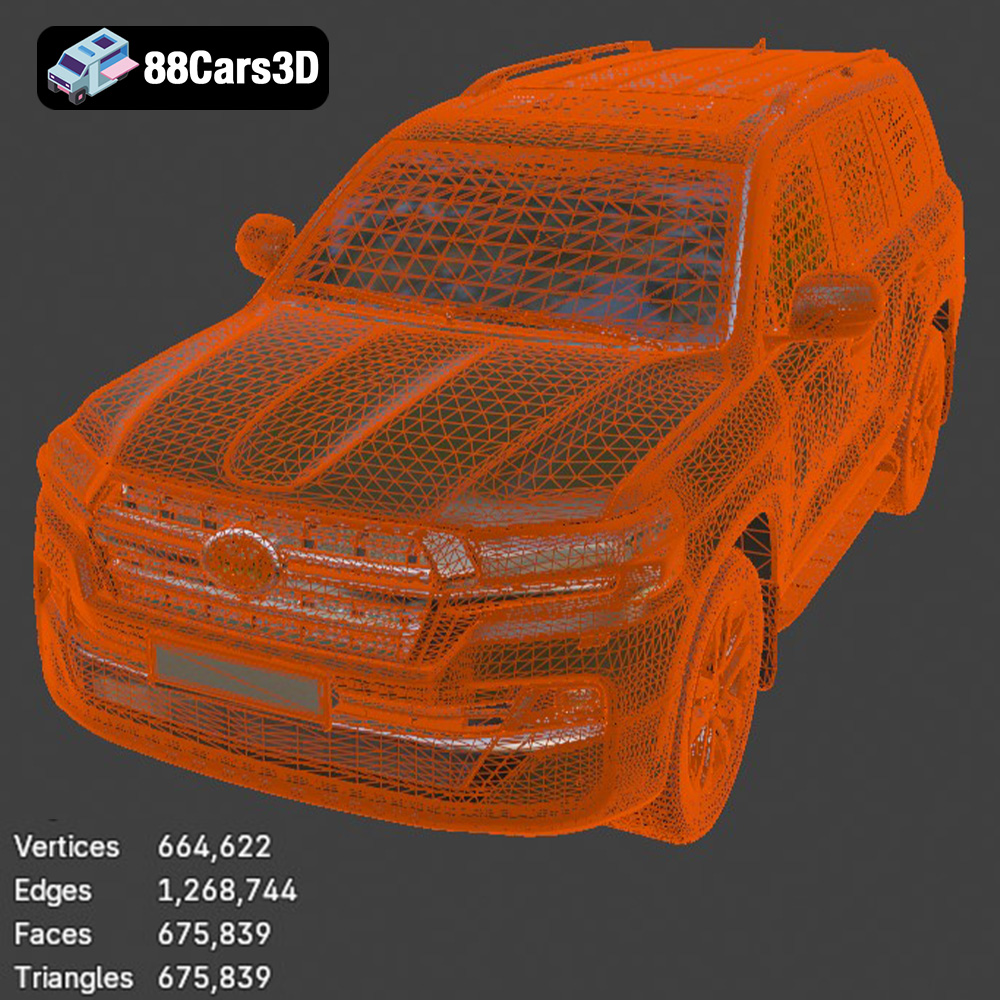
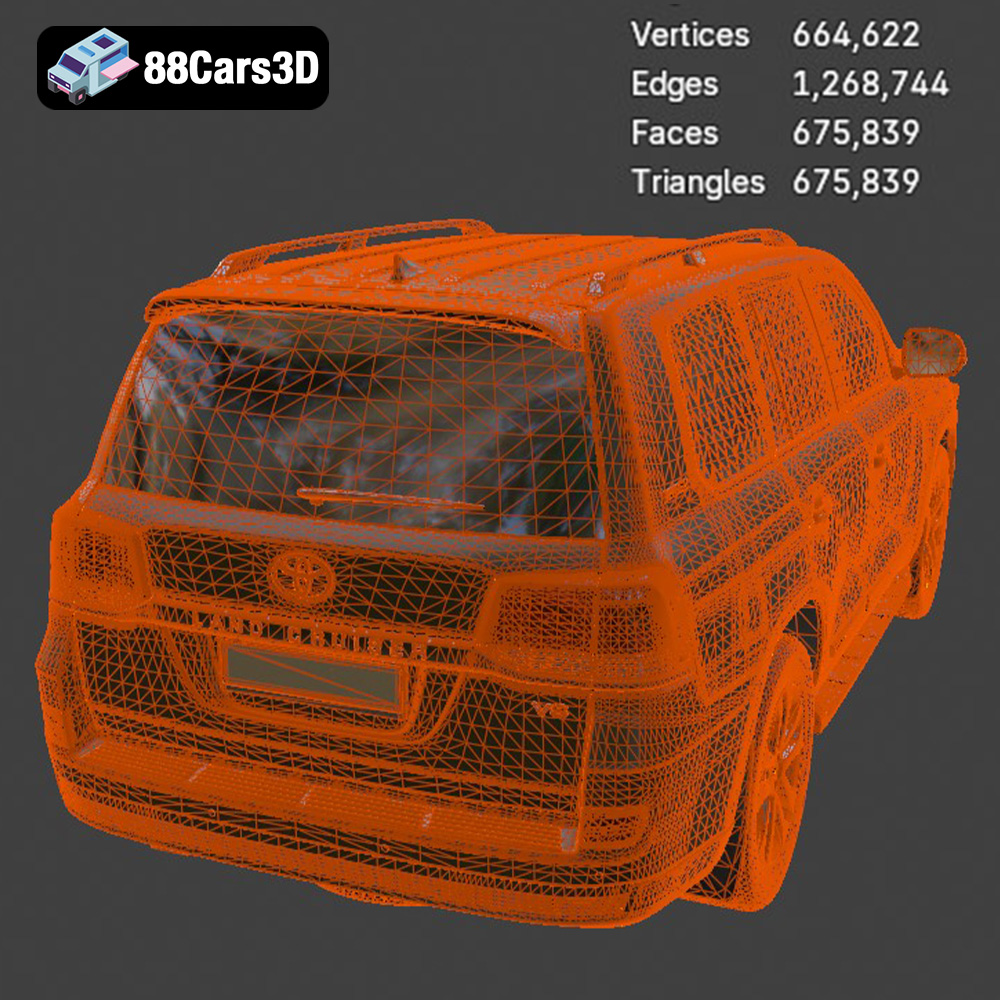
Beyond visual accuracy, the model boasts significant technical advantages. With an optimized topology of approximately 350,000 triangles, it strikes a perfect balance. This polycount is high enough to deliver unparalleled visual fidelity for cinematic renders and detailed close-ups, yet optimized enough to ensure excellent game-ready performance in real-time engines like Unreal and Unity. The model adheres to real-world scale accuracy, based on the actual vehicle chassis, ensuring correct proportions when integrated into larger scenes. Proper pivot setups are established for steering, wheel rotation, and suspension travel, drastically reducing the animation setup time for technical artists and riggers. This thoughtful engineering makes the Land Cruiser model a robust and versatile asset for any professional pipeline.
High-quality 3D car models are more than just digital sculptures; they are functional assets that drive innovation across multiple industries. The Toyota Land Cruiser 200 Executive Lounge 2021-08 3D Model exemplifies how a well-prepared asset can streamline production and enhance creative output.
For game developers, performance is paramount, but visual fidelity cannot be sacrificed. The Land Cruiser model, with its optimized ~350,000 triangle count, is perfectly suited for open-world exploration games, racing titles, and realistic simulators. Its “game-ready” status means it’s built to perform efficiently within real-time engines like Unreal Engine and Unity. The inclusion of the .unreal and .fbx formats directly supports these pipelines, allowing for quick integration with minimal setup. Developers can leverage the accurate pivot points for dynamic vehicle physics, implement custom LOD (Level of Detail) systems to further optimize performance at varying distances, and integrate the detailed cockpit for immersive first-person driving experiences. This allows for rapid prototyping and iteration, bringing new game concepts to life faster.
Architectural visualization (ArchViz) and high-end product rendering demand photorealism. The detailed geometry and PBR (Physically Based Rendering) materials of the Land Cruiser make it an ideal candidate for creating stunning marketing visuals, lifestyle scenes, and realistic environmental renders. Artists working in 3ds Max with V-Ray or Corona Renderer, or Blender with Cycles, can easily import the .max or .blend files, respectively. They can then take full advantage of the model’s precise reflections, accurate material responses to light, and rich surface details to create compelling compositions. Imagine placing this luxurious SUV within a modern architectural setting, bathed in golden hour light, to evoke a sense of aspiration and sophistication for a client presentation or advertising campaign.
Augmented Reality (AR) and Virtual Reality (VR) are transforming how consumers interact with products. The Toyota Land Cruiser 200 Executive Lounge 2021-08 3D Model is perfectly positioned for these emerging technologies. Its .glb format is specifically optimized for web-based AR/VR applications and mobile experiences, enabling rapid loading and smooth performance on diverse devices. Imagine a virtual showroom where potential buyers can walk around, inspect, and even “sit inside” the Land Cruiser in VR. Or an AR app that lets users project the vehicle into their driveway, customizing colors and inspecting details before making a purchase decision. The model’s balanced polycount ensures it runs efficiently on mobile chipsets, making immersive configurators and interactive showcases a reality.
The transition from a digital 3D model to a tangible physical object is a fascinating application of 3D assets. The Toyota Land Cruiser 200 Executive Lounge 2021-08 3D Model, with its detailed geometry and robust construction, is well-suited for 3D printing, especially given the inclusion of an .stl format.
Before hitting the print button, careful preparation is essential. The model is recommended for scales like 1:12, 1:18, or 1:24, which are common for hobbyist and collectible vehicle replicas. For optimal detail and surface finish, especially for fine elements like the grille and interior, resin printing is highly recommended over FDM (Fused Deposition Modeling). Suggested layer heights of 0.04–0.12 mm ensure high resolution. Wall thickness, typically 1.2–2.0 mm, is crucial for structural integrity, preventing fragile parts. An infill of 20–30% provides a good balance between material usage and model strength, preventing hollow areas that might collapse during printing.
Given the complexity of an automotive model, support structures will be required. These are necessary for overhangs and delicate parts such as the exhaust system, mirrors, and specific interior details. Print orientation also plays a significant role; printing the main frame at an angle can enhance structural integrity, while wheels should generally be printed separately for better detail and smoother rotation if intended to be functional. After printing, post-processing is key to achieving a professional finish. This typically involves removing supports, sanding down any rough spots, applying a primer to create a uniform surface, and finally, painting the model with authentic factory colors, often incorporating metallic finishes to mimic the real vehicle’s paintwork. This meticulous process transforms the digital Land Cruiser into a display-worthy physical artifact.
A truly professional 3D car model offers more than just static beauty; it provides a flexible foundation for boundless creative exploration. The Toyota Land Cruiser 200 Executive Lounge 2021-08 3D Model provides a rich canvas for artists to personalize and integrate into diverse scenarios.
One of the most powerful customization avenues lies in material and texture adaptation. Artists can effortlessly change body colors, experimenting with a spectrum of factory colors, bespoke custom finishes, or even unconventional artistic interpretations like matte, gloss, or metallic looks. Beyond the bodywork, tire textures can be swapped or modified to represent off-road variants, street-performance tires, or even weathered, mud-splattered versions, instantly changing the vehicle’s character. Adjusting material finishes allows for subtle shifts in realism, from a showroom-pristine gleam to a rugged, well-used appearance. This flexibility is invaluable for creating varied marketing visuals, different game assets from the same base mesh, or personalized client presentations.
The Land Cruiser model’s versatility extends to its environmental integration. Its well-defined geometry and PBR materials react realistically to different lighting conditions. Artists can adapt the lighting setup to suit any environment, whether it’s a harsh desert sun, a soft studio key light, the dramatic glow of a city street at night, or the atmospheric mood of a rainy day. This capability allows the model to be seamlessly placed into architectural visualizations, game levels, or cinematic sequences, with the lighting reinforcing the narrative or aesthetic. By leveraging these customization options, creators can transform a single premium 3D car model into an endless array of visual stories and interactive experiences, significantly extending its value and application.
The world of 3D modeling for automotive design is a complex interplay of artistic vision and technical precision. High-quality 3D car models are not just digital representations; they are fundamental building blocks for innovation across various sectors, from blockbuster game development and hyper-realistic rendering to immersive AR/VR experiences and even tangible 3D prints. The Toyota Land Cruiser 200 Executive Lounge 2021-08 3D Model stands as a prime example of a premium asset, offering unparalleled detail, game-ready optimization, and extensive file format compatibility.
Whether you are a game developer needing a robust vehicle asset, an architectural visualizer seeking to populate a scene with a luxury car, a marketer crafting a compelling brand campaign, or a hobbyist looking to 3D print an iconic SUV, assets of this caliber provide the flexibility and fidelity required. Understanding the intricacies of file formats, appreciating the depth of technical optimization, and embracing the potential for customization are all key to harnessing the full power of these digital masterpieces. For professionals seeking top-tier 3D car models that meet the most stringent industry standards, 88cars3d.com offers a curated selection designed to elevate any project.
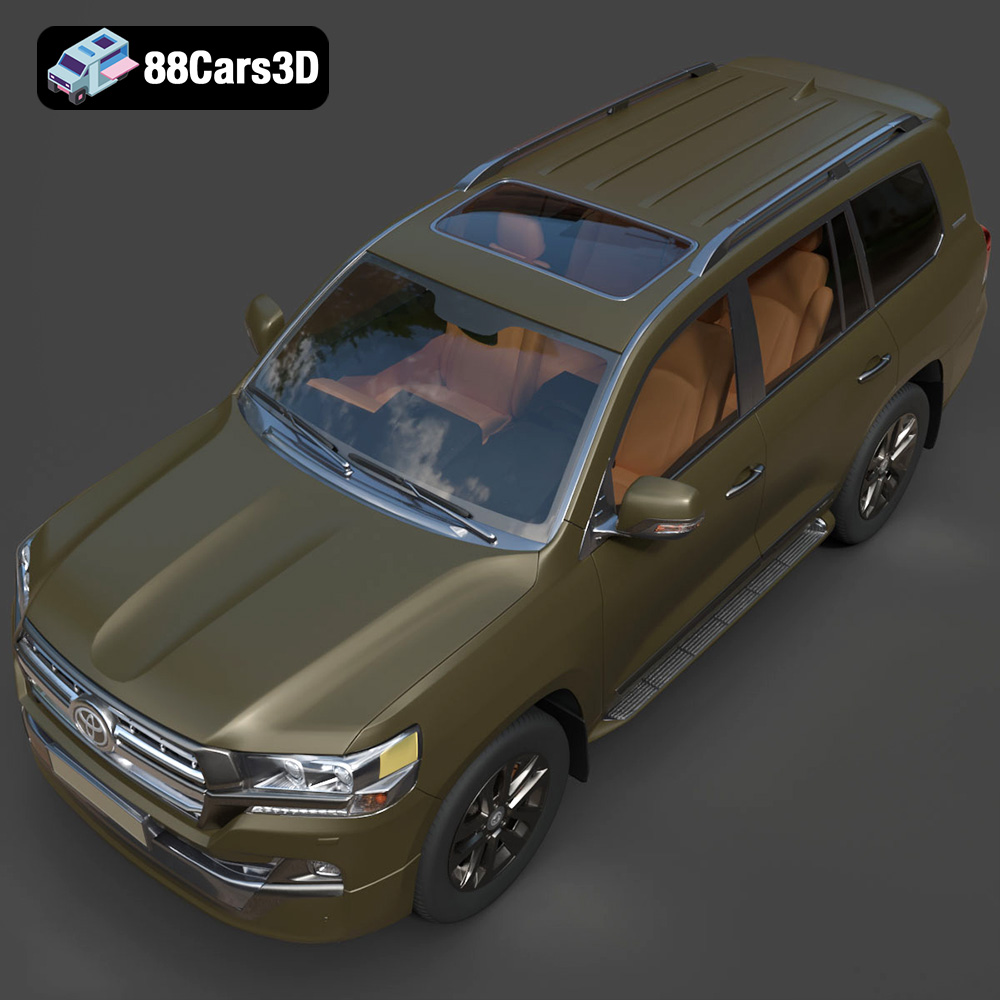
The Toyota Land Cruiser 200 Executive Lounge 2021 represents the absolute pinnacle of luxury off-roading, combining legendary durability with premium comfort. This meticulously crafted 3D model perfectly captures the imposing stance, bold Executive Lounge front grille, refined bodylines, and robust V8 engine heritage that define this iconic SUV. From its signature LED lighting signatures to its muscular wheel arches, every visual cue has been faithfully recreated.
$26.00
.2021
.blend
.fbx
.glb
.luxury suv
.max
.obj
.ply
.rendering
.stl
.toyota
.unreal
car-3d-model
executive-lounge
game asset
game-ready
land-cruiser
land-cruiser-200
low-poly
off-roader
optimized
SUV
VR/AR