Get 20% OFF All Premium 3D & STL Models!

In the dynamic worlds of game development, architectural visualization, and industrial simulation, the demand for highly detailed yet optimized 3D assets is ever-present. From the sleek lines of a performance car to the rugged majesty of a colossal mining truck, accurate and ready-to-use models are the foundation upon which immersive experiences are built. Heavy machinery, in particular, presents unique challenges and opportunities. These titans of industry, designed for immense power and durability, require meticulous attention to detail to capture their functional aesthetic and engineering prowess in a virtual environment.
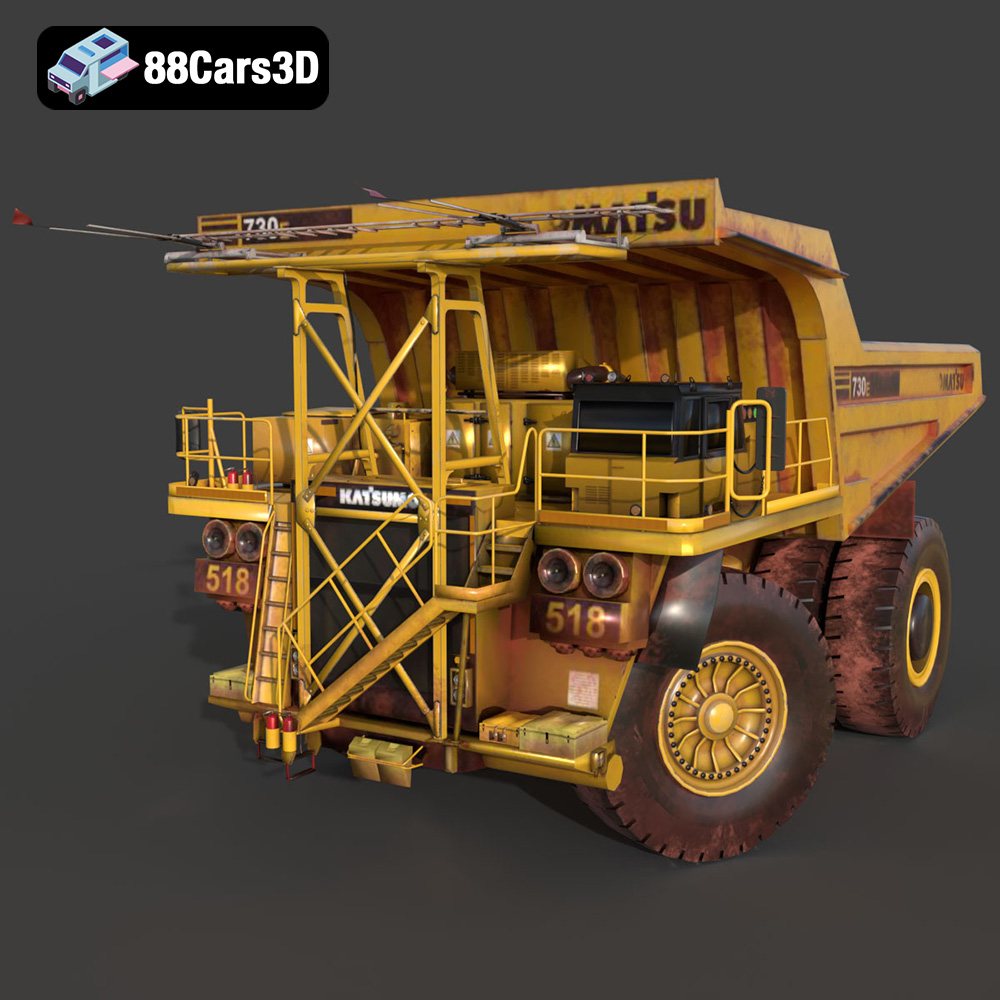
Imagine the roar of an electric drive, the massive wheels crushing terrain, and the sheer scale of a mining operation brought to life with unparalleled realism. This level of immersion is only possible with expertly crafted 3D car models and industrial assets. Today, we delve deep into the technical intricacies and creative possibilities offered by such models, spotlighting a prime example: the Komatsu 730E-08 3D Model. This formidable haul truck, a staple of open-pit mining, provides an excellent case study for understanding the value of high-quality, pre-optimized assets in accelerating projects across various sectors, from automotive rendering to cutting-edge game assets.
The choice of file format for a 3D model is far more than a technicality; it’s a critical decision that dictates compatibility, functionality, and the overall efficiency of your workflow. Different formats are optimized for distinct purposes, from real-time rendering in game engines to precision manufacturing via 3D printing. Understanding these nuances is essential for any professional working with 3D assets, ensuring smooth integration and maximum utility. The Komatsu 730E-08 3D model, for instance, offers a comprehensive suite of formats, catering to a wide array of professional needs.
The .blend format is native to Blender, the popular open-source 3D creation suite. When you receive a .blend file, you’re getting a fully editable scene, complete with materials, textures (often packed within the file or linked), lighting setups, cameras, and even animation data. This format is ideal for users who primarily work in Blender, as it retains all the scene’s intricacies, allowing for easy modifications, re-texturing, or integrating the model into existing Blender projects. Its greatest advantage lies in its completeness and the direct access it provides to the model’s underlying structure within its native environment.
.fbx (Filmbox) is a proprietary file format developed by Autodesk, but it has become an unofficial industry standard for exchanging 3D data between various software applications. It excels at preserving complex scene data, including geometry, materials, textures, animations, and skeletal rigs. This makes .fbx incredibly versatile for pipelines involving multiple software packages, particularly for game development. It is the go-to format for importing assets into game engines like Unreal Engine and Unity, where its ability to transfer animation and hierarchies flawlessly is paramount. For the Komatsu 730E-08, an .fbx file would be crucial for bringing its articulated dump mechanism and wheel rotation animations directly into a game project.
.obj (Wavefront OBJ) is one of the oldest and most widely supported 3D file formats. It’s renowned for its simplicity and universality, primarily storing geometric data like vertices, normals, UV coordinates, and groups. While it doesn’t typically store animation or complex material setups directly, it can reference external .mtl (material library) files for basic color and texture information. The .obj format is an excellent choice for cross-software compatibility when the primary goal is to transfer clean mesh data. It’s often used as a fallback or for simple asset exchange, ensuring that virtually any 3D software can open and work with the model’s core geometry.
.glb (GL Transmission Format Binary) is the binary version of glTF, a royalty-free specification for the efficient transmission and loading of 3D scenes and models by applications. It’s rapidly gaining traction as the “JPEG for 3D” due to its optimization for web-based applications, augmented reality (AR), and virtual reality (VR). A .glb file packages all necessary data—geometry, textures, materials, and animations—into a single, compact file, making it incredibly easy to share and display in browsers or mobile AR/VR viewers. For showcasing the Komatsu 730E-08 in an interactive web configurator or an AR experience, .glb would be the format of choice.
.stl (Stereolithography) is almost exclusively used for 3D printing. It represents a 3D model as a series of connected triangles, defining only the surface geometry of an object without color, texture, or other attributes. Its simplicity makes it universally compatible with 3D printers and slicing software. When preparing the Komatsu 730E-08 for a physical miniature model, converting it to .stl is the first step, followed by careful consideration of scale, supports, and print orientation, as detailed in the product specifications.
.ply (Polygon File Format) is another format for storing 3D data, particularly useful for scan data and scientific applications. It can store various properties for each vertex and face, including color, transparency, normals, texture coordinates, and even reliability information. While less common for general asset exchange than .fbx or .obj, .ply offers a higher degree of precision for mesh data, making it valuable in contexts requiring accurate geometric representation, such as reverse engineering, CAD integration, or finite element analysis.
The .unreal format, or more accurately, an asset package directly prepared for Unreal Engine, implies an asset that has been specifically processed and configured for optimal performance within the Unreal ecosystem. This typically means that the model, often originating from an .fbx, has been imported, had its materials set up using Unreal’s PBR (Physically Based Rendering) pipeline, collision meshes generated, and potentially LODs (Levels of Detail) created. An engine-ready .unreal asset significantly reduces setup time for developers, allowing them to drop the Komatsu 730E-08 directly into their project and start working immediately.
Similar to .blend for Blender, the .max format is the native file type for Autodesk 3ds Max. It stores a complete 3ds Max scene, including geometry, modifiers, materials, textures, lighting, cameras, animations, and render settings. This format is crucial for professionals who rely on 3ds Max for high-end rendering, animation, or complex scene assembly. Providing the Komatsu 730E-08 as a .max file means users have full creative control over the asset within a powerful industry-standard environment for intricate adjustments and detailed automotive rendering.
The creation of a high-fidelity 3D model like the Komatsu 730E-08 is a delicate balance between visual accuracy and technical optimization. For heavy machinery, this involves capturing not just the overall form but also the intricate details that convey its industrial strength and advanced engineering. The Komatsu 730E-08 model exemplifies this synthesis, offering a game-ready asset that doesn’t compromise on realism.
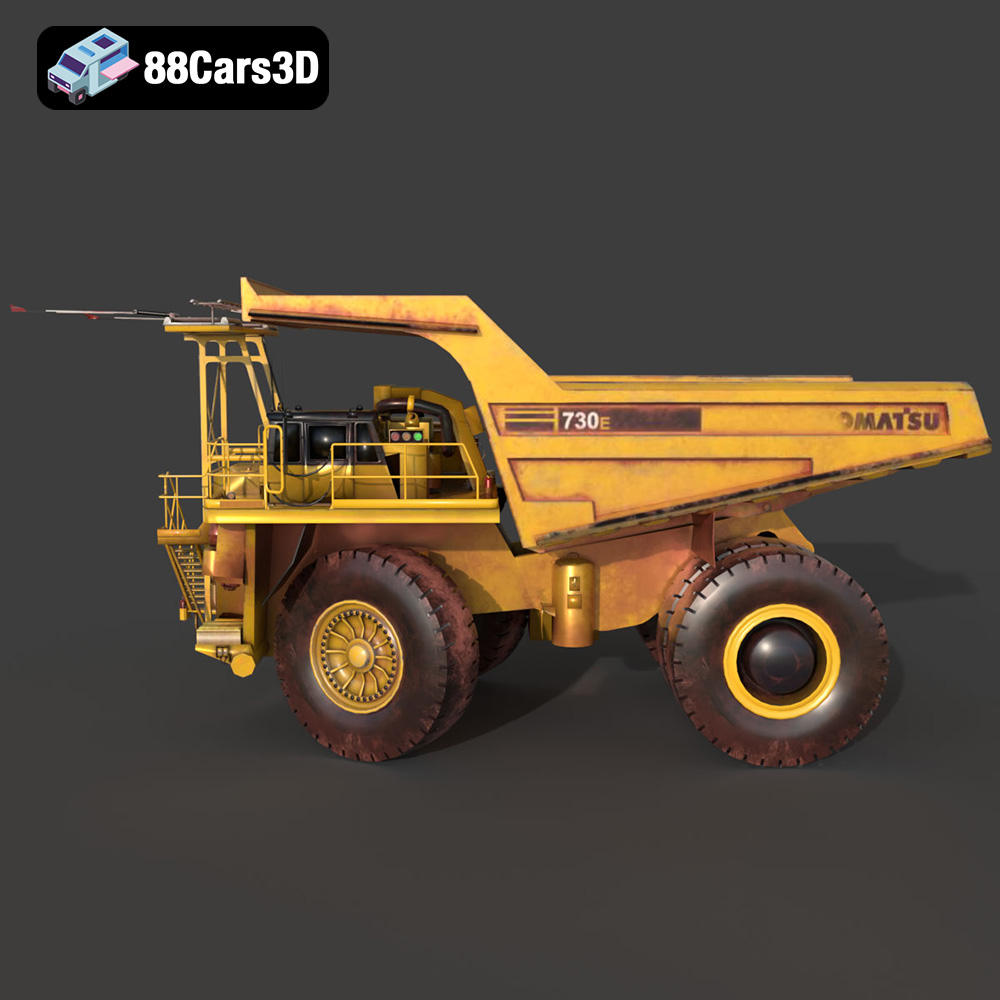
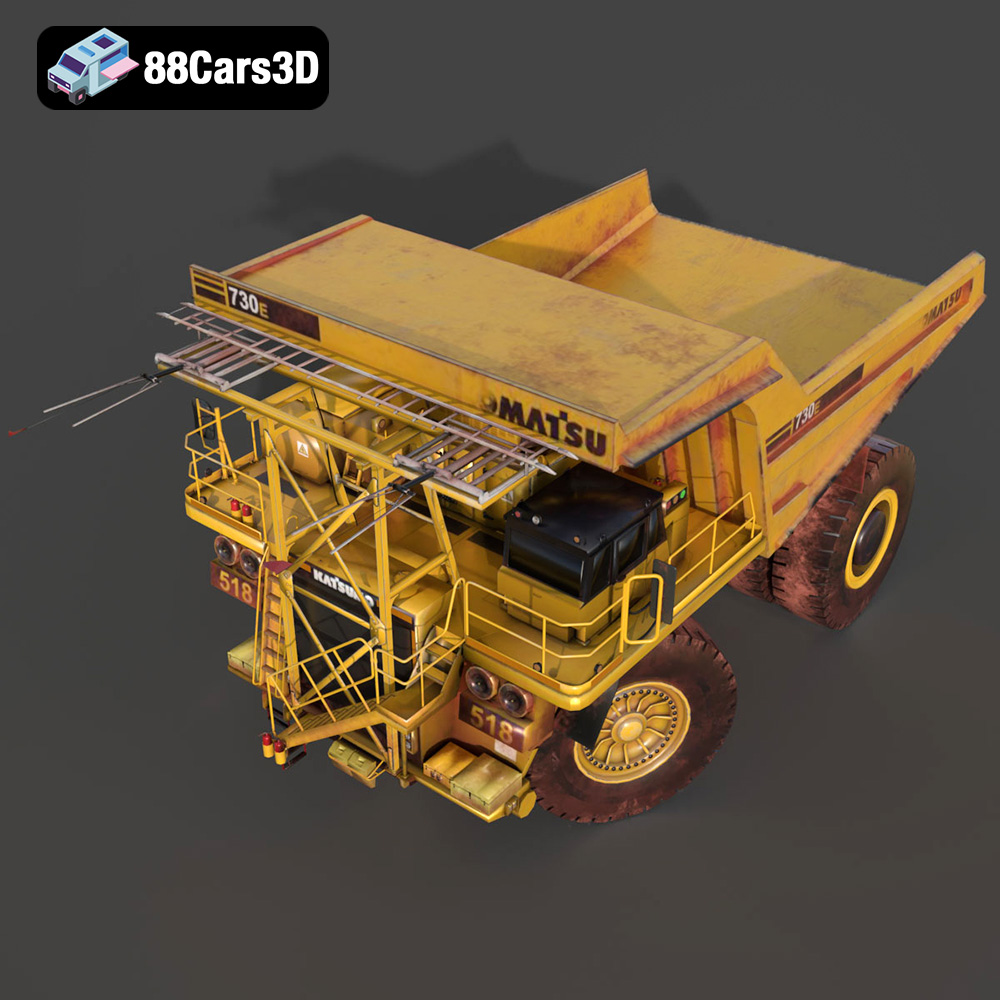
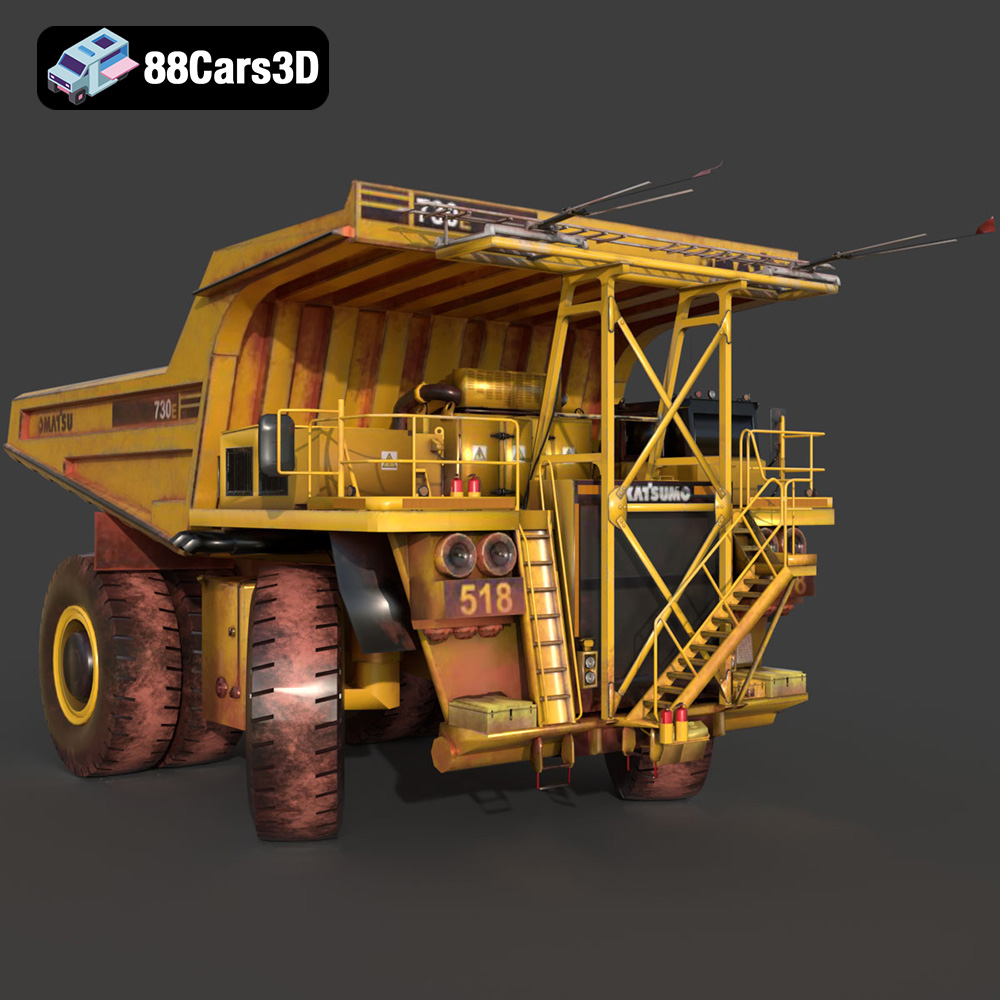
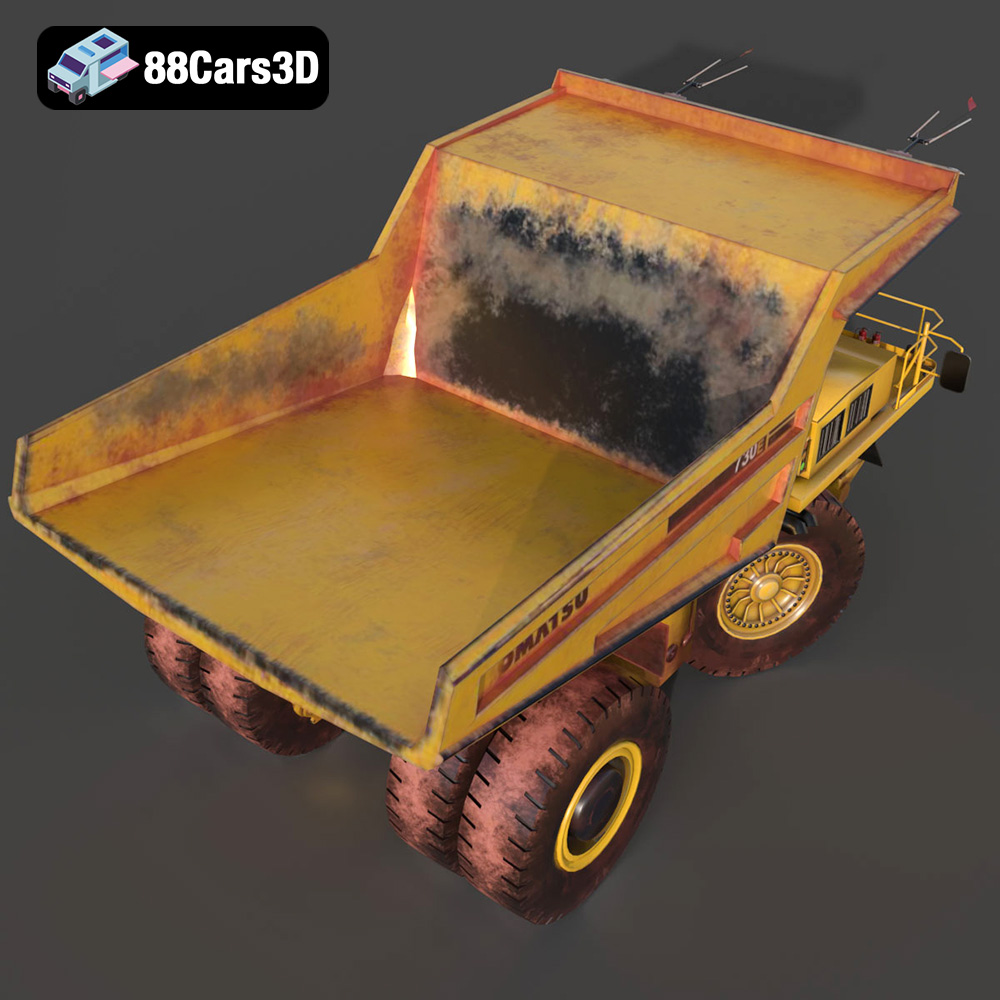
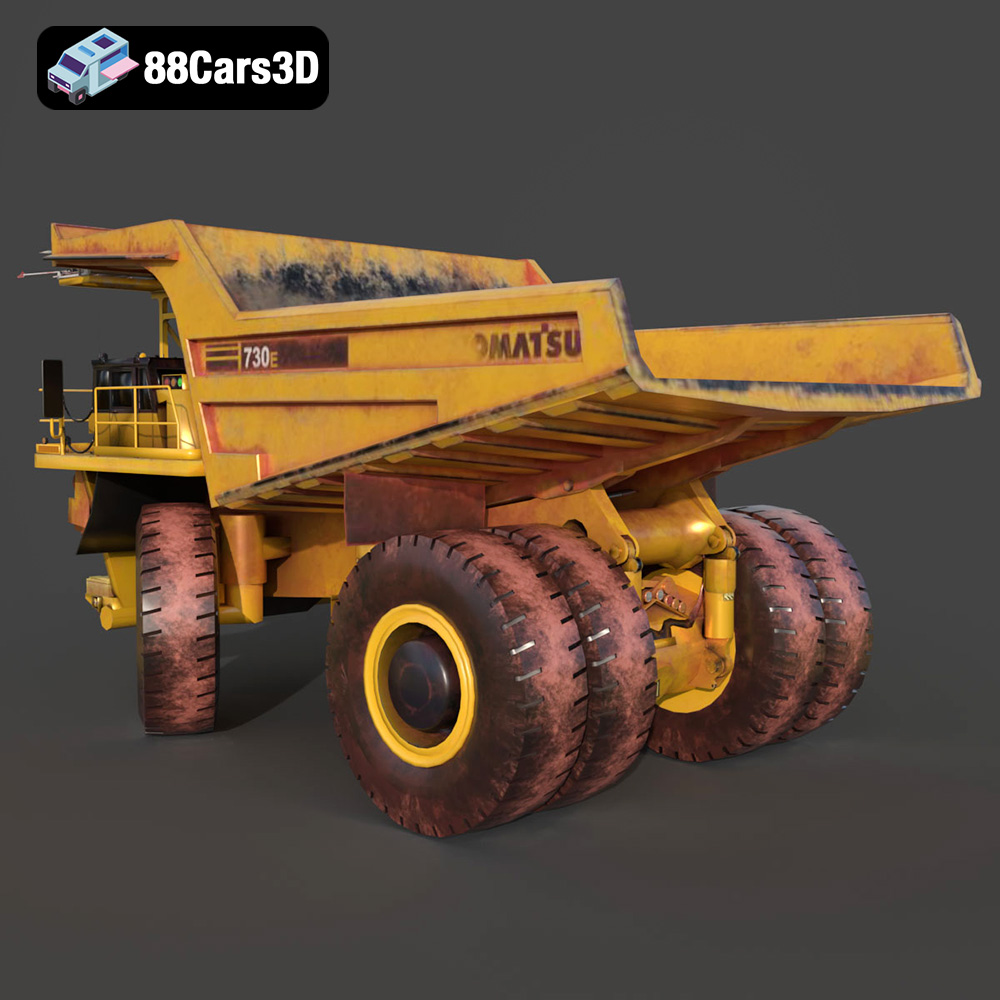
The foundation of any great 3D model is its accuracy. For the Komatsu 730E-08, this means a faithful recreation of its massive dump body proportions, the rugged industrial styling, and the distinctive features of its electric drive system. The model’s description highlights specific exterior details:
Beyond the exterior, the interior is equally crucial for immersive experiences, especially in simulators or first-person game perspectives. The model includes a fully enclosed, offset operator cabin, a heavy-duty steering wheel, ergonomic operator seat, detailed instrument cluster, functional control panels, joysticks, levers, and pedals. Such attention ensures that whether viewed from a distance or up close, the model maintains its integrity and believability.
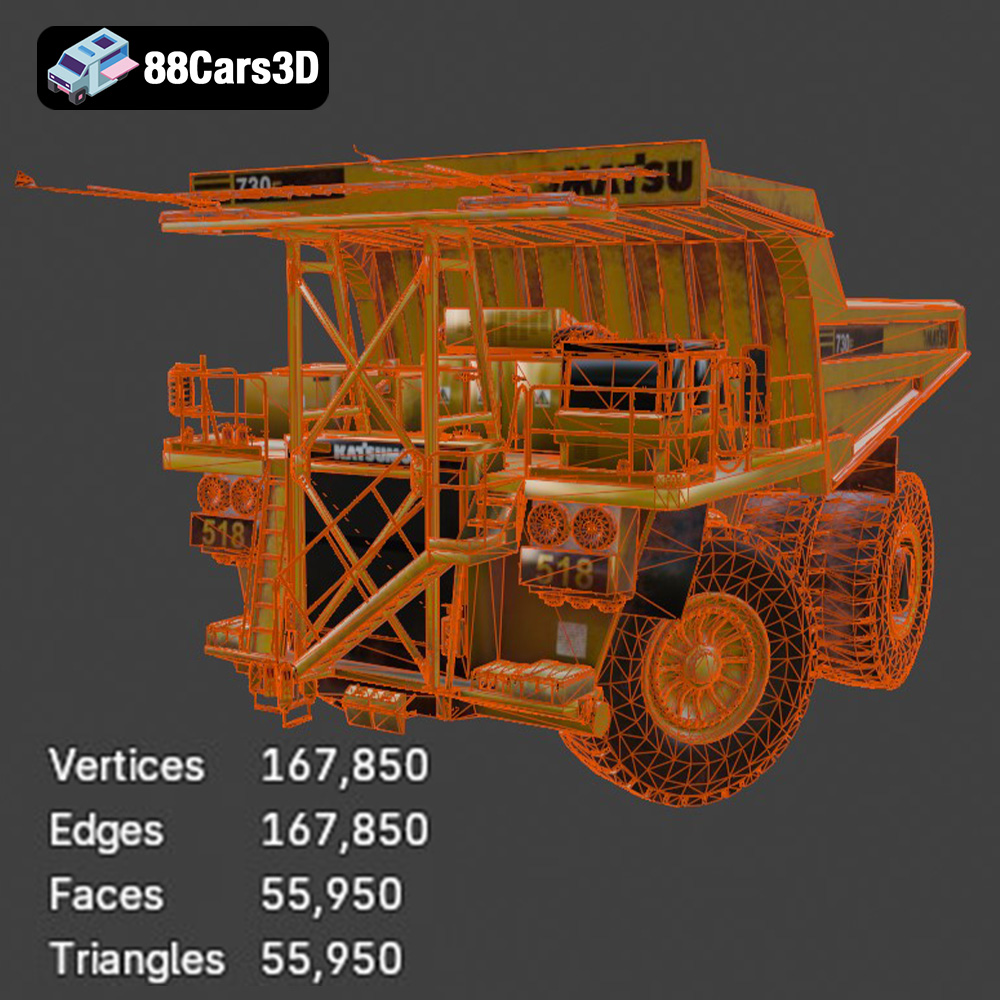
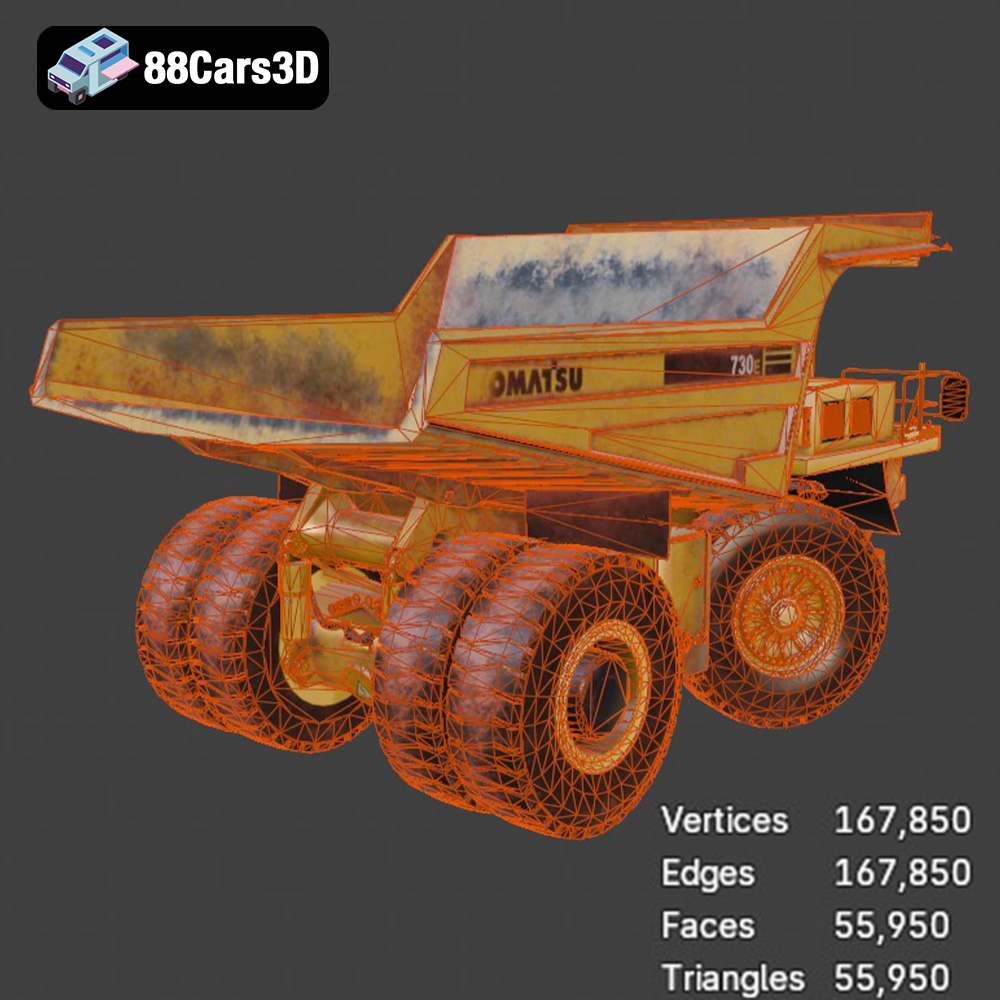
One of the standout technical specifications of the Komatsu 730E-08 3D model is its carefully optimized topology of 55,950 triangles. This figure is critical for its versatility across applications:
Furthermore, the model boasts “proper pivot setup for steering, wheel rotation, suspension travel, and bed dumping,” along with “separate wheels, suspension, steering components, and dump body for animation.” This modularity is a critical feature, empowering animators and developers to create realistic motion without extensive rigging work, significantly speeding up production time.
The true value of a versatile 3D asset lies in its seamless integration into various professional software environments. The Komatsu 730E-08 3D model, with its array of included file formats and optimized structure, is designed to enhance workflows across leading 3D platforms and real-time engines.
For artists and studios utilizing Blender, the included .blend file provides a significant head start. Upon opening, the Komatsu 730E-08 model will appear with its pre-assigned materials and potentially some basic scene setup.
For professionals in architectural visualization, product rendering, or complex animation, the .max file offers the full power of Autodesk 3ds Max. This environment is renowned for its robust rendering engines (like V-Ray or Corona Renderer) and sophisticated animation capabilities.
The .fbx and specifically the .unreal optimized asset are tailor-made for game development and real-time simulations in Unreal Engine. This allows developers to quickly populate their virtual worlds with high-quality, performant assets.
The utility of high-quality 3D models extends far beyond traditional screen-based rendering and gaming. Advanced formats and optimized geometry make assets like the Komatsu 730E-08 perfect candidates for immersive AR/VR experiences and even physical prototyping through 3D printing.
Augmented Reality (AR) and Virtual Reality (VR) are transforming how we interact with digital content, especially in industrial and educational sectors. The Komatsu 730E-08 3D model is exceptionally well-suited for these applications:
The ability to convert a digital model into a tangible object opens up a new realm of possibilities, from hobbyist collectibles to professional prototypes. The inclusion of the .stl format and specific 3D print settings for the Komatsu 730E-08 model highlights this versatility.
The demand for expertly crafted 3D car models and industrial assets like the Komatsu 730E-08 isn’t just theoretical; it drives real innovation and efficiency across various industries. Let’s explore some tangible applications.
A game studio is developing an open-world mining simulation game, aiming for unparalleled realism. They need a fleet of heavy machinery, including massive haul trucks. Sourcing high-quality 3D models like the Komatsu 730E-08 from 88cars3d.com significantly accelerates their development cycle. The model’s optimized 55,950 triangles ensure it runs smoothly in Unreal Engine without requiring extensive re-topology. The separated wheels, dump body, and steering components mean their animators can quickly set up in-game physics and interactive controls, allowing players to experience the truck’s operation authentically. The included high-quality PBR textures provide a photorealistic look that blends seamlessly with the game’s environment, elevating the overall visual fidelity and player immersion.
An engineering firm is bidding on a large-scale mine expansion project. To impress clients and stakeholders, they need to create a compelling visual presentation of the proposed site, including the machinery that will operate there. Using the Komatsu 730E-08 3D model in 3ds Max, they can integrate the truck into detailed architectural visualizations of the mine, showcasing its scale in relation to other structures and terrain. High-resolution renders demonstrate logistics, operational flows, and safety protocols. Furthermore, the model can be used to create an animated fly-through, showing the truck in action, dumping its payload, or navigating challenging terrain, providing a dynamic and persuasive marketing tool that highlights the project’s capabilities and efficiency.
A global mining corporation wants to reduce training costs and improve safety by implementing VR-based operator training for its new fleet of Komatsu 730E-08 trucks. They commission a VR development studio to create an interactive simulation. The studio leverages the Komatsu 730E-08 3D model, specifically the engine-ready .unreal asset. The detailed cockpit, complete with instrument clusters and functional controls, provides a realistic environment for trainees. The developers can script interactive scenarios, such as pre-operation checks, driving maneuvers, and emergency procedures. The model’s accurate scale and optimized geometry ensure a smooth, immersive VR experience, allowing new operators to familiarize themselves with the vehicle’s controls and dynamics in a safe, virtual environment before stepping into the actual truck.
The landscape of 3D content creation is constantly evolving, with increasing demands for realism, performance, and versatility. Whether you’re a game developer crafting immersive worlds, an architect visualizing complex projects, or an industrial designer prototyping new concepts, the foundation of your success lies in the quality of your assets. The Komatsu 730E-08 3D model stands as a testament to this principle, offering a meticulously crafted, technically optimized asset ready for deployment across a myriad of applications.
Its balanced polycount, detailed features, and comprehensive file format support (from .blend and .max for editable scenes to .fbx and .unreal for real-time engines, and .stl for 3D printing) ensure that professionals can integrate this industrial titan seamlessly into their workflows. By leveraging such high-quality 3D car models and heavy equipment assets, creators can save invaluable development time, achieve superior visual fidelity in their automotive rendering, and deliver more impactful, engaging experiences. For those seeking to equip their projects with exceptional game assets and visualization tools, platforms like 88cars3d.com provide a reliable source for these essential building blocks of the digital world.
The Komatsu 730E-08 is a titan of the mining industry, renowned for its massive payload capacity, incredible durability, and advanced electric drive system. This colossal haul truck features rugged industrial styling, a mammoth dump body designed for heavy earthmoving, and a robust chassis built to withstand the harshest mining environments. This high-quality 3D model boasts a carefully optimized topology of 55,950 triangles, making it exceptionally game-ready while preserving superb visual fidelity. It is engineered for seamless integration into game engines, VR/AR simulations, heavy machinery animations, and industrial visualization projects. Perfect for open-world mining simulators, industrial construction games, architectural visualizations, and heavy equipment showcases.
$14.99
.blend
.fbx
.glb
.max
.obj
.ply
.rendering
.stl
.unreal
730e-08
game asset
game-ready
haul-truck
heavy-machinery
komatsu
low-poly
mining-truck
optimized
truck-3d-model
VR/AR