Get 20% OFF All Premium 3D & STL Models!

In the dynamic world of 3D modeling and digital content creation, few subjects captivate the imagination quite like classic automobiles. These magnificent machines are not merely vehicles; they are rolling sculptures, encapsulating eras of design, engineering prowess, and cultural significance. For designers, game developers, architects, and visual artists, accurately bringing these legends to life in the digital realm presents both a challenge and an immense opportunity. It allows for the exploration of history, the recreation of iconic scenes, and the immersive experience of automotive heritage.
The demand for high-fidelity 3D car models, particularly those of classic vehicles, spans numerous industries. In game development, they serve as star vehicles in racing simulations or atmospheric elements in period-piece adventures. For architectural visualization, a meticulously rendered classic car can add unparalleled realism and a sense of luxury to a scene. Advertising and film industries leverage these assets for stunning cinematic visuals, while AR/VR applications create interactive historical experiences. The magic lies in the details: the gleam of chrome, the intricate curves, the texture of vintage leather – elements that resonate deeply with audiences and elevate any digital project.
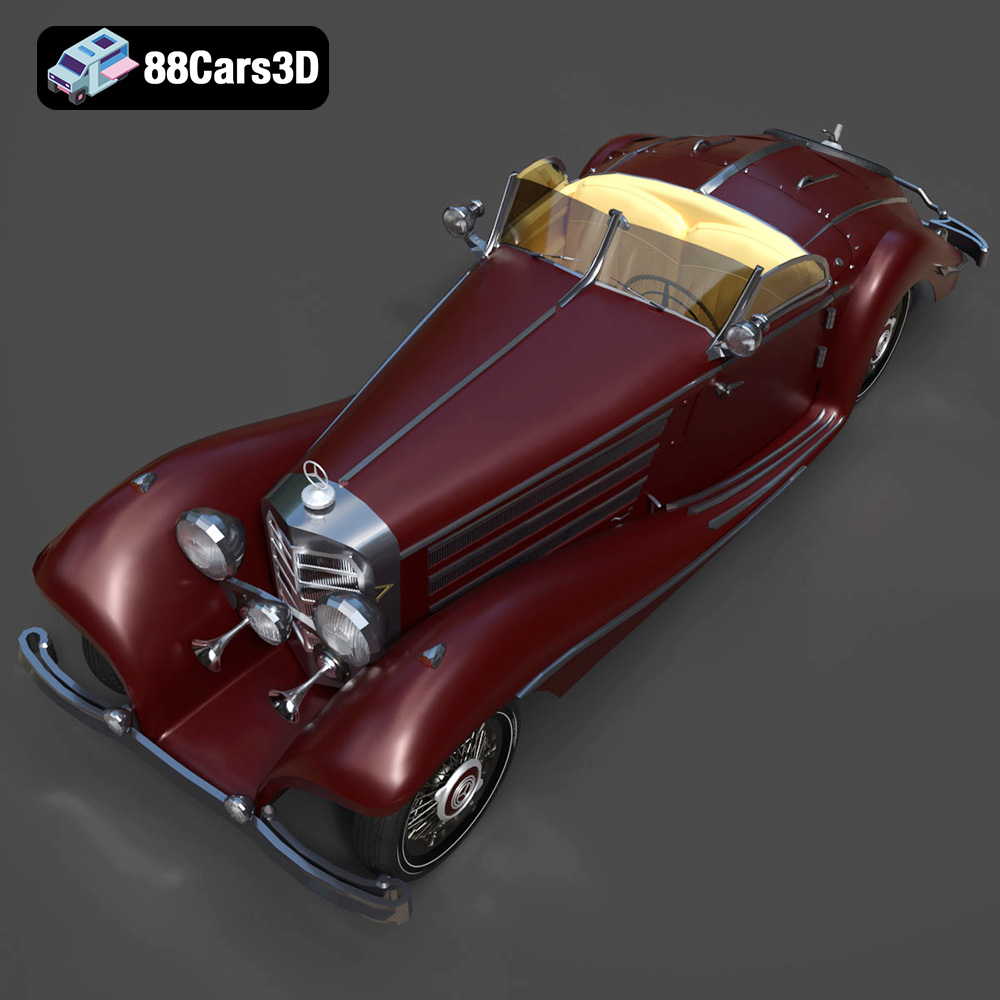
Among the pantheon of automotive legends, the Mercedes Benz 540 K Roadster stands out as a true icon of pre-war opulence and engineering. Its breathtaking design, characterized by sweeping fenders, a commanding grille, and the iconic external exhaust pipes, exudes an unparalleled sense of grandeur and power. To translate such a masterpiece into a 3D model requires exceptional skill and a deep appreciation for its historical significance. The Mercedes Benz 540 K Roadster 3D Model available at 88cars3d.com is a prime example of such dedication, offering a meticulously crafted digital twin that captures every vintage detail, from the intricate wire-spoke wheels to the luxurious cockpit. This model isn’t just a digital asset; it’s a piece of history, ready to be integrated into your next groundbreaking project.
Navigating the diverse landscape of 3D software and engines often begins with understanding file formats. The choice of format can drastically impact a model’s compatibility, performance, and the ease with which it can be integrated into a specific workflow. High-quality 3D car models, like the Mercedes Benz 540 K Roadster, are typically offered in multiple formats to ensure maximum versatility for professionals across various disciplines.
The `.blend` format is Blender’s native file type, storing a complete Blender scene including mesh data, materials, textures, animations, camera settings, and lighting. It’s fully editable, making it ideal for users who primarily work within Blender and require full access to the model’s construction for modifications, rigging, or custom rendering setups. When you download a `.blend` file, you’re getting the original working file, offering the most comprehensive control over the asset.
Autodesk’s `.fbx` (Filmbox) format has become an industry standard for exchanging 3D data between different software applications. It supports geometry, materials, textures, animations, and rigs, making it incredibly robust for complex scenes. `.fbx` is particularly popular in game development, serving as the go-to format for importing assets into engines like Unreal Engine and Unity. Its ability to maintain hierarchical data and animation curves ensures a smooth transition of game-ready models between DCC (Digital Content Creation) tools and real-time pipelines.
The Wavefront `.obj` format is one of the oldest and most widely supported 3D file formats. It’s a universal choice for basic geometry transfer, defining vertices, faces, UV coordinates, and normals. While it doesn’t typically store advanced features like animation or complex material setups directly within the file (materials are often referenced via a separate `.mtl` file), its widespread compatibility makes it a safe bet for cross-software integration. It’s excellent for static mesh exchange and is supported by virtually every 3D application, ensuring accessibility for all users.
`.glb` (GL Transmission Format Binary) is a relatively newer format optimized for efficient transmission and loading of 3D scenes and models, especially in web-based applications, AR (Augmented Reality), and VR (Virtual Reality). It’s a binary version of `.gltf`, embedding textures and other assets directly into a single file, which streamlines deployment. For immersive virtual showrooms or mobile AR experiences, `.glb` offers a compact, performant solution. Its rise in popularity is closely tied to the growing demand for interactive 3D content on the web and mobile platforms.
The `.stl` (Stereolithography) format is almost exclusively used for 3D printing. It represents a 3D model as a series of connected triangles (a tessellation) that define the surface geometry. Unlike other formats, `.stl` does not store color, texture, or material information; its sole purpose is to describe the physical shape for additive manufacturing. When converting a 3D car model, such as the Mercedes Benz 540 K Roadster, to `.stl`, careful consideration must be given to scale, wall thickness, and print orientation to ensure a successful physical output.
The `.ply` (Polygon File Format or Stanford Triangle Format) is often used for storing 3D data from 3D scanners or for CAD (Computer-Aided Design) and analytical purposes. It supports a wider range of properties than `.obj`, including color per vertex, normal information, and even material properties. While less common for general asset exchange than `.fbx` or `.obj`, `.ply` is valuable for applications requiring precise mesh data or when working with point cloud data and reconstructed surfaces.
While not a standard “file format” in the sense of an independent file that opens in any 3D software, a file designated as `.unreal` typically implies an asset package pre-configured for direct import and optimal performance within Unreal Engine. This often means the mesh has been correctly scaled, materials and textures are set up with appropriate shaders, and collision meshes, LODs (Levels of Detail), and proper pivots are established. Such an asset significantly reduces setup time for Unreal Engine developers, making it truly “game-ready.”
Similar to `.blend`, the `.max` format is Autodesk 3ds Max’s native project file. It contains all scene data, including geometry, materials, textures, lights, cameras, animations, and modifiers. For professionals utilizing 3ds Max for high-end rendering, animation, or architectural visualization, the `.max` file offers the most comprehensive control and editability. It allows users to fully dissect and customize the model within their preferred professional environment.
The availability of the Mercedes Benz 540 K Roadster 3D model in this comprehensive array of formats on 88cars3d.com underscores its commitment to providing flexible and high-utility assets for a broad spectrum of digital artists and developers.
The true value of a premium 3D asset lies in its meticulous construction and thoughtful optimization. The Mercedes Benz 540 K Roadster 3D model exemplifies this philosophy, offering a blend of visual fidelity and technical efficiency that makes it suitable for demanding professional applications.
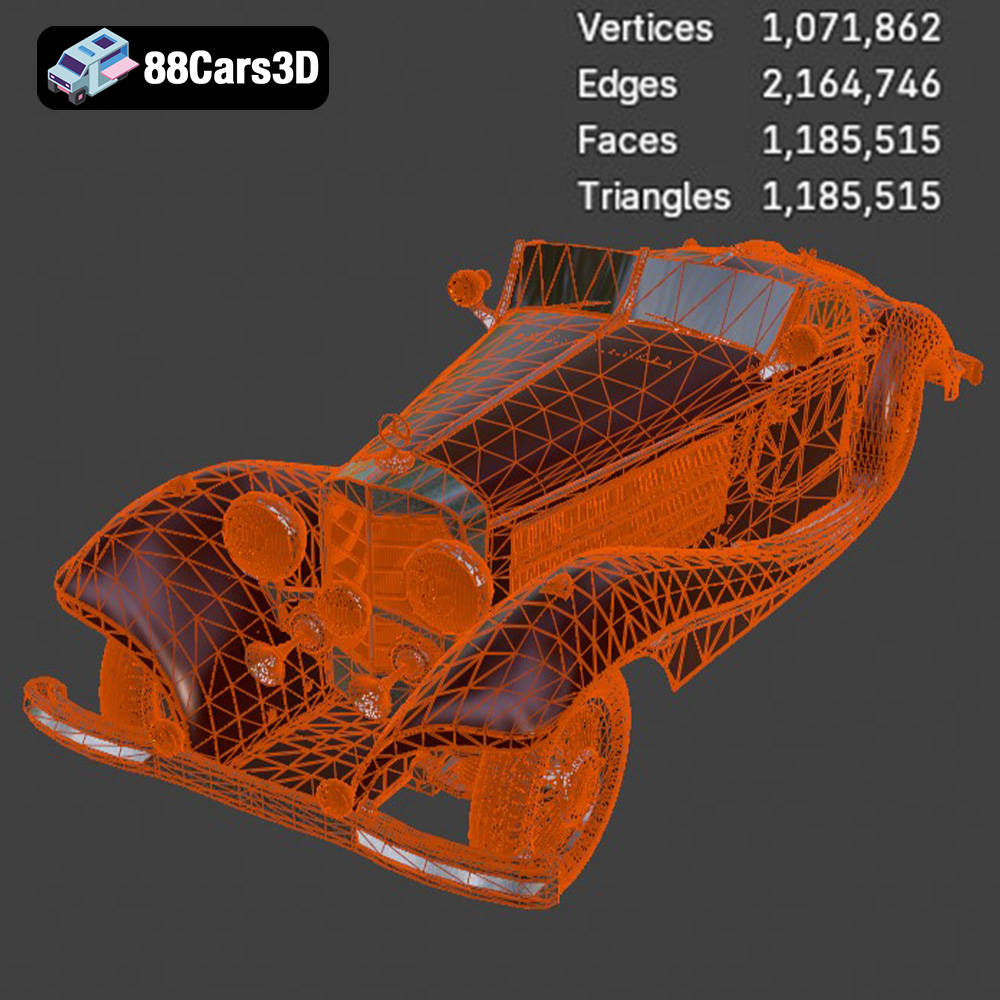
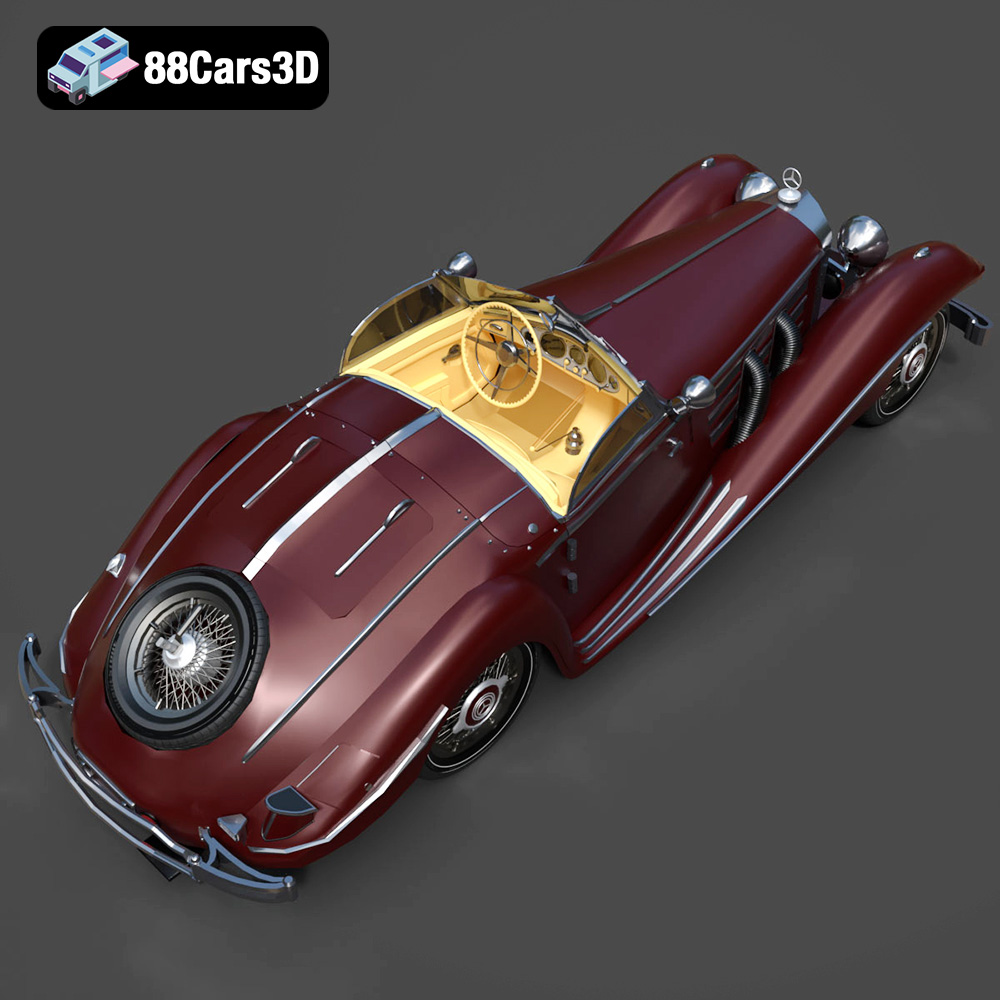
From the gracefully sculpted fenders to the formidable chrome radiator grille, every external feature of the 540 K Roadster has been faithfully recreated. The model boasts accurate frame geometry and classic proportions, ensuring that its digital representation is as breathtaking as the physical car. Critical details like the iconic external ribbed exhaust pipes, authentic vintage lighting assemblies, and intricate wire-spoke wheels with period-correct whitewall tires are all present and accounted for. Even the leaf spring and rigid axle suspension details are accurately represented, providing a robust foundation for realistic animation and close-up renders. The careful separation of wheels, suspension, and steering components further enhances its utility for dynamic scenes.
Stepping inside the virtual cockpit of the 540 K Roadster reveals an equally impressive level of detail. The luxurious vintage leather bench seat, complete with authentic stitching, invites the viewer into an era of unparalleled comfort. The classic large-diameter steering wheel with its distinctive chrome horn ring, the period-correct wood-trimmed dashboard, and the vintage instrument cluster are all rendered with precision. Even smaller control components like the floor shifter, handbrake, and pedals are detailed, making the model ideal for first-person perspective in gaming or interactive virtual experiences where users might explore the interior up close. The optimized geometry ensures that this interior richness doesn’t compromise real-time performance.
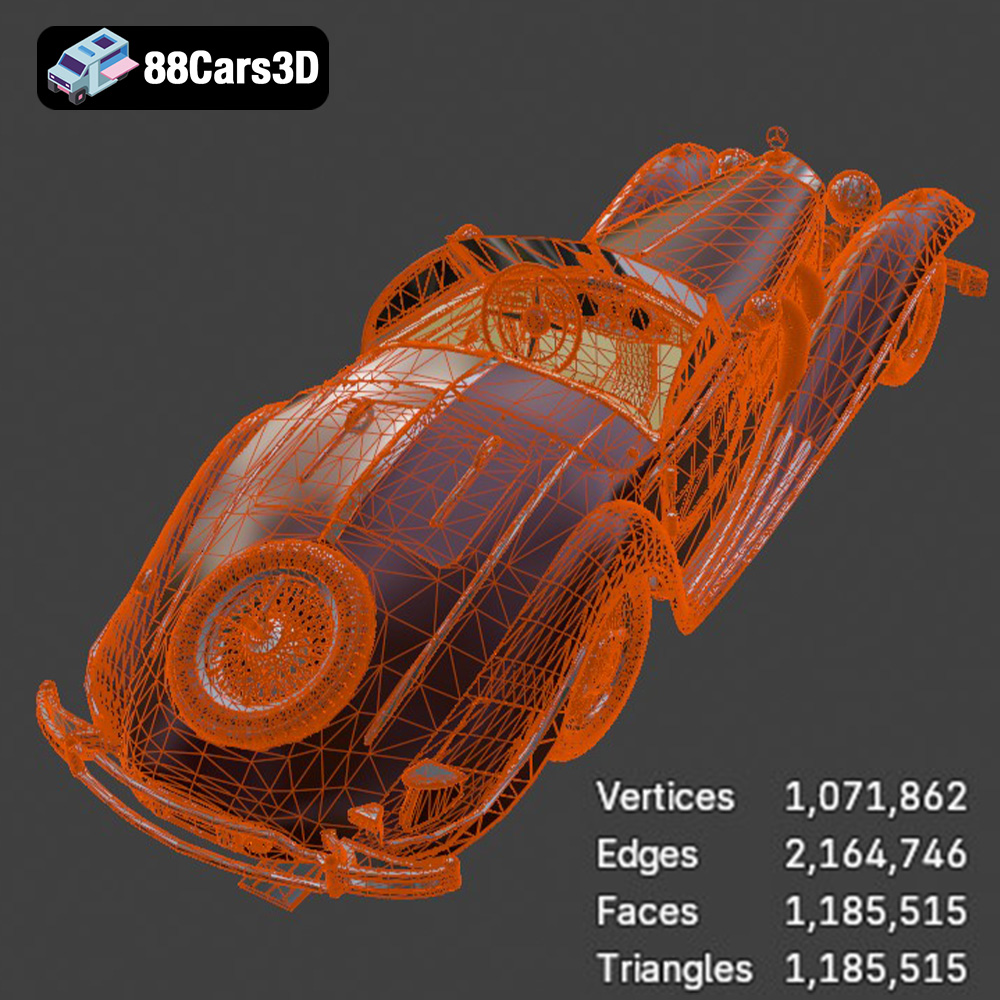
Technical specifications are the backbone of any professional 3D asset. The Mercedes Benz 540 K Roadster 3D model is designed with an optimized polygon count of approximately 150,000 triangles. This strikes a crucial balance, offering high-end visual realism suitable for stunning renders, while remaining efficient enough for real-time engines like Unreal and Unity. Real-world scale accuracy, based on the actual vehicle chassis, ensures seamless integration into environments without the need for manual scaling adjustments. Furthermore, proper pivot setups for steering, wheel rotation, and suspension travel mean that animators can immediately begin creating dynamic motion without extensive re-rigging. This attention to technical detail significantly streamlines the workflow for any project.
The availability of a high-fidelity 3D car model like the Mercedes Benz 540 K Roadster opens up a world of possibilities for professionals. Its versatility across various file formats and its optimized structure make it a cornerstone asset for many demanding digital endeavors.
For game developers, performance and visual quality are paramount. The Mercedes Benz 540 K Roadster 3D model is explicitly designed as “game-ready.” With its optimized polycount and `.fbx` or `.unreal` format options, it integrates seamlessly into game engines. Developers can use it for:
The model’s separated components allow for complex animations, such as realistic suspension travel over uneven terrain or intricate steering rack movements, enhancing the realism of any automotive game.
In architectural visualization (ArchViz) and cinematic rendering, the goal is often photorealism and emotional impact. A classic car can instantly elevate a scene, adding context, luxury, and a focal point. Using the Mercedes Benz 540 K Roadster in `.max` or `.blend` format, ArchViz artists can:
For cinematics, the model’s detailed exterior and interior can withstand close-up shots, delivering stunning visuals for commercials, films, or brand campaigns. The ability to easily adjust materials and lighting in professional rendering software like V-Ray, Corona, or Cycles allows for incredible artistic control.
The immersive capabilities of AR/VR and web-based 3D applications are rapidly expanding. The `.glb` format included with the 88cars3d.com model is specifically optimized for these applications, making the Mercedes Benz 540 K Roadster ideal for:
The optimized geometry ensures smooth performance even on less powerful mobile devices or web browsers, making these advanced interactions accessible.
Beyond the digital screen, the `.stl` format allows the Mercedes Benz 540 K Roadster 3D model to cross into the physical world. Hobbyists and professionals can 3D print scale replicas for display or prototyping. The provided print settings (recommended scale, layer height, wall thickness, infill, and support requirements) offer a clear roadmap for successful printing. Whether it’s a 1:12 scale model for a collector or a smaller desk ornament, the ability to convert this intricate digital asset into a tangible object is a testament to its robust design and the comprehensive package offered by 88cars3d.com.
A truly professional 3D asset provides not just immediate utility but also long-term value through its flexibility and adaptability. The Mercedes Benz 540 K Roadster 3D model is built with customization and longevity in mind, ensuring it remains a valuable component of your digital library for years to come.
The ability to tailor a 3D model’s appearance to specific project needs is crucial. This Mercedes Benz model offers extensive customization options:
These options provide artists with the creative freedom to integrate the classic car into virtually any scene or narrative they envision.
The model’s design inherently supports animation, reducing the need for extensive rigging work. With separate wheels, suspension, and steering components, animators can quickly set up realistic motion. Proper pivot setups ensure that elements rotate and move as they would in the real world. This is invaluable for:
This “animation-ready” state significantly speeds up production workflows and enhances the quality of animated content.
Investing in a high-quality, well-structured 3D asset is an investment in your future projects. Because the Mercedes Benz 540 K Roadster model is provided in multiple industry-standard and native formats, it guarantees compatibility with current and future software versions. Its clean topology and optimized geometry mean it can be easily adapted, retopologized, or even converted to higher detail levels (LODs) if project requirements evolve. This inherent flexibility ensures that the model remains a valuable, reusable asset in your creative arsenal for many years, justifying its place as a premium offering on 88cars3d.com.
In the expansive universe of 3D content creation, the pursuit of realism, efficiency, and historical accuracy is constant. High-quality 3D car models are more than just digital representations; they are pivotal assets that breathe life into games, ground architectural visualizations, and enhance immersive experiences. The Mercedes Benz 540 K Roadster 3D model stands as a testament to meticulous craftsmanship, offering a finely detailed, optimized, and versatile asset that caters to the diverse needs of professionals across various industries.
From its faithfully recreated exterior and interior details to its technical prowess with an optimized polycount and multi-format compatibility, this model provides an exceptional foundation for any project. Whether you are developing a next-generation racing game in Unreal Engine, crafting a photorealistic rendering in 3ds Max, or exploring interactive AR/VR experiences with GLB, this model delivers. Its comprehensive file formats, including .blend, .fbx, .obj, .glb, .stl, .ply, .unreal, and .max, ensure seamless integration into virtually any workflow.
By choosing such an asset, creators not only gain a stunning visual element but also unlock opportunities for deep customization and animation, ensuring their projects stand out. The Mercedes Benz 540 K Roadster 3D Model is not just a download; it’s an invaluable tool for elevating your digital storytelling and visualization projects. Explore this and other premium 3D car models at 88cars3d.com and bring your automotive visions to life with unparalleled quality.
The Mercedes Benz 540 K Roadster is a pinnacle of pre-war automotive design, renowned for its sweeping, aerodynamic fenders, massive chrome radiator grille, and unmatched luxury. Powered by a legendary supercharged straight-eight engine, this iconic classic car embodies elegance and power. The 3D model faithfully captures every vintage detail, from the signature external exhaust pipes to the intricate wire-spoke wheels and elegant chrome accents, delivering an unparalleled historical vehicle asset. This 3D model is meticulously crafted with high-quality topology and an optimized triangle count, ensuring game-ready performance without sacrificing visual fidelity. Designed for maximum versatility, the asset is fully prepped with separated components, making it exceptionally well-suited for high-end game development, interactive AR/VR experiences, professional animation, and architectural visualization. Perfect for historical racing games, cinematic period pieces, luxury virtual showrooms, and classic car configurators.
$19.99
.blend
.fbx
.glb
.max
.obj
.ply
.rendering
.stl
.unreal
540-k-roadster
car-3d-model
classic-car
game asset
game-ready
low-poly
luxury car
mercedes-benz
optimized
vintage-car
VR/AR