Get 20% OFF All Premium 3D & STL Models!

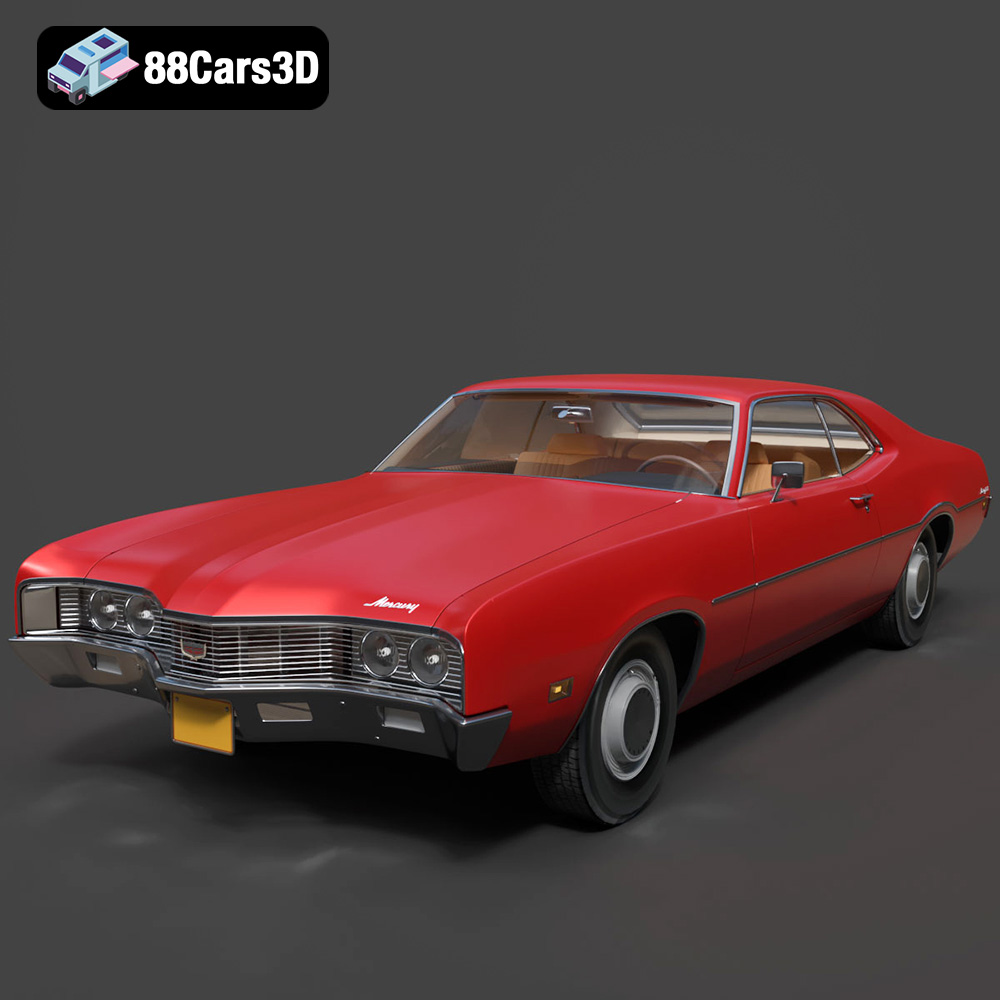
The roar of a classic V8 engine, the gleam of polished chrome, and the sweeping lines of a bygone era – there’s an undeniable magic to American muscle cars. Among these legendary machines, the 1970 Mercury Montego stands out with its imposing road presence, distinct split grille, and a silhouette that perfectly encapsulates 70s performance and style. For automotive enthusiasts, game developers, visualization artists, and AR/VR creators, bringing such an icon to life in the digital realm requires more than just a passing resemblance; it demands meticulous detail, technical precision, and absolute authenticity.
This is where high-quality 3D car models become indispensable. Imagine integrating that very essence of American muscle into your next project, whether it’s an immersive open-world racing game, a photorealistic cinematic render, or an interactive virtual showroom. The Mercury Montego 1970 3D Model Download STL FBX OBJ GLB Blend offers precisely this opportunity, delivering a meticulously crafted digital asset that transcends mere geometry to capture the soul of this classic. Available at 88cars3d.com, this model is a testament to the blend of artistic passion and technical expertise required to meet the demands of modern digital production, setting a high standard for 3D car models.
Classic cars are more than just vehicles; they are cultural touchstones, symbols of innovation, design philosophy, and a romanticized past. For many, they represent an aspirational lifestyle or evoke nostalgic memories. Translating this profound connection into a digital experience requires a deep understanding of what makes these machines so special, and how to replicate those feelings in a virtual environment.
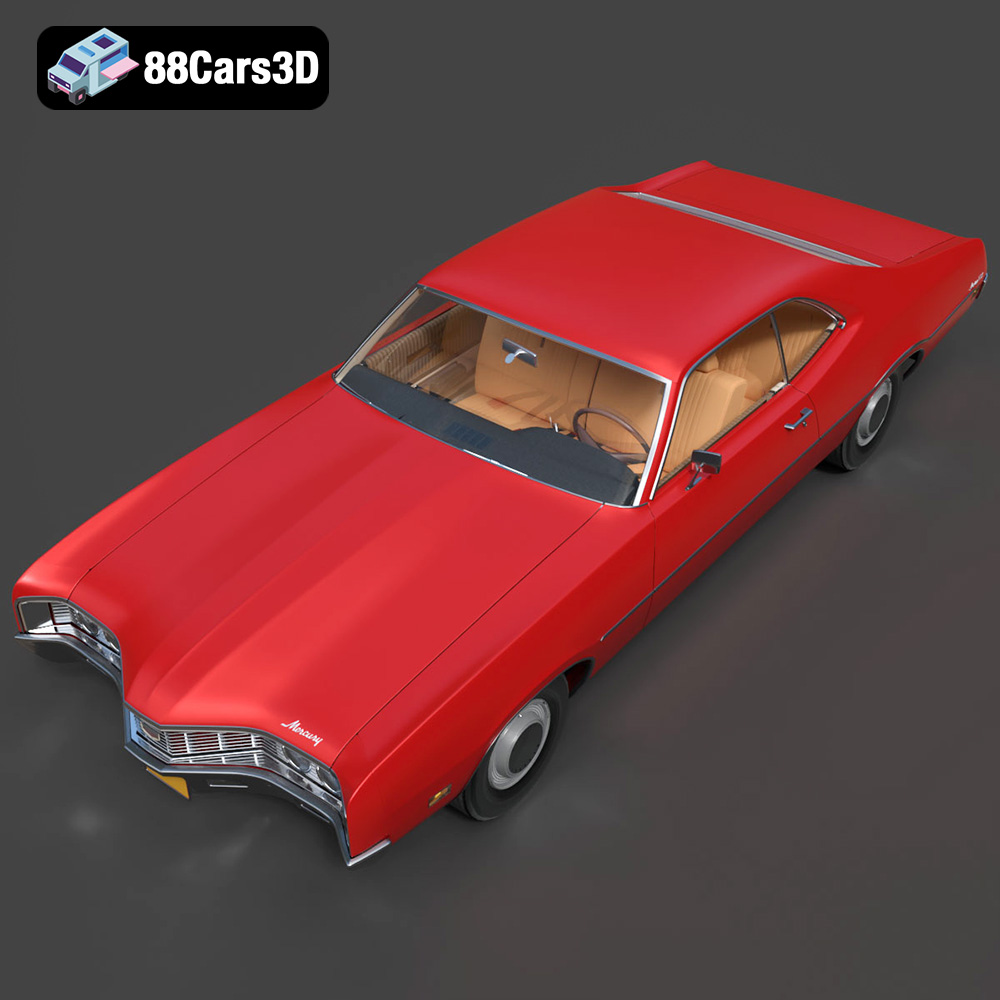
The authenticity of a 3D model is paramount. When we talk about the 1970 Mercury Montego, it’s not just about getting the overall shape right. It’s about the subtle curves of the fastback, the aggressive stance, the intricate design of the iconic split front grille, and the way light reflects off the chrome bumpers. This Mercury Montego 1970 3D Model goes far beyond surface-level aesthetics, digging into the very heart of the car’s mechanics and interior design. From the highly detailed V8 engine block, complete with architectural elements that hint at its power, to the authentic dual exhaust system with its chrome tips, every feature contributes to a convincing digital replica. Even the period-correct wheels, detailed classic tires, and hubcaps are painstakingly reproduced, ensuring that the model holds up under close scrutiny and provides a truly immersive experience.
Inside, the attention to detail continues. The vintage vinyl seating with accurate stitch patterns, the classic deep-dish steering wheel with period-correct badging, and the authentic dashboard featuring detailed instrument clusters and dials all combine to create an interior that feels genuinely ’70s. For first-person perspectives in driving simulators or games, these interior features are critical for immersion and believability.
Integrating a classic car like the Montego into modern digital pipelines presents unique challenges and opportunities. While the source material is historical, the application is cutting-edge. This means ensuring that the 3D model is not only visually accurate but also technically optimized for contemporary real-time engines and rendering software. The balance between high-end visual fidelity and game-ready performance is crucial. A model that looks incredible but brings a game to its knees is impractical, just as a low-poly asset that lacks detail fails to capture the desired realism. The Mercury Montego 1970 3D Model achieves this delicate balance, making it a versatile asset for a wide range of professional applications, from high-fidelity cinematic renders to performance-critical interactive experiences.
The versatility of a 3D model often lies in its compatibility and the range of file formats it supports. Each format serves specific purposes, catering to different stages of the 3D pipeline, from initial creation and editing to real-time deployment and physical production. Understanding these formats is essential for any professional working with 3D assets. The Mercury Montego 1970 3D Model is supplied with a comprehensive suite of formats, ensuring its adaptability across virtually any project or platform.
The `.blend` file is Blender’s native format. It’s a complete package, containing not just the mesh data but also materials, textures (packed within or linked), animations, lighting, cameras, scene settings, and even the user interface layout. For Blender artists, this is the most powerful format as it allows for full editability, leveraging Blender’s robust modifier stack, node-based materials, and comprehensive animation tools. If you intend to modify the Montego model extensively, re-rig it, create custom animations, or render it directly within Blender, the `.blend` file is your go-to choice.
The Filmbox (`.fbx`) format is arguably the most widely used proprietary 3D data exchange format, developed by Autodesk. It excels in transferring full scene data, including geometry, textures, materials, animations, skinning, and camera information, between different 3D software applications and game engines. For developers working with Unreal Engine or Unity, `.fbx` is the ideal choice for importing complex assets like the Montego model. It efficiently handles hierarchies, pivot points, and multiple UV sets, making it perfect for real-time pipelines where maintaining object relationships and animation data is critical. While materials often need to be re-setup in the target engine, the `.fbx` file reliably carries all the necessary geometric and structural data.
The Wavefront OBJ (`.obj`) format is a simple, universal 3D data format that is supported by virtually every 3D application. It primarily describes geometry (vertices, normals, texture coordinates, and faces) and can link to a separate `.mtl` (Material Template Library) file for basic material properties and texture references. While `.obj` does not support animation, rigging, or scene information like lights and cameras, its widespread compatibility makes it an excellent choice for transferring raw mesh data. If you need a clean geometric base of the Montego for sculpting, retopology, or importing into less common 3D software, `.obj` provides a highly compatible solution.
GLB (`.glb`) is the binary version of the GL Transmission Format (`.gltf`), an open standard for 3D scenes and models. Designed with efficiency in mind, `.glb` packs all assets – geometry, materials, textures, and animation – into a single, self-contained file. This makes it incredibly efficient for web-based 3D viewers, augmented reality (AR), and virtual reality (VR) applications, where file size and loading performance are paramount. The Montego model in `.glb` format is perfect for embedding in websites, creating virtual showrooms, or deploying on mobile AR platforms, ensuring quick load times and optimized rendering.
Stereolithography (`.stl`) is the de facto standard file format for 3D printing. It represents 3D surfaces as a series of connected triangles (a tessellated mesh) and contains no color, texture, or material information – only raw geometry. For hobbyists and professionals looking to bring the Mercury Montego into the physical world as a display model, the `.stl` format is essential. The Montego model in `.stl` format is prepped for conversion to a physical object, allowing for tangible representations from the digital file.
The Polygon File Format (`.ply`), sometimes referred to as the Stanford Triangle Format, is primarily used for storing 3D data from 3D scanners. It can store a wider range of properties than `.obj` or `.stl`, including color information per vertex, transparency, surface normals, and range data. While less common for general DCC software exchange, `.ply` is invaluable for applications requiring precise geometric data or when integrating the Montego into engineering, CAD, or scientific visualization workflows that demand high fidelity in mesh representation.
While `.unreal` isn’t a single universal file extension for 3D models like `.fbx`, its inclusion implies an asset specifically packaged or optimized for direct integration into Unreal Engine projects. This could mean a highly optimized `.fbx` file, along with pre-configured materials, textures, and perhaps even basic collision data or skeletal setups within an Unreal-compatible package. It signifies that the Montego model is prepared to minimize the setup time within Unreal Engine, providing a smooth workflow for game developers and architectural visualizers using this powerful real-time platform.
The `.max` file is the native scene file for Autodesk 3ds Max. Like the `.blend` file for Blender, it contains the complete project environment, including all geometry, materials, textures, lighting, cameras, animation data, modifiers, and rendering settings specific to 3ds Max. For users of 3ds Max, having the Montego model in `.max` format provides the highest level of flexibility for editing, scene integration, animation production, and leveraging 3ds Max’s extensive toolset for high-end rendering and visualization. It’s the ultimate format for deep customization and complex scene composition within the 3ds Max ecosystem.
The true value of a premium 3D asset lies not just in its visual appeal but in its underlying technical foundation. The Mercury Montego 1970 3D Model demonstrates a superior balance of aesthetic fidelity and technical optimization, making it a robust choice for any professional pipeline.
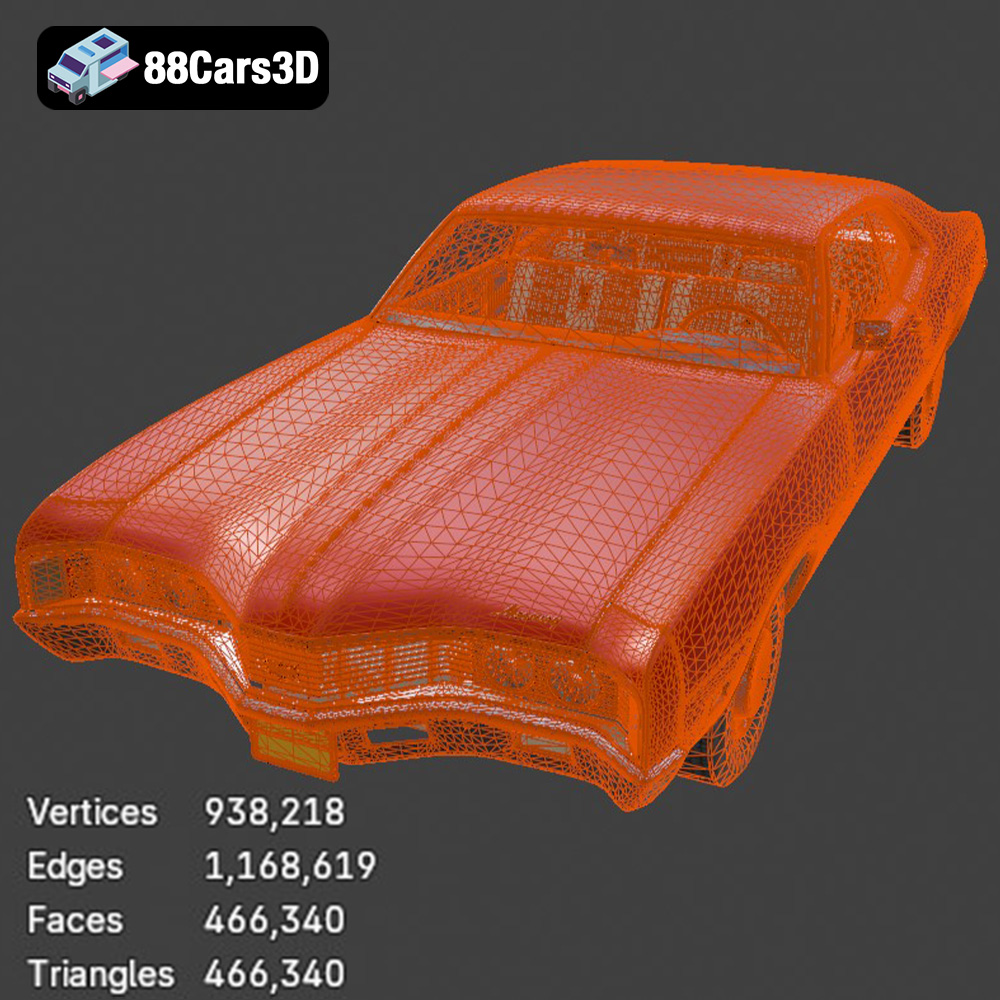
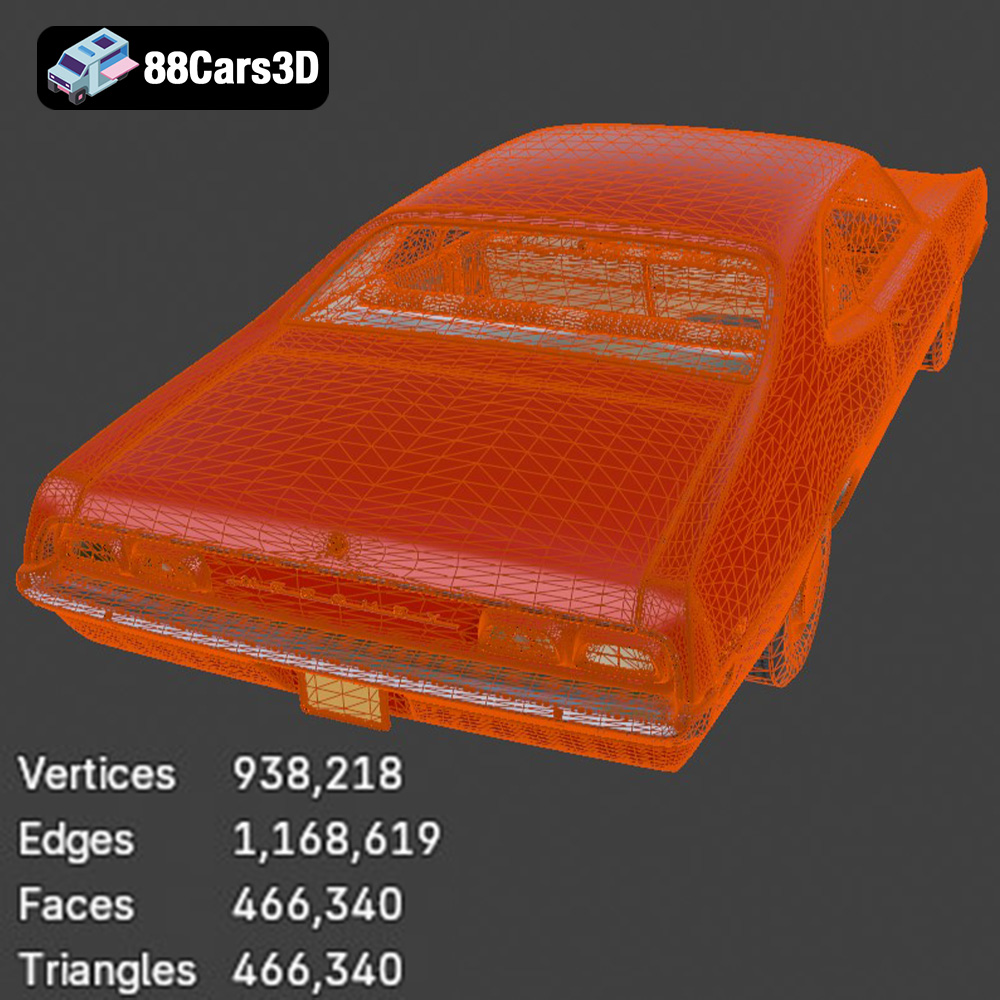
With a triangle count of 466,340, this 3D model strikes a perfect equilibrium. In the world of 3D, higher poly counts typically equate to greater detail, but also increased computational load. Conversely, overly low poly counts sacrifice visual fidelity. The chosen topology for the Montego is meticulously optimized, meaning it provides sufficient detail for close-up renders and cinematic sequences, accurately capturing the car’s nuanced curves and sharp edges, while simultaneously being efficient enough for real-time applications like games (Unreal, Unity) and AR/VR experiences. This “game-ready” optimization ensures smooth performance without compromising the high-end visual realism expected by discerning artists and developers.
The product description highlights an incredible array of specific details that elevate this model beyond a generic car asset. The exterior features include accurate 1970 Mercury Montego frame geometry, classic muscle car proportions, and iconic split front grille. Quad headlights and taillights are accurately modeled, enhancing its distinct character. The presence of an exposed, highly detailed V8 engine block, authentic dual exhaust system with chrome tips, period-correct wheels, detailed classic tires, and hubcaps, as well as accurate suspension and undercarriage detailing, speaks volumes about the commitment to authenticity. These elements are not merely suggested but fully realized, making the model suitable for shots where the hood is open or the car is elevated. Separated wheels, suspension, and steering components are critical for dynamic animations and real-time physics simulations.
The interior is equally impressive. Detailed vintage vinyl seating with accurate stitch patterns, a classic deep-dish steering wheel with period-correct badging, and an authentic dashboard with detailed vintage instrument clusters and dials contribute to a complete and immersive cockpit experience. Crucially, interior controls like pedals, window cranks, and the gear shifter are accurately modeled, ideal for first-person POV in driving simulators and gaming, ensuring that the user’s interaction with the virtual environment feels natural and authentic.
Adherence to real-world scale accuracy, based on the actual classic Mercury chassis, is fundamental for proper integration into any scene, ensuring correct proportions relative to other assets and environments. Beyond static representation, the model is engineered for dynamic interaction. Proper pivot setups for steering, wheel rotation, and suspension travel are already configured. This saves countless hours for animators and developers, allowing them to instantly integrate the Montego into driving mechanics, cinematic sequences, or interactive vehicle configurators with realistic movement and behavior.
The technical robustness and versatile file formats of the Mercury Montego 1970 3D Model make it an ideal candidate for integration into a multitude of professional 3D pipelines. Its design caters to diverse needs, from high-fidelity cinematic productions to performance-critical interactive applications.
For game developers, particularly those crafting open-world racing titles or simulators, the “game-ready & optimized” nature of this model, with its 466,340 triangle count, is a significant advantage. The `.fbx` and `.unreal` formats are crucial here. Developers can seamlessly import the FBX into Unreal Engine or Unity, where the proper pivot setup for wheels and suspension greatly streamlines the integration of vehicle physics. Artists can quickly set up PBR (Physically Based Rendering) materials using the included textures, and then proceed to configure collision meshes, LODs (Levels of Detail) for performance optimization, and custom shader effects. The separated components (wheels, suspension, steering) allow for realistic suspension travel and responsive steering, making the Montego model a high-performance asset for any classic car street racing game or 1970s urban environment simulation.
In the realm of automotive rendering and visualization, photorealism is the ultimate goal. The `.max` and `.blend` files allow artists using 3ds Max or Blender to leverage the model’s rich detail for stunning visual output. With access to the native scene files, artists can easily manipulate materials, adjust lighting setups for studio renders or environmental scenes, and animate the car for commercials or brand campaigns. The ability to change body colors, modify tire textures (classic whitewalls vs. street performance variants), and adjust material finishes (matte, gloss, metallic, heavy chrome) provides immense creative freedom. Imagine the Montego bathed in dramatic studio lighting, showcasing its chrome accents and deep paintwork for a luxury car advertisement, or parked in a vintage street scene for a lifestyle visualization.
The `.glb` format is a game-changer for immersive experiences and web-based presentations. For AR/VR developers, the optimized nature of the GLB model means it can be readily deployed in virtual showrooms, interactive configurators, or mobile AR experiences without significant performance bottlenecks. Clients can view the Mercury Montego 1970 3D Model in 3D directly in their web browser or overlay it onto the real world using their smartphone. This level of accessibility makes it perfect for marketing, education, and innovative product showcasing, providing a highly engaging way for users to interact with a classic car that might otherwise be out of reach.
Beyond digital displays, the Montego model also caters to the growing community of 3D printing enthusiasts and model makers. The inclusion of the `.stl` format, along with detailed 3D print settings, transforms the digital asset into a tangible collectible. Hobbyists can print the Montego at various recommended scales (1:12, 1:18, 1:24), with specific advice on layer height, wall thickness, infill, and crucially, support placement for delicate parts like the exhaust, mirrors, classic bumpers, and steering wheel. Recommendations for resin printing ensure the capture of fine details, and post-processing instructions guide users through sanding, priming, and applying authentic factory colors with metallic and chrome finishes. This allows for the creation of stunning, personalized physical models, demonstrating the incredible versatility of high-quality 3D car models from 88cars3d.com.
A truly professional 3D asset offers more than just out-of-the-box quality; it provides a canvas for creative expression. The Mercury Montego 1970 3D Model is designed with customization in mind, allowing artists and developers to tailor its appearance to fit any project’s specific aesthetic requirements.
The ability to easily change body and paint colors is fundamental. Whether you need the Montego in a vintage factory color to accurately represent historical context or a custom hot rod finish for a stylized racing game, the model’s material setup facilitates these changes. Furthermore, the capacity to modify tire textures allows for variations such as classic whitewalls or more aggressive street performance variants, significantly altering the vehicle’s character. Adjusting material finishes – from matte and gloss to metallic and heavy chrome – gives artists precise control over how the car interacts with light, enabling them to achieve anything from a showroom-perfect gleam to a weathered, battle-scarred look. This level of material customization ensures the Montego can seamlessly adapt to diverse artistic visions and technical requirements.
Beyond the car itself, its integration into various environments is key. The Mercury Montego 1970 3D Model is built to respond realistically to different lighting setups. Artists can adapt the lighting for diverse environmental scenarios, be it the harsh midday sun of a desert race track, the subtle glow of a twilight urban street, or the controlled environment of a professional studio render. This adaptability ensures that the Montego not only looks great in isolation but becomes a compelling focal point within any scene, enhancing the overall realism and narrative of the visual content. Its robust geometry and well-defined materials will react correctly to global illumination, reflections, and shadows, making it a dream to light and compose.
The 1970 Mercury Montego is a classic that continues to captivate, and its digital counterpart, the Mercury Montego 1970 3D Model Download STL FBX OBJ GLB Blend, perfectly translates that enduring appeal into a versatile, high-quality asset for modern digital creation. From its meticulously detailed exterior and interior to its optimized topology and animation-ready components, this model is built for performance and visual fidelity across a wide spectrum of applications.
Whether you are developing the next hit open-world driving game, crafting photorealistic automotive renders for a client campaign, designing immersive AR/VR experiences, or even 3D printing a physical model for your collection, this asset provides the technical foundation and creative flexibility required. The comprehensive suite of file formats – .blend, .fbx, .obj, .glb, .stl, .ply, .unreal, and .max – ensures unparalleled compatibility and ease of integration into virtually any professional workflow.
For creators seeking authentic, technically robust, and aesthetically stunning 3D car models, the Mercury Montego 1970 3D Model is an exceptional choice. Discover this and a curated selection of other premium 3D car models designed to elevate your projects to the next level by visiting 88cars3d.com today.
Experience the golden era of American muscle with this meticulously crafted 1970 Mercury Montego 3D model. Known for its imposing road presence, distinct pronounced front grille, and sweeping fastback or hardtop styling, the 1970 Montego captures the essence of classic 70s performance. This model highlights key visual elements including a highly detailed V8 engine block, authentic dual exhaust system, and beautifully reproduced chrome bumpers and trim lines that define its vintage character. Designed with exceptional attention to detail, this 3D model features a well-optimized topology with a triangle count of 466,340, striking the perfect balance between high-end visual fidelity and game-ready performance. Whether you are developing an open-world driving game, crafting an immersive VR showroom, or producing cinematic animations, this asset delivers unmatched realism and versatility.
$26.00
.blend
.fbx
.glb
.max
.mercury
.obj
.ply
.rendering
.stl
.unreal
car-3d-model
classic-car
game asset
game-ready
low-poly
montego-1970
muscle-car
optimized
VR/AR