Get 20% OFF All Premium 3D & STL Models!

The roar of a classic V8, the iconic lines, the sheer presence—American muscle cars hold a timeless appeal. Among these legends, the 1967 Pontiac Firebird stands out, a symbol of late-60s power and audacious style. While these automotive masterpieces once dominated the asphalt, their legacy now extends deep into the digital world, becoming essential assets for a myriad of creative and technical endeavors.
From breathtaking cinematic automotive rendering to exhilarating open-world racing games, and from immersive AR/VR experiences to precise 3D printing, the demand for high-quality 3D car models is constantly accelerating. Professionals in these fields understand that the foundation of any successful project lies in the fidelity and technical integrity of its assets. This is where a meticulously crafted digital replica, such as the Pontiac Firebird 1967 3D Model available on 88cars3d.com, becomes an invaluable tool. It’s not just a model; it’s a gateway to recreating history, crafting future narratives, and delivering unparalleled visual experiences.
In the world of 3D modeling, choosing the correct file format is as crucial as the model itself. Each format serves a specific purpose, offering unique advantages for different stages of a professional workflow, from initial design to final rendering, real-time implementation, or physical fabrication. Understanding these distinctions ensures maximum compatibility, efficiency, and fidelity for your projects, especially when working with complex assets like high-detail 3D car models.
The .blend format is native to Blender, the powerful open-source 3D creation suite. It encapsulates an entire Blender scene, including all mesh data, materials (often node-based for advanced shaders), textures, lighting, cameras, animations, physics simulations, and even scene layouts. For artists deeply embedded in the Blender ecosystem, this format offers full editability, allowing for seamless integration into existing Blender projects and leveraging all of Blender’s robust features for rendering with Cycles or Eevee, animation, and sculpting. When you download a .blend file, you’re not just getting a model; you’re getting a fully configured scene ready for immediate manipulation and rendering within Blender.
.fbx (Filmbox) is arguably the most widely adopted exchange format in the 3D industry, especially prevalent in game development and animation pipelines. Developed by Autodesk, it excels at storing not only mesh data and materials but also skeletal animations, blend shapes, cameras, and lights. Its robust support across major 3D software (3ds Max, Maya, Cinema 4D, Blender) and real-time engines (Unreal Engine, Unity) makes it ideal for transferring animated assets. For a 3D car model like the Pontiac Firebird, an .fbx file would typically include separated components (wheels, suspension, steering) with proper pivot points, ready for rigging and animation within a game engine or animation software. It’s the go-to for ensuring broad compatibility in a professional production environment.
.obj (Wavefront OBJ) is a universal, open-standard format recognized by virtually every 3D application. It’s a simpler format compared to .fbx, primarily storing geometry (vertices, normals, texture coordinates) and references to external material (.mtl) and texture files. While it doesn’t support animation or complex scene data, its widespread compatibility makes it an excellent choice for static mesh interchange between different software packages. When you need a clean, basic mesh to import into any 3D program for texturing, rendering, or further modification, .obj is a reliable foundation.
.glb (GL Transmission Format Binary) is the binary version of glTF (GL Transmission Format), a modern, open-standard format specifically designed for efficient transmission and loading of 3D scenes and models by engines and applications. It’s highly optimized for web-based 3D, augmented reality (AR), and virtual reality (VR) experiences due to its compact size and single-file nature (embedding textures and other data). For interactive virtual showrooms, mobile AR apps featuring the Pontiac Firebird, or browser-based configurators, .glb offers superior performance and ease of deployment.
.stl (STereoLithography) is the de facto standard format for 3D printing. It represents a 3D model as a series of connected triangles, defining only the surface geometry of an object without color, texture, or other properties. For successful 3D printing, an .stl file must describe a “watertight” mesh (no holes or gaps) to ensure the printer understands the solid volume. The Pontiac Firebird model, when converted to .stl, provides hobbyists and professionals with the means to physically manifest this classic car, requiring precise preparation for optimal print results.
.ply (Polygon File Format, or Stanford Triangle Format) is another format that stores graphical objects as collections of polygons. It’s often used for 3D scanning data, allowing for the storage of color, transparency, and sometimes even confidence data per vertex or face. While not as universally used as .fbx or .obj for general model exchange, .ply is valuable in scientific, engineering, and CAD applications where precise mesh data, often originating from 3D scanners, needs to be preserved for analysis or reverse engineering. Its ability to store vertex colors and normals makes it a versatile format for intricate mesh representation.
The .unreal designation often refers to assets that are specifically packaged and optimized for direct import and use within Unreal Engine. While not a standalone file extension in the traditional sense (Unreal uses its own internal UAsset format), it signifies that the model has been rigorously prepared with Unreal Engine’s specifications in mind. This typically means optimized meshes, PBR (Physically Based Rendering) material setups, proper collision meshes, LODs (Levels of Detail), and often pre-configured Blueprints for interactive elements. For developers looking to drop the Pontiac Firebird directly into an Unreal project, an “Unreal-ready” asset significantly reduces setup time and ensures optimal performance.
Finally, the .max format is the native file type for Autodesk 3ds Max, a leading 3D modeling, animation, and rendering software. Similar to .blend, a .max file contains the complete scene, including all models, lights, cameras, materials (often V-Ray, Corona, or Arnold specific), modifiers, and animation data. For professionals working in 3ds Max, having the Pontiac Firebird in its native .max format means access to all the original scene setup, material networks, and the ability to seamlessly integrate it into complex architectural visualizations, product renders, or cinematic sequences using 3ds Max’s powerful rendering capabilities.
The availability of the Pontiac Firebird 1967 3D Model in all these diverse formats—.blend, .fbx, .obj, .glb, .stl, .ply, .unreal, and .max—underscores its versatility and the foresight in providing a truly adaptable asset for any professional pipeline.
Creating a truly authentic 3D car model is an intricate dance between artistic vision and technical precision. It demands not just an eye for detail, but also a deep understanding of automotive design and the principles of 3D topology. The 1967 Pontiac Firebird 3D Model exemplifies this synthesis, capturing the very essence of this legendary muscle car with remarkable fidelity.
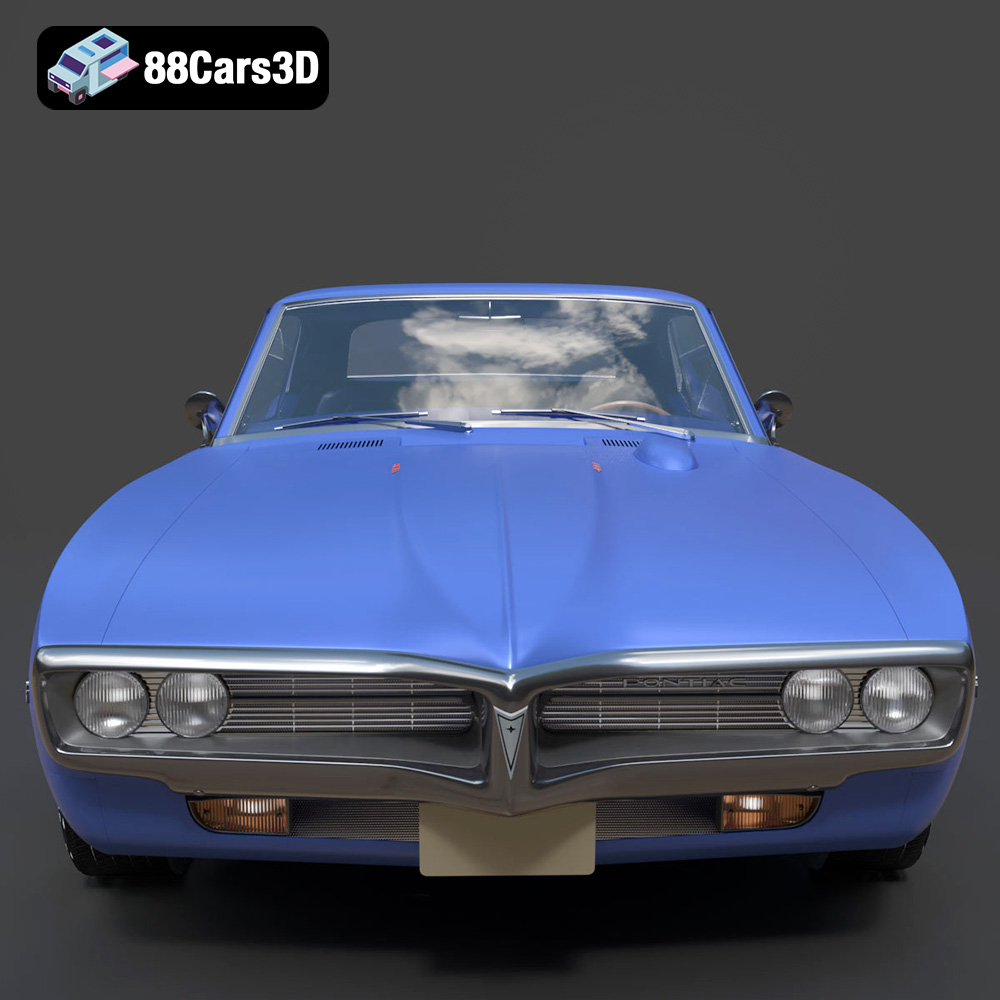
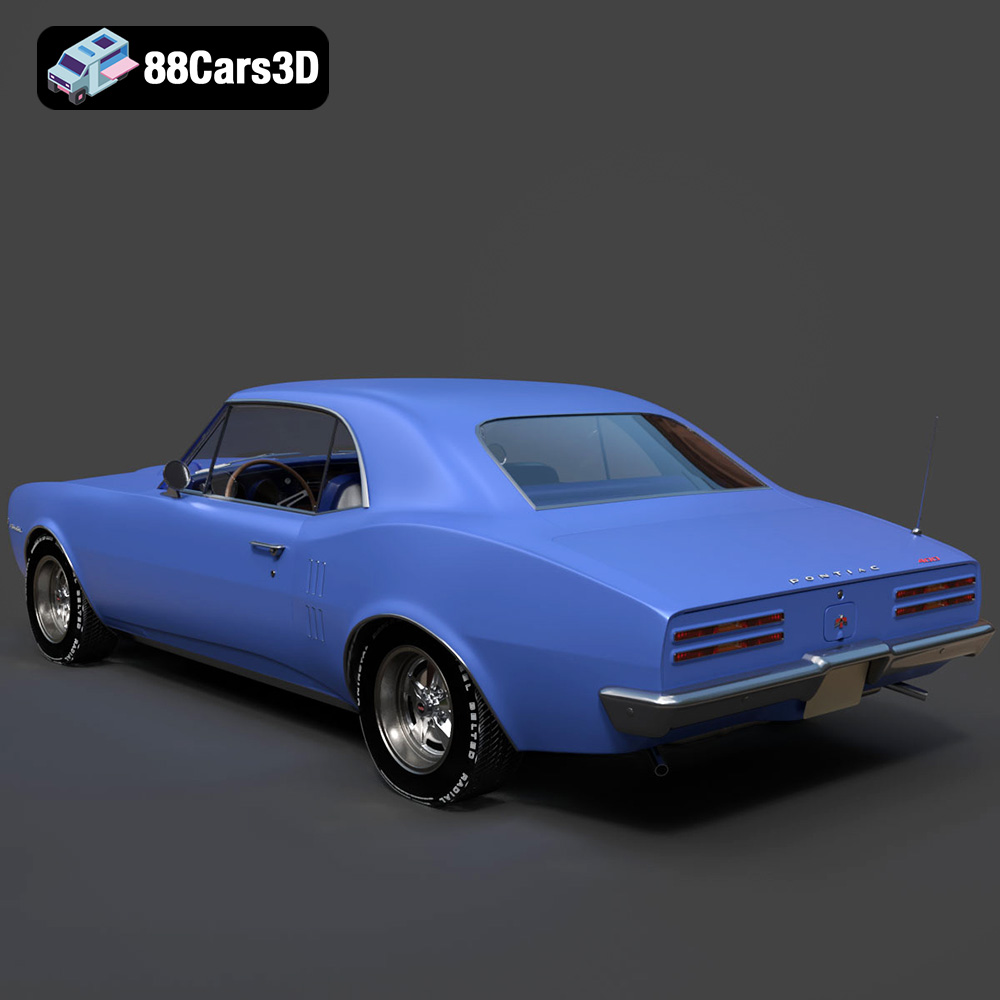
The Pontiac Firebird 1967 is defined by its aggressive “Coke-bottle” styling, a distinctive front split-grille bumper, and those iconic quad headlights that command attention. This digital replica meticulously recreates every curve, every vent, and every panel line to perfectly match the original. Beyond the aesthetics, the model delves into the engineering marvels that made the Firebird a powerhouse. A detailed V8 engine block, complete with intricate components, lies beneath the hood, ready for close-up showcases. The classic dual exhaust system, featuring polished chrome tips, adds to the authentic look, while the period-accurate rally wheels with precise tire treads complete the exterior.
Crucially, the model features authentic leaf-spring and independent front suspension details, along with separate wheels, suspension, and steering components. This level of granular detail is not merely for show; it’s fundamental for dynamic animation and realistic simulations, enabling artists and developers to accurately depict the car’s movements and interactions with its environment.
One of the most significant technical advantages of this 3D car model is its optimized topology. With an exceptional count of 3,853,174 triangles, it strikes a perfect balance. This poly count is high enough to deliver unparalleled visual fidelity for cinematic close-up shots and high-end automotive rendering, ensuring that every subtle curve and surface reflection is rendered with photorealistic accuracy. Yet, it remains efficiently optimized for high-end real-time applications such as Unreal Engine and Unity, where performance is paramount. Achieving this balance requires expert modeling techniques, ensuring clean quad topology where possible and efficient triangulation for complex surfaces, all while maintaining real-world scale accuracy based on actual vehicle chassis dimensions. This thoughtful optimization means the model can perform smoothly without excessive resource drain, making it a truly game-ready asset.
The experience of a classic car isn’t complete without its interior, and the Pontiac Firebird model doesn’t disappoint. The cockpit has been recreated with meticulous attention to detail, featuring vintage vinyl-style bucket seats that evoke the era. A classic three-spoke wooden steering wheel, deep-set analog instrument cluster, and historically accurate dashboard layout immerse the viewer in the driver’s seat. Furthermore, the floor-mounted shifter and precise pedal placement are optimized for first-person perspective (POV) in gaming, offering an authentic and engaging driving experience. This attention to interior detail makes the model suitable for virtual tours, interactive configurators, and any scenario where the user might experience the car from the inside out.
In professional 3D production, efficiency and quality are paramount. High-quality 3D car models like the Pontiac Firebird 1967 significantly streamline workflows across various applications, from rendering compelling visuals to populating interactive environments.
For cinematic automotive rendering and high-end visualization, the Pontiac Firebird model provides an exceptional foundation. In 3ds Max, utilizing the native .max file, artists can leverage powerful rendering engines like V-Ray or Corona. This allows for the creation of stunning photorealistic images and animations, setting up complex studio lighting, applying advanced physically based materials, and animating the car with precision. The proper pivot setup for steering, wheel rotation, and suspension travel embedded within the model saves countless hours of rigging. Imagine a luxury car advertisement, showcasing the Firebird in a dynamic urban setting, its metallic paint gleaming under meticulously crafted reflections—this model provides the perfect canvas.
Similarly, for artists working in Blender, the .blend file offers full compatibility. With Cycles or Eevee, artists can explore advanced node-based material creation, implement realistic paint shaders, and experiment with various lighting scenarios. Blender’s robust animation tools can be used to bring the car to life, from simple turns of the wheel to complex driving sequences. This versatility makes it ideal for independent studios or hobbyists who require professional-grade assets without proprietary software restrictions.
Game development often operates under strict performance budgets, yet demands high visual quality. The Firebird 3D model, optimized for game engines, excels here. Its .fbx and .unreal formats are specifically designed to facilitate seamless integration into platforms like Unreal Engine and Unity. The game-ready optimization ensures that despite its high visual fidelity, the model performs efficiently within real-time environments. The pre-rigged elements—such as separated wheels, suspension, and steering components with correctly positioned pivot points—are critical time-savers. Developers don’t have to spend hours setting up basic animations; the model is ready to be dropped into a vehicle Blueprint, configured with physics, and driven immediately. This significantly accelerates development cycles for racing titles, open-world adventures, and driving simulators, allowing teams to focus on gameplay mechanics and larger world-building rather than foundational asset preparation.
The utility of a high-quality 3D car model extends far beyond static renders. It becomes a dynamic component in interactive simulations, immersive environments, and engaging user experiences.
The 1967 Pontiac Firebird 3D model is an exceptional asset for game development. Its optimized polycount of 3,853,174 triangles strikes that crucial balance between visual richness and real-time performance, making it perfect for integration into racing games, open-world titles, and detailed driving simulators. In a racing game, players can experience the thrill of driving this classic muscle car, with accurately modeled physics interactions thanks to the proper pivot setup for steering, wheel rotation, and suspension travel. For an open-world environment, the Firebird can serve as a detailed hero car, a collectible, or simply an authentic element that adds historical depth and visual interest to the game world. Its fidelity ensures that even in cinematics or close-up garage scenes within the game, the model holds up to scrutiny.
Augmented Reality (AR) and Virtual Reality (VR) are transforming how we interact with digital content, offering immersive experiences that were once unimaginable. The Firebird model is perfectly suited for these cutting-edge applications. For virtual showrooms, automotive configurators, or even mobile AR experiences, its .glb format is ideal. .glb files are optimized for fast loading and efficient rendering in web browsers and mobile devices, making it easy to deploy interactive 3D models. Imagine customers exploring the 1967 Firebird in a virtual reality showroom, walking around it, opening the doors, or even sitting inside to admire the detailed cockpit, all rendered in real-time. In AR, the car could be superimposed onto a real-world environment through a smartphone, allowing potential buyers or enthusiasts to visualize it in their driveway or a preferred location. This creates a powerful, engaging, and memorable brand experience.
Flexibility is key in any professional project. This Pontiac Firebird 3D model offers significant customization options, empowering artists and developers to adapt it to diverse creative briefs. Professionals can easily change the body color to any of the original factory hues or apply custom finishes like metallic or matte paints. Modifying tire textures to switch between authentic period-correct street variants or more aggressive off-road designs for specific game scenarios is straightforward. Adjusting material finishes on chrome, glass, or interior elements allows for fine-tuning the visual presentation. Furthermore, the model can be seamlessly integrated into various lighting environments, from a sun-drenched desert scene to a moody, rain-swept cityscape, enhancing its versatility across different creative contexts. This adaptability reduces the need for multiple models and maximizes the utility of a single high-quality asset.
The journey of a 3D model from the digital screen to a tangible object is a testament to modern manufacturing capabilities. For enthusiasts, collectors, or even educational purposes, 3D printing offers a unique way to bring the 1967 Pontiac Firebird to life.
The Pontiac Firebird 1967 3D Model, available in .stl format, is perfectly prepared for 3D printing. The .stl format is the standard for additive manufacturing, translating the model’s geometry into a series of triangles that 3D printers understand. Before printing, the model undergoes rigorous checks to ensure it’s a “watertight” mesh—meaning there are no gaps or holes in its surface—which is crucial for the printer to correctly interpret the object’s solid volume. This digital foundation, developed with precision, ensures that the physical replica will accurately capture the intricate details, from the aggressive styling to the delicate suspension components.
Hobbyists and professionals alike can transform this digital legend into a display-scale model, a collectible, or even a detailed prototype. The fidelity of the original 3D model directly translates to the quality of the printed output, allowing for remarkable realism even in miniature form.
To achieve the best results when 3D printing the Pontiac Firebird, specific settings are recommended. A scale of 1:12, 1:18, or 1:24 is suggested to balance detail with printability. For optimal detail reproduction, especially for fine features like the exhaust system or interior components, resin printing is highly recommended over FDM (Fused Deposition Modeling) printers. A layer height between 0.04mm and 0.12mm will ensure smooth surfaces and sharp edges. Wall thickness should ideally be between 1.2mm and 2.0mm to provide structural integrity without excessive material usage, with an infill of 20-30% for internal strength.
Supports are almost always required for detailed parts and overhangs, such as the exhaust system, mirrors, and specific chassis elements. Proper print orientation is also key: printing the main frame angled can improve structural integrity and reduce the need for excessive supports, while wheels should generally be printed separately for finer detail and easier assembly. Post-processing is where the model truly shines. This typically involves sanding to smooth out layer lines, applying a primer, and then painting with authentic factory colors, often with metallic finishes, to bring the model to a museum-quality standard. This meticulous process ensures that the physical Firebird model mirrors the digital one in its breathtaking realism.
In today’s fast-paced digital landscape, the distinction between a mediocre project and an outstanding one often comes down to the quality of its foundational assets. High-end 3D car models are not just commodities; they are strategic investments that yield significant returns in terms of time, quality, and creative freedom.
Developing a complex 3D car model from scratch is an incredibly time-consuming and resource-intensive endeavor. It requires specialized skills in hard-surface modeling, topology optimization, texturing, and material development. By investing in a pre-built, high-quality asset like the Pontiac Firebird 1967 3D Model, professionals immediately gain a massive head start. The model is already built to real-world scale, with accurate proportions and intricate details, eliminating the need for extensive research, blueprint matching, and iterative modeling. This translates directly into substantial time and cost savings, allowing teams to allocate resources to other critical aspects of their project, such as animation, scene composition, or gameplay mechanics, without compromising on accuracy or visual fidelity.
With the technical foundation handled, artists and developers are liberated to focus purely on the creative aspects of their work. A robust 3D car model provides the flexibility to experiment with different lighting scenarios, material finishes, environmental backdrops, and narrative contexts. Whether it’s showcasing the Firebird in a gritty urban street scene, a sleek studio render, or a vast open-world landscape, the model’s adaptability encourages creative exploration. Its detailed interior makes it suitable for virtual tours and first-person perspectives, while its animation-ready components facilitate dynamic action sequences. This ability to easily iterate and visualize different creative directions empowers teams to achieve their artistic vision more effectively and efficiently.
Sourcing reliable, professional-grade 3D car models is a critical decision for any studio or individual artist. This is where platforms like 88cars3d.com prove invaluable. They offer a curated selection of high-quality assets, ensuring that every purchase, such as the Pontiac Firebird 1967 3D Model, meets the stringent demands of professional production pipelines. From game development to automotive rendering and AR/VR experiences, the models are meticulously crafted and provided in multiple optimized formats, ready for immediate deployment. 88cars3d.com stands as a trusted source for assets that not only look exceptional but are also technically sound and production-ready, giving creators the confidence to build truly remarkable experiences.
The 1967 Pontiac Firebird is more than just a classic car; it’s an icon, and its digital counterpart is equally iconic in the realm of 3D assets. The detailed 3D model, with its exceptional topology, accurate dimensions, and comprehensive detailing, offers unparalleled versatility for a wide array of professional applications. Whether you are a game developer needing a high-performance vehicle, a visualization artist crafting photorealistic renders, an AR/VR designer building immersive experiences, or a hobbyist eager to 3D print a piece of automotive history, this model is engineered to exceed expectations.
By providing a meticulously crafted digital twin in multiple industry-standard formats, this Pontiac Firebird model significantly streamlines workflows, enhances visual fidelity, and unlocks immense creative potential across diverse projects. It represents the pinnacle of what a professional 3D car model should be: a powerful, flexible, and accurate foundation upon which to build extraordinary digital worlds. For those seeking top-tier assets that blend historical accuracy with cutting-edge technical execution, models like this Firebird, available on 88cars3d.com, are an indispensable part of any professional toolkit.
The 1967 Pontiac Firebird stands as a true American muscle car legend, introduced to dominate the late-60s pony car era. This digital replica captures its aggressive Coke-bottle styling, distinctive front split-grille bumper design, and iconic quad headlights. Every detail, from the meticulously recreated V8 engine block to the classic dual exhaust system, reflects the raw power and heritage of this historic vehicle.
Featuring an exceptional topology of 3,853,174 triangles, this 3D model delivers unparalleled visual fidelity for close-up shots while remaining versatile enough for high-end real-time applications. Whether used in game development, AR/VR environments, detailed animation, or photorealistic visualization, it provides a premium foundation for any digital automotive project.
Perfect for cinematic automotive rendering, period-accurate open-world racing games, immersive virtual showrooms, and historical vehicle animations.
.blend, .fbx, .obj, .glb, .stl, .ply, .unreal, .max
Tags:
pontiac, firebird, 1967, classic-car, muscle-car, pony-car, car-3d-model, game-ready, high-poly, optimized, game-asset, rendering, vr-ar, blend, fbx, obj, glb, stl, ply, unreal, max
$37.50
.1967
.blend
.fbx
.firebird
.glb
.max
.obj
.ply
.pontiac
.rendering
.stl
.unreal
car-3d-model
classic-car
game asset
game-ready
high poly
muscle-car
optimized
pony-car
VR/AR