Get 20% OFF All Premium 3D & STL Models!

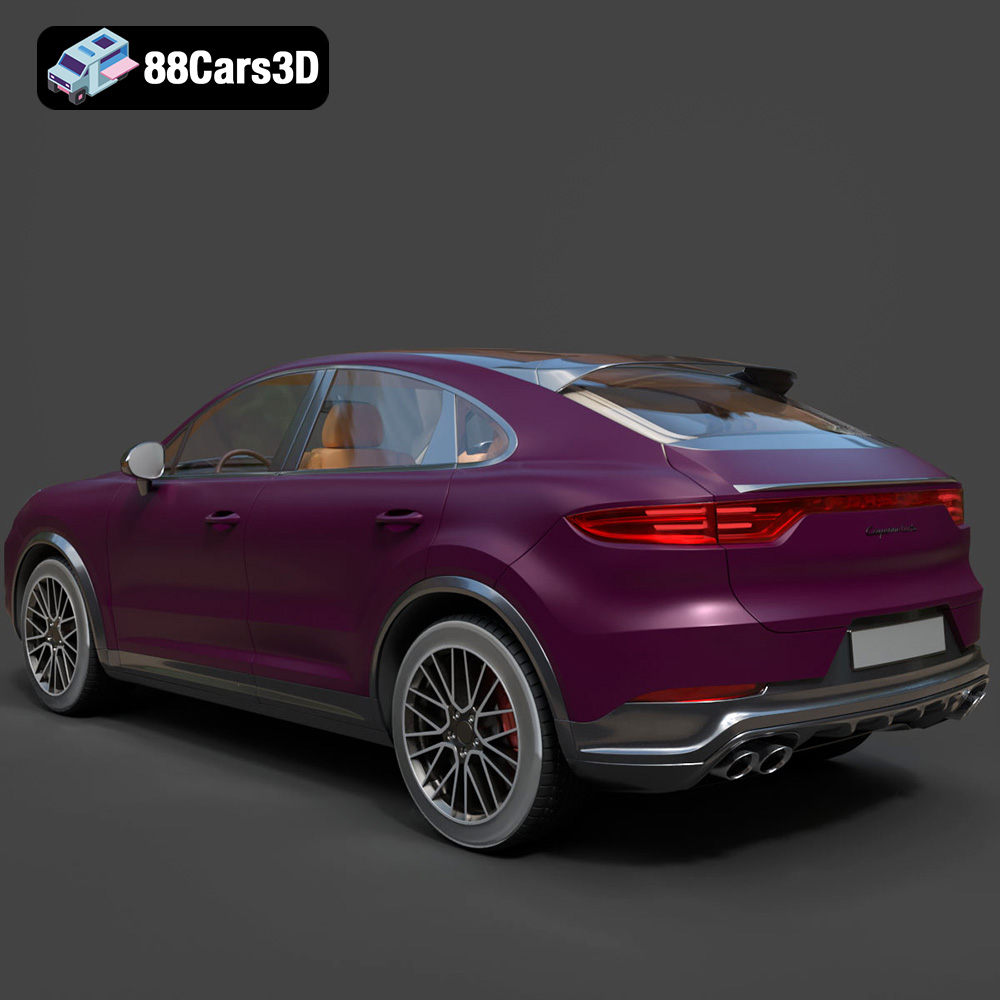
In the dynamic worlds of automotive design, game development, cinematic rendering, and immersive AR/VR experiences, the demand for exceptionally detailed and versatile 3D car models has never been higher. Professionals across these industries seek assets that not only capture the aesthetic essence of a vehicle but also provide the technical flexibility required for a multitude of applications. A prime example of such a meticulously crafted asset is the 2019 Porsche Cayenne Coupe Turbo 3D Model, a digital rendition that perfectly encapsulates the real-world vehicle’s blend of luxury, performance, and distinctive design.
The real 2019 Porsche Cayenne Coupe Turbo stands as a testament to modern automotive engineering, with its aggressive sloping roofline, signature LED lighting, and the powerful growl of its twin-turbo V8. Translating this level of sophisticated design into a 3D model requires precision, artistic vision, and a deep understanding of digital asset creation. This specific model, available at 88cars3d.com, exemplifies how a high-quality 3D asset can become an indispensable tool, serving as the foundation for breathtaking visualizations, realistic simulations, and engaging interactive content. Whether you’re animating a commercial, building a cutting-edge racing game, or designing a virtual showroom, the right 3D car model is your starting line.
Creating a premium 3D car model is a multi-faceted discipline that blends artistic skill with technical rigor. It involves painstaking attention to detail, from the overarching form to the smallest interior stitch, ensuring both visual authenticity and functional optimization.
The journey of a high-fidelity 3D car model often begins with extensive research, including CAD data, technical drawings, and countless photographic references of the real-world vehicle. For a model like the Porsche Cayenne Coupe Turbo 2019, this means accurately replicating its commanding presence, the elegant sweep of its coupe-like roofline, and the aggressive stance that defines its character. Every curve, panel gap, and ventilation grille is carefully sculpted to match the vehicle’s true proportions. The exterior features are a testament to this precision: the intricate LED matrix headlights and the continuous rear taillight strip, characteristic of Porsche’s modern design language, are faithfully reproduced. Moving to the lower half, the high-resolution alloy wheels, complete with detailed low-profile tires and precisely modeled brake calipers, add another layer of realism. Even elements like the signature quad-pipe sports exhaust system and the underlying adaptive air suspension components are modeled, providing comprehensive detail for close-up renders and dynamic simulations.
The interior of a luxury vehicle like the Porsche Cayenne Coupe Turbo is just as critical as its exterior. A premium 3D model must deliver a cockpit that feels authentic, whether viewed in a high-resolution still render or from a first-person perspective in a game. The detailed sport seats, with their accurate stitching and bolstering, along with the multi-function sports steering wheel and paddle shifters, immerse the viewer. The high-resolution digital instrument cluster and the center infotainment screen, coupled with the haptic touch control panels and gear selector, are all modeled with an emphasis on visual fidelity suitable for professional applications. Beyond just aesthetics, the technical specifications of such models are paramount. The Porsche Cayenne Coupe Turbo 2019 3D Model boasts an impressive 1,834,208 triangle count. This figure represents a carefully chosen balance: it’s high enough to convey exceptional visual fidelity and photorealistic details, ensuring smooth reflections and accurate shading across all lighting environments, while remaining optimized for next-generation game engines like Unreal and Unity. Furthermore, assets like this are built to real-world scale accuracy and feature proper pivot setups for animated elements such as steering, wheel rotation, and suspension travel, making them production-ready for dynamic scenarios.
The choice of file format for a 3D model is crucial, impacting everything from compatibility with various software to its intended application, be it real-time rendering, 3D printing, or web-based AR experiences. Understanding the nuances of each format ensures seamless integration into your professional workflow. The Porsche Cayenne Coupe Turbo 2019 3D Model, available at 88cars3d.com, offers a comprehensive suite of formats, catering to virtually every industry need.
The .blend format is native to Blender, the popular open-source 3D creation suite. When you download a .blend file, you’re getting a fully editable Blender scene. This means the model comes complete with its original setup, including materials, textures, lighting, camera positions, and even animation data if present. For artists deeply integrated into the Blender ecosystem, this offers unparalleled flexibility for customization, rigging, animation, and rendering directly within their preferred environment. It preserves all modifiers, procedural textures, and scene hierarchies, allowing for extensive non-destructive editing.
.fbx (Filmbox) is arguably the most widely adopted 3D interchange format, making it ideal for moving assets between different 3D software applications and, crucially, into real-time game engines like Unreal Engine and Unity. Developed by Autodesk, FBX files can store a vast amount of data, including geometry (meshes), materials, textures, skeletal animation, blend shapes, cameras, and lights. Its robustness and ability to maintain complex scene hierarchies make it indispensable for game development and professional animation pipelines where assets frequently move between modeling, rigging, and engine integration stages.
The .obj (Wavefront OBJ) format is a universal 3D data format known for its simplicity and widespread compatibility. It primarily stores geometric data like vertices, faces, normals, and UV coordinates, often accompanied by a separate .mtl (material template library) file for basic material properties and texture assignments. While OBJ doesn’t typically support animation or complex scene data, its straightforward nature makes it excellent for static models, cross-software compatibility, and situations where you need a clean mesh without extensive scene information. It’s a reliable fallback for almost any 3D application.
.glb (GL Transmission Format Binary) is a modern, efficient 3D file format designed specifically for web-based, AR, and VR applications. It’s the binary version of glTF, which aims to be the “JPEG of 3D.” A GLB file packages all necessary data (geometry, textures, materials, animations) into a single, compact file, making it incredibly easy to load and display in browsers and mobile environments. Its optimization for runtime delivery ensures fast loading and smooth performance for interactive virtual showrooms, configurators, and mobile AR experiences.
.stl (Stereolithography) is the de facto standard format for 3D printing. Unlike other formats that store color or material information, STL files describe only the surface geometry of a 3D object using a mesh of interconnected triangles. Its simplicity makes it universally compatible with 3D printers and slicing software. When preparing a detailed 3D car model like the Porsche Cayenne for physical fabrication, converting it to STL is the essential first step, ensuring that the printer has the precise surface data needed to build the object layer by layer.
The .ply (Polygon File Format) is another widely used format for storing 3D data, particularly in applications involving 3D scanning, scientific research, and CAD. It can store a wider range of properties than STL, including color, transparency, and normal vectors per vertex or face. PLY files are known for their precision and ability to handle dense meshes, making them suitable for scenarios requiring accurate geometric representation or for models derived from advanced scanning techniques.
While not a standalone file format in the same way as FBX or OBJ, the term .unreal implies an asset that has been specifically packaged or prepared for direct import and use within Unreal Engine. This often means the model has already been optimized, potentially including LODs (Levels of Detail), collision meshes, physically based rendering (PBR) materials configured for Unreal’s shader system, and proper hierarchy for Blueprints or Sequencer animation. An “unreal” package simplifies the workflow for developers, allowing for quick integration into complex game worlds or real-time architectural visualizations.
Finally, the .max format is the native file type for Autodesk 3ds Max, a leading software for 3D modeling, animation, and rendering in architectural visualization, product design, and visual effects. A .max file contains the complete 3ds Max scene, including all models, lights, cameras, materials, textures, modifiers, and animation data. It offers full control over every aspect of the project within 3ds Max, making it invaluable for artists whose primary workflow revolves around this powerful application for high-end rendering and detailed scene setup.
The availability of these diverse formats for the Porsche Cayenne Coupe Turbo 2019 3D Model highlights 88cars3d.com’s commitment to providing versatile assets that empower professionals to seamlessly integrate models into any project, regardless of their chosen software or end-use application.
High-quality 3D car models are no longer niche assets; they are foundational tools across numerous industries, driving innovation and delivering unparalleled realism.
In the realm of game development, assets like the Porsche Cayenne Coupe Turbo 2019 are invaluable. Its optimized polycount of 1,834,208 triangles strikes a perfect balance, delivering visually stunning details without overburdening real-time engines. This makes it ideal for integrating into open-world games, high-stakes racing titles, and sophisticated driving simulators. Game developers can leverage its accurate frame geometry, detailed interior (optimized for first-person POV), and pre-configured pivots for animation (steering, wheel rotation, suspension) to create truly immersive gameplay. Beyond traditional gaming, the model excels in AR/VR applications. Imagine a virtual showroom where prospective buyers can interact with the Cayenne in a fully immersive 3D space, customize its colors and features in real-time, or even place it in their driveway using augmented reality. The .glb format, specifically designed for these lightweight, interactive experiences, ensures seamless performance and rapid deployment.
For automotive marketing, advertising, and architectural visualization, photorealistic renders are paramount. The Porsche Cayenne Coupe Turbo 2019 3D Model from 88cars3d.com provides an exceptional foundation for creating stunning visuals. Marketing agencies can use it for product launch campaigns, creating studio renders that highlight the vehicle’s luxurious contours, or lifestyle scenes depicting it in dynamic urban or scenic environments. Architects and interior designers can integrate the model into their visualizations to populate virtual garages, driveways, or streetscapes, adding a touch of realism and aspiration to their designs. The model’s meticulously structured topology ensures smooth reflections and accurate shading, crucial for achieving that “showroom finish” under various lighting setups, from studio softboxes to realistic HDR environments.
Acquiring a high-quality 3D asset is just the first step; seamless integration into your existing professional workflow is key to maximizing its value and accelerating project timelines.
The process of incorporating the Porsche Cayenne Coupe Turbo 2019 3D Model into your projects is designed for efficiency. After selecting your preferred model from 88cars3d.com, you’ll have access to multiple file formats. For users of industry-standard software like 3ds Max or Blender, the respective .max or .blend files offer complete scene data and editable components. Game developers focusing on Unreal Engine can leverage the optimized .fbx or the dedicated .unreal asset, often pre-configured for easier import. Upon import, key initial checks include verifying real-world scale accuracy and confirming proper pivot setups for animated components like wheels and suspension, which are already handled in this model. From there, customization options are extensive: easily change body colors to match factory palettes or create custom finishes, modify tire textures for off-road or street variants, and adjust material finishes between matte, gloss, or metallic to suit your specific rendering requirements.
Achieving truly photorealistic results with any 3D car model, including this Cayenne, involves leveraging advanced rendering techniques. This often starts with sophisticated lighting setups. High Dynamic Range Images (HDRIs) are excellent for capturing realistic environmental lighting, providing nuanced reflections and natural ambiance. For studio-quality shots, a controlled 3-point lighting system or a custom light rig can highlight the vehicle’s form and details. Modern rendering engines like V-Ray, Corona Renderer, Cycles in Blender, Octane, or Unreal Engine’s advanced Lumen and Path Tracer features, can accurately simulate how light interacts with the model’s surfaces. The Cayenne model’s meticulously structured topology is crucial here, ensuring reflections roll smoothly across its body panels, perfectly simulating the clear coat and metallic flake of automotive paint. Post-processing in applications like Photoshop or Affinity Photo can further enhance renders with color grading, depth of field adjustments, and lens effects, pushing the boundaries of digital realism.
Beyond digital screens, high-fidelity 3D car models offer a unique opportunity for physical manifestation through 3D printing. The Porsche Cayenne Coupe Turbo 2019 3D Model is not just for rendering; it’s also designed with physical fabrication in mind, particularly for hobbyists and collectors.
For 3D printing, the .stl file format is the primary choice, as it provides the pure geometric data necessary for slicing software and printers. While the digital model is optimized for visual fidelity, preparing it for 3D printing requires specific considerations. The product description for the Cayenne model outlines practical recommendations: a suggested scale of 1:12, 1:18, or 1:24 ensures a manageable size for display while retaining detail. For optimal results, resin printing is strongly recommended, especially for capturing the fine details of the LED matrix headlights, the intricate alloy wheels, and the delicate grille patterns. Recommended layer heights between 0.04–0.12 mm are critical for smooth surface finishes, minimizing visible layer lines. Proper wall thickness (1.2–2.0 mm) and infill (20–30%) ensure structural integrity, preventing fragile parts and warping during the printing process. Supports are often required for overhangs and delicate features like mirrors, exhaust pipes, and the undercarriage, which are designed to be printed separately for better results and easier post-processing.
Bringing a 3D printed car model to life requires a skilled hand in post-processing. After printing, careful removal of supports, sanding to smooth out any imperfections or layer lines, and applying a primer are essential steps. The true magic happens during the painting phase. Achieving authentic factory colors with metallic finishes demands precision and often involves airbrushing techniques and high-quality automotive-grade paints. Masking is vital for painting different components, such as window frames, interior details, and brake calipers. The ability to print complex parts like the engine block and interior components separately allows for easier detailing and painting before final assembly. For display-scale models, this meticulous attention to detail can transform a digital file into a museum-quality miniature, satisfying the discerning tastes of model car enthusiasts and collectors who appreciate the blend of digital craftsmanship and traditional modeling skills.
The journey of a 3D car model, from meticulous digital sculpting to its diverse applications in rendering, game development, AR/VR, and even physical 3D printing, highlights the incredible versatility and technical sophistication demanded in today’s creative industries. Assets like the 2019 Porsche Cayenne Coupe Turbo 3D Model exemplify the pinnacle of this craft, offering an unparalleled blend of visual fidelity, technical optimization, and broad format compatibility. It serves as a powerful testament to how a single, well-executed digital asset can empower professionals across various fields, enabling them to create stunning visuals, immersive experiences, and tangible works of art.
Whether your project demands a high-impact automotive commercial, a hyper-realistic racing simulator, an interactive virtual showroom, or a detailed scale model for your collection, investing in premium 3D car models is a strategic choice. They provide the foundation for excellence, saving valuable development time while ensuring professional-grade results. Explore the extensive library of high-quality 3D car models available at 88cars3d.com, and discover how the right asset can elevate your next project from concept to masterpiece.
The 2019 Porsche Cayenne Coupe Turbo redefines the luxury sports SUV segment with its striking sloping roofline, aggressive aerodynamics, and thunderous twin-turbo V8 engine. Known for blending track-ready performance with everyday utility, this iconic vehicle features distinctive Porsche styling cues, including the signature continuous LED taillight strip, active rear spoiler, and an imposing front fascia with massive air intakes. The dynamic stance and muscular proportions make it a standout masterpiece in modern automotive design. This premium 3D model boasts an impressive 1,834,208 triangle count, delivering exceptional visual fidelity and photorealistic details. Meticulously modeled for high-end rendering and optimized for next-generation game engines, it offers unparalleled quality for game development, immersive AR/VR experiences, professional animation, and architectural visualization. The topology is carefully structured to ensure smooth reflections and accurate shading across all lighting environments. Perfect for high-end racing simulators, architectural visualizations, automotive commercials, and virtual showrooms.
$37.50
.2019
.blend
.fbx
.glb
.luxury suv
.max
.obj
.ply
.porsche
.rendering
.stl
.unreal
car-3d-model
cayenne-coupe
cayenne-turbo
game asset
game-ready
high poly
optimized
sports-suv
SUV
VR/AR