Get 20% OFF All Premium 3D & STL Models!

In the expansive realm of digital visualization, the demand for exceptionally detailed and historically accurate 3D car models is ever-present. From the glistening chrome of modern supercars to the timeless elegance of vintage automobiles, capturing the essence of these mechanical marvels in three dimensions requires a blend of artistic skill and technical precision. These assets serve as crucial components in everything from immersive game environments and cinematic sequences to sophisticated architectural visualizations and virtual reality showrooms.
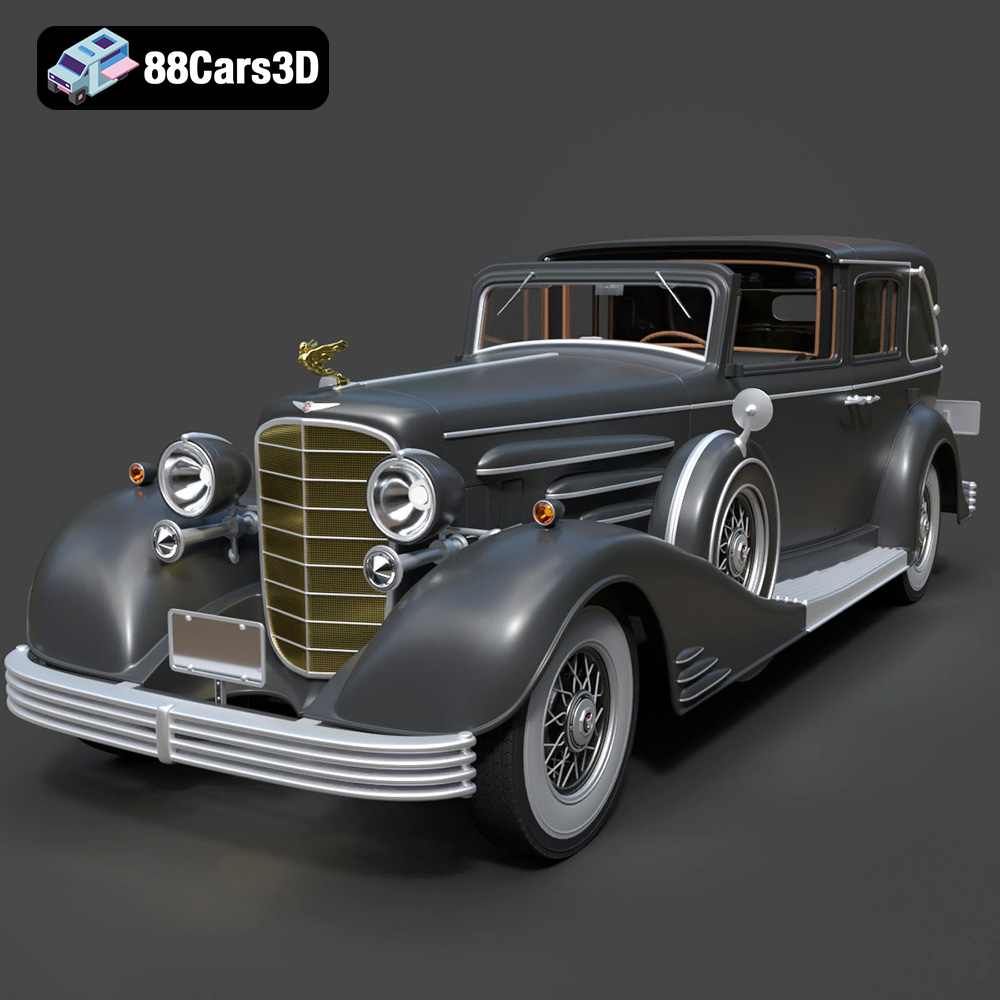
Today, we delve into the intricate world of high-fidelity 3D automotive assets, using a truly iconic example: the Cadillac V16 452-C Town Car 1933 3D Model. This magnificent digital rendition, available on 88cars3d.com, is not just a model; it’s a meticulously preserved piece of automotive history, engineered for professional deployment across various demanding digital pipelines. Its design represents the zenith of pre-war luxury and bespoke coachbuilding, and its 3D counterpart mirrors this grandeur, offering an unparalleled level of detail and versatility for artists and developers.
Recreating a vehicle as legendary as the 1933 Cadillac V16 (452-C) Town Car in 3D is a monumental task that demands rigorous attention to detail, historical accuracy, and a profound understanding of 3D modeling principles. It’s about translating the tangible majesty of a physical object into a digital asset that retains its soul.
The foundation of any high-quality 3D car model lies in its accuracy. For a classic like the Cadillac V16 452-C Town Car, this means exhaustive research into blueprints, historical photographs, and surviving vehicles to ensure every curve, dimension, and proportion is faithfully replicated. The model’s sweeping pontoon fenders, majestic chrome V-shaped grille, and distinctive open-chauffeur “Town Car” body style are not merely artistic interpretations but precise digital reconstructions. This dedication to real-world scale accuracy, based on the actual 1933 vehicle chassis and wheelbase, is what elevates a good model to an exceptional one, making it suitable for demanding applications where authenticity is paramount.
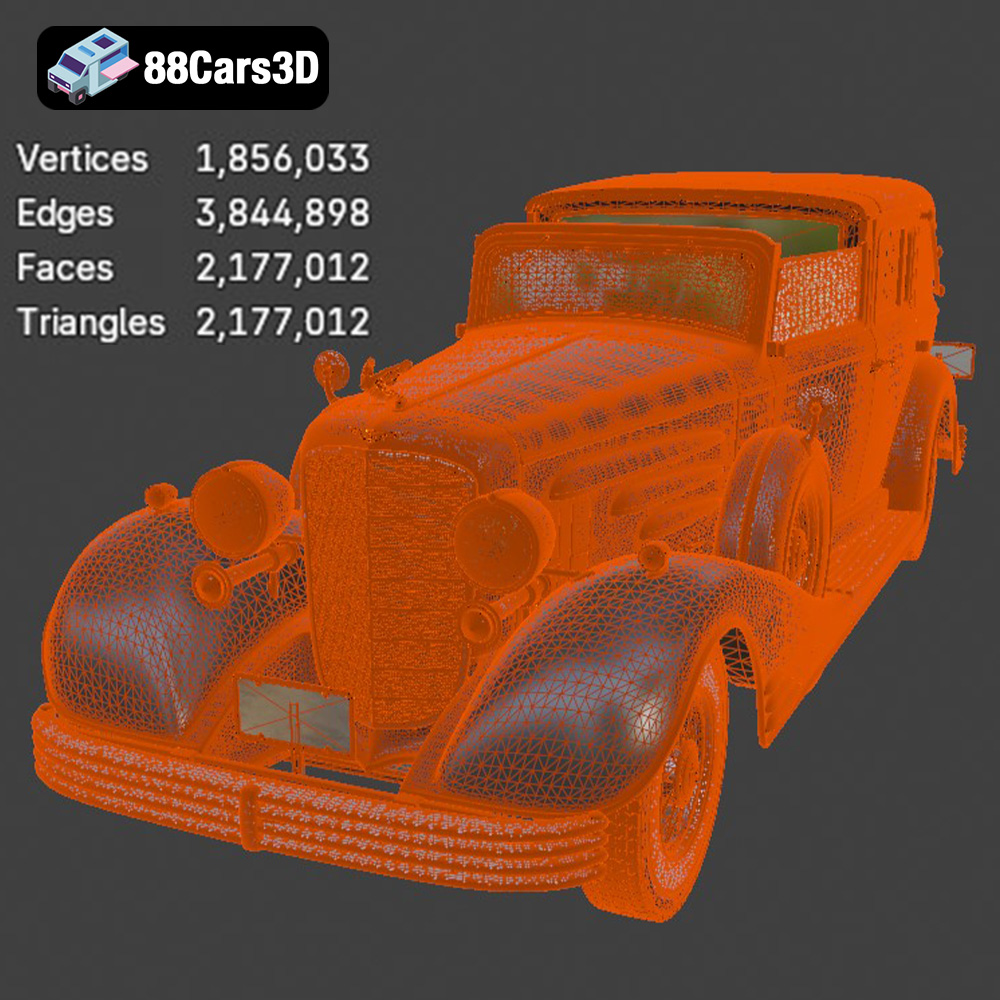
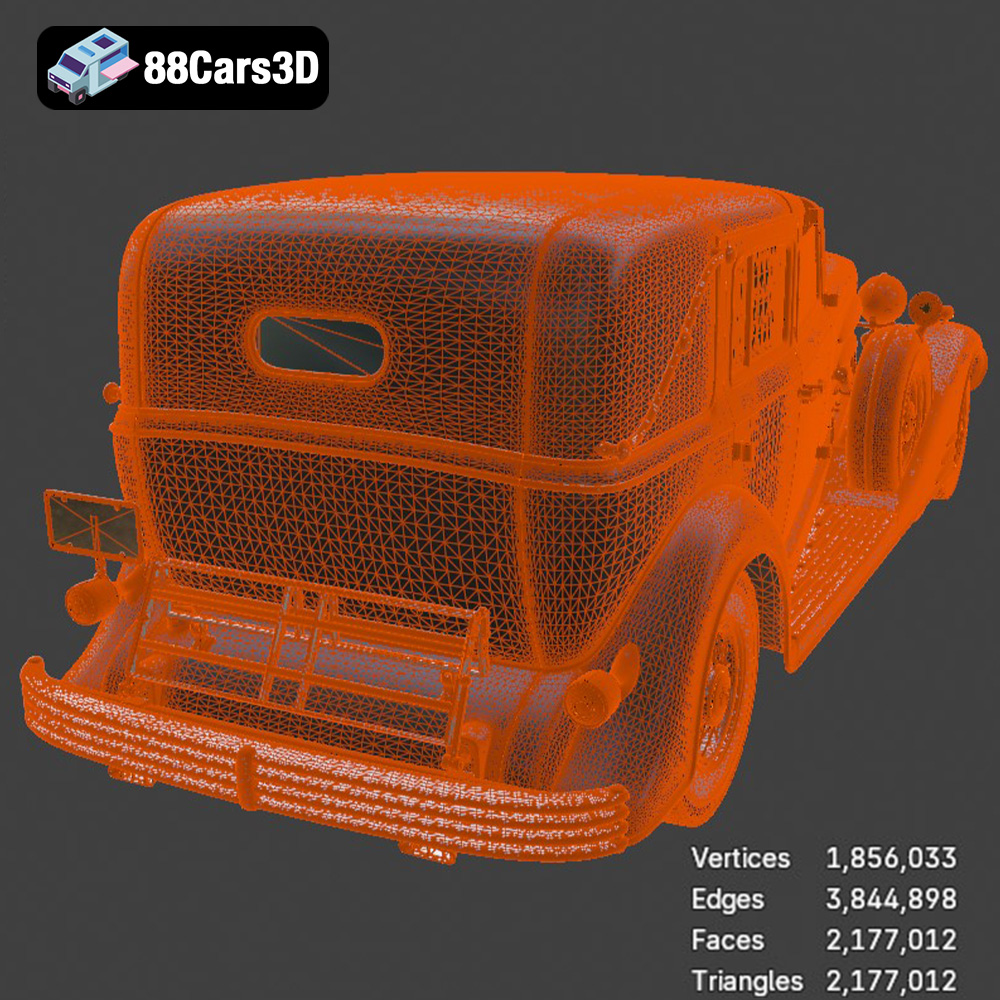
The Cadillac V16 452-C Town Car 1933 3D Model exemplifies this commitment to detail. With an extraordinary level of visual fidelity, boasting a detailed topology of 2,177,012 triangles, it captures every nuanced curve and chrome accent. Beyond the striking exterior, the model includes:
The interior is equally compelling, featuring an opulent rear passenger compartment with tufted seating and rich woodwork, alongside the exposed driver’s open-air cockpit. Classic Art Deco instrument clusters, detailed gauges, and accurate controls ensure a fully immersive experience, whether for first-person POV in gaming or close-up rendering in cinematics. Such granular detail ensures that this premium asset from 88cars3d.com can stand up to the closest scrutiny in any production.
Choosing the right 3D model file format is a critical decision that impacts workflow, compatibility, and the ultimate deployment of your digital assets. For the Cadillac V16 452-C Town Car 1933 3D Model, a comprehensive suite of formats is provided, ensuring maximum flexibility for diverse professional needs. Each format has its strengths, optimized for specific applications and software environments.
The .blend format is native to Blender, the popular open-source 3D creation suite. When you receive a .blend file, you’re getting a fully editable Blender scene, complete with materials, textures, lighting, cameras, and even animation data if present. This format is ideal for artists who primarily work in Blender, offering the most comprehensive access to the model’s underlying structure, modifiers, and shading networks. It allows for advanced customization, re-topology, and integration into existing Blender projects without any loss of data during import/export. Its technical advantage lies in preserving all Blender-specific features, making it the preferred choice for native Blender users.
.fbx (Filmbox) is arguably the most widely adopted interchange format in the 3D industry, especially for game development and real-time visualization. It’s renowned for its ability to store not just mesh data (vertices, faces, normals, UVs) but also materials, textures, lights, cameras, skeletal animations, and blend shapes. This makes it an ideal format for transferring assets between different 3D software (like 3ds Max, Maya, Blender) and into game engines such as Unreal Engine and Unity. The .fbx format is highly optimized for efficiency, making it perfect for real-time pipelines where performance is key. It’s often the go-to for complex animated assets, ensuring that pivots, hierarchies, and animation curves transfer cleanly.
The .obj (Wavefront OBJ) format is a universal standard for storing 3D geometry data. It’s a text-based format that defines vertices, faces, normals, and UV coordinates, often accompanied by a separate .mtl (material library) file for basic material properties and texture references. While .obj doesn’t support animation or scene information like cameras or lights, its simplicity and widespread support across virtually every 3D software make it an excellent choice for static mesh exchange. When you need to ensure cross-software compatibility for your core geometry, .obj is a reliable fallback format.
.glb (GLB format, derived from glTF) is a relatively newer format specifically optimized for web-based 3D, augmented reality (AR), and virtual reality (VR) applications. It’s a compact, binary form of glTF (GL Transmission Format), designed for efficient loading and rendering by WebGL-based viewers and AR/VR platforms. A key advantage of .glb is that it packages all necessary data – geometry, materials, textures, and even animations – into a single file, simplifying asset delivery and ensuring consistent presentation across different platforms. For interactive virtual showrooms or mobile AR experiences featuring the Cadillac V16, .glb is an outstanding choice.
.stl (Stereolithography) is the standard file format for 3D printing. It represents a 3D model as a series of connected triangles, defining only the surface geometry without color, texture, or material information. This simplicity makes it universally compatible with 3D printers and slicing software. While it sacrifices visual data, it’s essential for converting digital models like the Cadillac V16 into physical objects. The product description’s specific print settings recommendations (scale, layer height, supports) highlight its readiness for hobbyists and professionals looking to produce display-scale models.
The .ply (Polygon File Format, or Stanford Triangle Format) is another format for storing 3D data, particularly useful for high-resolution scan data and scientific applications. It can store various properties beyond just geometry, such as color, transparency, normals, texture coordinates, and even reliability information for each vertex or face. While not as universally used as .fbx or .obj for general asset exchange, .ply offers a robust solution for precision mesh data, making it valuable for CAD integration or analytical purposes where detailed per-vertex information is crucial.
The .unreal format refers to assets specifically configured or packaged for direct import and optimal performance within Unreal Engine. While not a standalone file extension in the same way as .fbx, it signifies that the asset has been pre-processed, textured, and sometimes even had its collision meshes and LODs (Levels of Detail) set up to be engine-ready. This provides a significant advantage, reducing the setup time for developers and ensuring the asset integrates seamlessly into real-time environments, leveraging Unreal’s rendering capabilities and performance optimizations right out of the box.
The .max format is native to Autodesk 3ds Max, a leading software for 3D modeling, animation, rendering, and visualization. Similar to .blend, a .max file contains the complete 3ds Max project, including geometry, materials, textures, lights, cameras, animation timelines, and all scene settings. This format is indispensable for studios and artists who rely on 3ds Max for architectural visualization, automotive rendering, and character animation. It offers the highest level of editability and ensures that all 3ds Max-specific features and render setups (like V-Ray or Corona settings) are preserved, making it perfect for advanced rendering and animation work with the Cadillac V16.
The utility of a high-quality 3D car model like the Cadillac V16 452-C Town Car 1933 extends across a multitude of professional pipelines. Its careful optimization and diverse file format support make it a powerful asset for various creative and technical endeavors.
For game developers, integrating realistic 3D car models into dynamic environments is a constant challenge. The Cadillac V16 452-C Town Car 1933 3D Model is explicitly designed to be “Game-Ready & Optimized.” Its 2,177,012 triangle count strikes an impressive balance, offering breathtaking visual realism without overburdening real-time engines like Unreal or Unity. The model’s real-world scale accuracy and proper pivot setup for steering, wheel rotation, and suspension travel are critical for implementing realistic physics and animation in driving simulators, open-world games, or period-specific titles. Its .fbx and .unreal formats ensure a smooth import process, minimizing the need for extensive re-topology or material setup. This efficiency translates directly into faster development cycles and higher quality interactive experiences.
In architectural visualization, advertising, and cinematic production, photorealism is paramount. The meticulous detailing of the Cadillac V16 makes it an exceptional candidate for high-end automotive rendering. Artists using 3ds Max, Blender, or other leading software, combined with renderers like V-Ray, Corona Renderer, or Cycles, can leverage the model’s rich geometry and customizable materials to produce stunning visuals. Imagine the Cadillac artfully placed within a luxurious digital estate for an architectural viz, or starring in a period film sequence. Its accurate proportions and fine details allow for precise lighting setups, showcasing its chrome, paint, and leather finishes with remarkable fidelity. The .max and .blend files provide native access for these advanced rendering scenarios, allowing full control over textures, shading, and cinematic camera movements.
The burgeoning fields of Augmented Reality (AR) and Virtual Reality (VR) demand highly optimized yet visually rich assets. The Cadillac V16 model, with its balanced polycount and availability in .glb format, is perfect for creating immersive virtual showrooms, interactive configurators, and mobile AR experiences. Imagine a user exploring this classic car in a virtual museum, walking around it, opening its doors, and even sitting inside (if interior assets are fully developed for interaction). The optimized geometry ensures smooth performance on AR/VR devices, delivering a truly engaging and educational experience.
Beyond its inherent quality, a truly versatile 3D asset provides avenues for customization, allowing artists and developers to tailor it to specific project requirements. The Cadillac V16 452-C Town Car 1933 3D Model is built with this flexibility in mind, alongside its direct application for physical replication.
The product description highlights several customization options, making the model incredibly adaptable:
This level of customization ensures that the model can be a foundational element for a wide array of projects, always looking perfectly at home in its digital environment.
The digital realm often inspires physical creations. For enthusiasts and collectors, the ability to 3D print a scaled replica of the Cadillac V16 is an exciting prospect. The model is convertible to .stl format, making it directly compatible with 3D printers. The provided 3D print settings are invaluable, guiding users towards successful physical output:
This direct path from digital asset to tangible artifact underscores the comprehensive utility of such a meticulously crafted 3D model, expanding its value beyond purely digital applications.
The strategic deployment of high-quality 3D car models has transformed various industries, enabling unprecedented levels of realism, immersion, and engagement. The Cadillac V16 model is a prime example of an asset that drives such innovation.
Filmmakers and documentary creators often face significant challenges in accurately depicting historical scenes. Access to rare vehicles like the 1933 Cadillac V16 452-C Town Car can be prohibitively expensive or simply impossible. Here, a premium 3D model becomes an indispensable tool. It allows directors to place the historically accurate car into digital backdrops, animate it, and integrate it into visual effects sequences, all while maintaining perfect period authenticity. From cinematic period pieces to educational documentaries, the Cadillac V16 model enables visual storytelling that was once beyond reach, ensuring that every detail, from its sweeping lines to its intricate wire wheels, contributes to an immersive historical narrative.
For luxury brands and cultural institutions, virtual experiences are becoming increasingly important. A digital museum can host rare and iconic vehicles, making them accessible to a global audience without the logistical constraints of physical display. Similarly, virtual showrooms allow potential buyers to explore high-value assets interactively. The Cadillac V16 452-C Town Car 1933 3D Model is perfectly suited for these applications. Its optimized geometry and support for formats like .glb facilitate smooth integration into web-based or standalone virtual platforms. Visitors can rotate the car, zoom in on details, and even view it in AR in their own driveways, providing a rich, interactive experience that educates and captivates.
While the Cadillac V16 is a classic, the principles behind its 3D modeling are directly transferable to modern automotive design and visualization. For designers, studying the proportions, surfacing, and detailing of such iconic vehicles in 3D can provide invaluable insights. Furthermore, in visualization projects where a classic car might be featured alongside contemporary architecture or products, the Cadillac V16 offers a compelling contrast and a touch of timeless elegance. Its inclusion in high-resolution renderings can elevate the entire scene, demonstrating versatility that extends beyond its historical context.
The journey from a historical automobile to a meticulously crafted 3D model is a testament to the evolving capabilities of digital artists and technical specialists. The Cadillac V16 452-C Town Car 1933 3D Model stands as a shining example of a premium 3D asset that combines breathtaking visual fidelity with robust technical optimization. Its detailed topology, real-world scale, and comprehensive file format support (.blend, .fbx, .obj, .glb, .stl, .ply, .unreal, .max) make it an invaluable tool for professionals in game development, cinematic rendering, AR/VR, and even 3D printing.
Such assets empower creators to push the boundaries of realism and immersion, whether they are recreating historical epochs, developing cutting-edge interactive experiences, or producing stunning visualizations. For those seeking top-tier 3D car models that truly capture the essence of automotive history and are engineered for seamless integration into diverse professional workflows, platforms like 88cars3d.com offer a curated selection of exceptional quality.
Investing in a high-fidelity asset like the Cadillac V16 452-C Town Car 1933 3D Model is an investment in authenticity, versatility, and the boundless creative potential it unlocks for your next project.
The 1933 Cadillac V16 (452-C) Town Car is an undisputed masterpiece of American automotive history, representing the absolute pinnacle of pre-war luxury and bespoke coachbuilding. Renowned for its whisper-quiet, colossal 16-cylinder engine and the distinctive open-chauffeur “Town Car” body style, this magnificent vehicle defined 1930s elegance and prestige. Key visual elements include its sweeping pontoon fenders, the iconic Goddess hood ornament, majestic chrome V-shaped grille, and dual side-mount spare tires, all culminating in a breathtakingly regal silhouette.
This premium 3D model boasts an extraordinary level of visual fidelity with a detailed topology of 2,177,012 triangles, capturing every nuanced curve and chrome accent of the classic original. Despite its high detail, the geometry is intelligently structured to ensure stunning photorealism while remaining versatile for high-end digital applications. It stands as an exceptional asset for developers and artists demanding true-to-life representation in historical recreations, architectural visualizations, and cinematic productions.
Perfect for cinematic period pieces, classic car driving simulators, luxury virtual showrooms, and museum-grade interactive visualizations.
.blend, .fbx, .obj, .glb, .stl, .ply, .unreal, .max
Tags:
cadillac, v16, 452-c, town-car, 1933, classic-car, luxury-car, pre-war, game-ready, optimized, car-3d-model, game-asset, rendering, vr-ar, blend, fbx, obj, glb, stl, ply, unreal, max
$37.50
.blend
.cadillac
.fbx
.glb
.max
.obj
.ply
.rendering
.stl
.unreal
.v16
1933
452-c
car-3d-model
classic-car
game asset
game-ready
luxury car
optimized
pre-war
town-car
VR/AR