Get 20% OFF All Premium 3D & STL Models!

In the rapidly evolving landscape of automotive design and digital content creation, the demand for high-quality, versatile 3D car models is at an all-time high. From breathtaking cinematic renders to immersive real-time game environments and interactive AR/VR experiences, artists and developers require assets that not only look spectacular but also integrate seamlessly into diverse professional workflows. This is where models like the Eli Zero Car 3D Model truly shine, offering a meticulously crafted digital representation of a revolutionary vehicle.
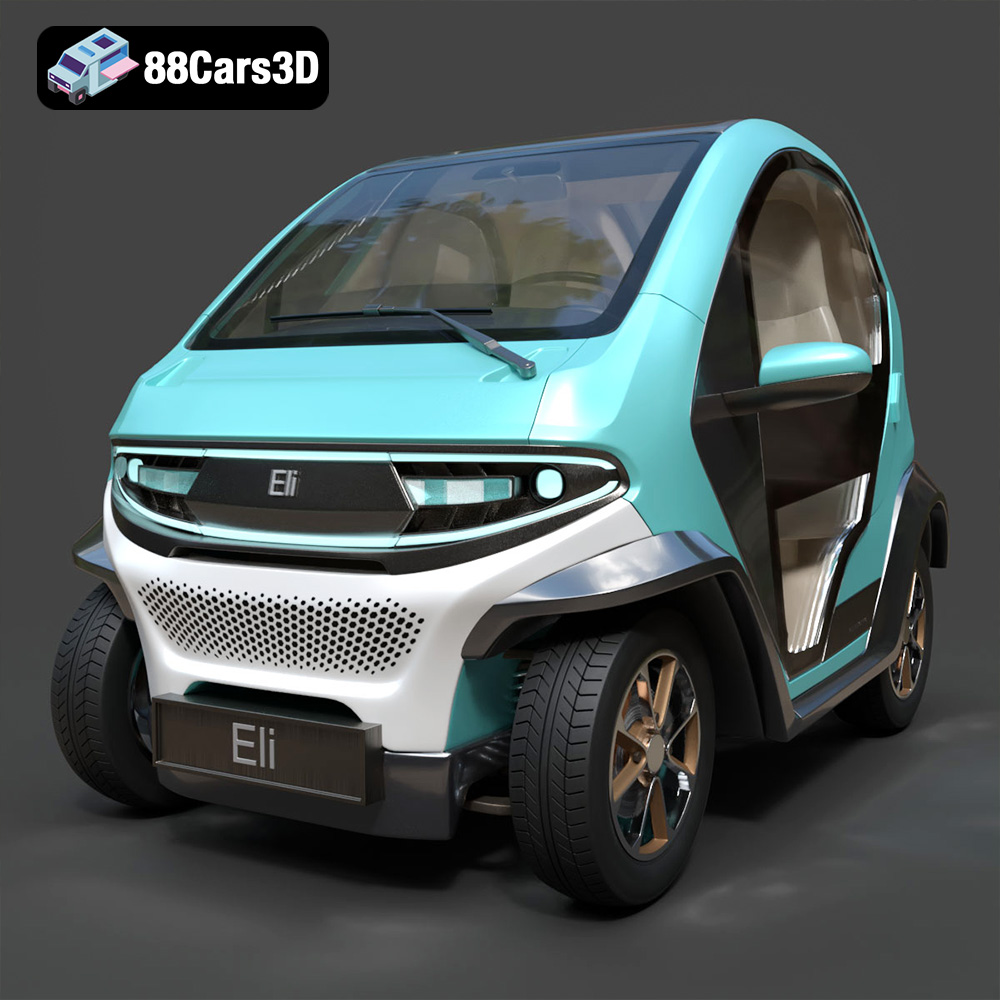
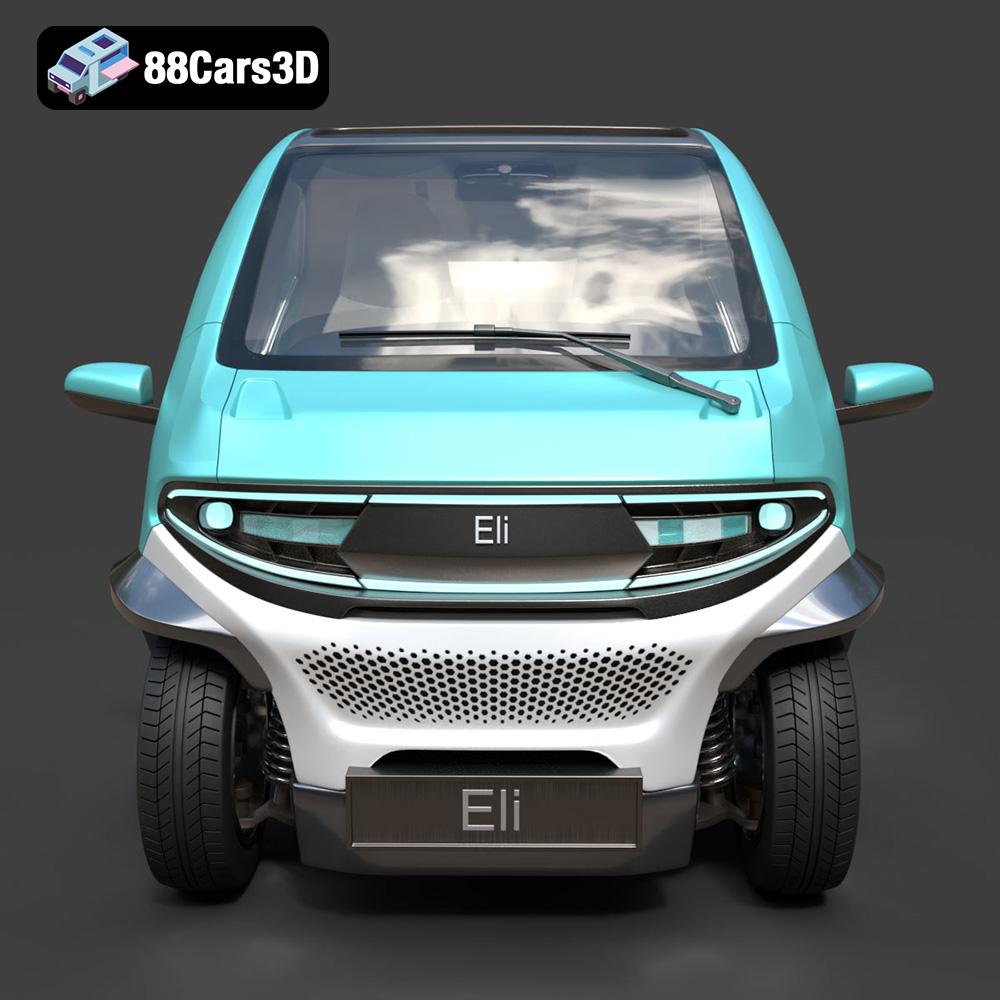
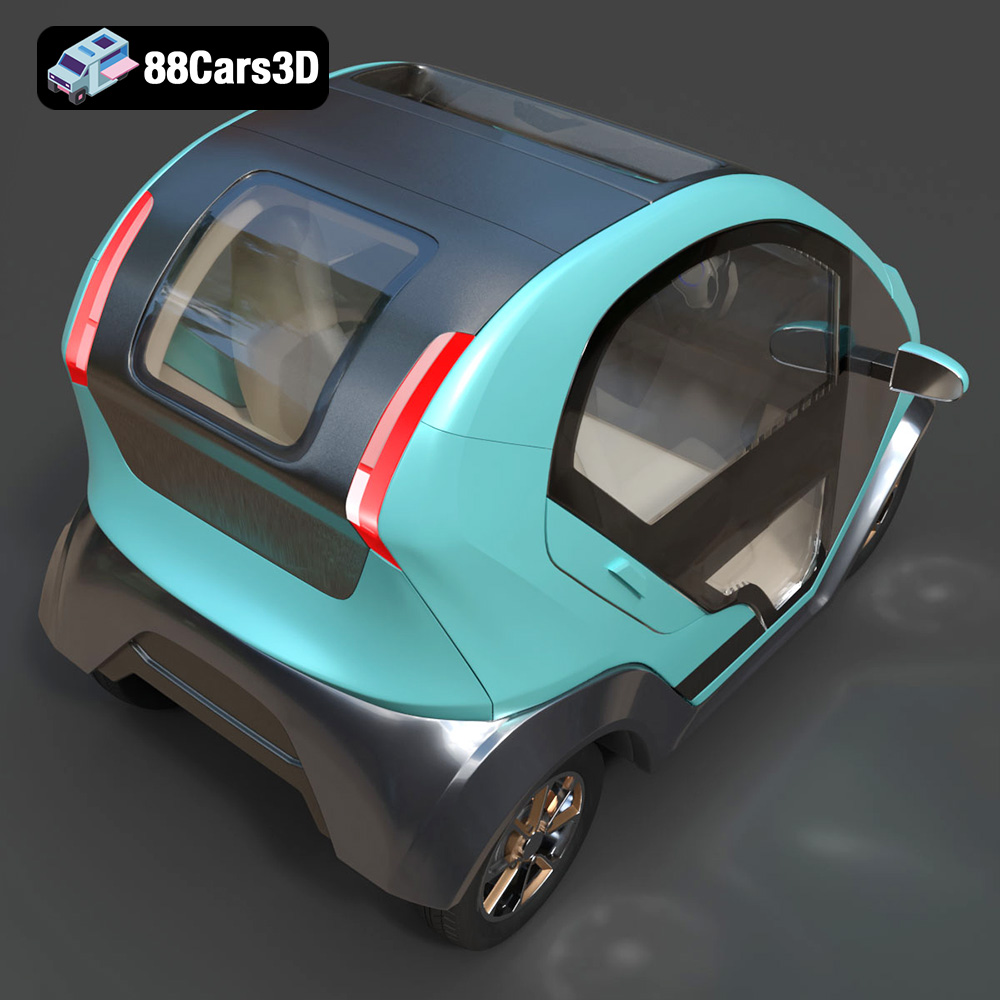
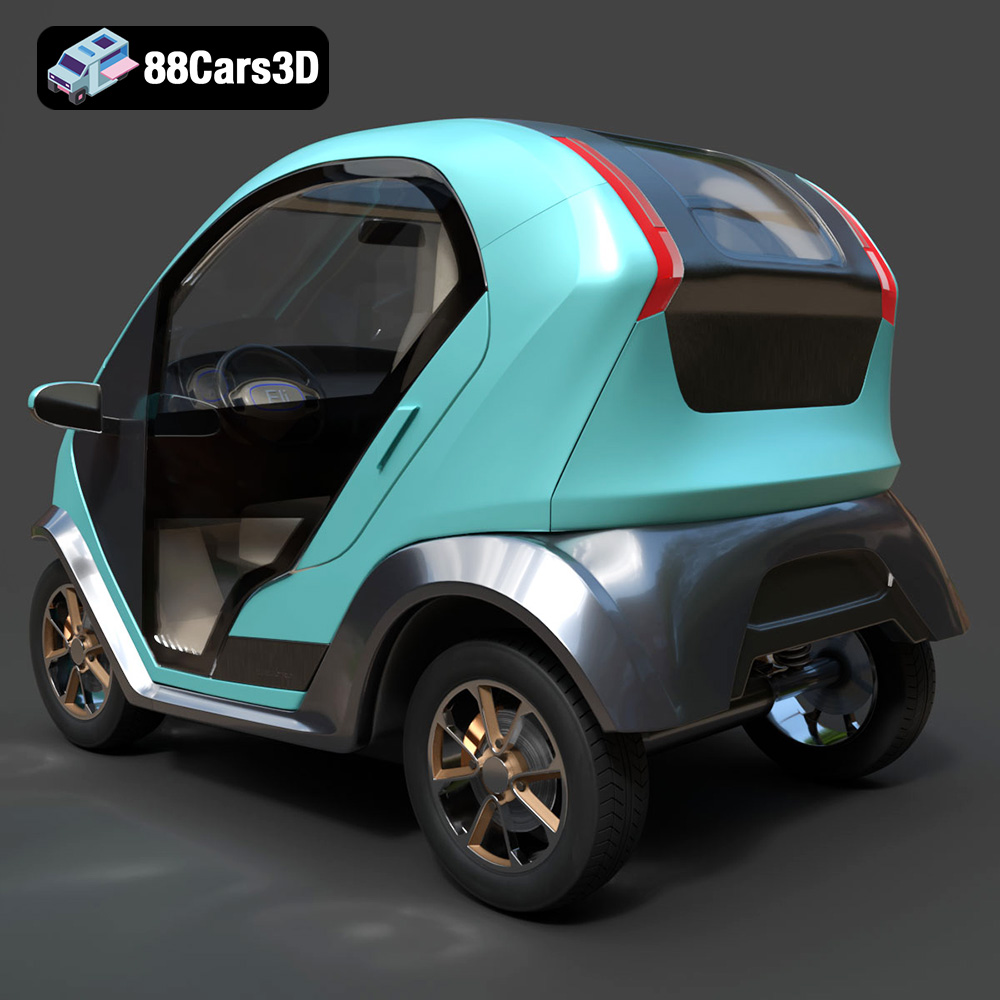
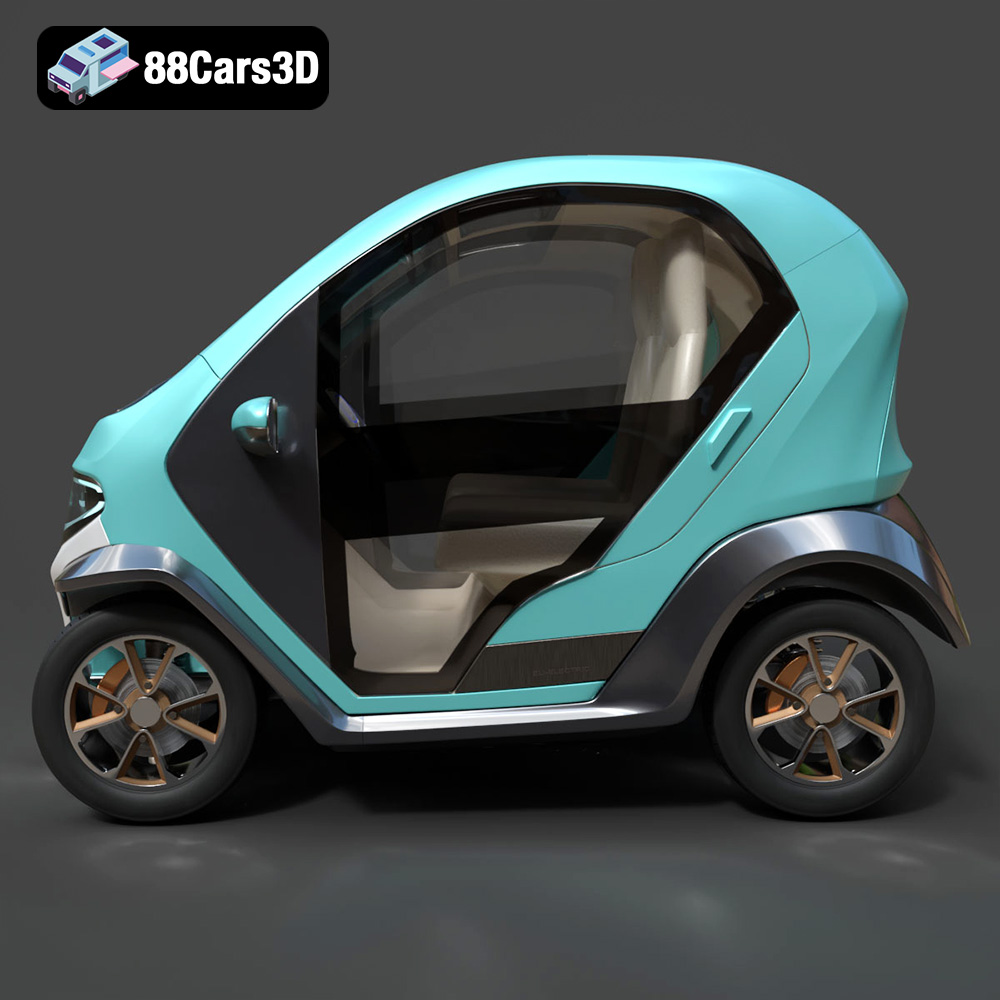
The Eli Zero itself is a vision of future urban mobility – an electric microcar that blends minimalist design with practical functionality. Its distinctive wraparound glass canopy, signature LED halo headlights, and ultra-compact footprint make it an iconic symbol of eco-friendly transportation. For 3D artists, this translates into a unique subject, a blend of sleek modernism and compelling technical detail. The Eli Zero Car 3D Model provides an unparalleled digital asset, capturing every nuance of this innovative vehicle, making it an indispensable tool for anyone involved in automotive rendering, game development, or cutting-edge visualization projects. Available for download on 88cars3d.com, this model is designed to empower creators across various industries.
Choosing the correct file format for your 3D car models is paramount for efficient workflow and optimal project outcomes. The Eli Zero Car 3D Model is offered in a comprehensive suite of formats, each serving distinct purposes and catering to specific software environments and pipeline requirements. Understanding these formats is crucial for maximizing the utility of your assets.
The .blend format is the native file type for Blender, the powerful open-source 3D creation suite. When you download the Eli Zero in .blend format, you gain access to a fully editable Blender scene. This typically includes the complete model geometry, materials (often set up for Cycles or Eevee renderers), lighting, camera setups, and even animation data if present. Artists working in Blender can immediately dive in, making modifications, re-texturing, or integrating the car into their existing Blender projects without any loss of fidelity or conversion headaches. It’s the ideal format for deep customization and native Blender development.
.fbx (Filmbox) is a proprietary file format developed by Autodesk, serving as one of the most widely adopted standards for 3D data exchange between different software applications. It’s particularly ideal for Unreal Engine, Unity, and real-time pipelines due to its robust support for mesh data, materials, textures, cameras, and critically, skeletal animation and skinning. For the Eli Zero, the .fbx file ensures that all separate animated components like wheels, suspension, and steering retain their pivot points and hierarchical relationships when imported into game engines or other DCC (Digital Content Creation) tools like 3ds Max or Maya, making it a cornerstone for game assets and animated sequences.
The .obj (Wavefront Object) format is a universal standard, renowned for its excellent cross-software compatibility. It primarily stores geometric data – vertices, normals, UV coordinates, and faces – making it a robust choice for transferring the core mesh of the Eli Zero without proprietary software dependencies. While it doesn’t typically store animation or complex material setups directly (materials are often referenced via an accompanying .mtl file), its widespread support ensures that virtually any 3D software can import and work with the model’s foundational structure. It’s a reliable backup and a great starting point for custom material work in new environments.
.glb is the binary version of the glTF (GL Transmission Format), a modern, royalty-free specification for the efficient transmission and loading of 3D scenes and models by engines and applications. It’s a single-file format that bundles geometry, materials, textures, and animation, making it highly optimized for web-based displays, augmented reality (AR), and virtual reality (VR) applications. The Eli Zero in .glb format is perfect for interactive virtual showrooms, mobile AR experiences, or showcasing the model directly on a website, offering a lightweight yet visually rich asset.
The .stl (STereoLithography) format is almost exclusively used for 3D printing. It represents a 3D model as a series of connected triangles (a tessellated surface), without any color, texture, or material information. For hobbyists or professionals looking to bring the Eli Zero into the physical realm, the .stl file is what your slicer software will use to prepare the model for printing. It’s a precision mesh format, ensuring the geometric integrity required for accurate physical replication.
The .ply (Polygon File Format or Stanford Triangle Format) is a file format for storing 3D data, often used for data from 3D scanners or CAD systems. It can store a variety of properties including color, transparency, normals, texture coordinates, and even confidence values. While less common for everyday 3D model exchange compared to .fbx or .obj, it’s a valuable format for high-precision applications or when dealing with complex datasets that require more granular mesh information, useful for specific analysis or archival purposes related to the Eli Zero’s geometry.
The .unreal format signifies an asset specifically prepared and optimized for direct integration into Unreal Engine. While often derived from .fbx, this format implies a higher level of engine-readiness, potentially including pre-configured materials, collision meshes, LODs (Levels of Detail), and blueprint setups that streamline the workflow for Unreal Engine developers. It ensures the Eli Zero is immediately functional within real-time environments, saving valuable development time and ensuring optimal performance within the engine.
Finally, the .max format is the native file type for Autodesk 3ds Max, a leading software for 3D modeling, animation, rendering, and visualization. Similar to .blend for Blender, the .max file contains the complete scene data – geometry, materials (often V-Ray or Corona), textures, lights, cameras, and animation curves. For artists accustomed to the 3ds Max ecosystem, this file provides the most comprehensive and editable version of the Eli Zero, allowing full control over all aspects of the model and its integration into complex rendering and animation projects.
The appeal of the Eli Zero extends far beyond its physical form; its digital counterpart, the Eli Zero Car 3D Model, is a testament to meticulous craftsmanship, making it an exceptional asset for any artist focused on high-fidelity automotive rendering. This model provides a foundation for stunning visuals, suitable for everything from glossy magazine advertisements to dynamic product showcases.
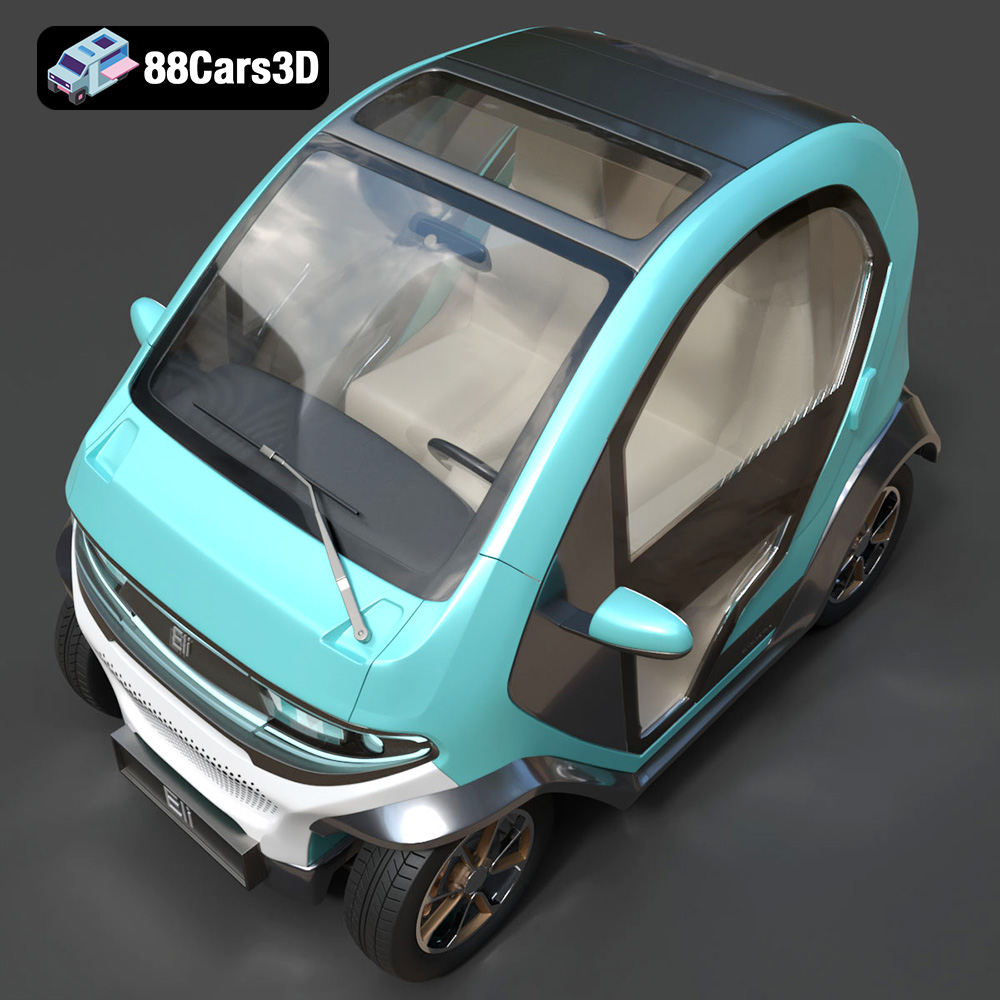
The Eli Zero’s distinctive design elements – its futuristic wraparound glass canopy, those signature LED halo headlights, and its remarkably compact proportions – are meticulously replicated in the 3D model. Every curve, every panel line, and every functional detail from the electric drivetrain to the interior components is accurately represented. This level of precision is critical for artists aiming for photorealism, ensuring that the final render authentically conveys the vehicle’s unique character and innovative spirit. Whether placed in an urban cityscape, a sleek studio environment, or an eco-conscious lifestyle scene, the model’s inherent accuracy allows it to stand out.
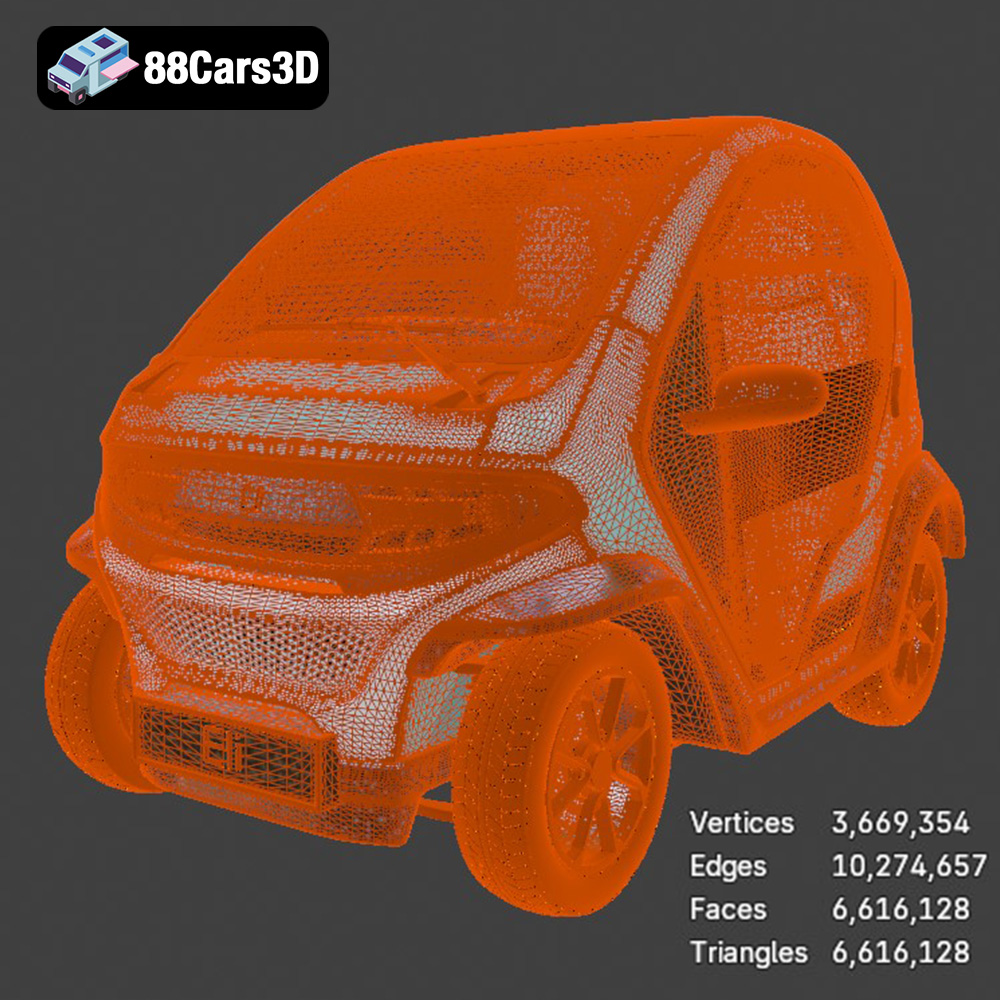
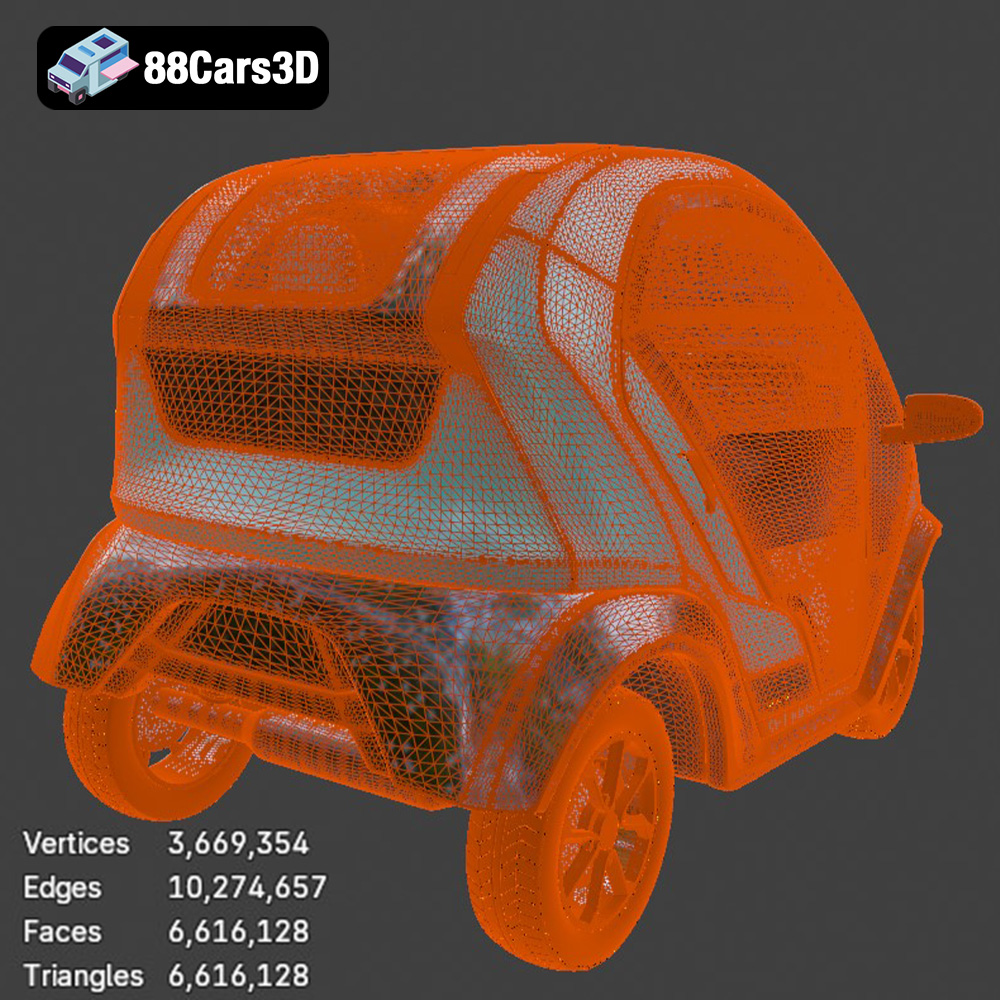
With a rich triangle count of 6,616,128, the Eli Zero Car 3D Model strikes an impressive balance between detail and manageability. This high polygon density allows for unparalleled visual accuracy, particularly vital for close-up renders where intricate details become paramount. The structured topology ensures that even with such a high poly count, the mesh remains clean and amenable to further subdivision or displacement if desired. Artists can confidently push in for extreme close-ups on features like the textured tire profiling, the detailed suspension geometry, or the ergonomic stitching on the interior seats, knowing that the underlying mesh will hold up and deliver premium visualizations without artifacts.
The multi-format availability of the Eli Zero Car 3D Model, including .max for 3ds Max and .blend for Blender, ensures seamless integration into leading rendering pipelines. In 3ds Max, artists can easily import the .max file, leveraging popular renderers like V-Ray or Corona. The model’s structured topology and clean UVs (implied by “high-fidelity” and “premium visualizations”) facilitate straightforward material application and texturing. Similarly, Blender users benefit from the native .blend file, enabling them to utilize Cycles or Eevee for equally impressive results. The model’s proper pivot setup for separate components (wheels, steering, suspension) also streamlines the process of setting up dynamic animations, allowing artists to create compelling motion graphics or animated sequences with ease.
The world of interactive media demands game assets that are not only visually compelling but also highly optimized for performance. The Eli Zero Car 3D Model is engineered with this dual requirement in mind, making it an exceptional choice for modern game development and various real-time applications, particularly through 88cars3d.com.
The reported 6,616,128 triangle count might seem high for game development at first glance, but for modern, high-end real-time engines like Unreal Engine 5 or Unity’s High Definition Render Pipeline (HDRP), this level of detail is increasingly viable, especially for hero assets or vehicles central to the player experience. The product description emphasizes its “Game-Ready & Optimized” nature, indicating that while visually rich, its topology is structured to scale. For wider game integration, experienced developers would typically implement LODs (Levels of Detail) – lower-polygon versions of the model that automatically swap in as the car moves further from the camera – to maintain performance across various hardware configurations. The model’s inherent detail provides an excellent base for generating these optimized LODs, ensuring maximum visual realism when needed without sacrificing framerates.
The inclusion of .fbx and specific .unreal formats significantly accelerates the workflow for game developers. The .fbx format, as an industry standard, imports robustly into both Unreal Engine and Unity, retaining crucial data such as the model’s mesh, basic materials, and most importantly, the proper pivot setup for steering, wheel rotation, and suspension travel. This means animators and developers don’t have to spend precious time manually correcting pivot points, allowing for immediate setup of physics simulations and custom driving mechanics. The .unreal file, specifically tailored for Unreal Engine, likely includes pre-configured aspects that streamline the import process even further, providing an engine-ready asset right out of the box. This saves significant development time, allowing teams to focus on gameplay and interaction rather than asset preparation.
Augmented Reality (AR) and Virtual Reality (VR) applications demand highly optimized assets that can render smoothly on diverse hardware, from mobile phones to high-end VR headsets. The Eli Zero Car 3D Model, with its .glb format, is perfectly suited for these immersive environments. The .glb format is ideal for virtual showrooms, allowing potential customers to explore the Eli Zero in a fully interactive 3D space, customize colors, and even “sit” inside. For mobile AR experiences, the model can be placed in real-world environments, enabling engaging product showcases or educational content. The combination of its optimized nature and specific format support ensures that the Eli Zero can deliver compelling and responsive virtual experiences.
The versatility of the Eli Zero Car 3D Model extends beyond digital screens, offering enthusiasts and professionals the unique opportunity to bring this futuristic microcar into the physical world through 3D printing. The inclusion of the .stl format, specifically designed for this purpose, unlocks a new dimension of creativity and practical application for 3D car models.
The journey from a digital 3D model to a tangible object begins with the .stl file. This format translates the smooth curves and intricate details of the Eli Zero into a tessellated mesh of triangles, a language that 3D printers can understand. Hobbyists can create highly detailed display models, while designers might use printed prototypes for scale demonstrations or physical concept validation. The ability to hold a physical representation of the Eli Zero, examining its proportions and design elements in three dimensions, adds a profound layer of appreciation and utility that static renders cannot replicate.
Successfully 3D printing a complex model like the Eli Zero requires careful attention to specific settings and techniques. The product description provides excellent guidance:
These guidelines are vital for achieving a high-quality physical replica that honors the digital model’s fidelity.
Just as digital artists customize renders, 3D printing opens the door to physical customization. Post-processing is a critical step to elevate a raw print into a showpiece. This includes sanding to smooth out any layer lines or support marks, applying primer for an even paint surface, and then painting with authentic factory colors, metallic finishes, or custom schemes. The process of assembling separate components and applying a meticulous paint job transforms the Eli Zero print into a truly unique, handmade display piece, allowing creators to personalize their physical model just as they would their digital renders.
A truly professional 3D car model offers more than just visual accuracy; it provides a flexible foundation for creative expression and project-specific adaptation. The Eli Zero Car 3D Model excels in its customization options and inherent versatility, making it a valuable asset for a wide array of applications, all available through 88cars3d.com.
One of the primary advantages of a well-constructed 3D model is the ability to adapt its appearance to suit diverse creative briefs. With the Eli Zero model, artists have extensive control over its visual properties:
These options ensure that the Eli Zero can be an integral part of countless visual narratives without requiring entirely new assets.
Beyond static renders, the Eli Zero Car 3D Model is engineered for dynamic storytelling. Its detailed structure includes separate wheels, suspension, and steering components, each with properly set pivot points. This fundamental engineering allows for seamless integration into animation pipelines. Imagine a cinematic sequence where the Eli Zero navigates a bustling city street, its suspension subtly reacting to road imperfections, and its wheels turning gracefully. Or a detailed simulation showcasing the innovative steering mechanism. This pre-rigged capability significantly reduces setup time for animators, allowing them to focus on crafting compelling motion without the tedious groundwork of preparing individual parts for movement.
Adherence to real-world scale accuracy is not just a detail; it’s a professional necessity for many applications. The Eli Zero Car 3D Model is built to actual vehicle chassis dimensions, making it invaluable for architectural visualizations, urban planning simulations, and product placement scenarios. Architects can accurately place the Eli Zero within proposed building designs to gauge spatial relationships and aesthetic impact. Game developers creating open-world environments can ensure the car feels naturally scaled against player characters and other environmental assets. This commitment to accuracy underscores the model’s professional-grade quality and expands its utility far beyond purely artistic endeavors, making it a reliable asset for any project requiring precise dimensional integrity.
The Eli Zero Car 3D Model stands as a prime example of a premium digital asset, meticulously engineered to meet the rigorous demands of modern 3D production. Its exceptional fidelity, diverse file format support, and inherent versatility make it an invaluable tool for professionals across industries. Whether your goal is to produce stunning automotive rendering for a marketing campaign, develop engaging game assets for an immersive simulation, create interactive AR/VR experiences, or even bring the model to life through 3D printing, this model provides the robust foundation you need.
From its intricate exterior details and functional interior to its game-ready optimization and animation capabilities, the Eli Zero Car 3D Model empowers artists and developers to push the boundaries of digital creation. Its availability in formats like .blend, .fbx, .obj, .glb, .stl, .ply, .unreal, and .max ensures compatibility with virtually any professional pipeline, providing flexibility and efficiency. For those seeking top-tier 3D car models that combine aesthetic excellence with technical precision, the Eli Zero Car 3D Model from 88cars3d.com is an investment in quality and creative potential.
The Eli Zero is a revolutionary neighborhood electric vehicle (NEV) designed to redefine urban commuting. With its futuristic wraparound glass canopy, ultra-compact footprint, and signature LED halo headlights, this microcar stands out as a symbol of modern, eco-friendly mobility. The 3D model perfectly captures its minimalist yet highly functional design, from its streamlined exterior profile to its efficient two-seat interior layout. This high-fidelity 3D model boasts a rich triangle count of 6,616,128, offering unparalleled visual accuracy while maintaining a structured topology. It is meticulously crafted to support stunning close-up renders and premium visualizations, and can be integrated into high-end real-time game engines, AR/VR applications, and detailed animations.
$37.50
.blend
.fbx
.glb
.max
.microcar
.obj
.ply
.rendering
.stl
.unreal
car-3d-model
city-car
electric-car
eli
eli-zero
game asset
game-ready
nev
optimized
VR/AR
zero