Get 20% OFF All Premium 3D & STL Models!

In the vast and ever-evolving landscape of digital content creation, the bedrock of any compelling visualization, game environment, or interactive experience lies in the quality and fidelity of its 3D models. From the sleek curves of a high-performance sports car to the rugged utility of heavy construction machinery, meticulously crafted digital assets are crucial for conveying realism, functionality, and immersive detail.
Today, we’ll delve deep into the technical intricacies and creative potential offered by high-quality 3D models, using a prime example from the industrial sector: the Road Roller Vibratory Tandem 3D Model. This exceptional asset, available on 88cars3d.com, encapsulates the precision and versatility demanded by professionals across game development, architectural visualization, AR/VR, and even 3D printing. Join us as we explore how such a specialized piece of equipment transitions from a real-world titan of construction to a digital powerhouse, ready to enhance your next project.
The ubiquity of 3D models has expanded far beyond the realms of cinema and video games, permeating almost every industry that benefits from visual communication. Architects use them to present future structures, engineers to prototype designs, marketers to showcase products, and educators to create interactive learning environments. The ability to visualize concepts in three dimensions provides unparalleled clarity, allowing for a deeper understanding and more informed decision-making.
High-quality 3D models are not merely aesthetic enhancements; they are functional components that drive realism and interactivity. For instance, simulating a construction site within an architectural visualization or developing a heavy machinery training simulator requires assets that not only look authentic but also behave realistically. This means paying close attention to technical specifications like polycount, UV mapping, material definitions, and rigging – all elements critical to the seamless integration and performance of a model within complex digital environments.
The pursuit of photorealism in digital visualization relies heavily on the quality of 3D assets. A highly detailed 3D model with accurate geometry, PBR (Physically Based Rendering) materials, and thoughtful texturing can transform a static scene into a believable, vibrant world. This is particularly vital for projects involving complex machinery, where every bolt, hydraulic line, and wear-and-tear detail contributes to the overall authenticity. Without such fidelity, the illusion of reality quickly breaks down, detracting from the user’s experience.
While realism is paramount, performance is equally critical, especially for real-time applications like video games, AR/VR experiences, and interactive configurators. An overly complex model, rich in geometric detail but lacking optimization, can cripple frame rates and lead to a sluggish user experience. Therefore, a balance must be struck between visual fidelity and technical efficiency. Techniques such as LOD (Level of Detail), efficient UV layouts, and optimized mesh topology are employed to ensure that 3D models can be rendered smoothly across various platforms and hardware specifications, making them truly “game-ready” or “engine-ready.”
The world of 3D modeling is rich with various file formats, each designed for specific purposes, workflows, and software compatibility. Understanding these formats is crucial for any professional working with 3D content, as selecting the right format can streamline pipelines, preserve data integrity, and ensure optimal performance. The Road Roller Vibratory Tandem 3D Model exemplifies this versatility by offering a comprehensive suite of file types to cater to diverse professional needs. Let’s break down the key formats:
The .blend file is Blender’s native format. It’s an all-encompassing package that can store an entire Blender scene, including meshes, materials, textures, animations, lighting, cameras, physics simulations, and even scripts. For artists deeply integrated into the Blender workflow, this format is invaluable. It provides full editability, allowing for quick adjustments to topology, materials, or animation curves without losing any scene data. The Road Roller model in its native .blend format means users can immediately dive into customization, leveraging Blender’s powerful rendering engines like Cycles or Eevee, and its robust modeling and animation tools. It’s the ideal starting point for those who wish to modify, animate, or incorporate the model into larger Blender-centric projects.
Developed by Autodesk, the .fbx (Filmbox) format has become an industry-standard for 3D data interchange. It excels at preserving a wide range of data, including geometry, materials (with texture paths), animations, and bone rigs, making it perfect for transferring assets between different 3D software applications. Its robust support for animation makes it the go-to choice for game engines like Unreal Engine and Unity. When integrating the Road Roller into a real-time pipeline, the .fbx file ensures that all crucial data – from the articulated steering joint to the rotating drums – is accurately transferred, maintaining animation potential and material assignments for swift setup in your engine of choice.
The .obj (Wavefront OBJ) format is one of the oldest and most widely supported 3D file formats. It’s known for its simplicity and universality, primarily storing geometric data (vertices, normals, texture coordinates, and faces). While it doesn’t typically store animation or rigging information directly within the file, it can reference external .mtl (material) files for basic material properties and texture maps. The .obj format is incredibly reliable for transferring static meshes across virtually any 3D software. For the Road Roller, the .obj is excellent for scenarios where you need a clean mesh for sculpting, retopology, or as a base model in a new software environment, offering maximum cross-software compatibility.
The .glb (GL Transmission Format Binary) is an increasingly popular format, especially for web-based 3D, augmented reality (AR), and virtual reality (VR) applications. It’s a binary version of the .gltf format, meaning all necessary data (geometry, materials, textures, animations) is packed into a single, self-contained file. This makes it incredibly efficient for streaming and loading in browser environments or mobile AR/VR apps, as it minimizes HTTP requests and parsing overhead. The Road Roller in .glb format is perfectly suited for showcasing the model interactively on a website, embedding it in an AR experience where users can view it in their physical space, or for creating lightweight VR training modules, all while retaining PBR material fidelity.
The .stl (Stereolithography) format is the industry standard for 3D printing. It represents a 3D model as a collection of unconnected triangular facets, defining only the surface geometry of an object. Crucially, .stl files do not contain color, texture, or material information. They are purely about shape and form. For hobbyists or professionals looking to physically manifest the Road Roller Vibratory Tandem, the provided .stl ensures direct compatibility with 3D slicer software. The model can be scaled, sliced, and prepared for additive manufacturing, allowing creators to produce physical replicas for dioramas, prototypes, or educational aids.
The .ply (Polygon File Format) is a versatile format often used for storing 3D scanner data and CAD models. Unlike .stl, it can store a broader range of information beyond just geometry, including color, transparency, normals, texture coordinates, and confidence values per vertex or face. This makes .ply files highly useful for scientific applications, reverse engineering, or when a precise, data-rich mesh is required for analysis or integration into specific CAD pipelines. For the Road Roller model, the .ply offers an additional level of detail and data integrity for specialized engineering visualization or archival purposes.
The inclusion of an .unreal asset typically implies a package specifically prepared and optimized for Unreal Engine. While not a standalone file extension in the traditional sense (Unreal uses .uasset files internally), an “Unreal” offering from a marketplace often means the .fbx has been meticulously imported, materials are set up as instances, textures are correctly linked, and potentially even simple blueprints for interactivity (like drum rotation or steering) are configured. This dramatically reduces setup time for developers. The Road Roller model, being provided as an Unreal-ready asset, means it’s ready for immediate drag-and-drop integration into your Unreal Engine project, saving countless hours on material setup and optimization and allowing you to focus on game logic or scene composition.
The .max file is the native format for Autodesk 3ds Max, a leading software for 3D modeling, animation, and rendering in architectural visualization, product design, and game development. Similar to .blend, a .max file stores all scene data, including geometry, materials, textures, lighting, cameras, and animation keyframes. For professionals using 3ds Max, having the Road Roller in its native .max format provides the highest level of editability and flexibility. Users can leverage 3ds Max’s powerful modeling tools, its comprehensive modifier stack, and integrate it seamlessly with high-end renderers like V-Ray or Corona to achieve stunning, photorealistic automotive rendering results for the heavy machinery.
The availability of the Road Roller Vibratory Tandem 3D Model in all these formats on 88cars3d.com underscores its adaptability and the commitment to providing a versatile asset for any professional workflow.
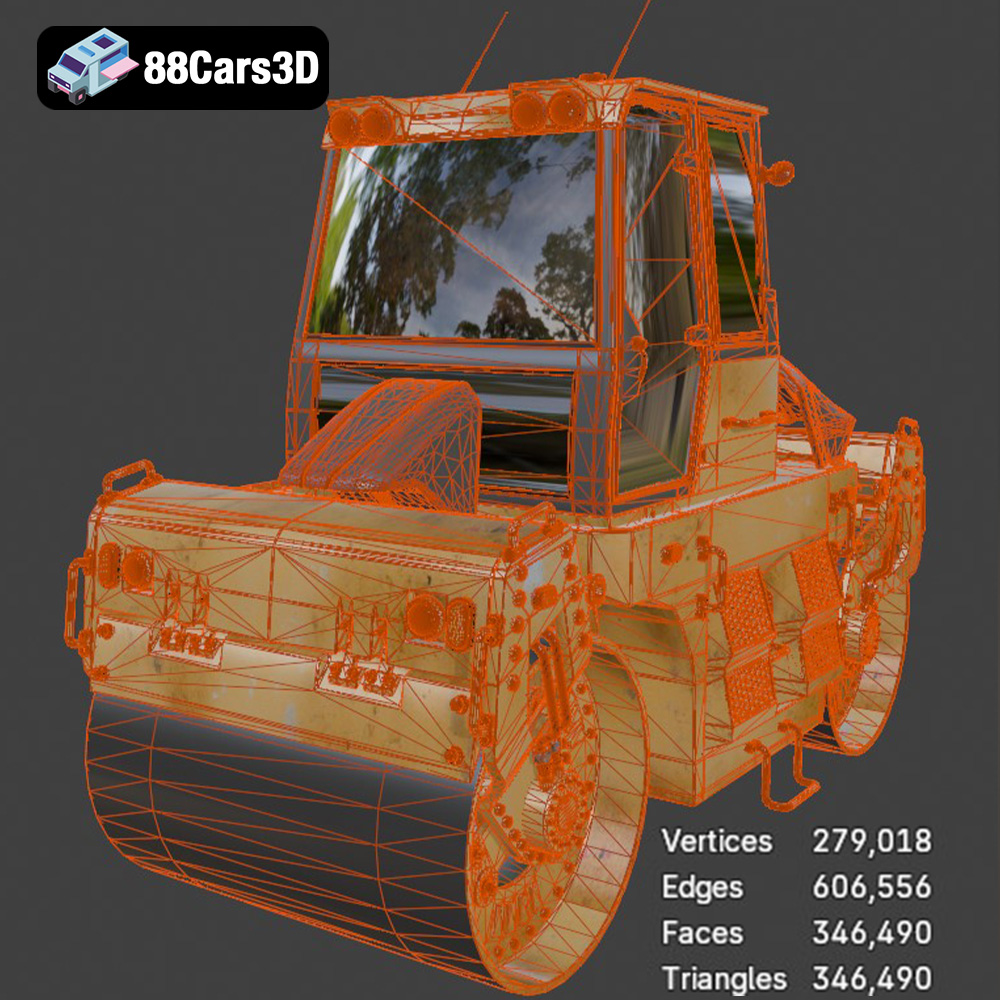
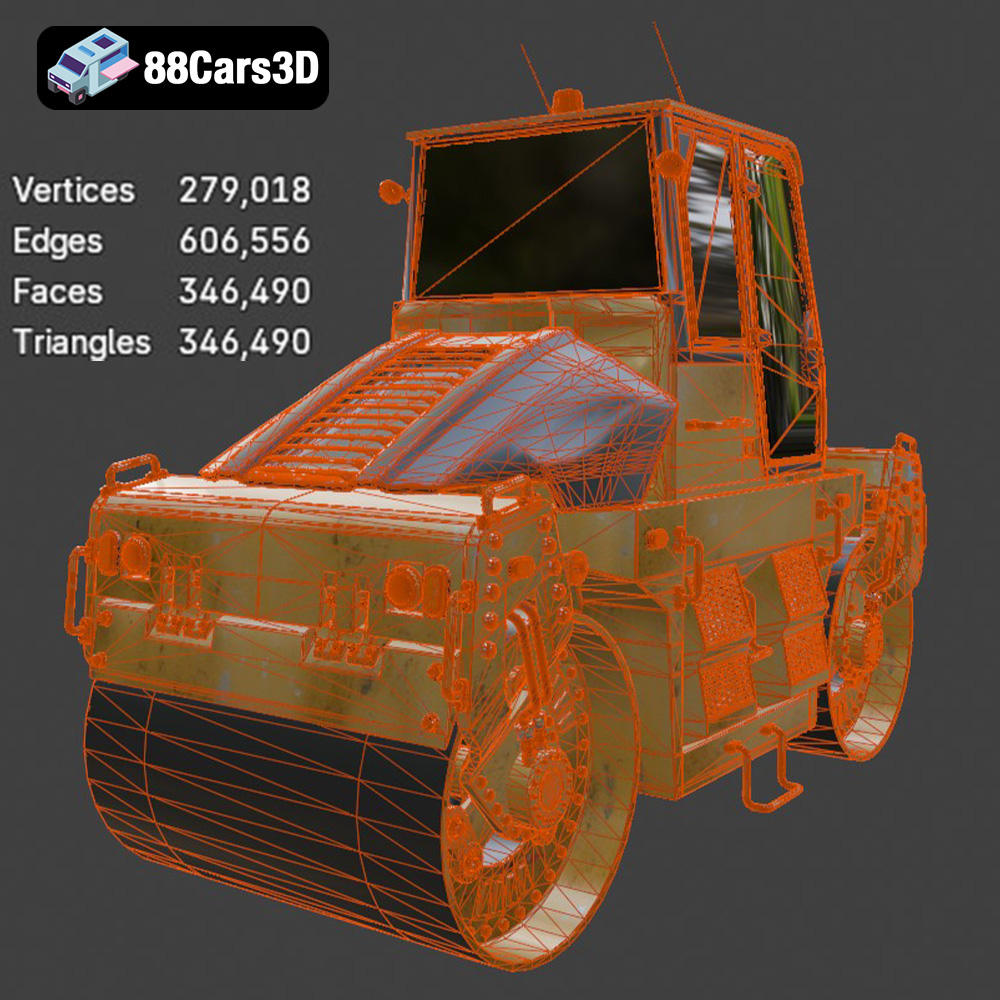
The Road Roller Vibratory Tandem 3D Model is far more than just a surface mesh; it’s a meticulously engineered digital replica. With exactly 346,490 triangles, it strikes a crucial balance between high-end visual fidelity and real-time application efficiency, a testament to thoughtful optimization. This level of detail ensures it performs exceptionally well in demanding scenarios, from cinematic rendering to interactive game environments.
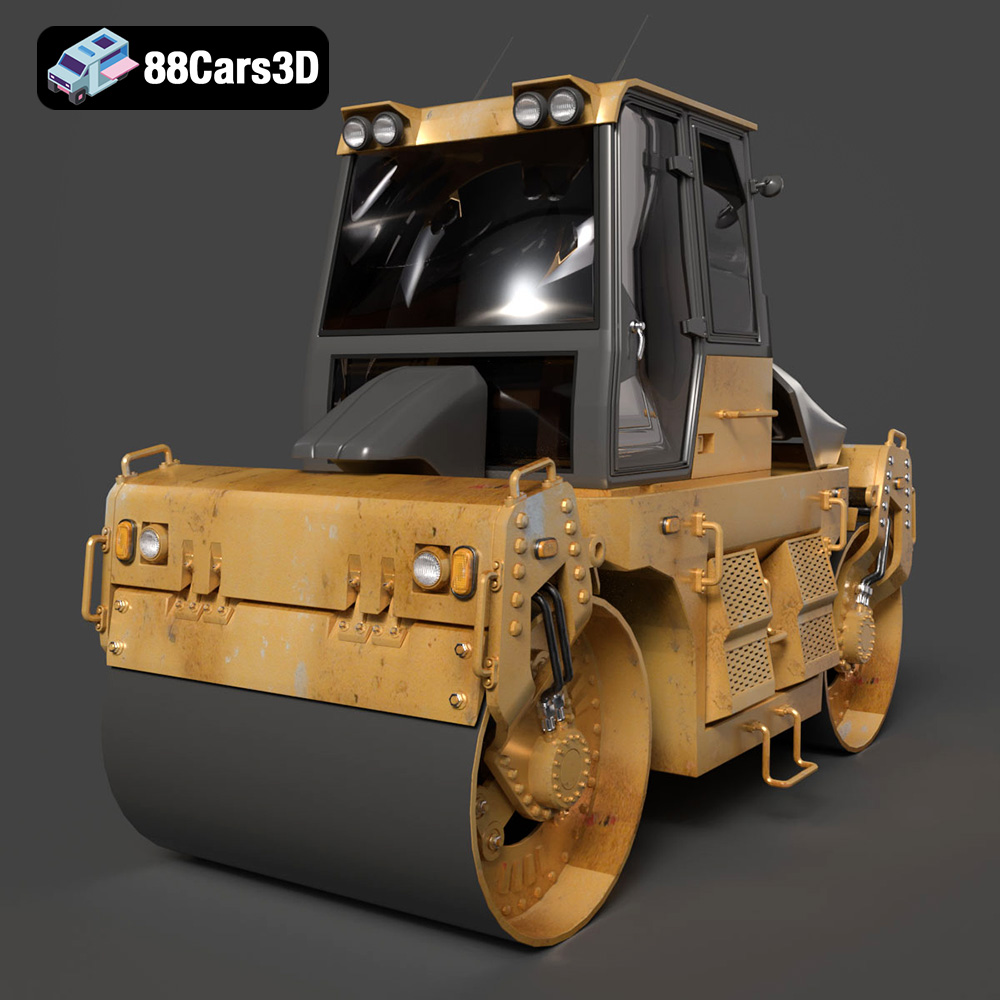
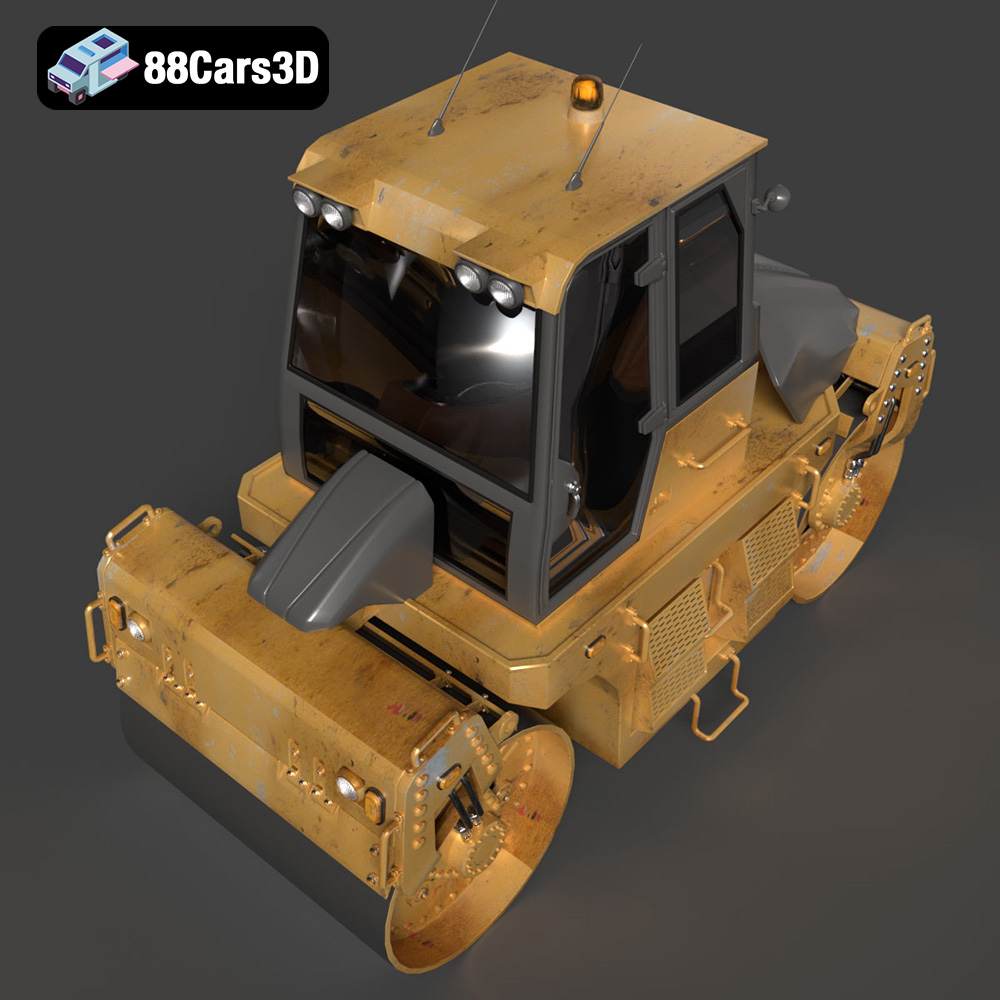
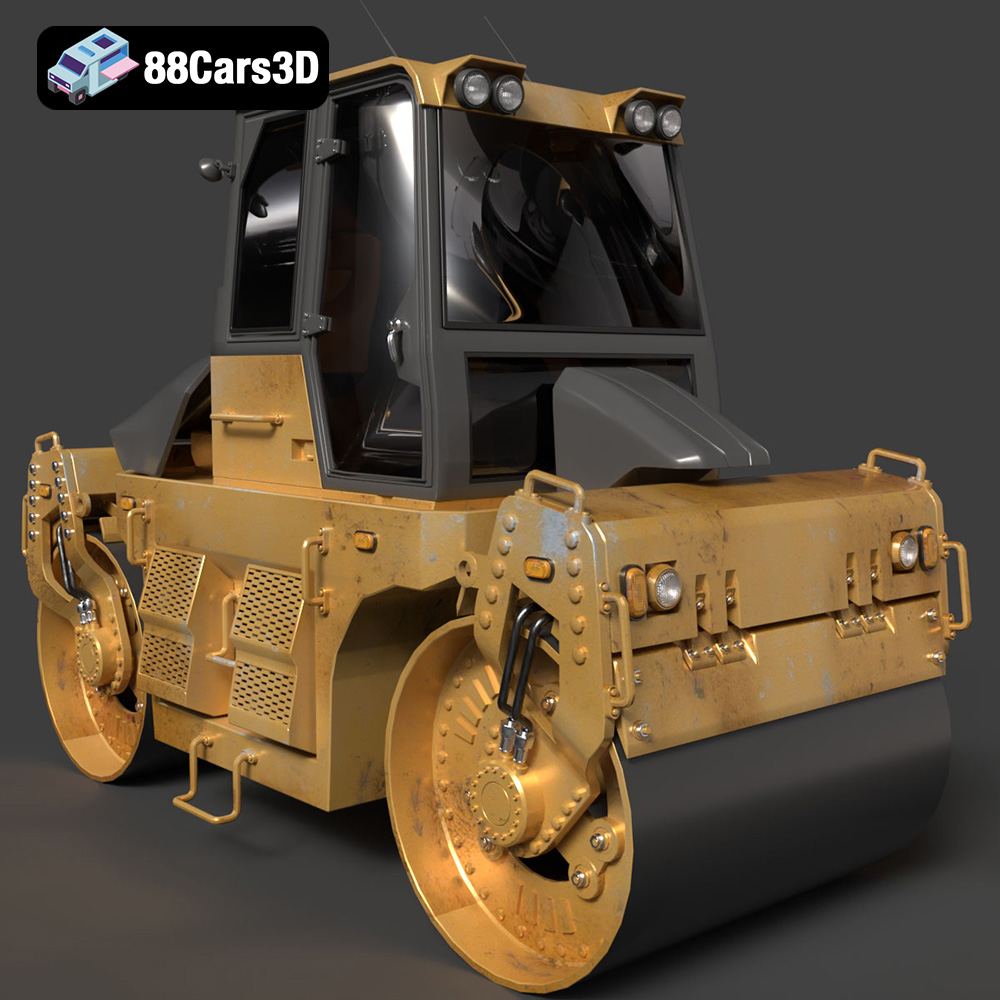
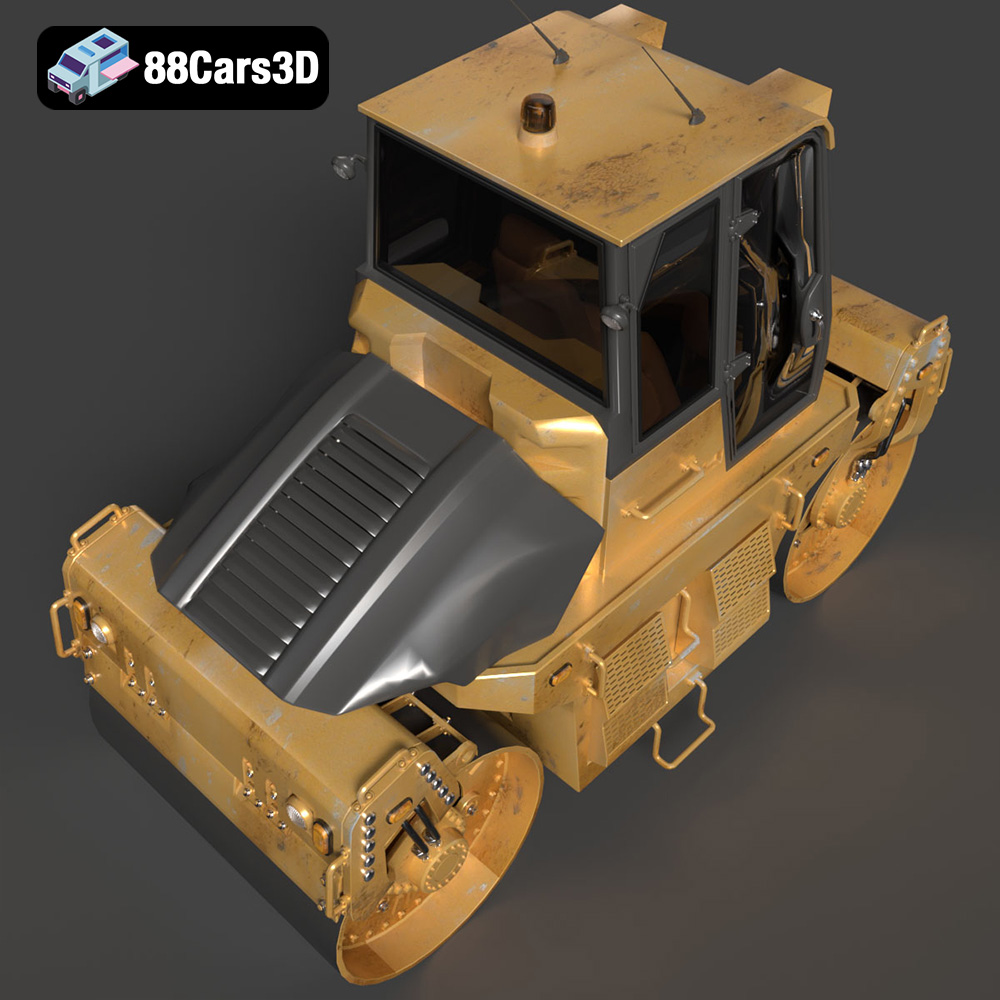
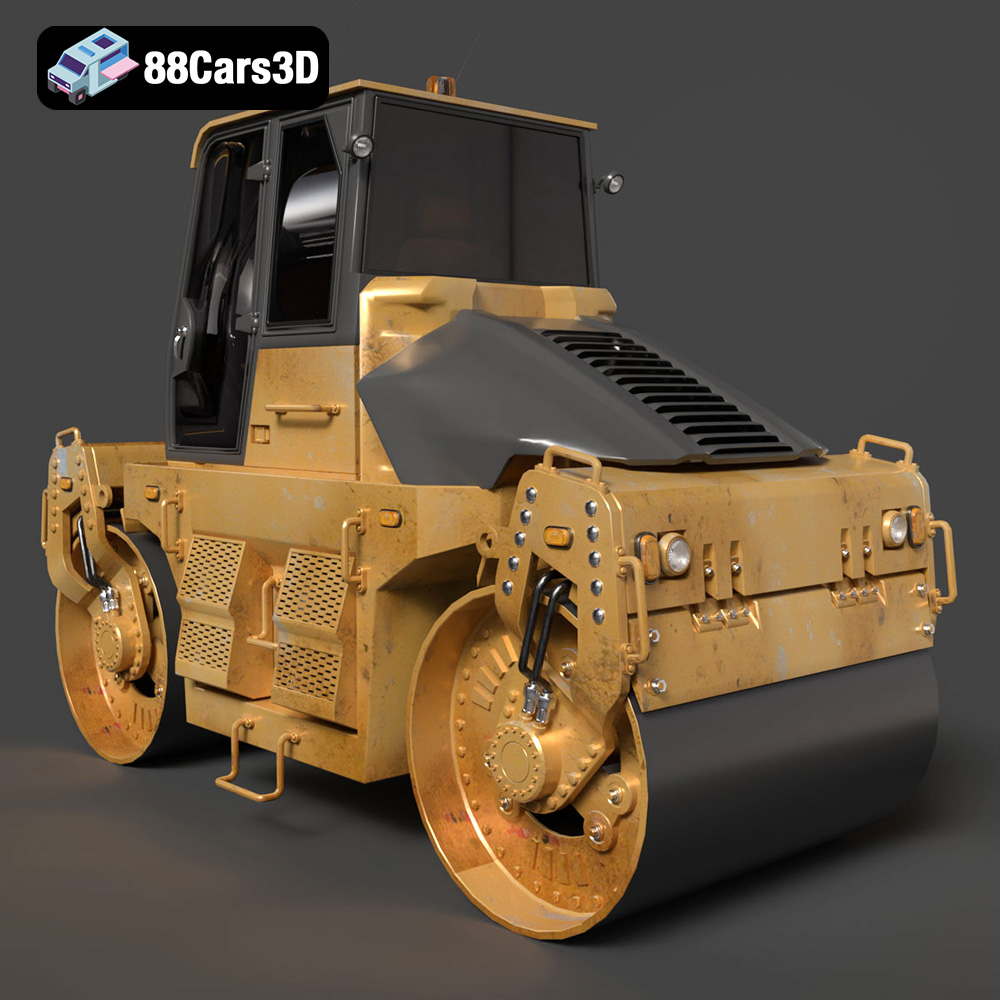
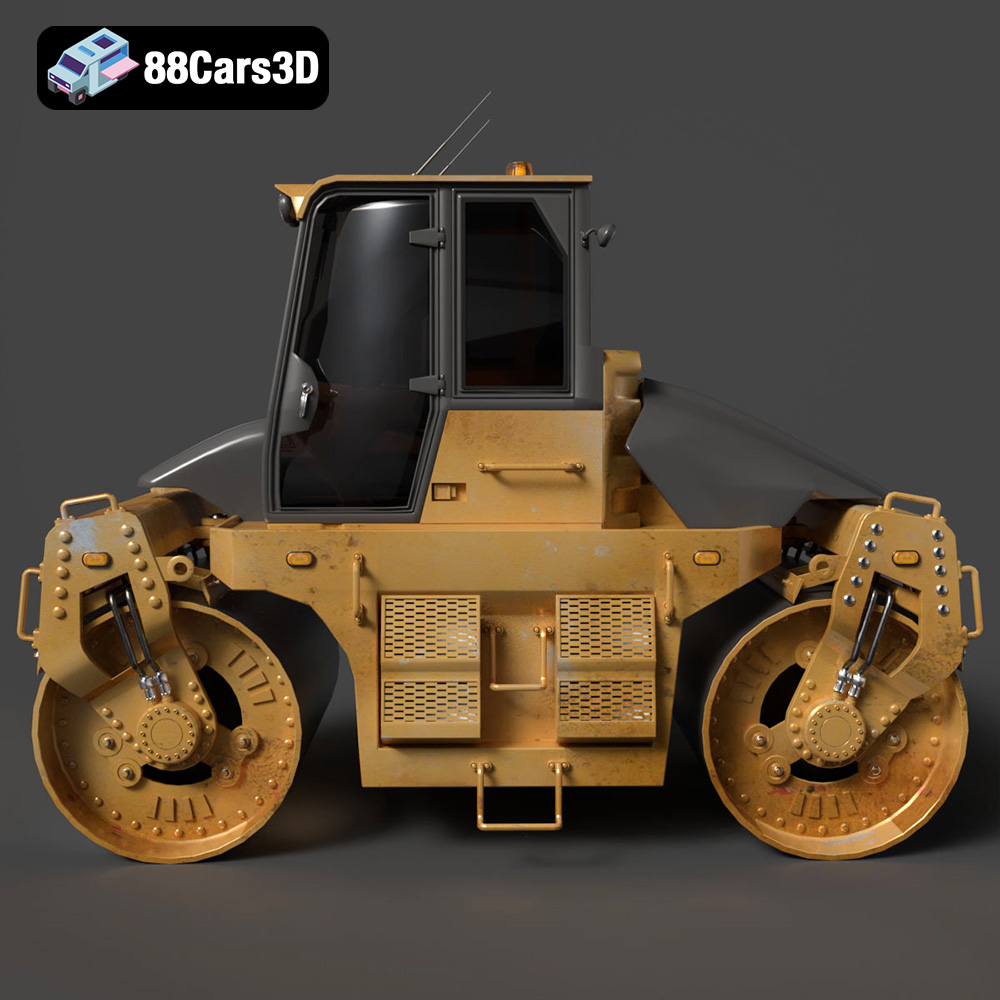
Every element of the real-world road roller has been faithfully reproduced. The model boasts accurate frame geometry and proportions, capturing the robust stance of this heavy-duty machine. Key exterior features include a detailed heavy-duty diesel engine housing with appropriate vents, authentic dual steel compacting drums complete with scraper mechanisms, and industrial-grade work lights and safety beacons—essential for construction site realism. The articulated center steering joint, a hallmark of tandem rollers, is precisely modeled with hydraulic cylinder details, allowing for realistic steering animations. Even the water spray system components and reservoir detailing are present, adding to the visual authenticity. Crucially, components like the drums, articulation joints, and steering are designed as separate elements, enabling full animation and dynamic interaction within a digital scene.
The attention to detail extends into the operator’s cabin. The interior features an ergonomic operator seat with suspension detailing, a heavy machinery steering wheel, and a comprehensive control console. An intricate instrument cluster, complete with industrial gauges, provides visual feedback that would satisfy a real-world operator. Vibration, throttle, and directional control levers are all present and accurately positioned, making the cockpit optimized for first-person POV in construction simulators. This level of interior fidelity is paramount for immersive training applications and enhances the player experience in simulator games, providing a sense of genuine control and presence.
The technical specification of 346,490 triangles is a strategic choice. For a complex vehicle like a road roller, this polycount allows for rich visual detail without becoming an undue burden on real-time rendering engines such as Unreal or Unity. The optimized topology means that edges are clean, surfaces are smooth, and the mesh is structured efficiently, facilitating easier UV mapping, texturing, and shading. This ‘game-ready’ optimization ensures that the Road Roller model can be seamlessly integrated into large-scale environments with many other assets without causing significant performance bottlenecks, a critical consideration for developing vast open-world games or detailed architectural visualizations.
The versatility of a well-crafted 3D model like the Road Roller Vibratory Tandem extends across numerous professional applications. Its technical precision and broad format compatibility make it a cornerstone asset for diverse projects.
For game developers, especially those crafting open-world games, construction simulators, or city builders, this model is a perfect fit. Its optimized polycount of 346,490 triangles ensures it can run efficiently in real-time engines, allowing for dozens or even hundreds of assets to populate a scene without significant performance degradation. The ability to animate separate components like drums and steering joints means it’s ideal for player-controlled vehicles or AI-driven construction operations, adding depth and realism to any digital construction site. Imagine a player driving this very roller to compact newly laid asphalt in a sprawling virtual city!
The demand for immersive training and interactive experiences is growing, particularly in industrial sectors. The Road Roller model is an excellent asset for AR/VR applications, enabling virtual training scenarios for heavy machinery operation, safety configurators, or mobile AR experiences where users can place the virtual roller in their physical environment. The availability of the .glb format is particularly advantageous here, streamlining deployment for web-based AR/VR platforms and mobile devices, making virtual learning and demonstration accessible and highly engaging.
For architectural visualization studios and infrastructure project planners, the Road Roller provides a highly realistic element to populate construction site renders. Whether showcasing a new road project, a large-scale building development, or a detailed urban plan, integrating this accurate 3D model elevates the realism of the scene. Its detailed geometry and realistic material separation make it excellent for studio lighting setups and cinematic renders, contributing significantly to the visual storytelling of infrastructure development. Professionals seeking premium 3D car models or other vehicle assets for their architectural rendering projects will find this model invaluable.
Beyond digital displays, the Road Roller Vibratory Tandem 3D Model offers tangible utility through 3D printing. Provided in .stl format, it’s ready for additive manufacturing. Hobbyists and diorama creators can print highly detailed scale models at recommended scales of 1:24, 1:35, or 1:50. The suggested print settings—layer height, wall thickness, infill, and support requirements—ensure successful outputs, especially with resin printers for fine details. Post-processing with sanding, primer, and authentic factory colors can bring a miniature version of this heavy machinery to life, making it a valuable asset for physical prototyping or display.
Integrating a new 3D asset into an existing project pipeline can sometimes be a challenge, but with the comprehensive file format support of the Road Roller Vibratory Tandem model, the process is streamlined across various industry-standard software and engines.
For Blender users, the native .blend file is the ultimate starting point. Upon opening, the Road Roller model appears with all its materials, textures, and pivot points correctly configured. Artists can immediately begin customizing. This could involve modifying body colors to match a specific fleet (e.g., standard construction yellow, orange, or a custom finish), adjusting material finishes from matte to glossy, or adding heavy weathering effects. The separate drums, articulation joints, and steering components are already set up for animation, allowing users to create complex sequences directly within Blender, whether for a short film, a product visualization, or preparing the asset for export to another platform.
Professionals working in 3ds Max will appreciate the dedicated .max file. This ensures that the model loads perfectly into the software environment, maintaining its geometry, material assignments, and any potential scene-specific data. Leveraging 3ds Max’s robust toolset, artists can quickly integrate the Road Roller into complex architectural scenes, utilize its advanced animation capabilities for intricate mechanical movements, or prepare it for high-end rendering with V-Ray or Corona Renderer. The native file ensures maximum compatibility and editability, allowing for seamless integration into even the most demanding automotive rendering projects involving heavy equipment.
The “Unreal-ready” asset for the Road Roller is a game-changer for developers. Importing the provided .fbx (or using the pre-configured Unreal asset package if available) into Unreal Engine involves a straightforward process. Materials can be quickly set up as instances, allowing for easy color and texture variations without creating new master materials. The proper pivot setup for articulation and drum rotation simplifies animation blueprinting. Developers can create simple blueprint scripts to control the roller’s steering, drum vibration, and movement, turning a static model into a fully interactive game asset. This direct integration streamlines the workflow for creating immersive construction simulators or populating vast open-world environments with dynamic heavy machinery.
A truly professional 3D asset offers more than just visual accuracy; it provides a canvas for creative expression and project-specific adaptation. The Road Roller Vibratory Tandem 3D Model is designed with extensive customization options to ensure it meets the unique requirements of any project.
The ability to change body colors is fundamental. Artists can easily switch between standard construction hues like vibrant yellow or safety orange, or even apply custom fleet finishes to align with specific branding. Beyond color, the model allows for modifications to drum textures, enabling a choice between pristine, clean steel or realistically worn, asphalt-coated surfaces. Material finishes can also be adjusted, transitioning from a clean, matte look to a glossy, freshly painted appearance, or even incorporating heavy weathering and dirt effects to depict a machine hard at work on a dusty construction site. Furthermore, the lighting can be adapted for various environments, from bright daytime sun to dramatic nighttime construction scenes with flickering beacons and headlights, enhancing the overall mood and realism of any render or game scene.
The thoughtful segmentation of the Road Roller model into separate components — drums, articulation joints, and steering — unlocks significant animation potential. This modularity is critical for creating dynamic simulations and interactive experiences. Artists can animate the dual drums rotating independently or in tandem, simulate the hydraulic action of the articulated steering joint, and even create complex physics-based movements. For game developers, this means the vehicle can be fully driveable, responding to player input with realistic mechanical feedback. For training simulations, it allows for accurate operational demonstrations and interactive learning modules, making the Road Roller Vibratory Tandem a highly versatile and adaptable asset for any professional seeking to bring complex machinery to life.
The world of 3D modeling is a complex but rewarding landscape, where the right assets can elevate any project from ordinary to extraordinary. The Road Roller Vibratory Tandem 3D Model stands as a prime example of a premium, technically sophisticated asset, meticulously crafted to meet the diverse demands of modern digital content creation. From its optimized 346,490 triangle topology to its comprehensive suite of file formats—including .blend, .fbx, .obj, .glb, .stl, .ply, .unreal, and .max—this model is engineered for versatility and performance.
Whether you are developing an immersive game, creating stunning architectural visualizations, building AR/VR training simulations, or even embarking on a detailed 3D printing project, this Road Roller model provides a robust foundation. Its detailed exterior and interior features, coupled with flexible customization options, ensure it can be seamlessly integrated into any professional workflow, delivering exceptional realism and functionality. For those seeking high-quality 3D car models, game assets, or advanced components for automotive rendering, look no further than the curated collection at 88cars3d.com. Investing in assets of this caliber ensures not only visual excellence but also a streamlined development process, empowering creators to bring their most ambitious visions to life.
The Road Roller Vibratory Tandem is an essential piece of heavy construction machinery, universally recognized for its robust double steel drums and articulated chassis. Designed to compact asphalt, gravel, and soil, this vehicle features distinctive industrial styling, a powerful diesel engine housing, and a specialized vibratory mechanism built for high-efficiency paving operations.
This highly detailed 3D model boasts an optimized topology with exactly 346,490 triangles, delivering remarkable visual fidelity while remaining efficient for real-time applications. Whether used in high-end game development, architectural visualization, or immersive VR training simulations, the model’s precise geometry and realistic material separation provide an exceptional asset for developers and 3D artists alike.
Perfect for construction site environments, city building games, heavy machinery simulators, and industrial visualizations.
.blend, .fbx, .obj, .glb, .stl, .ply, .unreal, .max
Tags:
road-roller, vibratory-tandem, heavy-machinery, construction-equipment, game-ready, optimized, car-3d-model, game-asset, rendering, vr-ar, blend, fbx, obj, glb, stl, ply, unreal, max
$35.50
.blend
.fbx
.glb
.max
.obj
.ply
.rendering
.stl
.unreal
car-3d-model
construction-equipment
game asset
game-ready
heavy-machinery
optimized
road-roller
vibratory-tandem
VR/AR