Get 20% OFF All Premium 3D & STL Models!

In the dynamic world of 3D visualization, automotive design, and game development, the demand for hyper-realistic and technically precise 3D car models is ever-growing. Whether you’re an architect needing to populate a luxury scene, a game developer crafting an immersive racing experience, or an advertiser creating a compelling commercial, the quality of your 3D assets can make or break a project. Achieving photorealism and optimal performance requires models that are not only visually stunning but also expertly engineered from the ground up.
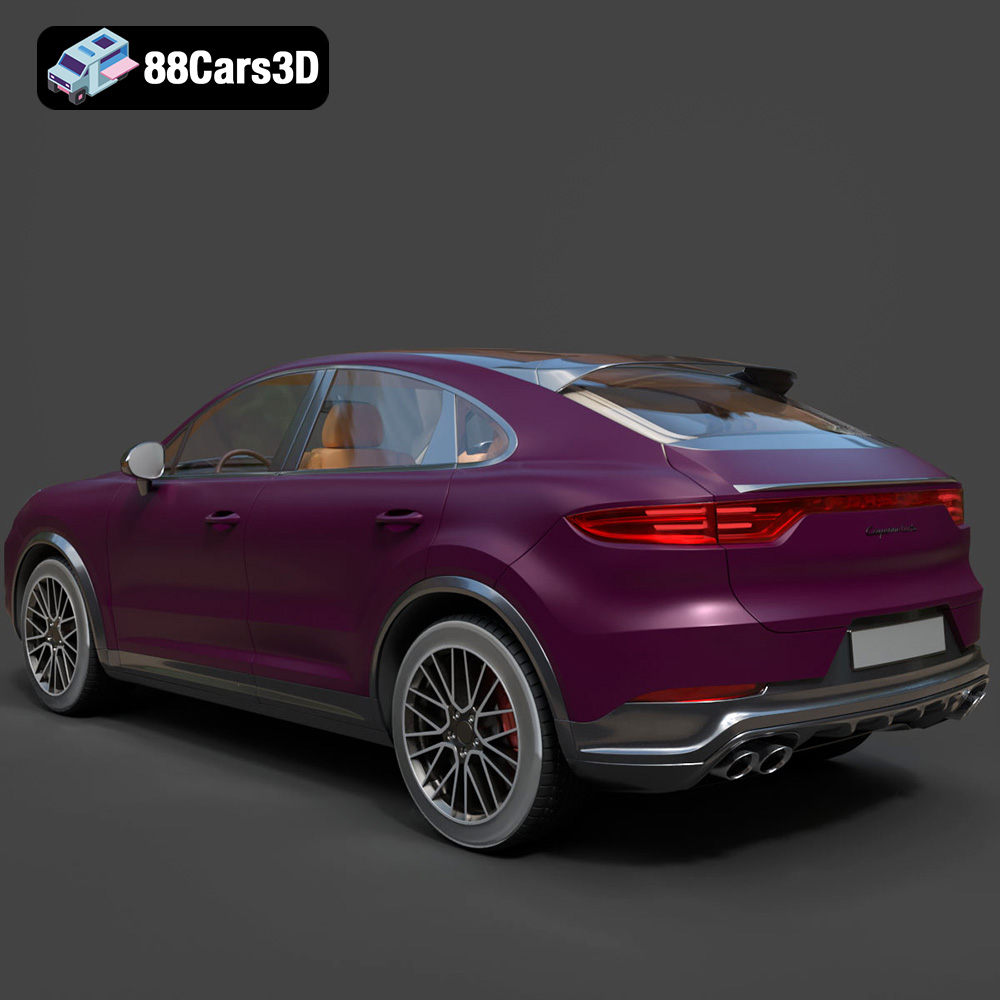
Consider the allure of modern automotive masterpieces. Vehicles like the 2019 Porsche Cayenne Coupe Turbo exemplify a perfect blend of aggressive performance and sophisticated luxury. Its distinctive silhouette, powerful stance, and intricate detailing demand an equally refined digital representation. This is precisely where a high-fidelity 3D model, such as the Porsche Cayenne Coupe Turbo 2019 3D model, becomes an indispensable tool. It offers an unparalleled level of detail and optimization, designed to integrate seamlessly into a myriad of professional workflows and elevate the visual fidelity of any creative endeavor.
The versatility of a professional 3D car model is often defined by the range of file formats it supports. Each format serves specific purposes, catering to different software environments, project types, and optimization needs. Understanding these distinctions is crucial for selecting the right asset for your pipeline and maximizing its utility. The Porsche Cayenne Coupe Turbo 2019 3D model from 88cars3d.com exemplifies this comprehensive approach by offering a broad spectrum of industry-standard formats, ensuring seamless integration across virtually any creative workflow.
The .blend format is the native file type for Blender, a powerful open-source 3D creation suite. When you acquire a model in .blend format, you’re getting a fully editable scene file. This includes not just the mesh data, but also materials, textures, lighting setups, animation rigs, modifiers, and any scene-specific configurations. For artists who primarily work in Blender, this format offers the most flexibility, allowing for deep customization, tweaking of shaders, adjusting topology, and modifying scene elements without data loss or conversion artifacts. It’s ideal for projects requiring extensive modification or for leveraging Blender’s robust suite of modeling, sculpting, and animation tools.
Autodesk’s .fbx (Filmbox) format has become an industry standard for interoperability, particularly between different 3D applications and real-time game engines like Unreal Engine and Unity. It’s renowned for its ability to store not only mesh data (geometry, UVs, normals) but also complex scene information such as hierarchies, animations (skeletal and blend shapes), cameras, and lights. For game development, .fbx is often the go-to choice due to its efficient handling of animation and scene data, making it perfect for animated 3D car models or assets that require dynamic interactions within an engine. Its robust support ensures that your asset, including the detailed mechanics of the Porsche Cayenne Coupe Turbo, transitions smoothly from modeling software to the final interactive environment.
The .obj (Wavefront OBJ) format is one of the most widely supported and simplest 3D file formats. It primarily stores geometric data like vertices, normals, UV coordinates, and faces. While it doesn’t typically store animation or scene setups, its universal compatibility makes it an excellent choice for static meshes that need to be imported into almost any 3D software application. If your primary need is the raw mesh and texture data for rendering or further modeling in a non-Blender or non-3ds Max environment, .obj provides a clean, reliable foundation.
The .glb (GL Transmission Format Binary) is the binary version of the glTF (Graphics Library Transmission Format) specification. Developed for efficient transmission and loading of 3D scenes and models by applications, it’s particularly optimized for web-based 3D, augmented reality (AR), and virtual reality (VR) experiences. A .glb file contains all necessary data—geometry, materials, textures, and animations—in a single, self-contained package, making it highly efficient for deployment on mobile devices, web browsers, and AR/VR platforms where file size and loading times are critical considerations. For interactive configurators or virtual showrooms of the Porsche Cayenne Coupe Turbo, .glb offers superior performance.
The .stl (Stereolithography) format is the ubiquitous standard for 3D printing. It represents a 3D model as a collection of interconnected triangles, defining only the surface geometry of an object without color, texture, or material information. While not suitable for rendering or animation, it is essential for bringing digital models into the physical world. The detailed Porsche Cayenne Coupe Turbo 3D model, when converted to .stl, allows hobbyists and professionals alike to produce high-quality physical replicas, offering a tangible connection to the digital design.
The .ply (Polygon File Format) is another common format for storing 3D data, particularly from 3D scanners or for CAD applications. Like .obj, it defines geometry through vertices, faces, and normals, but it can also store additional properties for each vertex or face, such as color, transparency, or even confidence values from scanning data. It’s often used in scientific visualization, reverse engineering, and applications where precise geometric data with additional attributes is required for analysis or manufacturing processes.
While not a standalone file format in the conventional sense, an .unreal asset typically refers to a complete, pre-configured asset package ready for direct import and use within Unreal Engine. This often means an optimized .fbx file that has been meticulously prepared with appropriate materials, textures, collision meshes, LODs (Levels of Detail), and pivot points configured to Unreal Engine’s specifications. This format significantly streamlines the development process for game artists and real-time visualizers, providing a “drop-and-play” solution for the Porsche Cayenne Coupe Turbo 2019 3D model directly within the engine.
The .max format is the native file type for Autodesk 3ds Max, a leading software for 3D modeling, animation, and rendering. Similar to .blend, a .max file stores the entire scene, including geometry, materials, textures, lights, cameras, animations, rigging, and all specific 3ds Max settings. It offers maximum flexibility for artists working within the 3ds Max ecosystem, enabling comprehensive adjustments, complex animations, and high-fidelity rendering setups using renderers like V-Ray or Corona. For those leveraging 3ds Max for automotive rendering or detailed animations of the Cayenne Coupe Turbo, the .max file provides the complete editable project.
Creating a truly authentic 3D car model is an intricate dance between artistic interpretation and precise technical execution. It requires a deep understanding of automotive design principles, aerodynamics, and material properties. The Porsche Cayenne Coupe Turbo 2019 3D model is a testament to this philosophy, translating the real vehicle’s essence into a digital masterpiece.
The 2019 Porsche Cayenne Coupe Turbo is instantly recognizable by its muscular proportions and dynamic, sloping roofline – a defining characteristic that sets it apart in the luxury SUV segment. Replicating this requires meticulous attention to every curve and contour. A professional 3D model captures the aggressive front fascia with its massive air intakes, the distinctive continuous LED taillight strip, and the active rear spoiler, all of which contribute to the vehicle’s unique aesthetic and aerodynamic profile. The topology is carefully structured, ensuring that light interacts with the surfaces precisely as it would on the real car, resulting in smooth, accurate reflections crucial for photorealistic renders.
Beyond the exterior, the interior of a luxury vehicle is equally vital for creating a fully immersive experience. The Porsche Cayenne Coupe Turbo 2019 3D model extends its detail into the cockpit, featuring accurately modeled sport seats with intricate stitching and bolstering, a multi-function sports steering wheel complete with paddle shifters, and a high-resolution digital instrument cluster. The center console, with its haptic touch control panels and gear selector, is also meticulously reproduced. This level of interior fidelity is essential for first-person perspective in racing games, virtual showrooms, and AR/VR applications, where users expect to explore every detail with unparalleled realism.
The application of high-quality 3D car models spans a broad spectrum, from generating breathtaking cinematic renders to powering fluid, interactive experiences in real-time environments. The technical specifications and optimization of the Porsche Cayenne Coupe Turbo 2019 3D model are tailored to excel in both domains, offering flexibility without compromise.
For artists focused on producing marketing materials, studio shots, or cinematic sequences, high-end automotive rendering is paramount. Using software like 3ds Max with powerful renderers such as V-Ray or Corona, the .max file format provides a complete scene ready for advanced material definition and lighting setups. The model’s optimized topology ensures that complex shaders, like iridescent car paint, metallic flakes, and reflective chrome, render flawlessly. Artists can leverage real-world scale accuracy to integrate the model seamlessly into architectural visualizations or product showcases, allowing for precise camera angles and environmental interactions that enhance realism and impact.
In the realm of game development and immersive AR/VR, performance is as critical as visual fidelity. The Porsche Cayenne Coupe Turbo 2019 3D model is engineered as a true game asset, optimized with an impressive yet balanced 1,834,208 triangle count. This polycount strikes an ideal equilibrium, providing exceptional visual realism without excessively burdening real-time engines like Unreal Engine or Unity. The inclusion of .fbx and .unreal formats facilitates a smooth import process, retaining proper pivot setups for crucial animated components like steering, wheel rotation, and suspension travel. This attention to detail ensures that the model performs optimally in high-speed racing simulators, open-world games, and interactive virtual showrooms, offering a seamless and engaging user experience.
The utility of a premium 3D car model extends beyond digital screens, offering avenues for physical creation and boundless creative customization. The Porsche Cayenne Coupe Turbo 2019 3D model provides features that cater to both tangible output and artistic freedom.
For enthusiasts, collectors, or designers looking to create physical prototypes, the ability to 3D print a model is invaluable. The inclusion of the .stl format, alongside detailed print settings, makes this a reality for the Cayenne Coupe Turbo model. Recommended scales (1:12, 1:18, 1:24) ensure manageable print sizes, while suggestions for layer height (0.04–0.12 mm) and the recommendation for resin printing underscore the focus on capturing fine details. Guidance on wall thickness, infill, and support placement helps users achieve optimal print quality, ensuring even intricate parts like the exhaust system and mirrors are faithfully reproduced. Post-processing with sanding, primer, and authentic factory colors can transform the printed model into a display-worthy replica.
A professional 3D model provides a robust foundation, but true flexibility lies in its customization potential. Artists and designers can easily modify the Porsche Cayenne Coupe Turbo model to fit specific project needs. This includes changing body colors to match factory palettes or experimenting with custom finishes like matte, gloss, or metallic. Tire textures can be swapped between off-road and street variants to suit different environments or scenarios. Furthermore, the model’s structure allows for easy adaptation of lighting to create diverse moods and atmospheres, from a sleek studio shoot to an urban night scene. The .blend and .max formats, in particular, empower users with full editability, offering complete control over materials, textures, and geometry to achieve a truly bespoke visual outcome.
The true measure of a high-quality 3D car model like the Porsche Cayenne Coupe Turbo 2019 3D model lies in its practical application across various professional industries. From advertising to simulation, these assets serve as critical components in modern digital pipelines.
In the highly competitive automotive market, captivating visuals are essential. High-fidelity 3D car models are a cornerstone of modern automotive advertising, enabling virtual photography, CGI commercials, and immersive product launch experiences. Agencies can use this model to create dynamic scenes without the logistical complexities and costs of real-world photoshoots. Imagine a Cayenne Coupe Turbo elegantly navigating a virtual cityscape or dynamically presented against a minimalist studio backdrop—all rendered with breathtaking realism, showcasing the vehicle’s features and design prowess. This allows for unparalleled creative control and rapid iteration, ensuring brand messaging is consistently impactful.
Beyond entertainment, precise 3D vehicle models are integral to professional training and simulation. Driving simulators for professional racers, automotive engineers, or even autonomous vehicle testing platforms rely on geometrically accurate and physics-ready assets. The real-world scale accuracy and proper pivot setup for steering, wheels, and suspension travel in the Porsche Cayenne Coupe Turbo model make it an ideal candidate for such applications. These details ensure that the virtual vehicle behaves predictably and realistically, providing a credible environment for skill development and research.
Architectural visualization (ArchViz) frequently uses vehicles to add realism, scale, and context to property renderings. A luxury SUV like the Cayenne Coupe Turbo naturally enhances the appeal of high-end architectural projects, from opulent residences to sophisticated urban developments. Integrating this detailed 3D car model into an ArchViz scene immediately elevates the visual narrative, conveying a sense of lifestyle and luxury that resonates with potential clients. The model’s optimized geometry and diverse file formats mean it can be easily incorporated into various rendering engines used in ArchViz, providing a polished and believable presence.
The journey from concept to a perfectly realized 3D automotive asset is complex, but the impact of a truly exceptional model is undeniable. The Porsche Cayenne Coupe Turbo 2019 3D model stands out as a prime example of engineering excellence and artistic fidelity, offering an invaluable resource for professionals across industries. Its meticulous detail, balanced polycount, and extensive file format support (from .blend and .max for comprehensive editing, to .fbx and .unreal for real-time applications, and .stl for 3D printing) ensure that it meets the rigorous demands of automotive rendering, game asset creation, AR/VR experiences, and much more.
Investing in such a high-quality 3D car model from a trusted source like 88cars3d.com significantly streamlines production workflows, reduces development time, and ultimately elevates the visual standard of any project. Whether you’re crafting the next generation of games, producing stunning marketing visuals, or bringing digital designs to life through 3D printing, the precision and versatility of this Cayenne Coupe Turbo model provide a robust foundation for success. Explore the possibilities and transform your creative vision into breathtaking reality with professional-grade assets.
The 2019 Porsche Cayenne Coupe Turbo redefines the luxury sports SUV segment with its striking sloping roofline, aggressive aerodynamics, and thunderous twin-turbo V8 engine. Known for blending track-ready performance with everyday utility, this iconic vehicle features distinctive Porsche styling cues, including the signature continuous LED taillight strip, active rear spoiler, and an imposing front fascia with massive air intakes. The dynamic stance and muscular proportions make it a standout masterpiece in modern automotive design. This premium 3D model boasts an impressive 1,834,208 triangle count, delivering exceptional visual fidelity and photorealistic details. Meticulously modeled for high-end rendering and optimized for next-generation game engines, it offers unparalleled quality for game development, immersive AR/VR experiences, professional animation, and architectural visualization. The topology is carefully structured to ensure smooth reflections and accurate shading across all lighting environments. Perfect for high-end racing simulators, architectural visualizations, automotive commercials, and virtual showrooms.
$37.50
.2019
.blend
.fbx
.glb
.luxury suv
.max
.obj
.ply
.porsche
.rendering
.stl
.unreal
car-3d-model
cayenne-coupe
cayenne-turbo
game asset
game-ready
high poly
optimized
sports-suv
SUV
VR/AR