Get 20% OFF All Premium 3D & STL Models!

In the rapidly evolving world of 3D visualization, the demand for highly detailed and accurate models is paramount. From blockbuster game titles and immersive virtual reality experiences to photorealistic architectural visualizations and precision 3D printing, the backbone of any successful project is a meticulously crafted 3D asset. This is especially true for industrial machinery, where every bolt, panel, and hydraulic line needs to convey authenticity and functionality. High-quality 3D car models, particularly those representing heavy machinery, are more than just visual elements; they are complex data structures designed to meet rigorous technical specifications.
Creating such assets requires a deep understanding of geometry, materials, optimization, and interoperability across various software platforms. The process is a blend of artistic skill and engineering precision, ensuring that the digital model not only looks the part but can also function within demanding real-time environments or render flawlessly in high-resolution stills. At 88cars3d.com, we understand this intricate balance, offering a curated selection of premium 3D assets that serve as the foundation for countless creative and professional endeavors. Today, we’ll delve into the world of industrial 3D modeling, focusing on how a prime example, the Articulated Dump Truck 3D Model, exemplifies the pinnacle of digital craftsmanship and its indispensable role across multiple industries.
Navigating the landscape of 3D modeling often begins with understanding the myriad of file formats available, each tailored for specific workflows and applications. Selecting the correct format is crucial for maintaining data integrity, optimizing performance, and ensuring compatibility. The Articulated Dump Truck 3D Model, for instance, comes equipped with a comprehensive suite of formats, enabling seamless integration into virtually any pipeline. Let’s break down the most common and critical formats you’ll encounter and why each holds its own unique value.
The .blend format is the native file type for Blender, the popular open-source 3D creation suite. When you download a .blend file, you’re not just getting a model; you’re getting a complete Blender scene. This includes all geometry, materials, textures, lighting, cameras, animation data, and even modifiers. It offers full editability, allowing artists to dissect the model, understand its construction, modify materials, adjust rigging, or re-render it directly within Blender. For those working primarily in Blender, this format provides the most flexibility and is ideal for extensive customization or learning from expert setups.
FBX (Filmbox) is a proprietary file format developed by Autodesk, serving as a widely adopted standard for exchanging 3D data between various software applications. It excels in transferring not only geometry but also crucial elements like animation, rigging, textures, and even basic materials. .fbx files are particularly ideal for game engines like Unreal Engine and Unity, where they streamline the asset import process, maintaining pivot points, hierarchies, and animation data. Its robustness and broad support make it a go-to choice for complex animated models and real-time pipelines.
OBJ (or .obj) is a simple, universal 3D geometry definition file format. It’s a fundamental exchange format, supported by almost every 3D application. While it’s excellent for transferring static mesh data, including vertices, faces, UV coordinates, and normals, it typically doesn’t store animation, rigging, or advanced material properties in the same way .fbx does. Materials are usually referenced via an accompanying .mtl file. .obj is highly reliable for cross-software compatibility, especially when the primary concern is the raw geometric data, making it a safe choice for static assets or as a fallback when other formats fail.
GLB is the binary version of glTF (Graphics Language Transmission Format), an open-standard 3D file format for scenes and models. Optimized for quick loading and efficient transmission, .glb files encapsulate all necessary data (geometry, textures, animations, and PBR materials) into a single, compact file. This makes it perfect for AR/VR applications, web-based 3D viewers, and mobile platforms where file size and performance are critical. For showcasing models interactively on a website or deploying them in a lightweight AR experience, .glb is the format of choice.
STL (STereoLithography) is the most prevalent file format used for 3D printing. It represents a 3D model as a series of connected triangles, defining only the surface geometry of an object. It lacks color, texture, or material information, focusing solely on the shape required by 3D printers. For hobbyists and professionals looking to bring digital models like the Articulated Dump Truck into the physical world, converting to .stl is a necessary step to prepare the model for fabrication. It is essential to ensure watertight meshes and correct scaling when using .stl for 3D printing.
PLY (Polygon File Format) is another format used to store 3D data, particularly suitable for raw 3D scans or point cloud data. It can store a wider range of properties than .stl, including color, transparency, and often more complex mesh structures. While less common for general asset exchange than .fbx or .obj, .ply is frequently used in scientific, CAD, and engineering applications for precise mesh analysis and when preserving detailed surface information from scanners is paramount.
While not a standard interchangeable file format in the way .fbx or .obj are, the inclusion of “.unreal” often refers to assets that have been specifically prepared and exported for direct import into Unreal Engine projects. This can mean a pre-processed .fbx with correct export settings, or even a packaged asset that includes material setups, LODs (Levels of Detail), and collision meshes, optimized to function immediately within the engine’s ecosystem. These files are designed to minimize post-import setup and maximize performance within Unreal Engine, making them invaluable for game developers.
The .max format is the native file type for Autodesk 3ds Max, a powerful 3D modeling, animation, and rendering software widely used in architectural visualization, game development, and film. Like .blend, a .max file contains the entire scene data, including all objects, materials, lights, cameras, animations, and scene settings. It provides full editability and is essential for anyone needing to work with the model natively within 3ds Max, allowing for complex rigging, advanced material setups with V-Ray or Corona Renderer, and detailed animation sequences.
Having access to this array of formats, as provided with the Articulated Dump Truck 3D Model on 88cars3d.com, ensures that irrespective of your chosen software or end-application, you have the right tool for the job.
The Articulated Dump Truck is a symbol of raw power and functionality on any major construction or mining site. Replicating such a complex piece of heavy machinery in 3D requires an obsessive attention to detail, not just in its visual appearance but in its underlying structure and potential for interaction. The Articulated Dump Truck 3D Model available at 88cars3d.com is a testament to this philosophy, engineered to meet the highest standards of realism and technical fidelity.
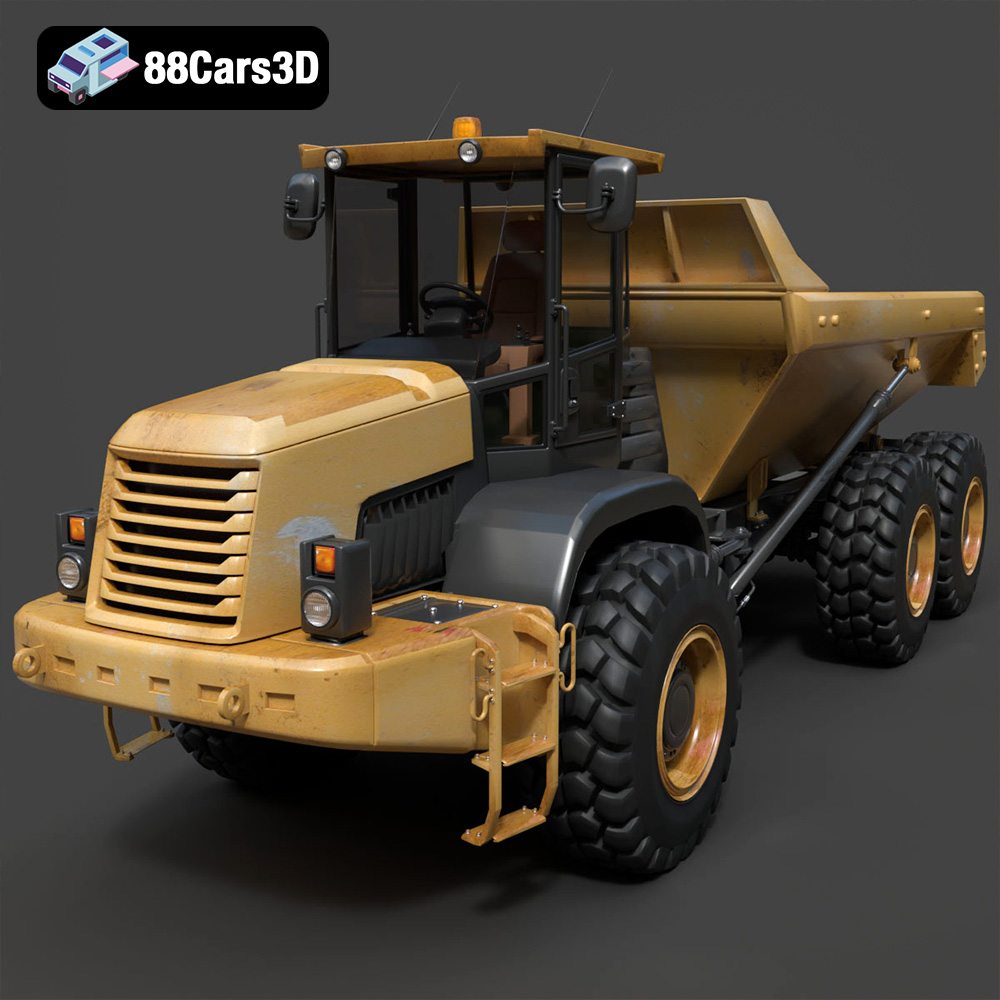
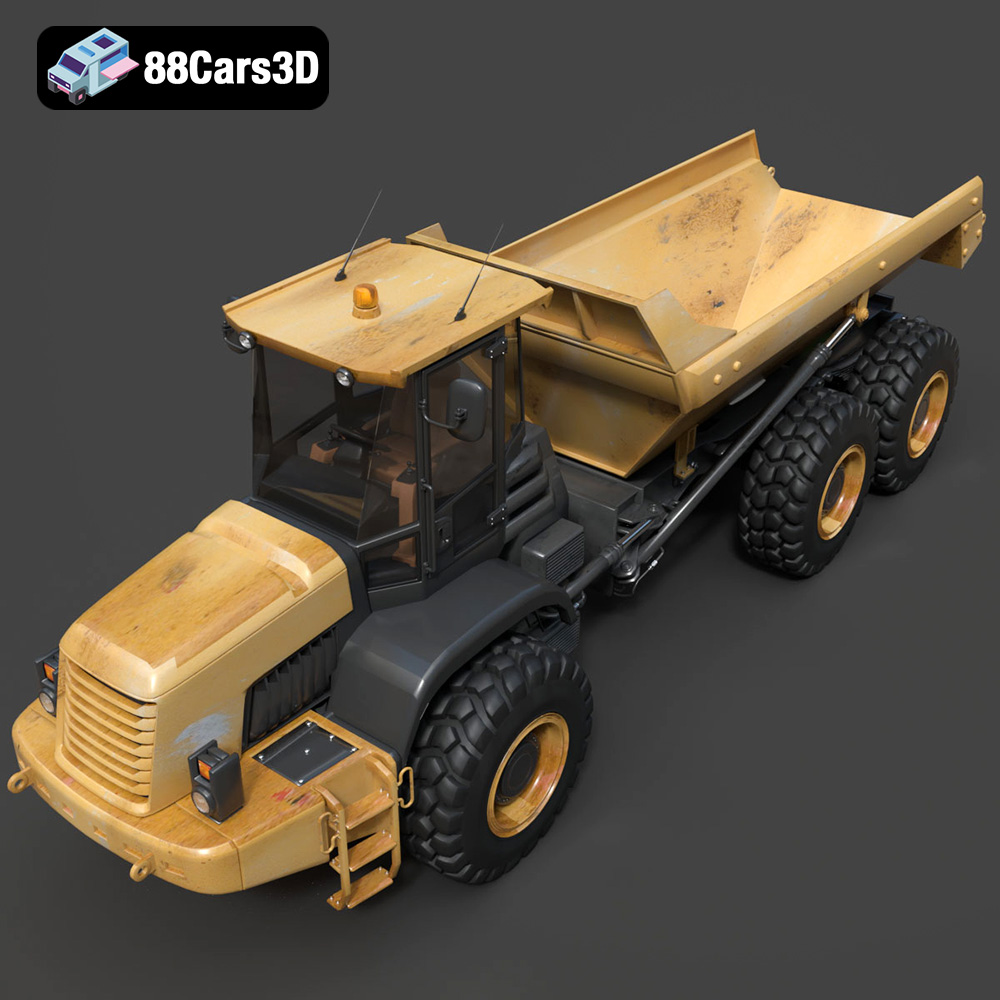
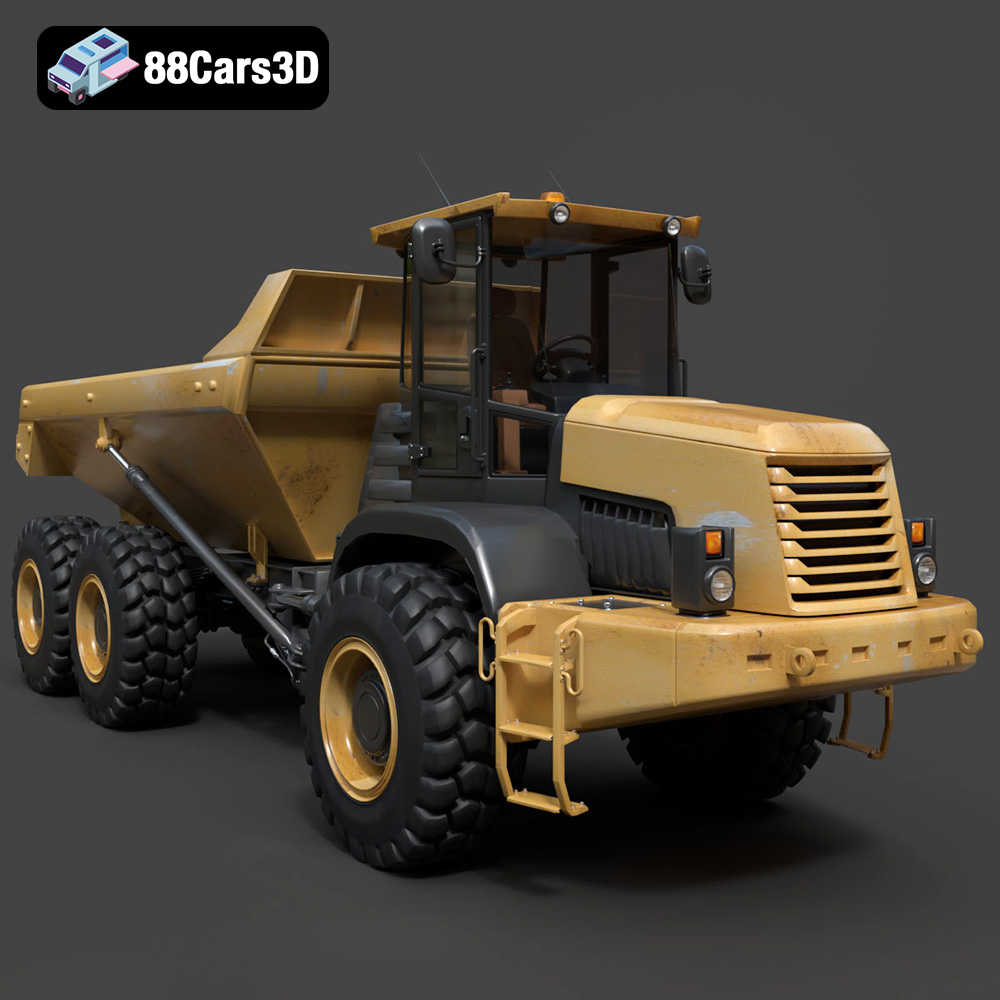
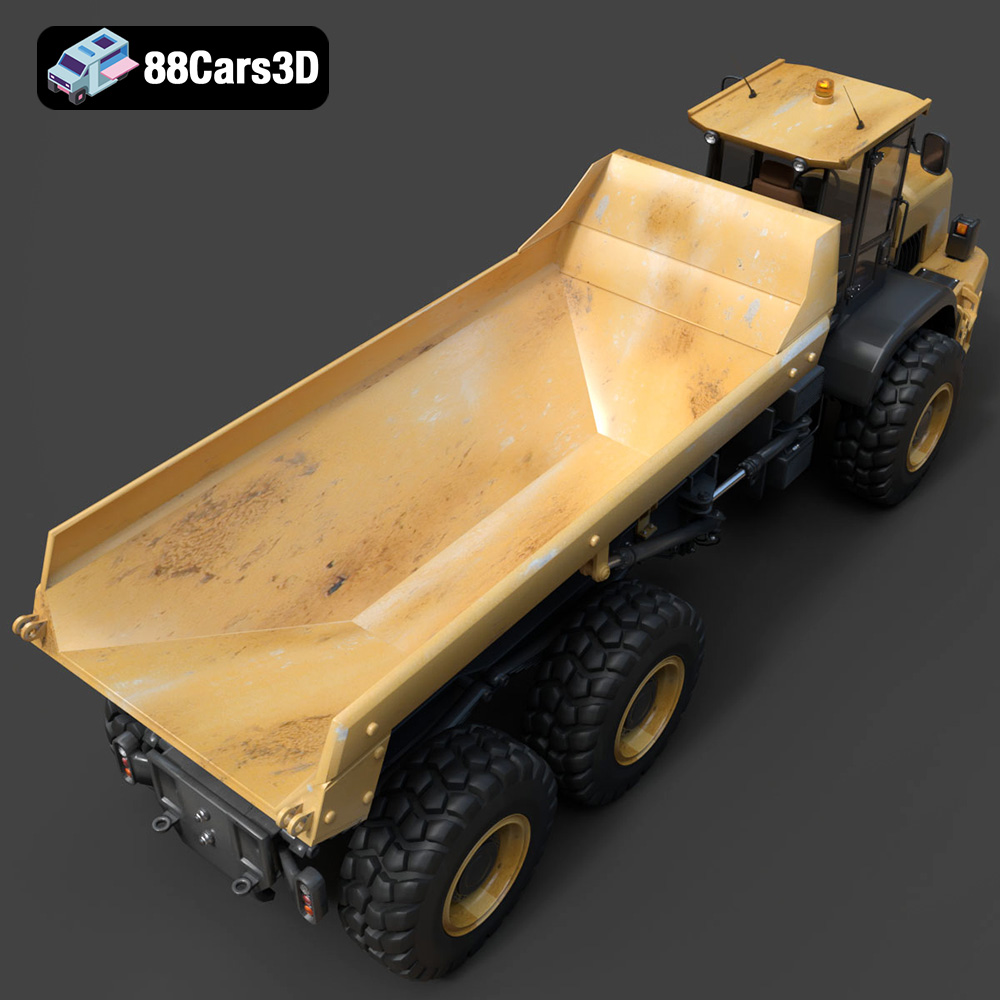
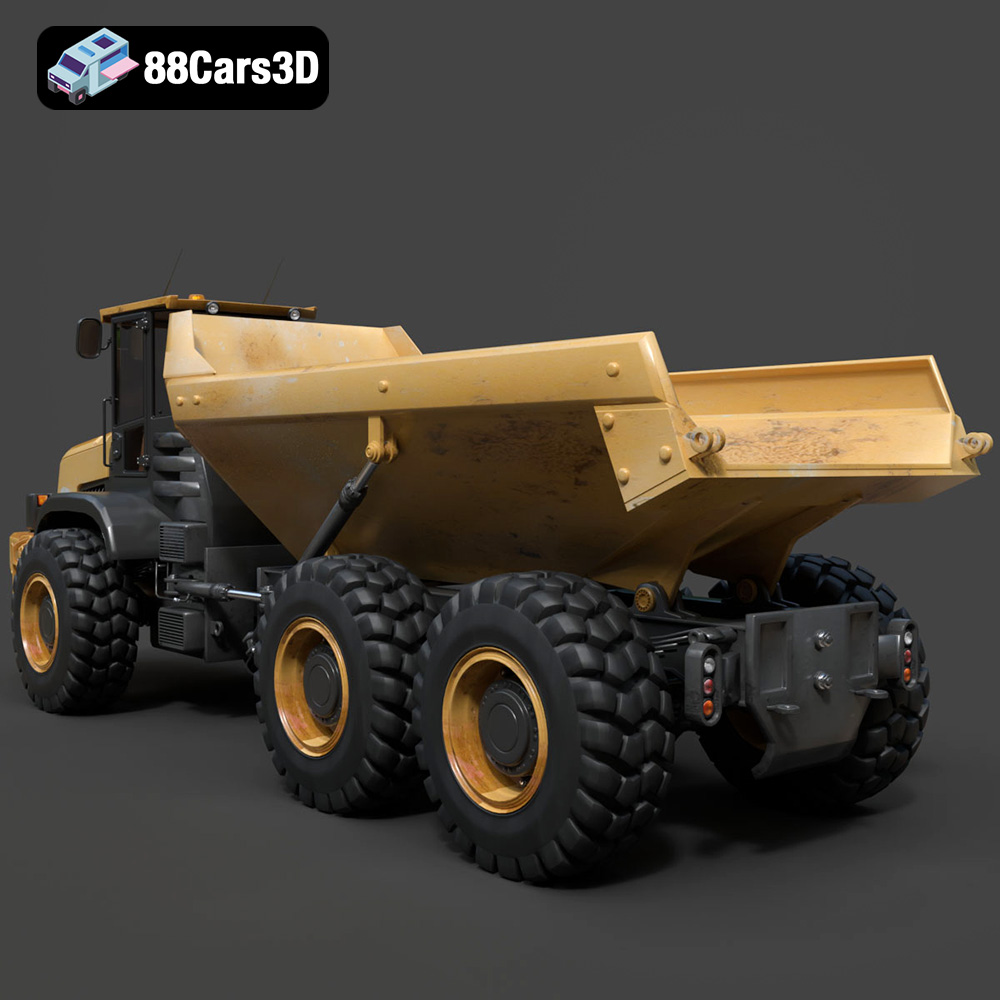
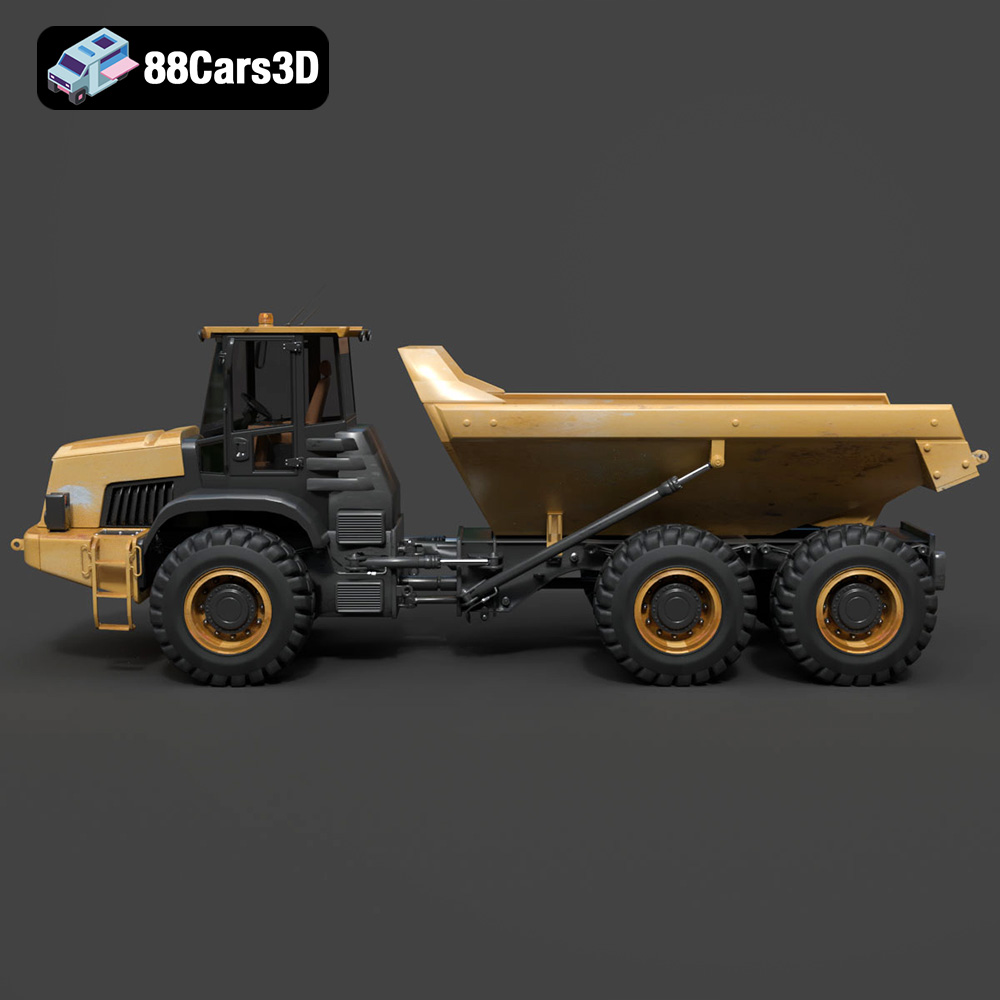
This model captures the imposing presence of a real-world articulated dump truck with remarkable accuracy. The geometry faithfully recreates the robust articulated chassis, a defining feature that grants these vehicles their exceptional maneuverability over challenging terrains. Every industrial proportion has been carefully considered, from the immense off-road deep-tread tires and heavy rims to the intricate heavy-duty suspension system. Builders and designers will appreciate the inclusion of a detailed heavy-duty diesel engine block and exhaust stacks, providing the realism necessary for close-up renders or in-depth technical simulations. Functional hydraulic cylinders and the dump bed mechanics are not just visually present but are designed with proper pivot setups, ready for animation to simulate the truck’s core operation – the massive payload tipping. Even smaller details, such as industrial safety lighting, headlights, and beacon details, are meticulously modeled, enhancing the overall authenticity.
Beyond the formidable exterior, the Articulated Dump Truck 3D Model offers a fully realized interior, crucial for applications like VR training or first-person simulator experiences. The cockpit is an accurate representation of an industrial operator’s environment, featuring a detailed operator seat with safety restraints, a comprehensive steering wheel, and realistic joystick control panels. The instrument cluster includes both digital and analog readouts, ensuring that any simulation accurately conveys real-world operational feedback. Foot pedals, safety levers, and transmission controls are all present, allowing for an optimized geometry that provides an immersive first-person point-of-view. This level of interior detail transforms the model from a static object into a potential interactive environment, offering immense value for serious simulation developers.
The true value of a high-quality 3D model lies in its seamless integration into diverse professional workflows. Whether you’re a game developer, an architect visualizing a construction site, or a VR trainer, the Articulated Dump Truck 3D Model is designed for maximum compatibility and ease of use across industry-standard software.
For users of Autodesk 3ds Max, the included .max file offers a native, fully editable project. This is invaluable for tasks requiring extensive customization, advanced animation, or high-fidelity rendering. Within 3ds Max, professionals can leverage tools like Reactor for realistic physics simulations of the dump bed’s tipping mechanism or use the robust animation tools to create complex sequences involving the articulated joint and hydraulic cylinders. For photorealistic outputs, pairing the model with rendering engines like V-Ray or Corona Renderer allows artists to apply advanced material shaders, intricate lighting setups, and depth of field effects to create stunning marketing visuals or architectural visualizations. Imagine the truck positioned dynamically on a virtual construction site, rendered with lifelike dust and grime, showcasing its true industrial character.
Blender users benefit from the dedicated .blend file, providing full access to the model’s structure within their preferred open-source environment. This allows for deep modification, re-texturing, or integrating the model into complex Blender scenes. Game developers can utilize Blender’s robust modeling and UV editing tools to further optimize the mesh or create custom LODs (Levels of Detail) if needed. Blender’s Grease Pencil can even be used for quick annotation during development. The Cycles and Eevee renderers offer powerful options for both realistic and stylized outputs, making the Articulated Dump Truck a versatile asset for indie game projects or detailed cinematic sequences.
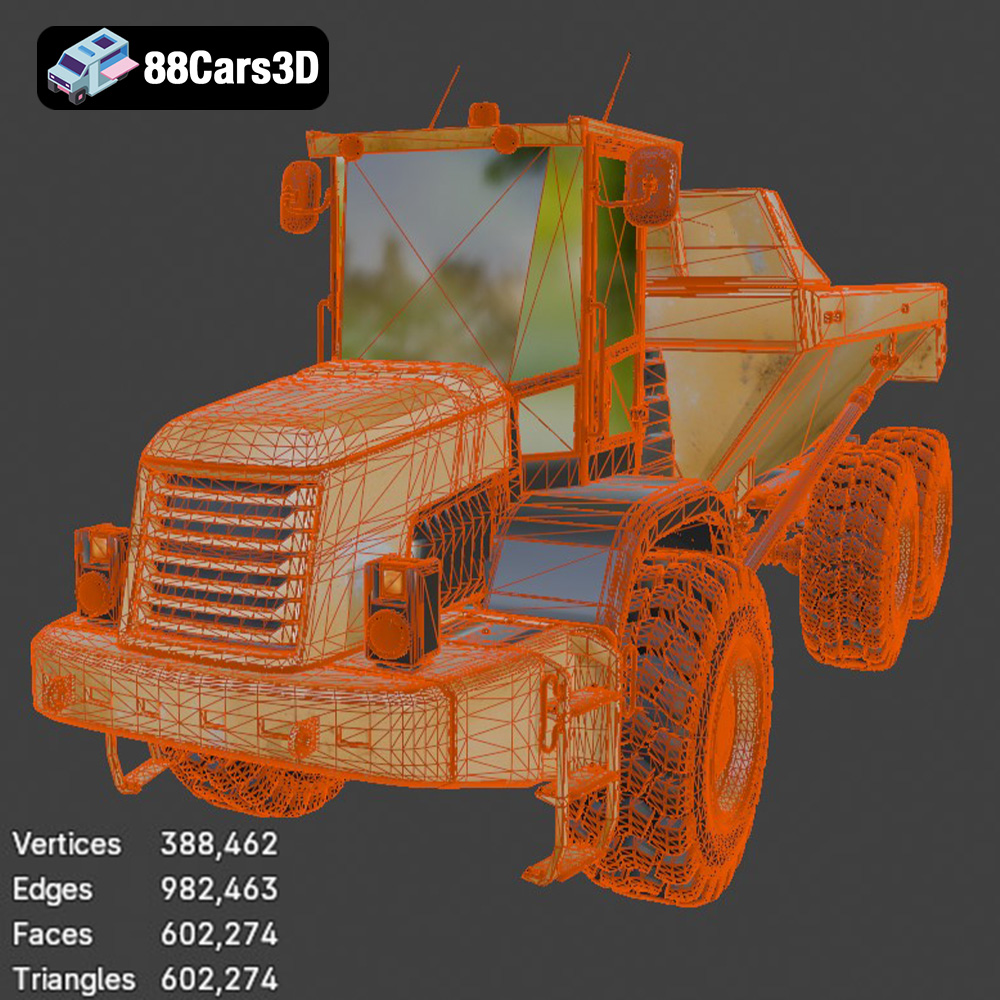
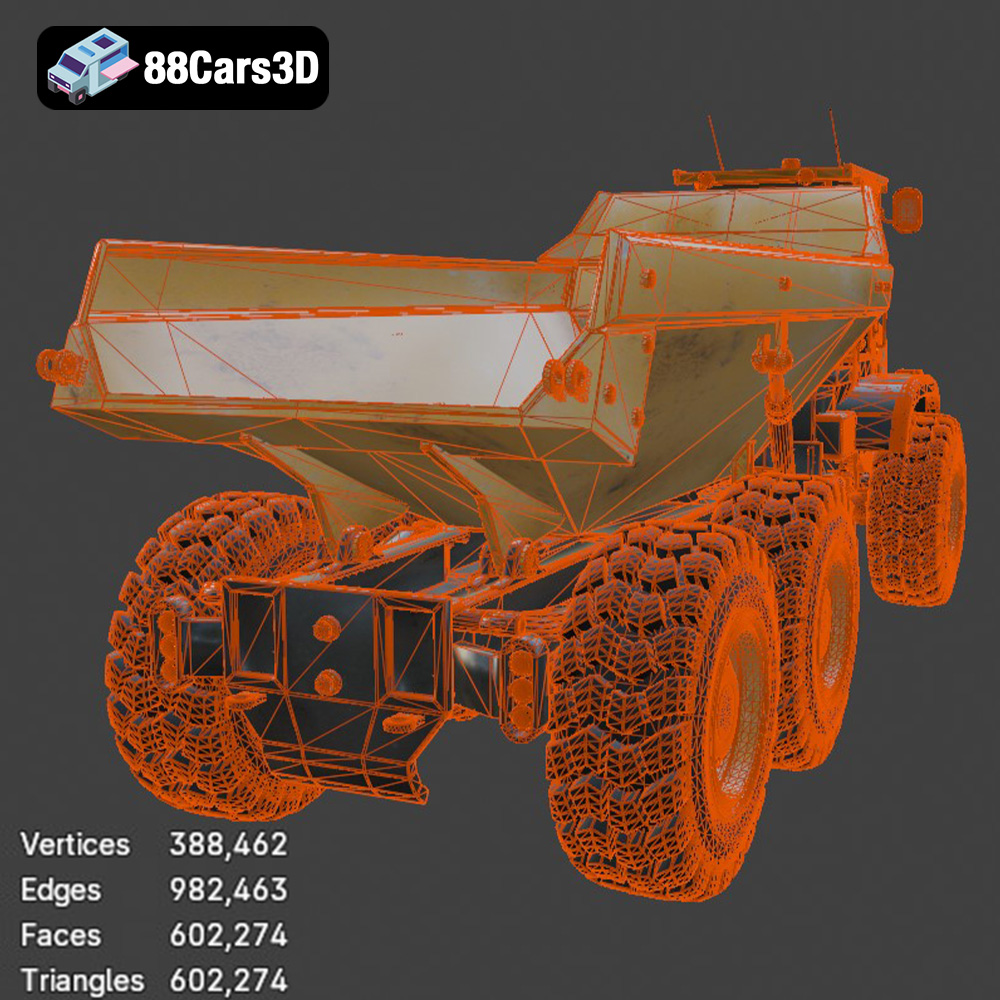
For real-time applications, particularly within the game development and simulation sectors, Unreal Engine is a dominant force. The Articulated Dump Truck 3D Model is “Game-Ready & Optimized,” meaning its 602,274 triangles strike an excellent balance between visual fidelity and real-time performance. With the .fbx and potentially pre-configured “.unreal” assets, importing the truck into Unreal Engine is straightforward. Developers can set up PBR (Physically Based Rendering) materials using the engine’s powerful material editor, integrate physics assets for dynamic interactions, and establish collision meshes for realistic gameplay. The model’s proper pivot setup for steering, wheel rotation, bed tipping, and chassis articulation is critical here, allowing for immediate rigging and animation within Unreal’s sequencer or blueprint system. This makes it an ideal asset for open-world games, heavy machinery simulators, or interactive VR training modules where performance and realism are paramount.
The utility of a highly detailed 3D model extends far beyond digital rendering. The Articulated Dump Truck 3D Model’s robust design and included file formats open doors to tangible creations and immersive interactive experiences, broadening its appeal to a diverse range of users.
For hobbyists, educators, or professionals requiring physical prototypes, the Articulated Dump Truck 3D Model is convertible to .stl format, making it ready for 3D printing. This capability transforms a virtual asset into a tangible display piece or a functional prototype. The recommended scales (1:12, 1:18, 1:24) ensure that printed models retain significant detail while remaining manageable. The suggestion of resin printing for fine details highlights the model’s intricate components, such as exhaust pipes and hydraulic lines, which benefit from higher resolution printing. Specific advice on layer height, wall thickness, infill, and supports guides users through the printing process, helping them achieve optimal results. Post-processing steps like sanding and painting can further enhance the realism, allowing for authentic factory colors and metallic finishes, creating a desk-sized replica that mirrors its full-scale counterpart.
The Articulated Dump Truck 3D Model is perfectly suited for modern AR/VR applications. Its optimized polycount and real-world scale accuracy make it an excellent candidate for immersive virtual showrooms, where potential buyers can explore the machinery in a 3D space, or for interactive configurators that allow for real-time customization. In VR training environments, this model becomes an invaluable tool. Operators can learn safety procedures, practice complex maneuvers, or familiarize themselves with the cockpit controls in a risk-free, immersive setting. The optimized geometry for first-person POV in simulators, combined with the detailed interior, offers a truly engaging experience. The .glb format is particularly beneficial here, ensuring efficient loading and display on AR/VR devices and web browsers, facilitating easy deployment of these advanced interactive experiences.
Achieving a balance between breathtaking visual quality and efficient performance is the hallmark of a professionally crafted 3D model. The Articulated Dump Truck 3D Model exemplifies this crucial balance, providing an asset that is both stunning and functional across various platforms.
With a triangle count of 602,274, the Articulated Dump Truck is engineered to be “Game-Ready & Optimized.” This specific polycount is not arbitrary; it represents a carefully calculated sweet spot. It’s detailed enough to offer high-end visual realism for close-up shots and cinematic sequences, yet optimized to perform efficiently within real-time engines like Unreal Engine and Unity. For game developers, this means less time spent on manual optimization and more time on creative implementation. The accurate topology further aids in performance by ensuring clean deformation during animation and efficient UV mapping for texture application, reducing rendering overhead.
Beyond static appearance, the model’s structural integrity is crucial for any dynamic application. The careful crafting ensures that the geometry maintains stability even under complex operations. Moreover, the Articulated Dump Truck features separate wheels, chassis sections, and hydraulic components, which is a key advantage for animators. This modularity, combined with the proper pivot setup for steering, wheel rotation, bed tipping, and chassis articulation, means the model is inherently animation-ready. Animators can quickly set up intricate movements, from the realistic turning radius of the articulated joint to the precise hydraulic action of the dump bed, without extensive re-rigging or cleanup.
A truly versatile 3D asset provides a solid foundation but also allows for creative freedom and adaptation to specific project needs. The Articulated Dump Truck 3D Model offers excellent customization options, enabling artists and developers to tailor its appearance to perfectly match their vision.
The ability to easily change body and tank colors is fundamental for adapting the truck to various branding or environmental contexts. Whether it’s the iconic factory yellow, a vibrant construction orange, or a custom color scheme for a specific client, modifying these elements is straightforward. Furthermore, adjusting material finishes – from matte and gloss to metallic – allows for a wide range of aesthetic outcomes. A weathered, matte finish might suit a gritty construction game, while a clean, glossy metallic finish could be perfect for a virtual showroom rendering. The separate components of the model further facilitate this, allowing for distinct material properties on different parts like the tires, engine block, or hydraulic lines.
The customization extends to more specialized elements like tire textures. The option to modify these from off-road to street variants means the truck can seamlessly fit into different virtual environments – from muddy, rocky mining sites to paved urban construction zones. Similarly, adapting lighting for different environments is crucial for photorealistic rendering. The model’s robust material setup allows it to react realistically to various lighting conditions, from bright daylight to moody twilight or indoor workshop illumination. This flexibility ensures that the Articulated Dump Truck 3D Model can be a consistent and high-quality asset across a multitude of visual scenarios, enhancing its longevity and value in any creative library.
In the demanding landscape of 3D production, from high-stakes game development to precision industrial simulations, the quality of your 3D assets can make or break a project. The Articulated Dump Truck 3D Model stands as a prime example of an asset that marries exceptional visual fidelity with robust technical optimization. Its detailed geometry, comprehensive interior, real-world scale, and animation-ready features make it an indispensable tool for professionals across diverse industries. From its meticulous exterior and cockpit features to its game-ready polycount and broad file format compatibility, every aspect has been crafted to accelerate workflows and elevate visual standards.
Whether you’re rendering photorealistic stills in 3ds Max, building an immersive VR training module in Unreal Engine, or even 3D printing a physical replica, this model provides the foundation you need. The versatility of included formats—from fully editable .blend and .max files to universal .fbx and web-optimized .glb—ensures that it integrates seamlessly into virtually any professional pipeline. This commitment to quality and flexibility is what defines the offerings at 88cars3d.com, where you can find an extensive collection of high-quality 3D car models and industrial assets designed to meet the rigorous demands of modern digital production. Elevate your next project with assets built for performance, realism, and unparalleled creative freedom.
The Articulated Dump Truck is a heavy-duty titan of construction and mining, designed to transport massive payloads over the most challenging terrains. Known for its rugged articulated chassis, immense hauling capacity, and robust hydraulic tipping mechanism, this workhorse is essential for earthmoving operations. Distinctive features include its massive off-road tires, heavy-duty dump bed, and functional pivot joint that provides unmatched maneuverability in tight, muddy job sites.
This high-quality 3D model boasts a detailed geometry with a triangle count of 602,274, delivering exceptional visual fidelity while maintaining structural integrity for close-up shots. Carefully crafted for accurate topology, this asset is highly versatile for industrial game development, heavy machinery simulation, VR training environments, and photorealistic architectural visualization.
$44.50
.blend
.fbx
.glb
.industrial
.max
.obj
.ply
.rendering
.stl
.unreal
articulated-dump-truck
construction-vehicle
dump-truck
game asset
game-ready
heavy-machinery
high poly
optimized
truck-3d-model
VR/AR