Get 20% OFF All Premium 3D & STL Models!

The automotive world has always been a muse for artists and engineers, but few vehicles encapsulate an era’s grandeur quite like the 1933 Cadillac V16 (452-C) Town Car. A symphony of pre-war luxury, bespoke craftsmanship, and unprecedented engineering, its colossal 16-cylinder engine and distinctive open-chauffeur body style cemented its status as an icon of 1930s elegance. For 3D artists, game developers, and visualization specialists, recreating such a masterpiece is more than just a technical challenge—it’s an act of digital preservation. It demands an acute understanding of historical accuracy, intricate modeling techniques, and versatile file formats to bring this legend back to life in pixels, polygons, and prints.
Today, thanks to advanced 3D modeling, we can not only admire but also interact with this classic in entirely new dimensions. A meticulously crafted digital replica, such as the *Cadillac V16 452-C Town Car 1933 3D Model* available on 88cars3d.com, offers an unparalleled opportunity to integrate this historical marvel into diverse modern projects. From high-fidelity cinematic renderings to optimized real-time game environments and even physical 3D prints, this model bridges the gap between historical reverence and contemporary digital application. It serves as a testament to how sophisticated 3D assets can empower creators across various industries, providing a foundation for immersive experiences and stunning visualizations.
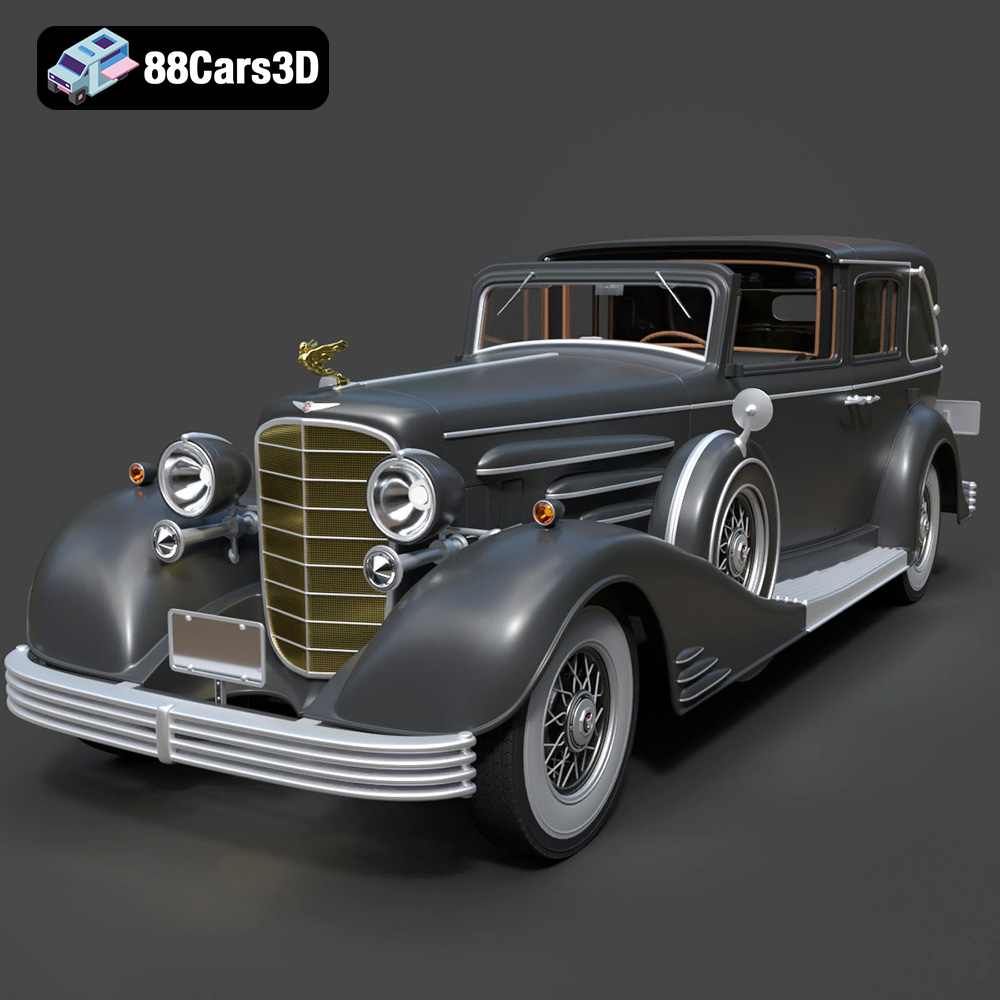
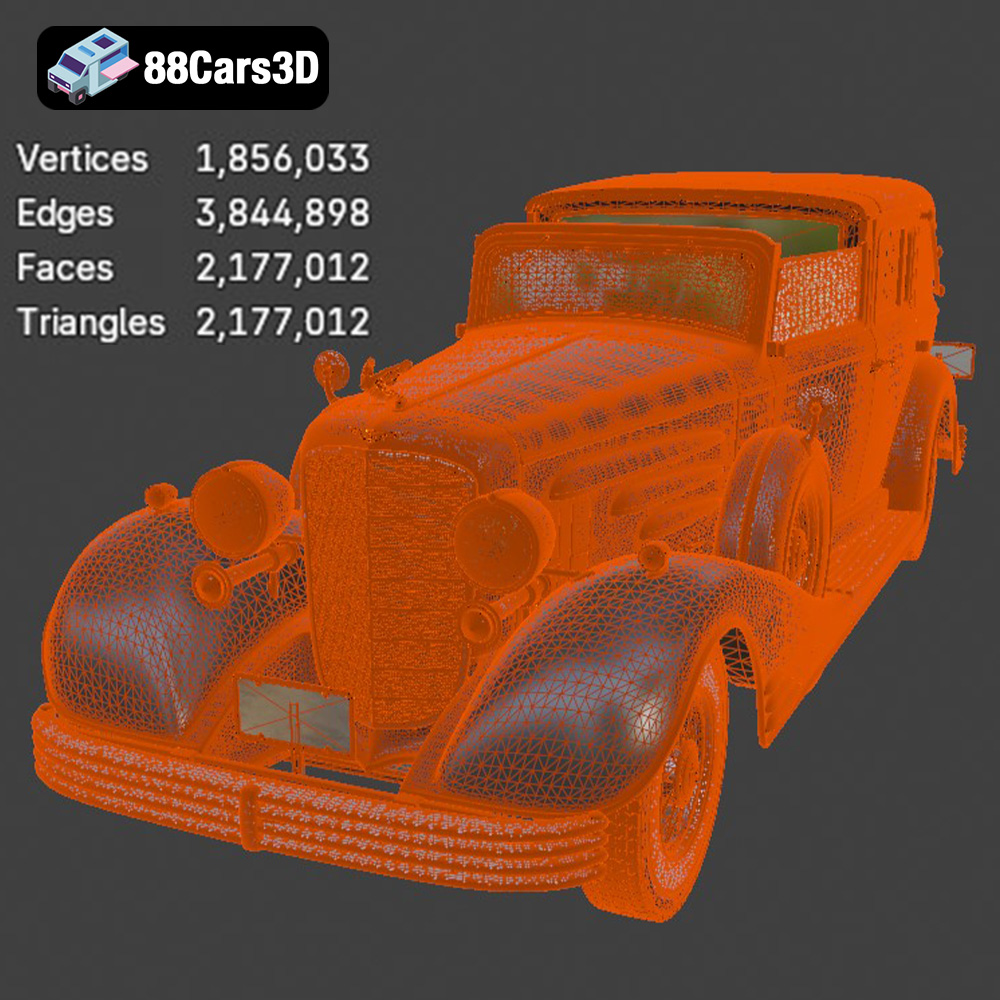
Recreating a vehicle of the Cadillac V16’s stature in 3D is an exercise in meticulous detail. Every sweeping pontoon fender, every gleaming chrome accent, and the iconic Goddess hood ornament must be accurately represented. For artists working on period pieces, historical recreations, or luxury virtual showrooms, the fidelity of the 3D model directly impacts the authenticity and impact of the final output. The *Cadillac V16 452-C Town Car 1933 3D Model* excels here, boasting a robust topology of 2,177,012 triangles. This seemingly high count is precisely what allows for the capture of nuanced curves and intricate details that define its breathtakingly regal silhouette, while being intelligently structured for versatile high-end digital applications.
Its detailed engine block enclosures, authentic dual exhaust, and period-correct lighting, including massive bullet-style headlights, are not just aesthetic choices—they are crucial components for convincing realism. The model even includes intricate multi-spoke wire wheels fitted with classic wide whitewall tires and historically accurate leaf spring suspension detailing, showcasing a commitment to comprehensive accuracy that elevates it beyond a mere visual shell.
The versatility of a premium 3D asset like the *Cadillac V16 452-C Town Car 1933 3D Model* is heavily dependent on the range and quality of its included file formats. Each format serves a specific purpose, catering to different software, workflows, and end applications. Understanding when and why to use each one is crucial for any professional working with 3D content.
The `.blend` format is the native file type for Blender, a powerful open-source 3D creation suite. When you receive a `.blend` file, you’re not just getting a mesh; you’re getting a fully editable Blender scene. This includes all geometry, materials, textures, lighting, camera setups, and even animation data within a single package. For artists primarily working in Blender, this is invaluable. It allows for direct manipulation of the model’s structure, modification of shaders, adjustment of scene lighting, and even the addition of new animation without any loss of data or conversion artifacts. The `.blend` file for the Cadillac V16 offers unparalleled flexibility for customization and further development within the Blender ecosystem.
The `.fbx` (Filmbox) format is arguably the most widely adopted interchange format in the 3D industry. Developed by Autodesk, it’s designed to facilitate data exchange between various 3D software applications and game engines like Unreal Engine and Unity. An `.fbx` file can store a comprehensive range of 3D data, including meshes, materials (with texture paths), animations, skeletal data, and more. It’s particularly ideal for real-time pipelines due to its optimized structure for engine import. The `.fbx` version of the Cadillac V16 ensures smooth integration into virtually any professional workflow, making it a go-to for exporting game assets or complex scenes between different DCC (Digital Content Creation) tools.
The `.obj` (Wavefront OBJ) format is one of the oldest and most universally supported 3D file formats. It’s a simple, text-based format primarily used to store 3D geometry data (vertices, normals, texture coordinates, and faces) and material references (via an associated `.mtl` file). While it doesn’t support advanced features like animation or rigging, its simplicity ensures broad compatibility across almost all 3D software. For static meshes, or when you need a foundational geometry to import into an obscure or specialized application, `.obj` is a reliable choice. The Cadillac V16 in `.obj` format provides a clean, compatible base mesh for any project.
The `.glb` (GL Transmission Format Binary) is an increasingly popular format optimized for efficient transmission and loading of 3D scenes and models on the web, in AR/VR applications, and mobile environments. It’s a binary version of the `glTF` format, meaning all assets—geometry, textures, animations, materials—are self-contained within a single file. This makes `.glb` incredibly lightweight and ideal for browser-based viewers, online configurators, and augmented reality experiences where quick loading and rendering are paramount. The `.glb` version of the Cadillac V16 is perfect for showcasing this luxury car in a virtual showroom directly within a web browser or integrating it into a mobile AR app.
The `.stl` (Stereolithography) format is the standard file type for 3D printing. It represents a 3D model as a series of connected triangles, describing only the surface geometry of an object without color, texture, or other advanced attributes. When a 3D model is prepared for printing, it’s typically converted to `.stl`. The `.stl` version of the Cadillac V16 enables hobbyists and professionals alike to bring this digital classic into the physical world, creating display-scale models. It requires careful preparation and understanding of printing parameters, which are often provided for premium models to ensure successful physical replication.
The `.ply` (Polygon File Format) is another popular format for storing 3D data, particularly useful for models generated from 3D scanners or for applications requiring precise mesh data for CAD or analysis. It can store not just geometric information but also properties like color, transparency, surface normals, and even confidence values for each vertex or face. While not as universally used as FBX or OBJ, `.ply` offers robust capabilities for detailed data capture and scientific visualization, making the Cadillac V16 model suitable for more analytical or engineering-focused endeavors.
The `.unreal` format signifies an asset specifically prepared and often packaged for Unreal Engine. This typically means the asset has been optimized for the engine’s rendering pipeline, potentially including pre-configured materials, Blueprints, LOD (Level of Detail) settings, and collision meshes. While Unreal can import `.fbx` files, a dedicated `.unreal` package streamlines the workflow significantly, often providing an “out-of-the-box” ready asset that minimizes setup time for game developers. The `.unreal` version of the Cadillac V16 is thus a premium offering for those building high-fidelity real-time experiences.
The `.max` format is the native file type for Autodesk 3ds Max, one of the leading software packages for 3D modeling, animation, and rendering. Similar to `.blend` for Blender, a `.max` file contains the complete scene data, including all geometry, modifiers, materials, textures, lighting, cameras, and animation curves. For artists and studios heavily invested in the 3ds Max ecosystem, this format provides the highest level of editability and integration within their existing pipelines, allowing for advanced rendering setups and complex animations. The `.max` file for the Cadillac V16 ensures that professionals using this software can leverage all its features to achieve stunning results.
This diverse selection of formats ensures that the *Cadillac V16 452-C Town Car 1933 3D Model* is a truly versatile asset, ready for deployment across a multitude of platforms and creative challenges.
Creating a 3D model like the Cadillac V16 452-C Town Car 1933 requires more than just knowing where the buttons are in your software; it demands an understanding of form, historical context, and technical precision. The goal is not just to replicate the shape, but to imbue the digital asset with the spirit and details of the original. This is where the artistry of 3D modeling truly shines.
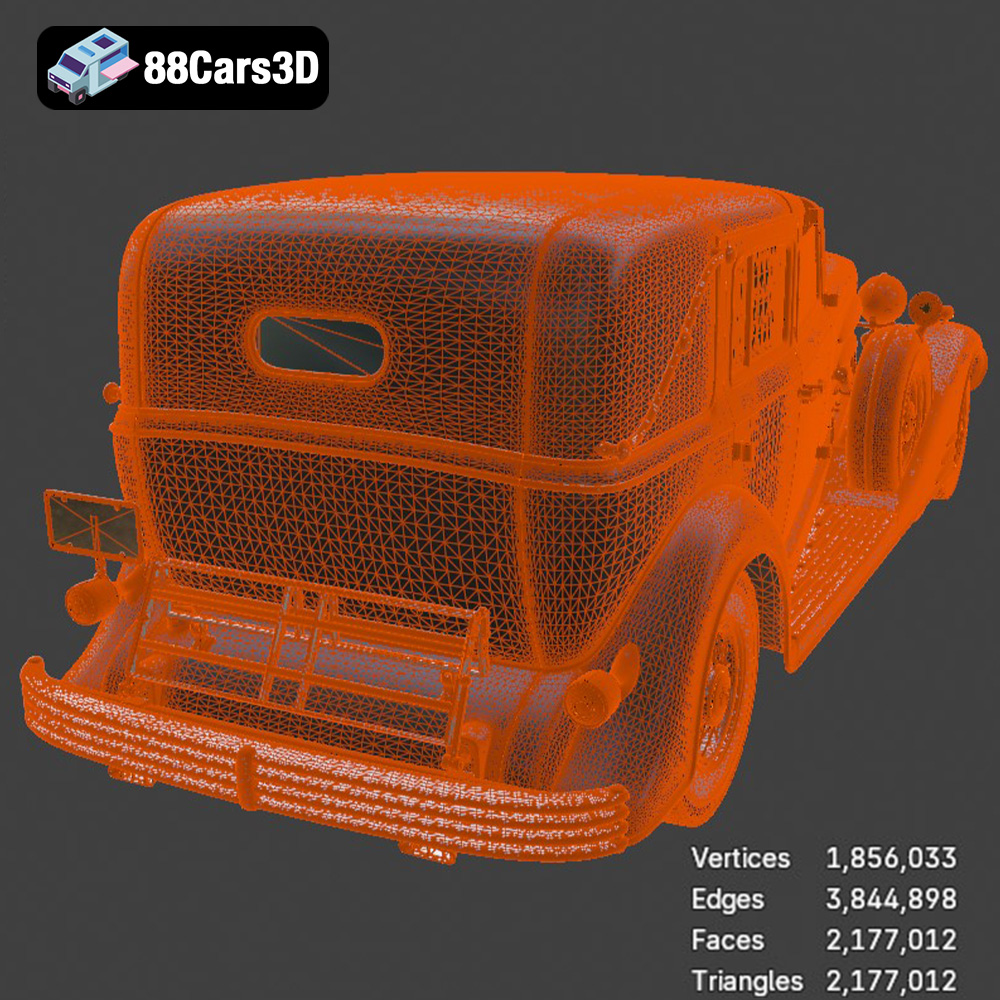
The foundation of any high-quality 3D model lies in its topology—the arrangement of vertices, edges, and faces that form the mesh. For the Cadillac V16, a detailed topology of 2,177,012 triangles strikes a crucial balance. This isn’t just a high number for the sake of it; it’s a carefully considered polygon budget that allows for ultra-fine details like the contours of the sweeping pontoon fenders, the sharp edges of the chrome grille, and the intricate spokes of the wire wheels. Good topology ensures smooth subdivisions, clean deformations for animation, and efficient UV mapping, which is essential for texture application without distortion. The model’s real-world scale accuracy, based on the actual 1933 vehicle chassis and wheelbase, further grounds its realism.
True fidelity extends beyond the visible exterior. The *Cadillac V16 452-C Town Car 1933 3D Model* distinguishes itself with comprehensive detailing both inside and out. The inclusion of accurate Cadillac V16 (452-C) Town Car frame geometry and detailed engine block enclosures showcasing the legendary 452 cubic-inch V16 layout speaks volumes about the model’s depth. Underneath, authentic dual exhaust systems and undercarriage details ensure that even angles rarely seen maintain historical accuracy. Inside, the opulent rear passenger compartment with tufted seating and rich woodwork, alongside the exposed driver’s open-air cockpit, brings the interior to life. The classic Art Deco instrument cluster and detailed gauges further immerse the viewer, making it suitable for even first-person POV in gaming and VR experiences.
Once a high-fidelity 3D model like the Cadillac V16 is created, the next step is often to render it into stunning, photorealistic images or animations. This process involves setting up materials, lighting, and camera angles within a dedicated rendering environment.
Both 3ds Max and Blender offer robust rendering engines capable of producing breathtaking visuals. For artists using 3ds Max, the included `.max` file provides a direct pathway to leveraging its powerful rendering capabilities, often with pre-configured materials and potentially V-Ray or Corona Renderer setups. Users can easily adjust lighting scenarios, add environmental effects, and fine-tune shaders to achieve desired looks—from a glistening showroom car to a weathered historical piece. The separate wheels, suspension, and steering components in the model also allow for complex animation sequences, from driving shots to detailed mechanical demonstrations.
Blender, with its Cycles and Eevee render engines, offers similar capabilities. The `.blend` file is fully editable, allowing artists to explore various material finishes, such as matte leather, gloss paint, and highly polished chrome. Customization options, like changing body/coachwork colors to classic two-tone 1930s factory finishes, can be effortlessly applied. The ability to adapt lighting for different environments—be it a moody film noir scene or a brightly lit virtual museum—makes this model incredibly flexible for diverse visualization projects. High-quality textures and careful UV mapping ensure that every material, from the metallic finishes to the tire textures, renders flawlessly.
The *Cadillac V16 452-C Town Car 1933 3D Model* is an exceptional asset for architectural visualization and cinematic productions. Imagine this majestic vehicle gracing the driveway of a meticulously rendered Art Deco mansion, or cruising through a meticulously reconstructed 1930s street scene in a historical drama. Its high level of detail makes it suitable for close-up shots, and its accurate proportions ensure it integrates seamlessly into any period environment. The intelligence of its geometry, despite the high triangle count, means it can be readily incorporated into complex scenes without bogging down render times unnecessarily, especially when optimized workflows like proxy objects or instancing are employed.
Beyond static renders, the true test of a versatile 3D asset lies in its performance within real-time interactive environments, such as video games, virtual reality, and augmented reality applications. The *Cadillac V16 452-C Town Car 1933 3D Model* has been designed with these demanding scenarios in mind.
The product description explicitly states “Game-Ready & Optimized” with a 2,177,012 triangle count, striking a perfect balance for high-end real-time engines like Unreal Engine and Unity. While this polycount is significant, it allows for breathtaking visual realism without compromising excessively on performance in modern hardware-accelerated engines. The `.fbx` and `.unreal` formats are crucial here. The `.fbx` is the standard for importing assets into both Unreal and Unity, carrying all necessary mesh, material, and animation data. The `.unreal` file takes this a step further, offering an engine-ready asset with potentially pre-configured materials, LODs (Levels of Detail), and physics assets, drastically speeding up integration.
Key technical advantages for game development include:
Case studies show premium 3D car models like this being used in classic car driving simulators, where fidelity is paramount, or as hero vehicles in period-set open-world games, delivering an unparalleled level of historical immersion.
The growth of AR/VR technology presents exciting new avenues for this model. For immersive virtual showrooms, configurators, or museum-grade interactive visualizations, the *Cadillac V16 452-C Town Car 1933 3D Model* is an ideal candidate. The `.glb` format, optimized for web and AR/VR, facilitates its deployment on mobile devices for augmented reality experiences, allowing users to place a virtual 1933 Cadillac in their real-world environment. Imagine exploring every detail of the car’s exterior and interior, or even changing its classic two-tone factory finishes in real-time, all within an immersive virtual space. The optimized polycount ensures smooth frame rates, critical for preventing motion sickness and providing a comfortable, engaging AR/VR experience.
The journey of a 3D model doesn’t always end on a screen. For enthusiasts and collectors, the ability to physically hold a miniature replica of the *Cadillac V16 452-C Town Car 1933* is a compelling prospect. The inclusion of the `.stl` format specifically caters to this rapidly growing segment of 3D modeling applications.
The `.stl` format converts the complex surfaces of the digital model into a mesh of triangles suitable for 3D printers. While the model is highly detailed digitally, preparing it for 3D printing requires specific considerations:
This meticulous attention to 3D printing guidelines ensures that the physical manifestation of the Cadillac V16 is as impressive as its digital counterpart, making it a truly multi-purpose asset for both digital and tangible applications.
In the competitive world of 3D content creation, efficiency and quality are paramount. Sourcing high-quality, pre-made 3D car models, especially iconic ones like the *Cadillac V16 452-C Town Car 1933 3D Model* from a reputable marketplace like 88cars3d.com, offers significant advantages over building assets from scratch.
Professional studios, whether in game development, film VFX, or architectural visualization, constantly seek ways to streamline their production pipelines. A ready-to-use, meticulously detailed 3D car model saves hundreds of hours of modeling, texturing, and optimization time. This allows artists to focus on creative direction, scene composition, lighting, and animation, rather than the foundational asset creation. The *Cadillac V16 452-C Town Car 1933 3D Model*, with its “Game-Ready & Optimized” status and wide array of file formats, is designed precisely for this purpose. Its proper pivot setup for animation and real-world scale further reduce integration challenges, making it a plug-and-play solution for many scenarios.
Consider a historical documentary needing accurate vehicle models for CGI shots. Recreating a 1933 Cadillac V16 from scratch would be cost-prohibitive. Leveraging a high-fidelity model from 88cars3d.com provides an immediate, historically accurate asset. Similarly, for a luxury automotive brand creating an interactive virtual showroom for classic car enthusiasts, this model provides the centerpiece, allowing customers to explore the car’s exquisite details in VR. For a mobile game developer building a period racing game, the optimized geometry ensures excellent performance on various devices without sacrificing visual quality. The versatility offered by the `.blend`, `.fbx`, `.obj`, `.glb`, `.stl`, `.ply`, `.unreal`, and `.max` formats means that irrespective of the target software or platform, there is a suitable version ready for deployment. This commitment to cross-platform compatibility underscores the professional value of such an asset.
The 1933 Cadillac V16 (452-C) Town Car is more than just a car; it’s a piece of history, an engineering marvel, and an artistic statement. Its digital reincarnation as a premium 3D model allows this legacy to thrive in the modern era of interactive media and visualization. By offering an extraordinary level of visual fidelity, a detailed yet optimized topology, and an extensive suite of industry-standard file formats, the *Cadillac V16 452-C Town Car 1933 3D Model* stands out as an indispensable asset.
Whether you are crafting cinematic period pieces in 3ds Max, developing immersive classic car driving simulators in Unreal Engine, building luxury virtual showrooms for AR/VR, or even bringing this majestic vehicle to life through 3D printing, this model provides the robust foundation you need. Its detailed exterior and interior features, coupled with thoughtful technical specifications and broad compatibility, make it a powerful tool for professionals across the 3D industry. Investing in such a high-quality 3D car model from 88cars3d.com empowers creators to achieve stunning realism and engage audiences in entirely new ways, proving that true artistry and engineering know no bounds, even in the digital realm.
The 1933 Cadillac V16 (452-C) Town Car is an undisputed masterpiece of American automotive history, representing the absolute pinnacle of pre-war luxury and bespoke coachbuilding. Renowned for its whisper-quiet, colossal 16-cylinder engine and the distinctive open-chauffeur “Town Car” body style, this magnificent vehicle defined 1930s elegance and prestige. Key visual elements include its sweeping pontoon fenders, the iconic Goddess hood ornament, majestic chrome V-shaped grille, and dual side-mount spare tires, all culminating in a breathtakingly regal silhouette. This premium 3D model boasts an extraordinary level of visual fidelity with a detailed topology of 2,177,012 triangles, capturing every nuanced curve and chrome accent of the classic original. Despite its high detail, the geometry is intelligently structured to ensure stunning photorealism while remaining versatile for high-end digital applications. It stands as an exceptional asset for developers and artists demanding true-to-life representation in historical recreations, architectural visualizations, and cinematic productions.
$37.50
.blend
.cadillac
.fbx
.glb
.max
.obj
.ply
.rendering
.stl
.unreal
.v16
1933
452-c
car-3d-model
classic-car
game asset
game-ready
luxury car
optimized
pre-war
town-car
VR/AR