Get 20% OFF All Premium 3D & STL Models!

In the dynamic world of digital content creation, the demand for realistic, high-quality 3D assets is ever-present. From the intricate detailing of a luxury sedan to the rugged authenticity of heavy machinery, creators across industries rely on meticulously crafted models to bring their visions to life. The challenge often lies in finding assets that are not only visually stunning but also technically optimized for diverse applications, whether it’s a bustling game environment, an immersive AR/VR training simulation, or a cinematic architectural visualization.
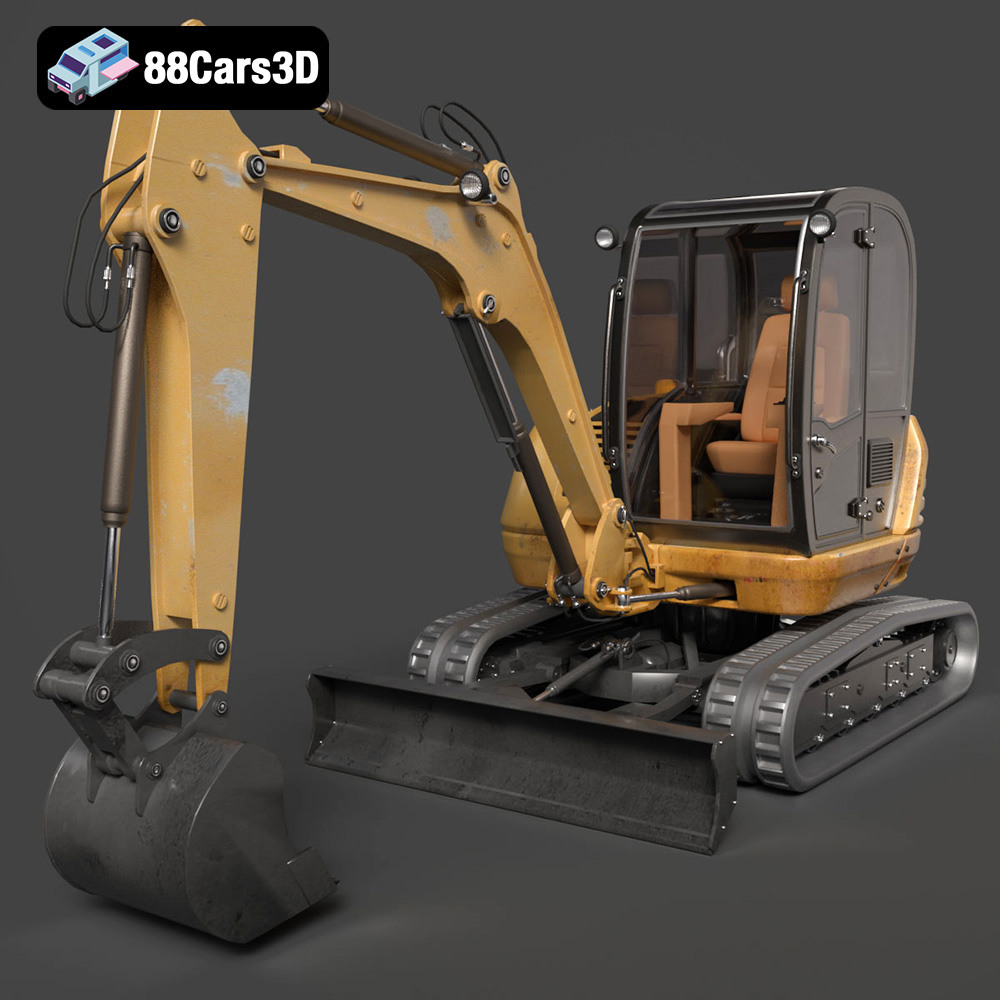
This is where specialized assets truly shine. Imagine the precision required to replicate the formidable presence of a construction vehicle, every hydraulic line, every track segment, every pivot point modeled with exacting accuracy. Such an asset forms the backbone of believable digital worlds. Today, we’re delving into one such exemplary creation: the Compact Track Excavator 3D Model Download STL FBX OBJ GLB Blend. This isn’t just another model; it’s a testament to professional-grade digital engineering, designed to seamlessly integrate into demanding pipelines and elevate any project that requires the robust power of modern construction equipment. Whether you’re a game developer, an architect, a simulation specialist, or a 3D printing enthusiast, this model offers a robust solution for a wide array of needs, embodying the quality you’d expect from a trusted source like 88cars3d.com.
Navigating the landscape of 3D production means understanding the language of file formats. Each format serves a specific purpose, excelling in certain applications while having limitations in others. Choosing the right format is crucial for workflow efficiency, compatibility, and ultimately, the success of your project. The Compact Track Excavator 3D Model, thoughtfully provided by 88cars3d.com, includes a comprehensive suite of formats, ensuring its utility across virtually any professional pipeline. Let’s break down these essential file types:
The .blend file is the native format for Blender, a powerful open-source 3D creation suite. When you download a .blend file, you’re getting a complete, fully editable Blender scene. This includes not just the mesh geometry, but also materials (often complex node-based setups for Cycles and Eevee renderers), textures, lighting, cameras, rigging, and even animations. For Blender users, this format offers unparalleled flexibility, allowing full customization, modification, and re-purposing of every aspect of the model. It’s the ideal choice if you intend to deeply integrate and modify the excavator within a Blender-centric workflow.
Autodesk’s .fbx (Filmbox) format is arguably the most widely adopted exchange format in the 3D industry. It’s an incredibly versatile format capable of storing complex scene data, including geometry, materials (though often simplified compared to native formats), textures, cameras, lights, skeletal rigs, and crucially, animation data. FBX is the go-to for transferring assets between different 3D software packages like Maya, 3ds Max, Blender, and directly into real-time game engines such as Unreal Engine and Unity. Its ability to embed media makes it a self-contained asset, simplifying asset management and ensuring consistent data transfer for assets like the excavator with its articulated components.
The .obj (Wavefront OBJ) format is one of the oldest and most universally supported 3D file formats. It primarily stores geometric data: vertices, normals, UV coordinates, and face definitions. While simple, it’s highly reliable for transferring mesh data between virtually any 3D application. It typically references a separate .mtl (Material Template Library) file for basic material properties and texture paths, but it does not support animation, rigging, or advanced scene data. For static meshes, or when you need a clean geometric base, the .obj format of the Compact Track Excavator is an excellent, highly compatible choice.
.glb is the binary version of the glTF (GL Transmission Format) standard, which is quickly becoming the “JPEG of 3D.” Designed for efficient transmission and loading of 3D scenes and models by engines and applications, .glb packages all necessary data—geometry, PBR materials, textures, and animations—into a single, self-contained binary file. This makes it exceptionally well-suited for web-based 3D viewers, augmented reality (AR) applications on mobile devices, and virtual reality (VR) experiences, where quick loading times and small file sizes are paramount. The excavator’s .glb format is perfect for showcasing it in a browser or integrating into an immersive experience.
The .stl (Stereolithography) format is the ubiquitous standard for 3D printing and rapid prototyping. It represents a 3D model as a collection of unconnected triangles, describing only the surface geometry without any color, texture, or material information. While simplistic, its robustness makes it ideal for manufacturing applications. When preparing the Compact Track Excavator for a physical print, the .stl file provides the clean, triangulated mesh required by slicer software, making the transition from digital asset to tangible model straightforward.
The .ply (Polygon File Format) is similar to OBJ in storing geometric information but can also include additional properties such as color per vertex, normal vectors, transparency, and confidence values. It’s particularly common in applications involving 3D scanning, scientific visualization, and CAD, where detailed attribute information per point or face is crucial. For specialized analysis or when importing highly detailed scanned data of machinery, the .ply format offers a robust and comprehensive data structure.
While not a traditional open file format like FBX or OBJ, the inclusion of an .unreal file implies a highly optimized, engine-ready asset specifically prepared for Unreal Engine. This typically means the model has been imported into Unreal, has its materials and textures properly set up, includes appropriate Level of Detail (LOD) meshes for performance optimization, and features pre-built collision geometry. For Unreal Engine developers, this format offers a significant workflow advantage, allowing for direct integration with minimal setup, saving countless hours and ensuring the model performs optimally in real-time environments.
The .max file is the native format for Autodesk 3ds Max, a leading software for 3D modeling, animation, and rendering. Similar to the .blend file for Blender, a .max file contains the complete 3ds Max scene, including all geometry, complex material setups (e.g., V-Ray, Corona, Arnold), textures, lights, cameras, animation data, modifiers, and scene hierarchy. For users entrenched in a 3ds Max workflow, this file provides the ultimate flexibility for advanced rendering, intricate animations, and detailed scene construction, leveraging the full power of 3ds Max for the Compact Track Excavator.
This diverse range of formats ensures that the Compact Track Excavator 3D Model is not just a high-quality asset but also an incredibly flexible one, ready for integration into virtually any professional creative pipeline.
Creating a 3D model that balances visual authenticity with technical efficiency is a demanding endeavor. This is especially true for complex machinery like an excavator, which features a myriad of moving parts, intricate mechanisms, and robust industrial styling. The Compact Track Excavator 3D Model available on 88cars3d.com stands as a prime example of this balance, showcasing meticulous attention to detail and optimization for performance.
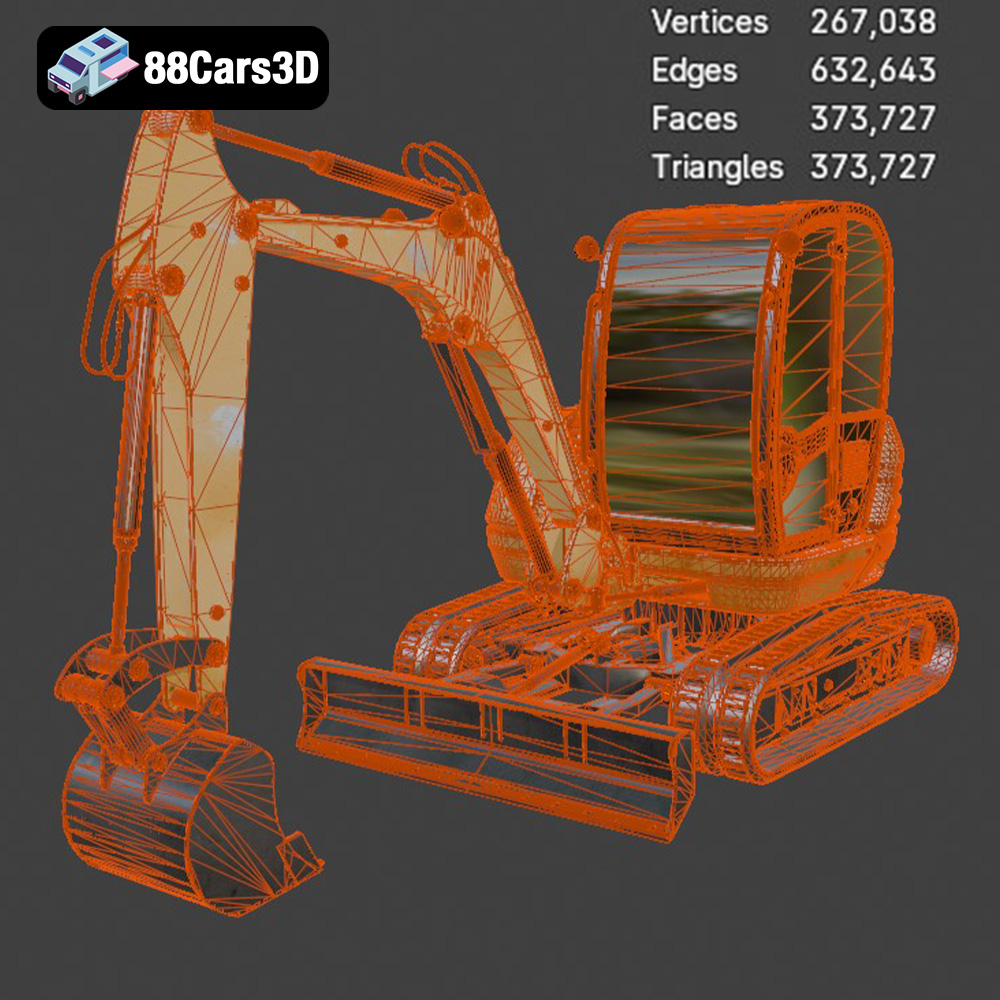
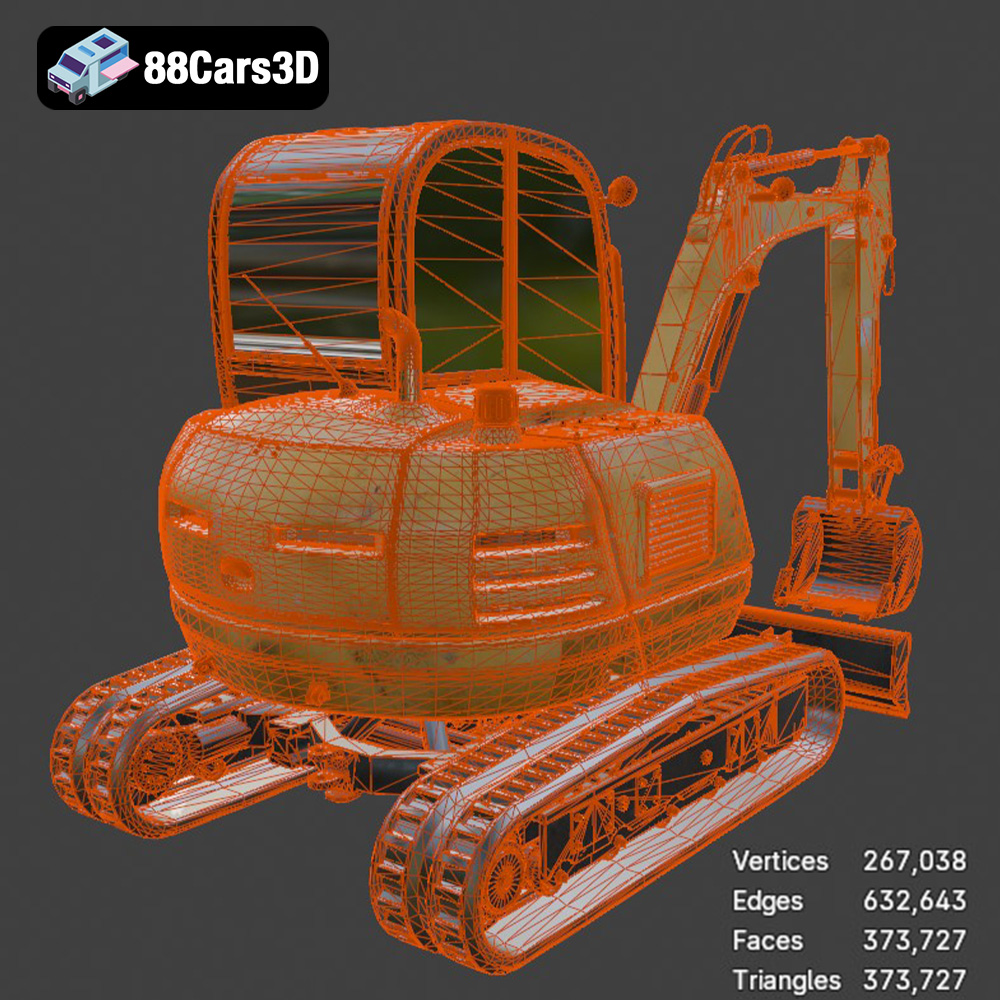
At the heart of any high-quality 3D asset lies its geometry and topology. This excavator model boasts a well-optimized topology with 373,727 triangles. This isn’t just a number; it represents a carefully considered balance. For real-time applications like game development or AR/VR, excessive polycounts can cripple performance. Conversely, too few polygons result in a blocky, unrealistic appearance. The chosen triangle count allows for exceptional visual fidelity, capturing the nuances of the excavator’s form, while remaining efficient enough for smooth rendering in engines like Unreal and Unity. The clean edge flow and optimized mesh ensure that the model deforms predictably during animation and renders cleanly, even in close-up shots.
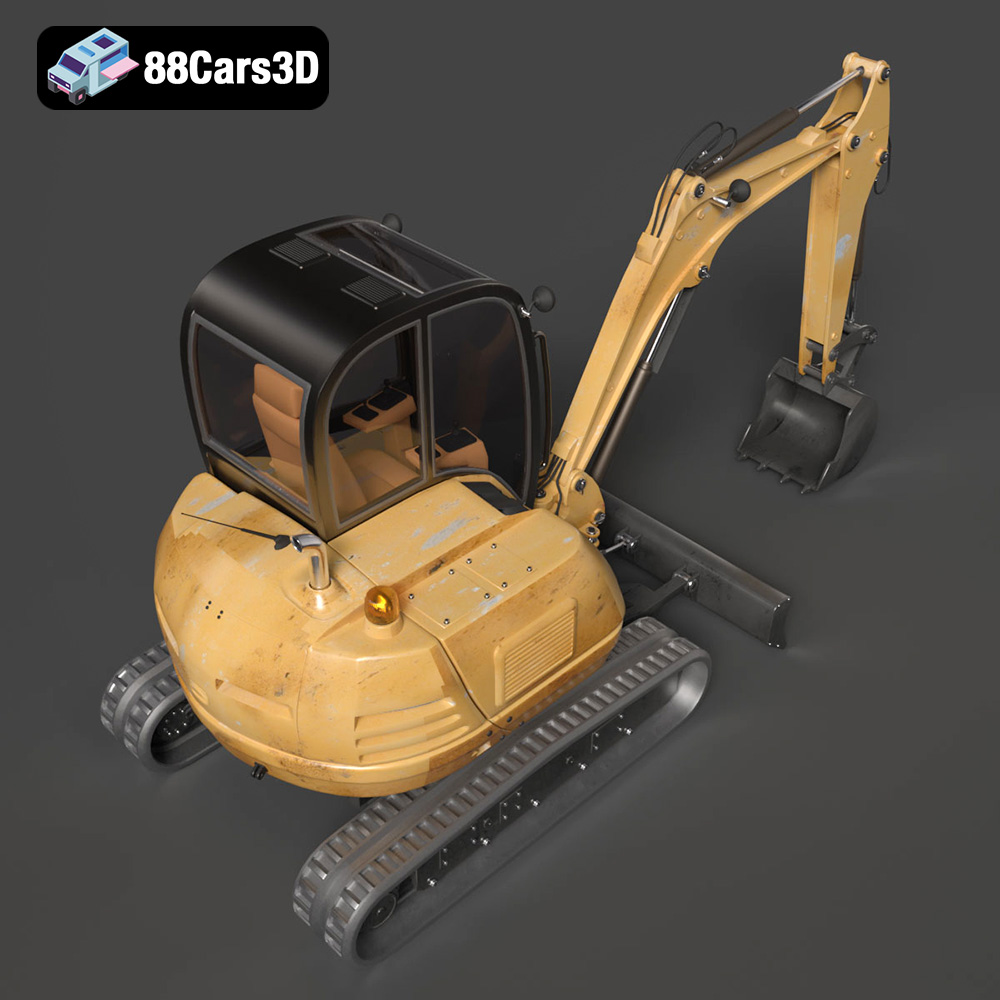
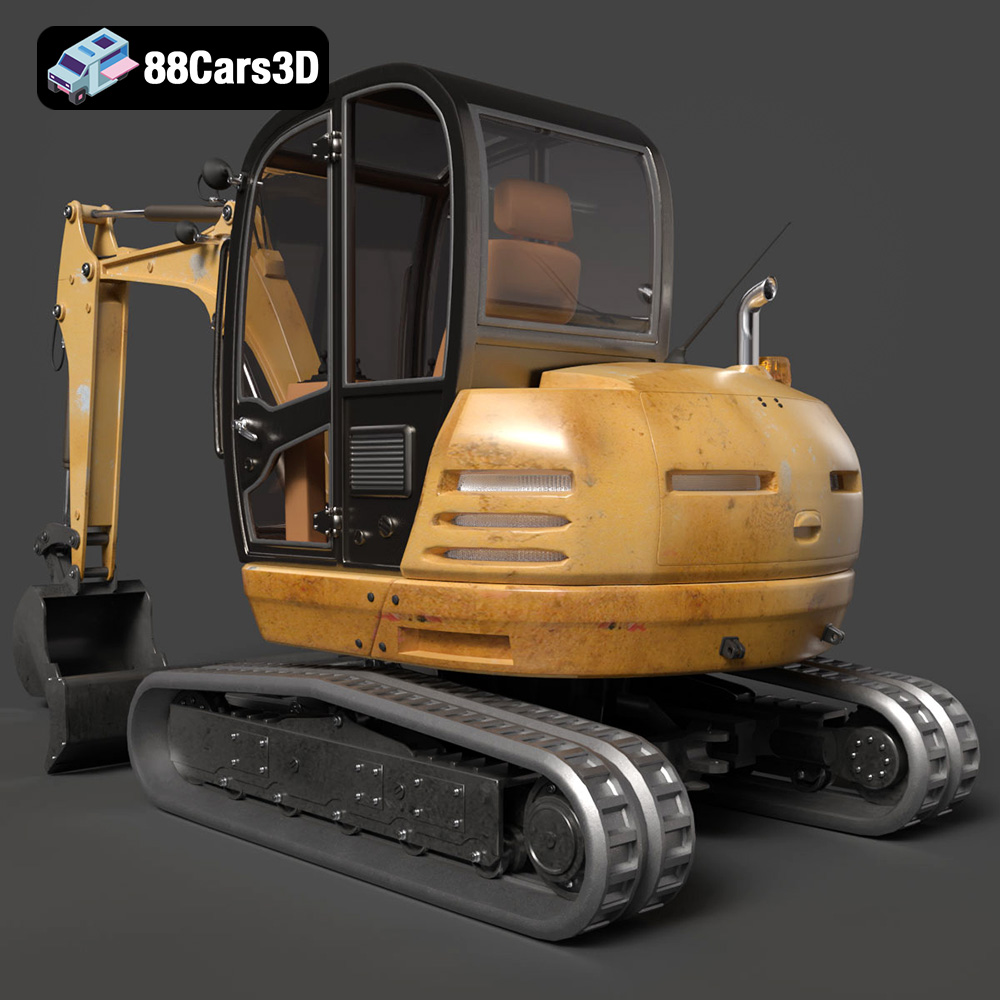
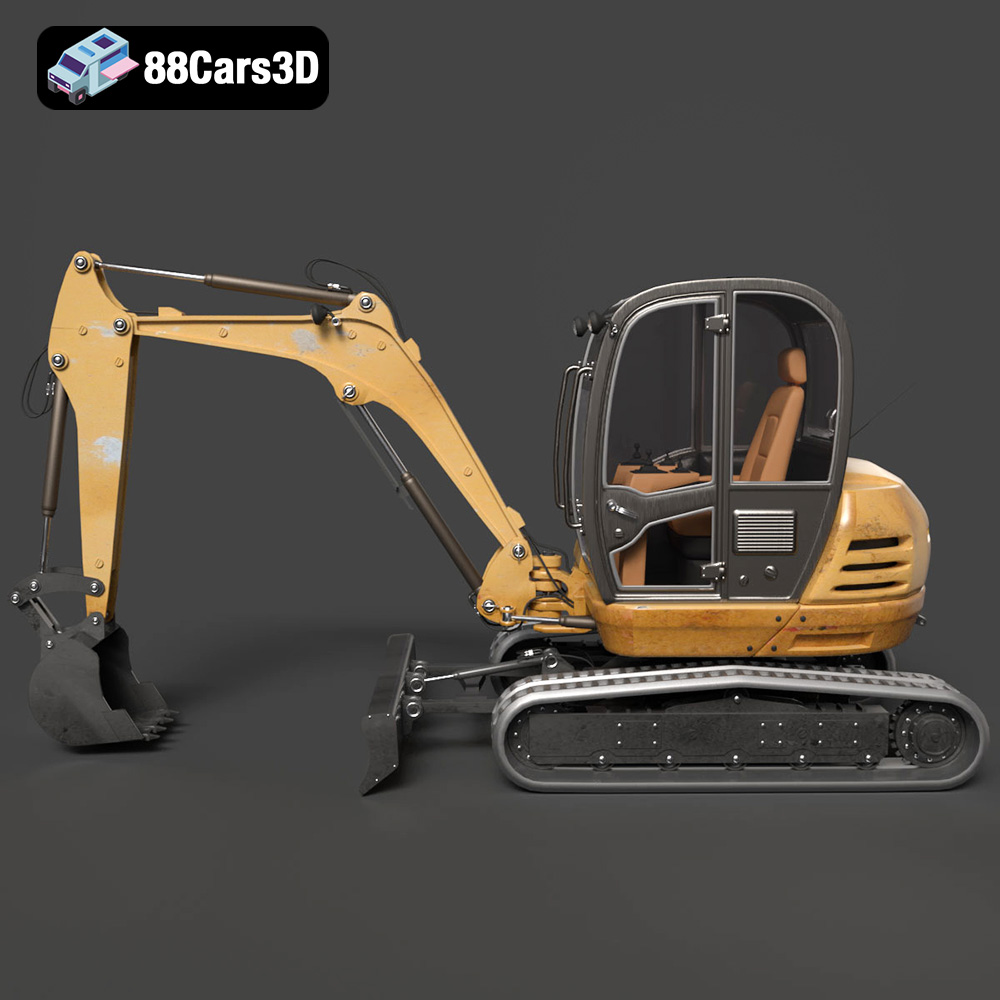
The true measure of a technical model’s quality often lies in its faithfulness to real-world counterparts. This Compact Track Excavator excels in this regard. Its frame geometry and industrial proportions are accurately replicated, giving it a powerful and authentic presence. Key exterior features include:
Beyond the exterior, the interior of the operator’s cabin is equally detailed, a vital aspect for simulations, VR experiences, and first-person game environments. The model includes:
This attention to both exterior ruggedness and interior functionality makes the Compact Track Excavator 3D Model an exceptionally versatile and credible asset for any project demanding high standards of realism.
A high-quality 3D model is only truly valuable if it can be seamlessly integrated into various professional workflows. The Compact Track Excavator 3D Model is designed with this versatility in mind, providing assets that are immediately useful across game development, architectural visualization, and AR/VR training.
For game developers, performance and visual quality are paramount. The “game-ready” nature of this excavator model, with its optimized 373,727 triangles and real-world scale, makes it an ideal game asset. The proper pivot setup for 360-degree turret rotation, track movement, and multi-stage boom articulation means animators can immediately create complex, realistic movements without extensive setup.
Workflow in game engines:
In architectural visualization (arch-viz) and product rendering, the emphasis shifts towards photorealism and artistic composition. The detailed nature of the Compact Track Excavator makes it perfect for industrial site renders, architectural site plans, and high-end demonstrations where close-ups are common.
Workflow in 3ds Max and Blender:
The immersive nature of AR/VR demands assets that are not only optimized for performance but also highly accurate to facilitate realistic training and simulation experiences.
Workflow for AR/VR:
The utility of a premium 3D model extends far beyond digital screens. For hobbyists, engineers, and educators, the ability to translate a digital asset into a physical object offers unique opportunities. The Compact Track Excavator 3D Model embraces this with its robust design and suitability for 3D printing, alongside comprehensive customization options that enhance its versatility.
The inclusion of the .stl format specifically caters to the growing community of 3D printing enthusiasts. Transforming a complex digital model like an excavator into a tangible object requires careful preparation, and this model is built to facilitate that process.
Key considerations for 3D printing:
Beyond its default appearance, the Compact Track Excavator 3D Model offers extensive customization possibilities, allowing it to adapt to diverse project requirements and artistic visions.
These customization options ensure that the Compact Track Excavator 3D Model is not a static asset, but a dynamic and adaptable tool capable of meeting a broad spectrum of creative and technical needs.
In today’s fast-paced digital production environment, time is often the most valuable commodity. Developing complex 3D models from scratch, especially highly detailed and optimized assets like the Compact Track Excavator, can consume hundreds of hours of skilled labor. This is where the strategic acquisition of premium 3D assets becomes not just a convenience, but a critical business advantage.
Investing in a professionally crafted model from a reputable source like 88cars3d.com offers immediate and significant benefits. Firstly, it provides an instant solution to a specific project need, dramatically reducing development cycles and allowing teams to allocate resources to other critical tasks, such as scene building, animation, or interactive programming. For studios that regularly need high-quality 3D car models or other specialized vehicles, 88cars3d.com acts as an invaluable library of ready-to-use content.
Secondly, quality assurance is built-in. When purchasing from a trusted marketplace, creators can expect models that are accurately proportioned, cleanly textured, and properly optimized for various applications. The Compact Track Excavator 3D Model exemplifies this, with its balanced polycount, real-world scale, proper pivot setups, and inclusion of multiple industry-standard file formats. This ensures that the asset performs as expected, minimizing frustrating debugging and rework.
Furthermore, these assets are often created by experienced artists who understand the nuances of production pipelines. They anticipate the needs of game developers, rendering artists, and AR/VR specialists, delivering assets that are not just beautiful but also technically robust. This means less time spent on fixing topology, re-rigging, or optimizing meshes for performance. The excavator model’s game-ready status and suitability for 3D printing are direct results of this foresight.
Ultimately, premium 3D assets from 88cars3d.com provide a cost-effective alternative to in-house production, democratizing access to professional-grade content and empowering creators of all scales to produce visually stunning and highly functional digital experiences. The Compact Track Excavator is a prime example of an asset that delivers exceptional value, quality, and versatility, making it a smart choice for any serious digital content creator.
The journey through the intricate details and versatile applications of the Compact Track Excavator 3D Model underscores the profound impact that high-quality 3D assets have on modern digital production. We’ve explored how its meticulous geometry, optimized topology, and accurate representation of industrial components – from the intricate hydraulic systems to the robust undercarriage and detailed operator cabin – position it as a truly professional-grade asset.
This model’s ability to seamlessly integrate into diverse workflows, enabled by its comprehensive suite of file formats, is a testament to its value. Whether you are a game developer building an immersive construction simulator, an architectural visualization artist creating photorealistic renders of industrial sites, an AR/VR specialist crafting realistic training modules, or a hobbyist bringing digital designs to life through 3D printing, this excavator model is engineered to exceed expectations. Its thoughtful design, catering to both visual fidelity and technical efficiency, ensures it’s a future-proof investment for any creative endeavor.
In a world where digital realism is paramount, choosing assets that combine aesthetic excellence with technical robustness is key. The Compact Track Excavator 3D Model stands as a shining example of such an asset, ready to elevate your projects to new heights. Discover this exceptional model and many other premium 3D assets, including a wide array of 3D car models, by visiting 88cars3d.com – your trusted source for high-quality digital content.
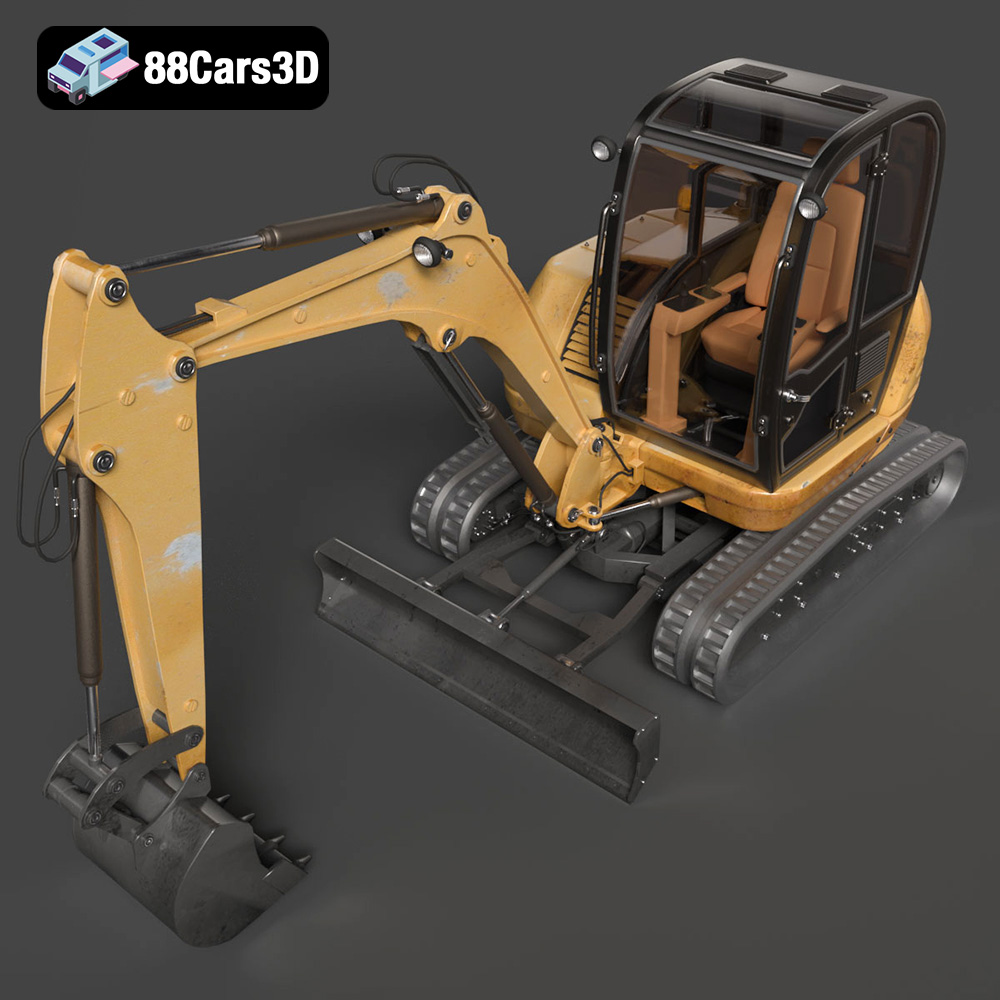
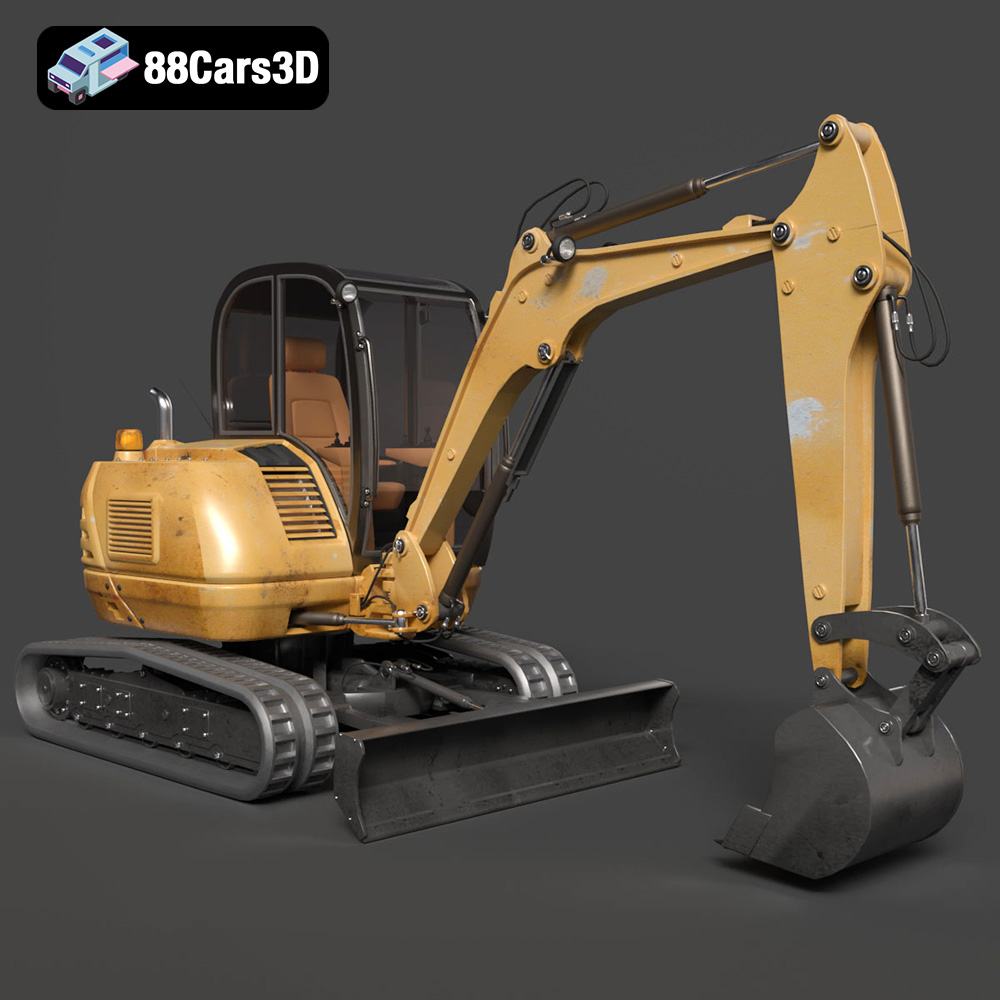
The Compact Track Excavator represents the pinnacle of modern construction and heavy machinery engineering. Designed for versatility and power in confined spaces, this machine is characterized by its robust track system, highly articulated hydraulic boom, and heavy-duty digging bucket. Its distinctive industrial styling is complemented by exposed hydraulic hoses, a reinforced operator cabin, and an aggressive stance that makes it a staple on any digital construction site. This meticulously crafted 3D model features a well-optimized topology with 373,727 triangles, delivering uncompromising visual fidelity while remaining efficient for real-time applications. Whether deployed in game development, industrial simulations, AR/VR training programs, or high-end architectural visualizations, the asset is structured to provide maximum realism. The meticulously modeled undercarriage and boom pivot points ensure seamless rigging and animation.
$36.50
.blend
.excavator
.fbx
.glb
.max
.obj
.ply
.rendering
.stl
.unreal
compact-track-excavator
construction-equipment
game asset
game-ready
heavy-machinery
low-poly
optimized
vehicle-3d-model
VR/AR