Get 20% OFF All Premium 3D & STL Models!

The roar of a classic V8, the unmistakable silhouette cruising down an open road—these are the timeless images evoked by the American muscle car. For designers, game developers, automotive enthusiasts, and visualization artists, capturing this essence in the digital realm is both an art and a technical challenge. A high-fidelity 3D model isn’t just a static representation; it’s a gateway to immersive experiences, photorealistic renders, and dynamic interactive environments. Few vehicles embody this spirit as purely as the 1967 Pontiac Firebird, a true legend of the pony car era. Its aggressive styling, distinctive grille, and powerful stance make it an ideal subject for detailed digital recreation, offering a wealth of opportunities for any project demanding authenticity and visual prowess. Let’s delve into what makes a premium 3D car model, using the exceptional Pontiac Firebird 1967 3D Model as our guide, and explore how such an asset elevates professional workflows across various industries.
The versatility of a 3D model is often defined by the file formats it supports. Different formats are optimized for various stages of the 3D production pipeline, from initial modeling and texturing to real-time engine integration and physical output. Understanding these distinctions is crucial for selecting the right asset for your project and ensuring seamless workflow compatibility. The Pontiac Firebird 1967 3D Model, for instance, comes equipped with a comprehensive suite of formats, each serving a specific purpose, catering to the diverse needs of professionals.
The .blend format is native to Blender, the popular open-source 3D creation suite. When a model is provided in .blend, it typically means the full scene file, complete with materials, textures, lighting, and even animation setups, is included. This offers unparalleled flexibility for artists who use Blender, allowing them to dissect the model’s construction, modify its topology, adjust materials, or re-rig components with ease. For the Pontiac Firebird 1967, a .blend file would provide direct access to the original source, making it perfect for deep customization, educational purposes, or integration into existing Blender projects without conversion hassles.
.fbx (Filmbox) is a proprietary file format owned by Autodesk and is one of the most widely supported 3D interchange formats. It excels at transferring entire scenes or individual assets, including geometry, materials, textures, animations, and even rigging information, between different 3D applications and game engines. For real-time applications like Unreal Engine and Unity, .fbx is the industry standard due to its robustness and efficient handling of complex data. The Pontiac Firebird 1967 in .fbx ensures that all its detailed features, from the engine block to the separate wheels, can be imported directly into game development pipelines, maintaining pivots, scale, and material assignments for immediate use or further engine-specific optimization.
The .obj (Wavefront OBJ) format is a simple, universally recognized geometry definition file. While it primarily stores vertex positions, UV coordinates, normals, and material group information (often accompanied by an .mtl file for basic material properties), it lacks support for animations, rigging, or scene data. Its strength lies in its widespread compatibility; almost every 3D software can import and export .obj files. This makes it an excellent choice for general 3D model exchange when the primary concern is the mesh data itself. For the Pontiac Firebird, the .obj version guarantees that artists using any 3D package, regardless of its primary focus, can access the core geometry for rendering or further processing.
.glb (GLB, the binary version of glTF) is an increasingly popular format, especially for web-based 3D applications, augmented reality (AR), and virtual reality (VR). It’s designed to be a “transmission format” for 3D models, meaning it’s highly optimized for efficient loading and rendering across various platforms. A .glb file packages geometry, materials, textures, and even animation into a single, compact file, making it incredibly easy to share and display 3D content online or in mobile AR/VR experiences. The Pontiac Firebird 1967 as a .glb is perfect for virtual showrooms, interactive web configurators, or integrating into mobile AR apps where performance and file size are critical.
.stl (STereoLithography) is the de facto standard format for 3D printing. It represents a 3D model as a series of connected triangles, describing only the surface geometry of an object without color, texture, or other attributes. While simple, its ubiquity makes it essential for anyone looking to bring a digital model into the physical world. For the Pontiac Firebird 1967, an .stl file would be the starting point for creating a physical replica, requiring careful attention to print settings like scale, layer height, and support structures, as detailed in the product specifications.
The .ply (Polygon File Format, or Stanford Triangle Format) is a versatile format for storing 3D data, particularly suited for scanner data and mesh processing. It can store a variety of properties including color, transparency, normals, texture coordinates, and even reliability information for each vertex and face. While less common for general 3D asset exchange than .fbx or .obj, it’s often preferred in scientific visualization, CAD, and specific mesh analysis pipelines due to its flexibility in storing detailed point cloud and polygonal data. Including .ply for the Firebird offers an additional layer of precision for specialized engineering or analysis tasks.
The .unreal format isn’t a standalone file type in the traditional sense, but rather indicates that the asset is specifically optimized and often pre-configured for direct import into Unreal Engine projects. This could mean it comes as an Unreal Engine project file, an asset pack, or simply an .fbx that has been rigorously tested and validated for Unreal’s import pipeline, often with materials and textures pre-setup using Unreal’s physically based rendering (PBR) standards. For a detailed 3D car model like the Pontiac Firebird 1967, an “engine-ready” Unreal asset significantly reduces setup time, ensuring correct material assignments, collision meshes, and LODs (Levels of Detail) are in place for optimal real-time performance.
Finally, the .max format is the native scene file for Autodesk 3ds Max, a powerful 3D modeling, animation, and rendering software widely used in architectural visualization, game development, and film. Like .blend, a .max file offers full editability, including access to modifiers, animation keyframes, complex material setups, and render settings specific to 3ds Max. For professionals working within the Autodesk ecosystem, the .max version of the Pontiac Firebird 1967 provides the ultimate flexibility for advanced rendering with V-Ray or Corona, sophisticated animation sequences, or detailed environmental integration directly within their familiar workflow.
Creating a truly exceptional 3D car model goes far beyond simply building a mesh. It involves meticulous research, a deep understanding of automotive design, and a dedication to technical precision. The Pontiac Firebird 1967 3D Model exemplifies this commitment, capturing the essence of a classic with unparalleled digital fidelity.
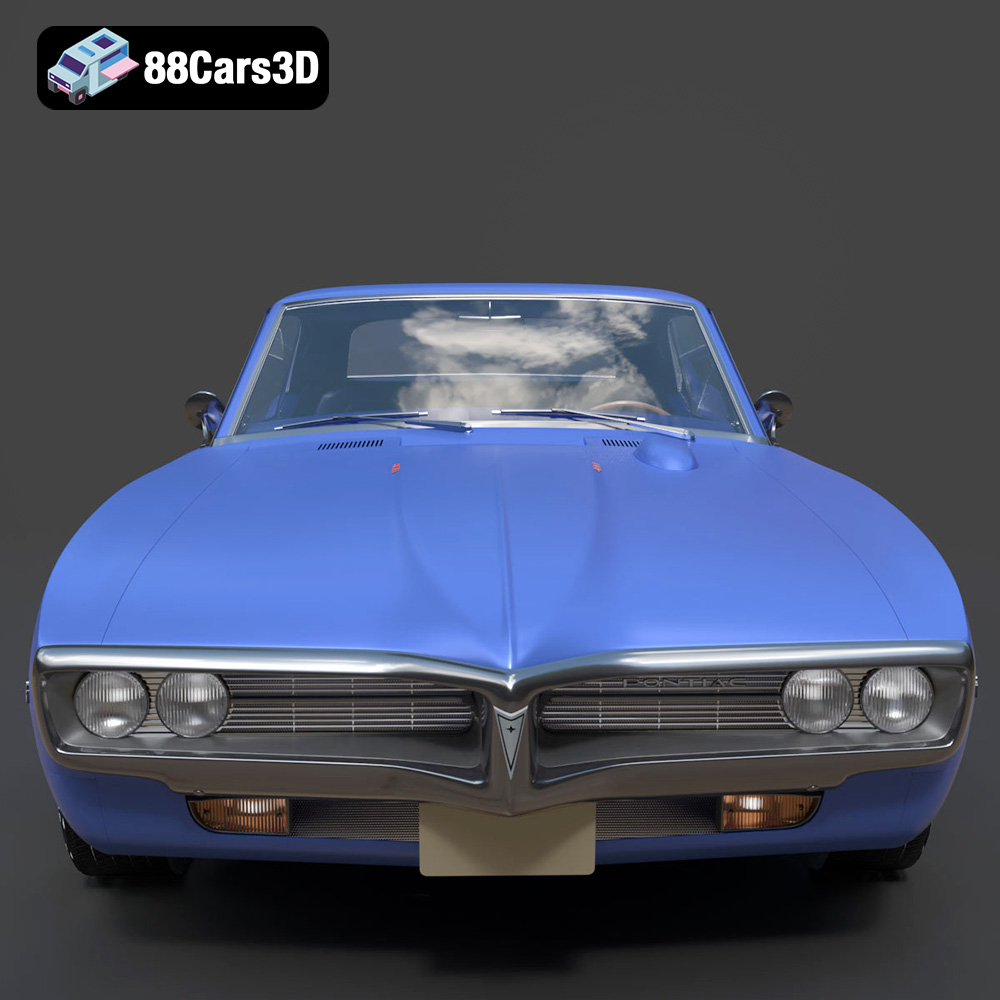
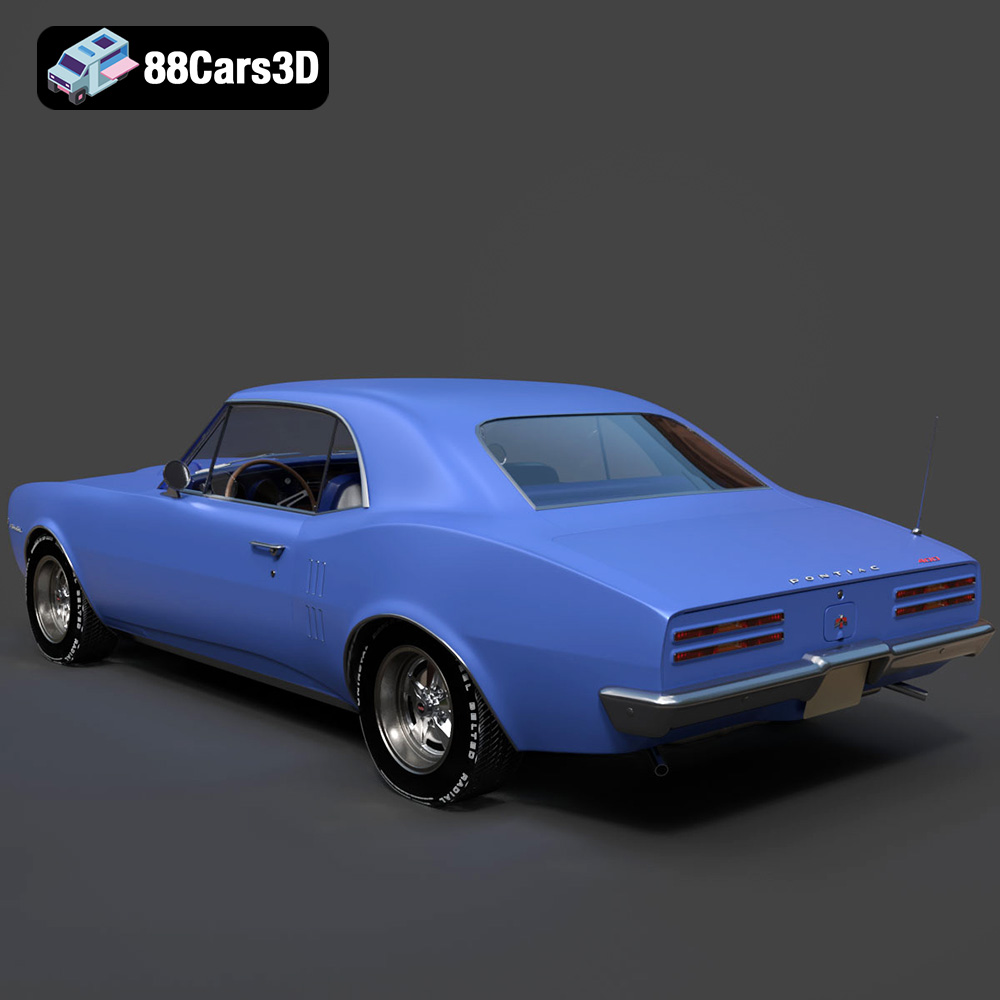
The first-generation Pontiac Firebird is renowned for its aggressive “Coke-bottle styling,” a design language that emphasized muscular curves and a tapered waistline. This 3D model flawlessly replicates these iconic proportions, from the distinctively recessed split-grille bumper design to the classic quad headlights that give the car its unmistakable face. Every curve and panel line has been carefully sculpted to reflect the original vehicle’s aesthetic. Beyond the overall shape, the model dives into intricate details: a meticulously recreated V8 engine block lurks beneath the hood, boasting components that give it a sense of mechanical authenticity, while the classic dual exhaust system with polished chrome tips adds to the car’s powerful rear profile. Even the rally wheels and period-accurate tire treads contribute to the historical accuracy, ensuring that this digital Firebird is indistinguishable from its real-world counterpart in high-resolution renders.
Stepping inside the virtual cockpit of the Pontiac Firebird 1967, one finds the same level of detail. The vintage vinyl-style bucket seats, the classic three-spoke wooden steering wheel, and the deep-set analog instrument cluster transport the viewer back to the late 60s. The dashboard layout and floor-mounted shifter are historically accurate, along with the pedal placement. This interior attention is not merely cosmetic; it’s optimized geometry designed for first-person perspective (POV) in gaming, providing a truly immersive experience for players. Crucially, the model adheres to real-world scale accuracy, based on actual vehicle chassis measurements, ensuring that whether it’s placed in an architectural visualization scene or driven in a simulator, its dimensions are correct. Furthermore, the inclusion of authentic leaf-spring and independent front suspension details, along with separate wheels, suspension, and steering components, means this model is not just visually accurate but also structurally prepared for dynamic animation and realistic physics simulation.
In today’s interactive media landscape, 3D car models must not only look stunning but also perform flawlessly in real-time environments. The Pontiac Firebird 1967 3D Model is engineered with this dual requirement in mind, striking a delicate balance between visual fidelity and engine optimization.
The model boasts an exceptional topology of 3,853,174 triangles. While this might seem high, it represents a carefully calculated “sweet spot” for modern game engines like Unreal and Unity. This polycount delivers unparalleled visual fidelity for close-up shots—essential for cinematic cutscenes, detailed virtual showrooms, or high-end racing simulators—while remaining efficiently optimized for high-end real-time applications. The balance ensures that the intricate details of the Firebird, from the individual spokes of the rally wheels to the textures of the chrome, are fully realized without unduly taxing the rendering pipeline. Furthermore, a truly game-ready asset goes beyond just polycount; it includes optimized UV layouts for efficient texture mapping, proper material setups for physically based rendering (PBR) workflows, and potentially even LODs (Levels of Detail) to manage performance dynamically based on distance from the camera. This ensures smooth frame rates even in complex open-world environments.
A static 3D model, no matter how detailed, has limited utility in interactive or animated contexts. The Pontiac Firebird 1967 excels here with its proper pivot setup for crucial animated components. This includes correct pivot points for steering, individual wheel rotation, and realistic suspension travel. Such precision is vital for game development, allowing developers to easily integrate physics systems for accurate vehicle handling. In cinematic animation, these pre-configured pivots drastically reduce rigging time, enabling animators to quickly create dynamic driving sequences, drift shots, or even detailed garage interactions. The fact that the wheels, suspension, and steering components are separate entities further enhances this flexibility, offering granular control over every moving part, which is critical for simulating realistic automotive mechanics and visual effects.
The utility of a high-quality 3D car model extends far beyond traditional gaming. It serves as a foundational asset for a myriad of applications, pushing the boundaries of how we interact with digital content.
For rendering and visualization professionals, the Pontiac Firebird 1967 3D Model is a premium foundation. Its exceptional detail and accurate materials make it ideal for cinematic automotive rendering, where every reflection and highlight must be perfect. Imagine a brand campaign showcasing a modern product alongside this classic, or a lifestyle scene brought to life with its iconic presence. It’s equally potent for studio lighting setups, allowing artists to experiment with different illumination schemes to achieve stunning photorealistic results. In the realm of AR/VR, the model transforms into an interactive object in virtual showrooms, allowing potential buyers to explore every angle, open doors, and even customize features in real-time. For mobile AR experiences, the optimized .glb format ensures a seamless, performant viewing experience on smartphones and tablets, bringing a piece of automotive history right into your living room.
The digital realm can also bridge to the physical, and the Pontiac Firebird 1967 3D Model is ready for this transition. Convertible to .stl format, it provides an excellent base for 3D printing, catering to hobbyists and collectors who wish to hold a tangible replica of this muscle car legend. For optimal results, specific 3D print settings are recommended: scales like 1:12, 1:18, or 1:24 are perfect for display, with resin printing highly recommended to capture the model’s fine details and smooth surfaces. Adhering to guidelines such as layer height (0.04–0.12 mm), wall thickness (1.2–2.0 mm), and infill (20–30%) ensures structural integrity and fidelity. Crucially, detailed parts like the exhaust and mirrors will require supports during printing, and printing the frame angled with wheels printed separately helps in achieving structural soundness and better detail. Post-processing involving sanding, primer, and applying authentic factory colors with metallic finishes can elevate the printed model to a museum-quality display piece.
In a professional production environment, efficiency and flexibility are paramount. Starting with a pre-built, high-quality asset like the Pontiac Firebird 1967 3D Model significantly streamlines workflows and opens up vast customization possibilities.
The comprehensive range of included file formats (.blend, .fbx, .obj, .glb, .stl, .ply, .unreal, .max) ensures that this Firebird model is compatible with virtually any professional 3D software and real-time rendering engine. Whether your team primarily uses Blender for creative ideation, 3ds Max for architectural visualizations, or Unreal Engine for game development, the model integrates seamlessly. This cross-platform compatibility saves countless hours that would otherwise be spent on conversion, re-texturing, or fixing geometry issues. For studios and individual artists, leveraging a pre-optimized, production-ready asset from a trusted source like 88cars3d.com means they can jump directly into creative work, focusing on scene composition, lighting, and animation, rather than the painstaking process of modeling a vehicle from scratch. This efficiency gain is invaluable in meeting tight deadlines and maintaining project budgets.
Beyond its inherent quality, the Pontiac Firebird 1967 3D Model offers robust customization options, allowing artists to tailor it precisely to their project’s requirements. Imagine changing the body color to any of the Firebird’s iconic factory hues, or experimenting with custom metallic or matte finishes for a unique look. The ability to modify tire textures allows for adaptations from classic street variants to even hypothetical off-road styles, dramatically altering the car’s character. Adjusting material finishes on chrome, glass, or interior elements can fine-tune its realism to match specific lighting conditions or artistic directions. Furthermore, the model provides an excellent canvas for adapting lighting for different environments—whether it’s a sun-drenched Californian highway, a moody urban night scene, or a brightly lit showroom. This level of flexibility ensures that the asset can be endlessly re-purposed, delivering fresh perspectives and meeting diverse creative demands across multiple projects.
The digital frontier continues to expand, and with it, the demand for high-quality, technically sound 3D assets grows exponentially. The Pontiac Firebird 1967 3D Model stands as a testament to what’s achievable when meticulous craftsmanship meets cutting-edge technical optimization. From its authentic exterior and immersive interior to its game-ready polycount and robust format support, this model is a versatile powerhouse for any project. Whether you’re crafting an open-world racing game in Unreal, designing an AR car configurator, rendering a cinematic advertisement, or even 3D printing a scale replica, this Firebird offers an exceptional foundation. It empowers artists and developers to bring iconic automotive history to life with unparalleled realism and performance. For those seeking to elevate their digital automotive projects with a legendary machine, a detailed 3D car model from 88cars3d.com provides the ideal starting point, merging heritage with the future of digital content creation.
The 1967 Pontiac Firebird stands as a true American muscle car legend, introduced to dominate the late-60s pony car era. This digital replica captures its aggressive Coke-bottle styling, distinctive front split-grille bumper design, and iconic quad headlights. Every detail, from the meticulously recreated V8 engine block to the classic dual exhaust system, reflects the raw power and heritage of this historic vehicle.
Featuring an exceptional topology of 3,853,174 triangles, this 3D model delivers unparalleled visual fidelity for close-up shots while remaining versatile enough for high-end real-time applications. Whether used in game development, AR/VR environments, detailed animation, or photorealistic visualization, it provides a premium foundation for any digital automotive project.
Perfect for cinematic automotive rendering, period-accurate open-world racing games, immersive virtual showrooms, and historical vehicle animations.
.blend, .fbx, .obj, .glb, .stl, .ply, .unreal, .max
Tags:
pontiac, firebird, 1967, classic-car, muscle-car, pony-car, car-3d-model, game-ready, high-poly, optimized, game-asset, rendering, vr-ar, blend, fbx, obj, glb, stl, ply, unreal, max
$37.50
.1967
.blend
.fbx
.firebird
.glb
.max
.obj
.ply
.pontiac
.rendering
.stl
.unreal
car-3d-model
classic-car
game asset
game-ready
high poly
muscle-car
optimized
pony-car
VR/AR