Get 20% OFF All Premium 3D & STL Models!

In the expansive and ever-evolving landscape of 3D design, the demand for highly detailed, authentic, and versatile assets is constant. From crafting immersive game worlds and realistic architectural visualizations to producing compelling cinematic renders and groundbreaking AR/VR experiences, the quality of a 3D model can significantly impact a project’s overall success and fidelity. This is particularly true when dealing with complex machinery, where precision, mechanical accuracy, and optimal performance are paramount.
Today, we delve into the world of heavy construction equipment and explore how a meticulously crafted 3D model can serve as the backbone for countless professional applications. Specifically, we’re spotlighting a truly exceptional asset: the Wheel Excavator 3D Model, available for download at 88cars3d.com. This model isn’t just a static representation; it’s a dynamic, game-ready, and render-optimized piece of digital engineering designed to elevate any project it becomes a part of.
This comprehensive guide will unpack the intricacies of working with such a sophisticated 3D asset, from understanding its technical specifications and file formats to integrating it seamlessly into various professional workflows. Whether you’re a game developer seeking realistic vehicles, a visualization artist requiring industrial accuracy, or an engineer exploring virtual prototyping, the principles and applications discussed here will illuminate the path to maximizing the potential of high-fidelity 3D models like our featured Wheel Excavator.
The journey of any 3D model, especially one as detailed as the Wheel Excavator, often begins and ends with its file format. The choice of format dictates compatibility, ease of use, data retention, and ultimate application. A truly versatile 3D asset, such as those found on 88cars3d.com, offers a range of formats to suit diverse needs. Understanding these is crucial for efficient workflow and optimal results.
The .blend format is Blender’s native file type. It’s incredibly powerful because it stores everything associated with a Blender project: mesh data, materials, textures, lighting, cameras, animation data, rigging, modifiers, and even scene settings. For artists primarily working in Blender, this is the most convenient and comprehensive format. It ensures full editability and preserves all intricate details, including any custom properties or drivers set up for the Wheel Excavator model’s articulated parts. It’s ideal for deep customization, animation, or rendering within the Blender ecosystem.
.fbx (Filmbox) is arguably the most widely adopted 3D interchange format in the industry, particularly favored in game development and real-time pipelines like Unreal Engine and Unity. Developed by Autodesk, FBX excels at preserving not just geometry, but also crucial animation data, materials (though often simplified, especially for PBR workflows), textures, rigging, and camera information. Its strength lies in its ability to transfer complex animated scenes between different 3D software packages with minimal data loss. For the Wheel Excavator, an .fbx export ensures that its separate wheels, suspension, boom joints, and steering components retain their pivot information, making it game-ready and easy to animate in engines.
The .obj (Wavefront Object) format is a venerable and universally supported file type primarily used for storing 3D geometry. It’s excellent for mesh data, UV coordinates, and basic material references. While it doesn’t typically store animation or rigging information, its widespread compatibility makes it a safe choice for transferring static models across virtually any 3D application. For users who need the raw geometric data of the Wheel Excavator to import into a less common software or for simple rendering tasks, .obj is a reliable foundation.
.glb (GL Transmission Format Binary) is the binary version of glTF, a modern, royalty-free specification for the efficient transmission and loading of 3D scenes and models by engines and applications. GLB packs all necessary assets (geometry, materials, textures, animations) into a single, self-contained file. This makes it incredibly efficient for web-based 3D viewers, AR/VR applications, and mobile platforms, where file size and loading speed are critical. The Wheel Excavator in .glb format would be perfect for an immersive virtual showroom or a mobile AR experience, offering a balanced trade-off between detail and performance.
The .stl (Stereolithography) format is the de facto standard for 3D printing. It represents a 3D model as a series of connected triangles (a triangular mesh) without color, texture, or other CAD attributes. While simple, its ubiquity in the 3D printing world is unmatched. When converting a complex model like the Wheel Excavator to .stl, careful consideration of scale, wall thickness, and potential for supports is necessary to ensure a successful physical print. This format allows hobbyists and professionals to bring the digital excavator into the physical realm.
.ply (Polygon File Format) is another format for storing 3D data, particularly useful for scanned data, point clouds, and precision meshes. It can store not only geometry but also color, transparency, and other properties per vertex or per face. While less common for general 3D model exchange compared to FBX or OBJ, PLY is valued in scientific, engineering, and CAD applications where precise geometric analysis or detailed material property representation is needed. It offers a robust alternative for certain niche applications of the Wheel Excavator model.
A specialized .unreal file (often a .uasset) indicates a file that has been specifically prepared and packaged for direct import or use within Unreal Engine. This often means the model has undergone specific optimizations, material conversions, collision mesh generation, and potentially even blueprint scripting or skeletal mesh setup to be fully functional within the engine’s ecosystem. For the Wheel Excavator, having an .unreal variant suggests it’s optimized to leverage Unreal Engine’s rendering capabilities and real-time performance, saving developers significant preparation time.
Finally, the .max format is the native file type for Autodesk 3ds Max, a leading software for 3D modeling, animation, and rendering in the design visualization and entertainment industries. Similar to .blend for Blender, a .max file contains all scene information, including geometry, materials, lighting, cameras, animation, and scene setup. This provides full editability and access to the original project structure, making it invaluable for professionals who use 3ds Max for high-end rendering, complex animation sequences, or integration into existing Max projects.
The Wheel Excavator 3D Model from 88cars3d.com is not merely a collection of polygons; it’s a testament to precision and utility in digital asset creation. This model brings the rugged utility of heavy machinery into the digital realm with remarkable fidelity, designed to perform across a spectrum of professional applications.
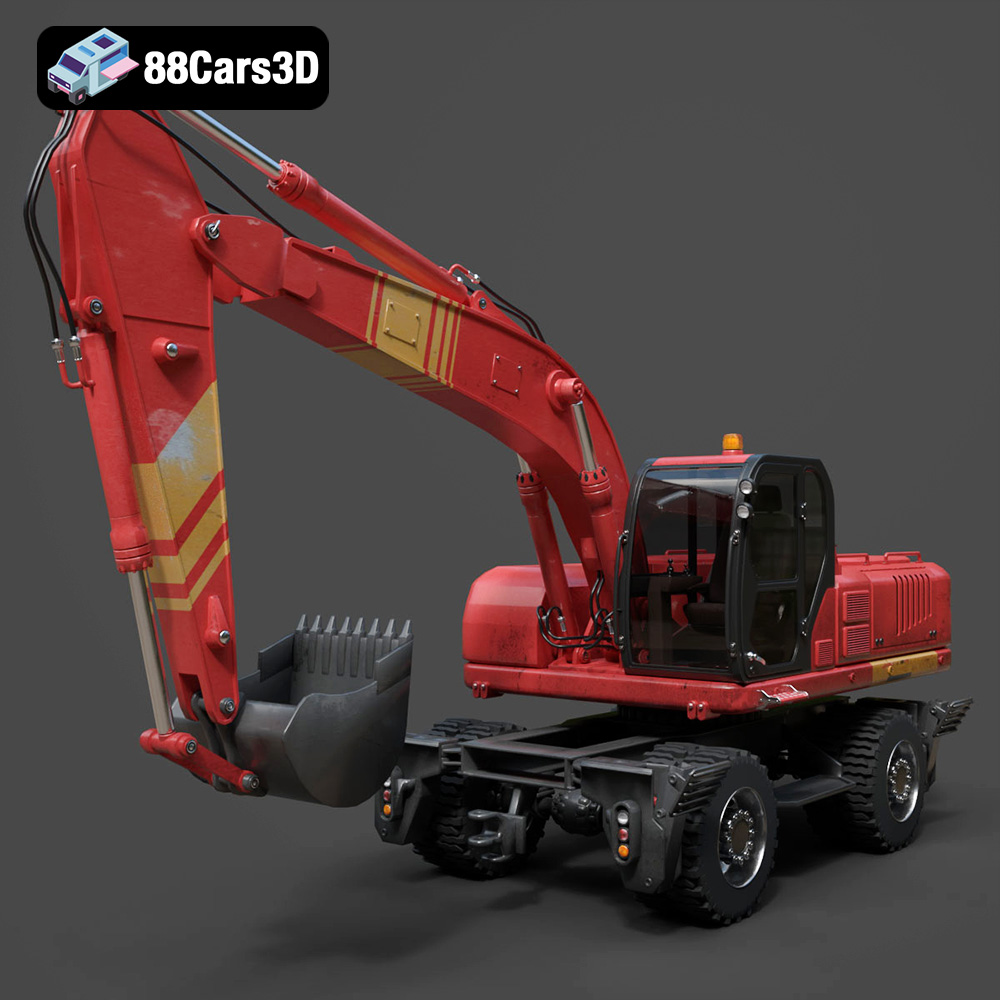
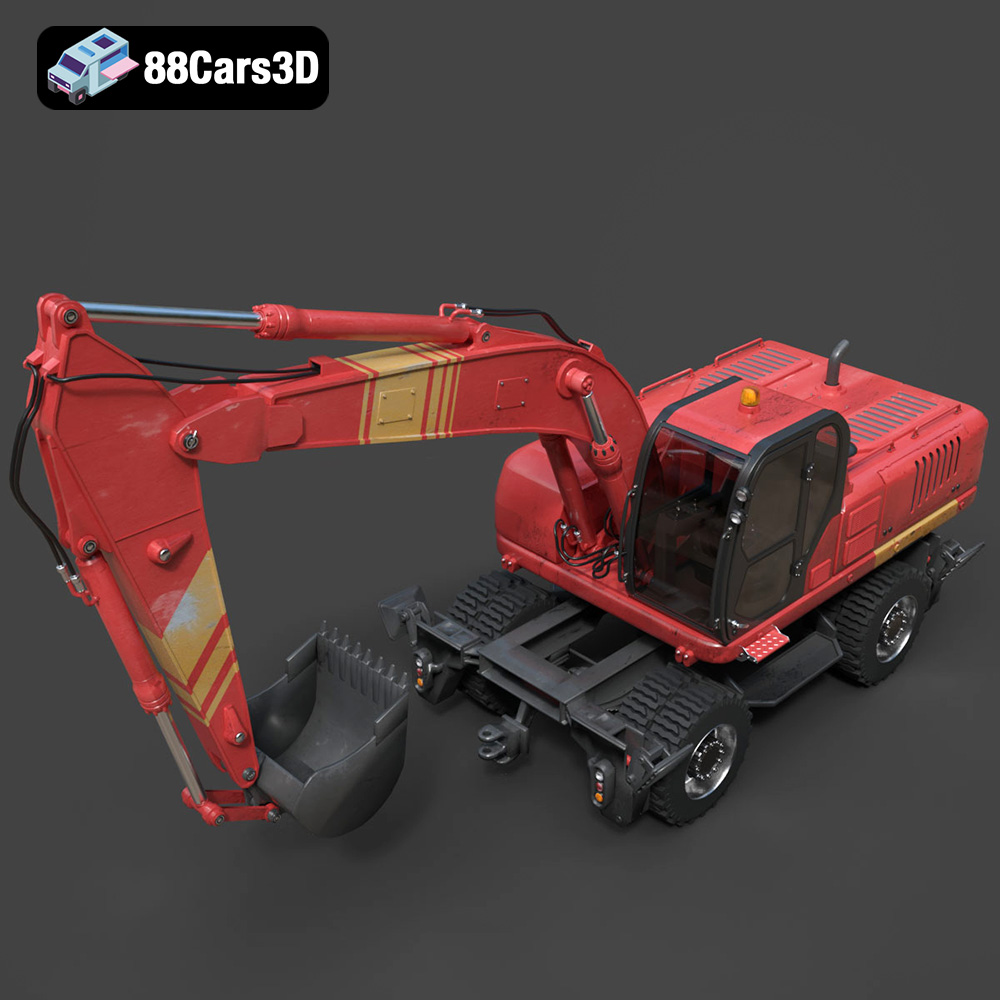
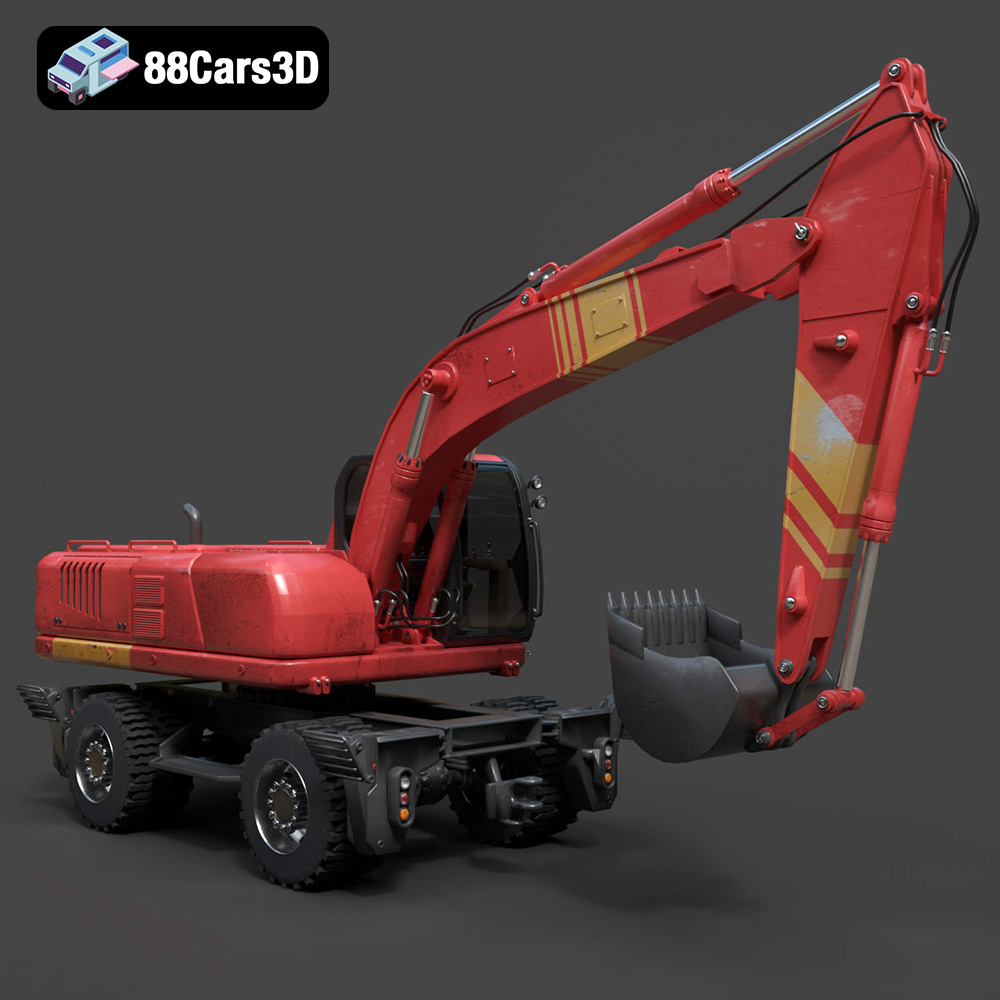
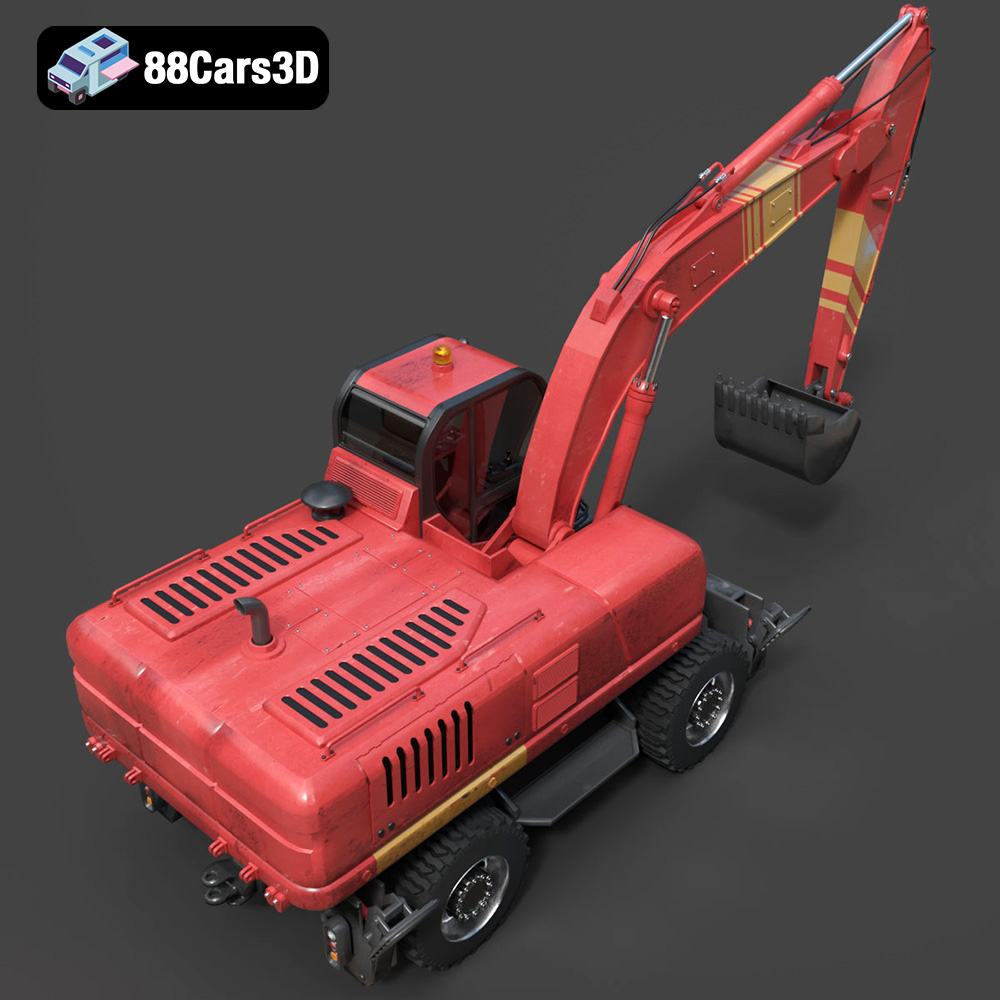
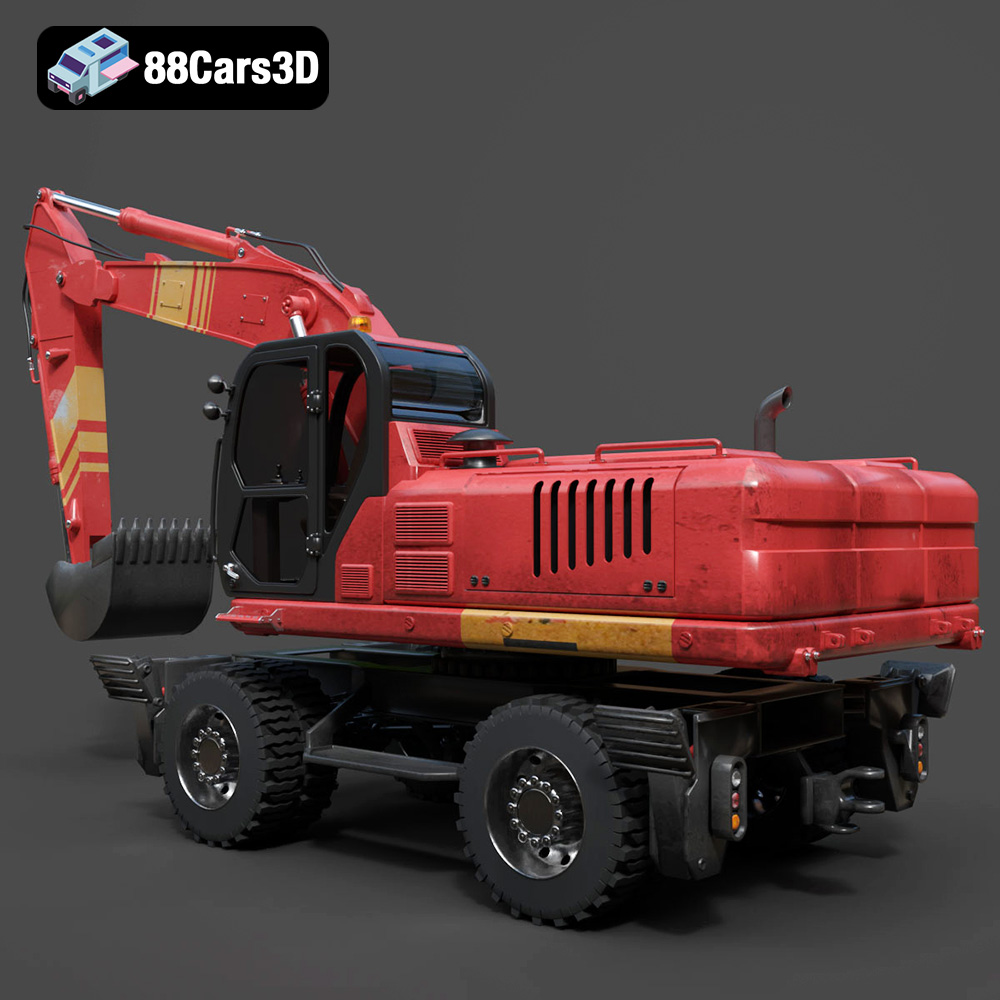
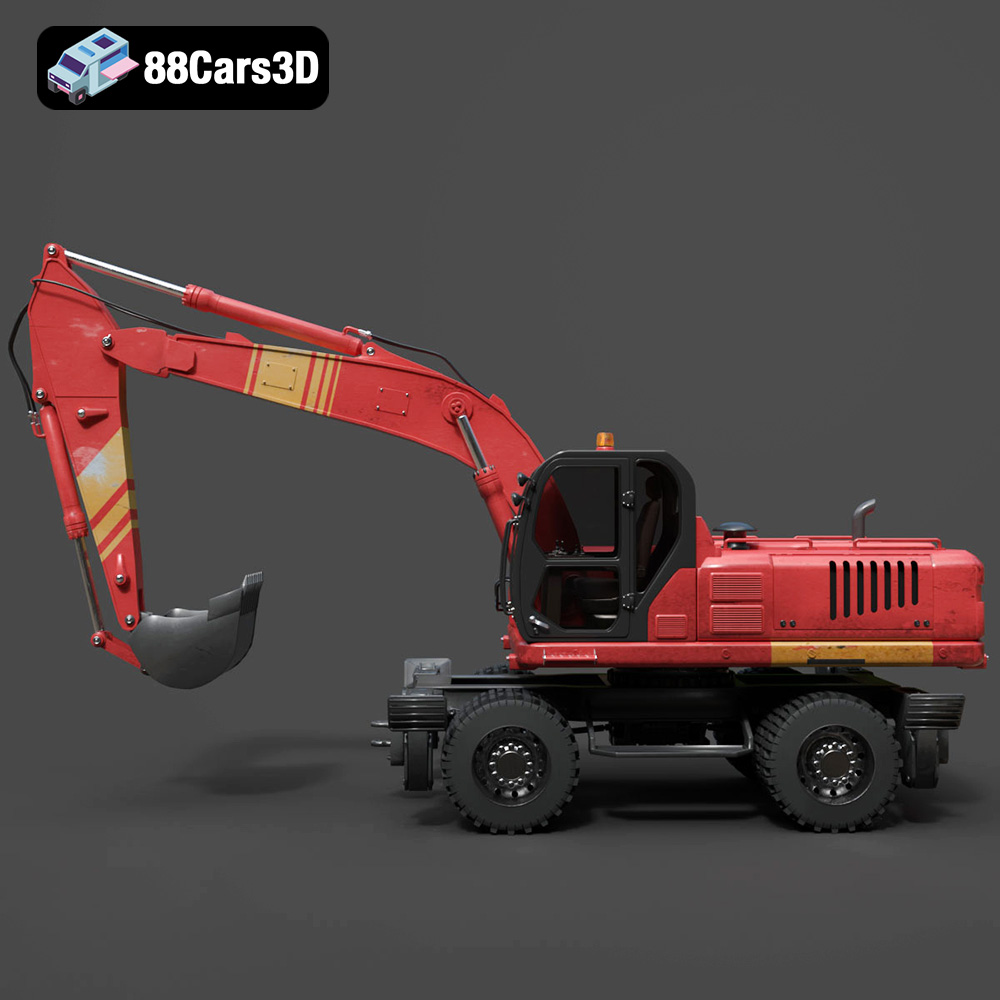
Starting with the external structure, the model faithfully replicates the robust essence of a modern wheel excavator. Its frame geometry and proportions are accurately scaled to real-world dimensions, a critical factor for simulations and visualizations requiring authentic representation. The detailed engine block and industrial housing hint at the power beneath the surface, while complex hydraulic cylinders, rams, and heavy-duty hose routing demonstrate an incredible attention to mechanical detail. These aren’t just cosmetic; they are structurally distinct elements that could be animated to show the full range of motion. Industrial-grade work lights and safety beacon details add to the realism, essential for nighttime or low-visibility scene compositions. The pneumatic tires, with their deep off-road tread patterns, are designed to convey both realism and functional purpose, visually communicating the excavator’s ability to traverse challenging terrain. Crucially, the model includes functional stabilizer outriggers and dozer blade assemblies, along with separate wheels, suspension, boom joints, and steering components. This modularity is key for animators and riggers, allowing for the creation of dynamic, believable movements that truly bring the machine to life in a digital environment.
Beyond the exterior, the interior of the Wheel Excavator model is equally impressive, offering a fully authentic operator cabin. The operator seat features ergonomic contours and armrests, suggesting comfort during long working hours. Detailed dual joystick controls and safety levers are meticulously recreated, offering visual cues for interactive applications like VR training modules. An accurate instrument cluster and digital display panels provide a sense of operational realism, while floor-mounted foot pedals offer full control over travel and auxiliary functions. This level of interior detail is particularly valuable for first-person POV experiences in gaming or for highly immersive VR simulations, allowing users to feel truly connected to the machinery.
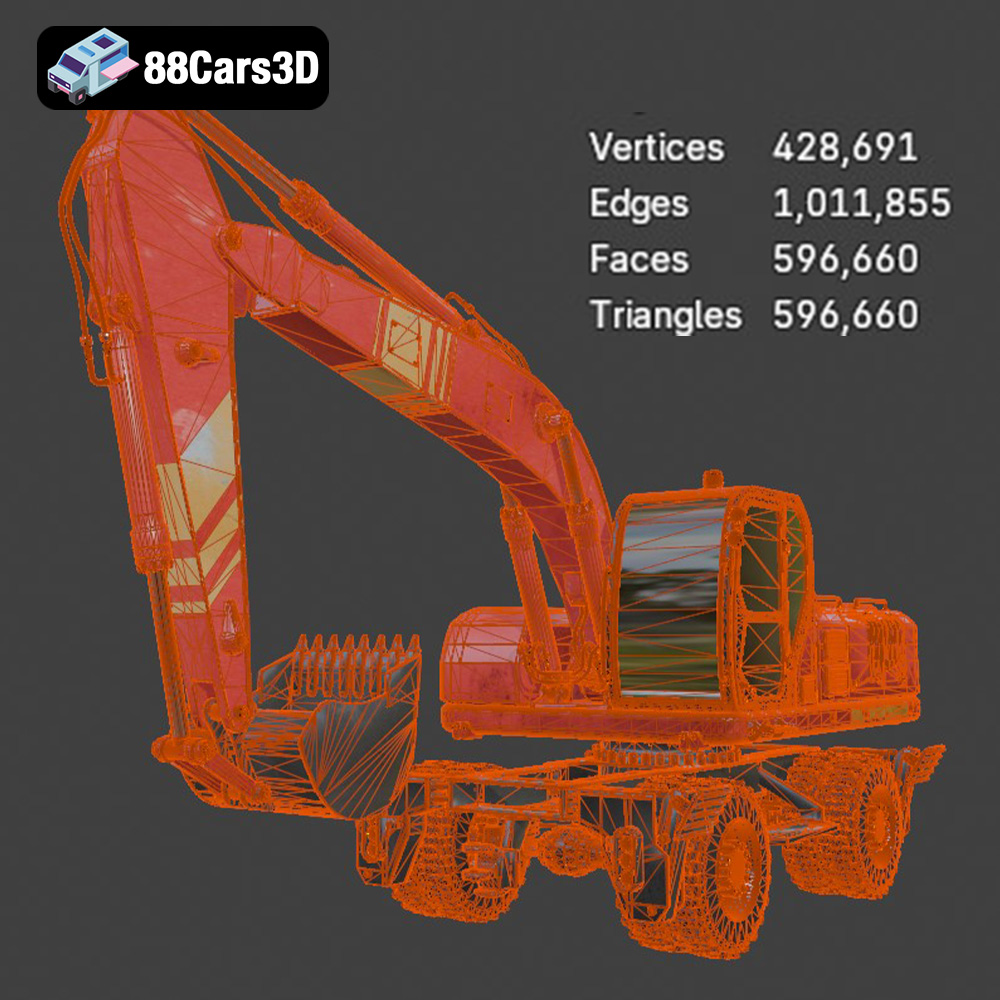
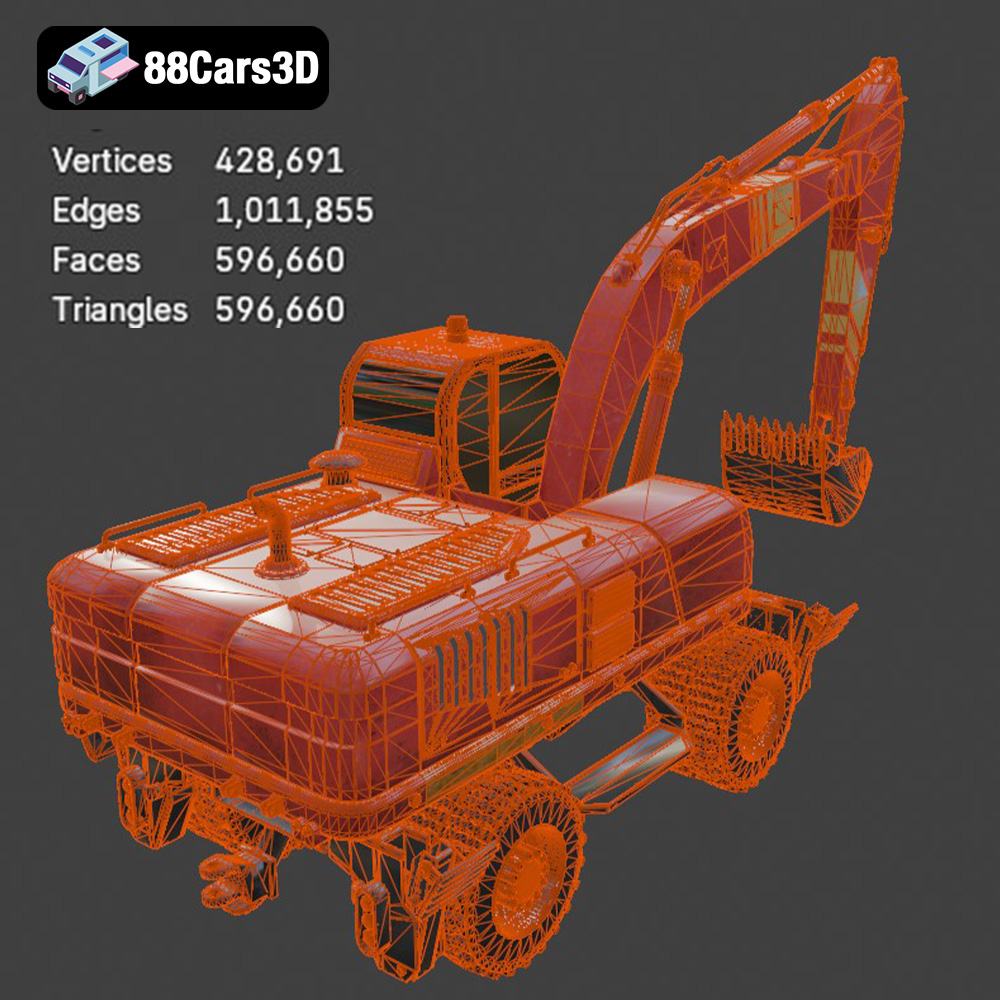
Technically, this Wheel Excavator model hits a sweet spot. With 596,660 triangles, it achieves a fantastic balance between close-up visual fidelity and real-time performance. This polycount is optimized for modern game engines like Unreal and Unity, ensuring smooth frame rates without sacrificing high-end visual realism. Real-world scale accuracy, based on actual vehicle chassis, guarantees that the model integrates seamlessly with other scaled assets in a scene. Furthermore, the proper pivot setup for steering, wheel rotation, turntable rotation, and suspension travel is a huge advantage. This pre-configured rigging dramatically reduces setup time for animators, allowing immediate integration and manipulation in various 3D software platforms and real-time rendering engines.
A high-quality 3D asset like the Wheel Excavator isn’t just a pretty picture; it’s a functional component in diverse professional pipelines. Its design and optimized topology make it an invaluable tool across multiple industries.
For game developers, the Wheel Excavator 3D Model is an immediate boon. Its “game-ready” optimization, boasting 596,660 triangles, means it can be dropped into environments without extensive re-topology or optimization. In Unreal Engine or Unity, the model’s pre-set pivot points for steering, wheel rotation, and boom articulation streamline the rigging and animation process. Developers can easily attach physics assets for realistic vehicle dynamics, create LODs (Levels of Detail) for performance scaling, and integrate it into a comprehensive vehicle system. This model is ideal for open-world construction simulators, vehicle-centric missions in action games, or even as environmental dressing to add realism to industrial zones. The detailed interior, with its optimized geometry, allows for compelling first-person cockpit views, enhancing player immersion significantly.
The rise of Augmented Reality (AR) and Virtual Reality (VR) has opened new avenues for technical 3D models. The Wheel Excavator is perfectly suited for immersive VR training modules, allowing operators to practice complex maneuvers in a safe, virtual environment before handling real equipment. Imagine a VR experience where trainees learn to operate the boom, bucket, and stabilizers with realistic haptic feedback, all powered by this detailed model. In AR, the excavator could be visualized in a real-world setting, perhaps at a construction site planning meeting, demonstrating its scale and placement with remarkable accuracy. Virtual showrooms, configurators, and mobile AR experiences also benefit from the model’s optimized nature, delivering high visual quality on performance-sensitive platforms without compromising detail.
For visualization artists and cinematic creators, the Wheel Excavator 3D Model offers unparalleled realism for brand campaigns, industrial site visualizations, and studio lighting setups. Using software like 3ds Max or Blender, artists can leverage the model’s meticulous detail to create stunning, photorealistic renders. The complex hydraulic systems, detailed engine block, and articulated boom provide ample opportunities for dramatic close-ups and dynamic camera movements. Artists can customize material finishes—from factory colors to weathered metallic textures—and adjust lighting to suit various environments, be it a dusty construction site at dawn or a pristine showroom under studio lights. The model’s clean topology ensures smooth Subdivision Surface application for even higher detail in close-up renders, making it versatile for both real-time and offline rendering pipelines.
The creation and deployment of a successful 3D asset like the Wheel Excavator require a deep understanding of technical optimization alongside artistic skill. The balance between visual fidelity and real-time performance is a constant challenge, expertly met by this model.
The quoted 596,660 triangles for the Wheel Excavator is a well-considered polycount. For a piece of heavy machinery with intricate details like hydraulic lines, an articulated boom, and a detailed interior, this number allows for excellent visual quality up close without becoming overly burdensome for real-time engines. High-quality topology ensures that the mesh deforms predictably during animation and renders cleanly, preventing artifacts. Equally crucial is the UV mapping. Clean, non-overlapping UVs are essential for applying realistic PBR (Physically Based Rendering) textures. For a model with varied materials like painted metal, rubber, glass, and plastic, well-executed UVs allow artists to bake ambient occlusion, normal maps, and other texture data efficiently, ensuring that details like wear, dirt, and reflections appear exactly where they should, enhancing the overall realism.
The “proper pivot setup for steering, wheel rotation, turntable rotation, and suspension travel” is a significant technical advantage. Correct pivot points are the cornerstone of believable animation. Without them, animating the Wheel Excavator would involve tedious manual adjustments. With pre-defined pivots, animators can quickly set up a control rig in Blender or 3ds Max, allowing them to simulate realistic movements. Imagine a custom rig where an operator model can interact with the joystick controls, or where the boom assembly can articulate with multiple degrees of freedom, mirroring its real-world counterpart. This pre-computation of pivot axes drastically reduces production time and enables dynamic scenarios, from a simple turning radius demonstration to a complex digging operation.
Modern 3D rendering heavily relies on PBR workflows to achieve photorealistic results. The Wheel Excavator model, with its robust material separation, allows for sophisticated PBR material application. This means artists can define properties like metallicness, roughness, albedo (base color), and normal mapping for each component. The painted metal of the body can reflect light differently than the matte rubber of the tires or the reflective glass of the cabin. This granular control over materials ensures that the model reacts accurately to various lighting conditions, making it suitable for both highly controlled studio renders and dynamic outdoor scenes. Customization options, such as changing body/tank colors, modifying tire textures, and adjusting material finishes (matte, gloss, metallic), are directly facilitated by a well-structured material setup, offering immense creative freedom without rebuilding the model.
The utility of a high-quality 3D model extends beyond digital screens. The ability to transition from a virtual asset to a tangible object through 3D printing opens up exciting possibilities for prototyping, display, and even educational purposes.
The Wheel Excavator 3D Model is provided in .stl format, which is the industry standard for 3D printing. However, preparing a complex digital model for physical fabrication requires careful consideration. While the digital model prioritizes visual detail and animation, the physical model needs to adhere to the constraints of the 3D printing process. This involves ensuring manifold meshes (watertight geometry), checking for sufficient wall thickness, and understanding the limitations of the chosen printing technology. For a model like the Wheel Excavator, breaking it down into manageable, printable components is often necessary. The product’s suggestion of printing the frame angled for structural integrity and wheels separately highlights this practical approach, ensuring stronger, more accurate physical reproductions.
The provided 3D print settings are invaluable guidelines. Recommended scales (1:12 / 1:18 / 1:24) cater to different display sizes and detail requirements. A layer height of 0.04–0.12 mm, with resin printing specifically recommended, points towards achieving the fine details present in the digital model, such as the hydraulic routing and cockpit elements. Adequate wall thickness (1.2–2.0 mm) is crucial for durability, while infill (20–30%) balances strength with material usage. The explicit mention of supports for detailed parts like exhaust, mirrors, and handlebars is a practical necessity, preventing print failures on overhangs. Post-processing is where the model truly shines in its physical form. Sanding removes layer lines, primer creates a uniform surface, and applying authentic factory colors with metallic finishes elevates the printed model to a high-quality collectible or prototype. This journey from a digital file to a detailed physical miniature underscores the versatility and comprehensive design of the Wheel Excavator 3D Model.
The digital realm thrives on detail, accuracy, and versatility, especially when it comes to sophisticated assets like heavy machinery. The Wheel Excavator 3D Model from 88cars3d.com stands as a prime example of an asset meticulously crafted to meet the demanding requirements of various professional applications. From game development and immersive AR/VR experiences to cinematic rendering and even 3D printing, this model offers a robust foundation for creativity and innovation.
Its thoughtful optimization, detailed interior and exterior features, and comprehensive range of file formats—including .blend, .fbx, .obj, .glb, .stl, .ply, .unreal, and .max—ensure maximum compatibility and ease of integration into virtually any workflow. Whether you’re an artist seeking a photorealistic centerpiece for your next visualization, a developer needing a game-ready vehicle with proper rigging, or an engineer looking to visualize industrial equipment, this Wheel Excavator delivers on all fronts.
Investing in high-quality 3D models like this one not only saves valuable production time but also elevates the overall fidelity and professionalism of your projects. Explore the potential and bring your digital worlds to life with the exceptional assets available at 88cars3d.com.
The Wheel Excavator stands as a highly versatile piece of heavy machinery, renowned for its mobility and robust earth-moving capabilities. This meticulously crafted 3D model captures the rugged essence of modern construction equipment, featuring a highly detailed wheeled undercarriage, complex hydraulic routing, a fully articulated boom assembly, and an authentic operator cabin designed for maximum visibility. Every mechanical joint and structural element has been recreated to provide unparalleled realism for industrial and construction scenes.
Boasting a highly detailed topology of 596,660 triangles, this 3D model strikes a fantastic balance between close-up visual fidelity and real-time performance. It is perfectly optimized for modern game engines, VR/AR simulations, and high-end cinematic renderings, ensuring smooth integration into any heavy machinery pipeline.
Perfect for construction simulators, industrial site visualizations, heavy machinery VR training modules, and cinematic renders.
$26.00
.blend
.fbx
.glb
.max
.obj
.ply
.rendering
.stl
.unreal
construction-equipment
game asset
game-ready
heavy-machinery
optimized
vehicle-3d-model
VR/AR
wheel-excavator