Get 20% OFF All Premium 3D & STL Models!

In the dynamic realm of 3D visualization, game development, and immersive experiences, the demand for high-fidelity automotive assets has never been greater. Whether you’re a seasoned arch-viz artist aiming for photorealistic renders, a game developer building a new open-world racing title, or an AR/VR innovator creating a virtual showroom, the quality of your 3D car models can make or break a project. Precision, optimization, and versatility are paramount.
Few vehicles embody luxury, performance, and an iconic aesthetic quite like the Mercedes-Benz G63 AMG. Its distinctive silhouette, robust presence, and meticulously crafted details make it a dream subject for digital recreation. However, translating such an intricate machine into a truly production-ready 3D model requires exceptional skill and technical prowess. This is where premium assets from trusted sources like 88cars3d.com become indispensable. Today, we’ll delve deep into how a high-quality 3D model of the Mercedes-Benz G63 AMG can elevate your projects, exploring its technical specifications, professional applications, and the crucial role of diverse file formats in modern 3D pipelines.
The journey of a 3D car model, from creation to its final application in a game engine, render farm, or even a 3D printer, is heavily reliant on the file formats used. Each format serves a specific purpose, catering to different software ecosystems, project requirements, and technical needs. Understanding these distinctions is critical for any professional working with 3D assets. The Mercedes-Benz G63 AMG model, available on 88cars3d.com, exemplifies this versatility by offering a comprehensive suite of formats, ensuring seamless integration into virtually any workflow.
The .blend format is the native file type for Blender, a powerful and increasingly popular open-source 3D creation suite. When you acquire a .blend file, you’re getting more than just geometry; you’re receiving a complete Blender scene. This includes all scene lights, camera setups, material nodes (which can be highly complex and procedural), modifiers, rigging, and animations. For artists and studios primarily working within Blender, this format offers the highest degree of editability and flexibility. You can easily adjust meshes, tweak PBR material parameters, modify procedural textures, or even deconstruct the model’s components to understand its construction. It’s the ideal starting point for deep customization or integrating the G63 AMG into a Blender-centric animation project.
.fbx (Filmbox) stands as an industry-standard proprietary file format developed by Autodesk, widely adopted for its excellent interoperability across various 3D applications and game engines. It’s a robust format capable of storing not just mesh data (vertices, faces, UVs), but also skeletal animations, blend shapes, cameras, and basic material definitions. For game developers using Unreal Engine or Unity, .fbx is often the go-to format. It efficiently transfers complex character rigs, animations, and static meshes with their associated UV maps, ensuring that the Mercedes-Benz G63 AMG model can be directly imported, textured, and integrated into a game environment with minimal fuss. While it may not retain all the intricacies of a native scene file, its ability to carry essential animation and scene data makes it indispensable for real-time applications.
The .obj (Wavefront Object) format is one of the oldest and most universally supported 3D file formats. It’s known for its simplicity and wide compatibility, making it an excellent choice for transferring geometric data between almost any 3D software. An .obj file typically stores polygonal geometry (vertices, normals, texture coordinates, and faces) and references external material files (.mtl) for color and texture information. While it doesn’t support animation, rigging, or lights, its strength lies in its ability to reliably transfer complex mesh data. For users needing a clean mesh to work with in less common software or for pure rendering purposes where materials will be rebuilt from scratch, the .obj version of the G63 AMG provides an incredibly stable foundation.
.glb (GL Transmission Format Binary) is a modern, open-standard file format specifically designed for efficient transmission and loading of 3D scenes and models in web and immersive applications. It’s a binary version of the glTF format, meaning all assets – geometry, textures, PBR materials, animations, and even scene hierarchy – are contained within a single, self-contained file. This makes .glb incredibly lightweight and perfect for web-based 3D viewers, AR/VR experiences, and mobile applications where fast loading times and minimal data transfer are crucial. For showcasing the Mercedes-Benz G63 AMG in an interactive virtual showroom or an augmented reality car configurator, the .glb format offers unparalleled performance and ease of deployment.
.stl (Stereolithography) is almost exclusively used for 3D printing. This format represents a 3D model as a series of connected triangles (a triangulated surface mesh) without any color, texture, or material information. It describes only the surface geometry of an object. For hobbyists or professionals looking to physically manifest the Mercedes-Benz G63 AMG, the .stl file is the critical link. It requires a “manifold” mesh, meaning every edge must be connected to exactly two faces to ensure a solid, printable object. The provided G63 AMG model’s .stl output is ready for slicing software, allowing you to bring its iconic design into the physical world.
The .ply (Polygon File Format) is another format for storing 3D data, often used for data acquired from 3D scanners. It can store not only the geometry but also properties like color, transparency, surface normals, and even confidence values per vertex or face. While less common for general 3D asset exchange than .fbx or .obj, .ply is particularly useful in applications requiring high precision, such as scientific visualization, CAD/CAM, or when detailed point cloud data is involved. For specific engineering or analytical tasks involving the G63 AMG, the .ply format can provide a more comprehensive dataset.
The inclusion of a dedicated .unreal file signifies an asset specifically prepared and optimized for direct integration into Unreal Engine. This isn’t just a raw mesh; it’s an asset that has likely undergone a specific pipeline within Unreal, potentially including optimized materials, pre-configured blueprints, collision meshes, LOD (Level of Detail) setups, and other engine-specific properties. This format streamlines the workflow immensely, saving game developers countless hours of setup time and ensuring the Mercedes-Benz G63 AMG performs optimally within Unreal’s real-time rendering environment, ready for high-fidelity automotive simulations or virtual production.
Similar to .blend for Blender, the .max format is the native file type for Autodesk 3ds Max, another industry-leading 3D modeling, animation, and rendering software. A .max file contains the entire scene, including geometry, materials (often V-Ray or Corona Renderer specific), textures, lights, cameras, modifiers, and animation data. For professionals entrenched in the Autodesk ecosystem, this format provides the most comprehensive access to the G63 AMG model’s underlying construction. It’s perfect for detailed customization, complex animation sequences, or leveraging the advanced rendering capabilities of 3ds Max for advertising and cinematic quality output.
The comprehensive range of formats offered with the Mercedes-Benz G63 AMG model ensures that regardless of your software preference or project’s final destination, you have the right tool for the job. This foresight in asset packaging is a hallmark of quality, making the model from 88cars3d.com a truly versatile investment.
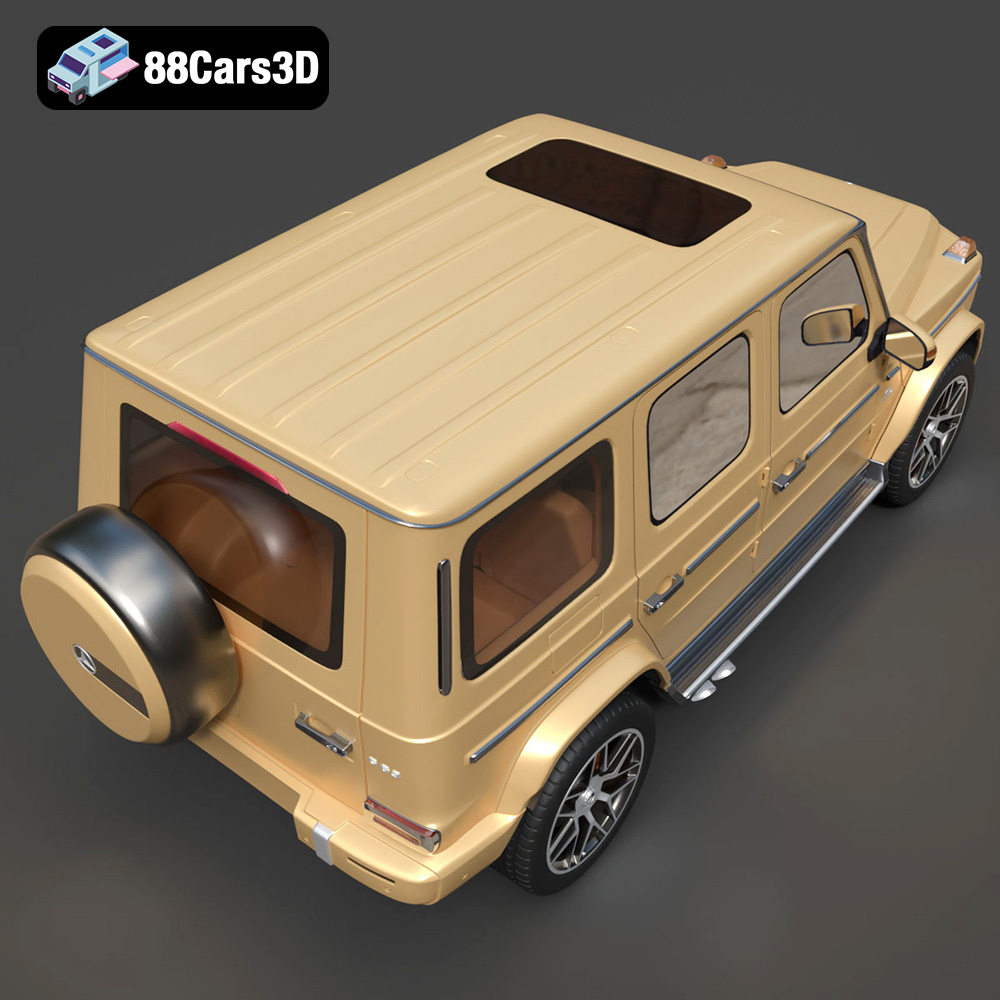
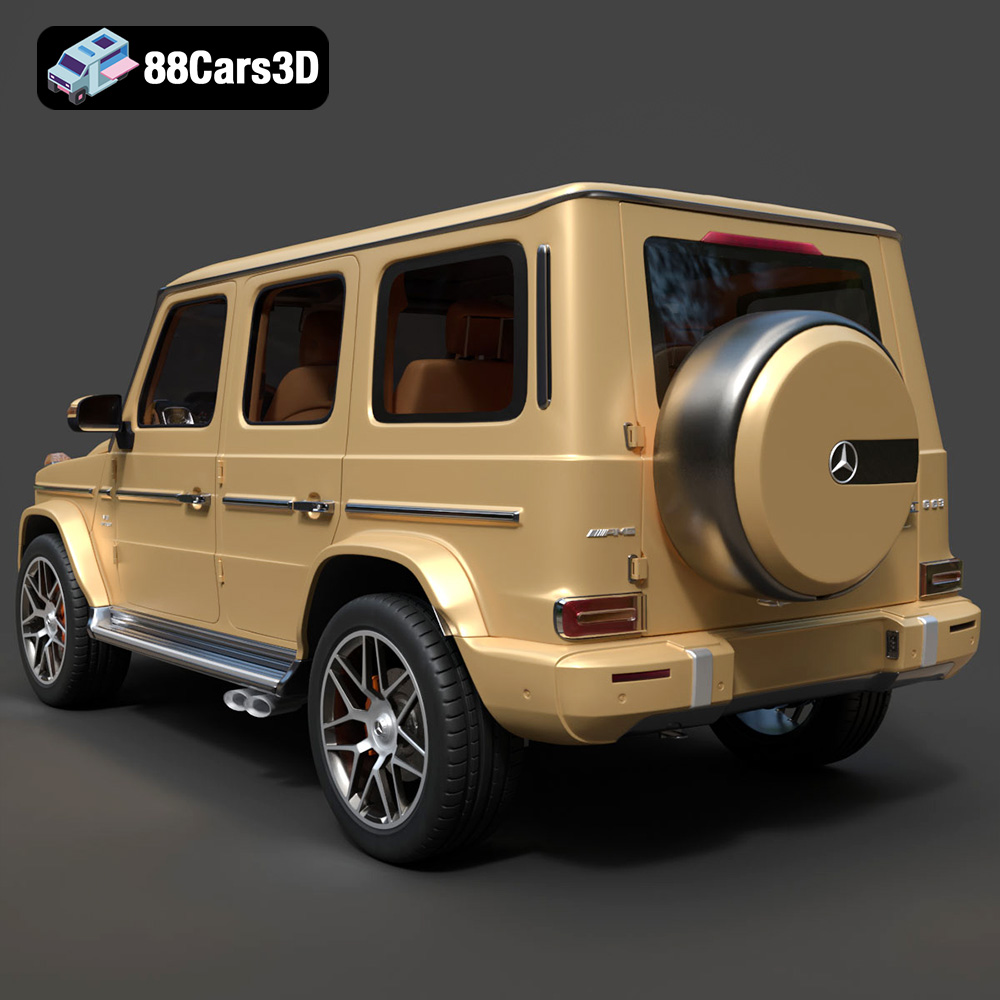
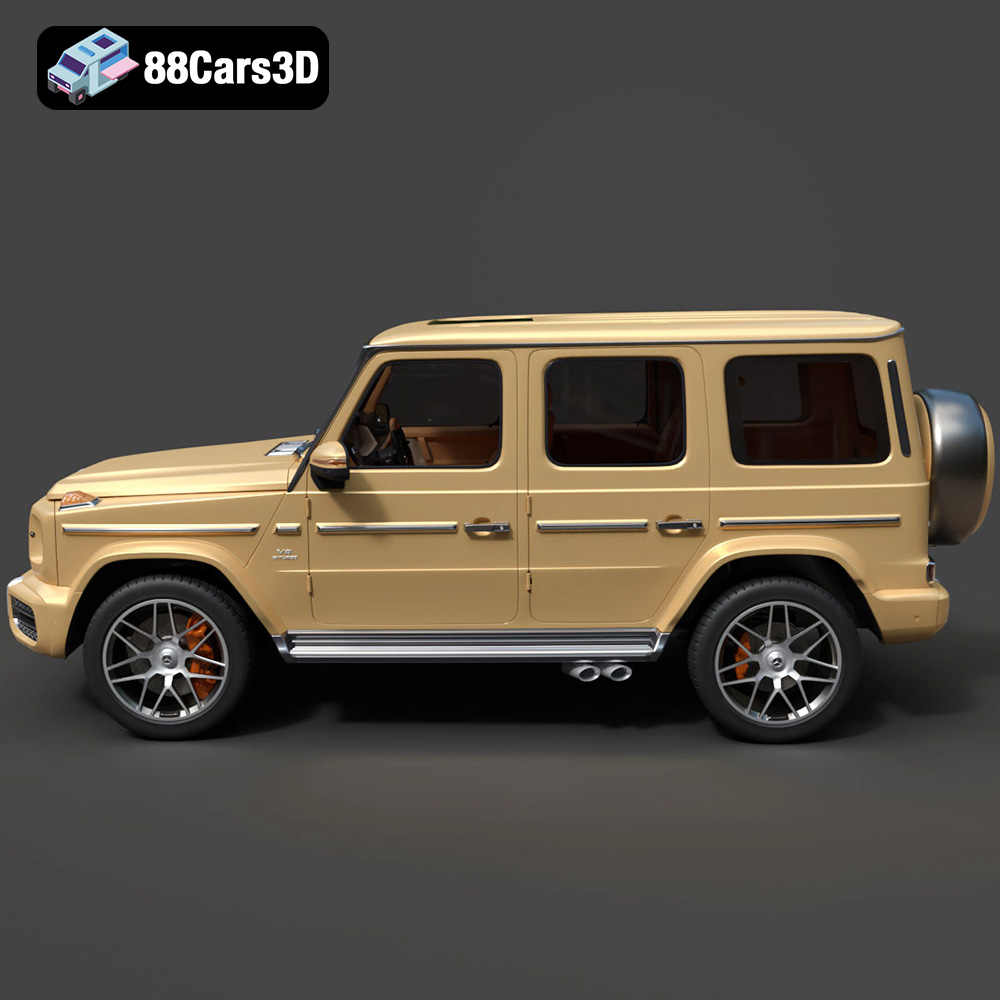
The Mercedes-Benz G63 AMG is more than just a vehicle; it’s an icon. Its unique blend of military-grade robustness, uncompromising luxury, and blistering performance makes it a captivating subject for any visual project. Replicating this machine in the digital realm requires an extraordinary commitment to detail, and this 3D model delivers precisely that, becoming a prime example of exceptional 3D car models.
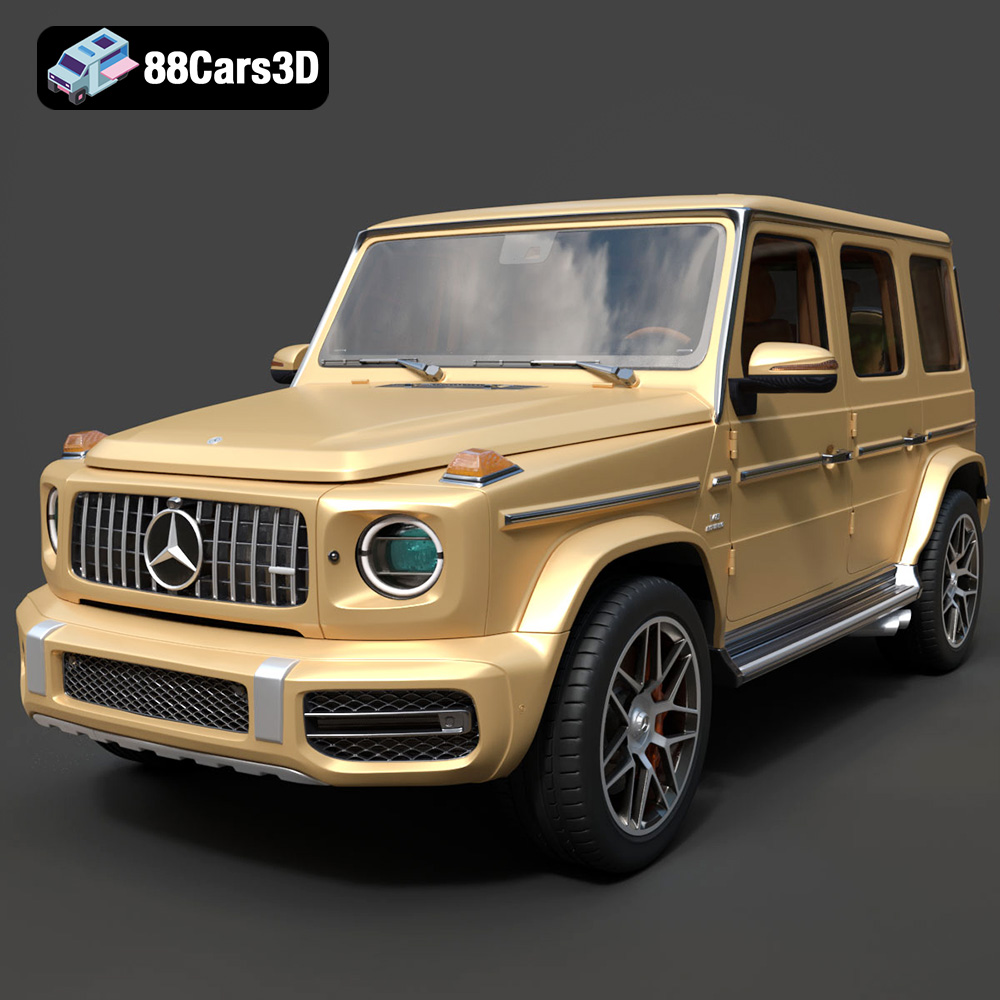
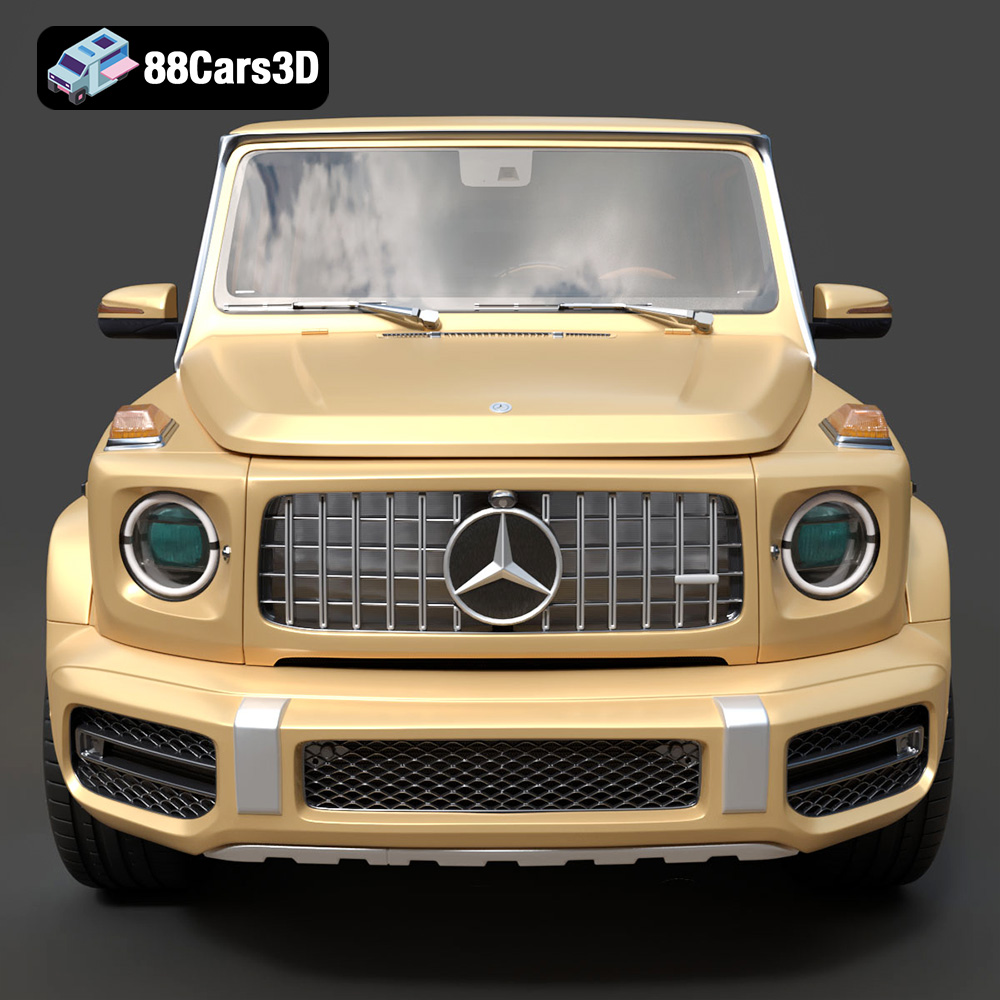
The G-Wagon’s “unmistakable boxy silhouette” is meticulously preserved, from its assertive stance to the signature circular LED headlights that define its front fascia. The aggressive Panamericana front grille, a hallmark of AMG performance, is accurately modeled, giving the digital vehicle its fierce character. Every exterior feature, from the “handcrafted biturbo V8 engine bay layout” (observable with proper camera angles) to the “distinctive side-exit dual exhaust system,” speaks to the model’s high fidelity. Even the “massive AMG alloy wheels, high-performance tires, and detailed brake calipers” are rendered with precision, complete with an “intricate ladder-frame chassis and suspension details,” providing an astonishing level of realism for extreme close-ups and detailed walkarounds.
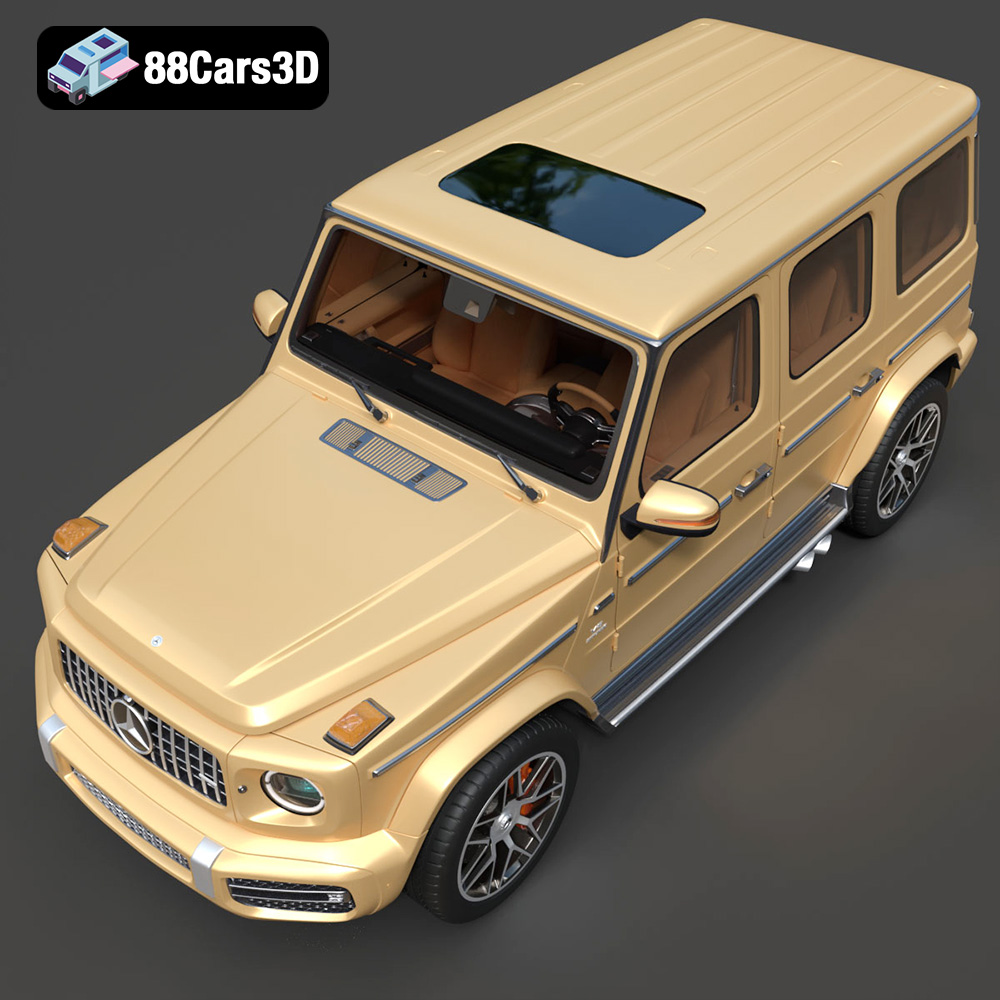
The fidelity extends seamlessly into the cockpit, offering a luxurious and technically accurate interior. The “premium diamond-stitched luxury leather seating details” immediately convey opulence, while the “detailed widescreen digital cockpit and instrument cluster” are ready to display intricate readouts. The “AMG performance steering wheel with integrated controls” feels tangible, and the “accurate center console, dashboard, pedals, and shifter” contribute to a fully realized cabin. This level of interior detail is crucial for projects requiring “first-person POV in gaming” or immersive VR experiences, ensuring that users feel truly inside this iconic SUV.
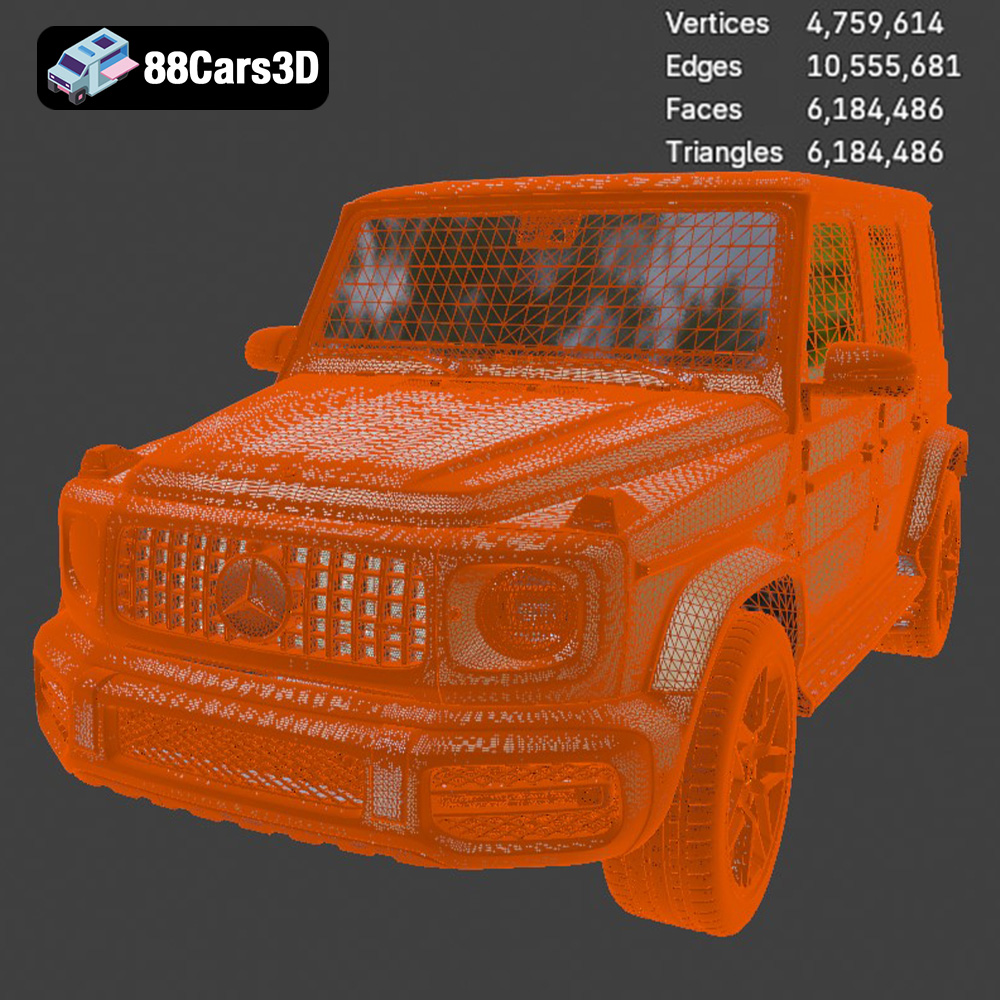
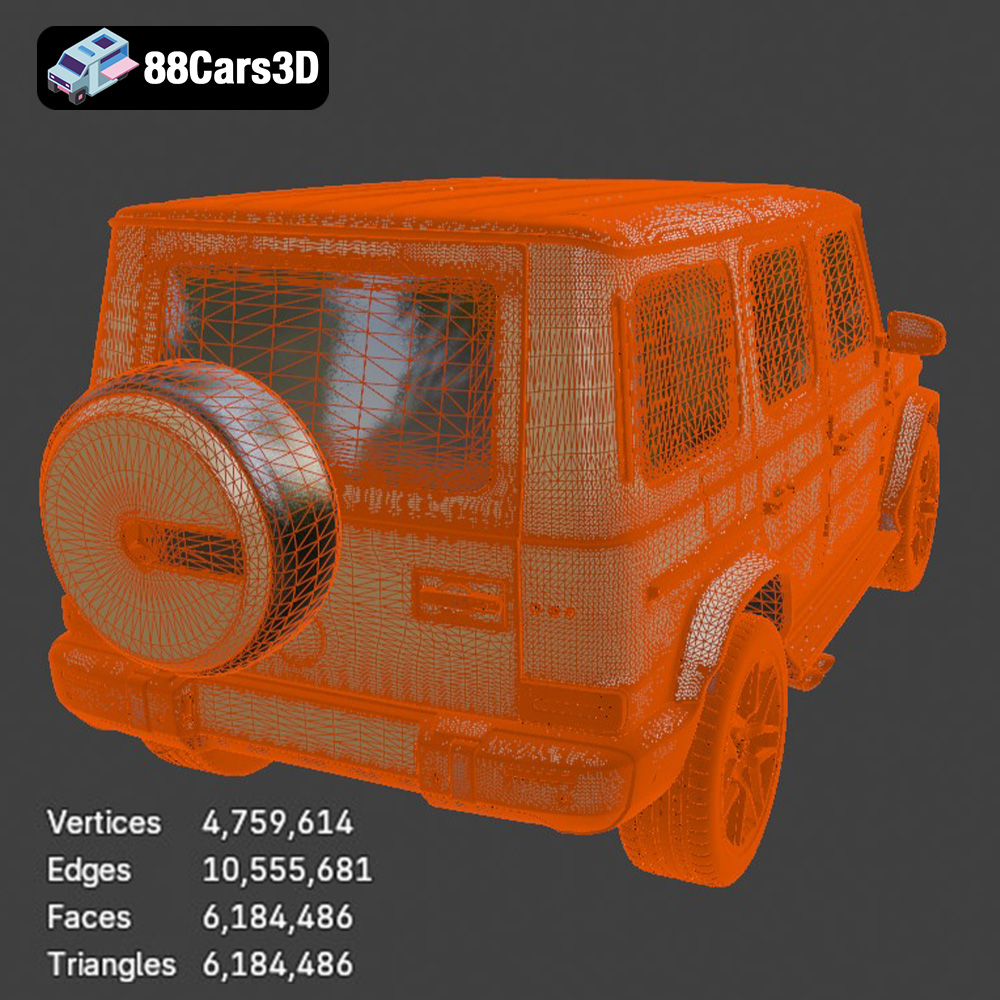
At the heart of this model’s versatility is its intelligent technical construction. Boasting “6,184,486 triangles,” it strikes a remarkable balance. While this is a substantial polycount, indicative of extreme visual fidelity, the geometry is “expertly structured” to allow for “seamless integration into advanced real-time applications like Unreal Engine 5.” This ‘game-ready & optimized’ approach means you get high-end visual realism without sacrificing performance unduly in demanding real-time environments. Furthermore, its “real-world scale accuracy” and “proper pivot setup for steering, wheel rotation, and suspension travel” are essential for realistic physics simulations and complex animations, making it an invaluable game asset.
The utility of a premium 3D model lies in its seamless integration into diverse professional workflows. The Mercedes-Benz G63 AMG model from 88cars3d.com is engineered for adaptability, providing the necessary assets for a range of industry applications.
For cinematic visuals, advertising campaigns, and architectural visualization, the native .max and .blend files are invaluable. Artists can leverage the full power of their preferred rendering engines—V-Ray, Corona, Cycles, or Eevee—to achieve breathtaking realism. The comprehensive nature of these files means materials are often pre-configured, requiring only minor adjustments to suit specific lighting conditions or artistic directions. Imagine the G63 AMG parked in front of a modern mansion for an architectural visualization, its metallic paint reflecting the environment’s subtleties. Or visualize it cruising through a serene landscape, showcasing its luxury for a marketing render. The ability to “change body/tank colors,” “modify tire textures,” and “adjust material finishes” provides complete creative control, allowing you to match brand guidelines or unique artistic visions.
The “game-ready & optimized” nature of this G63 AMG model shines brightest in real-time engine pipelines. The .fbx and .unreal formats are specifically tailored for engines like Unreal Engine and Unity. Importing the .fbx is straightforward, allowing developers to quickly assign PBR (Physically Based Rendering) materials and set up collision meshes. The .unreal format goes a step further, potentially providing an engine-native asset with pre-configured materials, LODs (Levels of Detail), and even basic vehicle blueprints, drastically reducing setup time. The “proper pivot setup for steering, wheel rotation, and suspension travel” is critical for implementing realistic vehicle physics, enabling the G63 to handle authentically in racing simulators or open-world games. This model serves as a robust foundation for building immersive and high-performance game experiences, directly benefiting from its balanced polycount and meticulous preparation.
The emergence of augmented and virtual reality has opened new avenues for showcasing automotive design. The .glb format is tailor-made for these immersive platforms, as well as for browser-based interactive experiences. Its single-file, optimized structure ensures fast loading times and smooth performance in virtual showrooms, interactive configurators, or mobile AR apps. Imagine a potential customer exploring the G63 AMG in their driveway via AR, or donning a VR headset to sit inside and interact with the detailed digital cockpit. The optimized geometry and PBR materials translate beautifully into these environments, providing a compelling and highly interactive way to engage with the vehicle, offering stunning realism for automotive simulations, VR showrooms, and high-fidelity rendering pipelines.
The utility of high-quality 3D car models extends beyond the digital screen into the physical world through 3D printing. For enthusiasts, collectors, or even designers needing a physical prototype, the Mercedes-Benz G63 AMG model offers a pathway to tangible creation.
The inclusion of .stl and .ply formats is crucial for 3D printing. The .stl format, in particular, is the universal language of additive manufacturing. It transforms the intricate digital mesh of the G63 AMG into a series of triangular facets that 3D printers can interpret to build layer by layer. While 3D printing is a different discipline from rendering, the underlying detail of the digital model, such as the “accurate Mercedes-Benz G63 AMG frame geometry” and the “detailed AMG biturbo V8 engine bay elements,” directly translates into the potential for highly detailed physical replicas.
Achieving a successful 3D print of a complex automotive model like the G63 AMG requires careful attention to print settings. The product description provides excellent guidance:
This attention to 3D print readiness makes the G63 AMG model from 88cars3d.com a versatile asset for hobbyists and professional prototypers alike.
A truly professional 3D car model offers more than just static beauty; it provides a canvas for boundless customization. The Mercedes-Benz G63 AMG model empowers artists and developers with extensive flexibility, making it adaptable to virtually any creative brief or technical requirement.
The ability to manipulate material properties is paramount in 3D production. With this G63 AMG model, you can effortlessly “change body/tank colors,” allowing for a spectrum of options from “authentic factory colors” to bespoke “custom finishes.” This is essential for branding, showcasing different trim levels, or creating unique artistic interpretations. Furthermore, the option to “modify tire textures (off-road vs. street variants)” instantly transforms the vehicle’s persona, whether it’s destined for a rugged desert scene or a sleek urban environment. Coupled with the capacity to “adjust material finishes (matte, gloss, metallic),” the model can embody any aesthetic, from a stealthy matte black to a gleaming metallic silver, ensuring it perfectly fits your scene’s mood and narrative.
A 3D model’s visual impact is profoundly influenced by its surrounding environment and lighting. This G63 AMG model’s robust topology and well-structured materials allow you to “adapt lighting for different environments” with ease. Whether you’re placing it under the harsh sun of a desert landscape, the soft glow of a studio photoshoot, or the dynamic reflections of a bustling city street, the model will react realistically. Its meticulously crafted surfaces and accurate PBR materials ensure that light interacts naturally, producing convincing reflections, refractions, and shadows. This adaptability makes the G63 AMG an ideal asset for diverse projects, from high-end rendering to interactive virtual showrooms, offering stunning realism for automotive simulations, VR showrooms, and high-fidelity rendering pipelines.
The Mercedes-Benz G63 AMG 3D model is a testament to the power of high-quality digital assets. From its meticulously recreated exterior and interior details to its expertly optimized technical specifications and versatile file format options, it stands as a prime example of what premium 3D car models can offer. Whether your project involves generating photorealistic automotive rendering, developing cutting-edge game assets for real-time engines, crafting immersive AR/VR experiences, or even producing high-fidelity 3D prints, this model provides the foundation for success.
Its comprehensive features, including game-ready optimization, real-world scale, and a rich array of customization options, ensure that creative professionals have all the tools needed to bring their visions to life. For those seeking to elevate their digital automotive projects, exploring the extensive collection of high-quality 3D car models available at 88cars3d.com is a crucial step. This particular Mercedes-Benz G63 AMG model is not just an asset; it’s an investment in unparalleled digital fidelity and creative flexibility, ready to drive your next project to new heights.
The Mercedes-Benz G63 AMG stands as the pinnacle of luxury SUVs, blending rugged military heritage with modern high-performance engineering. This 3D model captures the unmistakable boxy silhouette, iconic circular LED headlights, and aggressive Panamericana front grille that make the G-Wagon a global status symbol. Every detail, from the handcrafted biturbo V8 engine bay layout to the distinctive side-exit dual exhaust system, has been faithfully recreated.
$37.50
.blend
.fbx
.glb
.luxury suv
.max
.obj
.ply
.rendering
.stl
.unreal
car-3d-model
g63-amg
game asset
game-ready
mercedes-benz
off-road
optimized
SUV
VR/AR