Get 20% OFF All Premium 3D & STL Models!

In the expansive realm of digital content creation, the demand for highly detailed, accurately modeled assets is paramount. Whether you’re crafting an immersive video game, a compelling cinematic sequence, an interactive AR/VR experience, or a precise visualization, the quality of your 3D models forms the bedrock of your project’s success. Automotive rendering and military simulations, in particular, require an unwavering commitment to authenticity and technical precision.
Few vehicles embody rugged utility and tactical prowess quite like the BTR-80. This legendary 8×8 wheeled amphibious armored personnel carrier has left an indelible mark on military history, known for its formidable presence and versatile capabilities. Translating such an iconic machine into a digital asset demands meticulous attention to detail, efficient optimization, and broad compatibility. This is precisely what a premium 3D model, such as the BTR-80 available on 88cars3d.com, delivers to artists and developers worldwide.
This comprehensive guide delves into the technical intricacies, professional applications, and creative possibilities unlocked by high-fidelity 3D car models like the BTR-80. We’ll explore the essential file formats, integration into popular software and game engines, the nuances of 3D printing, and how such an asset empowers creators across various industries.
The journey of a 3D model from concept to deployment involves traversing a landscape of diverse file formats, each with its own strengths, weaknesses, and specialized applications. Choosing the correct format is crucial for maintaining data integrity, ensuring compatibility, and optimizing performance within your specific workflow. The BTR-80 3D model, for instance, offers a comprehensive suite of formats, catering to virtually any professional need.
The .blend format is Blender’s native project file. It encapsulates an entire Blender scene, including all mesh data, materials (with their node setups), textures, lighting, cameras, animations, rigging, and even modifiers. For users deeply integrated into the Blender ecosystem, a .blend file offers maximum flexibility and editability. It’s ideal for artists who wish to dissect the model, understand its construction, apply custom modifiers, re-rig it for specific animations, or modify materials extensively without losing any original scene data. This format provides the most comprehensive starting point for any significant customization.
Autodesk’s .fbx (Filmbox) format has become an industry standard for data exchange, particularly between 3D animation software and game engines like Unreal Engine and Unity. It’s designed to carry a rich set of data, including geometry, UVs, textures, materials, animations, rigging, cameras, and lights, making it incredibly versatile. Its robust support for skeletal animations and blend shapes makes it indispensable for character and vehicle rigging. For importing 3D car models into real-time pipelines, .fbx is often the go-to choice due to its balance of feature support and broad compatibility.
The .obj (Wavefront OBJ) format is one of the oldest and most widely supported formats for 3D geometry. It primarily stores mesh data (vertices, faces, UV coordinates, normals) and can reference external material files (.mtl) for basic color and texture information. While it doesn’t typically carry animation, rigging, or advanced material data, its universal compatibility makes it excellent for archiving models, sharing geometry across disparate software packages, or when the focus is purely on the mesh itself. The .obj format guarantees that your 3D car models can be opened and worked on in almost any 3D application.
.glb (GL Transmission Format Binary) is the binary version of glTF, a royalty-free specification for 3D scene and model transmission. It’s highly optimized for efficient delivery and loading in web applications, augmented reality (AR), and virtual reality (VR) environments. A .glb file is a single-file asset that bundles geometry, PBR (Physically Based Rendering) materials, textures, animations, and skeletal data into one compact package. Its efficiency and comprehensive PBR support make it an excellent choice for interactive 3D viewers, online product configurators, and mobile AR experiences, ensuring fast load times and consistent visual quality.
The .stl (Stereolithography) format is the de facto standard for 3D printing. It represents a 3D model as a series of connected triangles, defining only the surface geometry of an object without color, texture, or other advanced attributes. When a 3D car model is destined for physical creation, converting it to .stl is the crucial step. While simple, its ubiquity ensures compatibility with virtually all 3D printers and slicing software. The BTR-80’s .stl output allows hobbyists and professionals to bring this digital armored vehicle into the physical world as a detailed scale model.
The .ply (Polygon File Format) is often associated with 3D scanners and scientific applications. It’s more versatile than .obj or .stl in that it can store a wider range of properties, including vertex color, normal vectors, texture coordinates, transparency, and even properties per face. While less common for general animation, it’s invaluable for data-heavy applications like reverse engineering, CAD integration, and precise geometric analysis. For specific engineering or analytical tasks involving the BTR-80’s geometry, the .ply format offers enhanced data fidelity.
The .unreal format signifies an asset that has been specifically prepared and sometimes pre-imported or configured for direct use within Unreal Engine. This often means the model has appropriate material setups, collision meshes, LODs (Levels of Detail), and pivot points aligned with Unreal’s conventions, significantly streamlining the import and integration process for game developers. For a complex asset like the BTR-80, having an Unreal-ready format can save hours of setup time, allowing developers to immediately focus on gameplay and environment design.
Similar to .blend for Blender, the .max format is the native project file for Autodesk 3ds Max. It contains all scene data, including geometry, materials, lighting, cameras, animations, rigging, and modifier stacks. For professionals working in architectural visualization, high-end rendering, or complex animation sequences using 3ds Max, this format offers the most complete and editable version of the model. It allows for advanced scene construction, detailed material editing, and sophisticated animation workflows that leverage the full power of 3ds Max.
The availability of such a diverse range of formats for the BTR-80 3D model from 88cars3d.com underscores its adaptability, ensuring that no matter your software or project requirements, you have the right tools at your disposal.
A truly exceptional 3D car model strikes a delicate balance between visual authenticity and technical efficiency. The BTR-80 3D model exemplifies this principle, meticulously crafted to represent the real-world vehicle with high fidelity while being perfectly optimized for demanding digital environments.
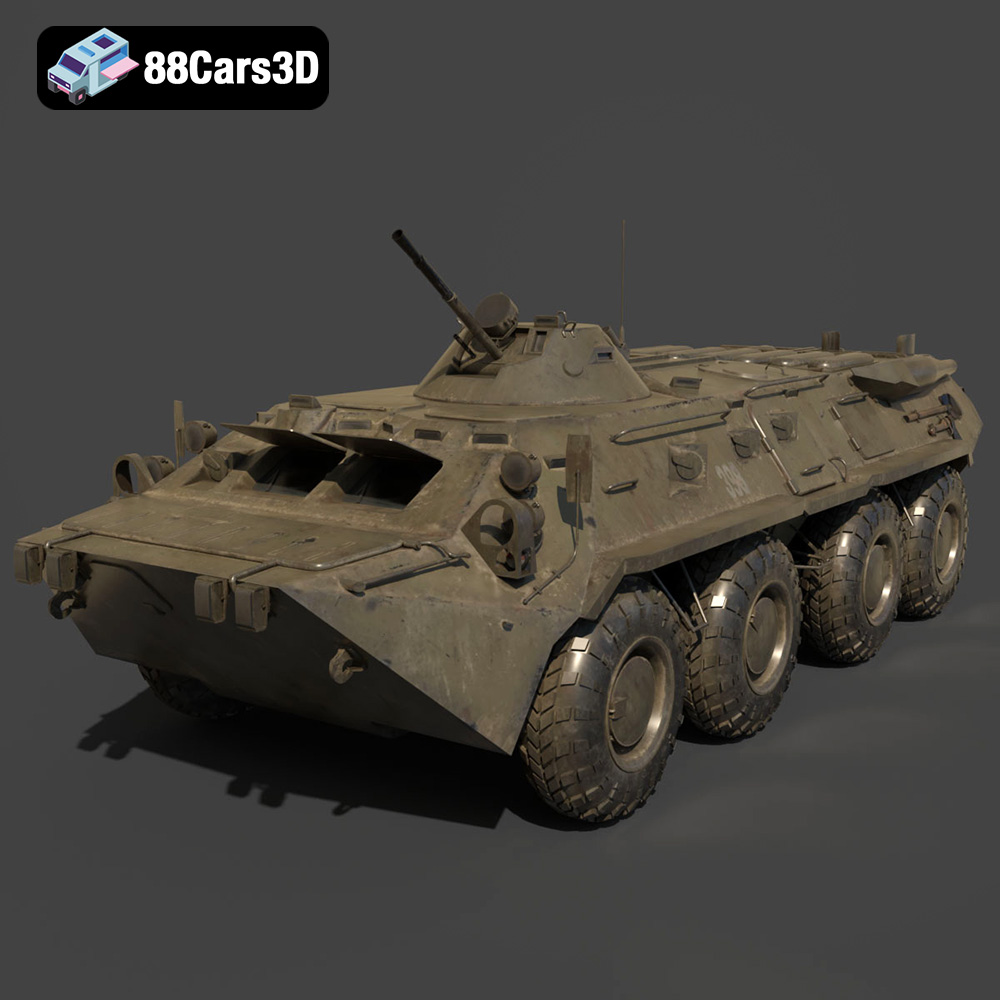
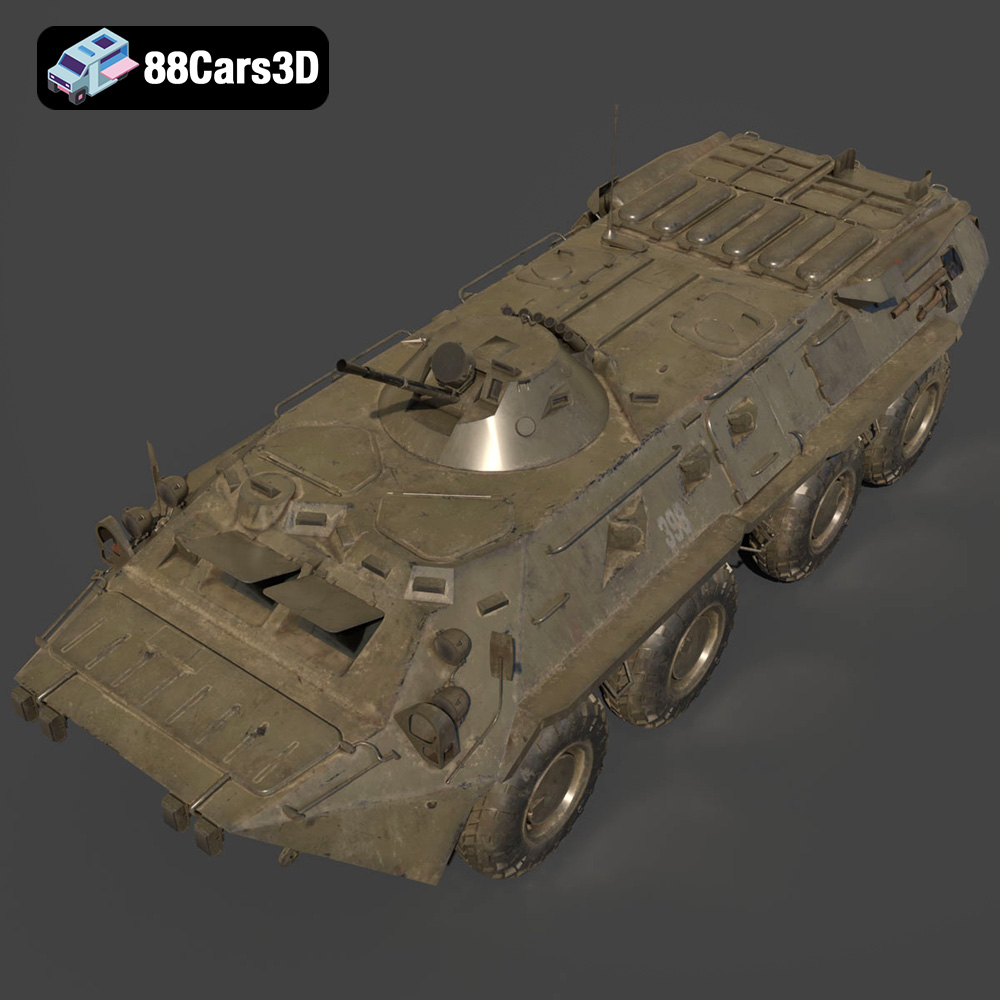
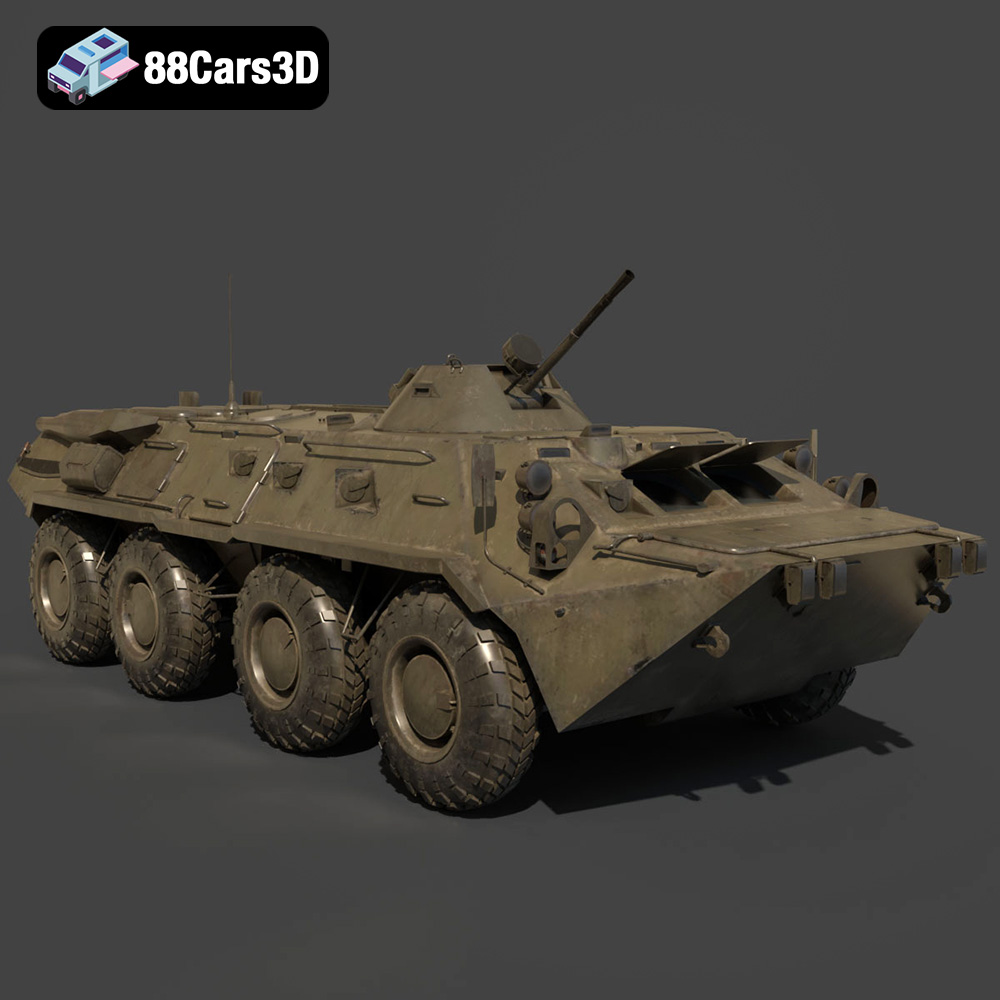
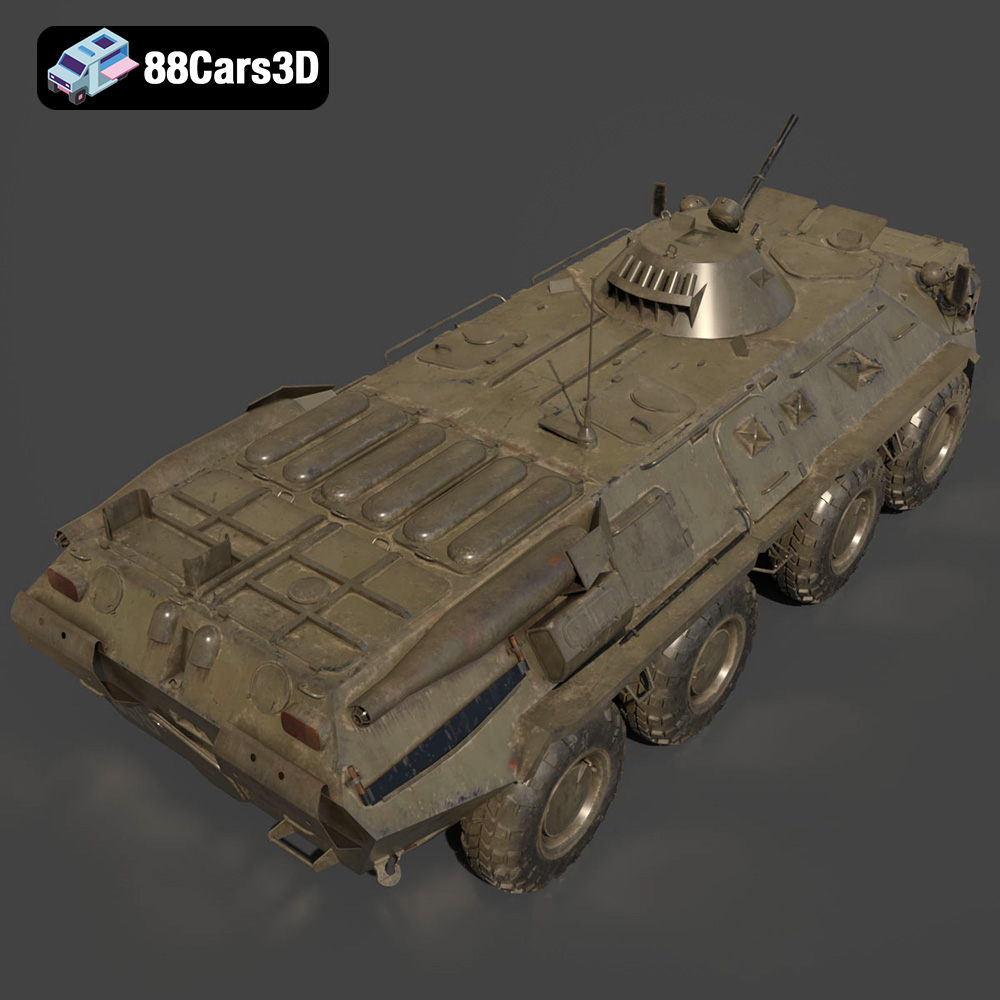
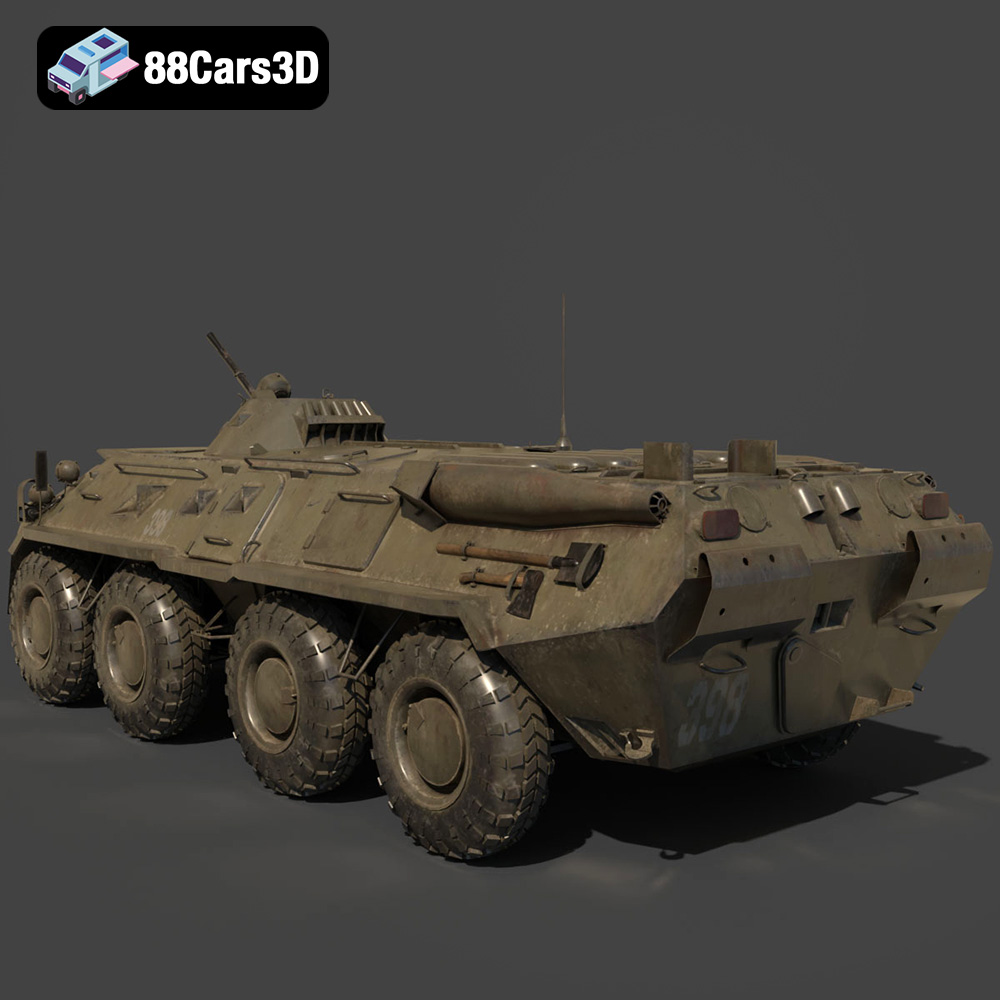
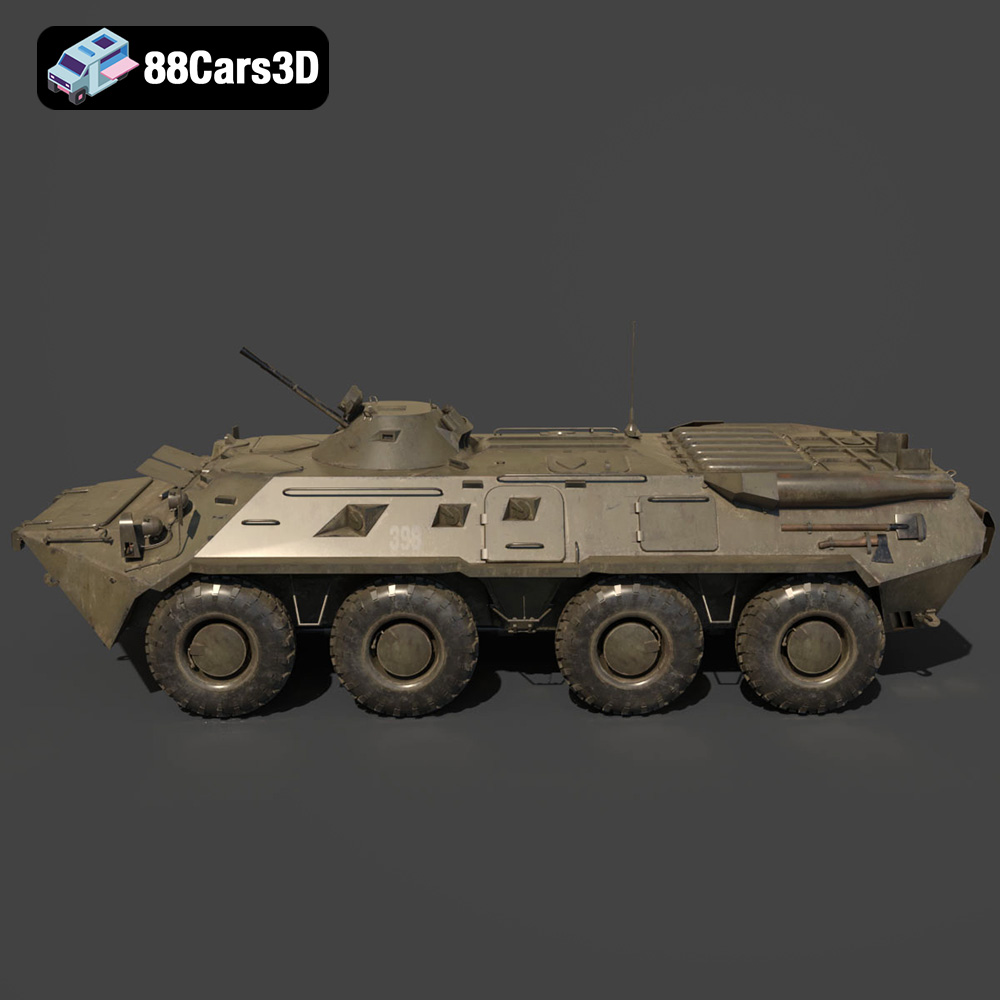
The BTR-80 is instantly recognizable, and its digital counterpart leaves no detail overlooked. The model accurately reproduces the vehicle’s signature sloped armor plating, a crucial element for both aesthetics and defensive function. The imposing BPU-1 turret, complete with a highly detailed 14.5mm KPVT heavy machine gun and a 7.62mm PKT machine gun, forms the centerpiece of its aggressive stance. Every element, from the rear-mounted engine deck exhausts for the KamAZ V8 diesel engine to the intricate periscopes and firing ports, has been modeled to deliver an authentic representation. The heavy-duty 8×8 drivetrain, rugged all-terrain tactical tires, and detailed rims convey its formidable off-road capabilities, while the complex independent suspension and steering linkages are prepared for realistic animation. Even subtle features like authentic tactical lighting, including infrared searchlights and marker lights, are faithfully replicated, enhancing its realism for various scenarios, from daytime patrols to night operations.
Beyond its robust exterior, the BTR-80 3D model offers significant interior detail, crucial for immersive first-person perspectives in games and VR simulations. The driver and commander stations feature accurate viewports and periscope details, providing a true sense of being inside the vehicle. A tactical steering yoke and essential dashboard instrumentation add to the realism of the controls. For the gunner, targeting optics and control mechanisms are modeled with precision. The utilitarian troop compartment layout, complete with bench seating, further enhances the sense of scale and realism, allowing for dynamic camera movements or even character placement within the vehicle. This level of internal detailing is particularly beneficial for military training simulators or cinematic sequences that require internal shots or interaction.
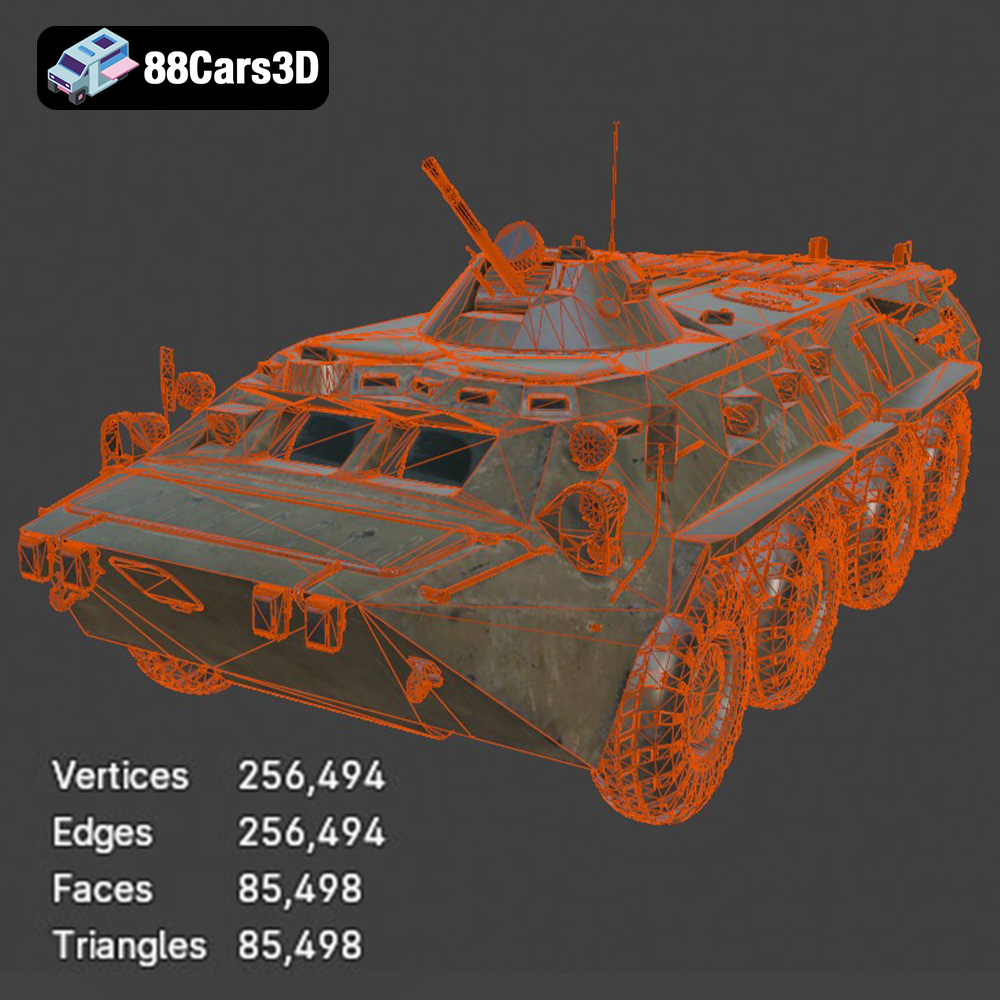
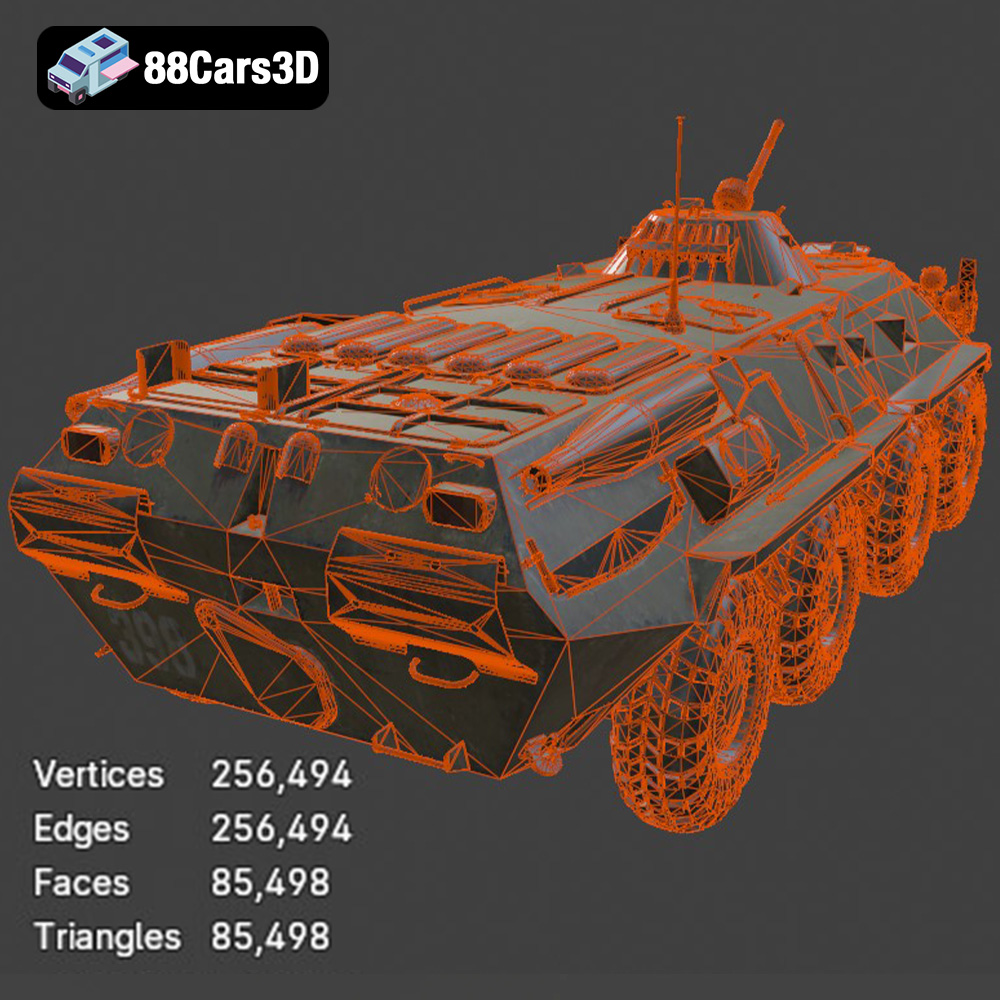
At the heart of any high-performance 3D asset lies its technical optimization. The BTR-80 model boasts a highly optimized topology of 85,498 triangles. This polycount strikes an ideal balance, providing the high-end AAA quality expected in modern game development and rendering without burdening real-time engines. Such efficiency ensures smooth frame rates in demanding applications like Unreal Engine and Unity, making it a true game-ready asset. The clean geometry guarantees flawless shading and silhouette rendering, eliminating visual artifacts and ensuring a polished appearance from every angle. Furthermore, the model adheres to real-world scale accuracy, based on actual BTR-80 blueprints and dimensions, which is critical for realistic simulations and seamless integration into existing scenes. Crucially, separate components like the wheels, turret, gun barrel, and hatches are set up with proper pivot points, making them immediately ready for rigging and animation, whether for steering, 8-wheel rotation, turret traverse, gun elevation, or realistic suspension travel.
The true value of a versatile 3D asset like the BTR-80 lies in its seamless integration into various professional workflows, from game development to high-fidelity rendering and immersive AR/VR experiences.
For game developers, time is a precious commodity. The BTR-80 3D model, especially with its .fbx and .unreal formats, offers a significant head start. Importing into Unreal Engine or Unity is straightforward; the optimized mesh and proper pivot setup mean less cleanup. Developers can quickly set up Physically Based Rendering (PBR) materials, leveraging existing texture maps (which would be provided with a complete asset) to achieve realistic surface qualities, from weathered paint to gleaming metal. The separate, pre-pivoted parts are invaluable for rigging and animation, allowing for quick implementation of intricate movements: turret rotation, gun elevation, individual wheel rotations, and a functional suspension system. Implementing collision meshes for realistic interaction with the environment and potentially setting up Levels of Detail (LODs) further refines its performance. Using a pre-optimized 3D car model from 88cars3d.com drastically reduces the development overhead, allowing teams to focus on gameplay mechanics and environmental storytelling rather than asset creation from scratch.
For cinematic renders, historical documentaries, or product visualization, fidelity is paramount. With the .max and .blend formats, artists gain full control over the BTR-80 model within their preferred software. In 3ds Max, artists can leverage V-Ray or Corona Renderer for photorealistic lighting and material customization. Imagine adjusting the hull color to a solid olive drab, desert tan, or intricate woodland camouflage, or modifying material finishes to depict matte military CARC paint, weathered metal, or rusted steel for a battle-hardened look. Blender users can achieve similar results with Cycles or Eevee, utilizing its powerful node-based shader editor for infinite material variations. The model’s clean geometry ensures perfect subdivision for close-up shots, and its accurate proportions make it ideal for integration into real-world backplates. This level of detail makes it perfect for creating compelling renders for action scenes, military showcases, or educational content, allowing artists to tell visually stunning stories without compromise.
The immersive nature of AR/VR and simulation demands assets that are not only visually appealing but also highly performant. The BTR-80’s optimized polycount and the availability of the .glb format make it an excellent choice for these applications. For virtual training modules, tactical planning apps, or immersive virtual tours, the model can be deployed with minimal performance impact. Its detailed interior is particularly effective for first-person VR experiences, allowing users to realistically navigate and interact within the armored personnel carrier. Developers can create scenarios where users can inspect the vehicle’s components, practice maintenance procedures, or simulate tactical maneuvers. The .glb format ensures seamless integration into web-based AR viewers or specific VR platforms, providing engaging and realistic experiences on a wide range of devices.
The digital realm often extends into the physical, and the BTR-80 3D model is perfectly suited for 3D printing, enabling enthusiasts and professionals to bring this military marvel to life as a tangible object.
The provided .stl format is specifically tailored for 3D printing. Before printing, users should convert or export the model to .stl if they are working with other native files. It’s crucial to review the mesh integrity in slicing software to ensure it’s manifold (watertight) and free of errors, which could cause printing issues. The BTR-80 model is designed for optimal printing, with recommended scales like 1:35, 1:48, or 1:72, catering to standard military diorama sizes. Each scale offers a balance between print time, material usage, and detail resolution, allowing hobbyists to choose based on their printer’s capabilities and desired display size.
Achieving a high-quality physical replica requires careful attention to print settings. For fine details, resin printing (SLA/DLP) is highly recommended over FDM, allowing for layer heights as low as 0.04–0.12 mm to capture intricate features like machine gun barrels, periscopes, and antennas. Wall thickness should be maintained between 1.2–2.0 mm for structural integrity. An infill of 20–30% provides a good balance between strength and material conservation. Supports are almost always required for complex military models, especially for overhangs, delicate parts, and areas like the turret, gun barrels, and exhaust systems. Print orientation is also strategic: printing the hull horizontally often ensures better structural integrity, while wheels and the turret might be printed separately to optimize detail and minimize supports. Post-processing is where the model truly shines: careful sanding, a good primer coat, and then applying authentic military camouflage colors with weathering finishes can transform a print into a museum-quality display piece. This attention to detail in both digital and physical output highlights the versatility of the BTR-80 3D model.
A truly professional 3D asset offers more than just fidelity; it provides a canvas for creativity and adaptation. The BTR-80 3D model is designed with customization in mind, allowing artists to tailor it to specific project requirements and narrative contexts.
The core structure and optimized geometry of the BTR-80 model provide a solid foundation for endless visual variations. Artists can easily change hull colors to match different operational theaters—from a classic solid olive drab for European forests to desert tan for arid environments or a complex woodland camouflage pattern. Modifying tire textures can dramatically alter its appearance, from clean tarmac variants for parades to muddy off-road versions for active combat scenes. Adjusting material finishes allows for depiction of brand-new vehicles straight from the factory, or heavily weathered metal and rusted steel for battle-scarred veterans. Furthermore, adapting the lighting for daytime operations or night-vision environments, along with adding dust, dirt, or battle damage textures, allows the same base model to serve a multitude of narrative and visual purposes, truly enhancing the immersive experience of any military-themed project.
Beyond visual customization, the BTR-80 model is architected for enhanced functionality. With separate parts like wheels, the turret, gun barrel, and hatches already prepared for rigging and animation, artists can bring the vehicle to life. Implementing full vehicle rigging enables realistic movement, including suspension articulation, individual wheel rotations, and precise steering. The turret can be animated for traverse and gun elevation, and the machine guns can be set up for firing animations. Opening and closing hatches adds another layer of realism and interaction, especially valuable in games or AR/VR applications where users might enter or exit the vehicle. This pre-configured structure saves significant time for riggers and animators, allowing them to jump straight into defining movements and interactions without the tedious initial setup. Such adaptability ensures that the BTR-80 is not just a static display piece but a dynamic, interactive asset capable of driving engaging digital experiences.
In a world saturated with digital assets, discerning creators seek quality, accuracy, and reliability. 88cars3d.com distinguishes itself as a premier marketplace for high-quality 3D car models by prioritizing these very attributes. The BTR-80 3D model serves as a prime example of the exceptional standards you can expect.
Every model featured on 88cars3d.com is meticulously crafted with an acute understanding of professional requirements. This means not only stunning visual fidelity but also optimized geometry, clean topology, and multi-format compatibility. For artists and developers, this translates directly into significant time savings and a higher quality end product. Instead of spending countless hours modeling from scratch or cleaning up problematic assets, you can acquire game-ready, render-ready, and print-ready 3D car models that seamlessly integrate into your workflow.
Whether your project demands photorealistic automotive rendering, high-performance game assets, immersive AR/VR experiences, or precise 3D prints, the curated selection at 88cars3d.com provides reliable solutions. Investing in premium assets ensures that your creative vision is supported by robust technical foundations, allowing you to focus on innovation and storytelling.
The BTR-80 3D model stands as a testament to the power of expertly crafted digital assets. Its meticulous detail, efficient optimization, and broad file format compatibility make it an invaluable resource for a diverse array of creative and technical projects. From enhancing the realism of military simulations and tactical shooters to creating breathtaking cinematic renders and detailed 3D printed dioramas, this model offers unparalleled versatility.
We’ve explored how its optimized polycount and precise geometry ensure peak performance in game engines like Unreal and Unity, while its extensive file format support (from .blend and .max for full editability to .fbx for universal exchange and .stl for 3D printing) caters to every professional workflow. The ability to customize its appearance and leverage its pre-prepared components for animation further solidifies its position as a top-tier asset.
For artists, developers, and hobbyists committed to excellence, high-quality 3D car models like the BTR-80 from 88cars3d.com are not just assets; they are foundational elements that elevate projects, save valuable time, and unlock new creative possibilities. Embrace the power of precision and efficiency to bring your digital visions to life.
The BTR-80 is an iconic 8×8 wheeled amphibious armored personnel carrier renowned for its ruggedness, high mobility, and unmistakable aggressive stance. This meticulously crafted 3D model captures the distinct heritage of the legendary military vehicle, showcasing its signature sloped armor plating, split side doors, and the imposing BPU-1 turret housing a 14.5mm KPVT heavy machine gun. Every visual element, from the rear-mounted engine deck exhausts and water jet propulsion ports to the intricate periscopes and firing ports, has been modeled to deliver a highly authentic representation of this tactical workhorse.
Engineered with exceptional visual fidelity and technical efficiency, this 3D model features a highly optimized topology of 85,498 triangles. This game-ready asset provides the perfect balance between high-end AAA quality and real-time performance, making it highly versatile for demanding digital environments. The clean geometry ensures flawless shading and silhouette rendering, making it a premium choice for game development, interactive AR/VR training applications, immersive simulations, and high-resolution military visualization.
Perfect for tactical FPS games, military training simulators, cinematic battlefield renders, and historical vehicle showcases.
.blend, .fbx, .obj, .glb, .stl, .ply, .unreal, .max
Tags:
btr, btr-80, armored-personnel-carrier, apc, military-vehicle, game-ready, low-poly, optimized, military-3d-model, game-asset, rendering, vr-ar, blend, fbx, obj, glb, stl, ply, unreal, max
$14.99
.apc
.blend
.btr
.fbx
.glb
.max
.obj
.ply
.rendering
.stl
.unreal
armored-personnel-carrier
btr-80
game asset
game-ready
low-poly
military-3d-model
military-vehicle
optimized
VR/AR