Get 20% OFF All Premium 3D & STL Models!

In the dynamic worlds of game development, architectural visualization, cinematic production, and virtual reality, the quality of 3D assets is paramount. A meticulously crafted 3D model doesn’t just fill a scene; it breathes life into it, conveying realism, functionality, and narrative depth. Whether you’re designing an immersive open-world game, simulating a complex industrial site, or creating a high-fidelity training module, the demand for authentic and optimized 3D assets is constant.
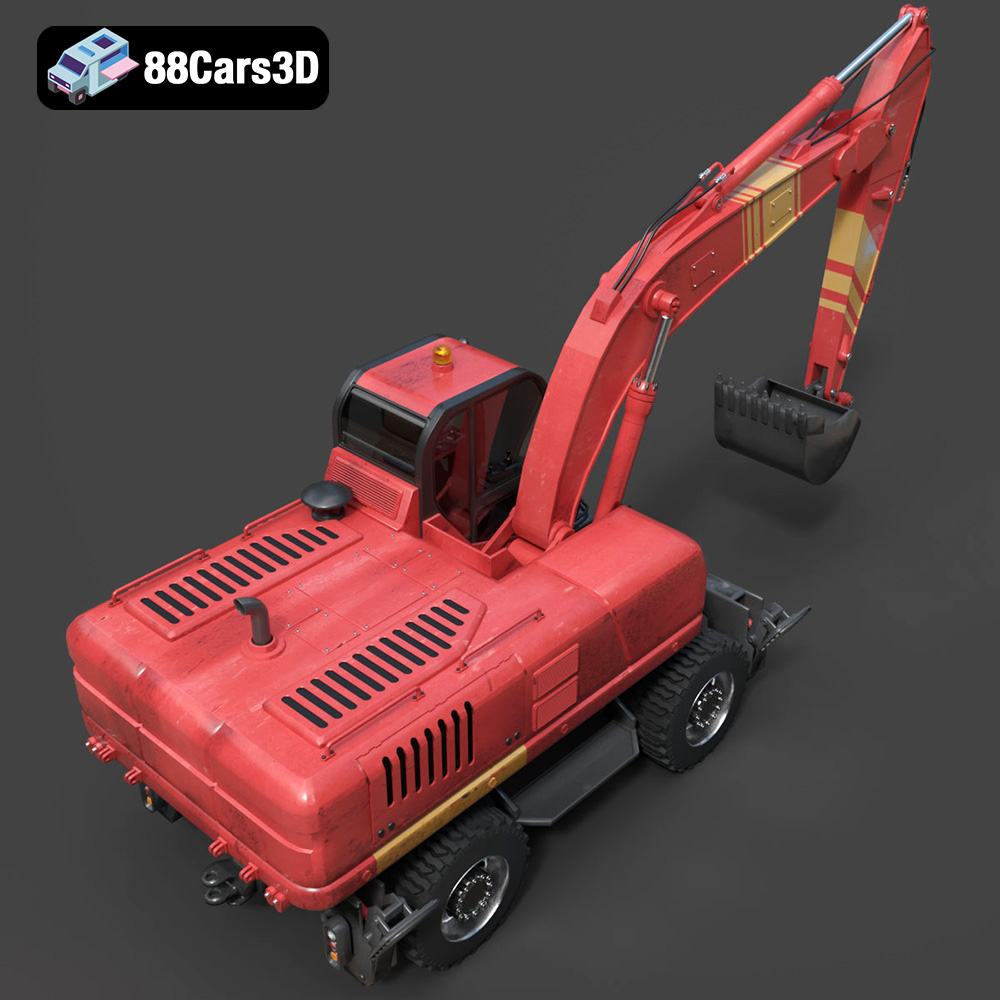
This pursuit of digital authenticity extends beyond the sleek curves of 3D car models to the robust mechanics of heavy machinery. Imagine needing a centerpiece for a construction simulator or a critical asset for an industrial visualization. This is where a truly outstanding model, such as the Wheel Excavator 3D Model available on 88cars3d.com, becomes indispensable. This particular model exemplifies the pinnacle of detailed design and optimization, offering a versatile solution for a multitude of professional applications.
From its intricate hydraulic systems to its fully articulated boom assembly and detailed operator cabin, this Wheel Excavator model is engineered to provide unparalleled realism. It’s not just a static object; it’s a dynamic asset ready to be integrated into diverse digital pipelines, making it a critical component for anyone serious about elevating their digital projects.
The journey of a 3D model from conception to integration into a final project often involves navigating a complex landscape of file formats. Each format serves specific purposes, optimized for different software, engines, or applications. Understanding these distinctions is crucial for seamless workflows, ensuring compatibility, preserving data integrity, and achieving optimal performance. The Wheel Excavator 3D Model, for instance, comes equipped with a comprehensive suite of formats, testifying to its versatility.
The .blend format is the native file type for Blender, the powerful open-source 3D creation suite. When you download a .blend file, you’re getting a complete Blender scene, often including not just the mesh data but also materials, textures, lighting setups, animation data, and even physics simulations. This format offers maximum editability and flexibility for Blender users, allowing direct manipulation of every aspect of the model. For the Wheel Excavator, a .blend file means artists can easily tweak materials, re-rig, or add custom animations within their familiar Blender environment, leveraging its robust toolset.
.fbx (Filmbox) is arguably the most widely used proprietary 3D file format for exchanging 3D data between different software applications. Developed by Autodesk, .fbx excels at carrying not just mesh and material data, but also complex animation, rigging, and even camera and light information. It’s the go-to format for transferring assets between 3ds Max, Maya, Cinema 4D, and critically, game engines like Unreal Engine and Unity. For a game-ready asset like the Wheel Excavator, an .fbx file ensures that all animation pivots, hierarchy, and basic material assignments translate effectively into your real-time pipeline, making it an ideal game asset.
The .obj (Wavefront OBJ) format is one of the oldest and most universally supported 3D file formats. It’s excellent for exchanging pure geometric data—vertices, faces, and UV coordinates—across virtually any 3D software. While it handles basic material assignments (via an accompanying .mtl file), it typically doesn’t store animation or rigging data. Its strength lies in its simplicity and widespread compatibility, making it a reliable choice for foundational mesh transfer. If you need to import the Wheel Excavator into a niche application or simply want the raw mesh data, .obj is a solid, dependable option.
.glb (GLB file format) is the binary version of glTF (GL Transmission Format), a modern, royalty-free specification for 3D scenes and models. Designed for efficient transmission and loading of 3D content, especially on the web and for AR/VR applications, .glb packages all necessary data (geometry, materials, textures, animations) into a single, compact file. It’s increasingly popular for browser-based 3D viewers, social media filters, and mobile AR experiences due to its optimization for real-time rendering and small file size. The Wheel Excavator in .glb format is perfectly poised for immersive virtual showrooms or mobile AR experiences.
.stl (STereoLithography) is the standard file format for 3D printing. It represents a 3D model as a series of connected triangles (a tessellation) without any color, texture, or material information. Its primary purpose is to define the surface geometry of a 3D object for additive manufacturing processes. While the Wheel Excavator is highly detailed, its .stl export would be focused on preparing it for physical manifestation, allowing hobbyists and professionals to 3D print scale models. This requires careful consideration of wall thickness, supports, and print orientation, as detailed in the product specifications.
The .ply (Polygon File Format) is a versatile format for storing 3D data, particularly useful for scanned data from 3D digitizers or for scientific applications. It can store various properties for each vertex (color, normal, confidence, transparency) and face (color), making it more feature-rich than .obj in some respects, though less commonly used for general asset exchange. For precision mesh analysis or CAD integration of the Wheel Excavator, .ply offers a robust data structure.
The .unreal format refers to assets specifically packaged or optimized for direct import and use within Unreal Engine. This could involve an .fbx file pre-processed with specific material setups, collision meshes, or even blueprints tailored for the engine. While not a standalone file extension in the traditional sense, providing an “unreal” option for the Wheel Excavator implies an asset prepared for seamless integration into Unreal’s powerful real-time environments, saving developers significant setup time and ensuring optimal performance.
The .max format is the native file type for Autodesk 3ds Max, a leading software for 3D modeling, animation, rendering, and compositing. Like .blend for Blender, a .max file offers full editability within its native environment, preserving all scene data, modifiers, materials, lighting, and animation rigs. For users who primarily work in 3ds Max, receiving the Wheel Excavator as a .max file means they can immediately dive into advanced rendering, complex animations, or deep customization without any data loss or conversion issues.
When it comes to intricate machinery, every bolt, every hydraulic line, and every panel contributes to the overall authenticity. The Wheel Excavator 3D Model from 88cars3d.com is a testament to this philosophy, meticulously designed to capture the rugged essence and complex functionality of its real-world counterpart. This model isn’t merely a visual representation; it’s a digital blueprint built for performance and realism across various applications.
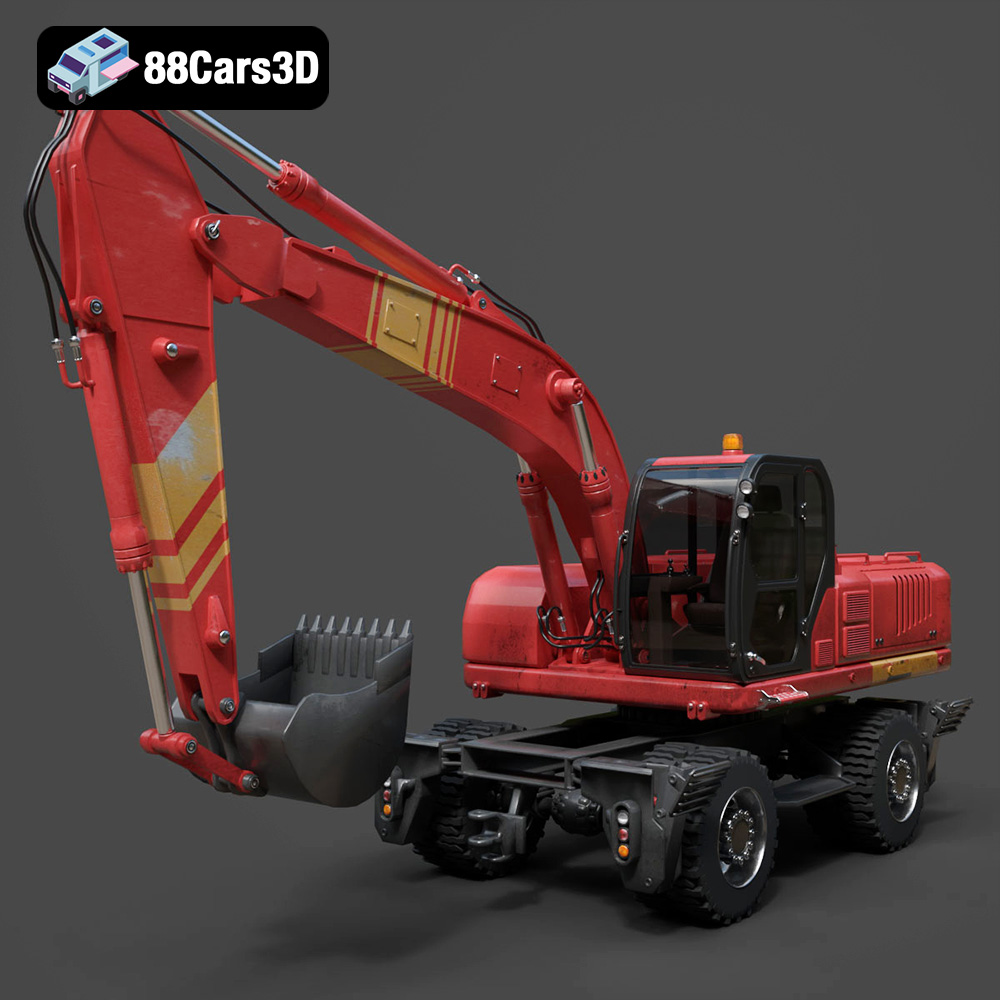
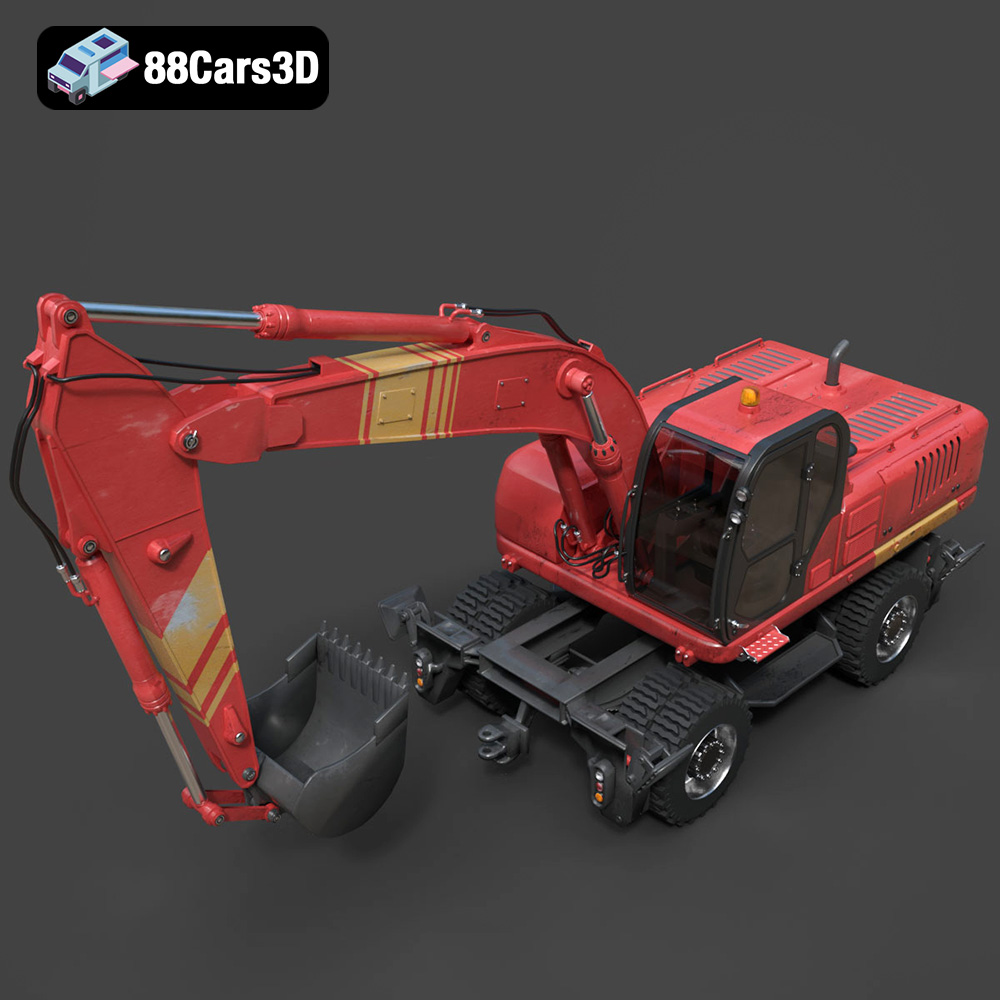
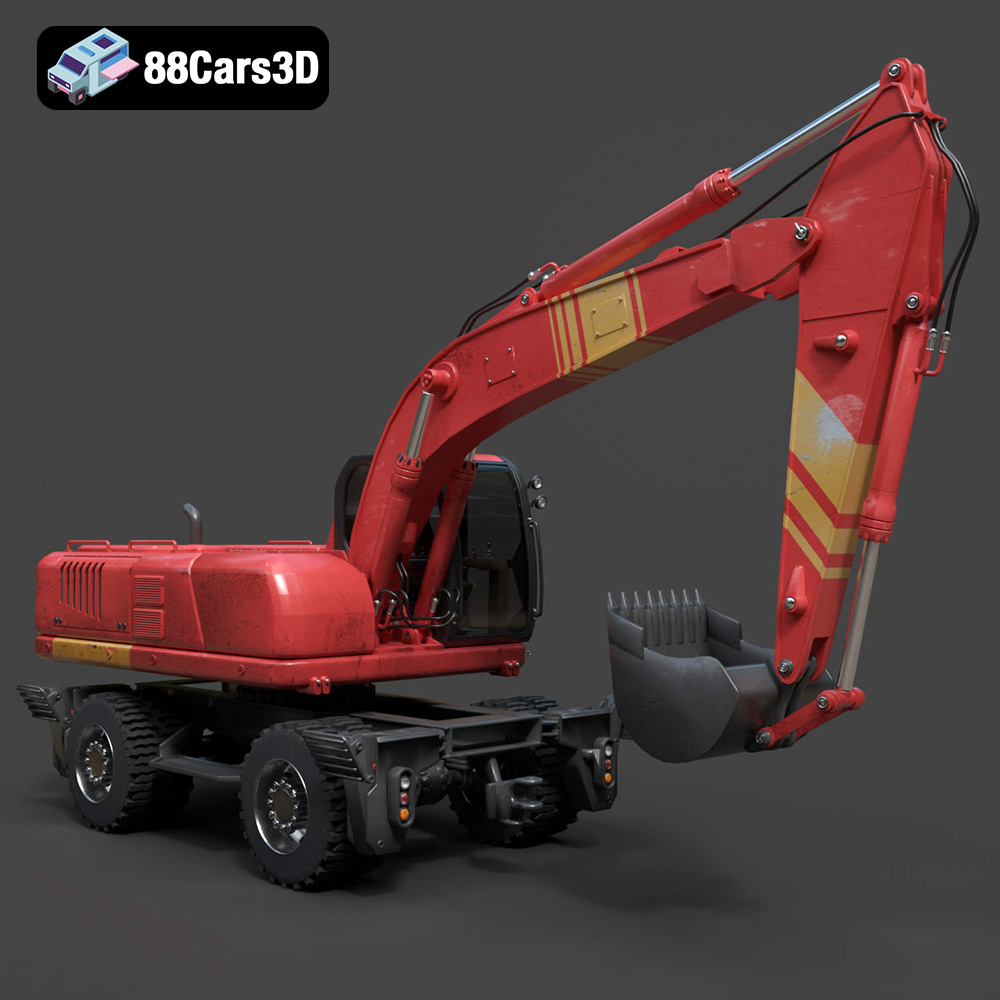
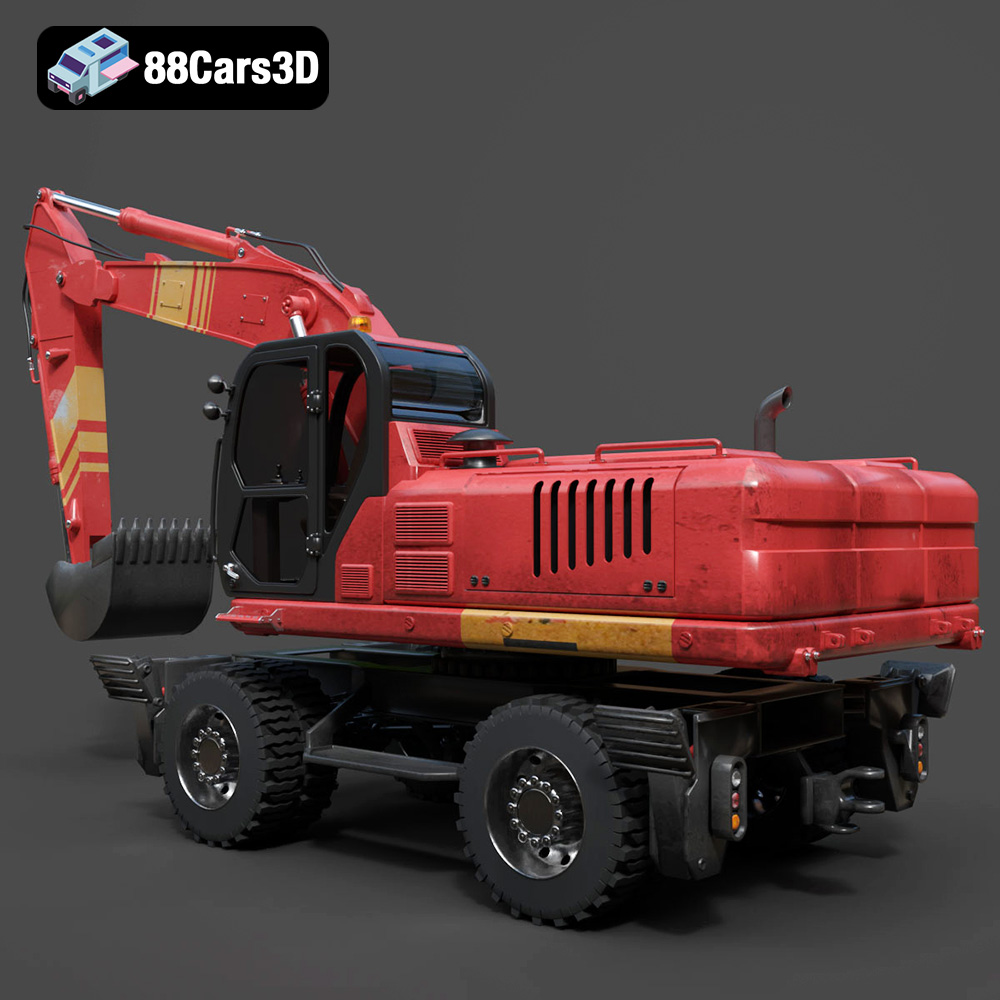
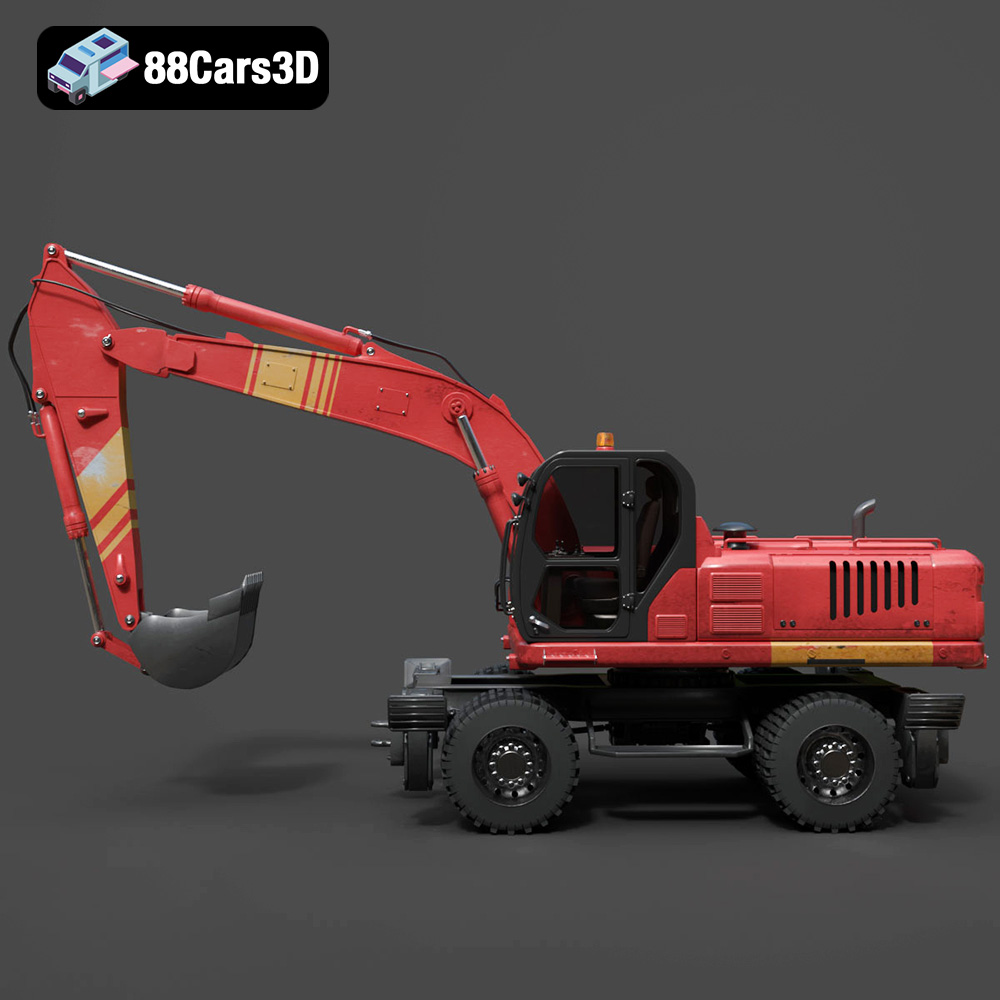
The external features of this Wheel Excavator model are where its high fidelity truly shines. The accurate frame geometry and proportions provide an immediate sense of real-world scale, crucial for immersive experiences and believable renders. Beyond the basic shape, the model boasts a highly detailed engine block and robust industrial housing, elements often overlooked but vital for close-up shots or technical visualizations. The complex hydraulic cylinders, rams, and heavy-duty hose routing are recreated with astonishing detail, allowing for realistic articulation and movement in animations. Industrial-grade work lights and safety beacon details add functional realism, making the model ready for day-night cycles or hazard simulations. Furthermore, the pneumatic tires with deep off-road tread patterns, functional stabilizer outriggers, and dozer blade assemblies are all separately modeled, providing not only visual accuracy but also the necessary components for dynamic animation. This level of external detail ensures that the Wheel Excavator will hold up under the closest scrutiny, whether in a cinematic render or a virtual reality environment.
The attention to detail doesn’t stop at the exterior. The cockpit and interior features are equally impressive, designed for an authentic operator experience, especially critical for first-person POV in gaming or VR training modules. The authentic operator seat, complete with ergonomic contours and armrests, immediately suggests comfort and control. Detailed dual joystick controls and safety levers are faithfully replicated, providing believable interaction points for a virtual operator. An accurate instrument cluster and digital display panels, alongside floor-mounted foot pedals for travel and auxiliary control, complete the immersive environment. This optimized geometry for first-person perspective ensures that players or trainees feel truly inside the machine, enhancing engagement and realism.
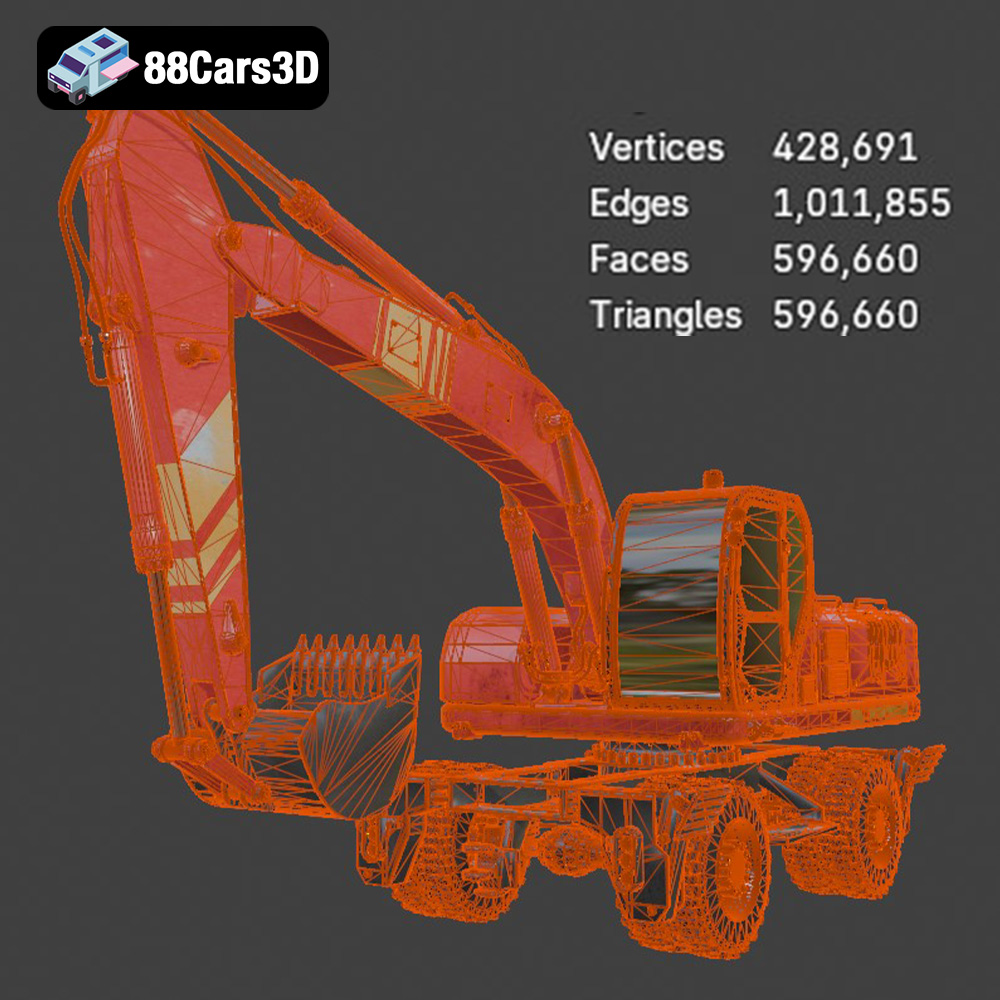
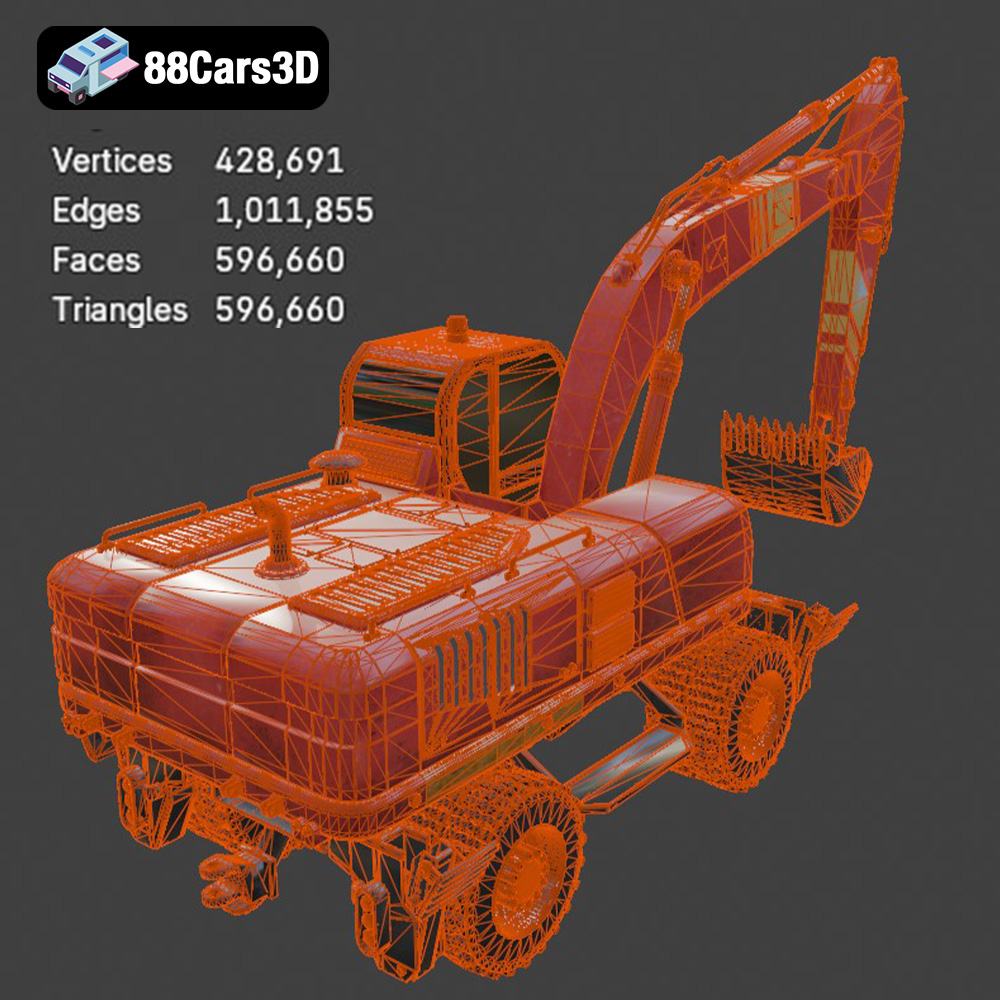
Technical specifications are where the true utility of a 3D model often lies, and the Wheel Excavator excels here. With a highly detailed topology of 596,660 triangles, it strikes a fantastic balance between high-end visual fidelity and real-time performance. This “game-ready & optimized” status is a significant advantage for developers working with Unreal Engine or Unity, as it ensures smooth integration without bogging down frame rates. Real-world scale accuracy is maintained throughout, making the model suitable for environments where scale consistency is vital. Crucially, the model features a proper pivot setup for steering, wheel rotation, turntable rotation, and suspension travel. This pre-configured rigging for animation saves countless hours for animators, allowing for immediate implementation of complex movements and realistic vehicle dynamics.
The true value of a high-quality 3D asset lies in its ability to seamlessly integrate into diverse professional pipelines, enhancing projects across various industries. The Wheel Excavator 3D Model from 88cars3d.com is engineered precisely for this purpose, offering robust solutions for game development, AR/VR, and cinematic rendering.
For game developers, the Wheel Excavator is a prime example of an optimized game asset. Its polycount of 596,660 triangles is carefully balanced to deliver stunning visual realism without compromising real-time performance, making it ideal for open-world games, construction simulators, or even specialized racing titles. The proper pivot setup for steering, wheel rotation, and suspension travel is a critical advantage, providing animators with a head start in creating realistic movement. Developers can quickly import the .fbx or .unreal formats into engines like Unreal or Unity, apply physics, and integrate the model into gameplay loops. Imagine a player operating this detailed excavator, digging trenches or moving debris in a dynamic construction environment – the model’s fidelity ensures that every interaction feels authentic and visually compelling. This efficiency allows studios to focus on core gameplay mechanics, knowing their heavy machinery assets are top-tier and ready for action.
The immersive capabilities of AR/VR demand highly optimized and realistic 3D models to create believable virtual environments. The Wheel Excavator 3D Model is perfectly suited for this, offering a tangible sense of presence in virtual spaces. For immersive virtual showrooms, clients can interact with the excavator in a lifelike setting, examining its details from every angle. In configurators, users might even customize colors or components in real-time. Perhaps one of the most impactful applications is in heavy machinery VR training modules. Trainees can practice operating the excavator in a safe, controlled virtual environment, learning to manipulate its detailed dual joystick controls, safety levers, and foot pedals. The optimized geometry for first-person POV ensures that the operator’s experience feels truly authentic, accelerating skill acquisition and reducing real-world training risks. The .glb format, specifically designed for AR/VR and browser-based display, facilitates easy deployment on various platforms, from mobile AR apps to high-fidelity VR headsets.
When visual impact is paramount, as in brand campaigns, industrial site visualizations, or architectural fly-throughs, the Wheel Excavator shines with its detailed aesthetics. For cinematic renders, its accurate frame geometry, complex hydraulic routing, and industrial-grade work lights can create dramatic and realistic scenes. Visualizers can leverage the .max or .blend formats to integrate the model into their preferred rendering software, applying advanced shaders, intricate lighting setups, and realistic environments. The ability to change body colors, modify tire textures, and adjust material finishes (matte, gloss, metallic) provides extensive creative control, allowing artists to match specific brand guidelines or environmental conditions. Whether depicting a construction project in progress or showcasing the rugged elegance of industrial equipment, this model delivers the visual fidelity required for compelling, high-end visualization projects.
While digital visualization is a core application for 3D models, the ability to transition from the virtual to the physical realm adds another layer of utility and excitement. The Wheel Excavator 3D Model offers this capability, providing an excellent foundation for 3D printing, allowing enthusiasts and professionals to create tangible replicas of this complex machinery.
Converting a high-detail digital model into a successful 3D print requires careful consideration and preparation, especially when dealing with intricate designs like a wheel excavator. The provided .stl format is specifically tailored for 3D printing, stripping away non-essential data like textures and animations, and presenting the model as a clean, triangulated mesh ready for slicing. Recommended scales such as 1:12, 1:18, or 1:24 allow users to choose a size that balances detail retention with printability. For optimal results, especially with fine details like hydraulic lines and intricate cabin controls, resin printing is often recommended over FDM, enabling layer heights as fine as 0.04–0.12 mm. Ensuring adequate wall thickness (1.2–2.0 mm) is crucial for structural integrity, preventing fragile parts from breaking during printing or post-processing. Additionally, parts like the exhaust, mirrors, and handlebars will undoubtedly require carefully placed supports during printing to maintain their form, and strategic print orientation (e.g., printing the frame angled) can significantly improve overall strength and reduce the need for extensive support structures.
The journey from a raw 3D print to a display-worthy model involves several crucial post-processing steps. After removing supports, sanding the printed parts helps to smooth out layer lines and imperfections, creating a cleaner surface for painting. Applying a primer coat is essential for achieving a uniform base and ensuring paint adhesion. The customization options mentioned for the digital model—changing body/tank colors and adjusting material finishes—can be directly translated to the physical model. Using authentic factory colors with metallic finishes can elevate the realism of the printed excavator, making it a faithful miniature replica. This hands-on process allows for a unique blend of digital design and traditional model-making skills, culminating in a tangible piece of high-quality industrial art. Whether for hobbyist display, educational tools, or unique desk models, the Wheel Excavator 3D Model provides an excellent starting point for engaging 3D printing projects.
In today’s fast-paced digital production environment, efficiency and quality are not just buzzwords; they are critical determinants of success. While the allure of creating every asset from scratch is strong for some, the strategic advantages of leveraging premium, pre-built 3D models from reputable sources like 88cars3d.com are undeniable. This applies equally to stunning 3D car models as it does to robust construction equipment like the Wheel Excavator 3D Model.
Developing a highly detailed and optimized 3D model from the ground up, especially complex machinery like an excavator, demands significant time, specialized skills, and resources. Artists must dedicate hundreds of hours to modeling, texturing, rigging, and optimizing for various platforms. By acquiring a professional-grade asset like the Wheel Excavator from 88cars3d.com, studios and individual creators can bypass this intensive initial phase entirely. This translates into substantial time savings, allowing teams to allocate resources to other critical aspects of their project, such as gameplay mechanics, environmental design, or animation sequences. The upfront cost of a premium model is often a fraction of what it would cost to commission or produce the same asset internally, representing a shrewd investment that accelerates project timelines and reduces overall development expenses. This efficiency is particularly valuable for smaller studios or independent developers who need to deliver high-quality content on tight budgets.
Purchasing a pre-made model doesn’t mean sacrificing creative control; quite the opposite. High-quality assets like the Wheel Excavator are built with customization in mind. The various file formats provided (.blend, .max, .fbx) offer maximum flexibility for artists to fine-tune the model within their preferred software. The ability to change body/tank colors, modify tire textures (e.g., off-road vs. street variants), and adjust material finishes (matte, gloss, metallic) allows for easy adaptation to specific project aesthetics or branding requirements. Lighting can be adapted for different environments, ensuring the model looks perfect whether it’s under harsh desert sun or a dimly lit industrial interior. This adaptability ensures that while the core quality is guaranteed, the final look and feel of the asset can be uniquely tailored to fit the creative vision of any project, from a gritty post-apocalyptic game to a clean, modern architectural visualization. It empowers creators to focus on artistic direction and storytelling, rather than the intricate technicalities of mesh creation.
The digital landscape is continually evolving, demanding ever-higher standards of realism and performance from 3D assets. From the intricate mechanics of heavy machinery to the sleek designs of modern vehicles, the quality of a 3D model can significantly impact the success and immersion of any digital project. The Wheel Excavator 3D Model stands out as a prime example of a meticulously crafted asset that meets these exacting demands, offering unparalleled detail, robust optimization, and versatile compatibility.
Whether you are a game developer striving for a rich, interactive environment, an AR/VR creator building an immersive training simulation, a visualization artist crafting cinematic renders, or even a hobbyist looking to create a physical replica through 3D printing, this Wheel Excavator provides an exceptional foundation. Its comprehensive file format support, from editable native files like .blend and .max to game-ready .fbx and AR/VR-optimized .glb, ensures seamless integration into virtually any professional pipeline.
By choosing high-fidelity 3D models from platforms like 88cars3d.com, creators gain a strategic advantage, saving invaluable time and resources while maintaining uncompromising quality. These assets are more than just models; they are catalysts for creativity, enabling the efficient realization of complex digital visions. Explore the possibilities and elevate your next project with the precision and performance of professional 3D models.
The Wheel Excavator stands as a highly versatile piece of heavy machinery, renowned for its mobility and robust earth-moving capabilities. This meticulously crafted 3D model captures the rugged essence of modern construction equipment, featuring a highly detailed wheeled undercarriage, complex hydraulic routing, a fully articulated boom assembly, and an authentic operator cabin designed for maximum visibility. Every mechanical joint and structural element has been recreated to provide unparalleled realism for industrial and construction scenes.
Boasting a highly detailed topology of 596,660 triangles, this 3D model strikes a fantastic balance between close-up visual fidelity and real-time performance. It is perfectly optimized for modern game engines, VR/AR simulations, and high-end cinematic renderings, ensuring smooth integration into any heavy machinery pipeline.
Perfect for construction simulators, industrial site visualizations, heavy machinery VR training modules, and cinematic renders.
$26.00
.blend
.fbx
.glb
.max
.obj
.ply
.rendering
.stl
.unreal
construction-equipment
game asset
game-ready
heavy-machinery
optimized
vehicle-3d-model
VR/AR
wheel-excavator