Get 20% OFF All Premium 3D & STL Models!

In the realm of automotive enthusiasts, few vehicles command the same reverence as the BMW M5. Specifically, the E60 generation, with its audacious V10 engine and distinctive styling, remains a benchmark for performance sedans. For 3D artists, game developers, animators, and visualization specialists, recreating such an icon with fidelity and technical excellence is paramount. This is where a high-quality 3D car model becomes an indispensable asset, providing the foundation for everything from photorealistic renders to immersive real-time experiences.
Today, we delve into the intricacies of a truly remarkable digital representation: the BMW M5 2008 3D Model. Available at 88cars3d.com, this model isn’t just a static representation; it’s a meticulously crafted asset engineered for diverse professional applications. Whether your project demands precise automotive rendering, seamless integration into a game engine, or a tactile 3D print, this model is built to deliver.
The BMW M5 2008 (E60) is more than just a car; it’s a statement. Its Formula 1-inspired S85 V10 engine, delivering 500 horsepower, shattered expectations for a luxury sedan. Visually, its aggressive stance, wide kidney grilles, and signature quad exhaust system instantly communicate its performance pedigree. Translating this iconic presence into a 3D model requires an acute understanding of both automotive design and digital craftsmanship.
The E60 M5 generation carved out a unique niche in automotive history. Its naturally aspirated V10 engine, a direct descendant of BMW’s F1 program, provided an auditory and visceral experience unlike any other production sedan. Beyond the engine, the car featured subtle but potent design cues: the sculpted power dome on the hood, the subtly flared wheel arches hinting at wider tires, and the aerodynamic M-specific body kit. These details define the vehicle’s character and are crucial for any authentic digital recreation.
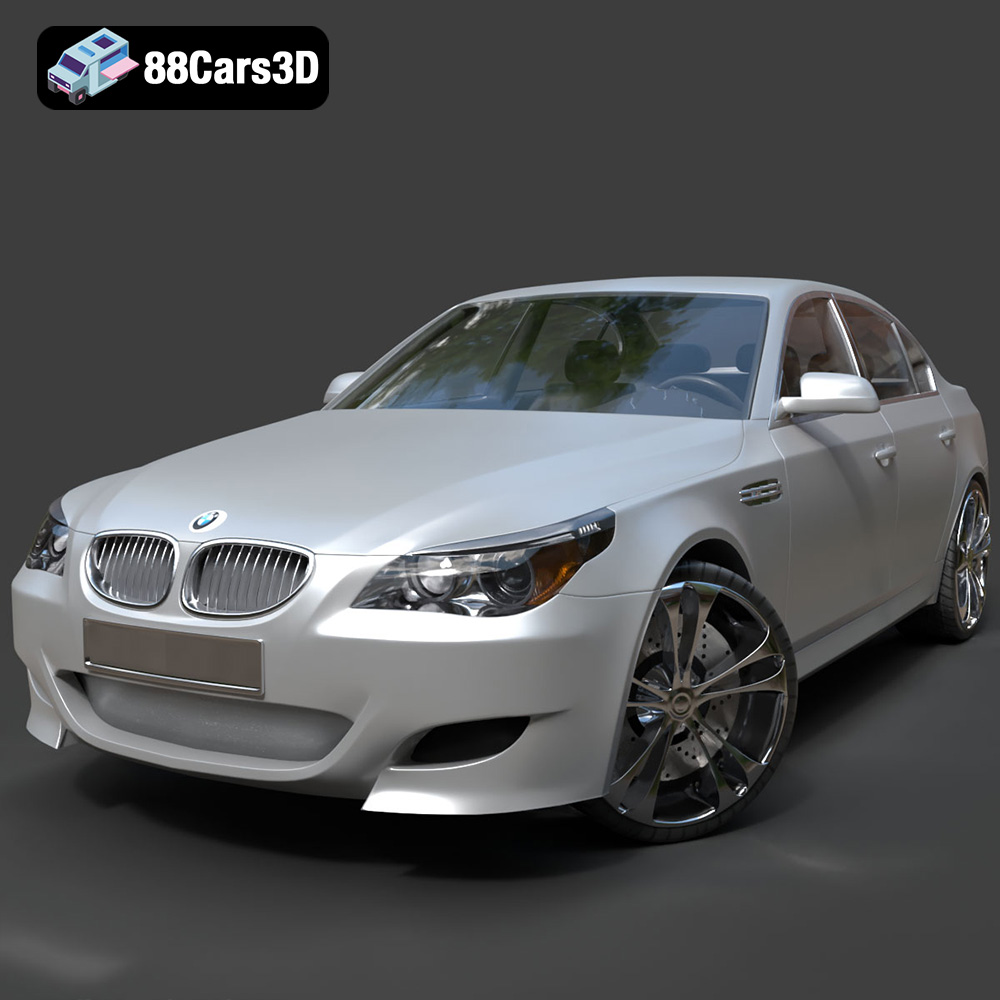
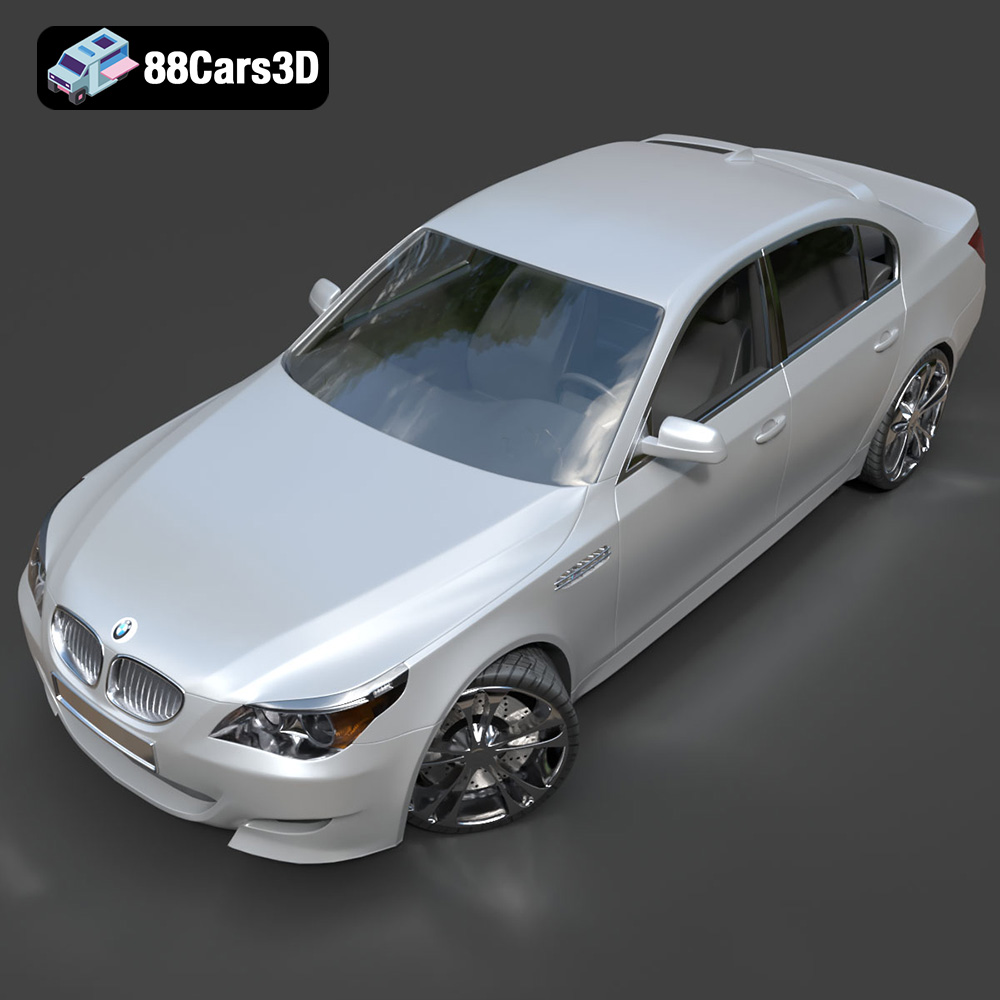
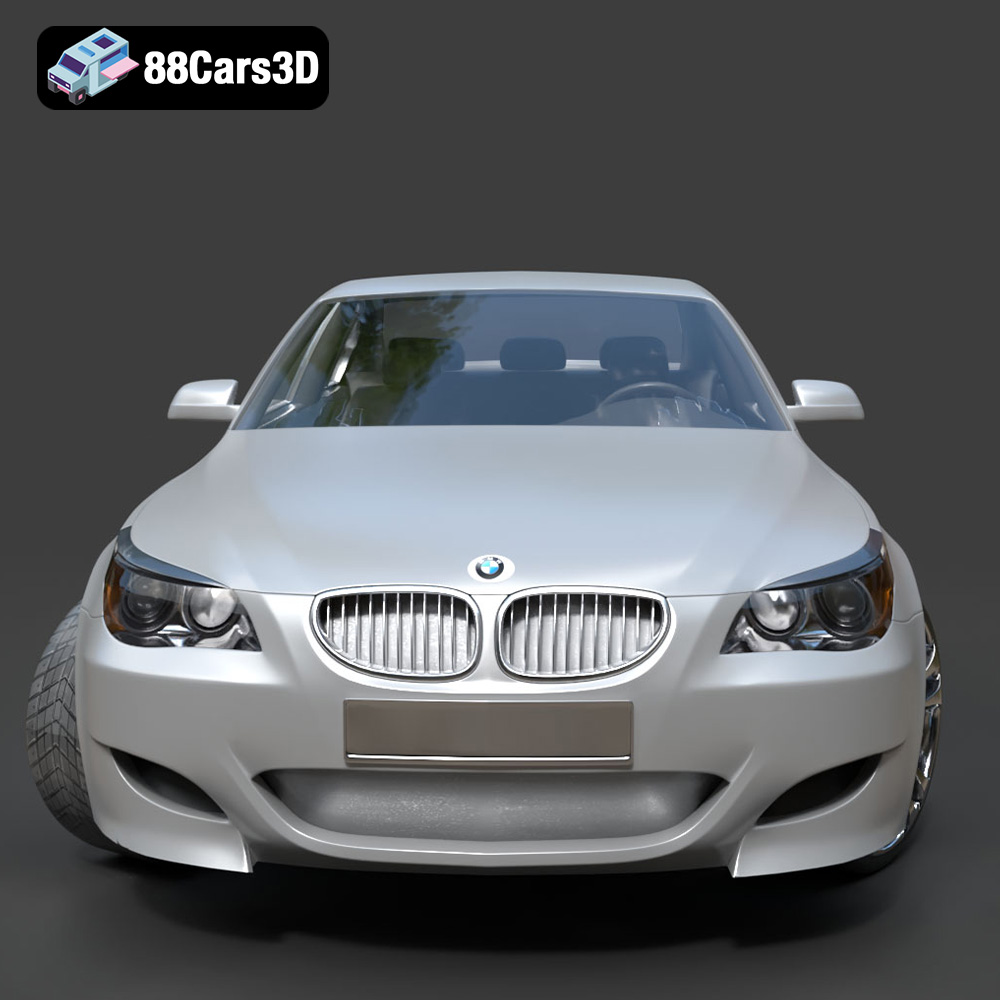
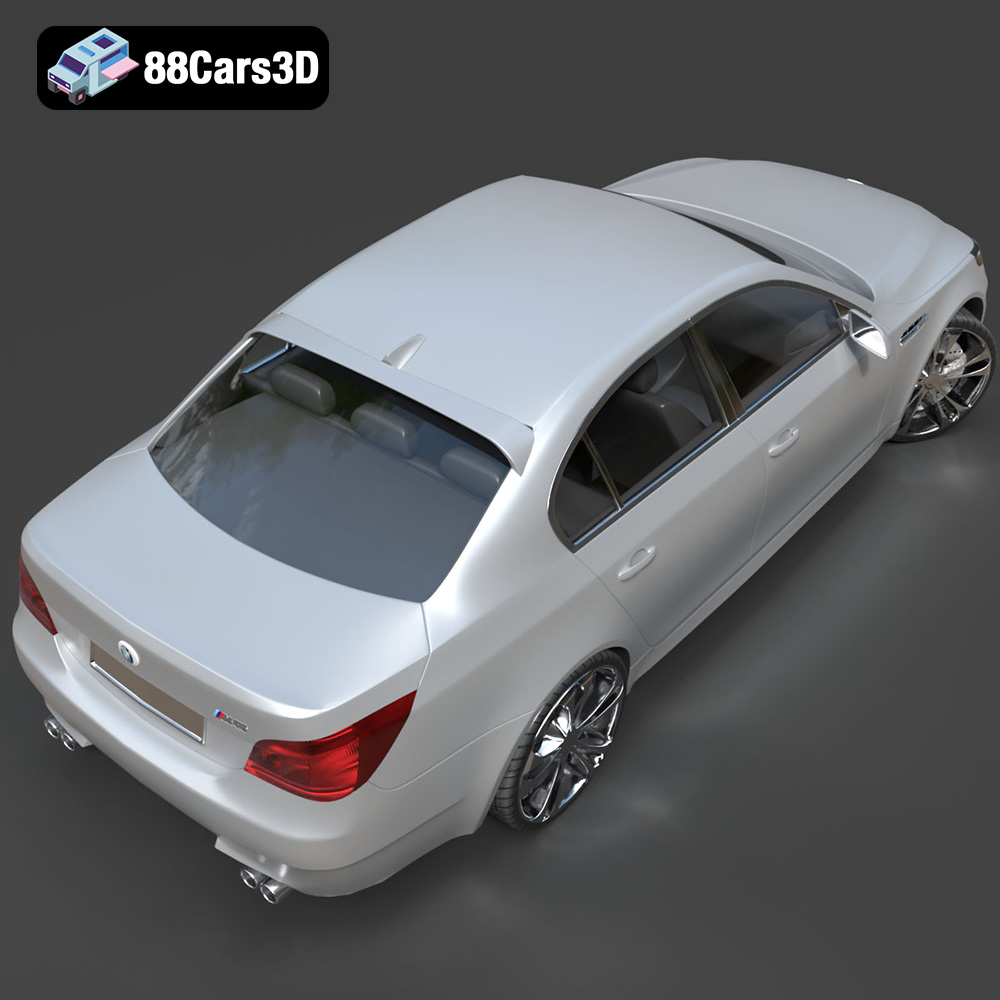
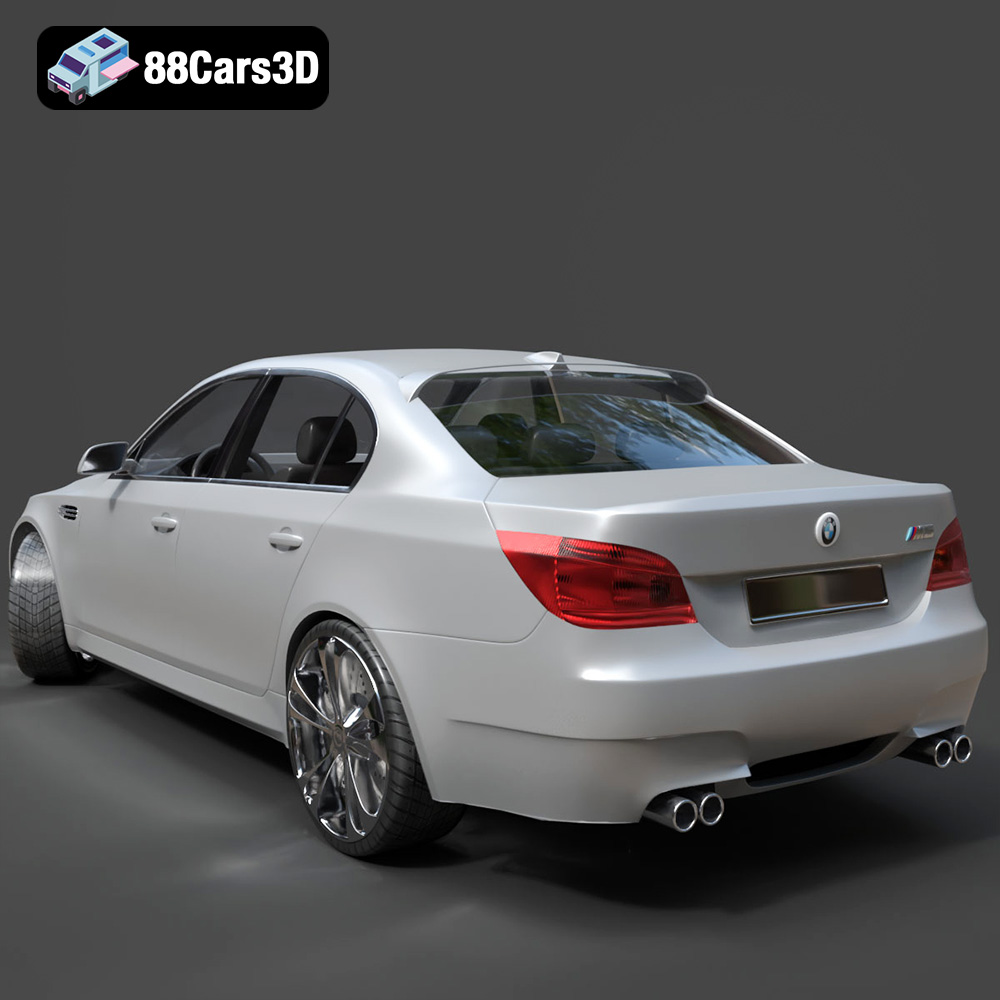
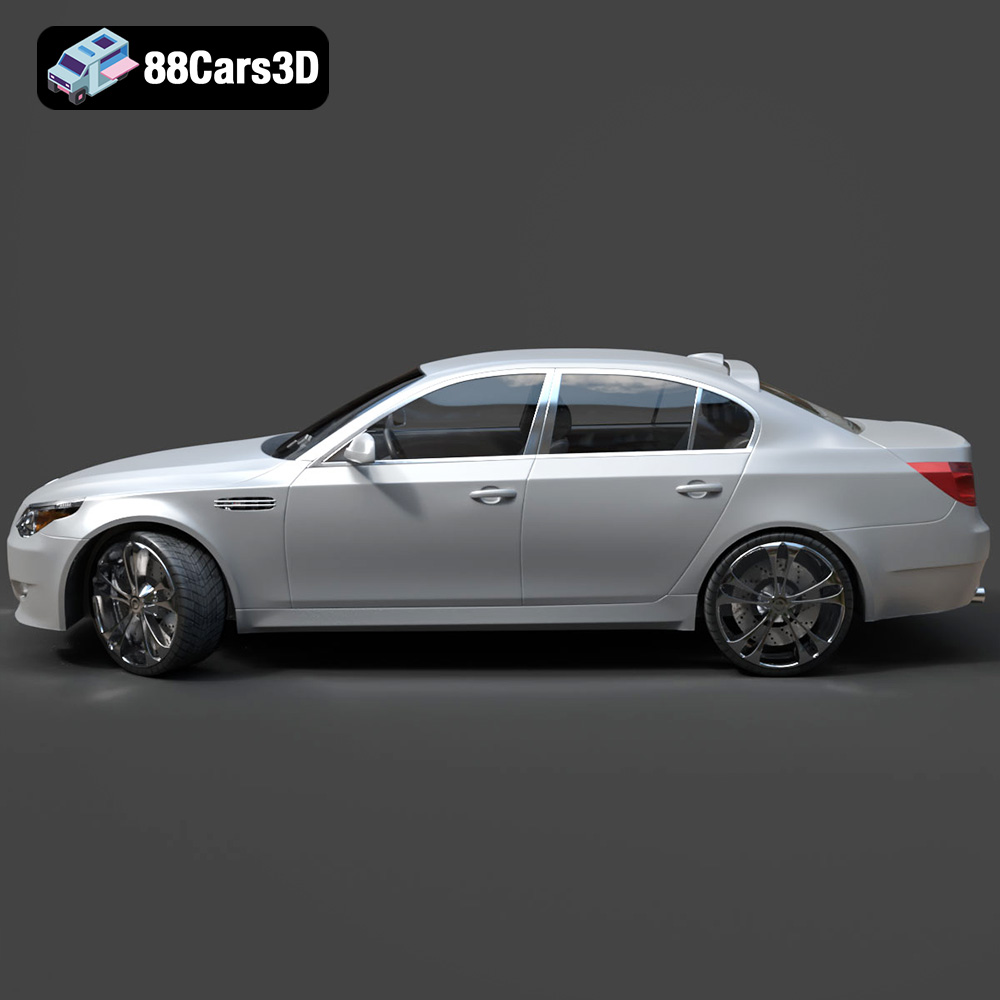
The BMW M5 2008 3D Model faithfully captures every critical visual element. The aggressive front fascia, complete with the iconic kidney grilles and authentic Bi-Xenon headlights, is meticulously modeled. Moving along the profile, the flared wheel arches and M-style lightweight alloy wheels with high-performance tire treads are accurately represented, conveying both sportiness and luxury. At the rear, the signature quad exhaust system with its integrated diffuser underscores the vehicle’s performance capabilities, complemented by distinct L-shaped LED taillights. Even the detailed 5.0L S85 V10 engine block is present, allowing for impressive under-the-hood shots or exploded views. This level of external detail ensures that the model holds up under the scrutiny of close-up renders and detailed presentations.
Inside, the model doesn’t compromise on interior fidelity. It features heavily bolstered M sport leather seats, an authentic instrument cluster with the M-specific tachometer, and a thick-rimmed M multi-function steering wheel complete with paddle shifters. Intricate control details, from the pedals to the SMG shifter and iDrive dial, are all carefully optimized for first-person perspective in gaming or detailed interior visualization. This comprehensive approach ensures that whether the viewer is admiring the exterior or experiencing the cockpit, the essence of the BMW M5 2008 is fully preserved.
One of the most crucial aspects of working with 3D assets, especially high-quality 3D car models like the BMW M5 2008, is understanding the various file formats available. Each format serves a specific purpose, catering to different software, workflows, and end applications. The BMW M5 2008 3D Model download comes equipped with a comprehensive suite of formats, ensuring maximum compatibility and utility across professional pipelines. Choosing the right format is key to optimizing your workflow, preserving data integrity, and achieving your project goals efficiently. Let’s break down the included formats:
The .blend format is native to Blender, the powerful open-source 3D creation suite. When you download a .blend file, you’re getting a fully editable Blender scene. This includes not just the mesh data, but also materials, textures, lighting setups, cameras, animations, modifiers, and even scene organization. For artists who primarily work in Blender, this is often the preferred format as it offers the most complete and robust starting point for customization and rendering within their familiar environment. It allows for direct manipulation of the model’s topology, application of advanced material nodes, and seamless integration into existing Blender projects.
.fbx (Filmbox) is an Autodesk-owned proprietary file format widely used for interoperability between 3D software applications and, critically, for game engines like Unreal Engine and Unity. It’s an excellent choice for real-time pipelines because it can store not only mesh data but also crucial information such as materials (often simplified or baked), textures, bone animations, blend shapes, and even camera data. The .fbx format is designed for efficient data transfer, making it ideal for taking a finished model, complete with its hierarchy and animations, from a modeling package into a game development environment. For the BMW M5 model, .fbx ensures that pivot points, separate wheel geometry, and potential animation setups are preserved.
.obj (Wavefront OBJ) is one of the oldest and most universally supported 3D file formats. It’s a simple, text-based format primarily used to store 3D geometry – vertices, UV coordinates, normals, and polygonal faces. While it doesn’t typically store advanced features like animation, rigging, or complex material networks (materials are usually defined in a separate .mtl file), its widespread compatibility makes it a safe bet for cross-software transfers. If you need a clean mesh to bring into virtually any 3D application for re-texturing, re-rigging, or sculpting, .obj is an excellent foundational choice. It’s a robust format for ensuring the core geometry of the BMW M5 is accessible everywhere.
.glb (GL Transmission Format Binary) is the binary version of glTF, a royalty-free specification for the efficient transmission and loading of 3D scenes and models by engines and applications. Developed by the Khronos Group, .glb is highly optimized for AR (Augmented Reality), VR (Virtual Reality), and browser-based 3D applications. It encapsulates textures and other assets directly within a single binary file, making it incredibly easy to share, load quickly on web pages, and integrate into mobile AR/VR experiences. For showcasing the BMW M5 2008 in a virtual showroom or an interactive web configurator, .glb offers superb performance and ease of deployment.
.stl (STereoLithography) is the standard file format for 3D printing and computer-aided manufacturing (CAM). It represents a 3D model as a series of connected triangles (a triangulated surface mesh) without color, texture, or other CAD attributes. Its simplicity makes it universally compatible with 3D printers and slicing software. While it lacks the visual richness of other formats, it provides the essential geometric data needed to physically manifest the BMW M5 2008 model, whether for scale models, prototypes, or educational purposes. The provided .stl for the M5 model ensures hobbyists and professionals can bring this digital car into the physical world.
.ply (Polygon File Format or Stanford Triangle Format) is another format primarily used to store 3D data, particularly from 3D scanners. It can store a wider range of properties than .obj or .stl, including color per vertex, normal information, transparency, and even texture coordinates. While less common for general 3D asset exchange, .ply is excellent for precision mesh data, often used in scientific, engineering, or detailed analysis applications. For the BMW M5, this format could be valuable for projects requiring extreme geometric fidelity or for workflows involving point cloud data.
The .unreal designation implies an asset specifically prepared and optimized for direct import or use within Unreal Engine. While not a standalone file format in the same way as .fbx or .obj, it suggests that the asset has been packaged or pre-configured to leverage Unreal Engine’s specific PBR (Physically Based Rendering) material system, collision setups, level of detail (LOD) meshes, and potentially even blueprint integrations. This significantly streamlines the workflow for game developers, reducing the time and effort typically spent on asset preparation for real-time environments. An “engine-ready asset” like this for the M5 is invaluable for high-performance game development.
The .max format is the native file type for Autodesk 3ds Max, one of the leading 3D modeling, animation, and rendering software packages in the industry. Similar to a .blend file for Blender, a .max file contains the complete 3ds Max scene, including all geometry, materials, textures, lights, cameras, animations, and scene settings. For artists and studios working within the 3ds Max ecosystem, this format offers the highest level of editability and allows for direct manipulation of the model using 3ds Max’s powerful toolset, making it ideal for advanced animation, complex scene integration, and high-fidelity rendering projects.
Having access to this diverse array of formats ensures that the BMW M5 2008 3D Model is not just a high-quality asset, but a highly adaptable one, ready for any challenge across the digital spectrum. This versatility is a hallmark of the premium 3D car models available on 88cars3d.com.
Beyond visual accuracy, a truly professional 3D model is defined by its technical specifications. For the BMW M5 2008, the underlying geometry, topology, and optimization decisions are what make it suitable for demanding pipelines, from real-time game engines to high-resolution cinematic rendering. The balance struck between detail and performance is crucial.
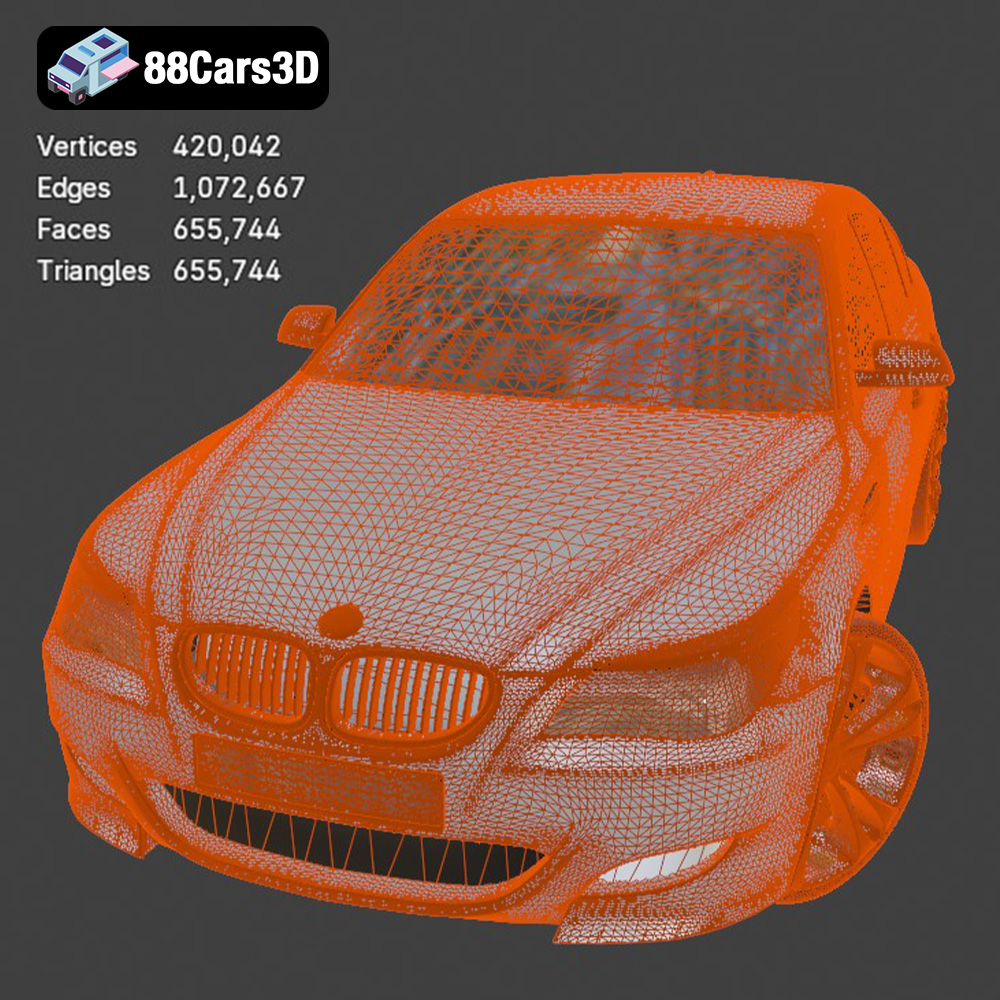
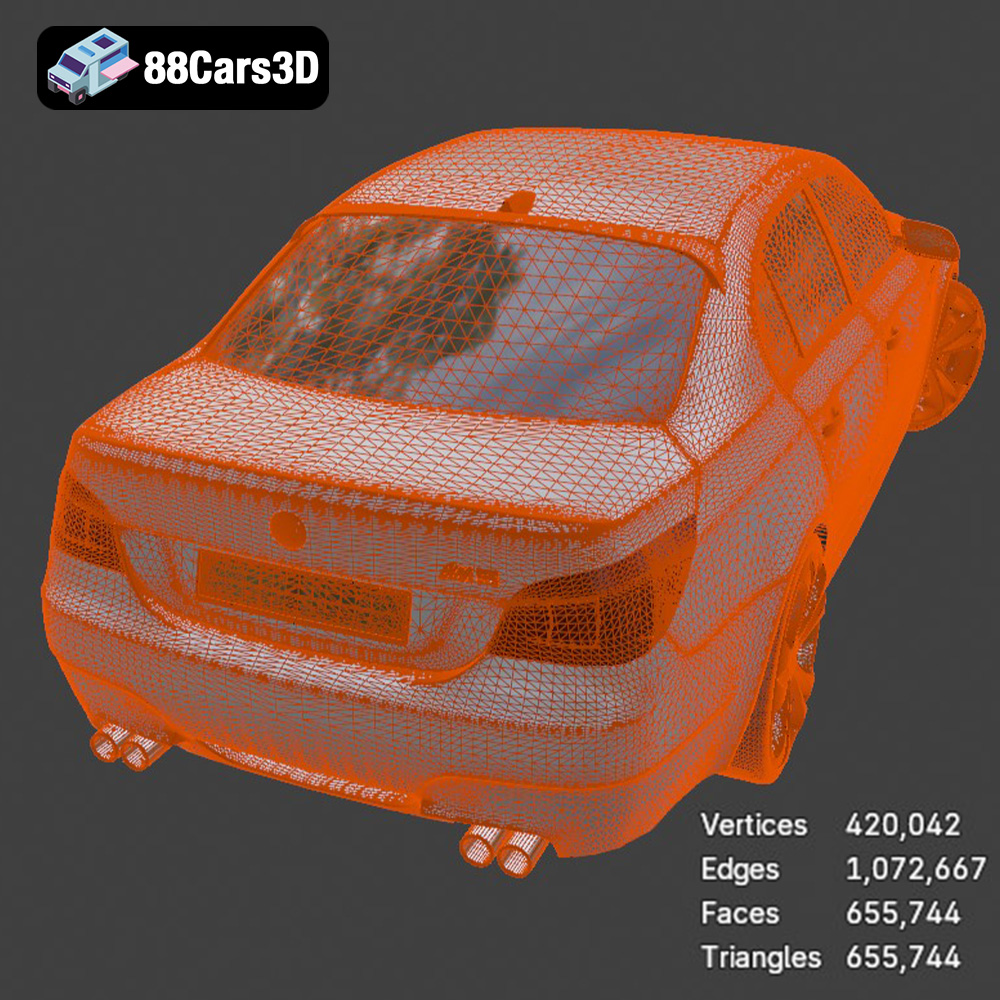
The BMW M5 2008 3D Model boasts a well-structured topology with a triangle count of 655,744. This figure represents a sweet spot for modern 3D car models, providing exceptional game-ready optimization without sacrificing high-end visual fidelity. A triangle count in this range allows for smooth curves and intricate details on the vehicle’s body, interior, and engine components, which would appear blocky or angular with a lower polycount. Yet, it remains manageable for real-time engines like Unreal Engine and Unity, where performance is paramount. Clean quad-based topology (which triangulates to this count) also ensures ease of UV unwrapping, deformation for animation, and subdivision for even higher detail if required for extreme close-ups or cinematics.
Accuracy extends to the model’s dimensions. It adheres to real-world scale, precisely based on the actual vehicle chassis. This is critical for architectural visualization (ArchViz), scene integration, and virtual reality experiences where incorrect scaling can break immersion. Furthermore, the model features a proper pivot setup for steering, wheel rotation, and suspension travel. This articulation is not merely a convenience; it’s a foundational requirement for any animated sequence, driving simulation, or interactive experience where the vehicle needs to move realistically. Separate wheels, suspension, and steering components enable animators to rig and animate the car with precision, mimicking real-world automotive mechanics.
The technical precision is evident in both the exterior and cockpit features. On the exterior, beyond the main body, separate components like headlights, taillights, mirrors, and door handles are individually modeled, allowing for distinct material assignments and potential damage states in games. The M-style lightweight alloy wheels are not just textures; they are detailed 3D geometry with high-performance tire treads, accurately capturing the depth and complexity of automotive wheels. Inside, the optimized geometry for first-person POV in gaming means that even subtle details like the texture of the M sport leather seats, the intricacies of the instrument cluster, and the iDrive dial are rendered with appropriate fidelity without overburdening the system.
A high-quality 3D car model is a versatile tool that can be integrated into various professional pipelines. The BMW M5 2008 3D Model, with its optimized geometry and multi-format availability, is designed to enhance efficiency and visual output across numerous creative industries.
For game developers, the BMW M5 2008 model is a significant asset. Its “game-ready & optimized” status, with a triangle count of 655,744, strikes an ideal balance for real-time engines such as Unreal Engine and Unity. This ensures smooth performance even in complex open-world environments or high-speed racing simulations. The .fbx and .unreal formats are particularly beneficial here, facilitating quick import and setup. Developers can leverage the properly set up pivots for wheels, steering, and suspension to implement realistic vehicle physics and animation. The optimized geometry for first-person POV also means that the detailed interior can be experienced without performance hitches, making it perfect for driving simulators, role-playing games, or even immersive virtual tours within a game engine.
Architectural visualization (ArchViz) and automotive rendering studios demand exceptional visual quality. The BMW M5 2008 3D Model excels in this arena, providing the foundation for photorealistic cinematic renderings. With its detailed exterior and interior, artists can create stunning marketing materials, brand campaigns, and lifestyle scenes. Using the .max or .blend files, artists can fine-tune materials using physically based rendering (PBR) workflows in renderers like V-Ray, Corona Renderer, or Cycles. The model’s real-world scale and accurate proportions allow for seamless integration into existing environments, from urban backdrops to luxury showrooms, ensuring that the final output is convincing and visually striking. The ability to customize body colors, material finishes (matte, gloss, metallic), and adapt lighting provides infinite creative possibilities for capturing the M5’s allure.
The burgeoning fields of Augmented Reality (AR) and Virtual Reality (VR) present exciting applications for 3D car models. The BMW M5 2008 model is perfect for creating immersive virtual showrooms, interactive configurators, and mobile AR experiences. The .glb format is particularly well-suited for these applications due to its optimization for efficient transmission and loading in web and mobile environments. Imagine a customer exploring the M5’s interior in a VR headset, or seeing the car appear realistically in their driveway via an AR app. The model’s clean topology and balanced polycount ensure that these experiences are fluid and engaging, delivering a premium virtual encounter with this legendary sports sedan.
The versatility of a high-quality 3D model extends beyond digital displays. For hobbyists, collectors, and professionals seeking physical prototypes or display pieces, the ability to 3D print the BMW M5 2008 model is a significant advantage. The inclusion of the .stl format specifically caters to this application, allowing the digital design to manifest as a tangible object.
Successfully 3D printing a complex automotive model like the BMW M5 2008 requires careful attention to print settings. The recommended scales of 1:12, 1:18, or 1:24 are ideal for balancing detail with manageable print times and material usage. For optimal results, especially for fine details like the kidney grilles, exhaust tips, and intricate interior elements, resin printing is highly recommended over FDM (Fused Deposition Modeling) due to its superior resolution and smoother surface finish. A layer height of 0.04–0.12 mm is suggested to capture these nuances. Critical structural considerations include wall thickness (1.2–2.0 mm for durability) and infill (20–30% for a balance of strength and material economy). Supports will be essential for overhangs and intricate parts such as the exhaust system, mirrors, and potentially interior elements like the steering wheel.
Print orientation is also key: printing the main frame angled can improve structural integrity and reduce visible layer lines. Separating components like wheels allows for easier printing with optimized supports and provides options for different materials or post-processing on individual parts.
Once printed, the real magic begins with post-processing. Resin prints will require curing and cleaning, while FDM prints might need support removal and sanding. For a truly professional finish, several steps are vital: meticulous sanding to smooth layer lines, applying a high-quality primer to prepare the surface, and finally, painting. Using authentic factory colors with metallic finishes will bring the miniature M5 to life, matching its real-world counterpart. Techniques like airbrushing, masking, and clear-coating can elevate the model from a printed object to a true showpiece, demonstrating the power of digital design translated into a physical form.
A static 3D model, however detailed, can only go so far. For professional projects, the ability to customize and adapt the asset to specific creative visions is paramount. The BMW M5 2008 3D Model offers robust customization options that empower artists and developers to tailor its appearance and integrate it seamlessly into any scene or application.
The model’s well-structured UVs and separate mesh components allow for extensive material manipulation. Artists can easily change body colors, experimenting with a vast palette of factory colors, custom finishes, or even artistic interpretations. Whether a classic Alpine White, a sophisticated Black Sapphire Metallic, or a vibrant Imola Red, achieving the desired look is straightforward. Beyond color, the material finishes can be adjusted from matte to gloss to metallic, accurately reflecting different paint types and their interactions with light. Tire textures can be modified to represent various scenarios, from standard street performance tires to custom variants for different environments. This flexibility in material parameters is crucial for creating diverse visual narratives, from sleek showroom renders to gritty, weathered in-game assets.
The visual impact of any 3D model is heavily influenced by its lighting and environment. The BMW M5 2008 model’s clean geometry and optimized materials respond beautifully to different lighting setups. Artists can adapt lighting for various environments, whether it’s a studio lighting setup for product shots, a dynamic outdoor scene under natural sunlight, or a moody nighttime urban environment. Integrating the model into existing scenes is facilitated by its real-world scale and pivot setups, ensuring it sits correctly within any digital world. This adaptability means that the M5 can transform its character to suit the mood and narrative of any project, making it an incredibly versatile asset for visual storytelling.
The BMW M5 2008 stands as a testament to automotive engineering and design, and its digital counterpart, the BMW M5 2008 3D Model, is a testament to digital craftsmanship. From its meticulously accurate exterior and interior details to its game-ready optimization and extensive file format support, this model is a powerhouse asset for any professional working in 3D. Whether your project involves high-end automotive rendering, immersive game development, cutting-edge AR/VR experiences, or precision 3D printing, this model provides the quality and flexibility needed to succeed.
The thoughtful balance of polycount, real-world scale, and articulated components ensures seamless integration into diverse workflows, while the inclusion of formats like .blend, .fbx, .obj, .glb, .stl, .ply, .unreal, and .max makes it universally accessible. Investing in such a high-fidelity 3D car model from 88cars3d.com significantly reduces development time and elevates the visual standard of your projects, allowing you to focus on creativity while resting assured of technical excellence.
Unlock the full potential of your creative vision with this exceptional BMW M5 2008 3D model, and explore a world of high-quality 3D assets designed for professionals at 88cars3d.com.
Experience the legendary BMW M5 2008 (E60 generation), a defining sports sedan famed for its Formula 1-inspired naturally aspirated V10 engine and striking aerodynamic styling. This 3D model faithfully captures the vehicle’s heritage, showcasing key visual elements like the aggressive front fascia, flared wheel arches, signature quad exhaust system, and iconic kidney grilles that make this super saloon truly special. Designed with meticulous attention to detail, this 3D model features a well-structured topology with a triangle count of 655,744. It offers exceptional game-ready optimization and high-end visual fidelity, making it a premier asset for real-time applications, game development, AR/VR experiences, professional animation, and architectural visualization.
$46.50
.2008
.blend
.bmw
.e60
.fbx
.glb
.m5
.max
.obj
.ply
.rendering
.stl
.unreal
car-3d-model
game asset
game-ready
low-poly
luxury car
optimized
sports-sedan
VR/AR