Get 20% OFF All Premium 3D & STL Models!

In the vast landscape of digital content creation, where precision and performance converge, the demand for exceptionally detailed and versatile 3D models is ever-present. From the gritty realism of a game engine to the stunning clarity of an architectural visualization, artists and developers constantly seek assets that not only look authentic but also integrate seamlessly into diverse workflows. Among the most iconic and visually striking subjects are heavy industrial vehicles, machines that embody raw power and engineering prowess.
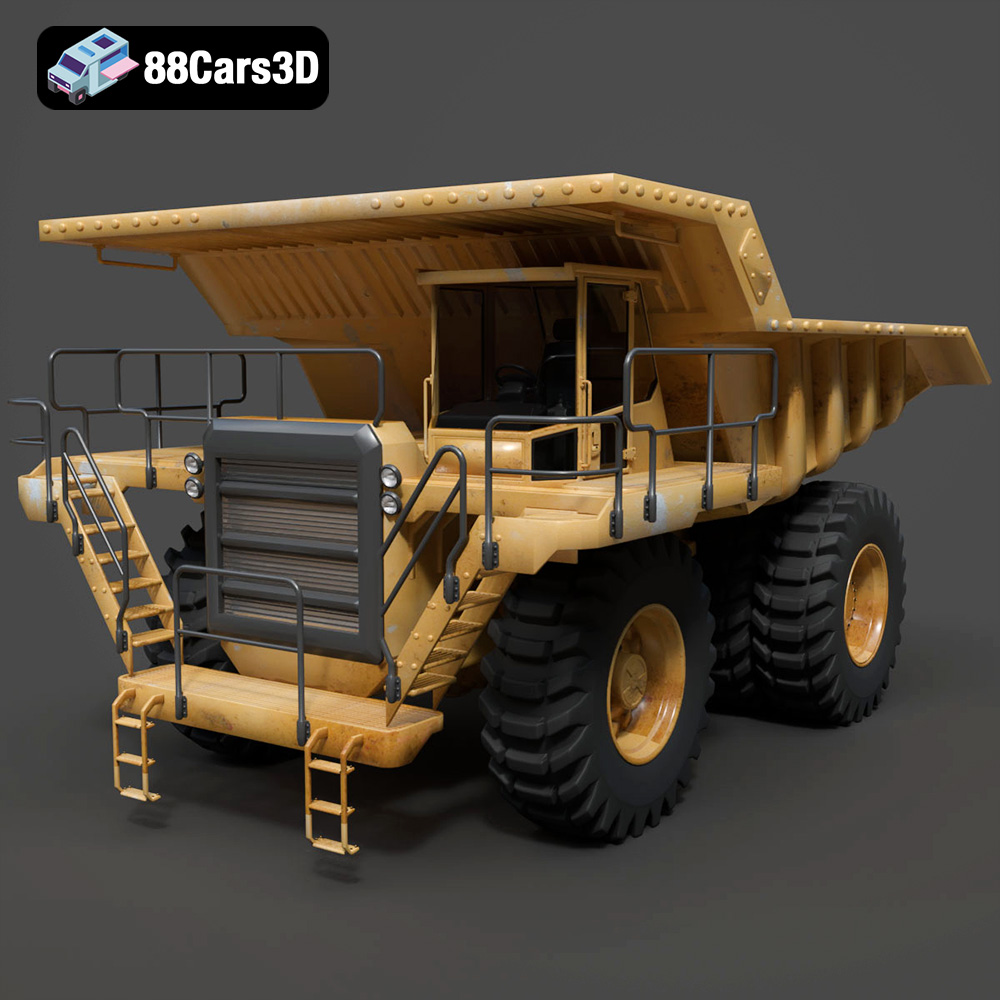
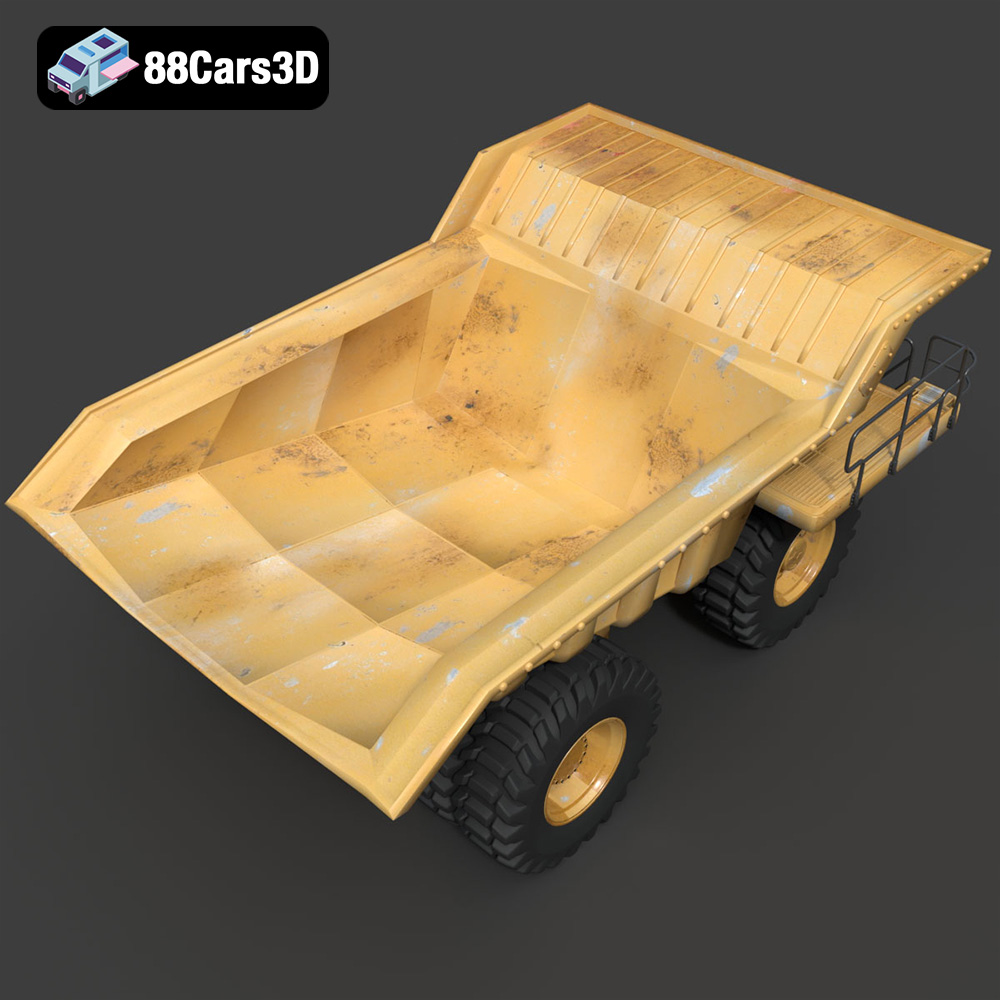
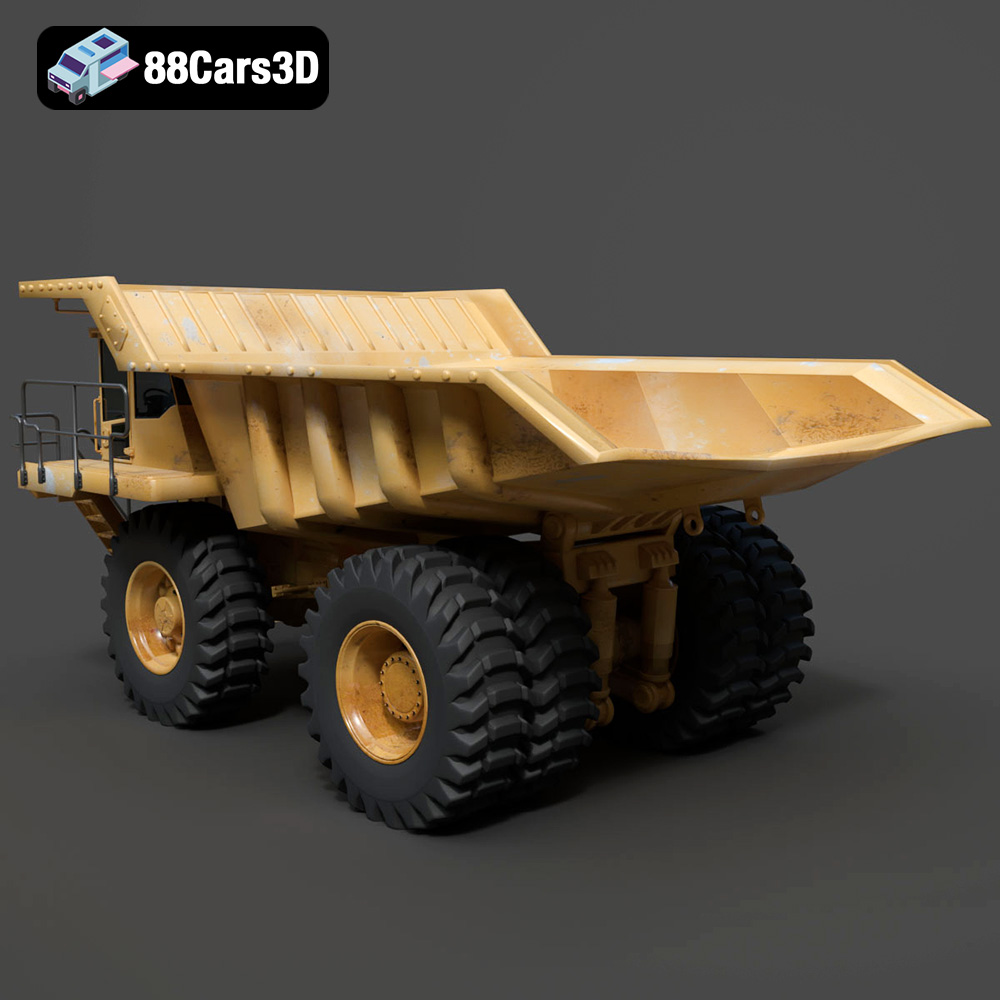
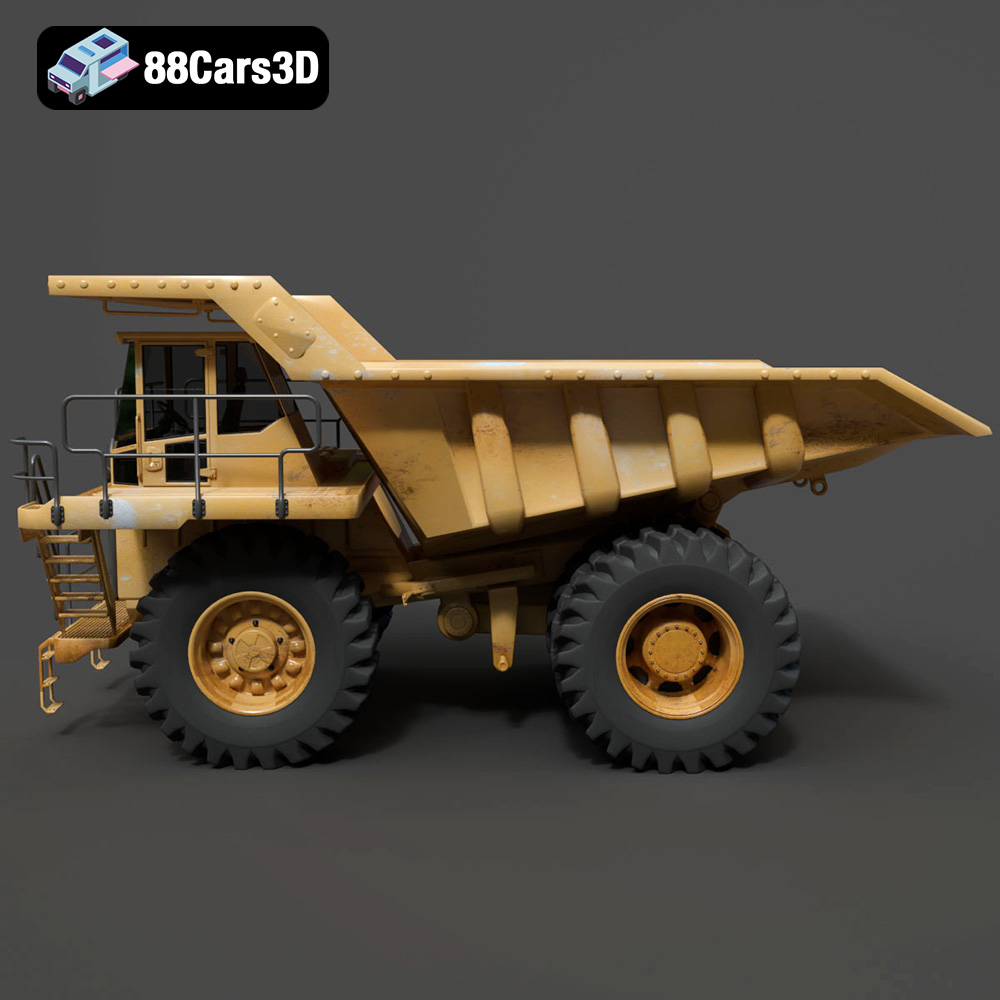
Today, we’re taking an in-depth look at a prime example of such a high-caliber asset: the Off-Highway Truck 3D Model, a massive heavy-duty vehicle designed for the most demanding environments. This particular model, available on 88cars3d.com, is a testament to the meticulous craft involved in creating digital assets that push the boundaries of realism and utility. Its colossal payload capacity, robust dual-axle chassis, and gargantuan off-road tires have been faithfully recreated, offering an unparalleled foundation for mining simulators, industrial visualizations, heavy machinery VR training, and rugged environment game development. As we navigate the technical intricacies and creative potential of this magnificent digital beast, you’ll discover why investing in quality 3D car models and game assets is paramount for any serious project.
The versatility of a 3D model often hinges on the breadth of file formats it supports. Each format serves a specific purpose, excelling in different stages of the 3D pipeline – from initial creation and animation to real-time rendering and physical fabrication. The Off-Highway Truck 3D Model exemplifies this flexibility by offering a comprehensive suite of file types, ensuring compatibility with virtually any professional workflow. Understanding these formats is crucial for optimizing your projects and leveraging the full potential of your 3D assets.
The .blend format is the native file type for Blender, a powerful open-source 3D creation suite. When you download the Off-Highway Truck in .blend, you receive a fully editable Blender scene. This means all the model’s geometry, materials (set up with Cycles or Eevee shaders), textures, lighting, cameras, and even animations (if present) are preserved within the file. It’s ideal for Blender users who want to dive deep into customization, tweak topology, modify materials, or extend the model’s functionality within its native environment. For automotive rendering and detailed scene composition, .blend offers unparalleled control.
.fbx (Filmbox) is arguably the most widely adopted interchange format in the 3D industry. Developed by Autodesk, it’s designed to transfer 3D data between various software applications while retaining as much information as possible, including meshes, materials, textures, animations, skeletons, and blend shapes. The Off-Highway Truck .fbx is perfect for importing into game engines like Unreal Engine and Unity, or into other DCC (Digital Content Creation) software like Maya, 3ds Max, and Cinema 4D. Its robust support for animation data makes it indispensable for any real-time pipeline or complex animated sequence.
The .obj (Wavefront OBJ) format is a universal standard for storing 3D geometry. While it doesn’t typically store animation or rigging data, it excels at preserving mesh information (vertices, normals, UV coordinates) and can reference external material files (.mtl) for basic shading. The .obj version of the Off-Highway Truck is an excellent choice when you need a clean mesh for sculpting, retopology, or for importing into software that might not fully support .fbx. It’s highly compatible across virtually all 3D applications, making it a reliable option for cross-software projects.
.glb (GLB format) is the binary version of glTF (GL Transmission Format), a relatively new standard specifically designed for the efficient transmission and loading of 3D scenes and models by engines and applications. It’s a “single-file” format that embeds textures and other assets directly, making it incredibly streamlined for web-based 3D viewers, augmented reality (AR), virtual reality (VR), and mobile applications. For showcasing the Off-Highway Truck in a virtual showroom or an interactive web experience, .glb offers optimal performance and ease of deployment.
.stl (Stereolithography) is the de facto standard for 3D printing. It represents a 3D model as a collection of unconnected triangular facets, defining only the surface geometry without color or texture information. When you download the Off-Highway Truck as an .stl file, it’s ready for slicing software and physical fabrication. The product description for this model even provides detailed 3D print settings, making it accessible for display-scale industrial hobbyists or prototyping scenarios. It’s a crucial format for bringing digital assets into the physical world.
.ply (Polygon File Format) is another format for storing 3D data, often used in scientific and engineering applications, especially those involving 3D scanning or CAD. It can store a wider range of properties, including color, transparency, and even normal vectors for each vertex or face. While less common for general animation, the .ply version of the Off-Highway Truck can be valuable for detailed mesh analysis, reverse engineering workflows, or integration into specialized simulation software where precision geometry is paramount.
The inclusion of an .unreal specific asset is a significant advantage for developers working with Unreal Engine. This often implies a pre-configured asset, possibly with materials already set up, collision meshes generated, and correct scaling applied, minimizing import headaches and maximizing efficiency. For game development and real-time visualization projects using Unreal Engine, this format delivers a truly engine-ready asset, saving valuable development time when deploying industrial game assets like the Off-Highway Truck.
Finally, the .max format is the native scene file for Autodesk 3ds Max, a leading software for 3D modeling, animation, and rendering in architectural visualization, automotive design, and game development. Similar to .blend, a .max file contains the complete scene, including geometry, materials (e.g., V-Ray, Corona), lighting, and animation data. For professionals rooted in the Autodesk ecosystem, the .max version of the Off-Highway Truck provides the highest level of editability and integration into their established pipelines for automotive rendering and detailed scene creation.
The availability of such a diverse range of formats for the Off-Highway Truck 3D Model highlights its incredible utility and ease of integration, making it a valuable asset regardless of your preferred software or project requirements. This commitment to compatibility is a hallmark of the quality products found at 88cars3d.com.
Creating a digital twin of an industrial behemoth like an off-highway truck requires a blend of artistic skill and technical precision. This particular 3D model stands out for its meticulous attention to detail and intelligent optimization, striking a balance that caters to both high-end cinematic rendering and demanding real-time applications.
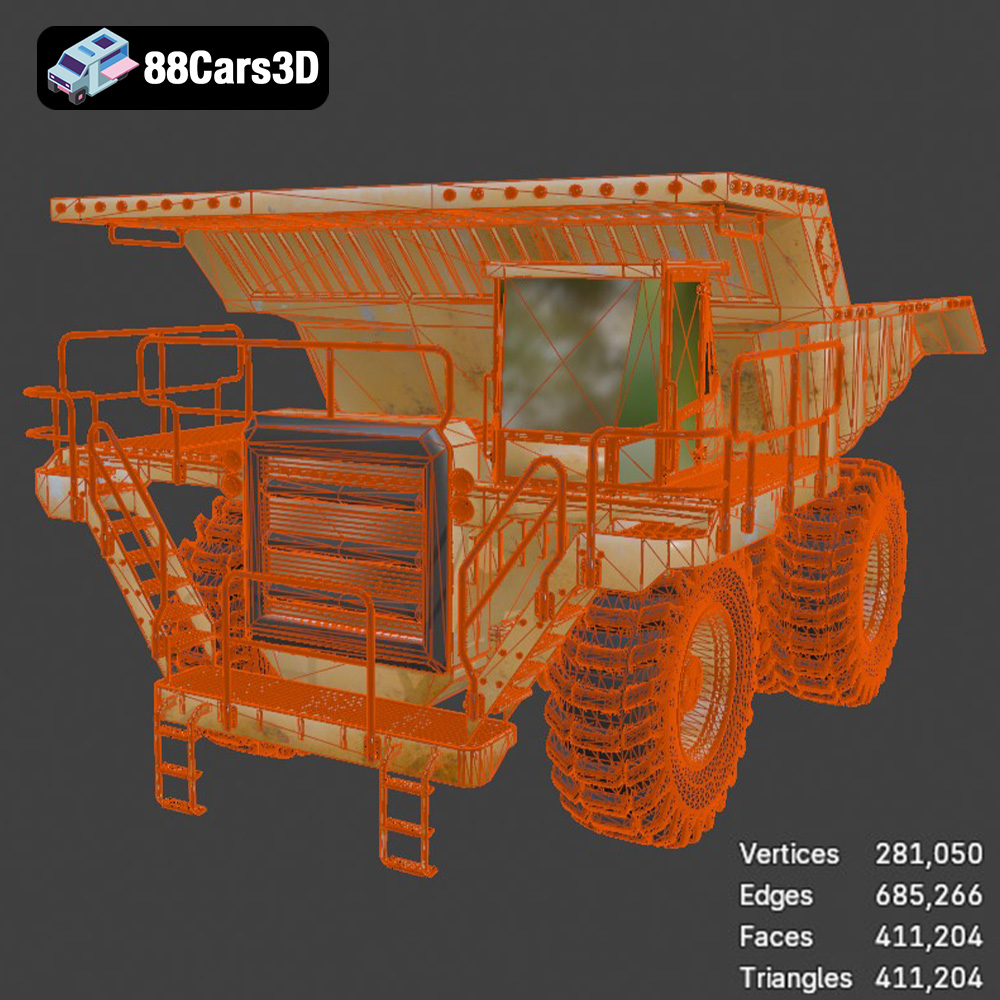
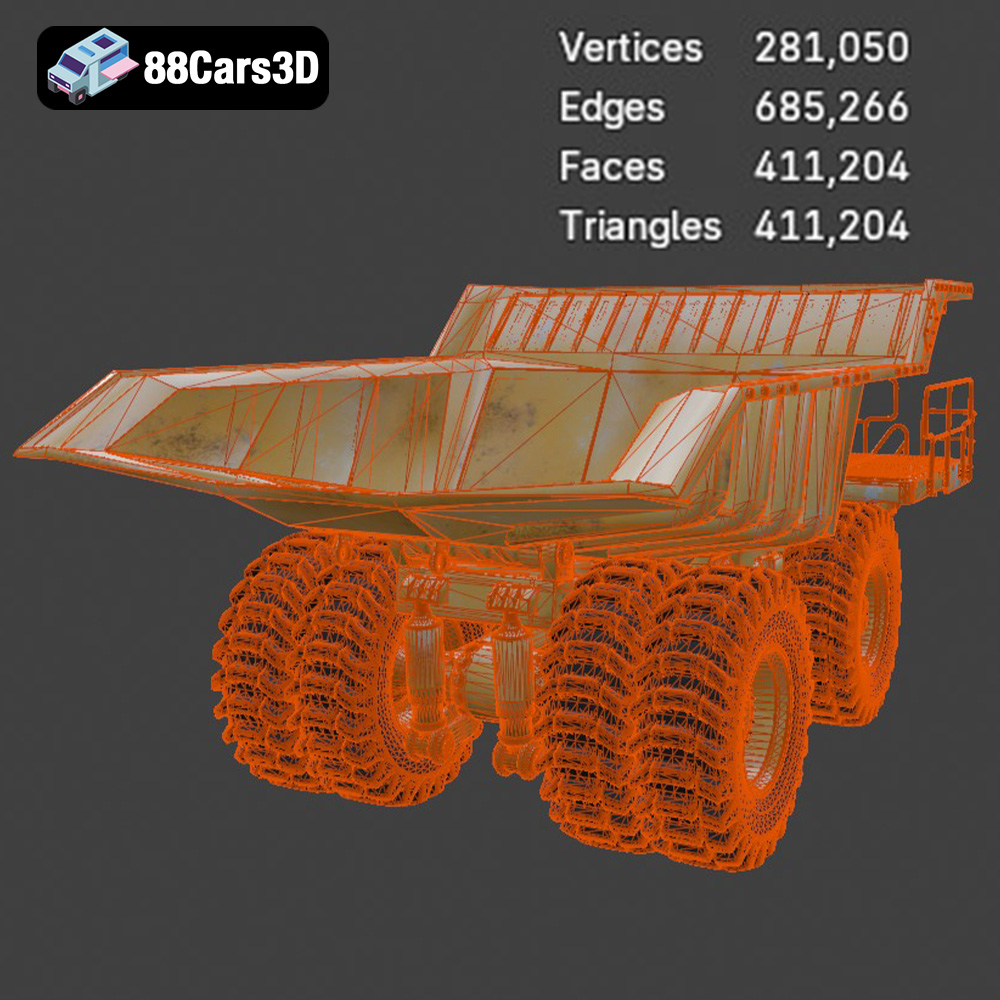
The Off-Highway Truck 3D Model boasts a detailed geometry of 411,204 triangles. This figure represents a carefully considered balance. For a vehicle of this scale and mechanical complexity, 411,204 triangles is robust enough to convey intricate mechanical realism, allowing for exceptional visual fidelity in close-up shots. Yet, it remains optimized enough to ensure excellent performance within real-time engines such as Unreal and Unity. This “game-ready & optimized” characteristic is crucial for developers seeking high-quality game assets that won’t cripple frame rates. Clean topology, implied by such an optimized model, ensures smooth deformations if animated and efficient UV unwrapping for texture application, crucial for realistic automotive rendering.
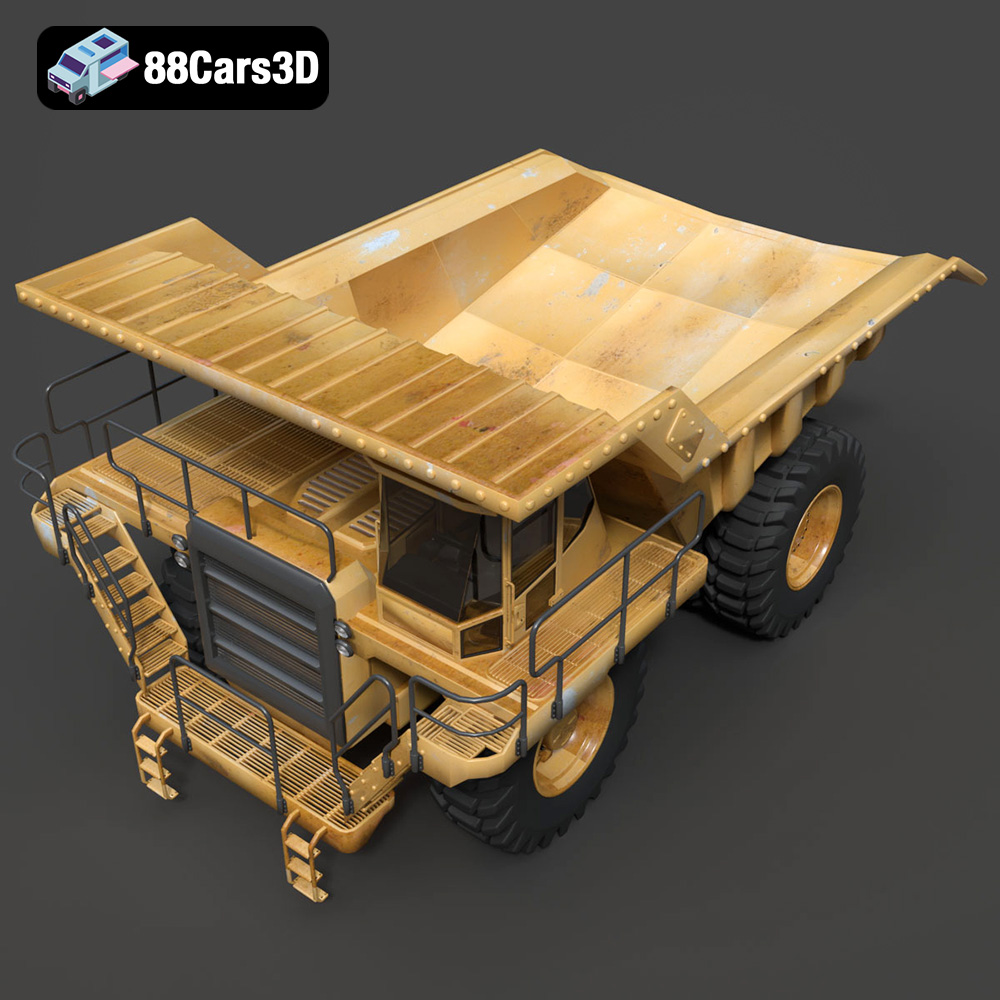
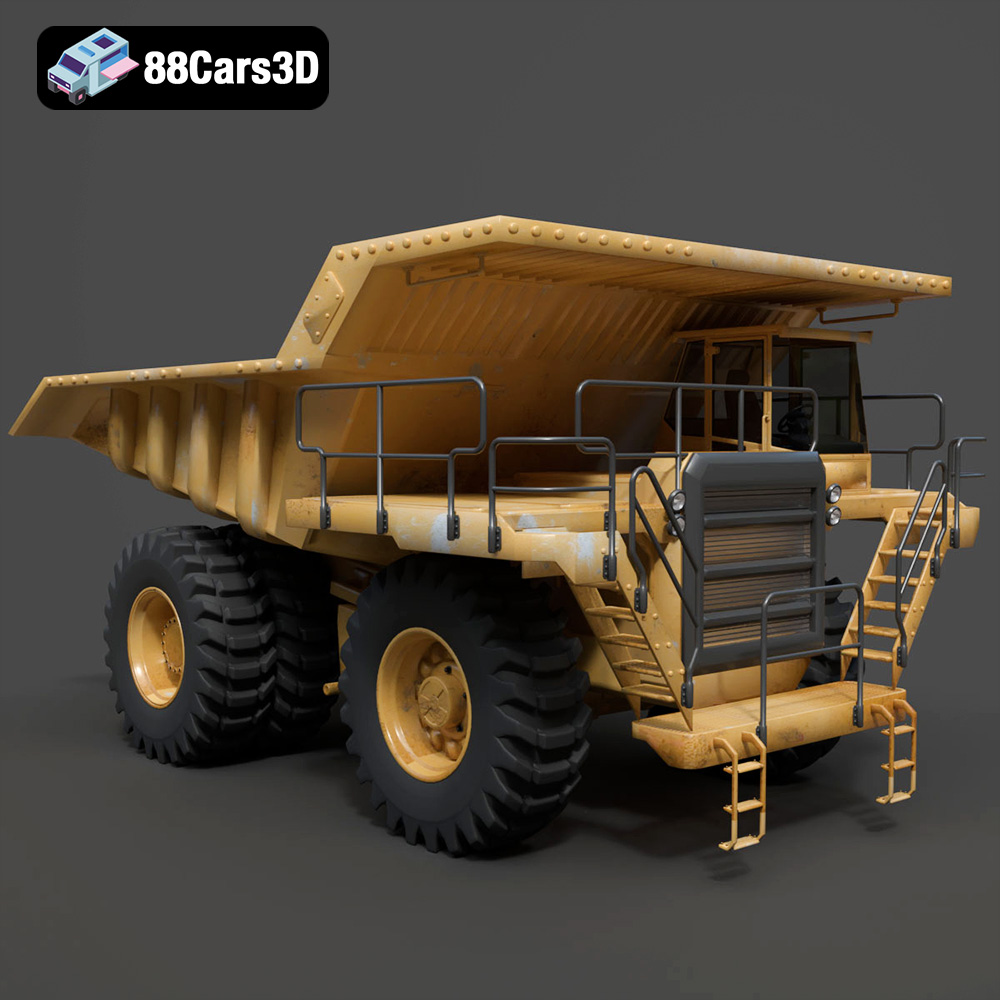
Every structural element of this Off-Highway Truck 3D Model has been meticulously recreated to capture the imposing presence of these mechanical giants. The exterior features include an accurate massive frame geometry, load-bearing proportions, and a detailed heavy-duty diesel engine block with prominent exhaust stacks. The fully modeled reinforced dump bed, complete with hydraulic lift cylinders, hints at its colossal payload capacity. Industrial-grade lighting systems, including powerful floodlights and work lamps, are present, ready to illuminate the darkest digital mining environments. Crucially, the colossal off-road mining tires feature deep, aggressive tread patterns, adding a layer of authenticity that is often overlooked in lesser models. Intricate safety features like access ladders, walkways, and heavy-duty railings further enhance the realism, demonstrating a deep understanding of the real-world counterparts.
The attention to detail extends to the interior. The accurately scaled operator cabin features high-visibility windows, providing a realistic perspective for first-person POV in simulators. Inside, a detailed heavy machinery steering wheel, ergonomic control setup, industrial digital instrument cluster, and operational monitors are all present, offering an immersive experience. Rugged, suspension-mounted operator seating and a secondary passenger seat complete the interior, ensuring that even a virtual operator feels at home in this industrial powerhouse.
Beyond static visual appeal, the functional potential of a 3D model is often defined by its readiness for animation. This Off-Highway Truck 3D Model comes with separate wheels, a distinct dump bed, and steering components, all configured for mechanical animation. This means that the proper pivot points have been established for steering, individual wheel rotation, and, critically, for the hydraulic dump bed elevation. This intelligent setup saves countless hours for animators and riggers, allowing immediate deployment into interactive scenarios like mining simulators or cinematic sequences where the truck needs to perform its heavy-lifting tasks dynamically. The inherent “real-world scale accuracy” further aids in creating believable motion and interactions within any digital environment.
A truly professional 3D asset must not only be detailed and optimized but also integrate seamlessly into various professional pipelines. The Off-Highway Truck 3D Model offers this flexibility, proving its worth across game development, high-fidelity rendering, and immersive AR/VR experiences.
For game developers, the “game-ready & optimized” nature of this model is a significant advantage. With 411,204 triangles, it strikes a balance suitable for modern game engines. Using the .fbx or even the dedicated .unreal format, developers can efficiently import the Off-Highway Truck into Unreal Engine or Unity. The separate components and proper pivot setup are invaluable here, allowing for easy rigging and integration into vehicle physics systems. Implementing realistic material instances, setting up custom collision meshes, and creating Level of Detail (LOD) assets for optimal performance at varying distances become straightforward. This model is ideal for creating immersive industrial simulators, heavy equipment games, or populating open-world construction environments, providing a foundation for realistic driving mechanics and interactive tasks, pushing the boundaries of what 3D car models can achieve in a gaming context.
When it comes to automotive rendering and high-impact visualization, the Off-Highway Truck shines. Users of 3ds Max can utilize the native .max file, while Blender enthusiasts have the .blend file. In either software, the model serves as an excellent base for creating stunning visuals with advanced rendering engines like V-Ray, Corona, Cycles, or Eevee. Artists can leverage the detailed geometry to craft photorealistic materials – from the rugged, worn steel of the dump bed to the aggressive rubber of the tires. The intricate details of the engine block and hydraulic cylinders come alive under studio lighting setups. This allows for the creation of powerful marketing campaigns for heavy industry, mining operation visualizations, or dramatic cinematic renders showcasing the sheer scale and capability of these machines. Customization options, such as changing chassis colors to match specific company liveries or applying procedural weathering (dirt, mud, rock dust, scratches), further enhance the visual storytelling.
The demand for immersive experiences is rapidly growing, and the Off-Highway Truck 3D Model is perfectly suited for AR/VR applications. The .glb format, optimized for web and real-time display, makes it a prime candidate for virtual showrooms where clients can explore heavy machinery in an interactive 3D space. For industrial VR training, the model’s accurately scaled operator cabin and detailed control setup offer an authentic environment for virtual operators to learn procedures without risk. Imagine an AR experience where a scaled-down version of this colossal truck appears on a conference table, allowing engineers to visualize its components and discuss maintenance protocols. The optimized geometry ensures smooth performance in these highly interactive and data-intensive environments, providing compelling game assets for the future of visualization.
The utility of a robust 3D model extends beyond digital screens, venturing into the realm of physical creation. The inclusion of the .stl format for the Off-Highway Truck 3D Model means it’s ready for the exciting world of 3D printing, transforming a digital asset into a tangible object.
Converting a detailed 3D model into a printable file involves careful consideration, and the .stl format provided is specifically designed for this purpose. For a model as complex as the Off-Highway Truck, the product description gives insightful recommendations: a recommended scale of 1:50 or 1:64 is suggested, acknowledging the massive real-world scale of such vehicles. This ensures the printed model is manageable yet retains impressive detail. Technical print settings like layer height (0.04–0.12 mm) are crucial for capturing the fine details, with resin printing specifically recommended for elements like railings and ladders where precision is paramount. Optimal wall thickness (1.2–2.0 mm) and infill (20–30%) are also advised to ensure structural integrity without excessive material usage, creating durable and accurate display models or prototypes.
For a mechanically complex model like this, support structures are indispensable during the 3D printing process. The product details explicitly state that supports are required for delicate parts such as exhaust stacks, access ladders, and hydraulic arms. Proper print orientation is also key; printing the main frame flat enhances structural integrity, while massive wheels and the dump bed are best printed separately for optimal results and easier post-processing. Once printed, the journey continues with post-processing steps. Sanding and priming are essential to achieve a smooth finish, ready for painting. Authentic industrial yellow/orange colors, coupled with weathering effects, can bring the printed model to life, mirroring the rugged aesthetic of its real-world counterpart. This capability to transition from digital asset to physical object opens up new avenues for product display, educational tools, and high-end hobbyist projects, showcasing the multifaceted value of high-quality 3D car models.
The true measure of a valuable 3D asset lies not just in its initial quality but also in its adaptability. The Off-Highway Truck 3D Model provides a robust foundation, offering numerous customization options that allow artists and developers to tailor it precisely to their project’s unique requirements.
A primary customization avenue involves altering the truck’s appearance. Users can easily change the chassis and dump bed colors, moving beyond the standard industrial yellow to incorporate custom company liveries or match specific branding guidelines. Beyond color, the material finishes can be adjusted. This allows for a range of looks, from a pristine, factory-fresh sheen to a rugged, worn metal texture or battle-hardened steel. Furthermore, the ability to apply procedural weathering effects is paramount for realism. Adding dirt, mud splatters, rock dust, and scratches transforms the model from a generic vehicle into one that tells a story of tireless work in harsh environments, enhancing the visual narrative in any automotive rendering or game scene.
The versatility extends to environmental adaptation. The industrial-grade lighting systems, including floodlights and work lamps, can be adjusted or reconfigured to suit different scenarios, such as illuminating a night-time mining operation or a dimly lit underground tunnel. The modular nature of the model, with its separate components, also allows for potential modifications to suit specific operational scales or unique project requirements. Whether you need a fleet of these trucks for a massive open-world game or a single, highly detailed model for a focused simulation, this asset from 88cars3d.com provides the necessary flexibility. It serves as an exceptional starting point for creating bespoke heavy-duty vehicles, ensuring that the core quality of the 3D car models remains consistently high while allowing for creative freedom.
In the dynamic world of 3D content creation, the difference between a good project and a great one often comes down to the quality and versatility of its assets. The Off-Highway Truck 3D Model stands as a shining example of a high-fidelity, meticulously engineered asset that meets the rigorous demands of professional workflows across various industries. From its intelligently optimized geometry and intricate detailing to its broad file format compatibility, this model is a powerhouse designed to perform.
We’ve explored its technical specifications, examined how its diverse file formats (.blend, .fbx, .obj, .glb, .stl, .ply, .unreal, .max) empower seamless integration into game development, automotive rendering, AR/VR, and even 3D printing. The customization options further ensure that this industrial giant can be perfectly tailored to any creative vision, from gritty mining simulators to stunning cinematic visualizations.
For artists, developers, and enthusiasts seeking top-tier 3D car models and game assets, the Off-Highway Truck 3D Model offers an unparalleled foundation for success. Investing in such quality assets saves valuable development time, enhances visual realism, and provides the flexibility needed to bring ambitious projects to life. Discover this exceptional model and a wide range of other professional-grade assets by visiting 88cars3d.com today, and elevate your next industrial visualization or real-time experience.
Discover the immense power and rugged utility of the Off-Highway Truck, a massive heavy-duty vehicle designed for large-scale mining operations and extreme construction environments. Characterized by its colossal payload capacity, robust dual-axle chassis, and gargantuan off-road tires, this truck is the ultimate symbol of industrial strength and earth-moving capability. Every structural element, from the reinforced dump bed to the heavy-duty suspension and safety railings, has been meticulously recreated to capture the imposing presence of these mechanical giants. This high-fidelity 3D model boasts a detailed geometry of 411,204 triangles, striking an excellent balance between intricate mechanical realism and optimization. Modeled with precision, it offers exceptional visual fidelity for close-up shots while maintaining performance for real-time applications. Whether deployed in an interactive mining simulator, a heavy equipment showcase, or a dramatic cinematic render, this model delivers unparalleled authenticity. Perfect for mining operation simulators, industrial construction visualizations, heavy machinery VR training, and rugged environment game development.
$26.00
.blend
.fbx
.glb
.heavy-equipment
.max
.obj
.ply
.rendering
.stl
.unreal
car-3d-model
game asset
game-ready
low-poly
mining-truck
off-highway-truck
off-highway-truck-08
optimized
VR/AR