Get 20% OFF All Premium 3D & STL Models!

In the dynamic landscape of 3D visualization, simulation, and interactive media, the demand for highly detailed and technically accurate models is paramount. From the intricate gears of a luxury sedan to the imposing frame of an industrial excavator, every digital asset plays a critical role in conveying realism and functionality. While sleek sports cars and elegant architectural renders often steal the spotlight, the robust world of heavy machinery holds a unique significance. These models are not just static representations; they are the backbone of realistic construction simulators, essential components in urban planning visualizations, and critical elements in immersive virtual reality training environments.
The ability to accurately depict and animate these powerful machines can elevate a project from good to exceptional. Imagine a sprawling construction site in a video game, bustling with authentic equipment, or an architectural firm presenting a new infrastructure project with photorealistic digital models of the very vehicles that will build it. This level of detail and authenticity is precisely what professional artists and developers seek, and it’s where specialized assets truly shine. Today, we delve deep into the technical intricacies and versatile applications of one such specialized asset: the Road Roller Vibratory Tandem 3D Model, a stellar example of the high-fidelity products available at 88cars3d.com, designed to meet the rigorous demands of various professional workflows.
The journey of any 3D model, especially one as detailed and versatile as the Road Roller Vibratory Tandem, often begins with selecting the correct file format. Each format is engineered for specific purposes, offering unique advantages in terms of compatibility, data retention, and optimization for particular applications. Understanding these distinctions is crucial for seamless integration into diverse production pipelines, from game development and architectural rendering to AR/VR experiences and 3D printing.
The .blend format is the native file type for Blender, the powerful open-source 3D creation suite. When you download a .blend file, you’re not just getting the mesh; you’re receiving a fully editable Blender scene. This includes all the model’s geometry, materials, textures, lighting setups, camera positions, animations, and even rigging information. For artists working primarily in Blender, this format offers the most flexibility, allowing for direct modification, material tweaks, animation adjustments, and scene integration without any loss of data or conversion artifacts. It’s the ideal starting point for extensive customization and iterative design within the Blender environment.
.fbx (Filmbox) is arguably the most widely adopted proprietary 3D file format for exchanging models between different software applications. Developed by Autodesk, FBX excels at storing not only mesh data but also critical information like animations, skeletal systems (rigs), skinning data, morph targets, and PBR (Physically Based Rendering) materials. This makes it an indispensable format for game development, especially when targeting engines like Unreal Engine and Unity, or when moving assets between 3ds Max, Maya, and other DCC (Digital Content Creation) tools. Its robustness ensures that animations and complex hierarchies are preserved, making it a reliable bridge for real-time pipelines.
The .obj (Object) format is a much older, simpler, and highly universal file format. It’s a text-based format primarily used for storing 3D geometry – vertices, UVs, normals, and faces – and can reference external material files (.mtl). While it doesn’t support animation or rigging, its widespread compatibility makes it a fantastic fallback for almost any 3D software. For simple static meshes like the Road Roller for rendering purposes, where animation is handled separately or not required, .obj provides a clean, universally readable mesh that can be imported into virtually any 3D application without issue.
.glb (GL Transmission Format Binary) is the binary version of glTF (GL Transmission Format), designed to be an efficient, single-file format for the transmission and loading of 3D scenes and models. It encapsulates geometry, materials, textures, and animation data into a single, compact file, making it incredibly well-suited for web-based 3D viewers, AR (Augmented Reality), and VR (Virtual Reality) applications. Its “transmission-optimized” nature means faster loading times and broader support across various platforms, especially for mobile and browser-based experiences. For showcasing the Road Roller in a web configurator or an AR training app, .glb is the format of choice.
.stl (Stereolithography) is almost exclusively used for 3D printing. This format describes only the surface geometry of a 3D object using a collection of interconnected triangles. It lacks color, material, or texture information, focusing purely on the physical form. While it can result in large file sizes for highly detailed models, its simplicity and ubiquitous support across 3D slicer software make it the industry standard for additive manufacturing. Converting the Road Roller to .stl is the essential step for bringing this digital asset into the physical realm.
The .ply (Polygon File Format) is a versatile format often used for storing 3D data from 3D scanners, CAD software, and other scientific applications. It supports a wider range of properties than .obj, including color, transparency, normals, texture coordinates, and confidence values per vertex or face. It’s particularly useful for models requiring high precision and detailed vertex attribute data, making it valuable for engineering analysis, reverse engineering, or high-fidelity asset creation where vertex-level data integrity is critical.
The .unreal format, or more accurately, assets imported and configured directly for Unreal Engine, represents the model in its most optimized state for the engine. While typically an FBX or similar format is imported, having an “Unreal-ready” asset implies it has undergone specific preparation: pivot points are correctly set, materials are configured with Unreal’s PBR shaders, LODs (Levels of Detail) might be integrated, and collision meshes are potentially generated. This ensures drag-and-drop functionality and immediate usability within the Unreal Engine environment, saving developers valuable integration time.
Similar to .blend for Blender, .max is the native file format for Autodesk 3ds Max, another industry-leading 3D modeling, animation, and rendering software. A .max file contains the complete scene data, including geometry, modifiers stack, materials, textures, lighting, cameras, animation keyframes, and plugins. For professionals heavily invested in the Autodesk ecosystem, this format offers the most comprehensive control and flexibility for iterative development, complex rigging, and high-fidelity rendering within 3ds Max.
The Road Roller Vibratory Tandem 3D Model’s availability in such a wide array of formats (.blend, .fbx, .obj, .glb, .stl, .ply, .unreal, .max) truly underscores its versatility, ensuring that artists and developers can access and utilize this high-quality asset regardless of their preferred software or intended application.
The Road Roller Vibratory Tandem 3D Model available on 88cars3d.com is more than just a digital representation; it’s a meticulously crafted asset designed for immediate deployment across a spectrum of professional projects. Its robust construction and attention to detail make it an ideal choice for any scenario demanding realism and functional accuracy for heavy machinery.
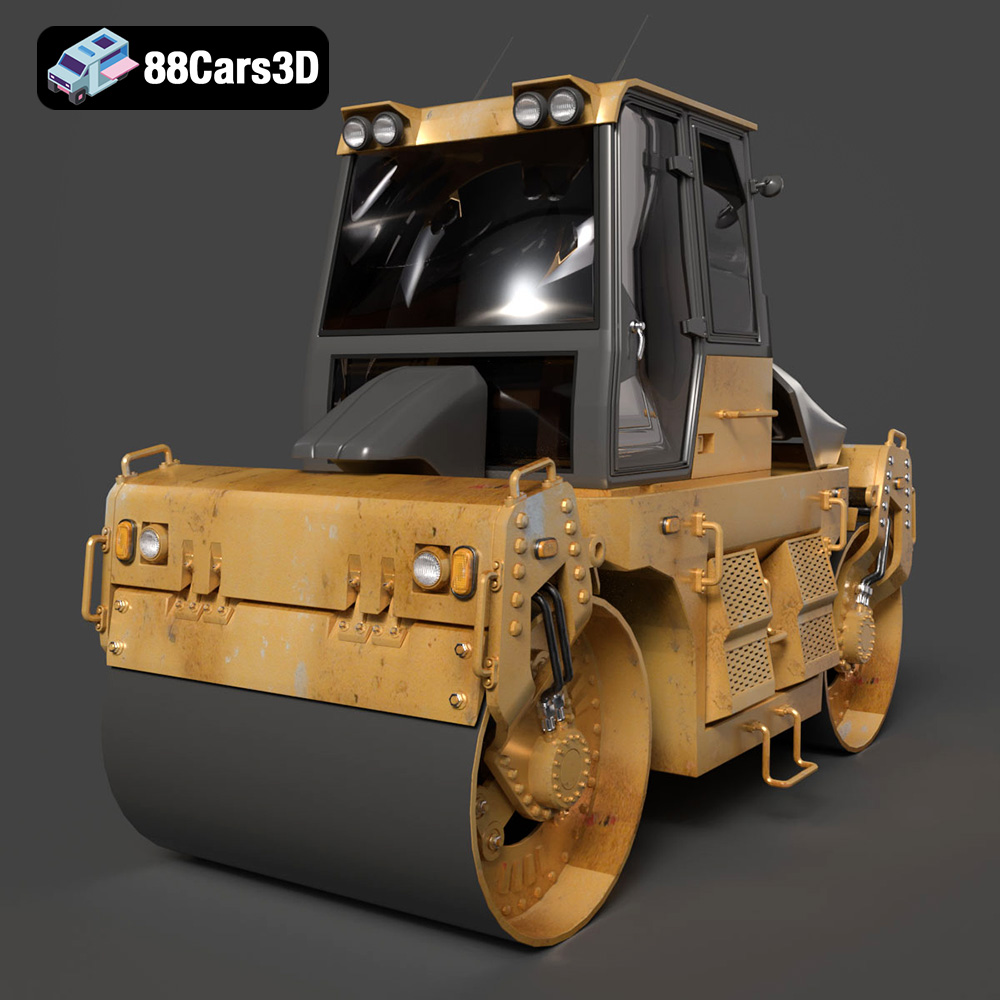
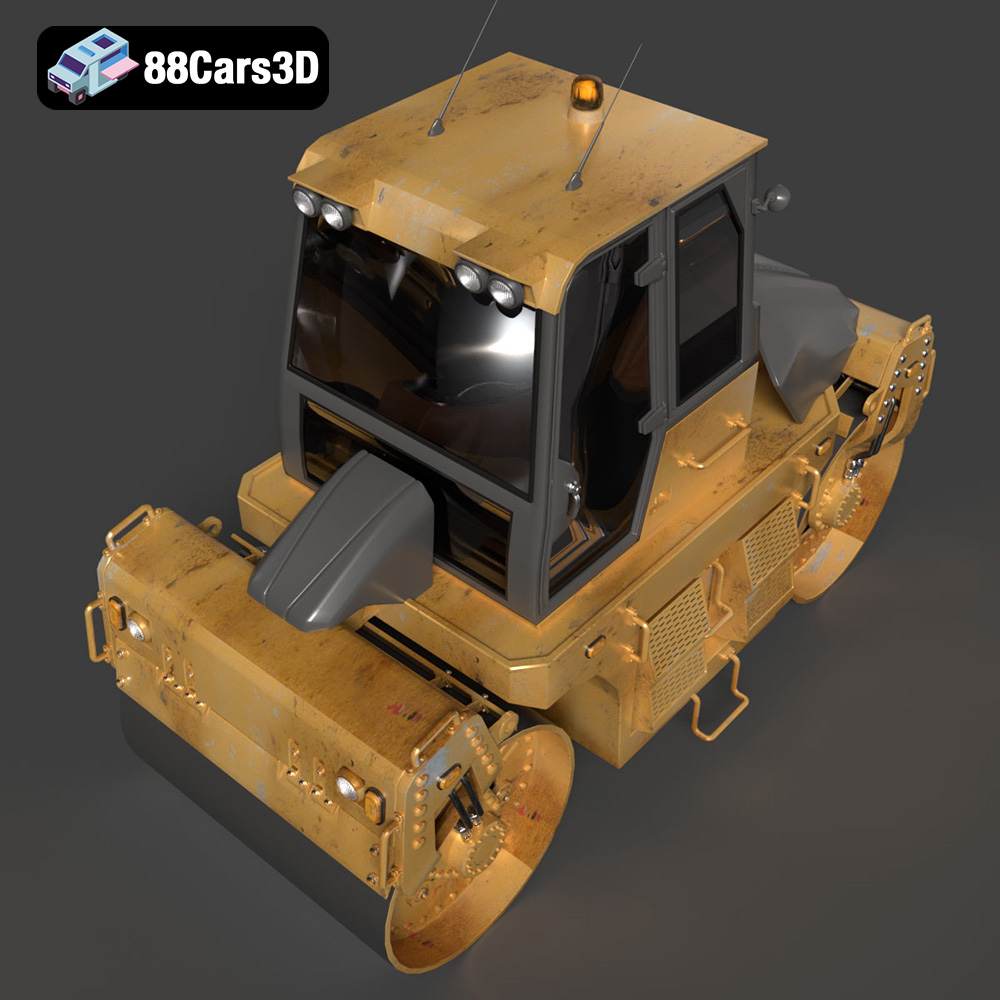
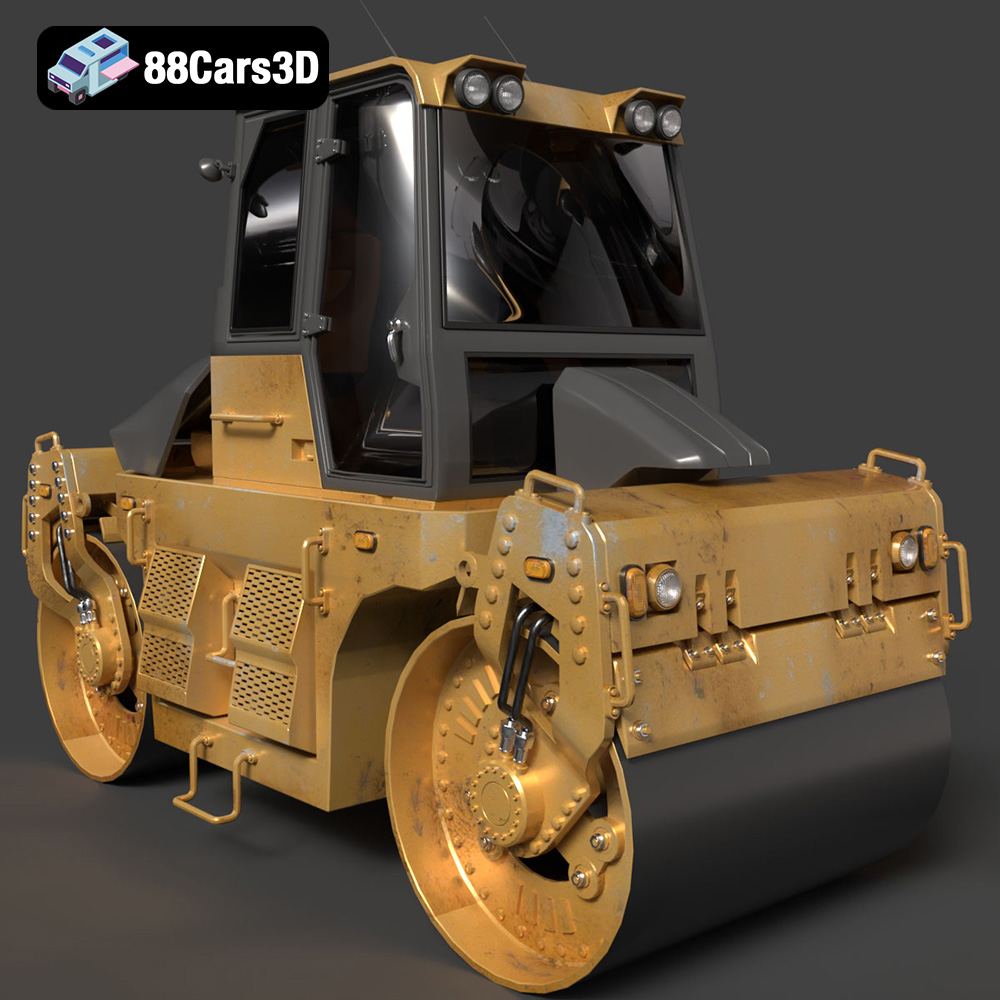
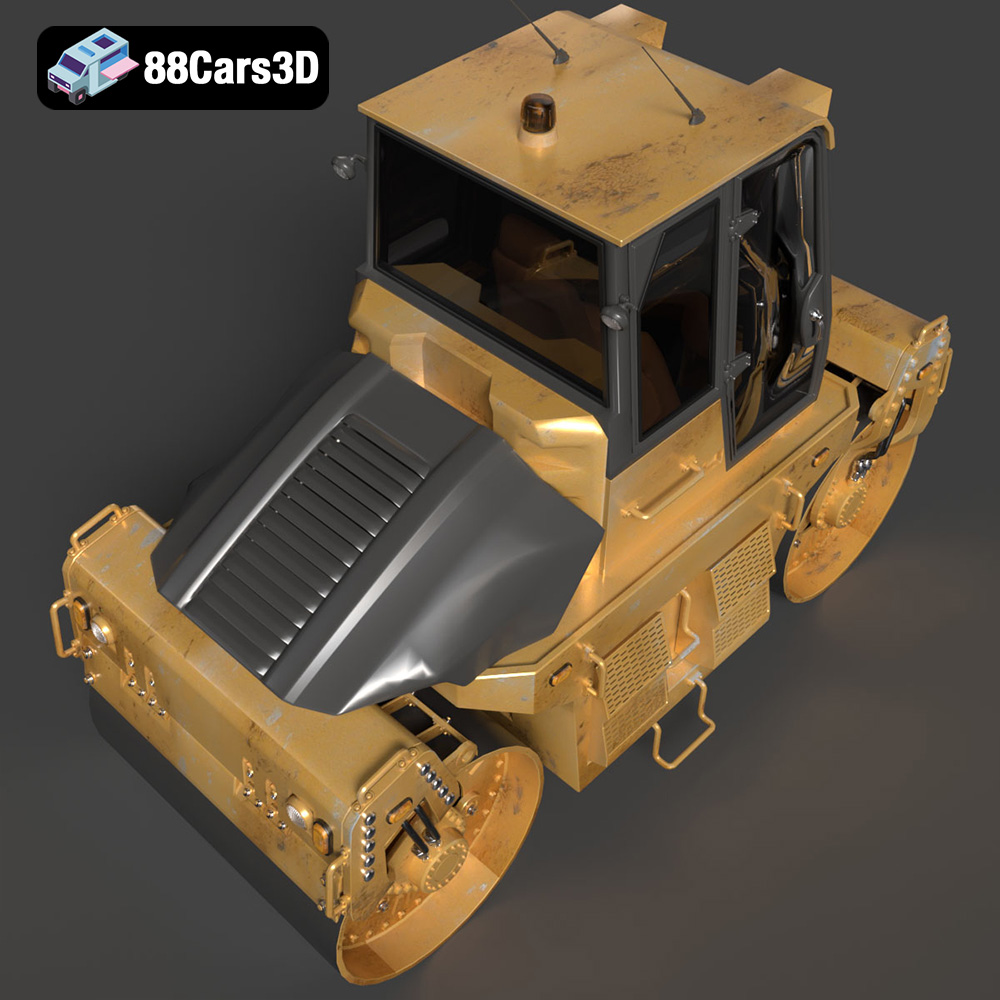
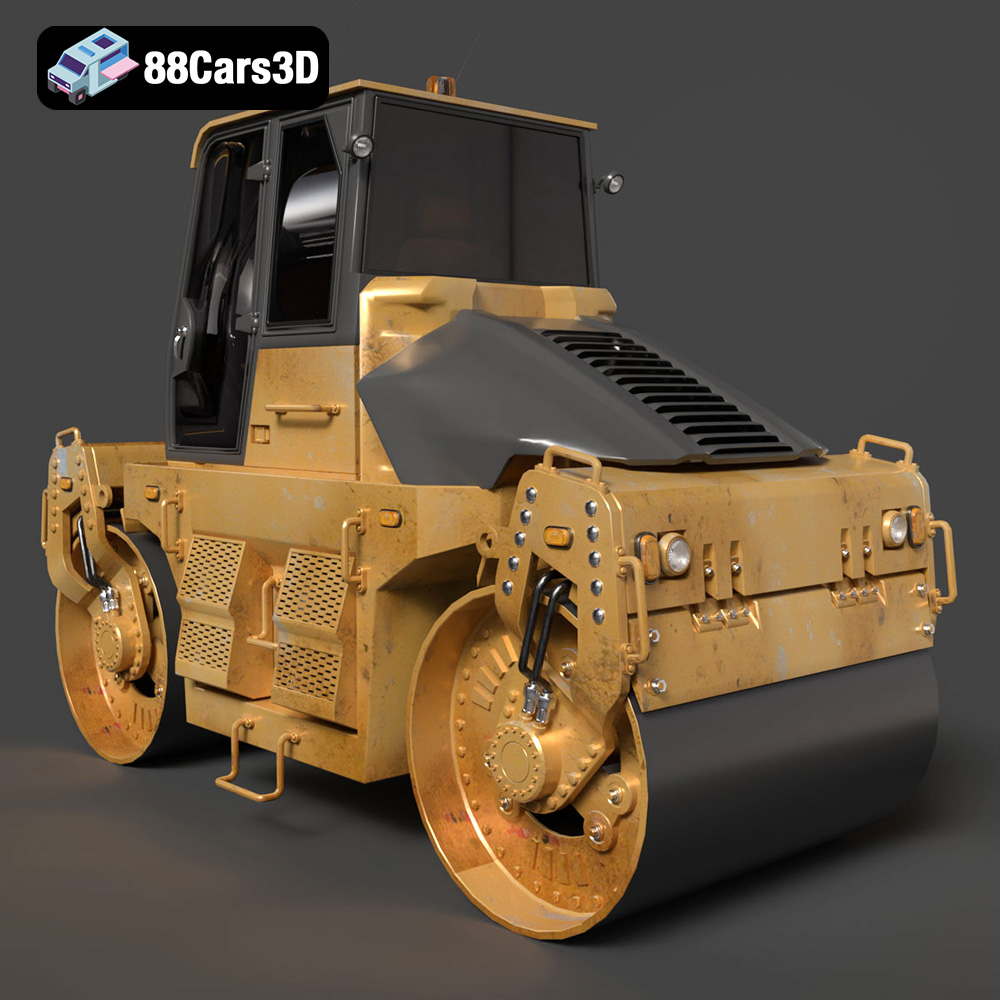
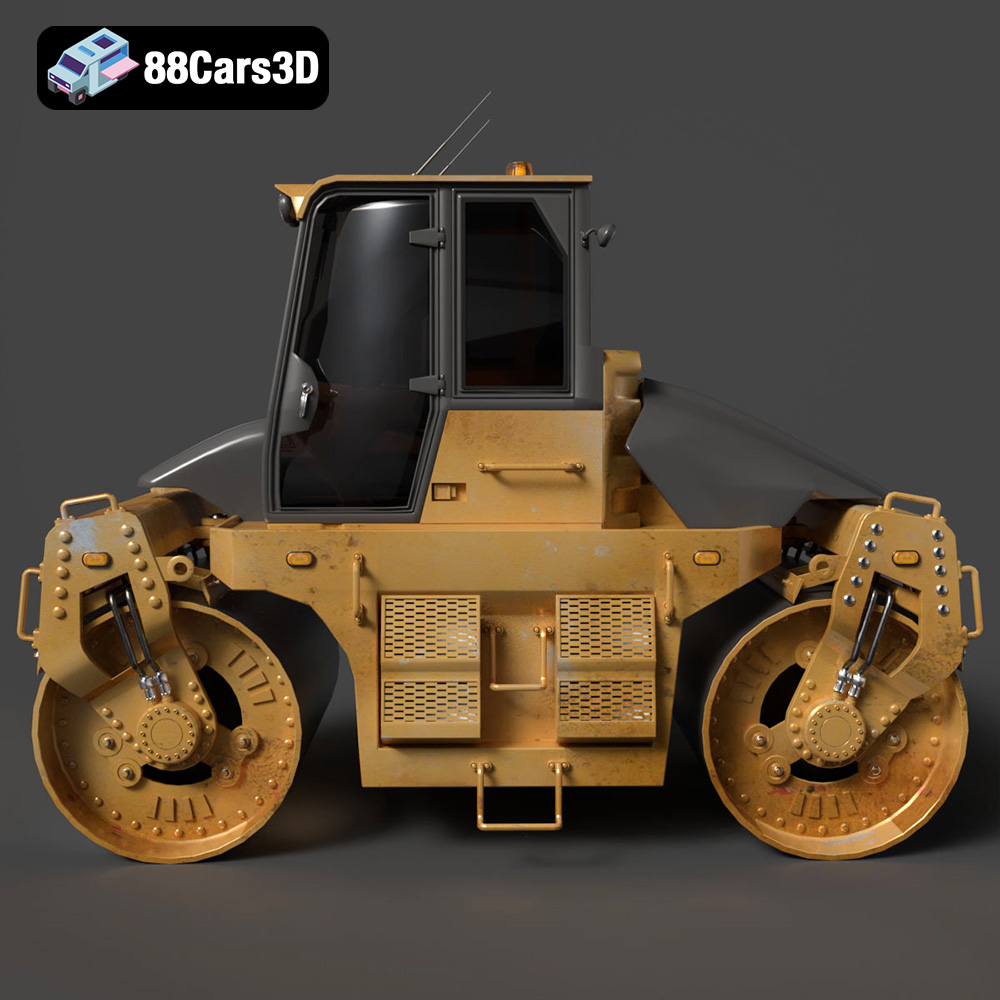
From the first glance, the model impresses with its accurate geometry and proportional fidelity. The distinctive industrial styling of a road roller, characterized by its powerful stance and robust components, is faithfully replicated. Key exterior details include a heavy-duty diesel engine housing, complete with vents and panels, conveying the sheer power of the machine. The authentic dual steel compacting drums feature realistic scraper mechanisms, essential for preventing material buildup during compaction. Industrial-grade work lights and safety beacons are integrated, adding a layer of realism vital for night-time construction scenarios. Perhaps one of the most critical mechanical details, the articulated center steering joint with its visible hydraulic cylinder components, is modeled with precision, allowing for realistic steering animation and movement simulation. Even subtle elements like the water spray system components and reservoir detailing are included, enhancing the overall authenticity and functionality of the asset.
Beyond the impressive exterior, the model extends its detail into the cockpit, providing an immersive experience for first-person perspectives. An ergonomic operator seat with suspension detailing offers a realistic sense of comfort and functionality. The heavy machinery steering wheel and comprehensive control console are faithfully recreated, featuring a detailed instrument cluster with industrial gauges. Crucial control elements like vibration, throttle, and directional control levers are present, designed with optimized geometry to ensure smooth interaction in construction simulators. This level of interior fidelity is particularly valuable for VR training applications, allowing users to experience the machine’s operation with genuine visual feedback.
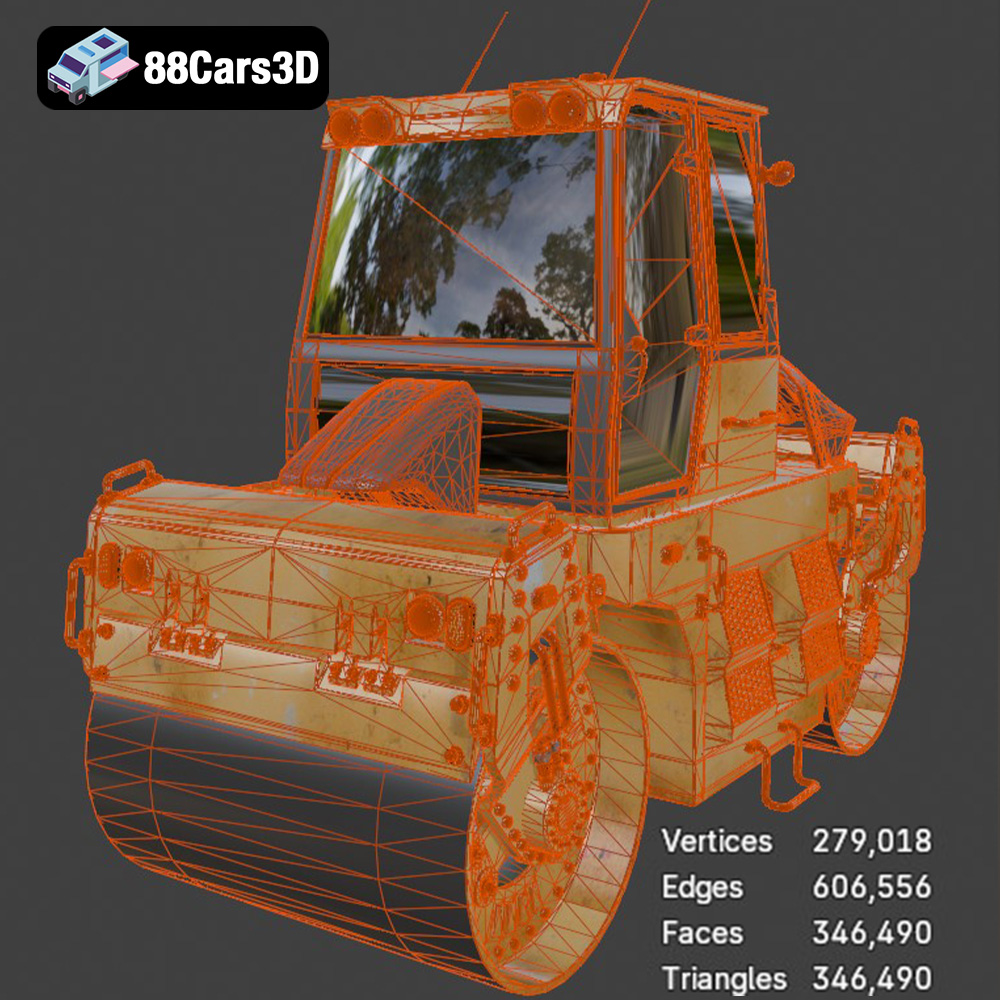
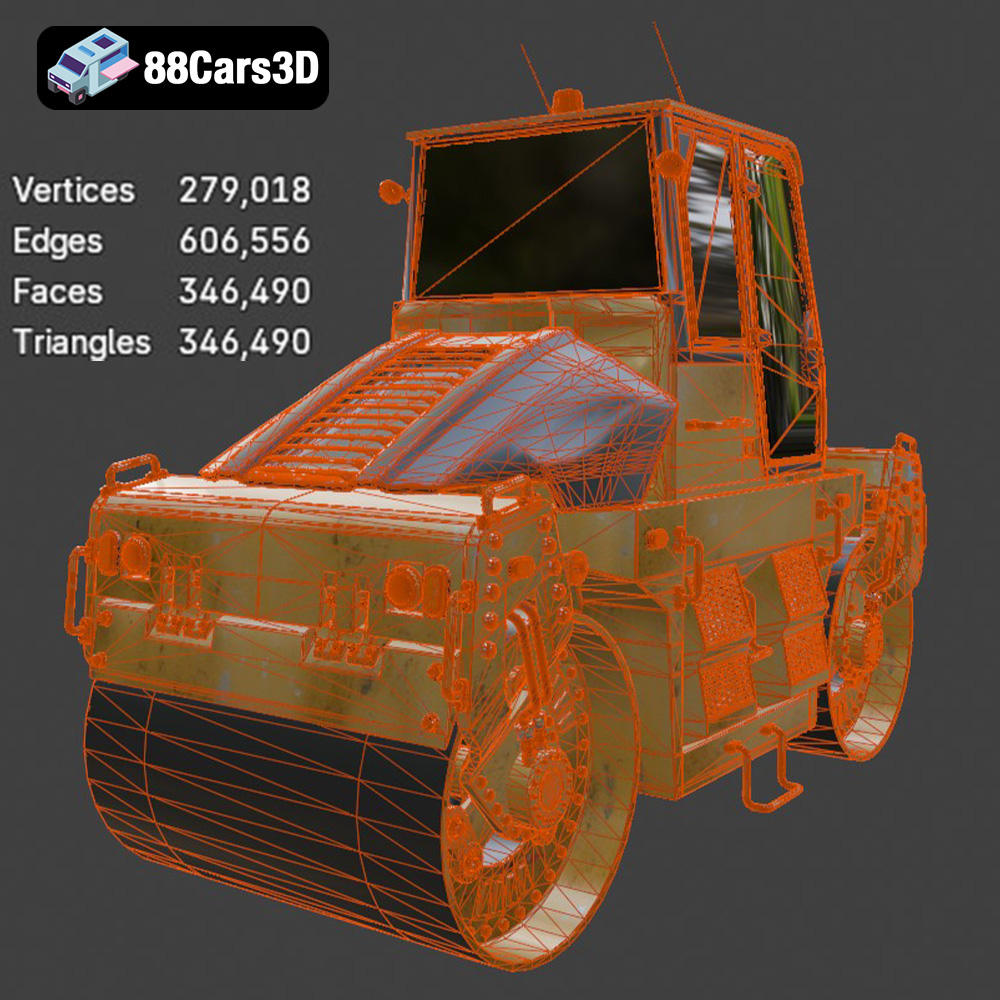
The core strength of this model lies in its meticulous balance between visual fidelity and performance optimization. With exactly 346,490 triangles, it achieves a “game-ready” polycount that is suitable for real-time engines like Unreal and Unity, without sacrificing the high-end visual realism expected in modern games and visualizations. This optimized topology ensures smooth performance even in complex scenes with multiple assets. Crucially, the model boasts real-world scale accuracy, a foundational requirement for architectural visualization, simulation, and CAD integration. Furthermore, proper pivot setups are included for key components like steering articulation, drum rotation, and other mechanical movements, making it incredibly easy for animators to bring the road roller to life with authentic motion. This careful attention to technical detail makes the model compatible with all major 3D software platforms and real-time rendering engines, ready for immediate deployment.
High-quality 3D assets like the Road Roller Vibratory Tandem model from 88cars3d.com are not just visual flair; they are instrumental tools that streamline production and enhance the realism of professional projects across various industries.
For game developers, especially those creating construction simulators or open-world environments, this road roller model is a game-changer. Its optimized polycount of 346,490 triangles is a sweet spot, providing ample detail for close-up shots and realistic visual impact while remaining efficient enough for real-time rendering within engines like Unreal Engine and Unity. The inclusion of proper pivot points for steering, drum rotation, and articulation means animators can quickly set up complex mechanical movements. In Unreal Engine, for instance, an FBX import with pre-set pivots allows for straightforward Blueprint scripting to control steering and vibratory functions. Artists can create material instances in Unreal to easily swap out body colors or apply weathering effects, crucial for different in-game scenarios or player customization. For a city-building game, these assets provide a layer of authenticity, showing the actual construction process rather than abstract representations. Imagine a player driving this very roller, compacting virtual asphalt with realistic physics feedback, all powered by a meticulously crafted game asset.
Architectural visualization (ArchViz) often goes beyond just buildings, extending to the surrounding infrastructure and construction processes. Integrating realistic heavy machinery like the Road Roller Vibratory Tandem can significantly enhance the credibility and impact of a render. For a presentation showing a new highway project or a large commercial development, populating the scene with accurate construction equipment adds a layer of dynamic realism. In 3ds Max or Blender, the .max or .blend formats provide full control over materials and lighting. Artists can apply V-Ray or Corona Renderer materials to achieve photorealistic surface qualities for the steel drums and painted body. The model’s real-world scale is critical here, ensuring it fits perfectly within the architectural context without appearing disproportionate. Scenario renders can depict various stages of construction, with multiple road rollers in action, giving clients a vivid understanding of the project’s scale and timeline.
The burgeoning fields of Augmented Reality (AR) and Virtual Reality (VR) offer powerful new avenues for utilizing 3D assets. For the Road Roller Vibratory Tandem, applications range from immersive virtual training simulations for new operators to interactive safety configurators. In a VR training scenario, operators can learn to maneuver the machine, understand its controls (thanks to the detailed cockpit interior), and practice compaction techniques without the risks or costs associated with physical equipment. The .glb format is particularly beneficial here, offering efficient loading for web-based AR experiences or mobile VR apps. Developers can implement interactive hotspots on the model, allowing users to explore different components, trigger animations of the vibratory drums, or even change paint schemes in real-time. This level of interactivity makes complex machinery more accessible for education, sales, and maintenance planning.
Beyond digital screens, the versatility of a high-quality 3D model like the Road Roller Vibratory Tandem extends into the tangible world through 3D printing. This process allows hobbyists, educators, and even engineers to create physical prototypes or display models of complex machinery.
The conversion of the digital Road Roller model into an .stl format is the first step towards 3D printing. The .stl file, which simplifies the model into a mesh of triangles, is universally recognized by 3D slicer software. The product explicitly recommends specific scales: 1:24, 1:35, or 1:50. These scales are popular for dioramas and model vehicle collections, striking a balance between detail retention and manageable print size. For optimal results, especially with intricate details like the cabin frame or hydraulic cylinders, resin printing (SLA/DLP) is highly recommended over FDM (Fused Deposition Modeling) due to its superior resolution and smoother surface finish. The recommended layer height of 0.04–0.12 mm further emphasizes the pursuit of fine detail.
Successful 3D printing requires careful consideration of structural integrity and printability. A wall thickness of 1.2–2.0 mm is suggested to ensure robust parts that can withstand handling. An infill of 20–30% provides a good balance between material usage, print time, and structural strength. Given the complexity of the road roller, supports will be essential for overhangs and delicate features such as the cabin frame, the articulation joint, and mirrors. The recommended print orientation—frame angled for structural integrity, drums printed separately—is a classic strategy to minimize warping and maximize detail. Printing complex models in multiple, smaller parts often yields better results and simplifies the support removal process, allowing for cleaner finishes and easier assembly.
Once printed, the physical model enters a post-processing phase to achieve the desired aesthetic. This typically involves sanding to smooth layer lines or support marks, followed by the application of primer to create an even surface for painting. For a road roller, authentic factory colors, often vibrant yellows or oranges, with metallic finishes for the drums and chassis components, will bring the model to life. The ability to assemble and paint a physically accurate model of heavy machinery can be incredibly rewarding, serving as a powerful educational tool or a striking display piece. It highlights the full lifecycle of a 3D asset, from digital concept to tangible reality, thanks to the quality provided by models like those on 88cars3d.com.
One of the significant advantages of investing in a high-quality 3D model is the inherent flexibility it offers for customization. The Road Roller Vibratory Tandem 3D Model is designed with this in mind, allowing artists and developers to adapt it to specific project requirements, ensuring unique and compelling results.
The foundation of visual customization often begins with materials and colors. The model is structured to allow easy modification of body colors. This means you can swiftly change the standard construction yellow to an orange, green, or a custom fleet finish to match a specific brand or client’s livery. Beyond simple color shifts, artists can modify drum textures to represent different states: clean, polished steel for a new machine, or worn, asphalt-coated surfaces for a vehicle that has seen extensive use. Adjusting material finishes from matte to gloss, or even applying heavy weathering effects like rust, dirt, and mud, can dramatically alter the model’s narrative and integrate it seamlessly into various environmental contexts, from pristine urban sites to rugged rural roads.
Beyond the model itself, its interaction with light is crucial for realism. The flexibility to adapt lighting for daytime or nighttime construction environments is a key customization. This involves not just external scene lighting but also activating the model’s industrial-grade work lights and safety beacons for night renders. In game engines, this can involve creating different light presets or material variants that respond dynamically to the time of day. For architectural visualizations, matching the road roller’s lighting to the ambient scene lighting ensures it feels like a natural part of the environment, whether it’s bathed in golden hour sunlight or illuminated by harsh construction site floodlights. These adaptations allow the same core asset to serve a multitude of visual scenarios without needing to create new models from scratch.
While the model comes with proper pivot setups for animation, further customization can extend to creating specific animation sequences. This could involve developing complex hydraulics movements for the articulation joint, simulating the subtle vibrations of the drums, or even rigging additional components like operator controls for interactive experiences. For a construction simulator, custom animations for ingress and egress of the operator, or specific operational sequences, would be vital. The clean topology and distinct parts of the model facilitate these advanced animation efforts, providing a robust base for any dynamic interaction designers might envision.
In a competitive digital landscape, the choice of 3D assets can significantly impact project timelines, quality, and overall budget. This is where specialized marketplaces like 88cars3d.com prove invaluable. They offer a curated selection of high-quality, professional-grade 3D car models and heavy machinery, explicitly designed to meet the rigorous demands of various industries.
Creating highly detailed and optimized 3D models from scratch is an incredibly time-consuming and expensive process, often requiring dozens or even hundreds of hours of expert artist time. By acquiring ready-to-use assets like the Road Roller Vibratory Tandem 3D Model, studios and individual artists can bypass the modeling and texturing phases, dedicating their resources to integration, animation, and unique project-specific elements. This not only accelerates production cycles but also provides access to expertise that might otherwise be unaffordable, ensuring projects stay on schedule and within budget without compromising on visual fidelity.
The models available on 88cars3d.com adhere to strict technical standards, such as optimized polycounts, real-world scale accuracy, proper pivot setups, and clean topology. The Road Roller Vibratory Tandem model exemplifies this with its 346,490 triangles and meticulously crafted interior and exterior details. This commitment to quality means that assets are not just visually appealing but also technically sound, minimizing headaches related to clean-up, re-topology, or re-rigging upon integration. The comprehensive list of included file formats further underscores the platform’s dedication to interoperability and user convenience.
Whether the end goal is a cinematic render, a real-time game, an interactive AR/VR experience, or a physical 3D print, the models from 88cars3d.com are designed for broad application. The wide range of file formats available, from .fbx for game engines to .stl for 3D printing and .glb for web-based AR, ensures that each asset is a truly multi-purpose investment. This versatility future-proofs projects, allowing for easy adaptation and re-use of assets across different mediums and technologies.
The digital world thrives on authenticity, and nowhere is this more evident than in the realistic portrayal of machinery that underpins our physical infrastructure. The Road Roller Vibratory Tandem 3D Model stands as a testament to the power of high-quality 3D assets, offering an unparalleled blend of technical precision, visual fidelity, and broad compatibility. From game developers crafting immersive construction simulators to architects visualizing future urban landscapes and AR/VR specialists creating interactive training modules, this model provides the robust foundation needed for success.
Its meticulously optimized geometry, detailed interior and exterior features, and availability in a comprehensive suite of file formats (including .blend, .fbx, .obj, .glb, .stl, .ply, .unreal, and .max) ensure seamless integration into any professional pipeline. This level of quality and adaptability not only streamlines workflows but also elevates the final output, delivering truly impactful and realistic digital experiences. For anyone seeking to enrich their projects with top-tier 3D car models or heavy equipment, 88cars3d.com offers a reliable source for expertly crafted assets that truly bridge the gap between imagination and reality.
The Road Roller Vibratory Tandem is an essential piece of heavy construction machinery, universally recognized for its robust double steel drums and articulated chassis. Designed to compact asphalt, gravel, and soil, this vehicle features distinctive industrial styling, a powerful diesel engine housing, and a specialized vibratory mechanism built for high-efficiency paving operations.
This highly detailed 3D model boasts an optimized topology with exactly 346,490 triangles, delivering remarkable visual fidelity while remaining efficient for real-time applications. Whether used in high-end game development, architectural visualization, or immersive VR training simulations, the model’s precise geometry and realistic material separation provide an exceptional asset for developers and 3D artists alike.
Perfect for construction site environments, city building games, heavy machinery simulators, and industrial visualizations.
.blend, .fbx, .obj, .glb, .stl, .ply, .unreal, .max
Tags:
road-roller, vibratory-tandem, heavy-machinery, construction-equipment, game-ready, optimized, car-3d-model, game-asset, rendering, vr-ar, blend, fbx, obj, glb, stl, ply, unreal, max
$35.50
.blend
.fbx
.glb
.max
.obj
.ply
.rendering
.stl
.unreal
car-3d-model
construction-equipment
game asset
game-ready
heavy-machinery
optimized
road-roller
vibratory-tandem
VR/AR