Get 20% OFF All Premium 3D & STL Models!

In the dynamic worlds of digital design, simulation, and real-world manufacturing, the quality of a 3D asset dictates the success of a project. From breathtaking cinematic sequences to highly interactive gaming environments and detailed engineering visualizations, the demand for meticulously crafted 3D models has never been higher. This is particularly true for specialized machinery, where accuracy and functionality are paramount. Imagine bringing the raw power and intricate mechanics of a heavy-duty track tractor to life, whether for an agricultural simulator, a construction-themed video game, or an immersive AR/VR training scenario.
Today, we delve into the technical intricacies and vast applications of professional-grade 3D assets, exemplified by a standout product: the Track Tractor 3D Model available on 88cars3d.com. This model is not just a visual representation; it’s a meticulously engineered digital twin, ready to integrate into virtually any professional pipeline. We’ll explore how such detailed 3D car models enhance projects, the crucial role of various file formats, and how this particular track tractor excels in diverse technical applications, from rendering to game development and even 3D printing.
The journey of a 3D model, from creation to deployment, often involves navigating a landscape of diverse file formats. Each format serves a specific purpose, offering unique advantages in terms of compatibility, features, and optimization. Understanding these differences is crucial for any professional working with 3D assets, ensuring smooth workflows and optimal performance. The Track Tractor 3D Model exemplifies this versatility by offering a comprehensive suite of formats, empowering artists and developers to choose the perfect fit for their project.
The .blend format is Blender’s native file type, encompassing an entire scene, including mesh data, materials, textures, animations, camera setups, lighting, and even the viewport configuration. For users deeply integrated into the Blender ecosystem, this format offers unparalleled flexibility. It allows for complete scene reconstruction and modification, making it ideal for artists who want to delve into the model’s construction, adjust materials, or re-rig components. For the Track Tractor model, the .blend file provides an editable project, allowing for deep customization of its heavy-duty diesel engine block, continuous track system, and cockpit details directly within Blender.
FBX (Filmbox) is arguably the most widely adopted proprietary file format for 3D data exchange between various software applications. Developed by Autodesk, it’s a robust format supporting geometry, materials, textures, animations, and skeletal data. Its strength lies in its ability to transfer complex animated scenes and rigged characters reliably, making it the go-to choice for game development (Unreal, Unity) and cinematic rendering pipelines. When you download the Track Tractor in .fbx format, you can expect a well-preserved hierarchy, accurate pivot points for track animation, and intact UVs, ready for import into your engine or renderer of choice.
OBJ (or Wavefront OBJ) is a universal, open-standard 3D data format primarily used for geometry exchange. It stores vertex positions, UV coordinates, normals, and material references, but typically does not store animation or skeletal information directly within the file. Its simplicity makes it highly compatible across almost all 3D software packages. For models like the Track Tractor, the .obj file is perfect for scenarios where you need the pure, clean mesh geometry for sculpting, retopology, or as a base for custom material assignments in a new software environment. It’s often accompanied by an .mtl file for basic material properties.
GLB (Binary glTF) is a relatively newer format rapidly gaining traction, especially in web-based 3D, AR, and VR applications. It’s a binary container format for glTF (Graphics Language Transmission Format), designed for efficient transmission and loading of 3D scenes and models. A single .glb file can contain all geometry, textures, and animations, making it highly portable and performant for real-time applications. The Track Tractor 3D Model’s .glb version is perfectly optimized for immersive virtual showrooms, configurators, and mobile AR experiences, leveraging its efficient geometry and packed data for quick loading and smooth interaction.
STL (STereoLithography) is the de facto standard file format for 3D printing. It represents a 3D model as a collection of unconnected triangular facets, defining the surface geometry without color, texture, or animation information. While it lacks visual data, its simplicity makes it universally compatible with 3D slicing software. The Track Tractor model, provided in .stl, is perfectly suited for display-scale hobbyists or engineers looking to create a physical prototype. It allows for the intricate track system, engine block, and cabin details to be accurately reproduced layer by layer, with specific recommendations for optimal print settings like scale and support structures.
PLY (Polygon File Format) is another common format for storing 3D data, particularly useful for high-resolution scan data, scientific visualization, and CAD/CAM applications. It can store not only geometry but also color, transparency, and normal data per vertex, making it more flexible than STL for certain precise applications. While less common for typical game assets, its inclusion for the Track Tractor model means it can be utilized in workflows requiring highly accurate mesh representation, such as engineering analysis or detailed measurement. Its capacity for precise mesh information supports high-fidelity analysis of the continuous track system’s mechanics or frame integrity.
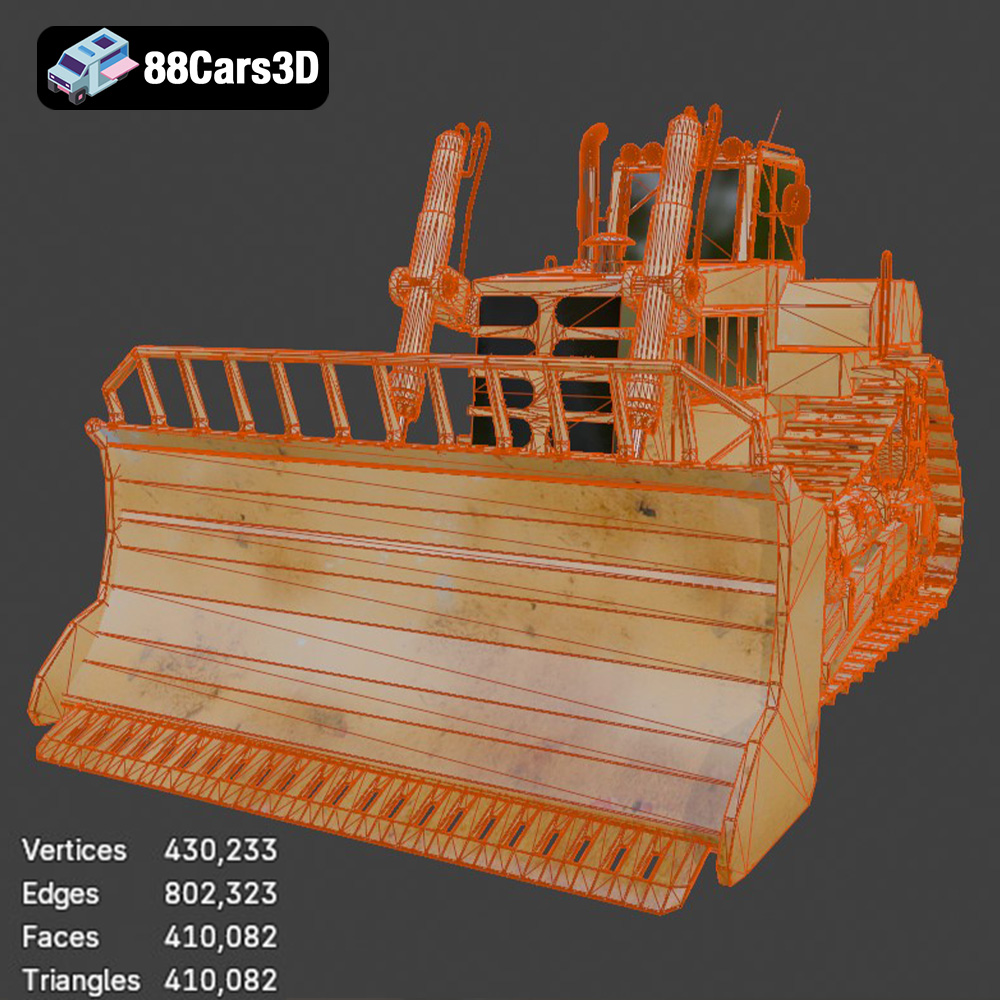
The .unreal extension typically refers to a packaged asset specifically prepared for direct import or integration into the Unreal Engine. This often implies optimized mesh data, PBR materials, collision meshes, LODs, and potentially pre-configured blueprints or animation setups. Having the Track Tractor available in an .unreal-ready format streamlines development significantly, saving countless hours on manual setup. It ensures that the 410,082 triangles are handled efficiently, materials are correctly mapped, and the model is ready for immediate deployment in an Unreal Engine project, whether for a game or an industrial simulation.
The .max format is the native file type for Autodesk 3ds Max, one of the leading software packages for 3D modeling, animation, and rendering. Similar to .blend, a .max file contains the complete scene, including all geometric data, modifiers, materials, lights, cameras, and animation data. Providing the Track Tractor model in .max format grants 3ds Max users full access to the original project file. This is invaluable for high-end rendering and animation studios that rely on 3ds Max for complex scene assembly, advanced material shading, and intricate animation sequences, allowing them to fully exploit the model’s detailed engine block and separate track components for dynamic simulations.
Automotive rendering demands an uncompromising commitment to detail. Whether it’s showcasing a futuristic concept car or, in our case, highlighting the rugged utility of heavy machinery, the goal is photorealism that blurs the line between digital and physical. The Track Tractor 3D Model stands as a testament to this principle, meticulously designed to excel in high-end visualization projects.
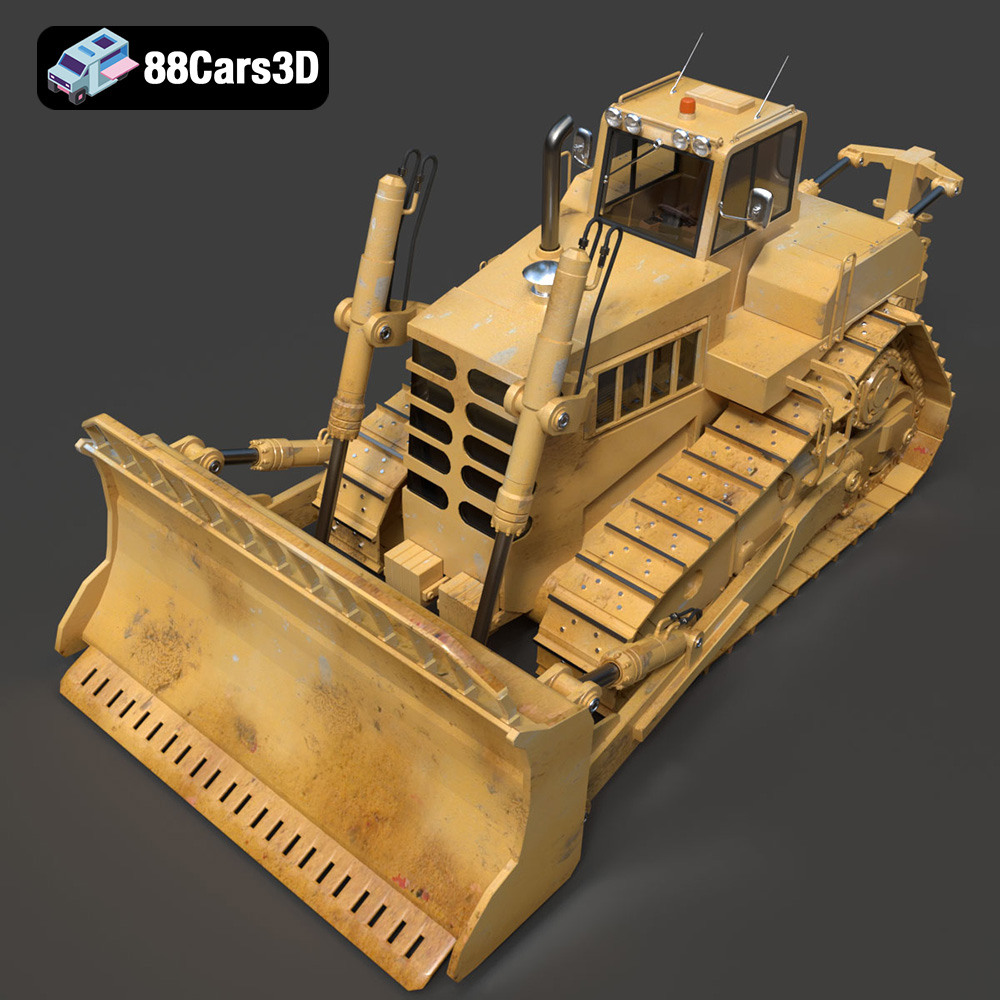
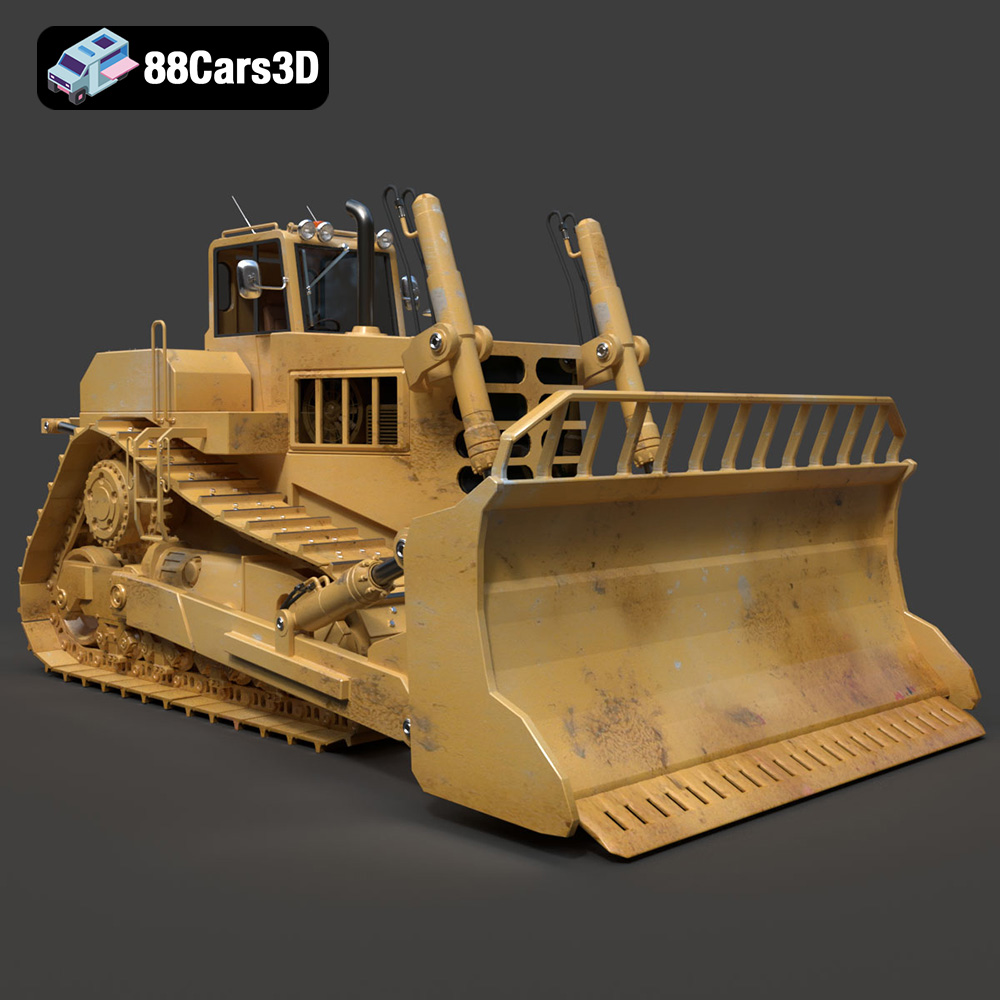
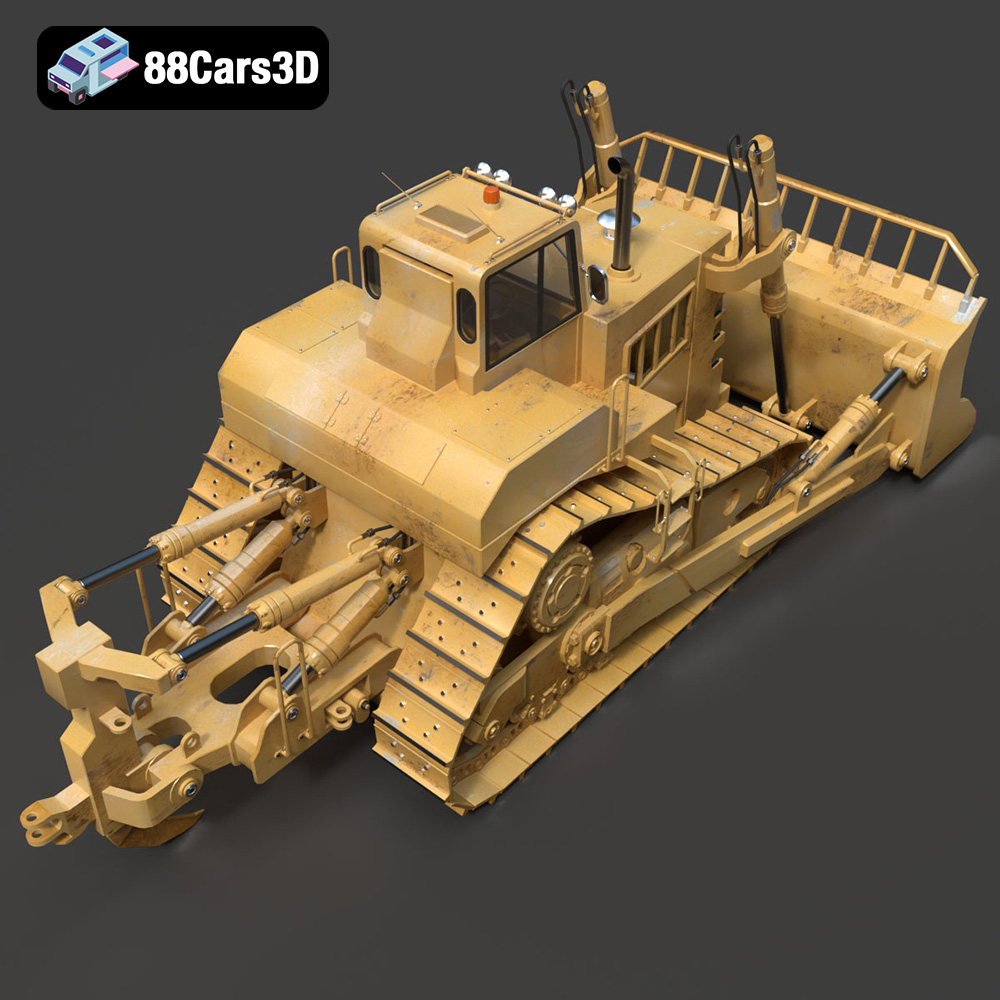
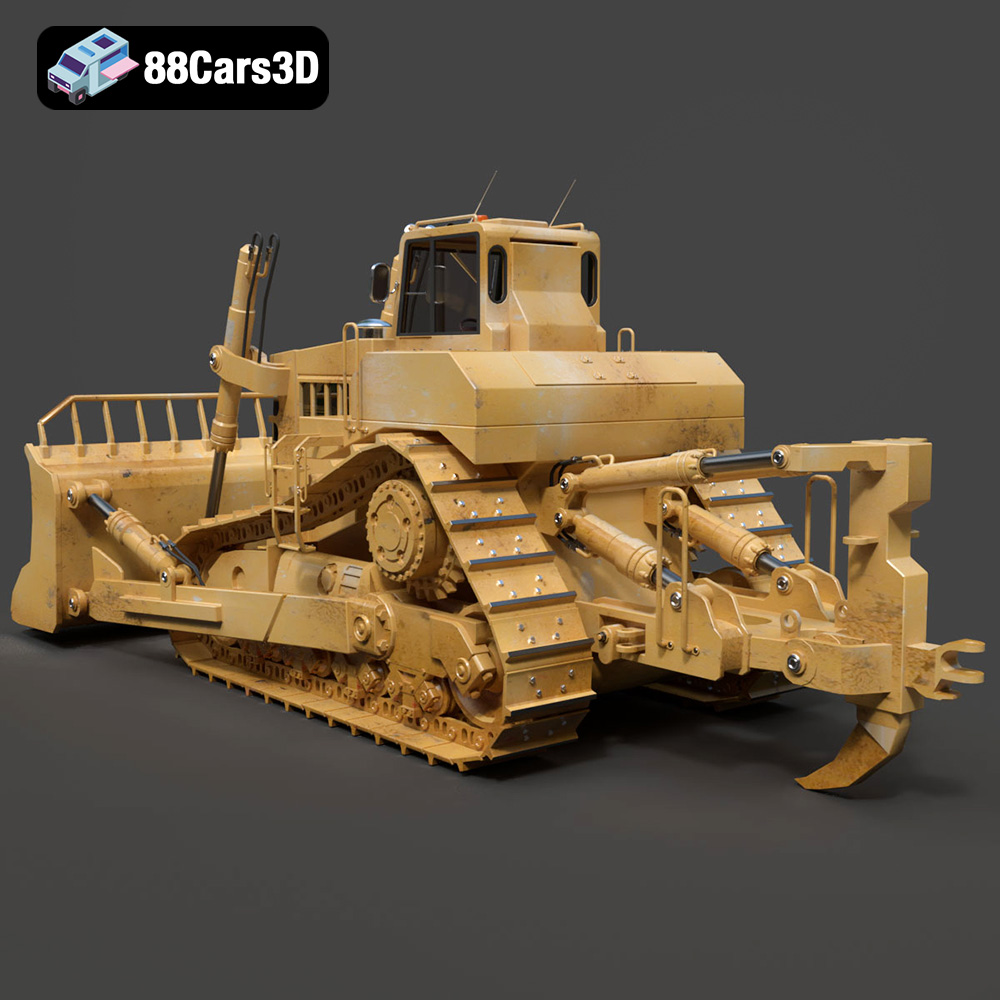
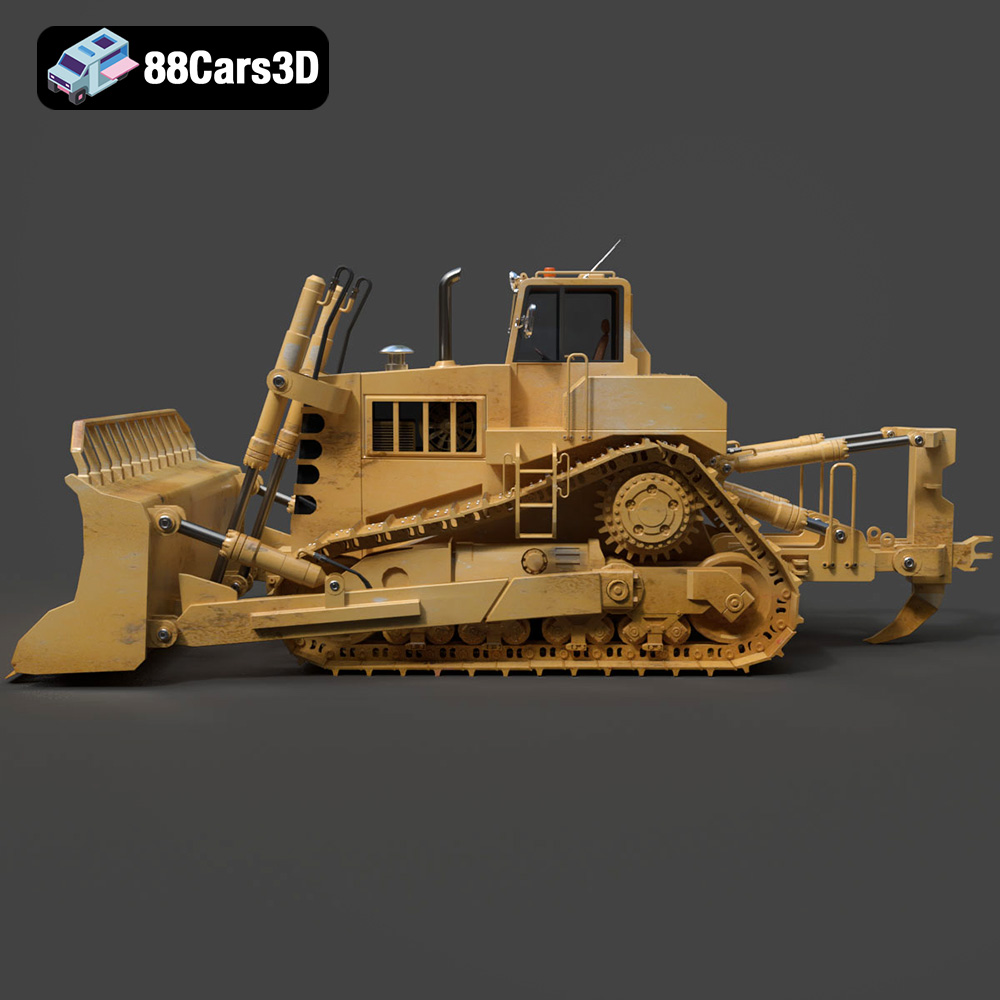
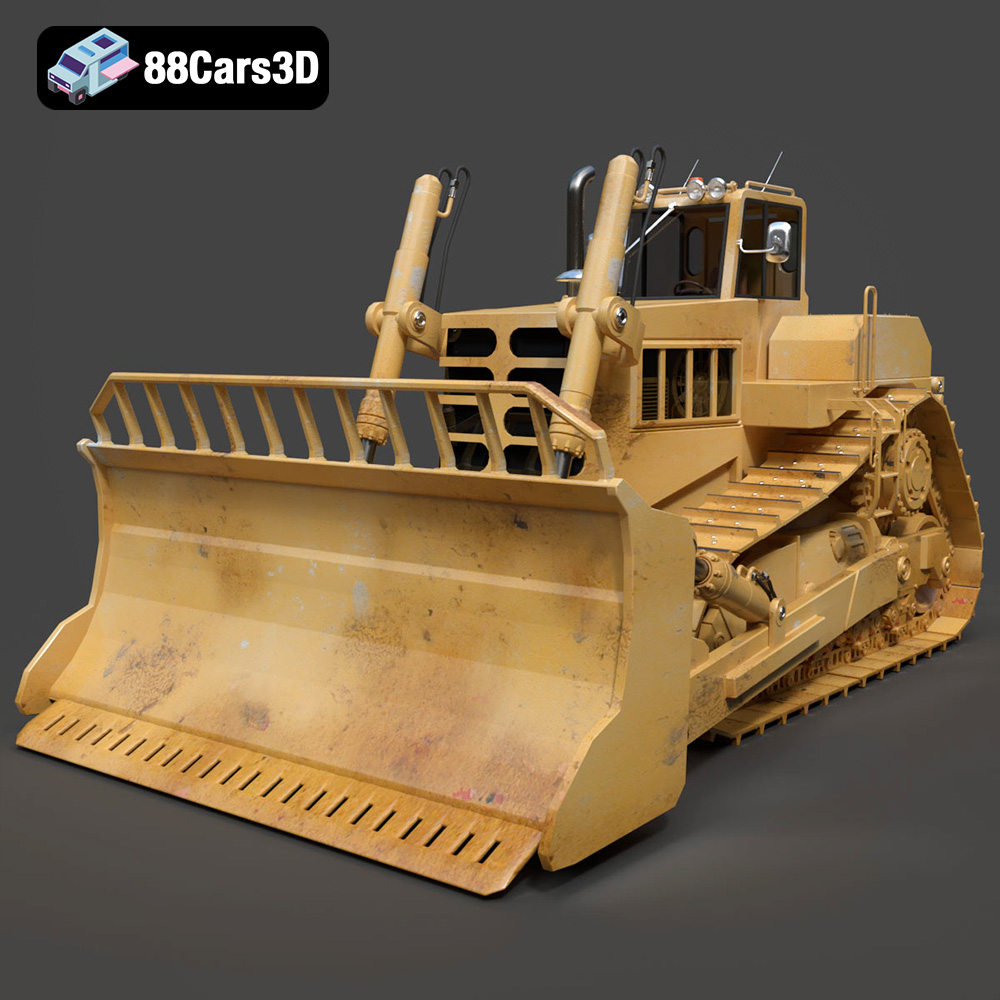
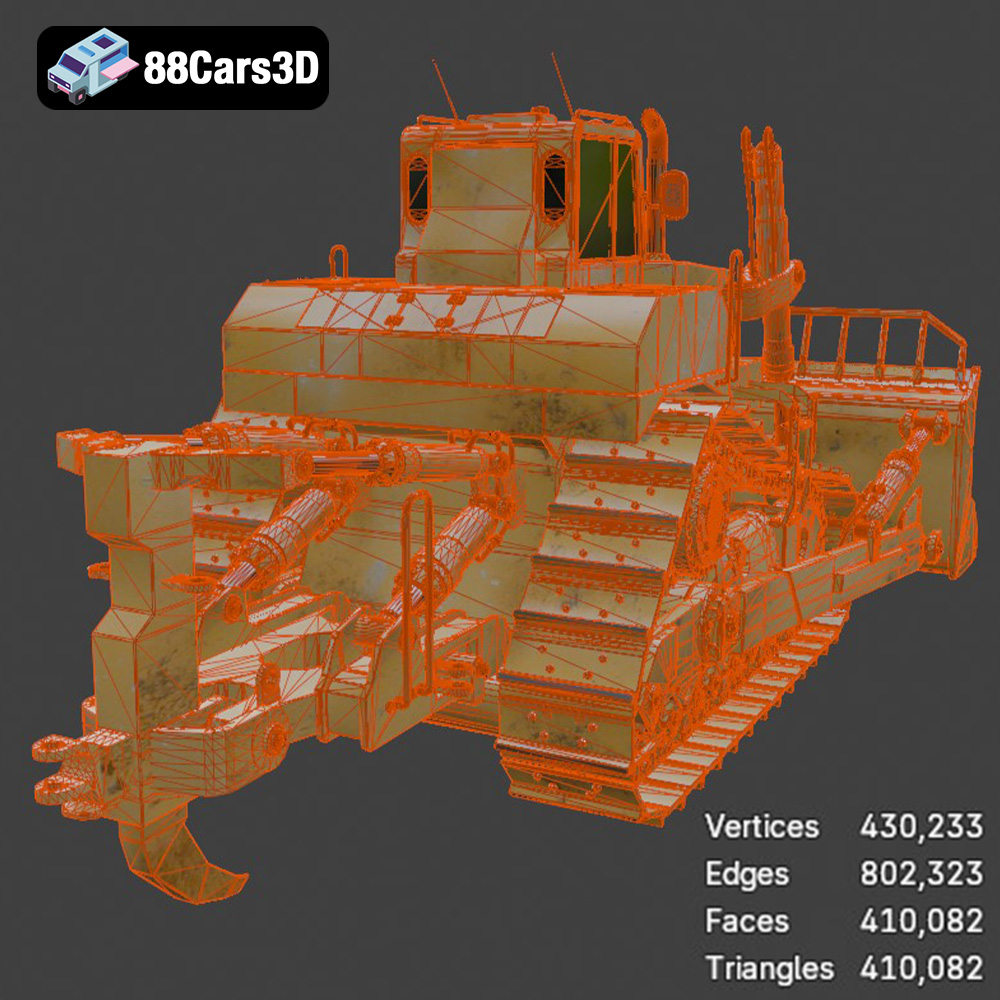
A truly high-fidelity 3D model goes beyond basic shape; it captures the essence of its real-world counterpart. For the Track Tractor, this means every rivet, weld line, and hydraulic hose is considered. The detailed heavy-duty diesel engine block isn’t just a generic shape but features distinct components that suggest functionality. The industrial exhaust stack, the robust front grille, and particularly the continuous track system with its individual pads, sprockets, and idlers, are all rendered with exceptional accuracy. These details are crucial for close-up shots and for convincing reflections and refractions in the final render. The model’s topology of 410,082 triangles strikes a perfect balance, providing stunning visual fidelity without becoming unmanageable for complex rendering scenes.
Photorealistic rendering relies heavily on Physically Based Rendering (PBR) materials. These materials simulate how light interacts with surfaces in the real world, producing accurate reflections, refractions, and diffuse scattering. The Track Tractor model would typically come with a robust PBR texture set, including albedo (color), roughness, metallic, normal, and perhaps ambient occlusion maps. This allows for realistic representation of weathered metal, grimy plastic, worn rubber tracks, and pristine paint finishes. Customization options, such as changing body/tank colors, modifying track textures, and adjusting material finishes (matte, gloss, metallic), are invaluable for tailoring the model to specific brand campaigns or stylistic requirements.
Even the most detailed 3D car models require sophisticated lighting to truly shine. Automotive rendering often employs High Dynamic Range Image (HDRI) maps to simulate realistic outdoor or studio lighting environments, providing accurate reflections and ambient illumination. Coupled with targeted area lights and volumetric effects, the Track Tractor can be placed in a gritty construction site, a pristine agricultural field, or a stark industrial showroom, with each environment enhancing its visual impact. Adjusting lighting for different environments is a key customization, allowing the model to adapt seamlessly to diverse rendering scenarios, from brand campaigns to lifestyle scenes and studio lighting setups.
Game development presents a unique set of challenges compared to static rendering. Assets must not only look good but also perform flawlessly in real-time environments, often under strict polygon budgets and memory constraints. The Track Tractor 3D Model is expressly designed as a “Game-Ready & Optimized” asset, perfectly suited for demanding real-time engines like Unreal Engine and Unity.
The model’s stated topology of 410,082 triangles is an excellent sweet spot for modern game engines, offering high visual detail for close-ups while remaining manageable. For larger scenes or open-world games where the tractor might be viewed from a distance, implementing Levels of Detail (LODs) is crucial. This involves creating simplified versions of the model (e.g., 50% less polygons, 75% less, etc.) that are swapped in based on the camera’s distance. This ensures optimal performance without sacrificing visual quality where it matters most. The Track Tractor’s robust geometry makes it an ideal candidate for such an LOD pipeline, maintaining realism even at various distances.
Efficient UV mapping is vital for game assets. It involves unfolding the 3D mesh into a 2D space, allowing textures to be painted onto it without distortion. For game assets, UVs are typically arranged to maximize texture space and avoid overlapping, often consolidated into texture atlases. This reduces draw calls, improving rendering performance. The Track Tractor model, designed with “optimized polycount,” implicitly suggests careful UV unwrapping that complements its game-ready nature, allowing for high-resolution textures to be applied efficiently across its complex surfaces, from the worn tracks to the instrument cluster in the cockpit.
Beyond static visuals, game assets need to be functional. The Track Tractor features “proper pivot setup for steering, wheel rotation, and suspension travel,” which is essential for realistic animation and physics simulation. The “separate tracks, sprockets, and suspension components” are specifically designed for animation, allowing developers to create dynamic movement, track deformation, and realistic suspension responses as the tractor traverses rugged terrain. Integrating this with a game engine’s physics system means the tractor will react authentically to collisions, gravity, and environmental forces, enhancing the player’s immersion in agricultural simulators or construction-themed video games.
Augmented Reality (AR) and Virtual Reality (VR) represent the frontier of immersive digital experiences, placing stringent demands on 3D assets. Performance, fidelity, and interactivity are paramount. The Track Tractor 3D Model, with its optimized geometry and diverse file formats, is ideally suited for these cutting-edge applications.
AR/VR environments require consistent, high frame rates to prevent motion sickness and ensure a smooth user experience. This means assets must be extremely well-optimized. The Track Tractor’s 410,082 triangles hit a “perfect balance for real-time engines,” making it suitable for VR without overtaxing the system. The availability of the .glb format is particularly beneficial here, as it’s designed for efficient transmission and rendering in web and mobile AR/VR applications, allowing for quick loading times and seamless interaction even on less powerful hardware.
In AR/VR, users expect to interact with their environment. For the Track Tractor, this could mean stepping into the “industrial operator seat,” manipulating the “heavy-machinery steering yoke,” or viewing the “functional dashboard and instrument cluster details” from a first-person perspective. The “optimized geometry for first-person POV in gaming” directly translates to AR/VR, enabling immersive cockpit experiences. Imagine a virtual training simulation where an operator can learn the controls of a track tractor before ever stepping into a real one, or a virtual showroom where potential buyers can inspect every detail of the heavy-duty engine block and continuous track system.
Consider an industrial VR training program for heavy equipment operators. The Track Tractor model provides a high-fidelity digital twin, allowing trainees to practice complex maneuvers, understand control layouts, and familiarize themselves with the machine’s capabilities in a safe, controlled virtual environment. For agricultural companies, AR applications could allow farmers to visualize how a new track tractor would fit into their existing farm layout, using their smartphone camera. In a virtual configurator, a customer could customize the “body/tank colors,” “modify tire textures,” and “adjust material finishes” in real-time, experiencing their personalized machine before purchase. These immersive applications leverage the model’s detail and optimization to provide unparalleled engagement and practical value.
While often associated with screen-based applications, high-quality 3D models also find a tangible presence through 3D printing. Transforming a complex digital asset like the Track Tractor into a physical object requires careful consideration and adherence to specific technical guidelines. The inclusion of the .stl format and detailed print settings for the Track Tractor model makes this transition seamless for hobbyists and professionals alike.
When preparing a 3D model for printing, manifold geometry (watertight models without holes or intersecting faces) is crucial. The Track Tractor model, designed with “real-world scale accuracy,” provides an excellent foundation. While its intricate details like the “detailed heavy-duty diesel engine block” and the “continuous track system with sprockets, idlers, and individual track pads” are stunning digitally, they also present challenges for physical reproduction. The recommended scales (1:12 / 1:18 / 1:24) are practical for achieving a balance between detail and manageable print size, making it suitable for display-scale hobbyists.
3D printing software (slicers) converts the .stl file into printable layers. For a model as complex as the Track Tractor, “supports: Required for detailed parts like exhaust, mirrors, handlebars” is a vital instruction. Overhangs and intricate components, such as the exposed engine parts and the individual track pads, would require careful support placement to prevent warping or collapsing during printing. The recommendation for “print orientation: Frame printed angled for structural integrity; wheels printed separately” is a professional tip that minimizes support material, enhances strength, and improves print quality, especially for a heavy-duty vehicle with distinct components.
The journey doesn’t end when the print is complete. “Post-processing: Sanding, primer, and authentic factory colors with metallic finishes” transforms a raw 3D print into a display-worthy replica. Resin printing is “recommended for fine details,” offering superior resolution compared to FDM (Fused Deposition Modeling) for capturing the nuances of the track system or the cabin interior. This meticulous attention to post-processing, much like texturing in digital rendering, adds the final layer of realism and craftsmanship to the physical model, making it a proud centerpiece for any enthusiast of heavy machinery.
The digital landscape is increasingly powered by high-quality 3D assets, and the Track Tractor 3D Model exemplifies the pinnacle of professional-grade design. From its meticulously crafted exterior and interior features to its optimized geometry and extensive file format support, this model is a versatile workhorse for virtually any creative or technical endeavor. Whether your project demands photorealistic automotive rendering, seamless integration into demanding game engines, immersive AR/VR experiences, or precision 3D printing, the Track Tractor delivers unparalleled fidelity and performance.
Investing in such a comprehensive asset streamlines workflows, reduces development time, and ultimately elevates the quality of your final output. The availability of multiple formats—from .blend for deep customization to .fbx for industry standard exchange and .glb for web-optimized AR/VR—ensures maximum compatibility and flexibility across professional pipelines. As the demand for sophisticated 3D models continues to grow, assets like the Track Tractor provide the foundational quality needed for success.
For designers, developers, and enthusiasts seeking top-tier 3D car models and heavy machinery assets, 88cars3d.com offers a curated selection of products that meet the highest standards of technical excellence and visual appeal. Discover how high-fidelity models can transform your next project by exploring the exceptional range available, including the impressive Track Tractor 3D Model.
The Track Tractor represents the pinnacle of heavy-duty industrial and agricultural machinery, renowned for its unparalleled traction and robust continuous track system. This model captures the rugged heritage of crawler tractors, featuring a meticulously designed heavy-duty diesel engine block, industrial exhaust stack, and a highly detailed undercarriage. The styling cues emphasize durability and raw power, making it a standout asset for any heavy machinery, construction, or off-road digital environment. Engineered with exceptional attention to detail, this 3D model boasts a topology of 410,082 triangles, offering a stunning visual fidelity that is fully optimized for modern real-time engines. Whether used in intensive game development, immersive AR/VR training simulations, or high-end cinematic animations, the geometry maintains sharp realism while ensuring smooth, game-ready performance. Perfect for agricultural simulators, construction-themed video games, industrial virtual reality training, and rugged landscape visualizations.
$37.99
.blend
.fbx
.glb
.max
.obj
.ply
.rendering
.stl
.tractor
.unreal
agricultural-vehicle
construction-equipment
crawler-tractor
game asset
game-ready
heavy-machinery
low-poly
optimized
track-tractor
vehicle-3d-model
VR/AR