Get 20% OFF All Premium 3D & STL Models!

In the illustrious history of automotive design, certain vehicles transcend mere transportation to become icons of engineering prowess, luxury, and artistic form. The Hispano Suiza H6B is unequivocally one of these legends. From its inception in the Roaring Twenties, this vehicle captivated royalty and elites with its aviation-inspired 6.6-liter inline-six engine and unparalleled craftsmanship. Capturing the essence of such a machine in a digital format requires not just skill, but an intricate understanding of both historical detail and modern 3D pipeline demands. This is precisely where high-fidelity 3D car models shine, offering artists, developers, and designers the opportunity to resurrect these masterpieces for contemporary audiences. Whether for cinematic rendering, immersive game development, or cutting-edge AR/VR experiences, a meticulously crafted asset like the Hispano Suiza H6B 3D model from 88cars3d.com provides the foundation for truly extraordinary digital creations.
The versatility of a 3D asset is often defined by the array of file formats it supports. Each format is designed with specific use cases and software ecosystems in mind, impacting everything from scene integrity to real-time performance. For a complex asset like the Hispano Suiza H6B 3D model, understanding these formats is crucial for leveraging its full potential across diverse professional workflows. Let’s delve into the technical nuances of the commonly provided formats.
The .blend file is Blender’s native format, encapsulating an entire scene with all its elements. This includes mesh data, materials, textures, lighting, camera setups, animation data, and even custom scripts. When you download a .blend file, you’re getting a fully editable Blender project. This is ideal for artists who primarily work in Blender, offering the highest level of flexibility for modifications, retopology, re-texturing, or integrating the model into existing Blender scenes. For the Hispano Suiza H6B, the .blend file allows direct access to the underlying structure, making it perfect for bespoke customizations or advanced rendering in Cycles or Eevee.
.fbx (Filmbox) is arguably the most prevalent exchange format in 3D production, especially within game development and animation pipelines. Developed by Autodesk, it excels at transferring complex scene data, including meshes, materials (often PBR setups), textures, animations, skinning, and sometimes even basic camera and light information, between different 3D applications like Maya, 3ds Max, Blender, and real-time engines like Unreal Engine and Unity. Its strength lies in its robust support for animation and skeletal data, making it the go-to choice for dynamic automotive rendering scenarios. For the Hispano Suiza H6B 3D model, the .fbx format ensures seamless integration into game engines or other DCC applications, retaining crucial pivot points for animation, such as wheel rotation and suspension travel.
The .obj (Wavefront OBJ) format is a widely adopted, simple, and universal format primarily used for transferring 3D geometry data. It stores vertex positions, UV coordinates, normals, and material definitions (usually in an accompanying .mtl file). While it doesn’t typically support animation or complex scene hierarchies like .fbx, its simplicity and near-universal compatibility make it excellent for static mesh transfers across virtually any 3D software. For the Hispano Suiza H6B, the .obj provides a clean mesh that can be easily imported into any program for sculpting, texturing, or static renders where animation is not the primary concern.
.glb (GL Transmission Format Binary) is an increasingly important format optimized for efficient transmission and loading of 3D scenes and models in web, augmented reality (AR), and virtual reality (VR) applications. It bundles textures, materials, and geometry into a single, compact file, making it incredibly efficient for browser-based viewers, mobile AR experiences, and low-latency VR. The .glb format uses physically-based rendering (PBR) materials, ensuring consistent visual fidelity across different platforms. For displaying the Hispano Suiza H6B in an interactive web viewer or an AR app on a smartphone, .glb offers the best performance and visual quality balance.
.stl (STereoLithography) is the de facto standard file format for 3D printing. It represents a 3D model as a collection of triangular facets, defining only the surface geometry of an object without color, texture, or other CAD attributes. Its simplicity makes it universally compatible with 3D printers and slicing software. When preparing the Hispano Suiza H6B 3D model for physical production, converting it to .stl is the essential first step, ensuring the mesh is manifold and ready for fabrication.
The .ply (Polygon File Format, or Stanford Triangle Format) is a versatile format often used for storing 3D data from 3D scanners, CAD software, and scientific applications. It can store a wider range of properties than .obj, including color, transparency, normals, texture coordinates, and even reliability information for each vertex and face. While less common for general 3D asset exchange, .ply is valuable when precision mesh data and additional per-vertex attributes are required for detailed analysis or specific CAD workflows involving the Hispano Suiza H6B’s intricate geometry.
The .unreal file refers to an asset specifically prepared and exported for the Unreal Engine, often containing optimized meshes, materials, and potentially Blueprints or other engine-specific data. While often distributed as .fbx, a dedicated .unreal package implies a refined asset directly configured for Unreal’s pipeline, potentially including collision meshes, LODs (Levels of Detail), and correctly set up material instances. This format offers a direct, optimized pathway for integrating the Hispano Suiza H6B into an Unreal project, minimizing setup time and maximizing performance within the engine.
Similar to .blend for Blender, the .max file is the native project format for Autodesk 3ds Max. It contains all scene data, including geometry, materials, lighting, cameras, animations, and modifiers, exactly as they exist within 3ds Max. For users of 3ds Max, this format offers full editability and direct integration into existing projects, allowing for comprehensive manipulation, animation, and rendering using renderers like V-Ray or Corona. The Hispano Suiza H6B .max file provides the highest fidelity and control for professionals working within the 3ds Max environment, making it an invaluable resource for animation studios and architectural visualization firms.
By offering the Hispano Suiza H6B 3D model in this comprehensive suite of formats, 88cars3d.com ensures maximum compatibility and utility, enabling professionals to integrate this exquisite vehicle into virtually any digital production pipeline with ease and confidence.
The true value of a premium 3D model lies in its meticulous attention to detail, balancing aesthetic fidelity with technical optimization. The Hispano Suiza H6B 3D model exemplifies this philosophy, providing a stunning digital replica that is both visually captivating and highly functional for various applications.
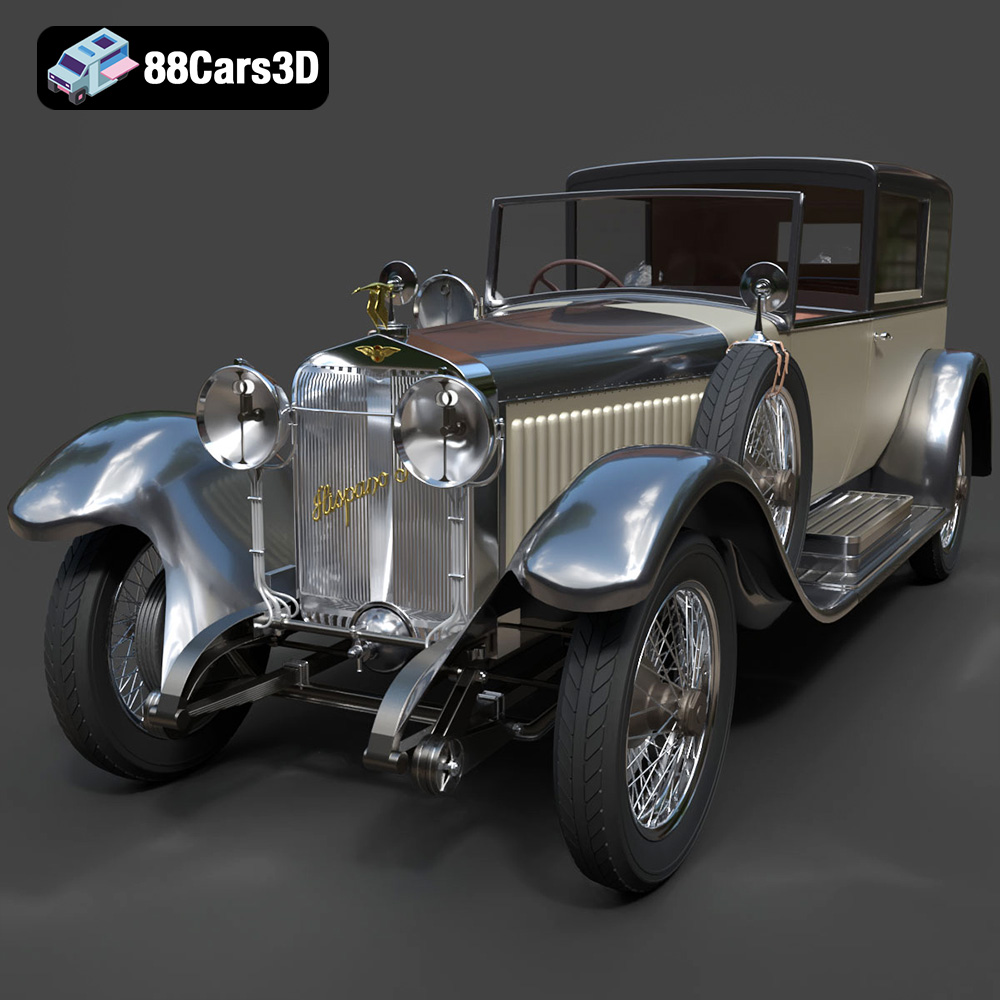
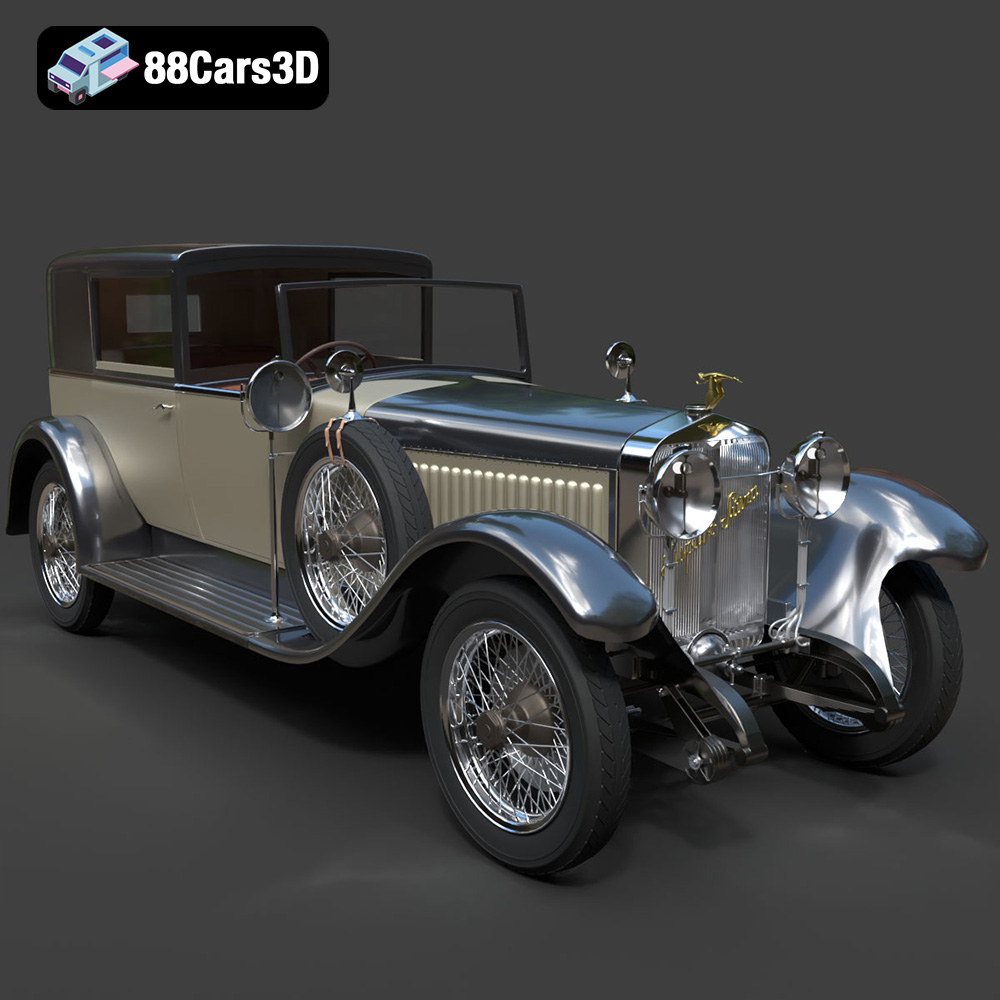
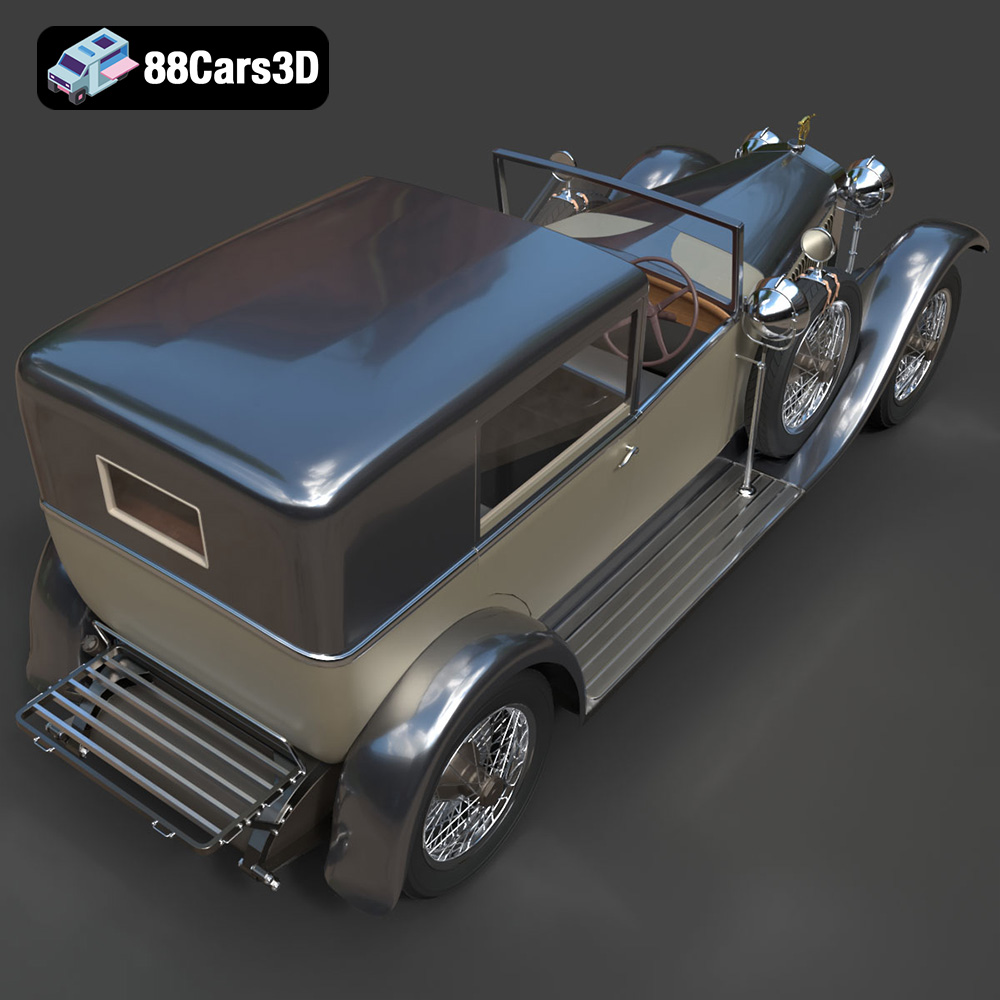
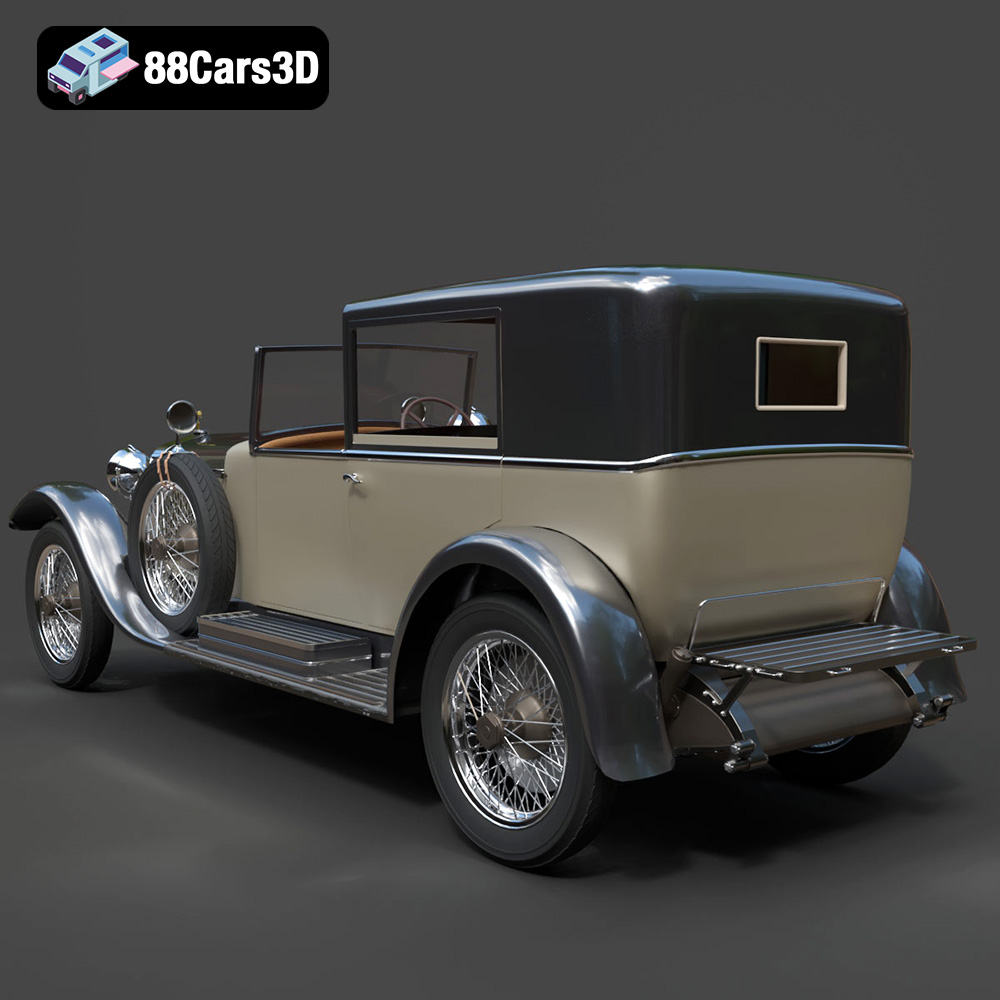
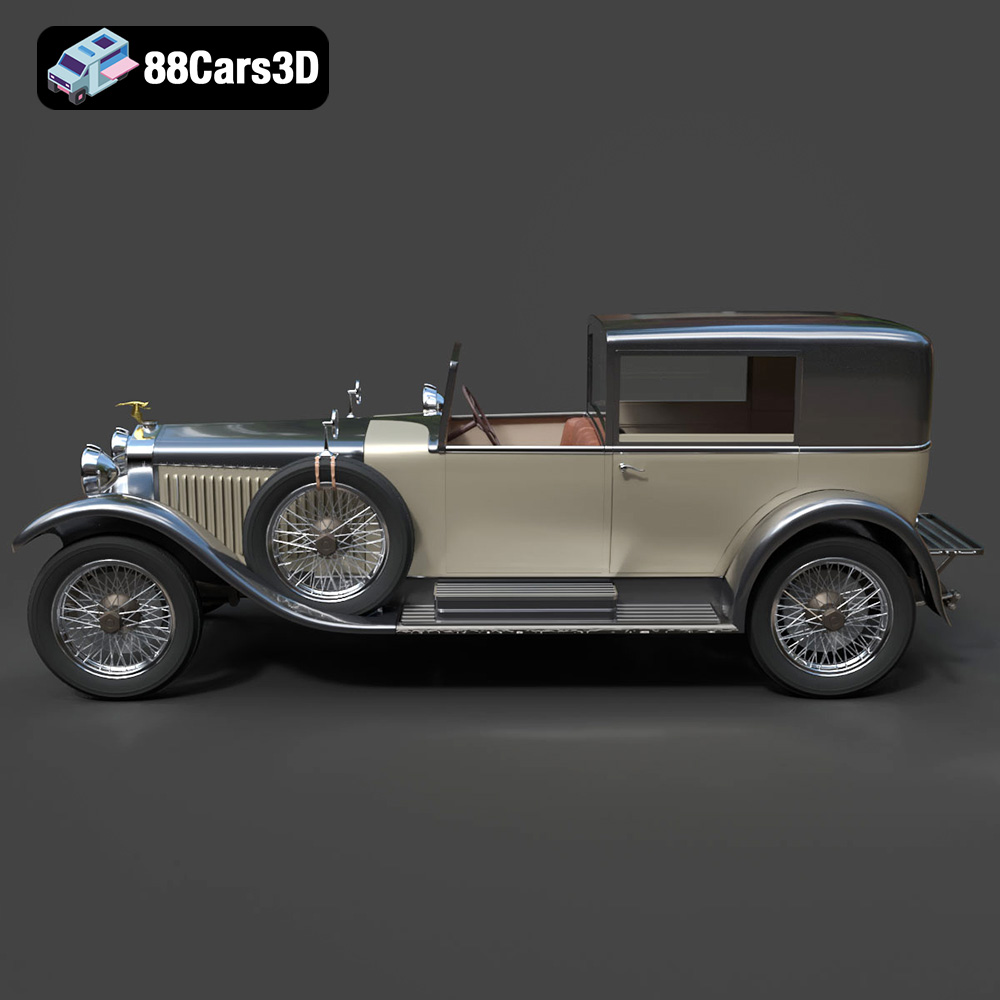
A classic car’s exterior is its most recognizable feature, and the Hispano Suiza H6B is no exception. This 3D model captures the elegant, sweeping fenders and the signature radiator grille, proudly adorned with the iconic flying stork mascot. Every curve of the coachwork and proportion of the chassis geometry is accurately represented, ensuring historical authenticity. Beneath the hood, the aviation-inspired 6.6-liter inline-six engine block is meticulously modeled, complete with authentic dual exhaust piping and a period-correct undercarriage. Vintage headlamps and prominent taillights are rendered with precision, as are the intricate spoked wheels fitted with era-appropriate pneumatic tires. The leaf spring suspension and rigid axle setup are also carefully detailed, contributing to a holistic and believable representation. Crucially, components like wheels, doors, suspension, and steering are separated, making the model ready for complex animation sequences, from driving simulations to cinematic cutscenes.
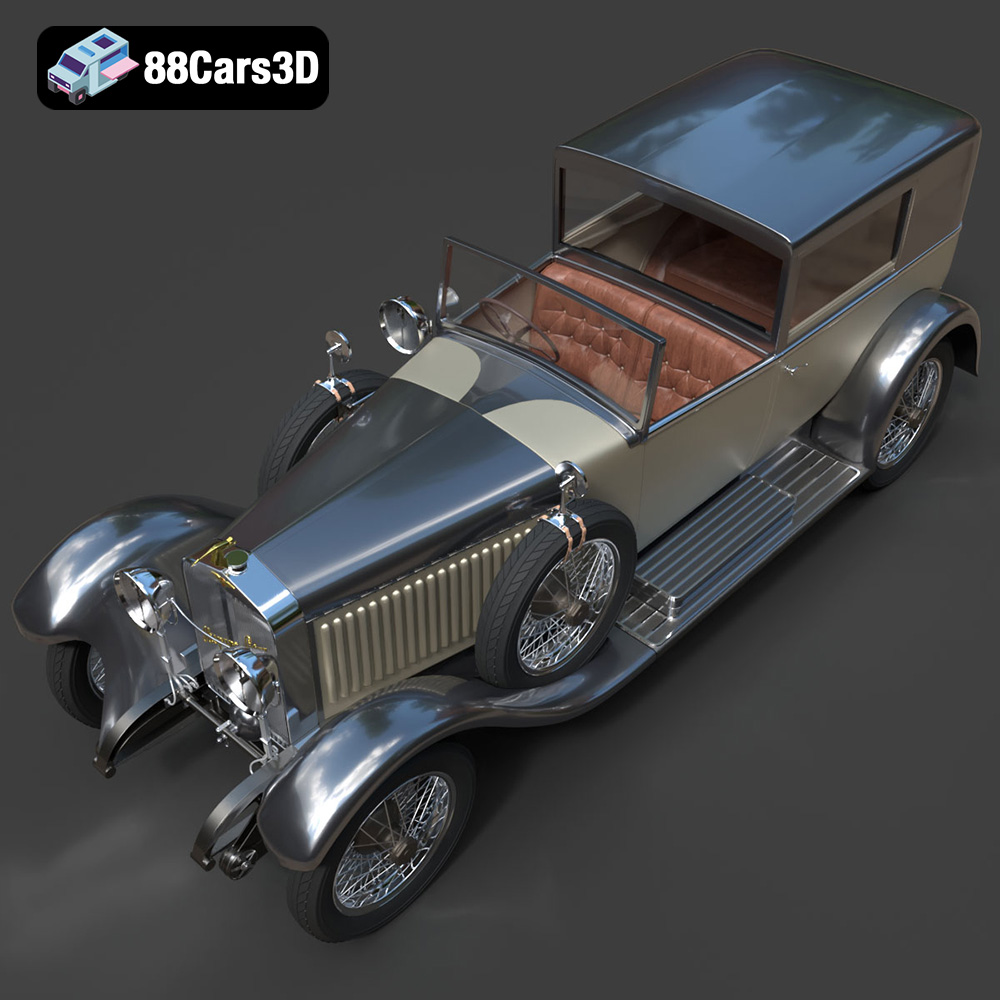
The luxury of the Hispano Suiza H6B extends into its exquisite cockpit. The 3D model meticulously recreates this opulent environment, featuring luxurious vintage leather-style seat upholstery and bench. The highly detailed wooden steering wheel, with its exposed steering column, captures the tactile essence of the period. An era-accurate instrument cluster with detailed dashboard gauges provides a rich sense of realism, perfect for close-up shots. Authentic control details, including brass-accented pedals, a long-throw gear shifter, and a handbrake, ensure the interior is not just visually appealing but also functionally plausible for interactive experiences. Optimized geometry makes it perfectly suited for first-person POV in gaming and virtual reality applications, allowing users to truly step inside this automotive legend.
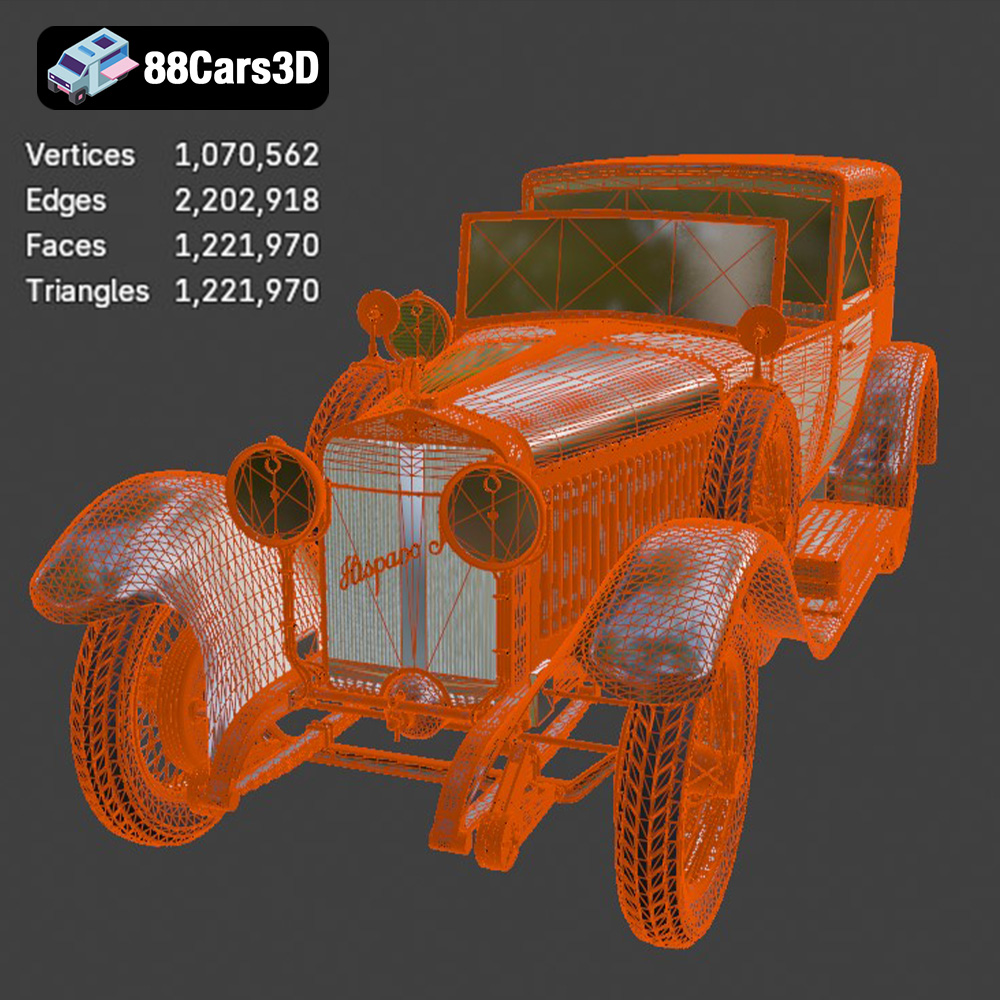
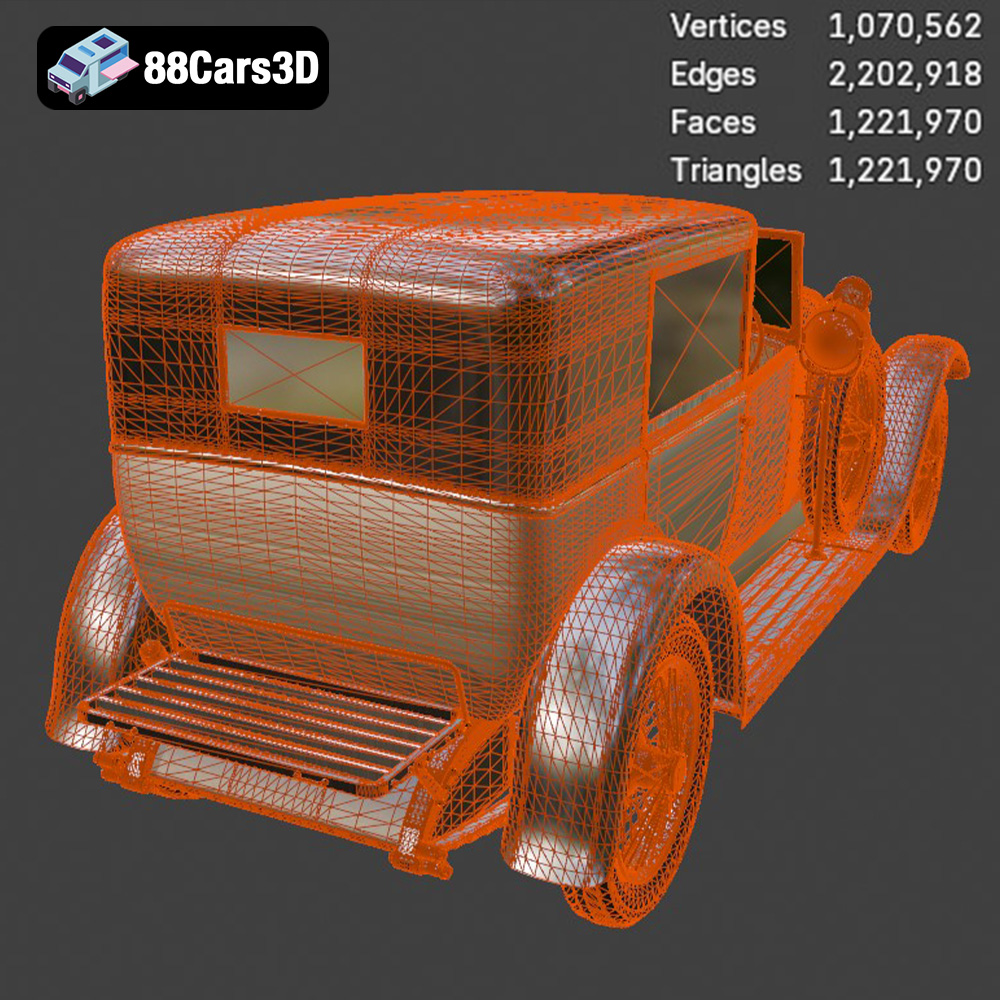
Achieving high visual fidelity without sacrificing performance is a delicate balance, especially for game assets. With a meticulously modeled 1,221,970 triangle count, the Hispano Suiza H6B 3D model strikes this perfect balance. This polycount delivers exceptional visual realism suitable for high-end rendering and close-up shots, while remaining optimized enough for modern high-performance engines like Unreal Engine and Unity. Furthermore, the model boasts real-world scale accuracy, based on actual classic vehicle chassis dimensions, ensuring it fits seamlessly into any scene. Proper pivot setups for steering, wheel rotation, and suspension travel are implemented, which are indispensable for realistic animation and interactive control. This technical foundation makes the model a robust asset for both static renders and dynamic simulations, ready to be integrated into diverse professional pipelines.
The true power of a high-quality 3D car model like the Hispano Suiza H6B lies in its adaptability across various professional industries. From entertainment to engineering, these digital assets serve as fundamental building blocks.
For game developers, efficiency and visual quality are paramount. The Hispano Suiza H6B 3D model, with its optimized polycount and game-ready status, is an ideal asset for integration into real-time engines such as Unreal Engine and Unity. Artists can import the .fbx or .unreal formats, leveraging the pre-configured pivot points for wheels and steering to quickly set up driving mechanics. Modern game development often requires multiple Levels of Detail (LODs) to ensure optimal performance across varying distances from the camera. While this model provides a high-fidelity base, developers can generate further LODs to suit specific performance targets. The model’s real-world scale and authentic geometry make it perfect for period-accurate open-world games, racing titles, or historical simulators, enhancing immersion and historical accuracy. Integrating robust collision meshes would further enable realistic physics interactions, a common practice in advanced game design.
When photorealism is the ultimate goal, such as in advertising, film, or architectural visualization, the Hispano Suiza H6B 3D model excels. Users working in 3ds Max can utilize the native .max file, or Blender users the .blend file, to access the complete scene data. This allows for unparalleled control over materials, lighting, and camera angles. Artists can fine-tune PBR (Physically Based Rendering) textures, adjust reflective surfaces for the coachwork, or add subtle imperfections to the vintage leather interior to achieve breathtaking realism. Advanced rendering engines like V-Ray, Corona, or Cycles can then be employed to produce stunning automotive visualizations for brand campaigns, luxurious lifestyle scenes, or intricate studio lighting setups. The model’s high level of detail ensures that even extreme close-up shots will hold up to scrutiny, making it perfect for marketing collateral or cinematic sequences.
The advent of Augmented Reality (AR) and Virtual Reality (VR) has opened new frontiers for showcasing products and creating immersive experiences. The Hispano Suiza H6B 3D model is perfectly suited for these emerging platforms, especially when provided in the optimized .glb format. Developers can create interactive virtual showrooms where users can explore the car’s exterior and interior in a fully immersive 3D environment. Imagine a museum experience where visitors can walk around, sit inside, and even interact with the H6B as if it were physically present. For AR applications, the model can be projected into real-world environments via a smartphone or tablet, allowing potential enthusiasts to visualize the classic car in their driveway. The model’s optimized geometry ensures smooth performance on mobile and standalone VR devices, facilitating engaging and responsive user interactions.
The utility of a high-quality 3D model extends beyond digital screens, offering tangible outputs through 3D printing. The Hispano Suiza H6B 3D model provides an excellent foundation for creating physical replicas, bringing this automotive legend into the physical realm.
The .stl format, included with the Hispano Suiza H6B 3D model, is the gateway to 3D printing. This triangulated mesh format is directly compatible with all modern 3D printers and slicing software. For hobbyists and professionals alike, transforming this digital asset into a physical object opens up new avenues for display and appreciation. When preparing for printing, several factors become critical:
Beyond simply printing, the underlying 3D data of the Hispano Suiza H6B allows for extensive customization, both in the digital realm and as a foundation for physical finishing. In a digital environment, artists can easily change body and coachwork colors, experimenting with factory dual-tone schemes or custom modern finishes. Tire textures can be modified to feature vintage whitewall variants or standard rubber. Material finishes, such as matte leather, gloss paint, or polished brass/chrome accents, can be adapted to achieve desired aesthetic effects. This level of flexibility allows designers to envision the H6B in various contexts, from pristine museum pieces to subtly weathered rally cars. For physical prints, these digital customizations guide the painting and finishing process, enabling modelers to replicate specific historical versions or create unique interpretations, leveraging the detailed geometry provided by the 3D model.
The theoretical benefits of a high-quality 3D car model become profoundly impactful when examined through the lens of real-world applications. The Hispano Suiza H6B 3D model serves as an exemplary asset for diverse projects.
Consider the burgeoning field of interactive historical experiences. A game developer embarking on a project set in the 1920s, perhaps a narrative-driven adventure or a period racing simulator, faces the daunting task of accurately recreating the world. The Hispano Suiza H6B 3D model would be an invaluable asset. Instead of spending hundreds of hours modeling the car from scratch, the development team can leverage this game-ready asset, saving significant time and resources. Its meticulously modeled exterior and interior mean that players could not only drive this legendary vehicle but also inspect its detailed engine block or admire the intricate dashboard gauges from a first-person perspective. Such an asset ensures historical accuracy, enhancing immersion and providing a richer, more believable digital environment. This direct integration of high-fidelity 3D car models like those available on 88cars3d.com streamlines production and elevates the quality of the final interactive product.
In the luxury automotive sector, cutting-edge marketing and design visualization are crucial. Imagine a high-end vintage car auction house wishing to create an immersive online preview for a rare Hispano Suiza H6B. Using this 3D model, they could develop a virtual showroom where potential bidders can explore every angle of the car, customize lighting conditions, and even toggle between different interior material options—all before the physical viewing. For a bespoke coachbuilder, the model could serve as a digital foundation for presenting historical designs or for integrating modern interpretations into classic chassis. The ability to render the car in various environments—from a sun-drenched European road to a sophisticated studio setup—provides unparalleled versatility for marketing campaigns. This approach not only showcases the vehicle’s beauty but also positions the brand at the forefront of digital presentation, efficiently delivering compelling visuals without the logistical complexities and costs associated with physical photography or videography.
The Hispano Suiza H6B is more than just a car; it’s a symbol of a golden age of automotive design and engineering. Bringing such an icon into the digital realm requires a blend of historical reverence and technical precision. The Hispano Suiza H6B 3D model stands as a testament to this philosophy, offering an unparalleled level of detail and optimization for a vast array of professional applications. From high-end automotive rendering and cinematic sequences to immersive game assets and innovative AR/VR experiences, this model provides a robust and versatile foundation. Its availability in a comprehensive range of file formats—including .blend, .fbx, .obj, .glb, .stl, .ply, .unreal, and .max—ensures seamless integration into any workflow, catering to the specific needs of designers, developers, and artists. Whether you’re aiming to recreate historical narratives, push the boundaries of real-time graphics, or even produce tangible 3D prints, this Hispano Suiza H6B 3D model from 88cars3d.com offers the quality and flexibility needed to bring your creative visions to life. It’s an investment in both historical fidelity and future-proof digital production.
The Hispano Suiza H6B is an undisputed masterpiece of automotive engineering and luxury from the roaring 1920s. Known for its aviation-inspired 6.6-liter inline-six engine and exceptional build quality, the H6B was the vehicle of choice for European royalty and elites. This highly detailed 3D model captures the elegance of its sweeping fenders, signature radiator grille adorned with the iconic flying stork mascot, and magnificent classic coachwork styling. Boasting a meticulously modeled 1,221,970 triangle count, this 3D asset delivers exceptional visual fidelity suited for high-end rendering and close-up shots while remaining optimized for modern high-performance engines. Whether you are developing an immersive period-accurate game, creating historical VR experiences, or rendering stunning automotive visualizations, this model provides uncompromising detail and historical accuracy.
$67.00
.blend
.fbx
.glb
.max
.obj
.ply
.rendering
.stl
.unreal
car-3d-model
classic-car
game asset
game-ready
h6b
high poly
hispano-suiza
luxury car
optimized
vintage-car
VR/AR