Get 20% OFF All Premium 3D & STL Models!

In the dynamic world of digital content creation, the demand for highly detailed, authentic 3D models continues to accelerate. From breathtaking automotive renders that blur the lines of reality to immersive open-world game environments and cutting-edge AR/VR experiences, the quality of your 3D assets is paramount. It’s not merely about having a model; it’s about possessing a meticulously crafted digital twin that embodies precision, performance, and aesthetic integrity.
Imagine bringing the iconic spirit of Italian design to life in your next project. We’re talking about a vehicle that transcends mere transportation, becoming a symbol of style and freedom. This is precisely what a premium asset like the Vespa 3-08 3D Model offers. It’s more than just a scooter; it’s a piece of history, an emblem of urban elegance, now meticulously recreated in a digital format ready to revolutionize your creative endeavors. Whether you’re an automotive visualization specialist, a game developer crafting vibrant cityscapes, or an AR/VR innovator building interactive showrooms, understanding the technical intricacies and versatile applications of such a model is crucial for unlocking its full potential.
The choice of a 3D model’s file format is far from trivial; it dictates compatibility, performance, and the scope of manipulation within your chosen software and final application. A premium asset, like the Vespa 3-08 3D Model available at 88cars3d.com, offers a comprehensive suite of formats, ensuring seamless integration across diverse pipelines. Understanding each format’s strengths and typical use cases is fundamental for any professional working with 3D content.
The .blend format is the native file type for Blender, the powerful open-source 3D creation suite. When you acquire a .blend file, you’re not just getting geometry; you’re gaining access to a fully editable Blender scene. This includes all materials, textures, lighting setups, cameras, animation data, and even modifiers. For artists who primarily work in Blender, this format offers the most complete and flexible starting point. It allows for deep customization, tweaking of shaders, re-rigging, or re-texturing directly within the familiar Blender environment, making it ideal for comprehensive project integration and iterative design.
FBX (Filmbox) stands as one of the most widely adopted proprietary file formats for 3D content interchange. Developed by Autodesk, it’s designed to facilitate data exchange between various 3D software applications, including 3ds Max, Maya, Cinema 4D, and game engines like Unreal Engine and Unity. The strength of .fbx lies in its ability to store not only mesh data but also animation, rigging, textures, and even rudimentary material definitions. This makes it an indispensable format for game development, real-time pipelines, and animation studios where assets need to move fluidly between different software packages while retaining crucial metadata. The Vespa 3-08 in .fbx format ensures it’s instantly ready for game engine import with pre-baked pivots and potentially basic material assignments.
OBJ (or .obj) is a universal geometry definition file format that is perhaps the most widely supported of all 3D formats. It stores pure geometric data—vertices, normals, texture coordinates, and faces—in a human-readable text file. While it lacks support for animation, rigging, or advanced material properties (these are typically handled by an accompanying .mtl file for basic color and texture references), its widespread compatibility makes it a safe bet for static mesh transfers between almost any 3D software. For the Vespa 3-08, the .obj version is excellent for importing into less common 3D applications or for scenarios where you primarily need the raw mesh data to build upon from scratch.
GLB (GL Transmission Format Binary) is the binary version of glTF (GL Transmission Format), a relatively new open standard designed for efficient transmission and loading of 3D scenes and models by applications. GLB files package all assets—geometry, textures, animations, and PBR (Physically Based Rendering) materials—into a single binary file. This makes them highly optimized for use in AR, VR, and web-based 3D viewers, where quick loading times and compact file sizes are critical. The Vespa 3-08 in .glb format is perfect for embedding in websites, mobile AR applications, or lightweight virtual reality experiences, offering excellent visual quality with minimal overhead.
STL (STereoLithography) is the de facto standard file format for 3D printing. It represents a 3D model as a series of connected triangles, describing only the surface geometry of an object without color, texture, or other CAD attributes. For applications like 3D printing the Vespa 3-08, an .stl file is essential. It provides the necessary watertight mesh data that 3D printers require to accurately build a physical object layer by layer. The Vespa model, convertible to .stl, directly supports hobbyists and professionals looking to produce physical prototypes or display models.
PLY (Polygon File Format or Stanford Triangle Format) is another format used for storing 3D data, particularly from 3D scanners. It can store a wide range of properties for each vertex, face, and edge, including color, transparency, normals, texture coordinates, and more. While less common than FBX or OBJ for general asset exchange, PLY is valued in fields like CAD, scientific visualization, and 3D scanning for its ability to represent complex mesh data with high precision. For niche applications requiring detailed mesh analysis of the Vespa 3-08, the .ply format can be highly beneficial.
The .unreal format implies an asset specifically packaged and optimized for direct import into Unreal Engine projects. While often an FBX is used and then imported, a native .unreal asset typically means the model has already undergone engine-specific optimizations, material setup, and potentially collision mesh generation. This ensures maximum compatibility and performance within Unreal’s real-time rendering pipeline, making the Vespa 3-08 an instant plug-and-play asset for games, simulations, and interactive experiences built in Unreal Engine.
Similar to .blend for Blender, .max is the native file format for Autodesk 3ds Max. This format contains all elements of a 3ds Max scene, including geometry, textures, materials, lighting, cameras, animation, and scene organization. For users of 3ds Max, the .max file for the Vespa 3-08 provides the most complete and editable version of the model, allowing full control over every aspect of the scene, from advanced V-Ray or Corona renders to complex animation sequences. This offers unparalleled flexibility for high-end visualization and animation projects.
The inclusion of all these diverse formats for the Vespa 3-08 3D model underscores its versatility and the commitment of 88cars3d.com to providing professional-grade assets that cater to every imaginable workflow and application.
Recreating an iconic vehicle like the Vespa in 3D is a meticulous endeavor, blending artistic sensibility with technical precision. The Vespa 3-08 3D model exemplifies this fusion, delivering a digital asset that is both visually stunning and functionally robust. It embodies the ultimate spirit of Italian scooter heritage, capturing the timeless retro design with modern commuting efficiency.
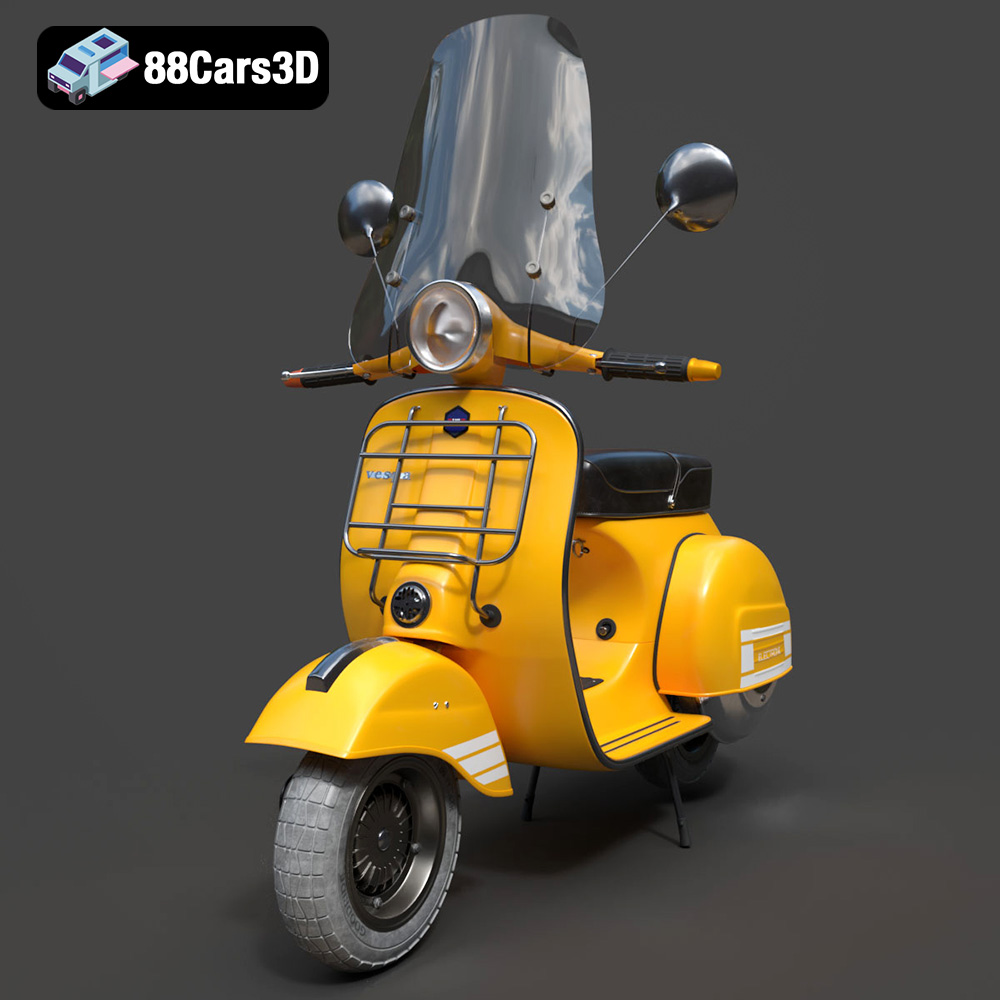
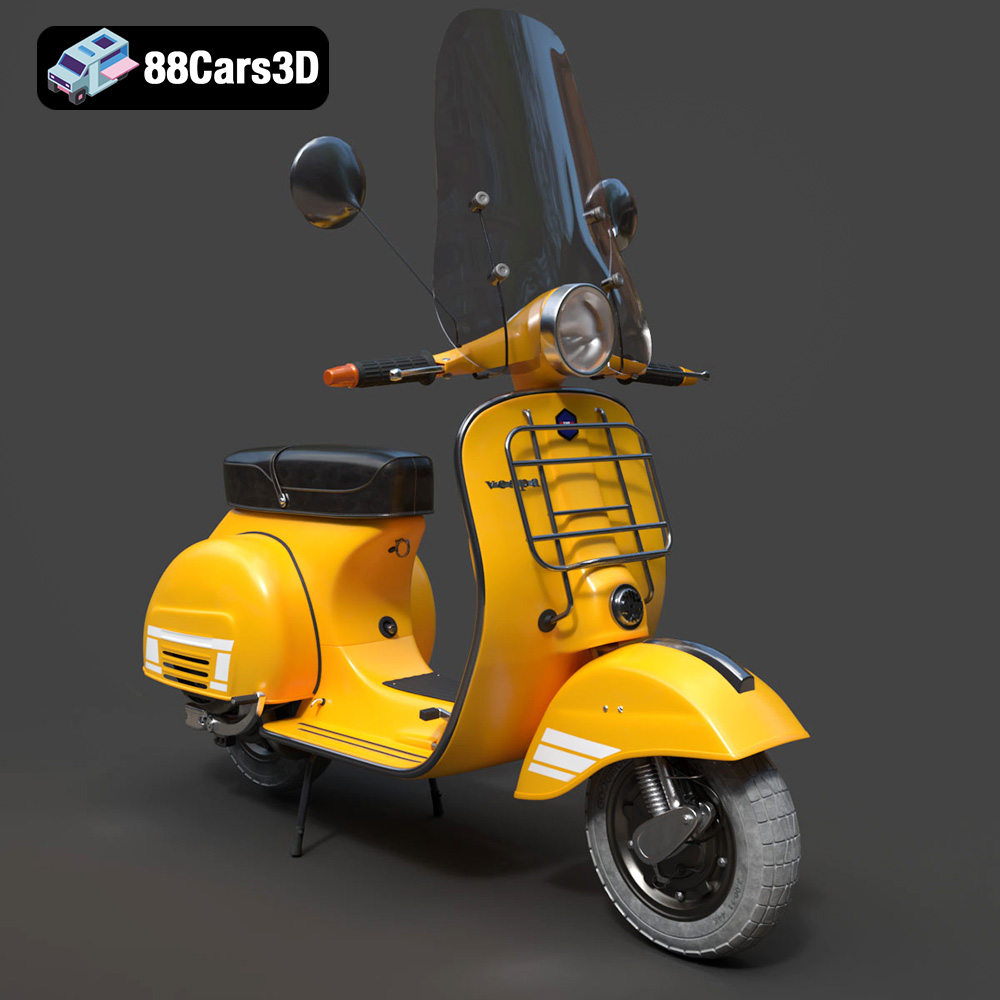
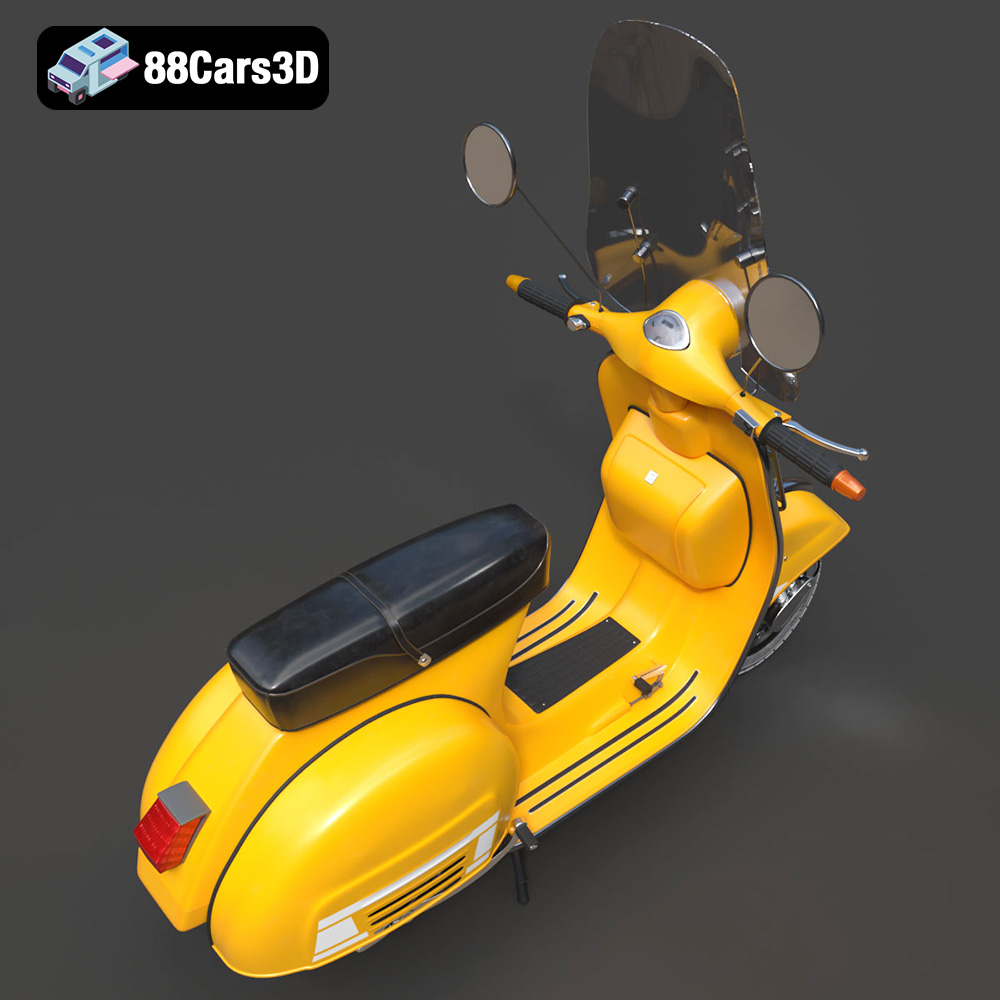
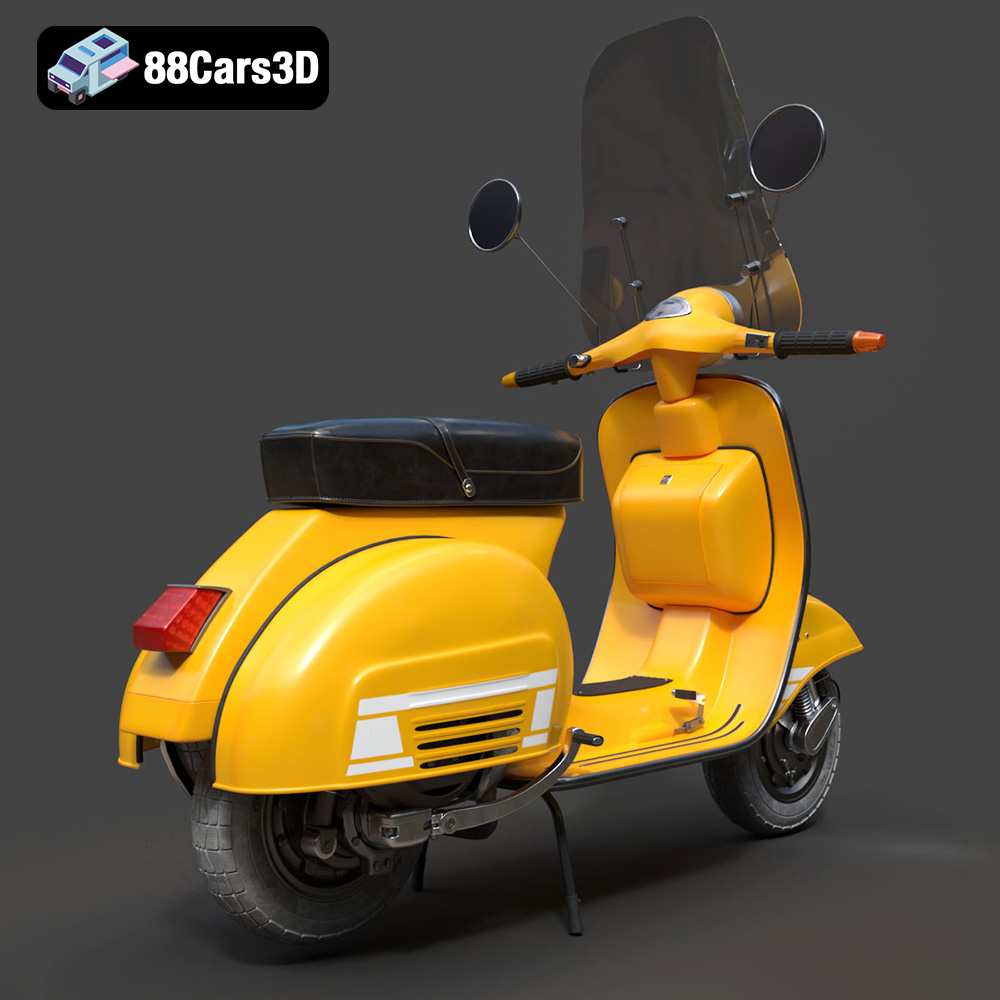
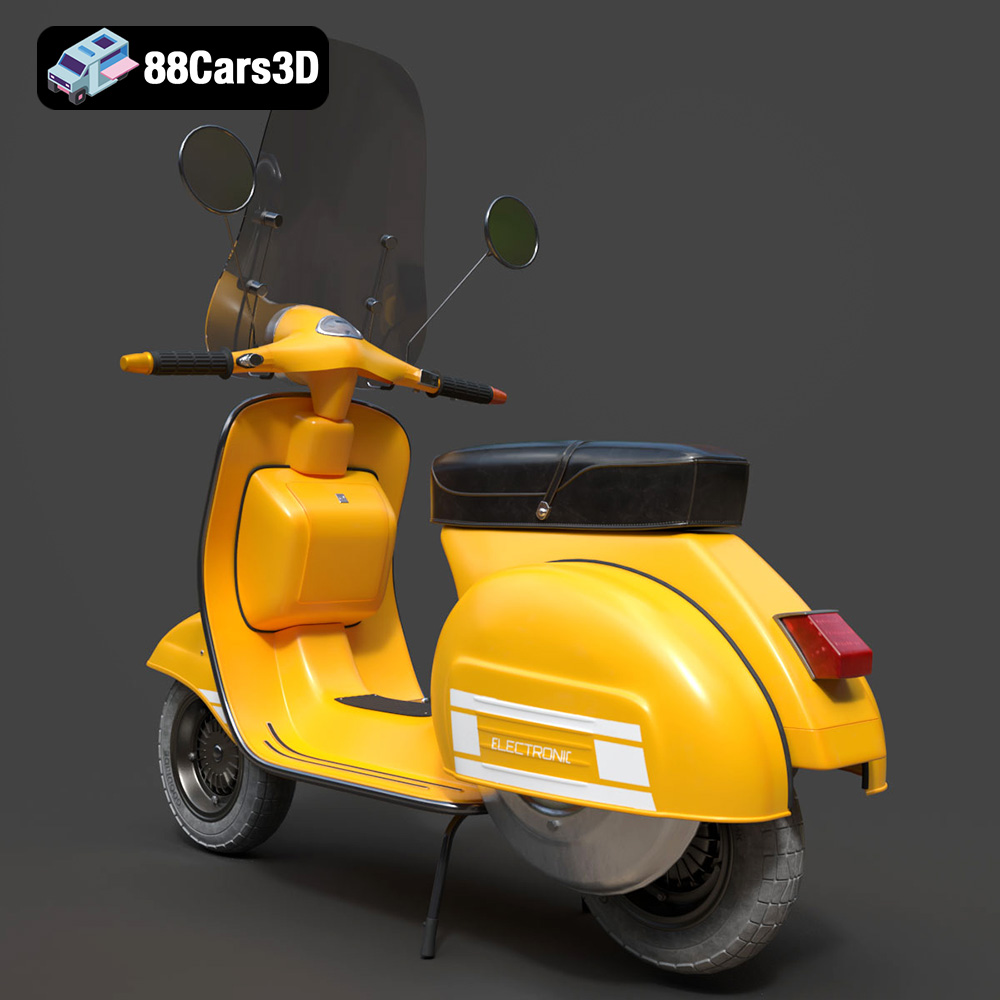
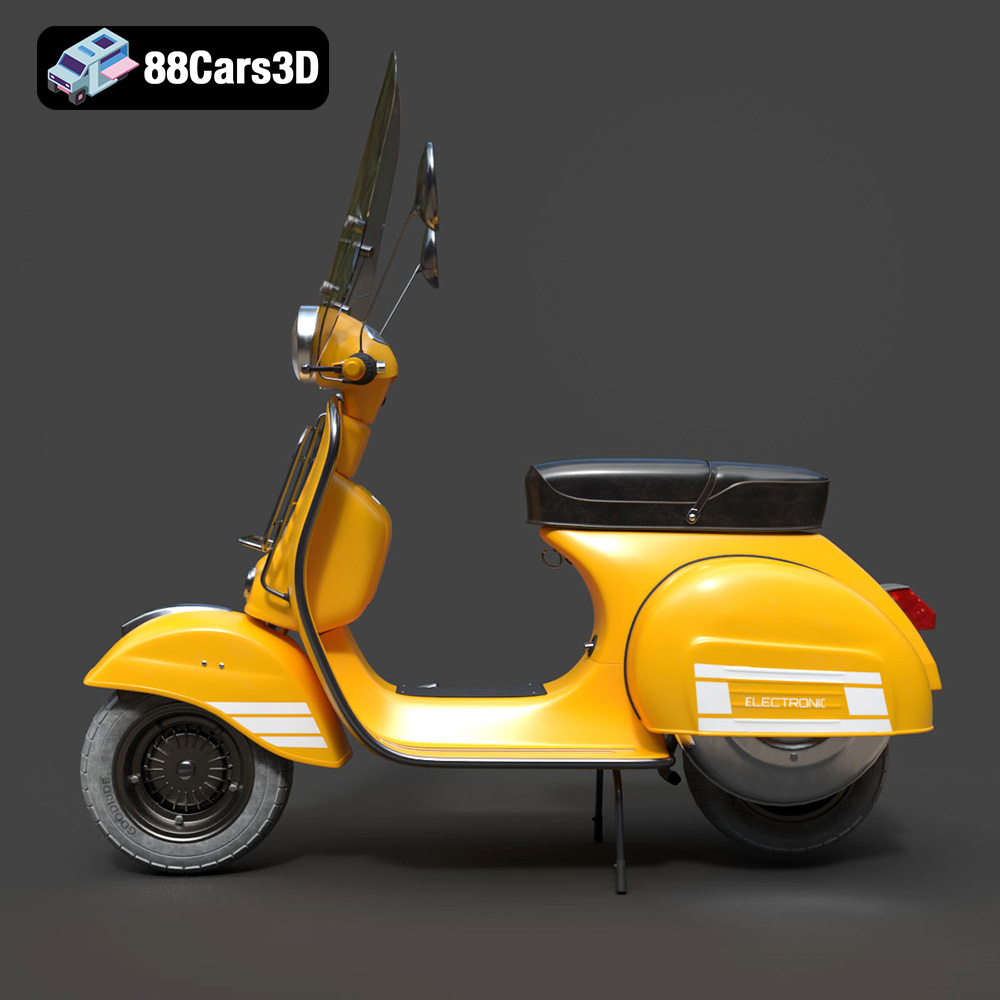
The model’s exterior is a testament to accurate replication. Its classic step-through frame and distinctive front shield fairing are immediately recognizable, invoking the charm of elegant urban mobility. Every curve and contour of the Vespa’s signature sweeping body lines has been painstakingly sculpted to ensure historical accuracy. Details extend to a beautifully rendered single-cylinder engine casing, complete with accurate continuous variable transmission (CVT) housing. The sleek side-mounted exhaust system, iconic round headlight assembly, and high-detail taillight and indicators further enhance the realism. The model even features authentic scooter alloy wheels and treaded urban commuting tires, along with classic single-sided front trailing link suspension details. These components are kept separate, a critical feature that allows for independent animation of steering, wheel rotation, and suspension travel, essential for dynamic scenes and interactive applications.
Beyond the exterior, the Vespa 3-08 3D model offers a richly detailed cockpit and interior. The ergonomically sculpted, dual-seat saddle boasts authentic textures, inviting a closer look. The handlebar setup is faithfully recreated with integrated mirrors and grips, providing a realistic feel. A retro-modern instrument cluster and speedometer are meticulously modeled, along with accurate hand controls, brake levers, and switchgear. This level of interior detail is particularly important for gaming and VR experiences, where first-person perspectives are common, demanding assets that hold up under close scrutiny and provide an immersive user experience.
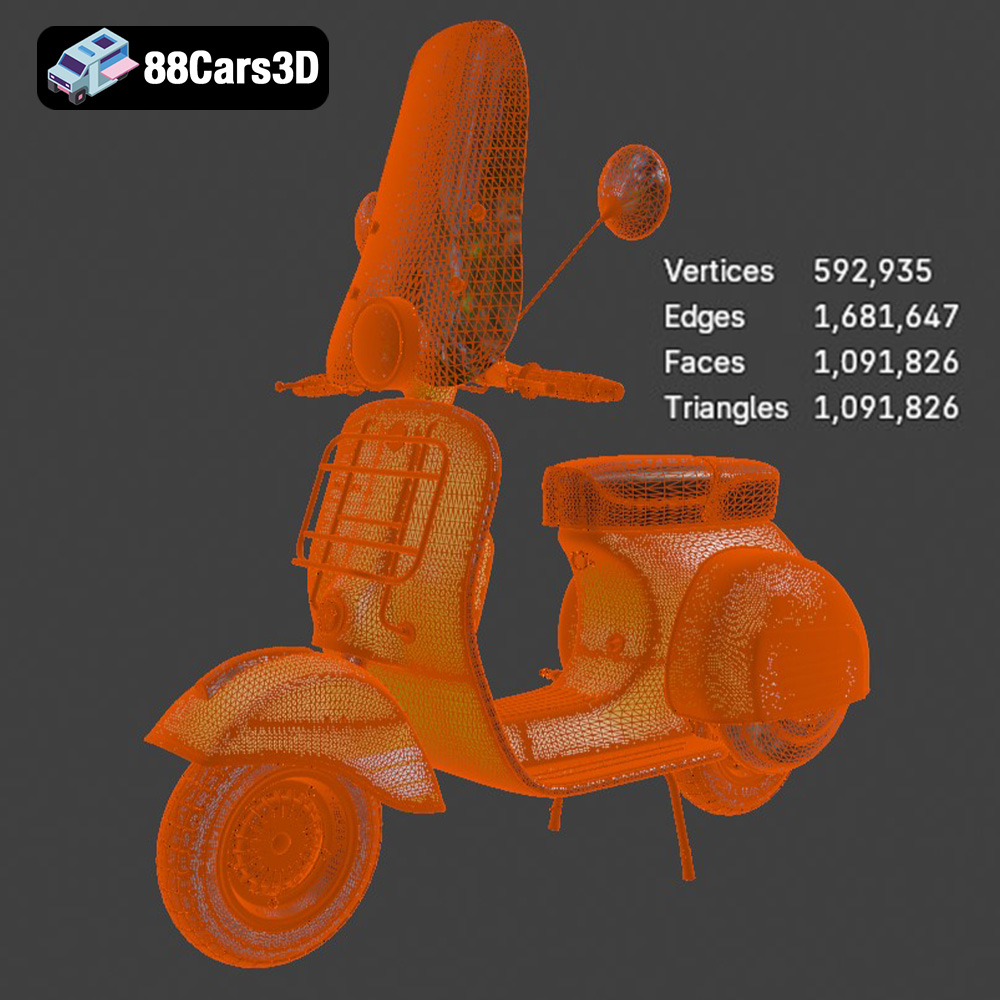
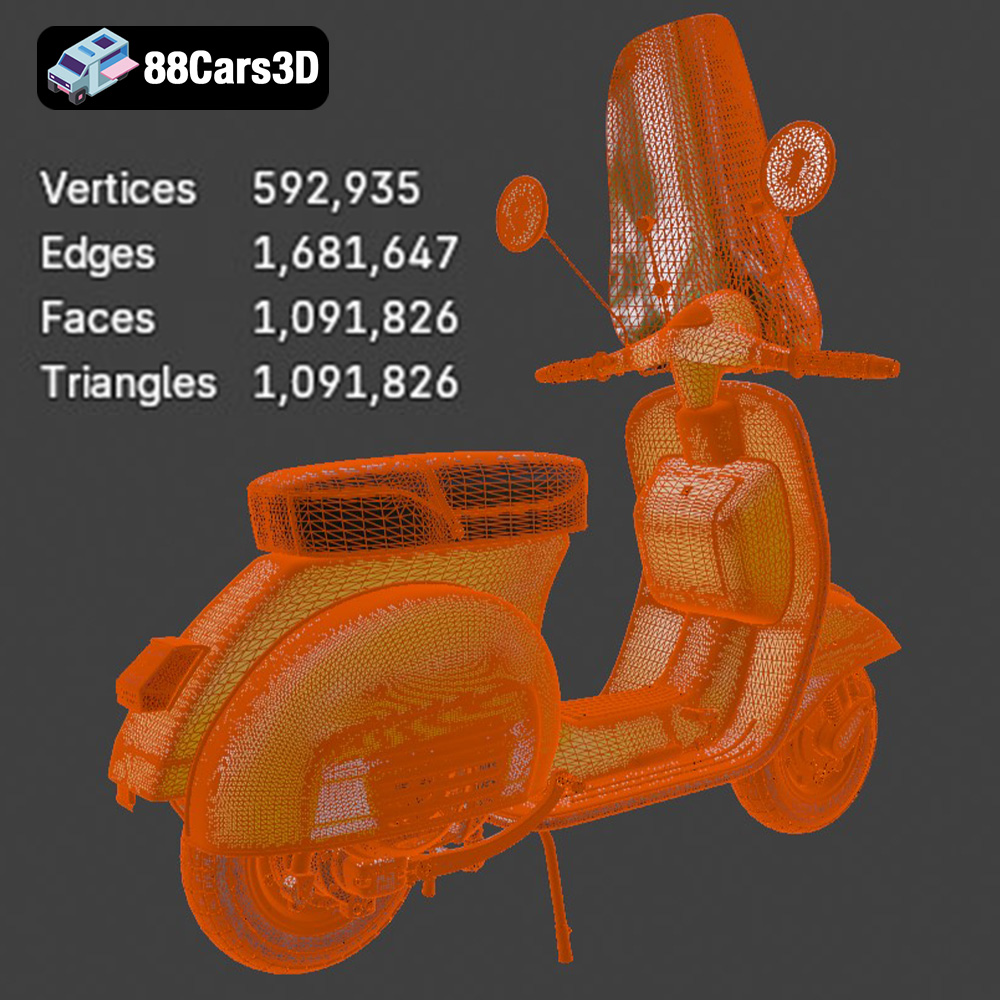
Underpinning this visual fidelity is a meticulous topology. With a triangle count of 1091826, the model strikes an ideal balance, delivering unparalleled visual detail suitable for high-end rendering without becoming overly heavy for real-time applications. The geometry is crafted to provide breathtaking close-up details, ensuring that every rivet and panel line is crisp and defined, while also maintaining efficiency for overall scene performance. Furthermore, the model is built to real-world scale accuracy, based on actual vehicle chassis dimensions. This attention to scale is vital for integration into architectural visualization projects, urban street scenes, or any scenario where accurate spatial relationships are crucial for believability.
In today’s interactive landscape, 3D assets must not only look good but also perform flawlessly. The Vespa 3-08 3D model is designed with this principle at its core, making it an exceptional asset for game development and other real-time applications where performance is as critical as visual quality.
The term “game-ready” signifies that an asset has been engineered to meet the stringent demands of real-time engines like Unreal and Unity. The Vespa 3-08’s triangle count of 1091826 is a carefully chosen sweet spot. It’s high enough to convey stunning realism and intricate details, making it suitable for modern AAA titles or high-fidelity simulators. Yet, it remains optimized to prevent excessive draw calls and maintain smooth frame rates, even when multiple instances of the model are present in a scene. This balance is crucial for creating bustling urban environments or engaging racing titles where visual richness and fluid performance must coexist.
A key technical advantage of this model is its proper pivot setup. Each functional component—wheels, suspension, and steering—has its pivot point correctly aligned. This might seem like a minor detail, but it’s indispensable for animators and game developers. Without correctly positioned pivots, animating rotation for wheels or articulation for steering becomes a cumbersome, inaccurate process, often requiring manual adjustments that waste valuable production time. With the Vespa 3-08, these elements are ready for immediate animation, allowing developers to quickly rig and animate dynamic sequences, from a simple turn of the handlebars to the complex interplay of suspension over uneven terrain, enhancing the realism and interactivity of the game or simulation.
Consider an open-world game set in a sprawling European city. Populating such an environment requires a diverse range of vehicles, each contributing to the authenticity of the setting. The Vespa 3-08 3D model would be a perfect fit. Its optimized polycount allows game designers to place numerous Vespas as static background dressing, traffic, or even player-controllable vehicles without bogging down the engine. Using the .fbx or .unreal formats, developers could import the model directly into Unreal Engine, set up basic PBR materials, and then use its pre-configured pivots to implement vehicle physics and animation systems. Players could ride the Vespa through cobbled streets, experiencing a slice of authentic urban mobility, all thanks to a meticulously crafted and optimized 3D asset from 88cars3d.com.
The utility of high-quality 3D car models extends far beyond traditional rendering and game development. The versatility of an asset like the Vespa 3-08 3D model makes it invaluable for emerging technologies such as Augmented Reality (AR), Virtual Reality (VR), and even physical fabrication through 3D printing.
AR/VR applications demand models that are both visually rich and performant. For virtual showrooms, configurators, or mobile AR experiences, the Vespa 3-08 is ideally suited. Its detailed geometry and texture work translate seamlessly into immersive environments, allowing users to interact with a digital representation of the scooter as if it were physically present. Imagine a customer using their smartphone to project the Vespa 3-08 into their driveway, inspecting its lines, changing colors, and even “sitting” on it in a virtual sense. The .glb format, in particular, is optimized for such web and mobile-based AR/VR scenarios, offering efficient loading and rendering across various devices. The precise scaling and detailed cockpit features also make it perfect for first-person VR experiences, enabling users to truly feel present within the virtual world of the scooter.
The ability to transform a digital model into a physical object is a powerful capability. The Vespa 3-08 3D model is convertible to the .stl format, making it perfectly suitable for 3D printing. This opens up avenues for display-scale hobbyists, product designers creating prototypes, or even marketing agencies producing unique promotional items.
This dual functionality—excelling in both digital and physical realms—highlights the comprehensive value of professional 3D car models.
The true measure of a high-quality 3D asset lies in its seamless integration into diverse professional workflows. The Vespa 3-08 3D model provides this flexibility through its comprehensive file format support and thoughtful design, making it an invaluable tool for artists and developers using a range of industry-standard software.
For artists working with Autodesk 3ds Max, the included .max file offers the ultimate flexibility. Upon opening, the entire scene is ready for immediate manipulation.
Blender users benefit immensely from the native .blend file, which provides a complete scene with all materials and textures intact.
For game developers and real-time visualization specialists using Unreal Engine, the .fbx and dedicated .unreal formats are critical.
This multi-software compatibility ensures that no matter your preferred digital workspace, the Vespa 3-08 3D model integrates smoothly, providing a solid foundation for your creative vision.
A truly versatile 3D model offers more than just stunning out-of-the-box visuals; it provides a canvas for boundless creative exploration. The Vespa 3-08 3D model excels in this regard, offering extensive customization options and seamless integration into a myriad of digital environments.
The included file formats and structured geometry of the Vespa 3-08 allow for deep customization:
Imagine an architectural visualization project showcasing a modern apartment building with a vibrant urban backdrop. Placing the Vespa 3-08 3D model strategically in the scene can instantly inject life and narrative. Its iconic presence suggests a cosmopolitan lifestyle, adding a touch of European charm and aspirational living. The real-world scale ensures it fits perfectly into the digital environment. Furthermore, for lifestyle brand campaigns, the Vespa can become a central character, symbolizing freedom, adventure, or classic elegance, driving engagement and reinforcing brand messaging through compelling visuals. This flexibility makes the Vespa 3-08 an indispensable asset for a wide array of visualization needs.
In the competitive landscape of 3D content creation, the difference between good and great often hinges on the quality of your assets. The Vespa 3-08 3D Model stands as a testament to exceptional craftsmanship, combining historical accuracy with modern technical optimization. From its meticulously sculpted exterior and detailed cockpit to its game-ready specifications and comprehensive file format support, this model is engineered to meet the highest demands of automotive rendering, game development, AR/VR experiences, and even precision 3D printing.
Whether you are building immersive open-world games, crafting photorealistic brand campaigns, or designing interactive virtual showrooms, the Vespa 3-08 offers unparalleled versatility and performance. Its integration capabilities across 3ds Max, Blender, Unreal Engine, and a host of other platforms ensure a smooth workflow for any professional. By providing this iconic Italian scooter in a ready-to-use, highly customizable format, 88cars3d.com empowers creators to focus on their artistic vision, knowing they have a technically robust and visually stunning foundation. Elevate your next project with this definitive 3D car model, and let the spirit of digital mobility drive your creativity forward.
The Vespa 3-08 embodies the ultimate spirit of iconic Italian scooter heritage, blending timeless retro design with modern commuting efficiency. Unmistakable with its classic step-through frame and distinctive front shield fairing, this model captures the essence of elegant urban mobility. Key visual elements include a beautifully sculpted single-cylinder engine casing, a sleek side-mounted exhaust system, and the signature sweeping body lines that make the Vespa an enduring symbol of style. Boasting a meticulous topology with a triangle count of 1091826, this 3D model delivers unparalleled visual fidelity while remaining structured for high-end rendering and advanced real-time applications. The geometry is crafted to provide breathtaking close-up details without compromising overall performance, making it the ultimate asset for game development, AR/VR experiences, professional animation, and architectural visualization.
$63.99
.blend
.fbx
.glb
.max
.moped
.obj
.ply
.rendering
.scooter
.stl
.unreal
.vespa
3-08
classic-scooter
game asset
game-ready
italian-scooter
low-poly
motorcycle-3d-model
optimized
VR/AR